×
Request Free Sample ×

Kindly complete the form below to receive a free sample of this Report

Leading companies partner with us for data-driven Insights

clients tt-cursor
Hero Background

Europe Data Center Colocation Market

ID: MRFR/ICT/56748-HCR
200 Pages
Aarti Dhapte
October 2025

Europe Data Center Colocation Market Research Report By Type (Retail Colocation, Wholesale Colocation), By Deployment Type (Cloud, On-Premises), By End User (BFSI, it and telecom, Government and Defense, Healthcare) and By Regional (Germany, UK, France, Russia, Italy, Spain, Rest of Europe)- Forecast to 2035

Share:
Download PDF ×

We do not share your information with anyone. However, we may send you emails based on your report interest from time to time. You may contact us at any time to opt-out.

Europe Data Center Colocation Market Infographic
Purchase Options

Europe Data Center Colocation Market Summary

As per MRFR analysis, the Europe data center colocation market size was estimated at 17.11 USD Billion in 2024. The Europe The data center colocation market is projected to grow from 19.25 USD Billion in 2025 to 62.45 USD Billion by 2035. This growth represents a compound annual growth rate (CAGR) of 12.49% during the forecast period from 2025 to 2035.

Key Market Trends & Highlights

The Europe data center-colocation market is experiencing robust growth driven by technological advancements and evolving customer needs.

  • Germany remains the largest market for data center-colocation services, reflecting a strong demand for cloud solutions.
  • The UK is emerging as the fastest-growing region, propelled by increasing investments in digital infrastructure.
  • There is a notable shift towards sustainability, with providers focusing on energy-efficient solutions to meet rising energy costs.
  • Key market drivers include the growing need for data security and the expansion of digital transformation initiatives across various sectors.

Market Size & Forecast

2024 Market Size 17.11 (USD Billion)
2035 Market Size 62.45 (USD Billion)

Major Players

Equinix (US), Digital Realty (US), NTT Communications (JP), CyrusOne (US), Interxion (NL), KDDI (JP), Global Switch (GB), Iron Mountain (US), QTS Realty Trust (US)

Europe Data Center Colocation Market Trends

The data center-colocation market is currently experiencing a transformative phase, driven by the increasing demand for cloud services and the need for efficient data management solutions. As businesses continue to migrate their operations to the cloud, the reliance on colocation facilities has intensified. This shift is largely influenced by the growing emphasis on data security, compliance with regulations, and the necessity for scalable infrastructure. Moreover, the rise of edge computing is prompting organizations to seek colocation services that can support low-latency applications, thereby enhancing overall operational efficiency. In addition, sustainability has emerged as a critical factor in the decision-making process for companies seeking colocation services. The focus on reducing carbon footprints and utilizing renewable energy sources is reshaping the landscape of the data center-colocation market. As a result, providers are increasingly adopting green technologies and energy-efficient practices to meet the evolving expectations of their clients. This trend not only aligns with corporate social responsibility goals but also offers potential cost savings in the long run. Overall, the data center-colocation market is poised for continued growth, driven by technological advancements and a heightened awareness of environmental impact.

Increased Demand for Cloud Services

The ongoing shift towards cloud computing is significantly influencing the data center-colocation market. Organizations are increasingly opting for colocation services to enhance their cloud capabilities, ensuring better performance and reliability. This trend is likely to continue as more businesses recognize the advantages of leveraging colocation for their cloud infrastructure.

Focus on Sustainability

Sustainability is becoming a pivotal concern within the data center-colocation market. Companies are prioritizing eco-friendly practices, leading to a rise in the adoption of renewable energy sources and energy-efficient technologies. This shift not only addresses environmental concerns but also aligns with the growing demand for corporate responsibility.

Rise of Edge Computing

The emergence of edge computing is reshaping the data center-colocation market. As organizations seek to minimize latency and enhance data processing capabilities, colocation providers are adapting their services to support edge deployments. This trend indicates a shift towards more localized data management solutions, catering to the needs of modern applications.

Europe Data Center Colocation Market Drivers

Emergence of 5G Technology

The rollout of 5G technology is poised to have a transformative impact on the data center-colocation market. With its promise of faster data transmission and lower latency, 5G is expected to drive demand for colocation services that can support the increased data traffic generated by connected devices. In Europe, the expansion of 5G networks is likely to create new opportunities for colocation providers, as businesses seek to enhance their connectivity and data processing capabilities. The data center-colocation market may experience growth as organizations invest in infrastructure that can accommodate the demands of 5G technology, potentially leading to a surge in colocation service adoption.

Growing Need for Data Security

The increasing frequency of cyber threats and data breaches has heightened the focus on data security within the data center-colocation market. Organizations are increasingly seeking colocation services that offer robust security measures, including advanced firewalls, intrusion detection systems, and physical security protocols. In Europe, the demand for secure data handling is underscored by regulations such as the General Data Protection Regulation (GDPR), which mandates stringent data protection standards. As a result, the data center-colocation market is witnessing a surge in investments aimed at enhancing security features, with some providers reporting up to a 30% increase in demand for secure colocation solutions. This trend indicates that businesses are prioritizing data security, thereby driving growth in the data center-colocation market.

Increased Focus on Hybrid IT Solutions

The shift towards hybrid IT environments is reshaping the landscape of the data center-colocation market. Organizations are increasingly adopting a mix of on-premises and cloud solutions to optimize their IT infrastructure. This trend is particularly pronounced in Europe, where businesses are looking for flexible colocation options that can seamlessly integrate with their existing systems. The demand for hybrid solutions is expected to drive the data center-colocation market, as companies seek to balance the benefits of cloud computing with the control of on-premises resources. As a result, colocation providers are adapting their offerings to meet this demand, potentially leading to a more competitive market landscape.

Rising Energy Costs and Efficiency Demands

As energy costs continue to rise, organizations are increasingly seeking energy-efficient solutions within the data center-colocation market. The demand for colocation services that utilize advanced cooling technologies and energy-efficient hardware is on the rise. In Europe, energy efficiency is not only a cost-saving measure but also a regulatory requirement, with many countries implementing strict energy consumption guidelines. This has led to a growing number of colocation providers investing in green technologies, such as renewable energy sources and energy-efficient designs. The potential for reduced operational costs and compliance with environmental regulations is driving businesses to opt for colocation services, thereby enhancing the growth prospects of the data center-colocation market.

Expansion of Digital Transformation Initiatives

The ongoing digital transformation across various sectors is significantly influencing the data center-colocation market. Organizations are increasingly adopting digital technologies to enhance operational efficiency and customer engagement. This shift is leading to a greater reliance on colocation services, as businesses seek to leverage scalable infrastructure without the burden of managing physical data centers. In Europe, the market is projected to grow at a CAGR of approximately 15% over the next five years, driven by the need for agile and flexible IT solutions. Companies are recognizing that colocation can provide the necessary resources to support their digital initiatives, thus propelling the data center-colocation market forward.
Market Segment Insights

By Type: Retail Colocation (Largest) vs. Wholesale Colocation (Fastest-Growing)

In the Europe data center-colocation market, Retail Colocation holds a significant market share, leveraging its ability to provide tailored services to clients. This market segment caters to smaller organizations and offers high degrees of accessibility and flexibility, resulting in its dominant position. On the other hand, Wholesale Colocation, while currently smaller, is gaining traction due to its appeal to larger enterprises that demand expansive spaces and resources, thus increasing its share over the coming years. The growth trends in this segment illustrate a strong shift towards increased demand for flexible and scalable solutions. Retail Colocation continues to be driven by small- to medium-sized businesses seeking cost-effective solutions with minimal commitments. Meanwhile, Wholesale Colocation is experiencing rapid growth, propelled by enterprises optioning for large-scale facilities equipped with advanced technology and services. This trend signifies a broader shift in enterprise strategy, fueling the demand for data centers capable of supporting diverse applications and workloads.

Retail Colocation (Dominant) vs. Wholesale Colocation (Emerging)

Retail Colocation is characterized by its focus on customized and easily accessible services, allowing small to medium-sized businesses to engage in colocation without the need for large scale investments. Its flexibility in terms of space and resources positions it as a popular choice among clients who prioritize service personalization. On the other hand, Wholesale Colocation is emerging as a strong alternative for large enterprises, offering vast spaces with substantial resource allocations. This segment is gaining momentum due to its competitive pricing and capacity to accommodate growing workloads, appealing to businesses needing dedicated infrastructure. As both segments evolve, the interplay between personalized service and scalable solutions will shape their market positions.

By Deployment Type: Cloud (Largest) vs. On-Premises (Fastest-Growing)

In the current landscape, the Cloud deployment type commands a dominant share of the market due to its scalability, cost-effectiveness, and flexibility, appealing to a wide array of businesses. On-Premises solutions, while traditionally popular for their control and security features, are increasingly losing ground as companies shift towards cloud-based solutions that offer greater agility in resource management and operational efficiency. Growth trends show an accelerating move toward Cloud technologies, driven by advancements in cloud computing infrastructures and the increasing adoption of hybrid cloud environments. Conversely, On-Premises options are emerging as a response to specific security and compliance requirements, especially in industries like finance and healthcare, leading to a faster growth trajectory for this deployment type as firms look to customize their infrastructures while still embracing digital transformation.

Cloud (Dominant) vs. On-Premises (Emerging)

The Cloud deployment type continues to be the dominant force in the market, leveraging vast capabilities for data storage and processing, making it the preferred choice for organizations seeking to optimize costs and improve scalability. With its inherent flexibility, Cloud solutions can easily adapt to the evolving needs of businesses across various sectors. On the other hand, On-Premises solutions are emerging as a competitive choice for companies prioritizing security, regulatory compliance, and data sovereignty. While they may not match the growth rate of Cloud, the resurgence of On-Premises deployment options indicates a significant shift as organizations strategize to find a balance between control and the advantages presented by Cloud technologies.

By End-User: BFSI (Largest) vs. IT and telecom (Fastest-Growing)

The market share distribution among the end-user segments reveals BFSI as the largest segment, capturing a significant portion of the market due to its robust demand for secure and reliable data storage solutions. IT and telecom also hold a notable share, driven by the increasing need for data management and networking solutions that support digital transformation across various businesses. The government and defense sector, while smaller in comparison, remains a critical area, emphasizing stringent compliance and security, particularly in data handling. Healthcare demonstrates a growing interest in data center colocation, primarily to manage patient records and comply with health regulations, although it lags behind in overall market share. Growth trends in the end-user segment indicate a shift towards digitalization and cloud computing, particularly among BFSI and healthcare. The BFSI sector is heavily investing in colocation services to enhance operational efficiency and data security, while IT and telecom are poised for rapid growth as cloud services become integral to their offerings. The government and defense sector requires upgrades to meet the growing demands for data protection, driving investments in colocation. Meanwhile, healthcare is emerging as a vital sector, requiring robust data centers to manage sensitive information amidst stringent compliance needs, indicating a significant shift towards reliance on colocation.

BFSI: Dominant vs. Government and Defense: Emerging

The BFSI sector remains the dominant force within the end-user segment of data center colocation, characterized by its substantial investment in advanced technologies and increasing data management needs. This sector prioritizes security and compliance, necessitating high-performance data infrastructure to support its operations. Emerging from behind, the government and defense sector is increasingly recognizing the advantages of colocation services, driven by the need for enhanced security and compliance with regulations. While it currently contributes a smaller share to the overall market, its strategic investments in modernizing data handling capabilities are indicative of a growing trend towards reliance on outsourcing data storage. As both sectors evolve, their dynamics will significantly influence the market landscape.

Get more detailed insights about Europe Data Center Colocation Market

Regional Insights

Germany : Robust Infrastructure and Demand Growth

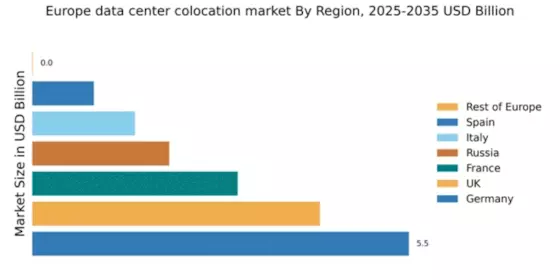
Germany holds a commanding 5.5% market share in the European data center-colocation sector, driven by a strong economy and increasing digitalization. Key growth drivers include the rise in cloud computing, data privacy regulations like GDPR, and government initiatives promoting tech innovation. The demand for colocation services is surging, particularly in urban centers, supported by advanced infrastructure and a skilled workforce.

UK : Innovation and Investment Drive Growth

Key cities such as London, Manchester, and Birmingham are central to the market, hosting major players like Equinix and Digital Realty. The competitive landscape is characterized by a mix of local and international firms, with a focus on sustainability and energy efficiency. The financial services sector, in particular, drives demand for secure and reliable colocation services.

France : Strategic Location and Growth Potential

Paris is the primary hub, with significant activity in cities like Lyon and Marseille. Major players such as Interxion and KDDI are well-established, contributing to a competitive landscape that emphasizes innovation and service diversity. The market is also influenced by sectors like telecommunications and media, which require robust data management solutions.

Russia : Regulatory Landscape and Infrastructure Needs

Moscow and St. Petersburg are key markets, hosting major players like Global Switch and local firms. The competitive landscape is evolving, with a focus on compliance and security. Local businesses in finance and telecommunications are significant consumers of colocation services, driving demand for reliable and secure data management solutions.

Italy : Infrastructure Development and Demand Trends

Milan is the primary market, with significant activity in Rome and Turin. The competitive landscape includes players like CyrusOne and local firms, focusing on energy efficiency and sustainability. The business environment is improving, with local enterprises increasingly recognizing the value of colocation services for their operations.

Spain : Growth Driven by Digital Transformation

Madrid and Barcelona are key markets, with a growing presence of international players like Digital Realty. The competitive landscape is characterized by a mix of local and global firms, focusing on innovation and service quality. Sectors such as retail and telecommunications are significant drivers of demand for colocation services.

Rest of Europe : Varied Growth Across Smaller Markets

Countries like Belgium, Netherlands, and the Nordics are seeing increased activity, with local players and some international firms establishing a presence. The competitive landscape is less defined, with a focus on niche markets and specific industry needs. Local businesses in sectors like healthcare and education are beginning to recognize the value of colocation services.

Europe Data Center Colocation Market Regional Image

Key Players and Competitive Insights

The data center-colocation market in Europe is characterized by a dynamic competitive landscape, driven by increasing demand for cloud services, data storage, and digital transformation initiatives. Major players such as Equinix (US), Digital Realty (US), and Interxion (NL) are strategically positioned to capitalize on these trends. Equinix (US) focuses on expanding its global footprint through acquisitions and partnerships, enhancing its interconnection capabilities. Digital Realty (US) emphasizes innovation in energy efficiency and sustainability, aligning with the growing emphasis on green technology. Interxion (NL), now part of Digital Realty, leverages its strong presence in key European markets to offer tailored solutions that meet local demands, thereby shaping a competitive environment that prioritizes customer-centric services and operational excellence.

The market structure appears moderately fragmented, with a mix of large multinational corporations and regional players. Key business tactics include localizing services to meet specific regional needs and optimizing supply chains to enhance operational efficiency. The collective influence of these major players fosters a competitive atmosphere where innovation and service differentiation are paramount, allowing them to maintain a competitive edge in a rapidly evolving market.

In October 2025, Equinix (US) announced the opening of a new data center in Frankfurt, Germany, aimed at enhancing its capacity to support the growing demand for cloud services in the region. This strategic move is significant as it not only expands Equinix's operational capabilities but also reinforces its commitment to providing high-performance interconnection services, which are critical for businesses seeking to optimize their digital infrastructure.

In September 2025, Digital Realty (US) launched a new sustainability initiative focused on achieving carbon neutrality across its European data centers by 2030. This initiative underscores the company's proactive approach to environmental responsibility, which is increasingly becoming a key differentiator in the market. By prioritizing sustainability, Digital Realty positions itself favorably among environmentally conscious clients and stakeholders.

In August 2025, Interxion (NL) unveiled a partnership with a leading cloud service provider to enhance its hybrid cloud offerings. This collaboration is strategically important as it allows Interxion to leverage its existing infrastructure while providing clients with seamless access to cloud resources, thereby addressing the growing demand for flexible and scalable IT solutions.

As of November 2025, current competitive trends in the data center-colocation market include a strong focus on digitalization, sustainability, and the integration of AI technologies. Strategic alliances are increasingly shaping the landscape, enabling companies to pool resources and expertise to deliver innovative solutions. Looking ahead, competitive differentiation is likely to evolve from traditional price-based competition to a focus on technological innovation, reliability of supply chains, and sustainable practices, reflecting the changing priorities of clients in a digital-first world.

Key Companies in the Europe Data Center Colocation Market market include

Industry Developments

The Europe data center colocation market is experiencing significant developments, particularly with companies such as Alibaba Cloud, Digital Realty, Global Switch, Interxion, and Equinix expanding their presence across the region.

In October 2023, Equinix announced a strategic investment to increase its data center capacity in Frankfurt to meet rising demand, reflecting growth in this sector. In September 2023, Digital Realty revealed its plans to acquire a leading data center facility in Berlin, aiming to enhance operational efficiencies and expand its customer base.

Likewise, OVHcloud launched new services to support increased cloud adoption in Europe, while Microsoft Azure continues to invest in energy-efficient data center technologies. The European market is projected to grow significantly as companies adapt to digital transformation trends, emphasizing the importance of sustainability and efficiency.

Regulatory frameworks put forth by the European Union, including data protection initiatives, are shaping the operational landscape, leading to a focus on compliance among service providers. Continued investment and technological advancements are expected to play a vital role in the market’s evolution.

Europe Data Center Colocation MarketSegmentation Insights

Data Center Colocation Market Type Outlook

  • Retail Colocation
  • Wholesale Colocation

Data Center Colocation Market Deployment Type Outlook

  • Cloud
  • On-Premises

Data Center Colocation Market End User Outlook

  • BFSI
  • IT and Telecom
  • Government and Defense
  • Healthcare

Data Center Colocation Market Regional Outlook

  • Germany
  • UK
  • France
  • Russia
  • Italy
  • Spain
  • Rest of Europe

Future Outlook

Europe Data Center Colocation Market Future Outlook

The data center-colocation market is projected to grow at a 12.49% CAGR from 2024 to 2035, driven by increasing demand for cloud services, energy efficiency, and digital transformation.

New opportunities lie in:

  • Expansion of edge data centers in urban areas
  • Development of green energy solutions for colocation facilities
  • Integration of AI-driven management systems for operational efficiency

By 2035, the market is expected to be robust, driven by innovation and strategic investments.

Market Segmentation

Europe Data Center Colocation Market Type Outlook

  • Retail Colocation
  • Wholesale Colocation

Europe Data Center Colocation Market End-User Outlook

  • BFSI
  • IT and telecom
  • Government and defense
  • Healthcare

Europe Data Center Colocation Market Deployment Type Outlook

  • Cloud
  • On-Premises

Report Scope

MARKET SIZE 2024 17.11(USD Billion)
MARKET SIZE 2025 19.25(USD Billion)
MARKET SIZE 2035 62.45(USD Billion)
COMPOUND ANNUAL GROWTH RATE (CAGR) 12.49% (2024 - 2035)
REPORT COVERAGE Revenue Forecast, Competitive Landscape, Growth Factors, and Trends
BASE YEAR 2024
Market Forecast Period 2025 - 2035
Historical Data 2019 - 2024
Market Forecast Units USD Billion
Key Companies Profiled ["Equinix (US)", "Digital Realty (US)", "NTT Communications (JP)", "CyrusOne (US)", "Interxion (NL)", "KDDI (JP)", "Global Switch (GB)", "Iron Mountain (US)", "QTS Realty Trust (US)"]
Segments Covered Type, Deployment Type, End-User
Key Market Opportunities Growing demand for sustainable energy solutions in the data center-colocation market presents significant opportunities.
Key Market Dynamics Rising demand for sustainable energy solutions drives innovation in the data center-colocation market.
Countries Covered Germany, UK, France, Russia, Italy, Spain, Rest of Europe

Leave a Comment

FAQs

What is the expected market size of the Europe Data Center Colocation Market in 2024?

The Europe Data Center Colocation Market is anticipated to be valued at 17.11 USD Billion in 2024.

What is the projected market size for the Europe Data Center Colocation Market by 2035?

By 2035, the Europe Data Center Colocation Market is expected to reach a valuation of 62.46 USD Billion.

What is the expected compound annual growth rate (CAGR) for the Europe Data Center Colocation Market from 2025 to 2035?

The anticipated CAGR for the Europe Data Center Colocation Market is 12.492% between 2025 and 2035.

Which region is forecasted to hold the largest market share in the Europe Data Center Colocation Market by 2035?

The UK is projected to be the dominant region, with an estimated market size of 14.58 USD Billion by 2035.

What are the market values for retail and wholesale colocation in 2024?

Retail colocation is valued at 8.56 USD Billion and wholesale colocation at 8.55 USD Billion in 2024.

What are the expected market values for retail and wholesale colocation by 2035?

By 2035, retail colocation is expected to be valued at 31.64 USD Billion, while wholesale colocation will reach 30.82 USD Billion.

Who are some of the key players in the Europe Data Center Colocation Market?

Major players in the market include Alibaba Cloud, Digital Realty, Global Switch, and Amazon Web Services.

What is the market size for the Data Center Colocation Market in Germany by 2035?

Germany's Data Center Colocation Market is expected to be valued at 12.26 USD Billion in 2035.

What are the growth opportunities in the Europe Data Center Colocation Market?

The market presents opportunities driven by increasing demand for data storage and cloud services.

How is the market size of the Europe Data Center Colocation Market expected to change by region from 2024 to 2035?

All key regions, including the UK, Germany, France, Russia, and Italy, are expected to experience significant market growth from 2024 to 2035.

Download Free Sample

Kindly complete the form below to receive a free sample of this Report

Compare Licence

×
Features License Type
Single User Multiuser License Enterprise User
Price $4,950 $5,950 $7,250
Maximum User Access Limit 1 User Upto 10 Users Unrestricted Access Throughout the Organization
Free Customization
Direct Access to Analyst
Deliverable Format
Platform Access
Discount on Next Purchase 10% 15% 15%
Printable Versions