×
Request Free Sample ×

Kindly complete the form below to receive a free sample of this Report

Leading companies partner with us for data-driven Insights

clients tt-cursor
Hero Background

Europe Edge AI Hardware Market

ID: MRFR/SEM/55467-HCR
200 Pages
Garvit Vyas
October 2025

Europe Edge AI Hardware Market Research Report: By Component (CPU, GPU, ASIC, FPGA), By Device (Smartphone, Camera, Robot, Automobile, Smart Speaker, Wearables, Smart Mirror, Others), By Power Consumption (0-5 W, 6-10 W, More Than 10 W), By Process (Training, Inference), By Vertical (Consumer Electronics, Smart Home, Automotive & Transportation, Healthcare, Aerospace & Defense, Government, Construction, Others) and By Regional (Germany, UK, France, Russia, Italy, Spain, Rest of Europe) - Forecast to 2035

Share:
Download PDF ×

We do not share your information with anyone. However, we may send you emails based on your report interest from time to time. You may contact us at any time to opt-out.

Europe Edge AI Hardware Market Infographic
Purchase Options

Europe Edge AI Hardware Market Summary

As per MRFR analysis, the edge ai-hardware market Size was estimated at 655.0 USD Million in 2024. The edge ai-hardware market is projected to grow from 699.02 USD Million in 2025 to 1339.28 USD Million by 2035, exhibiting a compound annual growth rate (CAGR) of 6.72% during the forecast period 2025 - 2035.

Key Market Trends & Highlights

The Europe edge AI-hardware market is experiencing robust growth driven by technological advancements and increasing demand for real-time data processing.

  • Germany leads the Europe edge AI-hardware market, showcasing a strong adoption of AI-driven solutions across various sectors.
  • The UK emerges as the fastest-growing region, reflecting a heightened focus on energy efficiency and sustainability in edge AI applications.
  • Enhanced security measures are becoming a priority, as organizations seek to protect sensitive data in an increasingly connected world.
  • Rising demand for real-time data processing and government initiatives are key drivers propelling the market forward.

Market Size & Forecast

2024 Market Size 655.0 (USD Million)
2035 Market Size 1339.28 (USD Million)

Major Players

NVIDIA (US), Intel (US), Qualcomm (US), Google (US), Amazon (US), Microsoft (US), IBM (US), Xilinx (US), Arm (GB)

Europe Edge AI Hardware Market Trends

The edge ai-hardware market is currently experiencing a notable transformation, driven by advancements in artificial intelligence and the increasing demand for real-time data processing. This shift is largely influenced by the growing need for efficient computing solutions that can operate at the network's edge, minimizing latency and enhancing performance. As industries across Europe adopt these technologies, the market is witnessing a surge in innovation, with manufacturers focusing on developing specialized hardware that meets the unique requirements of various applications. The integration of edge computing with AI capabilities is expected to redefine operational efficiencies, particularly in sectors such as manufacturing, healthcare, and transportation. Moreover, the regulatory landscape in Europe is evolving to support the adoption of edge ai-hardware. Initiatives aimed at fostering digital transformation and enhancing cybersecurity are likely to create a conducive environment for market growth. The emphasis on sustainability and energy efficiency is also shaping product development, as companies strive to align with environmental standards. As a result, the edge ai-hardware market is poised for substantial growth, with stakeholders keenly observing trends that could influence future investments and technological advancements.

Increased Adoption of AI-Driven Solutions

There is a growing trend towards the integration of AI capabilities within edge ai-hardware. This shift is driven by the need for faster data processing and decision-making at the source, particularly in sectors such as manufacturing and logistics. Companies are increasingly investing in hardware that supports AI algorithms, enabling real-time analytics and improved operational efficiency.

Focus on Energy Efficiency and Sustainability

Sustainability is becoming a central theme in the edge ai-hardware market. Manufacturers are prioritizing energy-efficient designs and materials to meet regulatory standards and consumer expectations. This trend reflects a broader commitment to reducing carbon footprints and promoting environmentally friendly practices within the technology sector.

Enhanced Security Measures

As the edge ai-hardware market expands, so does the focus on cybersecurity. With more devices connected at the edge, the potential for vulnerabilities increases. Consequently, there is a heightened emphasis on developing robust security features within hardware solutions to protect sensitive data and ensure compliance with stringent regulations.

Europe Edge AI Hardware Market Drivers

Integration of IoT Devices

The proliferation of Internet of Things (IoT) devices significantly influences the edge ai-hardware market in Europe. As more devices become interconnected, the demand for localized data processing increases, necessitating advanced edge computing solutions. This integration allows for improved data management and analytics, enabling businesses to derive actionable insights from vast amounts of data generated by IoT devices. The edge ai-hardware market is witnessing a shift towards hardware that can efficiently handle the influx of data from these devices, with estimates suggesting that the number of connected IoT devices in Europe could exceed 30 billion by 2025. Consequently, manufacturers are focusing on developing specialized edge ai-hardware that can seamlessly integrate with IoT ecosystems, enhancing overall system performance and reliability.

Advancements in AI Algorithms

Continuous advancements in AI algorithms are reshaping the edge ai-hardware market in Europe. As machine learning and deep learning techniques evolve, the demand for hardware capable of supporting these sophisticated algorithms grows. Enhanced algorithms require more computational power and efficiency, prompting hardware manufacturers to innovate and develop specialized chips optimized for AI workloads. The edge ai-hardware market is likely to see a shift towards neuromorphic computing and other cutting-edge technologies that can mimic human brain functions, thereby improving processing capabilities. This trend is expected to drive hardware sales, with projections indicating a potential market value of €5 billion by 2028, as organizations seek to implement more complex AI solutions at the edge.

Government Initiatives and Funding

Government initiatives across Europe play a crucial role in propelling the edge ai-hardware market. Various national and EU-level programs aim to foster innovation in AI and edge computing technologies. For instance, funding schemes and grants are increasingly available to support research and development in this sector. The European Commission has allocated substantial resources to enhance digital infrastructure, which includes edge computing capabilities. This financial backing not only stimulates technological advancements but also encourages collaboration between public and private sectors. As a result, the edge ai-hardware market benefits from a conducive environment for growth, with an expected increase in public sector investments projected to reach €1 billion by 2027, further solidifying the region's position in the global tech landscape.

Focus on Data Privacy and Compliance

The edge ai-hardware market in Europe is increasingly influenced by the emphasis on data privacy and regulatory compliance. With stringent regulations such as the General Data Protection Regulation (GDPR) in place, organizations are compelled to adopt solutions that ensure data security and privacy. This has led to a growing demand for edge computing solutions that process data locally, minimizing the risk of data breaches and ensuring compliance with legal standards. The edge ai-hardware market is adapting to these requirements by developing hardware that incorporates advanced security features, such as encryption and secure boot mechanisms. As businesses prioritize compliance, the market is expected to grow, with an estimated increase in demand for secure edge ai-hardware projected to reach €3 billion by 2026.

Rising Demand for Real-Time Data Processing

The edge ai-hardware market in Europe experiences a notable surge in demand for real-time data processing capabilities. Industries such as manufacturing, healthcare, and transportation increasingly rely on instantaneous data analysis to enhance operational efficiency and decision-making. This trend is driven by the need for low-latency responses in applications like autonomous vehicles and smart factories. According to recent estimates, the market for edge computing solutions is projected to grow at a CAGR of approximately 25% through 2026, indicating a robust appetite for advanced hardware that can support these applications. As organizations seek to leverage AI for predictive analytics and automation, the edge ai-hardware market is poised for significant expansion, with investments in high-performance processors and specialized AI chips becoming commonplace.

Market Segment Insights

By Component: GPU (Largest) vs. ASIC (Fastest-Growing)

The market share distribution among the component segment in the edge AI hardware market reveals that GPUs hold the largest share, driven by their versatility and widespread adoption in various applications. CPUs follow, serving as essential processing units, while ASICs and FPGAs represent emerging technologies that cater to specific needs in performance and efficiency, albeit with smaller market shares. This distribution signifies the current reliance on traditional GPU technology, while paving the way for more specialized solutions. Growth trends in the component segment are largely supported by advancements in AI applications and the demand for tailored processing solutions. GPUs are experiencing significant growth due to their adaptability in machine learning tasks, while ASICs are rapidly catching up, praised for their efficiency and performance in dedicated applications. The increasing need for faster and more efficient processing power drives innovation in FPGAs, presenting a competitive landscape where traditional and emerging technologies coexist and advance together.

GPU (Dominant) vs. ASIC (Emerging)

In the current landscape, GPUs are recognized as the dominant force within the edge AI hardware component market, offering unmatched processing capabilities and flexibility for various AI tasks. Their ability to handle parallel processing makes them a preferred choice for deep learning applications. In contrast, ASICs are positioned as an emerging technology, specifically tailored for dedicated tasks, enabling higher efficiency and performance in less energy consumption. This makes them increasingly attractive for applications requiring optimization, such as real-time data processing. Although still smaller in market share compared to GPUs, the rapid evolution of ASIC technology highlights a promising future with significant growth potential, appealing to enterprises seeking efficiency and performance.

By Device: Smartphone (Largest) vs. Camera (Fastest-Growing)

The device segment of the Europe edge ai-hardware market reveals a diverse distribution of market shares among various technologies. Smartphones lead the market as the largest segment, driven by their ubiquitous presence and increasing functionality. In contrast, the camera segment is emerging rapidly, catering to the growing demand for enhanced security and surveillance solutions, supported by advancements in AI capabilities and image processing technologies. Growth trends in this segment are primarily fueled by rising consumer adoption of smart technologies and the transition towards automation across industries. The increasing integration of AI into devices like cameras and smart speakers reflects a significant shift, positioning these technologies as critical in driving efficiency, security, and user engagement across both consumer and industrial applications.

Smartphone: Dominant vs. Camera: Emerging

Smartphones are the dominant force within the device segment, representing the pinnacle of integrated technology, offering a robust ecosystem of applications that leverage AI for enhanced user experiences. Their versatility, combined with widespread availability, underpins their market leadership. Conversely, cameras are positioned as the emerging technology within this space, gaining traction from increased investments in smart surveillance and security systems. The camera segment benefits from continuous innovations, including real-time image processing and enhancements in object recognition capabilities. As a result, cameras are increasingly being adopted in various applications ranging from personal security to industrial automation, highlighting their potential for substantial growth and market penetration in the coming years.

By Power Consumption: 0-5 W (Largest) vs. More Than 10 W (Fastest-Growing)

In the power consumption segment, the distribution is notably varied, with the 0-5 W category commanding the largest share in the market. This segment's dominance stems from its widespread applicability in low-power edge AI devices, making it an attractive option for manufacturers focusing on energy efficiency. Meanwhile, the 6-10 W range also contributes significantly to the overall market, serving a balanced demand for moderate power consumption applications. On the contrary, the More Than 10 W segment is recognized as the fastest-growing, driven by the increasing demand for more powerful edge AI solutions that can handle complex computations. Factors such as advancements in AI algorithms and the rising need for real-time processing are propelling this segment forward. As industries adopt more sophisticated technologies, the trend towards higher power consumption requirements becomes evident, further influencing market dynamics.

0-5 W (Dominant) vs. More Than 10 W (Emerging)

The 0-5 W power consumption category remains dominant in the market, primarily suited for low-power applications in various edge AI devices such as sensors and IoT devices. This segment's energy efficiency appeals to manufacturers aiming for sustainable practices while meeting consumer demands. Conversely, the More Than 10 W category represents an emerging trend that aligns with the growing sophistication of edge AI technologies. Devices requiring more than 10 W are typically employed in high-performance computing tasks, enabling advanced functionalities like machine learning and data analysis in real-time. As edge AI applications continue to evolve, both segments are poised to experience shifts in demand, reflecting the industry's rapid technological advancements.

By Vertical: Consumer Electronics (Largest) vs. Smart Home (Fastest-Growing)

The market for edge AI hardware is primarily driven by the consumer electronics segment, which holds the largest share, as connected devices continue to proliferate in households. This segment includes smart devices such as smartphones, laptops, and wearable technology, contributing significantly to overall market dynamics. Following closely is the smart home segment, characterized by devices like smart speakers and home automation systems, gaining traction as consumer interest in home efficiency and automation grows rapidly. Growth trends indicate that while consumer electronics will maintain dominance, the smart home segment is emerging as the fastest-growing category within the market. Factors driving this trend include advancements in IoT technologies, increased consumer awareness, and the push for energy efficiency. As manufacturing costs decline and more affordable smart devices enter the market, the adoption rate is expected to surge, leading to a more competitive landscape.

Consumer Electronics (Dominant) vs. Smart Home (Emerging)

The consumer electronics segment represents the dominant force in the edge AI hardware market, characterized by widespread adoption of advanced technology in mobile devices and personal computers. Consumers are increasingly seeking devices with enhanced capabilities, driving manufacturers to incorporate edge AI for improved performance, security, and user experience. In contrast, the smart home segment is emerging rapidly, supported by growing consumer demand for automation and connectivity within residential environments. This segment fosters innovation with products that integrate AI for smarter living, emphasizing convenience, energy management, and security. Together, these segments illustrate the evolving landscape of technology adoption, where established markets face new opportunities from burgeoning innovations.

Get more detailed insights about Europe Edge AI Hardware Market

Regional Insights

Germany : Germany's Dominance in AI Innovation

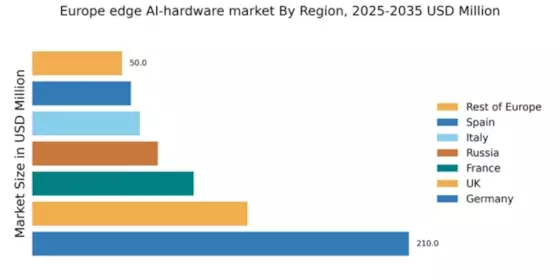
Germany holds a commanding market share of 30% in the European edge AI hardware sector, valued at $210.0 million. Key growth drivers include robust industrial automation, significant investments in AI research, and a strong push for digital transformation across sectors. The government has implemented favorable regulatory policies, including funding for AI startups and initiatives to enhance digital infrastructure, which are crucial for fostering innovation and demand in this market.

UK : UK's Innovation and Investment Surge

The UK edge AI hardware market is valued at $120.0 million, representing 20% of the European market. Growth is driven by increasing demand for AI in sectors like finance and healthcare, alongside government initiatives promoting AI research and development. The UK government has launched several programs to support AI adoption, enhancing the overall business environment and infrastructure necessary for growth in this sector.

France : France's Strategic AI Investments

France's edge AI hardware market is valued at $90.0 million, accounting for 15% of the European market. The growth is fueled by government-backed initiatives aimed at boosting AI research and development, particularly in smart cities and transportation. Regulatory frameworks are being established to support innovation, while infrastructure improvements are enhancing connectivity and data processing capabilities across the nation.

Russia : Russia's Expanding AI Landscape

Russia's edge AI hardware market is valued at $70.0 million, making up 12% of the European market. Key growth drivers include increased government investment in AI technologies and a focus on national security applications. Demand is rising in sectors such as defense and telecommunications, supported by regulatory policies that encourage local production and innovation in AI hardware.

Italy : Italy's Focus on Digital Transformation

Italy's edge AI hardware market is valued at $60.0 million, representing 10% of the European market. Growth is driven by the increasing adoption of AI in manufacturing and logistics, supported by government initiatives aimed at digital transformation. Regulatory frameworks are evolving to facilitate AI integration, while infrastructure investments are enhancing the technological landscape across key industrial regions.

Spain : Spain's Dynamic AI Sector

Spain's edge AI hardware market is valued at $55.0 million, accounting for 9% of the European market. The growth is propelled by rising demand in sectors like tourism and agriculture, where AI applications are becoming increasingly vital. Government initiatives are fostering innovation, while local startups are emerging as key players in the AI landscape, supported by favorable regulatory conditions.

Rest of Europe : Varied Growth Across Europe

The Rest of Europe edge AI hardware market is valued at $50.0 million, representing 8% of the European market. Growth is driven by diverse applications across various sectors, including healthcare and automotive. Regulatory policies are being harmonized to support cross-border trade and innovation, while infrastructure improvements are enhancing connectivity and data processing capabilities in these regions.

Europe Edge AI Hardware Market Regional Image

Key Players and Competitive Insights

The edge ai-hardware market is currently characterized by intense competition and rapid technological advancements, driven by the increasing demand for real-time data processing and analytics. Key players such as NVIDIA (US), Intel (US), and Qualcomm (US) are strategically positioned to leverage their technological prowess and extensive R&D capabilities. NVIDIA (US) focuses on innovation in AI-driven graphics processing units (GPUs), while Intel (US) emphasizes its transition towards edge computing solutions, enhancing its portfolio with specialized hardware. Qualcomm (US) is actively expanding its presence in the IoT sector, integrating AI capabilities into its chipsets, which collectively shapes a competitive environment that is both dynamic and multifaceted.

In terms of business tactics, companies are increasingly localizing manufacturing to mitigate supply chain disruptions and optimize operational efficiency. The market structure appears moderately fragmented, with several players vying for market share, yet dominated by a few key firms that exert considerable influence. This competitive landscape is further complicated by the rapid pace of technological change, compelling companies to continuously innovate and adapt.

In October 2025, NVIDIA (US) announced the launch of its latest AI accelerator, designed specifically for edge applications, which is expected to enhance processing speeds by up to 30%. This strategic move underscores NVIDIA's commitment to maintaining its leadership in AI hardware, as it seeks to cater to the growing demand for edge computing solutions across various industries. The introduction of this accelerator may significantly bolster its competitive edge, particularly in sectors such as automotive and healthcare, where real-time data processing is critical.

In September 2025, Intel (US) unveiled a new line of edge AI chips aimed at optimizing energy consumption while delivering high performance. This initiative reflects Intel's strategic focus on sustainability and efficiency, aligning with broader industry trends towards greener technologies. By prioritizing energy-efficient solutions, Intel positions itself favorably in a market increasingly concerned with environmental impact, potentially attracting clients who prioritize sustainability in their operations.

In August 2025, Qualcomm (US) entered a partnership with a leading telecommunications provider to develop 5G-enabled edge AI solutions. This collaboration is indicative of Qualcomm's strategy to integrate advanced connectivity with AI capabilities, enhancing the functionality of its hardware. Such partnerships are likely to facilitate the deployment of innovative solutions that leverage both AI and 5G technologies, thereby expanding Qualcomm's market reach and reinforcing its competitive position.

As of November 2025, the competitive trends in the edge ai-hardware market are increasingly defined by digitalization, sustainability, and the integration of AI technologies. Strategic alliances among key players are shaping the landscape, fostering innovation and collaboration. The shift from price-based competition to a focus on technological differentiation and supply chain reliability is evident, suggesting that future competitive dynamics will hinge on the ability to innovate and deliver robust, efficient solutions.

Key Companies in the Europe Edge AI Hardware Market market include

Industry Developments

In recent months, the Europe Edge AI Hardware Market has seen significant developments, particularly with companies like IBM, NVIDIA, and Qualcomm. These companies are investing heavily in Research and Development initiatives to enhance their AI hardware capabilities, responding to growing demand for AI solutions that can operate at the edge. For example, in June 2023, NVIDIA announced a partnership with Siemens to develop AI-enhanced manufacturing systems that leverage edge computing, highlighting a commitment to advancing industrial applications.

Additionally, there has been notable market growth, with companies such as Intel and Microsoft reporting substantial increases in revenue attributed to their edge AI solutions. In terms of mergers and acquisitions, AMD's acquisition of Xilinx in March 2022 has bolstered their presence in the market, further driving innovation in edge AI hardware technologies. Furthermore, the market is witnessing a surge in collaborations aimed at improving interoperability of edge devices, with Huawei and Alibaba forming strategic partnerships to enhance their offerings in smart city solutions.

Such activities are reshaping the competitive landscape in Europe, fostering innovation and accelerating the deployment of edge AI applications across various sectors. These trends underscore the dynamic evolution of the Edge AI Hardware Market in Europe.

Future Outlook

Europe Edge AI Hardware Market Future Outlook

The edge AI-hardware market is projected to grow at a 6.72% CAGR from 2024 to 2035, driven by advancements in AI algorithms, increased demand for real-time data processing, and IoT integration.

New opportunities lie in:

  • Development of AI-optimized edge computing devices for smart cities
  • Integration of edge AI solutions in manufacturing automation
  • Expansion of AI-driven security systems for real-time threat detection

By 2035, the edge AI-hardware market is expected to achieve substantial growth and innovation.

Market Segmentation

Europe Edge AI Hardware Market Device Outlook

  • Smartphone
  • Camera
  • Robot
  • Automobile
  • Smart Speaker
  • Wearables
  • Smart Mirror
  • Others

Europe Edge AI Hardware Market Vertical Outlook

  • Consumer Electronics
  • Smart Home
  • Automotive & Transportation
  • Healthcare
  • Aerospace & Defense
  • Government
  • Construction
  • Others

Europe Edge AI Hardware Market Component Outlook

  • CPU
  • GPU
  • ASIC
  • FPGA

Europe Edge AI Hardware Market Power Consumption Outlook

  • 0-5 W
  • 6-10 W
  • More Than 10 W

Report Scope

MARKET SIZE 2024655.0(USD Million)
MARKET SIZE 2025699.02(USD Million)
MARKET SIZE 20351339.28(USD Million)
COMPOUND ANNUAL GROWTH RATE (CAGR)6.72% (2024 - 2035)
REPORT COVERAGERevenue Forecast, Competitive Landscape, Growth Factors, and Trends
BASE YEAR2024
Market Forecast Period2025 - 2035
Historical Data2019 - 2024
Market Forecast UnitsUSD Million
Key Companies Profiled["NVIDIA (US)", "Intel (US)", "Qualcomm (US)", "Google (US)", "Amazon (US)", "Microsoft (US)", "IBM (US)", "Xilinx (US)", "Arm (GB)"]
Segments CoveredComponent, Device, Power Consumption, Vertical
Key Market OpportunitiesIntegration of advanced machine learning algorithms in edge ai-hardware enhances real-time data processing capabilities.
Key Market DynamicsRising demand for localized processing drives innovation in edge AI hardware across various European industries.
Countries CoveredGermany, UK, France, Russia, Italy, Spain, Rest of Europe

Leave a Comment

FAQs

What is the current market size of the Europe Edge AI Hardware Market?

As of 2024, the Europe Edge AI Hardware Market is projected to be valued at 787.2 million USD.

What is the expected market size of the Europe Edge AI Hardware Market in 2035?

In 2035, the Europe Edge AI Hardware Market is expected to reach a total value of 6950.0 million USD.

What is the projected CAGR for the Europe Edge AI Hardware Market from 2025 to 2035?

The Europe Edge AI Hardware Market is expected to grow at a compound annual growth rate of 21.896% from 2025 to 2035.

Which region holds the largest market share in the Europe Edge AI Hardware Market?

Germany is anticipated to hold the largest market share, with a value of 200.0 million USD in 2024 and estimated to grow to 1800.0 million USD by 2035.

Who are the key players in the Europe Edge AI Hardware Market?

Major players in the market include IBM, Qualcomm, NVIDIA, Siemens, and Microsoft among others.

What will be the GPU segment value in the Europe Edge AI Hardware Market by 2035?

The GPU segment is expected to reach a value of 2500.0 million USD in the year 2035.

Which country has the second-highest market value in the Europe Edge AI Hardware Market in 2024?

The United Kingdom has the second-highest market value, projected at 150.0 million USD in 2024.

What are the anticipated applications driving growth in the Europe Edge AI Hardware Market?

Key applications driving growth include automated systems, real-time data processing, and intelligent decision-making technologies.

What is the expected market value for the FPGA component in 2024?

The FPGA component is expected to have a market value of 87.2 million USD in 2024.

What opportunities exist for emerging technologies in the Europe Edge AI Hardware Market?

Emerging technologies such as AI-driven analytics and 5G integration present significant growth opportunities in the market.

Download Free Sample

Kindly complete the form below to receive a free sample of this Report

Compare Licence

×
Features License Type
Single User Multiuser License Enterprise User
Price $4,950 $5,950 $7,250
Maximum User Access Limit 1 User Upto 10 Users Unrestricted Access Throughout the Organization
Free Customization
Direct Access to Analyst
Deliverable Format
Platform Access
Discount on Next Purchase 10% 15% 15%
Printable Versions