×
Request Free Sample ×

Kindly complete the form below to receive a free sample of this Report

* Please use a valid business email

Leading companies partner with us for data-driven Insights

clients tt-cursor
Hero Background

Europe Enterprise Portal Market

ID: MRFR/ICT/58442-HCR
200 Pages
Aarti Dhapte
October 2025

Europe Enterprise Portal Market Research Report By Type (Information Portal, Collaborative Portal, Application Portal), By Service (Enterprise Content Management Service, Enterprise Collaboration Service, Enterprise Search Service), By Vertical (BFSI, IT and Telecommunications, Government, Healthcare, Retail, Others) and By Regional (Germany, UK, France, Russia, Italy, Spain, Rest of Europe)- Forecast to 2035

Share:
Download PDF ×

We do not share your information with anyone. However, we may send you emails based on your report interest from time to time. You may contact us at any time to opt-out.

Europe Enterprise Portal Market Infographic
Purchase Options

Europe Enterprise Portal Market Summary

As per MRFR analysis, the Europe enterprise portal market size was estimated at 3502.5 USD Million in 2024. The Europe enterprise portal market is projected to grow from 3781.3 USD Million in 2025 to 8133.0 USD Million by 2035, exhibiting a compound annual growth rate (CAGR) of 7.96% during the forecast period 2025 - 2035.

Key Market Trends & Highlights

The Europe enterprise portal market is experiencing robust growth driven by technological advancements and evolving user needs.

  • The integration with AI technologies is reshaping the functionality of enterprise portals across Europe.
  • Germany remains the largest market, while the UK is recognized as the fastest-growing region in this sector.
  • There is a notable emphasis on security and compliance, reflecting the increasing regulatory landscape in Europe.
  • Rising demand for digital transformation and a focus on remote work solutions are key drivers propelling market expansion.

Market Size & Forecast

2024 Market Size 3502.5 (USD Million)
2035 Market Size 8133.0 (USD Million)
CAGR (2025 - 2035) 7.96%

Major Players

Microsoft (US), IBM (US), SAP (DE), Oracle (US), Salesforce (US), Atlassian (AU), Liferay (US), OpenText (CA), Alfresco (US)

Europe Enterprise Portal Market Trends

The enterprise portal market is currently experiencing a transformative phase, driven by the increasing demand for integrated solutions that enhance organizational efficiency. Companies are increasingly recognizing the value of centralized platforms that facilitate seamless communication and collaboration among employees, clients, and stakeholders. This shift is largely influenced by the need for businesses to adapt to rapidly changing market conditions and technological advancements. As organizations strive to improve their operational workflows, the adoption of enterprise portals is becoming more prevalent, enabling them to streamline processes and enhance productivity. Moreover, the rise of remote work and digital transformation initiatives has further accelerated the growth of the enterprise portal market. Organizations are seeking robust solutions that not only support remote collaboration but also provide secure access to critical information and resources. This trend indicates a growing reliance on technology to foster innovation and maintain competitive advantage. As the enterprise portal market continues to evolve, it is likely to witness the emergence of new features and functionalities that cater to the diverse needs of businesses across various sectors. The focus on user experience and customization will play a pivotal role in shaping the future landscape of this market.

Integration with AI Technologies

The integration of artificial intelligence (AI) into the enterprise portal market is becoming increasingly prominent. AI-driven features such as chatbots and predictive analytics are enhancing user engagement and streamlining decision-making processes. This trend suggests that organizations are leveraging AI to improve operational efficiency and provide personalized experiences for users.

Emphasis on Security and Compliance

As data breaches and cyber threats become more prevalent, there is a heightened focus on security and compliance within the enterprise portal market. Organizations are prioritizing solutions that offer robust security measures, including data encryption and user authentication. This trend indicates a growing awareness of the importance of safeguarding sensitive information.

Mobile Accessibility and User-Centric Design

The demand for mobile accessibility is reshaping the enterprise portal market. Organizations are increasingly adopting mobile-friendly platforms that allow users to access information and collaborate on-the-go. This trend highlights the importance of user-centric design, as businesses seek to enhance user satisfaction and engagement through intuitive interfaces.

Europe Enterprise Portal Market Drivers

Integration of Advanced Analytics

The enterprise portal market in Europe is increasingly shaped by the integration of advanced analytics capabilities. Organizations are recognizing the value of data-driven decision-making and are seeking enterprise portals that offer robust analytical tools. This trend is underscored by the fact that approximately 65% of European businesses are investing in analytics to improve operational insights. By leveraging data analytics within enterprise portals, companies can gain valuable insights into user behavior, operational efficiency, and market trends. This integration not only enhances the functionality of enterprise portals but also positions the market for growth as organizations strive to harness the power of data.

Growing Importance of User Experience

The enterprise portal market in Europe is witnessing a heightened focus on user experience (UX) as organizations aim to improve employee engagement and satisfaction. A well-designed portal can significantly enhance usability, leading to increased adoption rates among employees. Recent surveys suggest that nearly 75% of users prioritize ease of use when selecting digital tools. As a result, the enterprise portal market is evolving to incorporate user-centric design principles, ensuring that portals are intuitive and accessible. This emphasis on UX is likely to drive market growth as organizations recognize the correlation between user satisfaction and productivity.

Increased Focus on Remote Work Solutions

The enterprise portal market in Europe is significantly influenced by the growing emphasis on remote work solutions. As organizations adapt to flexible work arrangements, the need for robust digital platforms that support collaboration and communication has intensified. Recent statistics indicate that around 60% of European employees now work remotely at least part-time, necessitating the deployment of effective enterprise portals. These platforms enable teams to access critical information and collaborate in real-time, regardless of their physical location. Consequently, the enterprise portal market is likely to see sustained growth as businesses prioritize tools that enhance productivity and connectivity among remote workers.

Rising Demand for Digital Transformation

The enterprise portal market in Europe is experiencing a notable surge in demand driven by the ongoing digital transformation initiatives across various sectors. Organizations are increasingly recognizing the necessity of integrating advanced digital solutions to enhance operational efficiency and improve customer engagement. According to recent data, approximately 70% of European companies have initiated digital transformation projects, which often include the implementation of enterprise portals. This trend is likely to continue as businesses seek to streamline processes and foster collaboration among employees. The enterprise portal market is thus positioned to benefit from this shift, as companies invest in platforms that facilitate seamless information sharing and enhance user experience.

Regulatory Compliance and Data Governance

The enterprise portal market in Europe is heavily influenced by the stringent regulatory landscape surrounding data governance and compliance. Organizations are increasingly required to adhere to regulations such as the General Data Protection Regulation (GDPR), which mandates strict data handling practices. This regulatory environment compels businesses to invest in enterprise portals that not only facilitate compliance but also enhance data security. Recent findings indicate that over 80% of European companies are prioritizing compliance in their digital strategies. Consequently, the enterprise portal market is expected to grow as organizations seek solutions that ensure adherence to legal requirements while maintaining operational efficiency.

Market Segment Insights

By Type: Information Portal (Largest) vs. Collaborative Portal (Fastest-Growing)

The market for enterprise portals is characterized by a diverse distribution among its key segments. Information Portals hold the largest share within this space, appealing to organizations that prioritize centralized access to information and resources. These portals enable streamlined communication and data-sharing across various departments, reflecting their significant market presence. In contrast, the Collaborative Portal segment is witnessing rapid growth as businesses increasingly seek tools that enhance teamwork and collaboration. This surge is driven by the demand for integrated solutions that facilitate real-time communication and project management among teams, thereby positioning collaborative portals as the fastest-growing segment within the enterprise solutions landscape.

Information Portal: Dominant vs. Collaborative Portal: Emerging

Information Portals are well-established in the market, characterized by their robust functionalities that cater to information dissemination and access. They often serve as a digital hub, enabling organizations to manage vast amounts of data efficiently while ensuring compliance with regulations. On the other hand, Collaborative Portals, though emerging, are experiencing a significant rise in adoption due to the increasing need for flexible work environments and remote collaboration. These portals integrate various tools that foster cooperation among users, making them essential for modern enterprises that require seamless workflows and enhanced productivity.

By Service: Enterprise Content Management Service (Largest) vs. Enterprise Collaboration Service (Fastest-Growing)

The Service segment of the market showcases a diversified distribution among its core components, namely Enterprise Content Management Service (ECM), Enterprise Collaboration Service (ECS), and Enterprise Search Service (ESS). ECM holds a substantial portion of the market share, representing the backbone of content management solutions adopted by organizations to streamline information flow and governance. Conversely, ECS is rapidly gaining traction, especially among businesses seeking improved collaborative efforts and digital communication tools, while ESS remains a critical niche focusing on enhancing data retrieval efficiencies across enterprises. The growth trajectory of this segment is propelled by several key factors, including the rising demand for digital transformation initiatives, seamless remote working capabilities, and the increasing need for efficient content governance. Organizations are investing heavily in ECM to better manage their data, while ECS is expanding due to its ability to foster innovation and teamwork within dispersed workforces. Meanwhile, ESS is seeing steady growth as companies strive to improve their search capabilities, enabling employees to access critical information quickly and effectively.

Enterprise Content Management Service (Dominant) vs. Enterprise Collaboration Service (Emerging)

Enterprise Content Management Service (ECM) is currently the dominant force within the Service segment, characterized by its comprehensive systems designed for content creation, management, and archiving. ECM solutions provide organizations with essential tools to ensure compliance, security, and effective collaboration over content. In contrast, the Enterprise Collaboration Service (ECS) is an emerging player, revolutionizing the way teams collaborate in real-time, especially in hybrid work environments. ECS platforms are increasingly integrated with social networking and project management functionalities, enabling users to communicate and share knowledge seamlessly. As organizations emphasize agile workflows, ECS is expected to attract more investments, positioning itself as a vital complement to traditional ECM solutions.

By Vertical: BFSI (Largest) vs. Healthcare (Fastest-Growing)

The market share distribution among the vertical segments within the enterprise portal landscape showcases BFSI as the dominant player, catering to financial institutions with tailored solutions for data security and customer engagement. IT and telecommunications also hold a substantial share, driven by the need for streamlined operations and integrated communication systems. Government and healthcare sectors follow closely, adapting to technological advancements to enhance service delivery and operational efficiency. Growth trends reveal that the healthcare sector is emerging as the fastest-growing segment, propelled by the increasing adoption of digital health solutions and patient-centric technologies. The BFSI segment remains robust, benefiting from ongoing digital transformation initiatives. The rising demand for compliance, security, and user-friendly interfaces further contributes to the expansion of these verticals as businesses strive to improve customer experiences and operational capabilities.

BFSI (Dominant) vs. Healthcare (Emerging)

The BFSI segment is characterized by its comprehensive approach to enterprise portals, integrating financial transactions, customer relationship management, and regulatory compliance into a unified platform. This segment has established itself as the dominant force due to its ability to leverage advanced technologies like AI and data analytics, which enhance decision-making processes and risk management. Conversely, the healthcare sector is rapidly emerging with its focus on improving patient outcomes through digital solutions. The adoption of telehealth services, electronic health records, and analytics-driven care has positioned healthcare as a significant player, allowing for increased accessibility and efficiency. As these sectors evolve, their interplay drives innovation and competitive dynamics in the enterprise portal domain.

Get more detailed insights about Europe Enterprise Portal Market

Regional Insights

Germany : Strong Demand and Innovation Hub

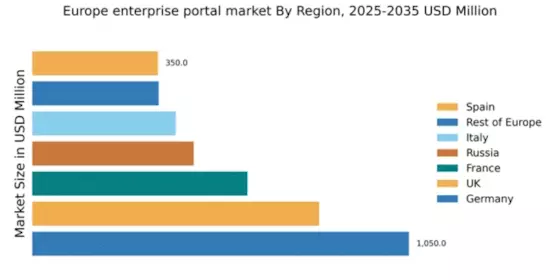
Germany holds a commanding market share of 35% in the European enterprise portal market, valued at €1,050 million. Key growth drivers include a robust industrial base, increasing digital transformation initiatives, and a strong emphasis on data security regulations. The German government supports innovation through various funding programs, enhancing infrastructure and fostering a conducive environment for tech startups and established players alike.

UK : Innovation and Investment Drive Market

The UK accounts for 25% of the European enterprise portal market, valued at €800 million. Growth is driven by a surge in remote work solutions and cloud adoption, alongside government initiatives promoting digital skills. The demand for integrated platforms is rising, particularly in sectors like finance and healthcare, where compliance and efficiency are paramount.

France : Strong Focus on User Experience

France captures 18% of the European market, valued at €600 million. The growth is fueled by increasing investments in digital infrastructure and a focus on enhancing user experience. Government policies supporting digital innovation and sustainability are pivotal, with initiatives aimed at fostering tech startups and enhancing connectivity across urban areas.

Russia : Regulatory Landscape Influences Growth

Russia holds a 13.5% share of the market, valued at €450 million. Key growth drivers include a rising demand for localized solutions and government initiatives aimed at digital sovereignty. However, regulatory challenges and geopolitical factors create a complex business environment, impacting foreign investments and partnerships.

Italy : Cultural Factors Shape Demand Trends

Italy represents 12% of the European enterprise portal market, valued at €400 million. Growth is driven by the need for tailored solutions in various sectors, including manufacturing and retail. Government initiatives promoting digitalization and infrastructure improvements are crucial, while regional disparities in technology adoption present unique challenges and opportunities.

Spain : Focus on Collaboration and Integration

Spain accounts for 10% of the market, valued at €350 million. The growth is propelled by a strong emphasis on collaboration tools and integrated platforms, particularly in the education and tourism sectors. Government support for digital transformation initiatives is significant, fostering a vibrant startup ecosystem and enhancing connectivity across regions.

Rest of Europe : Opportunities Across Multiple Sectors

The Rest of Europe holds a 10.5% market share, valued at €352.5 million. This sub-region encompasses a variety of markets with distinct needs, driven by local regulations and economic conditions. Growth opportunities exist in sectors like healthcare and public services, with increasing demand for customized enterprise solutions tailored to local requirements.

Europe Enterprise Portal Market Regional Image

Key Players and Competitive Insights

The enterprise portal market is currently characterized by a dynamic competitive landscape, driven by the increasing demand for integrated digital solutions that enhance organizational efficiency and collaboration. Key players such as Microsoft (US), SAP (DE), and Oracle (US) are strategically positioned to leverage their technological prowess and extensive customer bases. Microsoft (US) focuses on innovation through its Azure cloud services, which facilitate seamless integration of enterprise portals with existing IT infrastructures. SAP (DE) emphasizes regional expansion, particularly in Europe, by enhancing its offerings to cater to local compliance and operational needs. Oracle (US) is actively pursuing partnerships to bolster its cloud capabilities, thereby enhancing its competitive edge in the market. Collectively, these strategies indicate a trend towards comprehensive solutions that address diverse business requirements, shaping a competitive environment that is increasingly collaborative yet fiercely competitive.

In terms of business tactics, companies are increasingly localizing their operations to better serve regional markets, optimizing supply chains to enhance efficiency and responsiveness. The market structure appears moderately fragmented, with a mix of established players and emerging startups vying for market share. The collective influence of these key players is significant, as they set industry standards and drive innovation, thereby shaping the overall market dynamics.

In October 2025, Microsoft (US) announced a strategic partnership with a leading European telecommunications provider to enhance its enterprise portal capabilities. This collaboration aims to integrate advanced communication tools into Microsoft’s existing offerings, thereby improving user experience and operational efficiency for businesses across Europe. The strategic importance of this partnership lies in its potential to expand Microsoft’s market reach and solidify its position as a leader in the enterprise portal space.

In September 2025, SAP (DE) launched a new version of its enterprise portal, which incorporates AI-driven analytics to provide users with actionable insights. This development is particularly noteworthy as it reflects SAP’s commitment to digital transformation and its focus on delivering value-added services to its customers. The integration of AI capabilities is likely to enhance decision-making processes for organizations, thereby reinforcing SAP’s competitive positioning in the market.

In November 2025, Oracle (US) unveiled a new suite of tools designed to facilitate seamless integration of third-party applications into its enterprise portal framework. This move is indicative of Oracle’s strategy to create a more open ecosystem, allowing businesses to customize their portal experiences. The strategic significance of this initiative lies in its potential to attract a broader customer base, as organizations increasingly seek flexible solutions that can adapt to their unique operational needs.

As of November 2025, current competitive trends in the enterprise portal market are heavily influenced by digitalization, sustainability, and the integration of AI technologies. Strategic alliances are becoming increasingly vital, as companies recognize the need to collaborate in order to innovate and meet evolving customer demands. Looking ahead, competitive differentiation is likely to shift from traditional price-based competition towards a focus on innovation, technological advancement, and supply chain reliability. This evolution suggests that companies that prioritize these aspects will be better positioned to thrive in an increasingly complex and competitive landscape.

Key Companies in the Europe Enterprise Portal Market market include

Industry Developments

In recent months, the Europe Enterprise Portal Market has witnessed significant developments, with companies like Microsoft and SAP continuing to innovate solutions tailored for diverse industries, enhancing user experience and integration capabilities. Notably, in September 2023, ServiceNow completed its acquisition of a European IT service management firm, expanding its reach in the European market and reinforcing its commitment to digital workflow solutions. The current market environment is characterized by a growing emphasis on cloud-based solutions and artificial intelligence, driving companies such as Workday and Oracle to invest heavily in Research and Development to maintain competitive advantage. 

Moreover, the European Commission has placed a strong focus on data privacy and cybersecurity regulations, influencing market dynamics for companies like Alfresco and OpenText, which emphasize data security in their offerings. Over the past couple of years, significant events include Microsoft's launch of new collaborative features in Microsoft SharePoint in November 2022 and Salesforce's expansion into Europe through enhanced partnerships to improve customer relationship management opportunities. The sector's growth trends indicate a robust increase in market valuation, driven by the advancing technological landscape and rising demand for integrated enterprise solutions among European businesses.

Future Outlook

Europe Enterprise Portal Market Future Outlook

The enterprise portal market is projected to grow at a 7.96% CAGR from 2024 to 2035, driven by digital transformation, increased collaboration, and enhanced user experience.

New opportunities lie in:

  • Integration of AI-driven analytics for personalized user experiences.
  • Development of mobile-first enterprise portal solutions to enhance accessibility.
  • Expansion into niche markets with tailored portal solutions for specific industries.

By 2035, the enterprise portal market is expected to achieve substantial growth and innovation.

Market Segmentation

Europe Enterprise Portal Market Type Outlook

  • Information Portal
  • Collaborative Portal
  • Application Portal

Europe Enterprise Portal Market Service Outlook

  • Enterprise Content Management Service (ECM)
  • Enterprise Collaboration Service (ECS)
  • Enterprise Search Service (ESS)

Europe Enterprise Portal Market Vertical Outlook

  • BFSI
  • IT and telecommunications
  • Government
  • Healthcare
  • Retail
  • Others

Report Scope

MARKET SIZE 2024 3502.5(USD Million)
MARKET SIZE 2025 3781.3(USD Million)
MARKET SIZE 2035 8133.0(USD Million)
COMPOUND ANNUAL GROWTH RATE (CAGR) 7.96% (2024 - 2035)
REPORT COVERAGE Revenue Forecast, Competitive Landscape, Growth Factors, and Trends
BASE YEAR 2024
Market Forecast Period 2025 - 2035
Historical Data 2019 - 2024
Market Forecast Units USD Million
Key Companies Profiled ["Microsoft (US)", "IBM (US)", "SAP (DE)", "Oracle (US)", "Salesforce (US)", "Atlassian (AU)", "Liferay (US)", "OpenText (CA)", "Alfresco (US)"]
Segments Covered Type, Service, Vertical
Key Market Opportunities Integration of artificial intelligence enhances user experience in the enterprise portal market.
Key Market Dynamics Rising demand for integrated solutions drives innovation and competition in the enterprise portal market.
Countries Covered Germany, UK, France, Russia, Italy, Spain, Rest of Europe

Leave a Comment

FAQs

What is the expected market size for the Europe Enterprise Portal Market in 2024?

The Europe Enterprise Portal Market is expected to be valued at 3.92 USD Billion in 2024.

What will the market value of the Europe Enterprise Portal Market be by 2035?

By 2035, the market is projected to reach a value of 11.75 USD Billion.

What is the projected CAGR for the Europe Enterprise Portal Market between 2025 and 2035?

The expected CAGR for the Europe Enterprise Portal Market during this period is 10.49%.

Which region is anticipated to hold the largest market share in the Europe Enterprise Portal Market in 2024?

Germany is expected to have the largest market share, valued at 1.0 USD Billion in 2024.

What will be the market size of the Information Portal segment by 2035?

The Information Portal segment is projected to grow to 4.7 USD Billion by 2035.

Which are the key players in the Europe Enterprise Portal Market?

Major players include Workday, Sage, SAP, Atlassian, Moodle, and Microsoft among others.

How is the Collaborative Portal segment valued for the year 2024?

The Collaborative Portal segment is anticipated to be valued at 1.24 USD Billion in 2024.

What is the expected market size of the Application Portal by 2035?

The Application Portal is expected to reach a market size of 3.35 USD Billion by 2035.

What market value is expected for the UK in 2024?

In 2024, the UK's market size in the Europe Enterprise Portal Market is expected to be 0.9 USD Billion.

What challenges are influencing the growth of the Europe Enterprise Portal Market?

Market growth may be influenced by emerging technologies and evolving customer needs in the digital landscape.

Download Free Sample

Kindly complete the form below to receive a free sample of this Report

Compare Licence

×
Features License Type
Single User Multiuser License Enterprise User
Price $4,950 $5,950 $7,250
Maximum User Access Limit 1 User Upto 10 Users Unrestricted Access Throughout the Organization
Free Customization
Direct Access to Analyst
Deliverable Format
Platform Access
Discount on Next Purchase 10% 15% 15%
Printable Versions