×
Request Free Sample ×

Kindly complete the form below to receive a free sample of this Report

* Please use a valid business email

Leading companies partner with us for data-driven Insights

clients tt-cursor
Hero Background

Europe Generative Ai In Fulfillment Logistics Market

ID: MRFR/ICT/62959-HCR
200 Pages
Aarti Dhapte
October 2025

Europe Generative AI in Fulfillment Logistics Market Research Report By Offerings (Solution, Services), By Type (VAE, GANs, RNNs, LSTM Networks), By Application (Warehouse Operations, Optimization and Management, Supply Chain Operations, Predictive Maintenance, Logistics Network Design, Inventory Management, Fraud Detection, Autonomous Robotics, Data Analytics & Reporting), By Industrial vertical (Automotive, Pharmaceutical & Healthcare, Semiconductors & Electronics, Retail & E-Commerce, Food), and By Regional (Germany, UK, F... read more

Share:
Download PDF ×

We do not share your information with anyone. However, we may send you emails based on your report interest from time to time. You may contact us at any time to opt-out.

Europe Generative Ai In Fulfillment Logistics Market Infographic
Purchase Options

Europe Generative Ai In Fulfillment Logistics Market Summary

As per MRFR analysis, the Europe generative ai-in-fulfillment-logistics market Size was estimated at 69330.71 USD Million in 2024. The Europe generative ai-in-fulfillment-logistics market industry is projected to grow from 80770.28 USD Million in 2025 to 371789.84 USD Million by 2035, exhibiting a compound annual growth rate (CAGR) of 16.5% during the forecast period 2025 - 2035.

Key Market Trends & Highlights

The Europe generative AI-in-fulfillment-logistics market is experiencing robust growth driven by automation and data integration.

  • Germany leads the Europe generative AI-in-fulfillment-logistics market, showcasing a strong emphasis on automation in warehousing.
  • The UK emerges as the fastest-growing region, reflecting a rising demand for enhanced predictive analytics.
  • Sustainability initiatives are becoming increasingly central to logistics strategies across Europe, influencing operational practices.
  • Key market drivers include the rising demand for real-time data processing and the integration of AI with IoT technologies.

Market Size & Forecast

2024 Market Size 69330.71 (USD Million)
2035 Market Size 371789.84 (USD Million)
CAGR (2025 - 2035) 16.5%

Major Players

Amazon (US), Google (US), IBM (US), Microsoft (US), Siemens (DE), SAP (DE), Oracle (US), C3.ai (US), Zebra Technologies (US)

Europe Generative Ai In Fulfillment Logistics Market Trends

The generative ai-in-fulfillment-logistics market is currently experiencing a transformative phase, driven by advancements in artificial intelligence technologies. These innovations are reshaping traditional logistics operations, enhancing efficiency, and optimizing supply chain management. Companies are increasingly adopting AI-driven solutions to streamline processes, reduce operational costs, and improve customer satisfaction. The integration of generative AI into fulfillment logistics appears to facilitate real-time decision-making, predictive analytics, and automated inventory management, which are crucial for meeting the demands of a rapidly evolving market landscape. Moreover, the emphasis on sustainability and environmental responsibility is becoming more pronounced within the generative ai-in-fulfillment-logistics market. Organizations are exploring AI applications that not only enhance operational efficiency but also contribute to reducing carbon footprints. This dual focus on technological advancement and sustainability suggests a significant shift in how logistics companies operate, potentially leading to more eco-friendly practices and innovative solutions. As the market continues to evolve, the interplay between AI capabilities and sustainable logistics practices is likely to shape future developments in the sector.

Increased Automation in Warehousing

The generative ai-in-fulfillment-logistics market is witnessing a surge in automation within warehousing operations. AI technologies are being utilized to optimize inventory management, streamline order processing, and enhance picking accuracy. This trend indicates a shift towards more efficient and cost-effective warehousing solutions, allowing companies to respond swiftly to market demands.

Enhanced Predictive Analytics

Predictive analytics powered by generative AI is becoming a cornerstone of decision-making in the generative ai-in-fulfillment-logistics market. By analyzing historical data and market trends, companies can forecast demand more accurately, leading to improved inventory control and reduced waste. This capability appears to be crucial for maintaining competitiveness in a dynamic environment.

Focus on Sustainability Initiatives

Sustainability is increasingly influencing strategies within the generative ai-in-fulfillment-logistics market. Companies are leveraging AI to develop eco-friendly logistics solutions, such as optimizing delivery routes to minimize fuel consumption and emissions. This trend reflects a growing commitment to environmental responsibility, aligning business practices with societal expectations.

Europe Generative Ai In Fulfillment Logistics Market Drivers

Advancements in Robotics and Automation

Advancements in robotics and automation technologies are significantly influencing the generative ai-in-fulfillment-logistics market. The deployment of autonomous robots in warehouses and fulfillment centers is streamlining operations and reducing labor costs. These robots, powered by generative AI, can optimize picking and packing processes, leading to faster order fulfillment. In Europe, the market for warehouse automation is expected to exceed €5 billion by 2027, driven by the increasing adoption of robotic solutions. This trend not only enhances operational efficiency but also addresses labor shortages in the logistics sector, making it a crucial driver for the future of fulfillment logistics.

Integration of AI with IoT Technologies

The integration of artificial intelligence (AI) with Internet of Things (IoT) technologies is emerging as a pivotal driver in the generative ai-in-fulfillment-logistics market. This convergence allows for enhanced visibility and control over supply chain operations. IoT devices generate vast amounts of data, which, when analyzed through generative AI algorithms, can lead to improved inventory management and predictive maintenance. In Europe, the IoT market in logistics is expected to reach €10 billion by 2026, indicating a robust growth trajectory. This integration not only streamlines operations but also reduces costs, making it an attractive proposition for logistics companies aiming to optimize their fulfillment processes.

Regulatory Compliance and Data Security

In the context of the generative ai-in-fulfillment-logistics market, regulatory compliance and data security are becoming increasingly critical. As logistics operations become more digitized, the need to adhere to stringent data protection regulations, such as the General Data Protection Regulation (GDPR), is paramount. Companies are investing in generative AI solutions that not only enhance operational efficiency but also ensure compliance with these regulations. The European market for data security solutions in logistics is projected to grow by 20% annually, reflecting the heightened focus on safeguarding sensitive information. This driver underscores the importance of integrating compliance measures into AI-driven logistics strategies.

Rising Demand for Real-Time Data Processing

The generative ai-in-fulfillment-logistics market in Europe is experiencing a notable surge in demand for real-time data processing capabilities. As businesses increasingly rely on data-driven decision-making, the ability to analyze and act on data instantaneously becomes crucial. This trend is particularly evident in sectors such as e-commerce and retail, where timely information can significantly enhance customer satisfaction and operational efficiency. According to recent estimates, the market for real-time data analytics in logistics is projected to grow at a CAGR of approximately 25% over the next five years. This growth is likely to drive investments in generative AI technologies that facilitate rapid data processing, thereby transforming fulfillment logistics operations across Europe.

Shift Towards Customization and Personalization

The generative ai-in-fulfillment-logistics market is witnessing a shift towards customization and personalization of services. As consumer preferences evolve, logistics providers are increasingly leveraging generative AI to tailor their offerings to meet specific customer needs. This trend is particularly pronounced in the e-commerce sector, where personalized delivery options can enhance customer loyalty and satisfaction. Market analysis suggests that companies that adopt personalized logistics solutions may see a revenue increase of up to 15% within the first year of implementation. This growing emphasis on customization is likely to drive further investment in generative AI technologies, enabling logistics firms to adapt swiftly to changing consumer demands.

Market Segment Insights

By Offering: Solution (Largest) vs. Services (Fastest-Growing)

In the Europe generative ai-in-fulfillment-logistics market, the Solution segment dominates with significant market share, outpacing the Services segment. This distribution is largely influenced by the increasing demand for comprehensive software solutions that enhance operational efficiency in logistics. As companies seek to streamline their fulfillment processes and integrate advanced technologies, the adoption of various solutions becomes critical to compete effectively in the market. Conversely, the Services segment is emerging as the fastest-growing area, driven by the increasing need for customizable service offerings that complement technological solutions. Rapid advancements in AI capabilities, demand for automation, and tailored logistical services are propelling this growth. As organizations aim for more adaptive and responsive supply chains, service providers are stepping up to meet these evolving requirements, making it a key area to watch in the coming years.

Solution (Dominant) vs. Services (Emerging)

The Solution segment is characterized by mature offerings that provide robust software and systems aimed at enhancing logistics and fulfillment operations. With a focus on integrating advanced AI technologies, these solutions enable businesses to optimize inventory management, streamline order fulfillment, and improve customer satisfaction. In contrast, the Services segment represents a more adaptive approach, wherein service providers offer personalized support and consulting to help enterprises navigate their logistic challenges. This flexibility in service delivery caters to specific business needs, forging closer relationships between providers and clients, ultimately driving growth within this dynamic market.

By Type: Generative Adversarial Networks (Largest) vs. Variational Autoencoder (Fastest-Growing)

In the segment of generative AI technologies, Generative Adversarial Networks (GANs) hold the largest market share owing to their effectiveness in generating high-quality synthetic data that aids fulfillment logistics. Variational Autoencoders (VAEs), while they have a smaller share, are gaining traction due to their unique ability to learn efficient representations of data. Together, these technologies are pivotal in optimizing logistics operations in the region. The growth trend for generative AI in fulfillment logistics is driven by increasing demands for automation, enhanced data analytics capabilities, and the rising importance of data quality in supply chain decisions. Companies are increasingly adopting GANs for their robustness in simulation and forecasting, while VAEs are recognized for their agility and innovative data processing, making them key players in emerging logistics solutions.

Generative Adversarial Networks (Dominant) vs. Variational Autoencoder (Emerging)

Generative Adversarial Networks (GANs) are characterized by their ability to generate highly realistic data, making them dominant in logistics optimization applications. Their architecture, consisting of two neural networks competing against each other, allows for exceptional data synthesis and simulation capabilities, which are critical in various logistical scenarios. In contrast, Variational Autoencoders (VAEs) serve as an emerging technology by efficiently encoding input data into a compressed latent space. This enables businesses to explore innovative data representations and applications. As more companies recognize the potential of VAEs in enhancing decision-making processes, they are becoming increasingly important in the logistics landscape, particularly in Europe.

By Application: Warehouse Operations (Largest) vs. Data Analytics & Reporting (Fastest-Growing)

The application segment in the market shows a diverse distribution of focus areas. Warehouse Operations holds the largest share, representing a crucial element in fulfillment logistics, driven by the necessity for streamlined processes and enhanced inventory management. Other significant applications include Supply Chain Operations and Inventory Management, which contribute to operational efficiency and resource optimization in the logistics sector. The growth trends reveal a shift towards predictive technologies, particularly in areas like Predictive Maintenance and Autonomous Robotics. These segments are gaining traction as businesses seek efficiency and agility in their operations. Additionally, Data Analytics & Reporting is recognized as the fastest-growing segment, propelled by rising demands for real-time decision-making and operational insights in logistics processes.

Warehouse Operations (Dominant) vs. Data Analytics & Reporting (Emerging)

Warehouse Operations remains the dominant force in the application segment, characterized by its emphasis on optimizing storage and retrieval processes, ensuring timely fulfillment, and reducing operational costs. This segment is underpinned by advancements in automation and the integration of AI technologies that enhance efficiency. In contrast, Data Analytics & Reporting is an emerging player, leveraging data-driven insights to enhance decision-making processes. Its rapid growth can be attributed to the increasing importance of big data in logistics, allowing for improved forecasting, inventory accuracy, and customer satisfaction. Together, these segments illustrate the evolving landscape of fulfillment logistics, whereby traditional operations integrate cutting-edge technological solutions.

By Industry Vertical: Retail & E-Commerce (Largest) vs. Pharmaceutical & Healthcare (Fastest-Growing)

In the Europe generative ai-in-fulfillment-logistics market, the distribution of market share among the industry verticals reveals that Retail & E-Commerce holds the largest segment, driven by the increasing demand for efficient logistics solutions to adapt to changing consumer behaviors. This sector benefits significantly from advancements in AI technologies, facilitating automation and improved inventory management. On the other hand, the Pharmaceutical & Healthcare sector is emerging as the fastest-growing segment. The rising necessity for effective and swift delivery systems, especially for sensitive medical supplies, is spurring investment in generative AI solutions. Factors such as regulatory pressures to streamline operations and the growing emphasis on patient-centric logistics further propel growth within this vertical.

Retail & E-Commerce: Dominant vs. Pharmaceutical & Healthcare: Emerging

The Retail & E-Commerce segment stands out as the dominant force in the Europe generative ai-in-fulfillment-logistics market, characterized by its robust embrace of digital transformation. This sector relies heavily on AI to optimize supply chains, enhance customer engagement through personalized services, and streamline fulfillment processes. Conversely, the Pharmaceutical & Healthcare segment is rapidly emerging, characterized by unique challenges such as stringent regulatory requirements and the need for temperature-controlled logistics. As this sector adapts to technology, the incorporation of generative AI is streamlining operations, thereby ensuring timely and compliant delivery of medical products.

Get more detailed insights about Europe Generative Ai In Fulfillment Logistics Market

Regional Insights

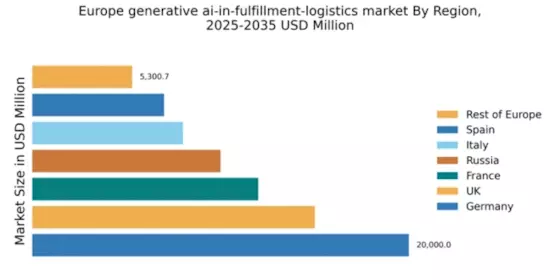
The Europe Generative AI in Fulfillment Logistics Market is witnessing notable transformations across various regions, significantly influenced by advancements in technology and shifts in consumer behavior. Germany stands out as a major player, leveraging its robust manufacturing and logistics infrastructure to integrate Generative AI solutions, thereby optimizing supply chains and increasing operational efficiency.

The UK also plays a vital role, with a strong emphasis on digital innovation and a favorable environment for startups focusing on AI applications within logistics. France is seeing a surge in investment, enhancing its competitive edge in the global logistics landscape, while Russia’s growing logistics sector is turning towards AI adoption to streamline processes.

Italy, known for its rich industrial base, is embracing AI technologies to enhance fulfillment strategies, ensuring timely deliveries and improved customer satisfaction. Spain is rapidly expanding its logistics capabilities, increasingly adopting Generative AI to address the rising demand for efficient supply chain solutions.

The rest of Europe is experiencing diverse growth, with varying levels of AI integration and investment across different nations, contributing to a comprehensive Europe Generative AI in Fulfillment Logistics Market landscape.Overall, these regional dynamics showcase the critical importance of Generative AI in shaping the future of logistics across Europe, driven by innovation, investment, and the quest for greater efficiency in supply chain management.

Europe Generative Ai In Fulfillment Logistics Market Regional Image

Key Players and Competitive Insights

The generative ai-in-fulfillment-logistics market is currently characterized by a dynamic competitive landscape, driven by rapid technological advancements and increasing demand for efficiency in supply chain operations. Major players such as Amazon (US), Siemens (DE), and SAP (DE) are at the forefront, leveraging innovative technologies to enhance their operational capabilities. Amazon (US) continues to focus on automation and AI integration, aiming to streamline its logistics processes, while Siemens (DE) emphasizes digital transformation through its smart logistics solutions. SAP (DE) is strategically positioning itself by enhancing its cloud-based offerings, which facilitate real-time data analytics and decision-making in logistics. Collectively, these strategies contribute to a competitive environment that is increasingly reliant on technological innovation and operational efficiency.

Key business tactics within this market include localizing manufacturing and optimizing supply chains to meet regional demands. The competitive structure appears moderately fragmented, with several key players exerting influence over various segments. This fragmentation allows for a diverse range of solutions, catering to different customer needs while fostering innovation through competition. The collective influence of these major companies shapes market dynamics, as they continuously adapt to evolving consumer expectations and technological advancements.

In October 2025, Amazon (US) announced the launch of its new AI-driven logistics platform, designed to enhance delivery speed and accuracy. This strategic move is significant as it underscores Amazon's commitment to maintaining its competitive edge through technological innovation. By integrating advanced AI algorithms, the platform aims to optimize route planning and inventory management, potentially reducing operational costs and improving customer satisfaction.

In September 2025, Siemens (DE) unveiled its latest smart logistics solution, which incorporates generative AI to predict supply chain disruptions. This initiative is crucial as it positions Siemens as a leader in proactive logistics management, enabling companies to mitigate risks and enhance resilience. The predictive capabilities of this solution could significantly improve operational efficiency, thereby attracting more clients seeking reliable logistics partners.

In August 2025, SAP (DE) expanded its partnership with various logistics providers to enhance its cloud-based logistics solutions. This strategic alliance is noteworthy as it allows SAP to integrate diverse logistics capabilities into its platform, thereby offering clients a more comprehensive suite of services. The collaboration is likely to enhance SAP's market position by providing clients with innovative tools to optimize their supply chain operations.

As of November 2025, current trends in the generative ai-in-fulfillment-logistics market include a strong emphasis on digitalization, sustainability, and AI integration. Strategic alliances among key players are shaping the landscape, fostering innovation and collaboration. Looking ahead, competitive differentiation is expected to evolve, with a shift from price-based competition to a focus on innovation, technology, and supply chain reliability. Companies that can effectively leverage these trends are likely to secure a competitive advantage in this rapidly changing market.

Key Companies in the Europe Generative Ai In Fulfillment Logistics Market market include

Industry Developments

Blue Yonder introduced Blue Yonder Orchestrator, a generative AI feature integrated into its Luminate® Cognitive Platform, in December 2023. It uses natural language-based LLMs to provide more intelligent supply chain orchestration across planning and execution tasks.

In order to facilitate quicker, autonomous AI-driven decisions across logistics workflows, Blue Yonder further increased its European footprint in May 2025 by announcing a new suite of AI agents and a supply chain knowledge graph during ICON 2025.

A significant step toward AI-assisted asset management in European industrial logistics environments was taken in March 2025 when Siemens unveiled an advanced Industrial Copilot maintenance solution driven by generative AI to revolutionize predictive and preventative maintenance operations.

To illustrate AI's revolutionary potential in European marine logistics, Google teamed up with international shipping operator CMA CGM in July 2024 to use its AI technologies to enhance routes, container handling, and warehouse demand forecasting.

In the meantime, Oracle keeps incorporating AI into its ERP logistics solutions throughout Europe, gradually distributing AI-driven insights and optimization to its clientele in Europe.These advancements demonstrate the growing importance of generative AI in European logistics and fulfillment processes, encompassing intelligent orchestration, self-governing decision-making, and practical operational effects.

Europe Generative AI in

Future Outlook

Europe Generative Ai In Fulfillment Logistics Market Future Outlook

The generative ai-in-fulfillment-logistics market is projected to grow at a 16.5% CAGR from 2024 to 2035, driven by automation, efficiency improvements, and enhanced data analytics.

New opportunities lie in:

  • Integration of AI-driven predictive analytics for inventory management.
  • Development of autonomous delivery drones for last-mile logistics.
  • Implementation of AI-powered customer service chatbots for order tracking.

By 2035, the market is expected to achieve substantial growth, driven by technological advancements and increased demand.

Market Segmentation

Europe Generative Ai In Fulfillment Logistics Market Type Outlook

  • Variational Autoencoder (VAE)
  • Generative Adversarial Networks (GANs)
  • Recurrent Neural Networks (RNNs)
  • Long Short-Term Memory (LSTM) Networks

Europe Generative Ai In Fulfillment Logistics Market Offering Outlook

  • Solution
  • Services

Europe Generative Ai In Fulfillment Logistics Market Application Outlook

  • Warehouse Operations
  • Optimization and Management
  • Supply Chain Operations
  • Predictive Maintenance
  • Logistics Network Design
  • Inventory Management
  • Fraud Detection
  • Customer Service Operations
  • Autonomous Robotics
  • Data Analytics & Reporting
  • Others

Europe Generative Ai In Fulfillment Logistics Market Industry Vertical Outlook

  • Automotive
  • Pharmaceutical & Healthcare
  • Semiconductors & Electronics
  • Retail & E-Commerce
  • Food & Beverages
  • Others

Report Scope

MARKET SIZE 2024 69330.71(USD Million)
MARKET SIZE 2025 80770.28(USD Million)
MARKET SIZE 2035 371789.84(USD Million)
COMPOUND ANNUAL GROWTH RATE (CAGR) 16.5% (2024 - 2035)
REPORT COVERAGE Revenue Forecast, Competitive Landscape, Growth Factors, and Trends
BASE YEAR 2024
Market Forecast Period 2025 - 2035
Historical Data 2019 - 2024
Market Forecast Units USD Million
Key Companies Profiled ["Amazon (US)", "Google (US)", "IBM (US)", "Microsoft (US)", "Siemens (DE)", "SAP (DE)", "Oracle (US)", "C3.ai (US)", "Zebra Technologies (US)"]
Segments Covered Offering, Type, Application, Industry Vertical
Key Market Opportunities Integration of generative AI enhances efficiency and accuracy in fulfillment logistics operations.
Key Market Dynamics Rising adoption of generative AI technologies enhances efficiency and responsiveness in fulfillment logistics operations.
Countries Covered Germany, UK, France, Russia, Italy, Spain, Rest of Europe

Leave a Comment

FAQs

What is the expected market size of the Europe Generative AI in Fulfillment Logistics Market in 2024?

The expected market size in 2024 is 70.62 USD Billion.

What will be the projected market value of the Europe Generative AI in Fulfillment Logistics Market by 2035?

By 2035, the market is expected to be valued at 3717.89 USD Billion.

What is the CAGR for the Europe Generative AI in Fulfillment Logistics Market from 2025 to 2035?

The expected CAGR for the market from 2025 to 2035 is 43.379%.

Which region is expected to have the largest market share in 2024?

Germany is expected to have the largest market share, valued at 20.247 USD Billion in 2024.

What is the expected market value for the United Kingdom in 2024?

The market value for the United Kingdom in 2024 is expected to be 17.007 USD Billion.

Who are the key players in the Europe Generative AI in Fulfillment Logistics Market?

Major players in the market include Oracle, Siemens, SAP, IBM, and Amazon.

What will be the market value for services in 2035?

The market value for services in 2035 is expected to reach 2690.74 USD Billion.

What is the expected market size for France in 2035?

France is expected to reach a market size of 737.414 USD Billion by 2035.

What are some of the growth drivers for the Europe Generative AI in Fulfillment Logistics Market?

Growing demand for automation and efficiency in logistics is a key driver for market growth.

What challenges might the Europe Generative AI in Fulfillment Logistics Market face?

Challenges may include regulatory hurdles and the need for advanced technology integration.

Download Free Sample

Kindly complete the form below to receive a free sample of this Report

Compare Licence

×
Features License Type
Single User Multiuser License Enterprise User
Price $4,950 $5,950 $7,250
Maximum User Access Limit 1 User Upto 10 Users Unrestricted Access Throughout the Organization
Free Customization
Direct Access to Analyst
Deliverable Format
Platform Access
Discount on Next Purchase 10% 15% 15%
Printable Versions