×
Request Free Sample ×

Kindly complete the form below to receive a free sample of this Report

* Please use a valid business email

Leading companies partner with us for data-driven Insights

clients tt-cursor
Hero Background

Europe Incident Emergency Management Market

ID: MRFR/ICT/58282-HCR
200 Pages
Aarti Dhapte
October 2025

Europe Incident Emergency Management Market Research Report By Solution (Geospatial Technology Solution, CBRNE/Hazmat Solution, Situational Awareness Solution), By System (Simulation Systems), By Professional Service (Training, Consultant) and By Regional (Germany, UK, France, Russia, Italy, Spain, Rest of Europe)-Forecast to 2035

Share:
Download PDF ×

We do not share your information with anyone. However, we may send you emails based on your report interest from time to time. You may contact us at any time to opt-out.

Europe Incident Emergency Management Market Infographic
Purchase Options

Europe Incident Emergency Management Market Summary

As per MRFR analysis, the Europe incident emergency-management market size was estimated at 28.82 USD Billion in 2024. The Europe incident emergency-management market is projected to grow from 30.06 USD Billion in 2025 to 45.8 USD Billion by 2035, exhibiting a compound annual growth rate (CAGR) of 4.3% during the forecast period 2025 - 2035.

Key Market Trends & Highlights

The Europe incident emergency-management market is experiencing robust growth driven by technological advancements and regulatory changes.

  • Germany remains the largest market for incident emergency management, reflecting its strong infrastructure and investment capabilities.
  • The UK is emerging as the fastest-growing region, propelled by increasing public-private partnerships and innovative solutions.
  • Technological integration is becoming a focal point, enhancing communication and response strategies across various sectors.
  • Rising natural disasters and increased government funding are key drivers, fostering a more resilient emergency management framework.

Market Size & Forecast

2024 Market Size 28.82 (USD Billion)
2035 Market Size 45.8 (USD Billion)
CAGR (2025 - 2035) 4.3%

Major Players

Honeywell (US), Siemens (DE), Motorola Solutions (US), AT&T (US), Cisco Systems (US), IBM (US), Raytheon Technologies (US), General Dynamics (US), Northrop Grumman (US)

Europe Incident Emergency Management Market Trends

The incident emergency-management market is currently experiencing a transformative phase. This change is driven by evolving regulatory frameworks and increasing awareness of disaster preparedness. Governments across Europe are prioritizing the enhancement of their emergency response capabilities, which appears to be a response to the growing frequency of natural disasters and other crises. This shift is reflected in the allocation of resources towards advanced technologies and training programs aimed at improving response times and coordination among various agencies. Furthermore, public-private partnerships are emerging as a vital component in strengthening the overall resilience of communities, suggesting a collaborative approach to managing incidents effectively. In addition, the integration of innovative technologies such as artificial intelligence and data analytics is reshaping the landscape of the incident emergency-management market. These advancements enable more efficient risk assessment and resource allocation, potentially leading to better outcomes during emergencies. As stakeholders recognize the importance of proactive measures, investment in infrastructure and community engagement initiatives is likely to increase. This trend indicates a broader commitment to not only respond to incidents but also to mitigate their impact through strategic planning and preparedness efforts.

Technological Integration

The adoption of advanced technologies is becoming increasingly prevalent in the incident emergency-management market. Tools such as artificial intelligence, machine learning, and data analytics are being utilized to enhance decision-making processes and improve response strategies. This trend suggests a shift towards more data-driven approaches, allowing for better risk assessment and resource management.

Regulatory Enhancements

Recent changes in regulations are influencing the incident emergency-management market significantly. Governments are implementing stricter guidelines and standards for emergency preparedness and response. This development indicates a growing recognition of the need for robust frameworks to ensure effective management of incidents.

Public-Private Collaboration

The trend of collaboration between public entities and private organizations is gaining momentum within the incident emergency-management market. Such partnerships are fostering innovation and resource sharing, which may lead to improved emergency response capabilities. This collaborative approach appears to be essential for building resilient communities.

Europe Incident Emergency Management Market Drivers

Growing Public Awareness

Public awareness regarding emergency preparedness is on the rise, influencing the incident emergency-management market. Citizens are increasingly recognizing the importance of being prepared for various emergencies, from natural disasters to health crises. This heightened awareness has led to a demand for educational programs and resources that equip individuals and communities with the knowledge to respond effectively. Surveys indicate that approximately 70% of Europeans believe that emergency preparedness should be a priority for local governments. Consequently, this trend is driving investments in community engagement initiatives and training programs, thereby fostering a more resilient society and enhancing the incident emergency-management market.

Rising Natural Disasters

The increasing frequency of natural disasters in Europe is a critical driver for the incident emergency-management market. Events such as floods, wildfires, and storms have become more prevalent, prompting governments and organizations to invest in robust emergency management systems. According to recent data, the economic impact of natural disasters in Europe has surged, with losses estimated at €10 billion annually. This trend necessitates the development of advanced incident management solutions to mitigate risks and enhance response capabilities. As climate change continues to influence weather patterns, the demand for effective emergency management strategies is likely to grow, thereby propelling the incident emergency-management market forward.

Increased Government Funding

Government funding for emergency management initiatives is a significant driver in the incident emergency-management market. In recent years, European governments have recognized the importance of preparedness and response capabilities, leading to increased budget allocations for emergency services. For example, the European Union has committed over €500 million to enhance disaster resilience across member states. This financial support facilitates the development of training programs, infrastructure improvements, and the acquisition of advanced technologies. As funding continues to rise, the incident emergency-management market is expected to expand, providing opportunities for innovation and improved service delivery.

Cross-Border Collaboration Initiatives

Cross-border collaboration initiatives among European nations are emerging as a vital driver in the incident emergency-management market. As incidents often transcend national boundaries, cooperation between countries is essential for effective response and recovery. Programs such as the European Civil Protection Mechanism facilitate joint exercises and resource sharing, enhancing collective preparedness. Recent statistics show that collaborative efforts have improved response times by up to 30% in cross-border emergencies. This trend not only strengthens regional resilience but also encourages the development of standardized protocols and technologies, thereby advancing the incident emergency-management market.

Technological Advancements in Communication

Advancements in communication technologies are transforming the incident emergency-management market. The integration of real-time data analytics, mobile applications, and social media platforms enables faster and more efficient communication during emergencies. For instance, the use of Geographic Information Systems (GIS) allows for better mapping and resource allocation during incidents. A report indicates that investments in communication technologies for emergency management in Europe are projected to reach €1.5 billion by 2026. This technological evolution not only enhances situational awareness but also improves coordination among various stakeholders, thereby strengthening the overall effectiveness of incident management.

Market Segment Insights

By Solution: Geospatial Technology Solutions (Largest) vs. CBRNE/Hazmat Solutions (Fastest-Growing)

In the incident emergency-management market, the distribution of market share among solution segments shows that Geospatial Technology Solutions hold the largest share due to their vital role in enhancing situational assessments and operational efficiency. Meanwhile, CBRNE/Hazmat Solutions, despite having a smaller current share, are rapidly gaining traction as organizations invest more in specialized technologies to address chemical, biological, radiological, nuclear, and explosive threats effectively. The growth trends for these segments indicate that Geospatial Technology Solutions will continue to dominate due to their integral applications across various emergency scenarios. In contrast, CBRNE/Hazmat Solutions are experiencing accelerated growth driven by increased regulatory requirements and heightened awareness of hazardous materials. The rising incidents of CBRNE threats further propel demand for these specialized solutions, making them essential in the market landscape.

Geospatial Technology Solutions (Dominant) vs. CBRNE/Hazmat Solutions (Emerging)

Geospatial Technology Solutions are characterized by their advanced mapping and analytical capabilities, essential for real-time situational awareness and decision-making in emergencies. They leverage GIS technology to provide accurate data visualizations that aid in resource allocation and operational planning. As the dominant solution in the market, these technologies find extensive use across policing, firefighting, and disaster response scenarios. Conversely, CBRNE/Hazmat Solutions are emerging as critical components in the incident management toolkit, tailored to equip responders with tools for identifying and mitigating hazardous materials. Their increasing importance is influenced by the complex nature of modern threats, which necessitate specialized training and equipment for effective management of incidents involving hazardous substances.

By System: Simulation Systems (Largest) vs. Training Systems (Fastest-Growing)

Within the System segment of the incident emergency-management market, Simulation Systems holds a significant portion of the market share. This segment is critical for providing realistic training scenarios that enhance the preparedness of emergency responders. Training Systems, while a smaller segment currently, is witnessing increased adoption, driven by organizations seeking to enhance the capabilities of their personnel through advanced methodologies in training and evaluation. The growth trends in this segment are largely fueled by technological advancements and the rising need for efficient emergency response solutions. Simulation Systems are evolving to integrate virtual reality and other immersive technologies, making them indispensable for realistic training. Meanwhile, Training Systems are emerging rapidly as organizations recognize the importance of continuous learning and skill enhancement in the face of evolving threats, establishing themselves as a dynamic and essential area within the market.

Simulation Systems (Dominant) vs. Training Systems (Emerging)

Simulation Systems, as a dominant force in this segment, offer comprehensive solutions that simulate real-life emergency scenarios, providing invaluable hands-on experience for responders. These systems are characterized by their ability to create realistic environments where personnel can practice their skills without the risks associated with real emergencies. On the other hand, Training Systems are rapidly carving their niche in this landscape. They focus on developing the knowledge and skills of emergency management personnel through structured educational programs and online training. The shift towards more interactive and accessible training methods is propelling the growth of Training Systems, making them an essential complement to the established Simulation Systems. Together, they support a holistic approach to preparing for and managing emergencies.

By Professional Service: Training (Largest) vs. Consultants (Fastest-Growing)

In the Europe incident emergency-management market, the Professional Service segment is predominantly shaped by the Training and Consultants sub-segments. Training services hold a substantial market share, primarily due to the essential need for skills and knowledge enhancement among emergency response teams. On the other hand, Consultants are increasingly gaining traction as organizations seek expert guidance on developing and implementing effective emergency management strategies. This shift in focus indicates a growing recognition of the importance of specialized consultancy in crisis preparedness and response. Growth trends in the Professional Service segment are driven by several factors, including the rise in regulatory requirements for emergency preparedness and the increasing frequency of incidents necessitating robust management strategies. Organizations are investing in both training and consultancy services to ensure compliance and enhance response capabilities. As a result, while Training remains dominant, Consultants are emerging as a key driver for growth, highlighting the need for expert advice and tailored solutions in emergency management practices.

Training: Largest vs. Consultants: Fastest-Growing

Training services within the Professional Service segment are characterized by their widespread adoption across various sectors, as they focus on equipping personnel with the necessary skills to respond effectively to emergencies. This dominance is attributed to continuous investments in training programs, which are essential for maintaining readiness and adapting to evolving challenges. Conversely, Consultants are becoming an increasingly vital part of the landscape, offering specialized knowledge and strategic insights that organizations require. The rising complexity of emergency situations amplifies the demand for consultants who can provide tailored solutions, thereby driving their rapid growth. This dynamic reflects an evolving market where both segments serve crucial roles, complementing each other in enhancing overall emergency management capabilities.

Get more detailed insights about Europe Incident Emergency Management Market

Regional Insights

Germany : Strong Infrastructure and Innovation Drive Growth

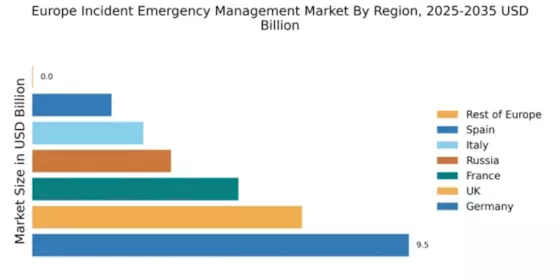
Germany holds a dominant market share of 9.5% in the incident emergency-management sector, valued at approximately €1.2 billion. Key growth drivers include stringent regulatory frameworks, increased investment in smart city initiatives, and a rising demand for integrated emergency response systems. Government initiatives, such as the Digital Strategy 2025, aim to enhance public safety through advanced technologies, while robust infrastructure supports rapid deployment of emergency services.

UK : Innovation and Regulation Shape Landscape

The UK accounts for 6.8% of the European market, valued at around €850 million. Growth is driven by increasing urbanization, heightened awareness of disaster preparedness, and government policies promoting resilience against emergencies. The UK government has implemented the National Resilience Strategy, focusing on improving emergency response capabilities and infrastructure, which is crucial for meeting rising demand.

France : Government Initiatives Fuel Market Expansion

France's market share stands at 5.2%, valued at approximately €650 million. Key growth drivers include the government's commitment to enhancing public safety through the National Security Strategy, which emphasizes the integration of technology in emergency management. Demand for advanced communication systems and real-time data analytics is rising, reflecting a shift towards proactive emergency response.

Russia : Regulatory Frameworks and Infrastructure Gaps

Russia holds a 3.5% market share, valued at about €450 million. Growth is influenced by increasing government focus on disaster management and emergency preparedness, particularly in urban areas. However, challenges such as outdated infrastructure and regulatory inconsistencies hinder market potential. The government is working on the National Emergency Management Plan to address these issues and improve response capabilities.

Italy : Cultural Factors Influence Market Trends

Italy's market share is 2.8%, valued at approximately €350 million. The growth is driven by rising awareness of natural disasters and the need for effective emergency management solutions. Government initiatives, such as the National Civil Protection Plan, aim to enhance preparedness and response. Regional disparities in infrastructure development also impact market dynamics, with northern regions showing higher demand.

Spain : Public-Private Partnerships Enhance Growth

Spain accounts for 2.0% of the market, valued at around €250 million. Growth drivers include increased investment in public safety technologies and collaborative efforts between government and private sectors. The Spanish government has launched initiatives to modernize emergency response systems, focusing on urban areas like Madrid and Barcelona, where demand for advanced solutions is high.

Rest of Europe : Diverse Needs Across Smaller Regions

The Rest of Europe holds a minimal market share of 0.02%, valued at approximately €25 million. This sub-region presents niche opportunities driven by localized needs and varying regulatory environments. Countries like Belgium and the Netherlands are exploring innovative emergency management solutions, albeit with limited market penetration. The competitive landscape is fragmented, with local players dominating.

Europe Incident Emergency Management Market Regional Image

Key Players and Competitive Insights

The incident emergency-management market is characterized by a dynamic competitive landscape, driven by the increasing need for effective response mechanisms to various emergencies. Key players are focusing on innovation, digital transformation, and strategic partnerships to enhance their operational capabilities. Companies such as Honeywell (US), Siemens (DE), and Motorola Solutions (US) are at the forefront, leveraging advanced technologies to improve incident response times and operational efficiency. Their strategies collectively shape a competitive environment that emphasizes technological advancement and integrated solutions.

In terms of business tactics, companies are increasingly localizing manufacturing and optimizing supply chains to enhance responsiveness and reduce costs. The market appears moderately fragmented, with a mix of established players and emerging firms. The collective influence of key players like AT&T (US) and Cisco Systems (US) is significant, as they drive innovation and set industry standards through their extensive product offerings and service capabilities.

In October 2025, Honeywell (US) announced a partnership with a leading European telecommunications provider to enhance its emergency response solutions. This collaboration aims to integrate advanced communication technologies into Honeywell's existing platforms, thereby improving real-time data sharing during incidents. The strategic importance of this partnership lies in its potential to streamline operations and enhance situational awareness for emergency responders, ultimately leading to more effective incident management.

In September 2025, Siemens (DE) launched a new cloud-based platform designed to facilitate better coordination among emergency services. This platform utilizes AI to analyze data from various sources, enabling quicker decision-making during crises. The introduction of this technology is crucial as it positions Siemens as a leader in digital transformation within the sector, potentially reshaping how emergency management is approached across Europe.

In August 2025, Motorola Solutions (US) expanded its portfolio by acquiring a software company specializing in AI-driven analytics for emergency response. This acquisition is expected to enhance Motorola's capabilities in predictive analytics, allowing for more proactive incident management. The strategic move underscores the growing importance of AI integration in the market, as companies seek to leverage data for improved operational outcomes.

As of November 2025, current trends in the incident emergency-management market include a strong emphasis on digitalization, sustainability, and AI integration. Strategic alliances are increasingly shaping the competitive landscape, as companies recognize the value of collaboration in driving innovation. Looking ahead, competitive differentiation is likely to evolve, with a shift from price-based competition to a focus on technological innovation and supply chain reliability. This transition suggests that companies will need to invest in advanced technologies and foster partnerships to maintain a competitive edge.

Key Companies in the Europe Incident Emergency Management Market market include

Industry Developments

Recent developments in the Europe Incident Emergency Management Market have seen significant activities among key players. In September 2023, Thales announced advancements in its digital identity solutions, which support public safety and emergency services across Europe. Motorola Solutions has been enhancing its command center software, enabling better resource allocation during emergencies, with updates released in August 2023.

In July 2023, Everbridge launched a new platform for critical event management, which broadens its service offerings to public agencies and organizations. A noteworthy acquisition in this sector was Siemens acquiring a majority stake in a German cybersecurity firm in June 2023 to bolster its incident management capabilities.

The market has been valued at approximately €4.5 billion in 2022, with anticipated growth due to increasing awareness and regulatory requirements surrounding public safety and disaster response. In the past two years, Honeywell and ESRI launched collaborations to improve geospatial analysis for incident management in April 2022. Overall, the European market dynamics continue to evolve with technological advancements and strategic partnerships that enhance emergency response and resilience.

Future Outlook

Europe Incident Emergency Management Market Future Outlook

The incident emergency-management market is projected to grow at 4.3% CAGR from 2024 to 2035, driven by technological advancements, regulatory support, and increasing awareness of emergency preparedness.

New opportunities lie in:

  • Development of AI-driven incident response platforms
  • Integration of IoT devices for real-time monitoring
  • Expansion of training programs for emergency personnel

By 2035, the market is expected to achieve robust growth, enhancing resilience and response capabilities.

Market Segmentation

Europe Incident Emergency Management Market System Outlook

Europe Incident Emergency Management Market Solution Outlook

  • Geospatial Technology Solutions
  • CBRNE/Hazmat Solutions
  • Situational Awareness Solutions

Europe Incident Emergency Management Market Professional Service Outlook

  • Training
  • Consultants

Report Scope

MARKET SIZE 202428.82(USD Billion)
MARKET SIZE 202530.06(USD Billion)
MARKET SIZE 203545.8(USD Billion)
COMPOUND ANNUAL GROWTH RATE (CAGR)4.3% (2024 - 2035)
REPORT COVERAGERevenue Forecast, Competitive Landscape, Growth Factors, and Trends
BASE YEAR2024
Market Forecast Period2025 - 2035
Historical Data2019 - 2024
Market Forecast UnitsUSD Billion
Key Companies Profiled["Honeywell (US)", "Siemens (DE)", "Motorola Solutions (US)", "AT&T (US)", "Cisco Systems (US)", "IBM (US)", "Raytheon Technologies (US)", "General Dynamics (US)", "Northrop Grumman (US)"]
Segments CoveredSolution, System, Professional Service
Key Market OpportunitiesIntegration of advanced technologies enhances response efficiency in the incident emergency-management market.
Key Market DynamicsGrowing emphasis on regulatory compliance drives innovation in incident emergency-management solutions across Europe.
Countries CoveredGermany, UK, France, Russia, Italy, Spain, Rest of Europe

Leave a Comment

FAQs

What is the projected market size of the Europe Incident Emergency Management Market in 2024?

The market is expected to be valued at 36.02 USD billion in 2024.

How much will the Europe Incident Emergency Management Market grow by 2035?

By 2035, the market is projected to reach 61.64 USD billion.

What is the expected compound annual growth rate (CAGR) for the market from 2025 to 2035?

The expected CAGR for the Europe Incident Emergency Management Market is 5.004% for the period from 2025 to 2035.

Which region is expected to dominate the market in 2024?

Germany is anticipated to dominate the market with a value of 9.0 USD billion in 2024.

What will be the market size for the Geospatial Technology Solution segment in 2035?

The Geospatial Technology Solution segment is expected to grow to 17.65 USD billion by 2035.

Who are the key players operating in the Europe Incident Emergency Management Market?

Major players include Thales, Motorola Solutions, Honeywell, and IBM among others.

How much is the CBRNE/Hazmat Solution segment expected to be valued at in 2024?

The CBRNE/Hazmat Solution segment is estimated to be valued at 9.4 USD billion in 2024.

What is the expected market value for the Situational Awareness Solution in 2035?

The Situational Awareness Solution segment is projected to reach 28.29 USD billion in 2035.

What are the market values for the UK and France in 2024?

The UK market value is expected to be 8.5 USD billion, while France is projected at 6.5 USD billion in 2024.

How will the market be affected by emerging trends and challenges?

The market is expected to evolve with emerging technologies and increasing demand for efficient emergency management solutions amid several challenges.

Download Free Sample

Kindly complete the form below to receive a free sample of this Report

Compare Licence

×
Features License Type
Single User Multiuser License Enterprise User
Price $4,950 $5,950 $7,250
Maximum User Access Limit 1 User Upto 10 Users Unrestricted Access Throughout the Organization
Free Customization
Direct Access to Analyst
Deliverable Format
Platform Access
Discount on Next Purchase 10% 15% 15%
Printable Versions