×
Request Free Sample ×

Kindly complete the form below to receive a free sample of this Report

* Please use a valid business email

Leading companies partner with us for data-driven Insights

clients tt-cursor
Hero Background

Europe Industrial Analytics Market

ID: MRFR/ICT/63736-HCR
200 Pages
Aarti Dhapte
October 2025

Europe Industrial Analytics Market Research Report By Deployment Type (On-Premises, Cloud-Based, Hybrid), By Application (Predictive Maintenance, Supply Chain Management, Quality Control, Production Optimization), By Component (Software, Hardware, Services), By End Use Industry (Manufacturing, Energy and Utilities, Healthcare, Transportation, Retail) and By Regional (Germany, UK, France, Russia, Italy, Spain, Rest of Europe)- Forecast to 2035

Share:
Download PDF ×

We do not share your information with anyone. However, we may send you emails based on your report interest from time to time. You may contact us at any time to opt-out.

Europe Industrial Analytics Market Infographic
Purchase Options

Europe Industrial Analytics Market Summary

As per MRFR analysis, the Europe industrial analytics market Size was estimated at 5.64 USD Billion in 2024. The Europe industrial analytics market is projected to grow from 5.89 USD Billion in 2025 to 9.02 USD Billion by 2035, exhibiting a compound annual growth rate (CAGR) of 4.37% during the forecast period 2025 - 2035.

Key Market Trends & Highlights

The Europe industrial analytics market is experiencing robust growth driven by technological advancements and increasing demand for data-driven insights.

  • The adoption of AI and Machine Learning technologies is transforming operational efficiencies across various sectors in Europe.
  • Germany remains the largest market for industrial analytics, while the UK is recognized as the fastest-growing region in this domain.
  • There is a notable emphasis on real-time data analysis, which enhances decision-making processes and operational agility.
  • Rising demand for predictive maintenance and integration of IoT technologies are key drivers propelling market expansion.

Market Size & Forecast

2024 Market Size 5.64 (USD Billion)
2035 Market Size 9.02 (USD Billion)
CAGR (2025 - 2035) 4.37%

Major Players

Siemens (DE), General Electric (US), IBM (US), Honeywell (US), Rockwell Automation (US), SAP (DE), Microsoft (US), Oracle (US), PTC (US)

Europe Industrial Analytics Market Trends

The industrial analytics market is currently experiencing a transformative phase, driven by advancements in technology and the increasing need for data-driven decision-making. Organizations are increasingly adopting analytics solutions to enhance operational efficiency, reduce costs, and improve product quality. This trend is particularly evident in sectors such as manufacturing, energy, and logistics, where real-time data analysis is becoming essential for maintaining competitiveness. The integration of artificial intelligence and machine learning into analytics tools is further propelling this market forward, enabling businesses to derive actionable insights from vast amounts of data. Moreover, the regulatory landscape in Europe is evolving, with stricter compliance requirements pushing companies to invest in robust analytics frameworks. This shift not only aids in meeting regulatory standards but also fosters a culture of continuous improvement and innovation. As organizations recognize the value of predictive analytics, the demand for skilled professionals in this field is likely to rise, creating new opportunities for growth. The industrial analytics market is poised for significant expansion, as businesses seek to leverage data for strategic advantage and operational excellence.

Adoption of AI and Machine Learning

The integration of artificial intelligence and machine learning technologies into analytics tools is reshaping the industrial analytics market. These advanced technologies enable organizations to process large datasets more efficiently, uncovering patterns and trends that were previously difficult to identify. As a result, businesses can make more informed decisions, optimize processes, and enhance overall productivity.

Focus on Real-Time Data Analysis

There is a growing emphasis on real-time data analysis within the industrial analytics market. Companies are increasingly recognizing the importance of immediate insights for operational decision-making. This trend is particularly relevant in sectors such as manufacturing and logistics, where timely information can lead to significant improvements in efficiency and responsiveness.

Regulatory Compliance and Data Governance

The evolving regulatory landscape in Europe is driving organizations to prioritize compliance and data governance within their analytics strategies. Companies are investing in analytics solutions that not only meet regulatory requirements but also enhance data integrity and security. This focus on compliance is likely to shape the future of the industrial analytics market, as businesses seek to mitigate risks and build trust with stakeholders.

Europe Industrial Analytics Market Drivers

Enhanced Data Security Measures

As the industrial analytics market in Europe expands, the importance of data security becomes paramount. With the increasing reliance on data analytics, organizations face heightened risks of cyber threats. Consequently, there is a growing emphasis on implementing robust data security measures to protect sensitive information. The European Union's General Data Protection Regulation (GDPR) has set stringent guidelines for data handling, compelling companies to invest in secure analytics solutions. This regulatory landscape drives the demand for advanced security features within analytics platforms, thereby shaping the industrial analytics market. Companies that prioritize data security are likely to gain a competitive edge.

Integration of IoT Technologies

The integration of Internet of Things (IoT) technologies significantly influences the industrial analytics market in Europe. IoT devices generate vast amounts of data, which can be analyzed to derive actionable insights. This data-driven approach enables companies to optimize processes, enhance product quality, and improve supply chain management. The European IoT market is projected to grow at a CAGR of 25% over the next five years, indicating a robust adoption of IoT solutions. As organizations increasingly connect their machinery and systems, the demand for advanced analytics tools that can process and analyze this data will likely escalate, further propelling the industrial analytics market.

Rising Demand for Predictive Maintenance

The industrial analytics market in Europe experiences a notable surge in demand for predictive maintenance solutions. This trend is driven by the need to minimize downtime and enhance operational efficiency. Companies are increasingly leveraging data analytics to predict equipment failures before they occur, thereby reducing maintenance costs. According to recent estimates, predictive maintenance can lead to a reduction in maintenance costs by up to 30%. As industries strive for operational excellence, the integration of predictive analytics into maintenance strategies becomes essential. This shift not only improves asset longevity but also aligns with the broader goals of digital transformation within the industrial analytics market.

Investment in Workforce Skill Development

The industrial analytics market in Europe is witnessing a significant investment in workforce skill development. As analytics technologies evolve, there is a pressing need for skilled professionals who can interpret complex data and derive insights. Companies are increasingly focusing on training programs to equip their workforce with the necessary skills to leverage analytics tools effectively. This investment is crucial, as a skilled workforce can enhance the implementation of analytics solutions, leading to improved decision-making and operational efficiency. The emphasis on skill development not only addresses the talent gap but also strengthens the overall capabilities of the industrial analytics market.

Focus on Sustainability and Energy Efficiency

Sustainability initiatives are becoming a focal point for industries across Europe, thereby impacting the industrial analytics market. Companies are increasingly adopting analytics solutions to monitor and reduce their carbon footprint. By utilizing data analytics, organizations can identify inefficiencies in energy consumption and implement strategies to enhance energy efficiency. Reports suggest that businesses that adopt energy analytics can achieve energy savings of up to 20%. This growing emphasis on sustainability not only aligns with regulatory requirements but also enhances corporate reputation, making it a critical driver for the industrial analytics market.

Market Segment Insights

By Deployment Type: Cloud-Based (Largest) vs. Hybrid (Fastest-Growing)

The deployment type segment in the industrial analytics market showcases significant diversity in preferences, with Cloud-Based solutions commanding a substantial share. These solutions are favored for their scalability, flexibility, and cost-effectiveness, appealing to organizations eager to enhance operational efficiency. On-Premises deployments, while still relevant, see lesser adoption as enterprises transition towards more dynamic Cloud models. Hybrid deployment options are emerging rapidly, driven by the need for businesses to leverage both on-premises resources and cloud capabilities. This trend is propelled by the demand for enhanced data security and compliance alongside the flexibility of cloud services. As industries seek to optimize their analytics capabilities, the hybrid model is expected to witness the highest growth as companies navigate between traditional and modern analytics infrastructures.

Cloud-Based (Dominant) vs. Hybrid (Emerging)

Cloud-Based deployment is characterized by its ability to deliver comprehensive analytics solutions over the internet, leading to lower infrastructure costs and faster implementation times. Organizations benefit from automatic updates and maintenance, reducing IT burdens. The rise of big data and IoT has fueled the demand for such solutions, establishing Cloud-Based as the dominant mode in the market. In contrast, Hybrid deployment is gaining traction as a flexible option that allows businesses to maintain critical operations on-premises while leveraging cloud computing for additional capabilities. This model is especially appealing for industries with stringent regulatory requirements, as it provides a balance between compliance and agility.

By Application: Predictive Maintenance (Largest) vs. Production Optimization (Fastest-Growing)

In the application segment, Predictive Maintenance dominates the market, holding the largest share due to its ability to reduce operational downtime and enhance equipment reliability. Supply Chain Management and Quality Control follow, showcasing significant contributions but exhibiting less market influence compared to the leading applications. This distribution highlights the critical importance of predictive capabilities in industrial settings, reshaping maintenance strategies across sectors. The growth trends indicate a robust expansion within the Production Optimization segment, driven by the increasing need for efficiency in manufacturing processes. Emerging technologies like IoT and AI are propelling these applications forward, facilitating data-driven decisions that enhance agility and responsiveness in production environments. As industries pivot towards smarter operations, these applications are anticipated to play pivotal roles in shaping the market landscape.

Quality Control (Dominant) vs. Supply Chain Management (Emerging)

Quality Control has established itself as a dominant application in the market, emphasizing the need for consistent product standards and reliability. This segment is characterized by advanced analytics tools that monitor production processes in real-time, enabling immediate corrective actions and minimizing defects. In contrast, Supply Chain Management is emerging rapidly, leveraging data analytics to optimize logistics and inventory management. This segment is gaining traction as businesses seek to enhance their supply chain efficiency and responsiveness. Together, these applications illustrate the critical relationship between maintaining quality and optimizing supply chain operations, acting as cornerstones for operational success.

By Component: Software (Largest) vs. Hardware (Fastest-Growing)

The component segment of the industrial analytics market displays a diverse distribution of market share, with software holding the largest portion. This dominance is attributed to the increasing reliance on data-driven decision-making processes and the need for organizations to adapt to evolving technology. Software solutions are essential for extracting insights from vast datasets, driving their prominent market position. Conversely, hardware stands out as the fastest-growing segment, propelled by advancements in IoT and edge computing technologies. As industries increasingly invest in sophisticated sensing and data acquisition devices, the demand for hardware components rises. This shift is characterized by a growing focus on real-time data processing and analytics capabilities, indicating robust growth potential for hardware in the coming years.

Software (Dominant) vs. Hardware (Emerging)

Software solutions are crucial for enabling efficient industrial analytics, providing powerful tools for data integration, visualization, and predictive analytics. Their dominance is rooted in the continuous need for businesses to leverage data insights to improve operational efficiency and decision-making. On the other hand, hardware is emerging as an essential player in this sector, driven by innovations in sensors, communication technologies, and computing solutions. As the demand for real-time analytics increases, hardware providers are focusing on developing high-performance devices that complement software capabilities. This dual reliance on software and hardware creates a synergistic effect, enhancing the overall efficacy of industrial analytics solutions while fostering competitiveness in the market.

By End Use Industry: Manufacturing (Largest) vs. Healthcare (Fastest-Growing)

The market share distribution among the end use industries in the industrial analytics space is characterized by a strong dominance of the manufacturing sector. Manufacturing not only utilizes industrial analytics extensively for optimizing processes and increasing efficiency but also boasts a substantial share of the market. Closely following are energy and utilities, transportation, and retail, each contributing to the landscape with targeted analytics solutions tailored to their specific needs, although they hold smaller portions of the total market. In terms of growth trends, healthcare is emerging as the fastest-growing segment due to the increasing need for advanced analytics to improve patient care and operational efficiency. The acceleration in digital transformation across sectors, particularly in healthcare, spurred by the recent pandemic, has driven investments in analytics solutions. Additionally, the push for sustainability in energy and utilities further propels growth in these segments, as organizations leverage analytics to optimize resource use and minimize environmental impact.

Manufacturing: Dominant vs. Healthcare: Emerging

Manufacturing remains the dominant force in the industrial analytics market, characterized by its extensive adoption of data-driven tools for optimizing production processes, supply chain management, and predictive maintenance. This sector values analytics primarily for its ability to drive efficiency and reduce operational costs. On the other hand, healthcare represents an emerging segment with rapid growth potential, fueled by the integration of advanced analytics for enhancing patient outcomes and operational efficiencies. The healthcare industry increasingly relies on analytics to streamline processes, from patient data management to resource allocation, highlighting a shift towards data-driven decision-making. Both segments hold unique positions within the market, underscoring the diverse applications and technologies catering to these industries.

Get more detailed insights about Europe Industrial Analytics Market

Regional Insights

Germany : Innovation and Infrastructure Drive Growth

Germany holds a dominant market share of 1.8 in the industrial analytics sector, driven by robust manufacturing and engineering capabilities. Key growth drivers include the push for Industry 4.0, increasing automation, and a strong focus on data-driven decision-making. Government initiatives, such as the Digital Strategy 2025, aim to enhance digital infrastructure, while stringent regulations ensure data security and compliance. The demand for predictive maintenance and operational efficiency is on the rise, reflecting a shift towards smart manufacturing.

UK : Innovation Fuels Industrial Analytics Growth

The UK boasts a market share of 1.2 in industrial analytics, supported by a vibrant tech ecosystem and significant investments in AI and IoT. Key growth drivers include the increasing need for operational efficiency and real-time data analytics. The UK government has launched initiatives like the Industrial Strategy Challenge Fund to promote innovation. Demand is particularly strong in sectors such as manufacturing, energy, and transportation, reflecting a growing trend towards data-centric operations.

France : Government Support and Innovation Thrive

France's industrial analytics market holds a share of 0.9, bolstered by government support for digital transformation and innovation. The French government has initiated programs like the 'France 2030' plan, which aims to enhance industrial competitiveness through digital technologies. Demand trends indicate a rising interest in smart factories and data analytics solutions across various sectors, including automotive and aerospace, driven by the need for efficiency and sustainability.

Russia : Industrial Analytics on the Rise

Russia's industrial analytics market is valued at 0.7, with growth driven by modernization efforts in key industries such as oil and gas, manufacturing, and utilities. Government initiatives aimed at digitalization and infrastructure development are crucial for market expansion. However, regulatory challenges and geopolitical factors may impact foreign investments. Cities like Moscow and St. Petersburg are central to this growth, with local players increasingly adopting advanced analytics solutions.

Italy : Manufacturing Renaissance Through Data

Italy's market share in industrial analytics stands at 0.5, with a focus on revitalizing its manufacturing sector. Key growth drivers include the push for digital transformation and the adoption of smart manufacturing practices. Government initiatives, such as the 'Industry 4.0 Plan,' support investments in technology and innovation. Regions like Lombardy and Emilia-Romagna are pivotal, with major players like Siemens and SAP enhancing their presence in the local market.

Spain : Investment and Innovation Drive Growth

Spain's industrial analytics market is valued at 0.4, with significant potential for growth driven by increased investments in technology and innovation. The Spanish government has launched initiatives to promote digitalization across industries, particularly in manufacturing and energy. Demand for analytics solutions is rising, especially in regions like Catalonia and Madrid, where local companies are increasingly adopting data-driven strategies to enhance operational efficiency.

Rest of Europe : Regional Dynamics Shape Analytics Landscape

The Rest of Europe accounts for a market share of 0.14 in industrial analytics, characterized by diverse market dynamics across various countries. Growth drivers include regional government initiatives aimed at enhancing digital infrastructure and promoting innovation. Demand trends vary significantly, with some countries focusing on manufacturing while others emphasize services. Local players are increasingly collaborating with global firms to leverage advanced analytics solutions tailored to specific regional needs.
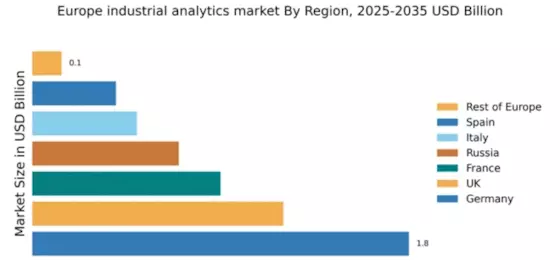

Europe Industrial Analytics Market Regional Image

Key Players and Competitive Insights

The industrial analytics market in Europe is characterized by a dynamic competitive landscape, driven by the increasing demand for data-driven decision-making and operational efficiency. Key players such as Siemens (DE), General Electric (US), and IBM (US) are at the forefront, each adopting distinct strategies to enhance their market positioning. Siemens (DE) focuses on digital transformation and innovation, leveraging its expertise in automation and IoT to provide comprehensive analytics solutions. General Electric (US) emphasizes partnerships and collaborations, particularly in the energy sector, to expand its analytics capabilities. IBM (US) is heavily investing in AI and machine learning technologies, aiming to integrate these advancements into its analytics offerings, thereby enhancing predictive capabilities and operational insights.

The business tactics employed by these companies reflect a concerted effort to optimize supply chains and localize manufacturing processes. The market structure appears moderately fragmented, with a mix of established players and emerging startups. This fragmentation allows for diverse solutions and innovations, although the collective influence of major companies like Siemens (DE) and IBM (US) tends to dominate market trends and customer preferences.

In October 2025, Siemens (DE) announced a strategic partnership with a leading European automotive manufacturer to develop advanced analytics solutions aimed at optimizing production processes. This collaboration is expected to enhance operational efficiency and reduce costs, showcasing Siemens' commitment to driving innovation through strategic alliances. The significance of this partnership lies in its potential to set new benchmarks for productivity in the automotive sector, thereby reinforcing Siemens' position as a leader in industrial analytics.

In September 2025, General Electric (US) launched a new analytics platform designed specifically for the healthcare sector, aimed at improving patient outcomes through data-driven insights. This initiative underscores GE's strategy to diversify its analytics applications beyond traditional industries, tapping into the growing demand for healthcare analytics. The platform's introduction is likely to enhance GE's competitive edge by addressing critical needs in healthcare, thus expanding its market reach.

In August 2025, IBM (US) unveiled a significant upgrade to its Watson Analytics suite, incorporating advanced AI capabilities to enhance data visualization and predictive analytics. This upgrade reflects IBM's ongoing commitment to innovation and its focus on providing cutting-edge solutions to its clients. The strategic importance of this enhancement lies in its potential to attract new customers and retain existing ones by offering superior analytics capabilities that meet evolving market demands.

As of November 2025, the competitive trends in the industrial analytics market are increasingly defined by digitalization, sustainability, and the integration of AI technologies. Strategic alliances among key players are shaping the landscape, fostering innovation and collaboration. Looking ahead, it is anticipated that competitive differentiation will increasingly pivot from price-based strategies to a focus on technological innovation, reliability in supply chains, and the ability to deliver tailored solutions that meet specific industry needs.

Key Companies in the Europe Industrial Analytics Market market include

Industry Developments

In recent months, the Europe Industrial Analytics Market has witnessed significant developments, particularly with companies like Siemens, Rockwell Automation, and Honeywell expanding their offerings in predictive maintenance and operational efficiency through advanced analytics solutions. Siemens announced enhancements to their MindSphere platform in September 2023, aiming to leverage artificial intelligence for better data integration and analytics capabilities. 

PTC unveiled new features in its ThingWorx platform in August 2023, emphasizing the importance of real-time data insights in driving industrial innovation. Notably, in July 2023, SAP revealed a new partnership with Microsoft to optimize supply chain analytics, enhancing operational visibility for businesses across the region. A notable merger occurred in June 2023 when Oracle successfully acquired a European analytics startup, further strengthening its position in the market. 

Over the last two years, the demand for industrial analytics solutions has surged due to increased automation and digital transformation initiatives, particularly in manufacturing and energy sectors. As a result, companies like IBM and GE Digital continue to invest heavily in Research and Development to innovate their analytics capabilities and meet evolving customer demands. The overall growth trajectory forecasts significant market valuation increases, driven by strategic partnerships and technological advancements.


Future Outlook

Europe Industrial Analytics Market Future Outlook

The industrial analytics market is projected to grow at a 4.37% CAGR from 2024 to 2035, driven by advancements in IoT, AI integration, and data-driven decision-making.

New opportunities lie in:

  • Development of predictive maintenance solutions for manufacturing equipment.
  • Implementation of real-time data analytics platforms for supply chain optimization.
  • Creation of customized analytics dashboards for enhanced operational visibility.

By 2035, the market is expected to achieve substantial growth, driven by innovative analytics solutions.

Market Segmentation

Europe Industrial Analytics Market Component Outlook

  • Software
  • Hardware
  • Services

Europe Industrial Analytics Market Application Outlook

  • Predictive Maintenance
  • Supply Chain Management
  • Quality Control
  • Production Optimization

Europe Industrial Analytics Market Deployment Type Outlook

  • On-Premises
  • Cloud-Based
  • Hybrid

Europe Industrial Analytics Market End Use Industry Outlook

  • Manufacturing
  • Energy and Utilities
  • Healthcare
  • Transportation
  • Retail

Report Scope

MARKET SIZE 2024 5.64(USD Billion)
MARKET SIZE 2025 5.89(USD Billion)
MARKET SIZE 2035 9.02(USD Billion)
COMPOUND ANNUAL GROWTH RATE (CAGR) 4.37% (2024 - 2035)
REPORT COVERAGE Revenue Forecast, Competitive Landscape, Growth Factors, and Trends
BASE YEAR 2024
Market Forecast Period 2025 - 2035
Historical Data 2019 - 2024
Market Forecast Units USD Billion
Key Companies Profiled ["Siemens (DE)", "General Electric (US)", "IBM (US)", "Honeywell (US)", "Rockwell Automation (US)", "SAP (DE)", "Microsoft (US)", "Oracle (US)", "PTC (US)"]
Segments Covered Deployment Type, Application, Component, End Use Industry
Key Market Opportunities Integration of artificial intelligence in the industrial analytics market enhances operational efficiency and decision-making.
Key Market Dynamics Rising demand for predictive maintenance solutions drives innovation in the industrial analytics market.
Countries Covered Germany, UK, France, Russia, Italy, Spain, Rest of Europe

Leave a Comment

FAQs

What is the projected market size of the Europe Industrial Analytics Market by 2035?

The Europe Industrial Analytics Market is expected to reach a value of 11.96 USD Billion by 2035.

What was the market size of the Europe Industrial Analytics Market in 2024?

In 2024, the Europe Industrial Analytics Market is valued at 6.37 USD Billion.

What is the expected CAGR for the Europe Industrial Analytics Market from 2025 to 2035?

The expected CAGR for the Europe Industrial Analytics Market from 2025 to 2035 is 5.894 %.

Which region is expected to have the largest market share in the Europe Industrial Analytics Market?

Germany is expected to have the largest market share, valued at 2.0 USD Billion in 2024.

What is the market size of the UK in the Europe Industrial Analytics Market by 2035?

The market size of the UK is projected to reach 3.0 USD Billion by 2035.

Who are the key players in the Europe Industrial Analytics Market?

Key players in the market include Siemens, Oracle, IBM, and SAP.

What will be the market size for Cloud-Based deployment in 2035?

The market size for Cloud-Based deployment is forecasted to reach 4.67 USD Billion by 2035.

What is the expected market growth rate for the France region by 2035?

The France market is expected to grow to 2.25 USD Billion by 2035.

What is the anticipated market size of the On-Premises deployment type by 2024?

The On-Premises deployment type is anticipated to have a market size of 2.54 USD Billion in 2024.

What are the emerging trends driving the growth of the Europe Industrial Analytics Market?

Emerging trends include increased adoption of AI and machine learning for enhanced data analysis.

Download Free Sample

Kindly complete the form below to receive a free sample of this Report

Compare Licence

×
Features License Type
Single User Multiuser License Enterprise User
Price $4,950 $5,950 $7,250
Maximum User Access Limit 1 User Upto 10 Users Unrestricted Access Throughout the Organization
Free Customization
Direct Access to Analyst
Deliverable Format
Platform Access
Discount on Next Purchase 10% 15% 15%
Printable Versions