×
Request Free Sample ×

Kindly complete the form below to receive a free sample of this Report

Leading companies partner with us for data-driven Insights

clients tt-cursor
Hero Background

Europe Industrial Networking Solutions Market

ID: MRFR/ICT/63428-HCR
200 Pages
Aarti Dhapte
October 2025

Europe Industrial Networking Solutions Market Research Report By Component (Technologies, Services), By Application (Remote monitoring, Asset tracking and management, Supply chain management, Real time streaming and video, Emergency and incident management, Predictive maintenance), By Deployment (Cloud, On premises), By Networking type (Wireless networking, Wireline networking) and By Regional (Germany, UK, France, Russia, Italy, Spain, Rest of Europe)- Forecast to 2035

Share:
Download PDF ×

We do not share your information with anyone. However, we may send you emails based on your report interest from time to time. You may contact us at any time to opt-out.

Europe Industrial Networking Solutions Market Infographic
Purchase Options

Europe Industrial Networking Solutions Market Summary

As per MRFR analysis, the industrial networking-solutions market Size was estimated at 5.04 USD Billion in 2024. The industrial networking-solutions market is projected to grow from 5.72 USD Billion in 2025 to 20.18 USD Billion by 2035, exhibiting a compound annual growth rate (CAGR) of 13.44% during the forecast period 2025 - 2035.

Key Market Trends & Highlights

The Europe industrial networking-solutions market is experiencing robust growth driven by technological advancements and increasing demand for automation.

  • Germany remains the largest market for industrial networking solutions, reflecting a strong emphasis on advanced manufacturing technologies.
  • The UK is emerging as the fastest-growing region, propelled by significant investments in smart manufacturing initiatives.
  • There is a notable increase in the integration of IoT technologies, enhancing connectivity and operational efficiency across various sectors.
  • Rising demand for automation and increased investment in infrastructure are key drivers fueling market expansion.

Market Size & Forecast

2024 Market Size 5.04 (USD Billion)
2035 Market Size 20.18 (USD Billion)

Major Players

Cisco Systems (US), Siemens (DE), Rockwell Automation (US), Schneider Electric (FR), Moxa (TW), Hirschmann (DE), Belden (US), Phoenix Contact (DE)

Europe Industrial Networking Solutions Market Trends

The industrial networking-solutions market is currently experiencing a transformative phase, driven by the increasing demand for automation and connectivity across various sectors. As industries strive for enhanced efficiency and productivity, the integration of advanced networking solutions becomes paramount. This shift is particularly evident in manufacturing, where the adoption of IoT devices and smart technologies is reshaping operational frameworks. Furthermore, the emphasis on real-time data exchange and remote monitoring is fostering a more interconnected environment, enabling businesses to respond swiftly to market dynamics. In addition, the regulatory landscape in Europe is evolving, with stricter compliance requirements influencing the adoption of secure networking solutions. Companies are increasingly prioritizing cybersecurity measures to protect sensitive data and maintain operational integrity. This trend is likely to drive innovation within the industrial networking-solutions market, as organizations seek to implement robust systems that not only meet regulatory standards but also enhance overall performance. As the market continues to mature, collaboration among stakeholders, including technology providers and end-users, will be essential in navigating the complexities of this rapidly changing environment.

Increased Focus on Cybersecurity

The industrial networking-solutions market is witnessing a heightened emphasis on cybersecurity. As industries become more interconnected, the risk of cyber threats escalates. Companies are investing in advanced security protocols and solutions to safeguard their networks and data. This trend reflects a broader recognition of the importance of protecting sensitive information in an increasingly digital landscape.

Integration of IoT Technologies

The integration of IoT technologies is reshaping the industrial networking-solutions market. Businesses are leveraging IoT devices to enhance operational efficiency and facilitate real-time data analysis. This trend is particularly relevant in manufacturing, where smart devices enable better monitoring and control of processes, leading to improved productivity and reduced downtime.

Regulatory Compliance and Standards

Regulatory compliance is becoming a critical driver in the industrial networking-solutions market. Stricter regulations are prompting companies to adopt solutions that meet specific standards. This trend not only ensures adherence to legal requirements but also fosters trust among stakeholders, as organizations demonstrate their commitment to maintaining high operational standards.

Europe Industrial Networking Solutions Market Drivers

Rising Demand for Automation

The industrial networking-solutions market in Europe experiences a notable surge in demand for automation technologies. This trend is driven by the need for enhanced operational efficiency and productivity across various sectors, including manufacturing and logistics. As companies strive to optimize their processes, the integration of advanced networking solutions becomes essential. According to recent data, the automation sector in Europe is projected to grow at a CAGR of approximately 8% from 2025 to 2030. This growth is likely to propel the adoption of industrial networking solutions, as businesses seek to implement smart factories and interconnected systems that facilitate real-time data exchange and decision-making. Consequently, the industrial networking-solutions market is poised to benefit significantly from this increasing focus on automation, as organizations invest in technologies that streamline operations and reduce costs.

Emphasis on Energy Efficiency

The industrial networking-solutions market in Europe is increasingly driven by an emphasis on energy efficiency and sustainability. As environmental concerns gain prominence, industries are seeking solutions that not only enhance productivity but also reduce energy consumption. The European Union has set ambitious targets for reducing greenhouse gas emissions, which has prompted companies to adopt energy-efficient technologies. Recent data indicates that the energy efficiency market in Europe is projected to grow at a CAGR of 7% through 2030. This growth is likely to influence the industrial networking-solutions market, as businesses invest in networking solutions that enable better monitoring and management of energy usage. By integrating energy-efficient practices, organizations can achieve cost savings while contributing to sustainability goals, thereby driving demand for advanced industrial networking solutions.

Growing Need for Data Analytics

The industrial networking-solutions market in Europe is increasingly shaped by the growing need for data analytics capabilities. As industries generate vast amounts of data, the ability to analyze and derive insights from this information becomes crucial for maintaining a competitive edge. Companies are investing in networking solutions that enable real-time data collection and analysis, facilitating informed decision-making processes. Recent studies indicate that the data analytics market in Europe is expected to reach €50 billion by 2025, with a significant portion of this growth attributed to industrial applications. This trend suggests that the industrial networking-solutions market will likely experience heightened demand for solutions that support data-driven strategies, as organizations seek to leverage analytics for operational improvements and innovation.

Expansion of Smart Manufacturing

The industrial networking-solutions market in Europe is significantly influenced by the expansion of smart manufacturing initiatives. As industries embrace the concept of Industry 4.0, there is a growing emphasis on interconnected systems that leverage data analytics and real-time monitoring. This shift is expected to drive the demand for robust networking solutions that can support the seamless integration of machines, sensors, and software. Recent statistics indicate that the smart manufacturing market in Europe is anticipated to reach €200 billion by 2026, reflecting a compound annual growth rate (CAGR) of around 10%. This growth underscores the necessity for advanced industrial networking solutions that can facilitate communication and data sharing among various components of the manufacturing ecosystem. Thus, the industrial networking-solutions market stands to gain from the ongoing transformation towards smarter production processes.

Increased Investment in Infrastructure

The industrial networking-solutions market in Europe is witnessing a substantial increase in investment aimed at upgrading and expanding infrastructure. Governments and private entities are recognizing the importance of modernizing industrial networks to support advanced technologies and improve overall efficiency. Recent reports suggest that infrastructure spending in Europe is projected to exceed €500 billion by 2027, with a significant portion allocated to enhancing industrial connectivity. This investment is likely to create opportunities for the industrial networking-solutions market, as companies seek to implement state-of-the-art networking solutions that can accommodate the growing demands of digital transformation. Enhanced infrastructure not only facilitates better communication but also supports the integration of emerging technologies, thereby driving the overall growth of the industrial networking-solutions market.
Market Segment Insights

By Component: Hardware (Largest) vs. Services (Fastest-Growing)

In the Component segment, Hardware maintains a commanding lead, accounting for a significant portion of the market share. This dominance stems from the essential role of physical devices and network infrastructure in ensuring operational efficiency and reliability. Services, while smaller in comparison, are rapidly gaining traction as businesses recognize the value of support, maintenance, and integration in maximizing the potential of their hardware investments. Growth trends in this segment are driven primarily by the increasing demand for robust networking solutions that can accommodate the expanding Internet of Things (IoT) ecosystem. As organizations strive for digital transformation, the need for comprehensive service offerings that complement hardware investments has never been greater, positioning Services as the fastest-growing area in the market.

Hardware: Dominant vs. Services: Emerging

Hardware serves as the cornerstone of the Component segment, providing the necessary infrastructure for efficient networking operations. This offers an array of devices including routers, switches, and gateways, which are vital for communication within industrial environments. On the other hand, Services represent a significant emerging value, focusing on installation, maintenance, and support. These services facilitate seamless integration of advanced networking solutions, enabling businesses to enhance operational readiness and minimize downtime. The interplay between Hardware and Services is crucial, as the latter enhances the functionality of Hardware, driving an ecosystem that supports innovation and adaptability in the marketplace.

By Applications: Remote Monitoring (Largest) vs. Predictive Maintenance (Fastest-Growing)

In the market for industrial networking solutions, Remote Monitoring emerges as the largest application segment, showcasing significant market share due to its extensive use in real-time data collection and operational oversight. Following closely, Predictive Maintenance is gaining traction rapidly, appealing to industries aiming to preemptively address equipment failures and reduce downtime. Other segments like Asset Tracking and Management, Real-Time Diagnostics and Repair, and Supply Chain Management hold important roles, but they are not growing at the same pace as the leading applications. Growth trends indicate a shift towards more integrated and automated solutions, with organizations prioritizing efficiency and data-driven decision making. The increasing demand for IoT devices is propelling the Remote Monitoring sector, while Predictive Maintenance is being accelerated by advancements in AI and machine learning. Furthermore, regulatory compliance and the need for sustainability are driving investments in Asset Tracking and Supply Chain Management, ensuring that these solutions remain relevant in a competitive landscape.

Remote Monitoring (Dominant) vs. Predictive Maintenance (Emerging)

Remote Monitoring stands as a dominant application segment within the industrial networking solutions sphere, characterized by its ability to oversee processes from a distance, ensuring optimal operations and minimizing risks of equipment failure. This application is highly valued for its capacity to deliver real-time insights, allowing businesses to react swiftly to potential issues. On the other hand, Predictive Maintenance is emerging as a crucial player, leveraging analytics and machine learning to forecast equipment failures before they occur. This preventive approach not only facilitates cost savings but also enhances operational efficiency, leading to increased reliance on such systems. As Europe moves towards Industry 4.0, both segments are likely to see continued focus, with Remote Monitoring serving as the backbone for operational visibility and Predictive Maintenance driving innovation in maintenance practices.

By Deployment: Cloud (Largest) vs. On Premises (Fastest-Growing)

In the Deployment segment, Cloud solutions lead the distribution spectrum, characterized by a significant demand across various industrial sectors. Many organizations are rapidly adopting Cloud-based networking solutions due to their scalability and flexibility, diversifying the market landscape to accommodate evolving technological needs. On the other hand, On Premises solutions are witnessing a surge in growth, driven by industries that prioritize data security and regulatory compliance. This segment is gaining traction as more businesses look for tailored networking solutions that provide control over their infrastructure and meet specific operational requirements.

Deployment: Cloud (Dominant) vs. On Premises (Emerging)

Cloud solutions dominate the Deployment segment, offering unparalleled scalability, ease of integration, and enhanced collaboration for businesses across sectors. They are increasingly favored due to lower upfront costs and the ability to access advanced technologies without substantial investments. Conversely, On Premises solutions are classified as emerging in this landscape, appealing to sectors with stringent data protection requirements. While these solutions demand higher initial investments and maintenance overhead, their appeal lies in the complete control and customization they provide, enabling organizations to closely align their networking infrastructure with strategic goals and compliance needs.

By Networking: Wireless Networking (Largest) vs. Wireline Networking (Fastest-Growing)

In the Europe industrial networking-solutions market, Wireless Networking currently holds the largest market share, driven by rapid advancements in wireless technologies and the increasing need for flexibility in industrial operations. This segment appeals to numerous industries due to its capability to reduce installation costs and enhance connectivity across a variety of environments. Conversely, Wireline Networking is gaining traction as industrial facilities seek reliable, high-speed connections to support critical applications and large data transfers, establishing itself as a vital component in the networking landscape. Growth trends within the networking segment are being propelled by the urgent need for enhanced connectivity, particularly with the rising adoption of IoT and Industry 4.0 technologies. Companies are investing in upgrading their infrastructures to ensure seamless communication and data flow. Furthermore, the emphasis on digital transformation across industries is pushing the demand for both Wireless and Wireline Networking solutions, allowing for more efficient operations and improved productivity.

Wireless Networking (Dominant) vs. Wireline Networking (Emerging)

Wireless Networking is characterized by its vast adaptability and ease of deployment in industrial setups, making it the dominant choice for companies looking to enhance operational efficiency. It supports a wide range of applications, including remote monitoring and control, thereby reducing downtime and improving productivity. On the other hand, Wireline Networking is emerging as a crucial player, providing stable and high-bandwidth connections that are essential for data-heavy applications in environments where reliability is non-negotiable. As industries continue to evolve, both segments will play essential roles, with Wireless Networking focusing on flexibility and mobility, while Wireline Networking addresses the need for robust, uninterrupted connectivity.

Get more detailed insights about Europe Industrial Networking Solutions Market

Regional Insights

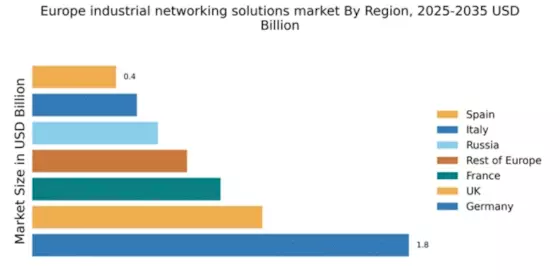
The Europe Industrial Networking Solutions Market is witnessing robust growth driven by advancements in automation and the increasing integration of smart technologies across industries. Key countries such as Germany and the UK are at the forefront, with Germany dominating due to its strong automotive and manufacturing sectors, while the UK is investing significantly in Industry 4.0 initiatives. France also plays a crucial role in this market, leveraging its established industrial base to enhance networking solutions. Meanwhile, Russia presents opportunities with its growing focus on the modernization of industrial infrastructure.

Italy and Spain contribute with their unique market dynamics, reflecting both traditional industries and emerging technology sectors. The Rest of Europe, comprising various smaller economies, enhances the market diversity by adopting innovative networking solutions tailored to local industrial needs. The increasing emphasis on digital transformation in operational processes across these nations is driving demand for advanced networking technologies, presenting significant opportunities while also posing challenges related to cybersecurity. Overall, the Europe Industrial Networking Solutions Market segmentation clearly highlights a diverse regional landscape with varying growth potentials and industry needs.

Europe Industrial Networking Solutions Market Regional Image

Key Players and Competitive Insights

The industrial networking-solutions market in Europe is characterized by a dynamic competitive landscape, driven by rapid technological advancements and increasing demand for automation across various sectors. Key players such as Cisco Systems (US), Siemens (DE), and Schneider Electric (FR) are at the forefront, each adopting distinct strategies to enhance their market positioning. Cisco Systems (US) focuses on innovation through the development of advanced networking solutions that integrate seamlessly with IoT technologies, while Siemens (DE) emphasizes regional expansion and digital transformation initiatives to bolster its presence in the industrial sector. Schneider Electric (FR) is actively pursuing partnerships to enhance its sustainability offerings, indicating a collective shift towards environmentally conscious solutions that shape the competitive environment.

In terms of business tactics, companies are increasingly localizing manufacturing and optimizing supply chains to enhance operational efficiency. The market structure appears moderately fragmented, with a mix of established players and emerging companies vying for market share. The collective influence of these key players fosters a competitive atmosphere where innovation and strategic collaborations are paramount.

In October 2025, Cisco Systems (US) announced a strategic partnership with a leading European telecommunications provider to enhance its IoT capabilities. This collaboration is expected to facilitate the deployment of next-generation networking solutions, thereby strengthening Cisco's foothold in the European market. The strategic importance of this partnership lies in its potential to accelerate the adoption of IoT technologies across various industries, positioning Cisco as a leader in this rapidly evolving landscape.

In September 2025, Siemens (DE) unveiled a new digital platform aimed at optimizing industrial processes through advanced analytics and AI integration. This initiative underscores Siemens' commitment to digital transformation, enabling clients to achieve greater operational efficiency and reduce downtime. The introduction of this platform is likely to enhance Siemens' competitive edge by providing clients with innovative tools to navigate the complexities of modern industrial environments.

In August 2025, Schneider Electric (FR) launched a sustainability initiative focused on reducing carbon emissions in industrial operations. This initiative not only aligns with global sustainability goals but also positions Schneider as a frontrunner in providing eco-friendly solutions. The strategic importance of this move is evident in its potential to attract environmentally conscious clients, thereby expanding Schneider's market reach and reinforcing its commitment to sustainable practices.

As of November 2025, current competitive trends in the industrial networking-solutions market are heavily influenced by digitalization, sustainability, and AI integration. Strategic alliances are increasingly shaping the landscape, enabling companies to leverage complementary strengths and enhance their offerings. Looking ahead, competitive differentiation is likely to evolve from traditional price-based competition to a focus on innovation, technology, and supply chain reliability. This shift suggests that companies that prioritize these aspects will be better positioned to thrive in an increasingly complex and competitive environment.

Key Companies in the Europe Industrial Networking Solutions Market market include

Industry Developments

In recent months, the Europe Industrial Networking Solutions Market has witnessed significant developments. Companies such as Siemens and Rockwell Automation are expanding their portfolio to support increased automation and digitalization in industries, caused largely by the rising demand for Industry 4.0 solutions. Sierra Wireless announced an upgrade to its IoT modules, enhancing connectivity in industrial applications while improving security features as firms increasingly focus on cyber resilience. Additionally, there has been noticeable growth in market valuations across various segments driven by technological advancements and heightened investments in smart manufacturing.

In terms of mergers and acquisitions, Schneider Electric has made headlines with its acquisition of a smart factory solutions provider in June 2023, aimed at strengthening its position in the Industrial Internet of Things. Similarly, in September 2023, Emerson Electric acquired a leading network solutions firm to bolster its offerings in industrial software and connectivity solutions. Over the past two to three years, developments such as the increasing adoption of cloud-based solutions and the implementation of 5G technology have reshaped the industrial networking landscape in Europe, impacting operational efficiency and decision-making processes across sectors.

Future Outlook

Europe Industrial Networking Solutions Market Future Outlook

The industrial networking-solutions market is projected to grow at 13.44% CAGR from 2024 to 2035, driven by advancements in IoT, automation, and increased connectivity demands.

New opportunities lie in:

  • Development of AI-driven predictive maintenance solutions
  • Expansion of secure remote access technologies for industrial applications
  • Integration of edge computing with existing networking infrastructures

By 2035, the market is expected to achieve robust growth, driven by innovation and increased demand.

Market Segmentation

Europe Industrial Networking Solutions Market Component Outlook

  • Hardware
  • Services

Europe Industrial Networking Solutions Market Deployment Outlook

  • Cloud
  • On Premises

Europe Industrial Networking Solutions Market Networking Outlook

  • Wireless networking
  • Wireline networking

Europe Industrial Networking Solutions Market Applications Outlook

  • Remote monitoring
  • Asset tracking and management
  • Real-time diagnostics and repair
  • Supply chain management
  • Predictive maintenance
  • Emergency & incident management

Report Scope

MARKET SIZE 2024 5.04(USD Billion)
MARKET SIZE 2025 5.72(USD Billion)
MARKET SIZE 2035 20.18(USD Billion)
COMPOUND ANNUAL GROWTH RATE (CAGR) 13.44% (2024 - 2035)
REPORT COVERAGE Revenue Forecast, Competitive Landscape, Growth Factors, and Trends
BASE YEAR 2024
Market Forecast Period 2025 - 2035
Historical Data 2019 - 2024
Market Forecast Units USD Billion
Key Companies Profiled ["Cisco Systems (US)", "Siemens (DE)", "Rockwell Automation (US)", "Schneider Electric (FR)", "Moxa (TW)", "Hirschmann (DE)", "Belden (US)", "Phoenix Contact (DE)"]
Segments Covered Component, Applications, Deployment, Networking
Key Market Opportunities Integration of advanced cybersecurity measures in the industrial networking-solutions market enhances operational resilience and compliance.
Key Market Dynamics Rising demand for secure, high-speed connectivity drives innovation in industrial networking solutions across Europe.
Countries Covered Germany, UK, France, Russia, Italy, Spain, Rest of Europe

Leave a Comment

FAQs

What is the projected market size of the Europe Industrial Networking Solutions Market in 2024?

The Europe Industrial Networking Solutions Market is projected to be valued at 4.2 USD Billion in 2024.

What will the market size reach by 2035?

By 2035, the Europe Industrial Networking Solutions Market is expected to reach a value of 32.25 USD Billion.

What is the expected CAGR for the Europe Industrial Networking Solutions Market from 2025 to 2035?

The expected CAGR for the Europe Industrial Networking Solutions Market from 2025 to 2035 is 20.359%.

Which region is expected to have the largest market share in 2024?

Germany is expected to have the largest market share with a valuation of 1.05 USD Billion in 2024.

What is the projected value of the market in the UK by 2035?

The projected value of the market in the UK is expected to reach 6.76 USD Billion by 2035.

Who are the key players in the Europe Industrial Networking Solutions Market?

Key players in the market include Siemens, Cisco Systems, and Rockwell Automation among others.

What is the market size of the Technologies segment in 2024?

The Technologies segment of the Europe Industrial Networking Solutions Market is valued at 2.04 USD Billion in 2024.

What value is expected for the Services segment by 2035?

The Services segment is anticipated to reach 16.55 USD Billion by 2035.

What challenges does the Europe Industrial Networking Solutions Market face?

The market faces challenges such as cybersecurity threats and the need for integration with legacy systems.

How much is the market expected to grow in France from 2024 to 2035?

The market in France is expected to grow from 0.65 USD Billion in 2024 to 5.42 USD Billion in 2035.

Download Free Sample

Kindly complete the form below to receive a free sample of this Report

Compare Licence

×
Features License Type
Single User Multiuser License Enterprise User
Price $4,950 $5,950 $7,250
Maximum User Access Limit 1 User Upto 10 Users Unrestricted Access Throughout the Organization
Free Customization
Direct Access to Analyst
Deliverable Format
Platform Access
Discount on Next Purchase 10% 15% 15%
Printable Versions