×
Request Free Sample ×

Kindly complete the form below to receive a free sample of this Report

* Please use a valid business email

Leading companies partner with us for data-driven Insights

clients tt-cursor
Hero Background

Europe KVM Market

ID: MRFR/SEM/55608-HCR
200 Pages
Aarti Dhapte
October 2025

Europe KVM Market Research Report By Type (Digital KVM Matrix System, Analog KVM Matrix System), By Product (KVM Switch, KVM Extender, KVM Matrix Manager, Others), By Control (USB, Ethernet, RS-232, Infrared, RS-485, Others), By Vertical (IT & Telecommunication, Broadcasting, Government, Aerospace & Defense, BFSI, Aviation), and By Regional (Germany, UK, France, Russia, Italy, Spain, Rest of Europe) - Forecast to 2035

Share:
Download PDF ×

We do not share your information with anyone. However, we may send you emails based on your report interest from time to time. You may contact us at any time to opt-out.

Europe KVM Market Infographic
Purchase Options

Europe KVM Market Summary

As per MRFR analysis, the kvm market Size was estimated at 225.0 USD Million in 2024. The kvm market is projected to grow from 261.72 USD Million in 2025 to 1186.84 USD Million by 2035, exhibiting a compound annual growth rate (CAGR) of 16.32% during the forecast period 2025 - 2035.

Key Market Trends & Highlights

The Europe KVM Market is experiencing robust growth driven by virtualization and remote work solutions.

  • Germany remains the largest market for KVM solutions, reflecting a strong demand for advanced IT infrastructure.
  • The UK is emerging as the fastest-growing region, indicating a shift towards innovative remote work technologies.
  • There is a notable emphasis on data security and compliance, as organizations prioritize safeguarding sensitive information.
  • The increasing adoption of cloud computing and the growing need for remote work solutions are key drivers propelling market expansion.

Market Size & Forecast

2024 Market Size 225.0 (USD Million)
2035 Market Size 1186.84 (USD Million)
CAGR (2025 - 2035) 16.32%

Major Players

Raritan (US), ATEN International Co Ltd (TW), Tripp Lite (US), Schneider Electric (FR), Belkin International Inc (US), StarTech.com (CA), IOGEAR (US), Avocent (US), Black Box Corporation (US)

Europe KVM Market Trends

The kvm market in Europe is currently experiencing a notable evolution, driven by the increasing demand for efficient data management solutions. Organizations across various sectors are recognizing the necessity of robust infrastructure to support their operations. This trend is likely influenced by the growing reliance on virtualization technologies, which facilitate the management of multiple servers through a single interface. As businesses strive for operational efficiency, the adoption of kvm solutions appears to be gaining momentum, suggesting a shift towards more integrated and streamlined IT environments. Moreover, the regulatory landscape in Europe is evolving, with stricter data protection laws prompting organizations to invest in secure and compliant kvm solutions. This regulatory pressure may lead to an uptick in demand for advanced kvm technologies that ensure data integrity and security. Additionally, the increasing focus on sustainability and energy efficiency within the IT sector could further drive innovation in the kvm market. As companies seek to reduce their carbon footprint, energy-efficient kvm solutions may become a priority, indicating a potential shift in purchasing behavior among European enterprises.

Rising Demand for Virtualization Solutions

The kvm market is witnessing a surge in demand for virtualization technologies. Organizations are increasingly adopting these solutions to optimize resource utilization and enhance operational efficiency. This trend reflects a broader shift towards cloud computing and remote management capabilities.

Focus on Data Security and Compliance

With the tightening of data protection regulations in Europe, there is a heightened emphasis on security within the kvm market. Companies are prioritizing solutions that ensure compliance with legal standards, thereby driving innovation in secure kvm technologies.

Sustainability and Energy Efficiency Initiatives

The growing awareness of environmental issues is influencing purchasing decisions in the kvm market. Organizations are seeking energy-efficient solutions that not only reduce operational costs but also align with sustainability goals, indicating a shift towards greener technologies.

Europe KVM Market Drivers

Growing Need for Remote Work Solutions

The kvm market in Europe is significantly influenced by the growing need for remote work solutions. As organizations adapt to flexible work arrangements, the demand for technologies that support remote access to virtual machines has escalated. KVM solutions enable employees to access their work environments securely from any location, which is crucial for maintaining productivity. Recent statistics indicate that approximately 30% of the European workforce is now engaged in remote work, a trend that is expected to persist. This shift necessitates reliable and efficient KVM technologies, thereby driving growth in the kvm market. Companies are increasingly investing in these solutions to ensure seamless connectivity and collaboration among remote teams.

Increasing Adoption of Cloud Computing

The kvm market in Europe is experiencing a notable surge due to the increasing adoption of cloud computing solutions. Organizations are increasingly migrating their operations to the cloud, which necessitates robust virtualization technologies. This trend is driven by the need for scalability, flexibility, and cost-effectiveness. According to recent data, the cloud computing market in Europe is projected to grow at a CAGR of 20% from 2023 to 2028. As businesses seek to optimize their IT infrastructure, the demand for KVM solutions that facilitate seamless cloud integration is likely to rise. This shift not only enhances operational efficiency but also aligns with the broader digital transformation initiatives across various sectors, thereby propelling the kvm market in Europe.

Regulatory Compliance and Data Governance

The kvm market in Europe is significantly impacted by regulatory compliance and data governance requirements. With stringent regulations such as GDPR in place, organizations are compelled to adopt technologies that ensure data protection and compliance. KVM solutions play a crucial role in facilitating secure data management and virtualization, thereby helping businesses adhere to regulatory standards. Recent surveys indicate that over 50% of European companies prioritize compliance in their IT strategies, leading to increased investments in KVM technologies. This focus on regulatory adherence not only mitigates risks but also enhances organizational reputation, thereby driving growth in the kvm market. As compliance requirements evolve, the demand for advanced KVM solutions is likely to increase.

Enhanced Demand for High-Performance Computing

The kvm market in Europe is witnessing enhanced demand for high-performance computing (HPC) solutions. As industries such as finance, healthcare, and research increasingly rely on data-intensive applications, the need for robust virtualization technologies becomes paramount. KVM solutions are well-suited for HPC environments, offering the necessary performance and scalability. Recent analyses indicate that the HPC market in Europe is expected to grow by 15% annually over the next five years. This growth is likely to drive the adoption of KVM technologies that can efficiently manage and allocate resources in high-demand scenarios. As organizations strive to leverage data for competitive advantage, the kvm market is positioned to capitalize on this trend.

Rising Focus on IT Infrastructure Modernization

The kvm market in Europe is being propelled by a rising focus on IT infrastructure modernization. Organizations are recognizing the importance of upgrading their legacy systems to enhance performance and security. The modernization efforts often involve the integration of KVM solutions, which provide efficient virtualization capabilities. Data suggests that nearly 40% of European enterprises are currently engaged in IT infrastructure upgrades, with a significant portion allocating budgets specifically for virtualization technologies. This trend is indicative of a broader movement towards adopting advanced technologies that can support business agility and innovation. Consequently, the kvm market is likely to benefit from this ongoing transformation as companies seek to optimize their IT environments.
Market Segment Insights

By Type: Digital KVM Matrix System (Largest) vs. Analog KVM Matrix System (Fastest-Growing)

In the Europe kvm market, the Digital KVM Matrix System holds a significant portion of the market share, proving itself as the dominant technology in this segment. It is widely adopted across various industries due to its scalability and ability to handle high-definition content. On the other hand, the Analog KVM Matrix System, although smaller in market share, is witnessing an increase in adoption driven by specific use cases that require straightforward, cost-effective solutions. The growth trends in this segment are heavily influenced by the advancement in digital technologies and the increasing need for efficient IT management solutions. The Digital KVM Matrix System is being pushed by the demand for higher resolutions and more expansive connectivity options, while the Analog KVM Matrix System benefits from markets focusing on legacy systems. The shift in consumer preferences towards integrated digital systems suggests a dynamic market landscape where both segments can thrive under different circumstances.

KVM Type: Digital (Dominant) vs. Analog (Emerging)

The Digital KVM Matrix System is recognized for its advanced features such as support for IP-based management, enhanced security, and compatibility with modern devices, making it a superior choice for organizations looking to future-proof their IT infrastructure. This system allows for centralized control of multiple computers, thereby improving efficiency and accessibility. Conversely, the Analog KVM Matrix System caters to more traditional setups where legacy support is critical. Despite being viewed as less advanced, it continues to find relevance in environments where cost constraints are paramount, providing reliable performance for basic operations. Hence, while the Digital KVM system leads in innovation and market share, the Analog variant serves as a crucial fallback for specific applications.

By Product: KVM Switch (Largest) vs. KVM Extender (Fastest-Growing)

In the Europe kvm market, KVM Switches currently hold the largest market share, reflecting a significant preference among users for centralized control of multiple servers. KVM Extenders, while not as dominant in terms of market share, are rapidly gaining traction due to their ability to enhance flexibility and workspace ergonomics. The demand for efficient remote management solutions is a key factor in their increasing popularity. The growth trends in this segment are driven by the rising adoption of cloud-based services and the increasing need for efficient data center management. As enterprises continue to invest in technology that optimizes their operational capabilities, the KVM Extender segment is likely to outpace others. Innovations in KVM technology, coupled with the proliferation of high-definition display standards, are further propelling market expansion.

KVM Switch (Dominant) vs. KVM Matrix Manager (Emerging)

KVM Switches dominate the market due to their established presence and versatility, allowing users to manage multiple computers through a single keyboard, video monitor, and mouse setup. They are highly valued in environments where multiple server management is crucial, such as data centers and IT infrastructure. On the other hand, KVM Matrix Managers are emerging as innovative products that facilitate complex switching and routing of video and data to multiple locations from a range of input sources. They are gaining attention for their ability to streamline workflows in professional settings, especially in broadcasting and large enterprise environments.

By Control: USB (Largest) vs. Ethernet (Fastest-Growing)

In the Control segment, USB holds the largest market share, benefiting from its widespread adoption across various applications due to its ease of use and compatibility. Ethernet follows, showcasing a significant portion of the market as well, especially within networking solutions that require robust connectivity. Other segment values like RS-232, Infrared, RS-485, and Others contribute to the overall dynamics, with their unique applications catering to specific industrial needs. Growth trends indicate that while USB remains a staple, Ethernet is rapidly gaining traction as industries adopt more networked solutions, integrating KVM over IP functionalities. The push for automation and improved remote management capabilities further drives the adoption of Ethernet, positioning it as the fastest-growing within the segment. Such shifts reflect the evolving technological landscape where seamless connectivity is paramount.

USB (Dominant) vs. RS-232 (Emerging)

USB technology is characterized by its universal applicability and ease of integration, making it the dominant choice for control mechanisms in the KVM landscape. Its versatility supports various devices, creating a strong market position. Conversely, RS-232 is emerging as a valuable choice for legacy systems requiring reliable, long-distance serial communication. Although its adoption is slower compared to USB, it caters specifically to environments where legacy compatibility is critical. The characteristic stability and simplicity of RS-232 make it an appealing option for industries slowly transitioning towards modern solutions.

By Vertical: IT & Telecommunication (Largest) vs. Broadcasting (Fastest-Growing)

In the KVM market, the vertical segment is witnessing diverse distribution, with IT & Telecommunication holding the largest market share, significantly influencing the overall dynamics. This sector's extensive demand is primarily driven by the growing reliance on cloud services and the need for efficient data management. Broadcasting follows closely as a pivotal sector, gaining traction due to the rising need for integrated broadcasting solutions and remote content delivery systems. Growth trends indicate a robust upward trajectory for the broadcasting sector as technological advancements fuel the demand for innovative KVM solutions. The surge in remote work and content creation demands effective KVM systems that enhance workflow efficiency. Moreover, governmental and defense applications are evolving, driving investments in KVM technologies for better security and reliable performance, thus supporting an expanding market base.

IT & Telecommunication: Dominant vs. Broadcasting: Emerging

The IT & Telecommunication vertical stands out as the dominant player in the KVM market, characterized by its vast infrastructure, advanced technology adoption, and a significant necessity for high-performance computing systems. This sector encompasses a variety of applications, ranging from network management to cloud computing, making it integral to operational success. In contrast, the Broadcasting segment is emerging with its innovative approaches, particularly in live streaming and remote production, rapidly catching up with IT & Telecommunication. The shift towards agile and scalable broadcasting solutions reflects a response to consumer demands, thereby creating opportunities for KVM systems that are adaptable and cost-efficient. As competition heightens, both segments are set to influence future growth trajectories in diverse and dynamic ways.

Get more detailed insights about Europe KVM Market

Regional Insights

Germany : Strong Demand and Infrastructure Growth

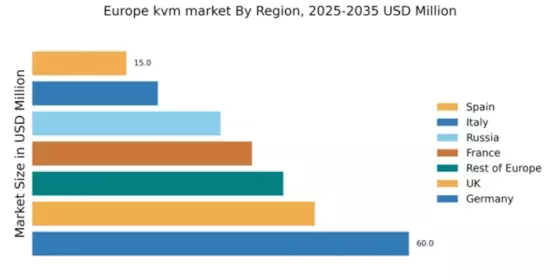
Germany holds a commanding 60.0% market share in the KVM sector, driven by robust industrial growth and technological advancements. Key growth drivers include the increasing adoption of virtualization technologies and the demand for efficient data center management. Government initiatives promoting digital transformation and investments in IT infrastructure further bolster market expansion. The regulatory environment supports innovation, ensuring compliance with data protection laws and enhancing consumer confidence.

UK : Innovation and Competitive Edge

The UK KVM market accounts for 45.0% of the European share, fueled by a strong emphasis on innovation and technology adoption. Demand is driven by the growing need for remote management solutions and the rise of cloud computing. Regulatory frameworks encourage investment in cybersecurity, enhancing the market's appeal. The UK's advanced infrastructure supports a thriving tech ecosystem, making it a hub for KVM solutions.

France : Growth in Tech Adoption

France captures 35.0% of the KVM market, with growth propelled by increasing digitalization across various sectors. The demand for KVM solutions is rising, particularly in finance and telecommunications, where efficient data management is crucial. Government policies promoting innovation and sustainability are key growth drivers. The French market benefits from a well-established IT infrastructure, facilitating the deployment of advanced KVM technologies.

Russia : Infrastructure Development and Demand

Russia holds a 30.0% market share in the KVM sector, with growth driven by significant investments in IT infrastructure and data centers. The demand for KVM solutions is increasing, particularly in the public sector and large enterprises. Government initiatives aimed at enhancing digital capabilities are pivotal. The competitive landscape features both local and international players, fostering innovation and market growth.

Italy : Growing Demand in Key Sectors

Italy's KVM market represents 20.0% of the European share, with growth fueled by the increasing need for efficient data management in sectors like manufacturing and retail. The demand for KVM solutions is supported by government initiatives promoting digital transformation. The competitive landscape includes both established players and emerging startups, contributing to a dynamic market environment.

Spain : Focus on Digital Transformation

Spain accounts for 15.0% of the KVM market, with growth driven by the rising adoption of cloud services and remote management solutions. Demand is particularly strong in the healthcare and education sectors, where efficient data handling is essential. Government policies supporting digital innovation are crucial for market expansion. The competitive landscape features both local and international companies, enhancing market dynamics.

Rest of Europe : Varied Demand Across Regions

The Rest of Europe holds a 40.0% market share in the KVM sector, characterized by diverse demand across different countries. Growth is driven by varying levels of digital adoption and infrastructure development. Regulatory policies differ, impacting market dynamics. Key players are expanding their reach, catering to local needs and preferences, which fosters a competitive environment across the region.

Europe KVM Market Regional Image

Key Players and Competitive Insights

The kvm market exhibits a dynamic competitive landscape characterized by rapid technological advancements and increasing demand for efficient data management solutions. Key growth drivers include the rising need for remote access and control of IT infrastructure, alongside the growing trend of digital transformation across various sectors. Major players such as Raritan (US), ATEN International Co Ltd (TW), and Schneider Electric (FR) are strategically positioned to leverage these trends. Raritan (US) focuses on innovation in power management and environmental monitoring, while ATEN International Co Ltd (TW) emphasizes expanding its product portfolio to include advanced KVM over IP solutions. Schneider Electric (FR) is enhancing its operational focus on sustainability and energy efficiency, which collectively shapes a competitive environment that prioritizes technological innovation and customer-centric solutions.

Key business tactics within the kvm market include localizing manufacturing to reduce costs and optimize supply chains, which is particularly relevant in the context of fluctuating global trade dynamics. The market structure appears moderately fragmented, with several key players exerting influence over specific segments. This fragmentation allows for niche players to thrive, while larger companies consolidate their market positions through strategic partnerships and acquisitions.

In September 2025, Raritan (US) announced the launch of its latest KVM switch, which integrates advanced AI capabilities for predictive analytics in data center management. This strategic move is likely to enhance operational efficiency for clients, positioning Raritan as a leader in innovation within the market. The integration of AI not only streamlines operations but also aligns with the growing trend of digital transformation, suggesting a forward-thinking approach to customer needs.

In October 2025, ATEN International Co Ltd (TW) expanded its European distribution network by partnering with several local IT service providers. This strategic action aims to enhance product accessibility and support for customers across the region. By localizing its distribution, ATEN may improve its market penetration and responsiveness to customer demands, thereby strengthening its competitive position.

In August 2025, Schneider Electric (FR) unveiled a new sustainability initiative aimed at reducing the carbon footprint of its KVM solutions by 30% by 2027. This initiative reflects a broader industry trend towards sustainability, indicating that Schneider is not only focused on technological advancements but also on environmental responsibility. Such initiatives may resonate well with environmentally conscious consumers and businesses, potentially enhancing brand loyalty and market share.

As of November 2025, current competitive trends in the kvm market are heavily influenced by digitalization, sustainability, and the integration of AI technologies. Strategic alliances are increasingly shaping the landscape, allowing companies to pool resources and expertise to drive innovation. The competitive differentiation appears to be shifting from traditional price-based competition to a focus on technological innovation, reliability, and sustainable practices. This evolution suggests that companies that prioritize these aspects may be better positioned to thrive in the future.

Key Companies in the Europe KVM Market market include

Industry Developments

The Europe KVM Market has seen significant activity recently, particularly with major players like Google Cloud, IBM, and AWS expanding their services to meet increasing demand for cloud solutions. In October 2023, DigitalOcean announced enhancements to its infrastructure services aimed at small and medium-sized businesses in Europe, demonstrating a focus on localized support.

Furthermore, in June 2023, Oracle expanded its cloud infrastructure in Europe which is expected to enhance its competitiveness against regional providers. Noteworthy mergers include VMware's acquisition of a regional cybersecurity firm in March 2023, reflecting its strategy to bolster security in its cloud offerings.

The market has been fueled by an overall growth projection, with data showing an increase in the valuation of European KVM providers driven by the rising trend of remote work and hybrid cloud solutions. Citrix and Nutanix are also focusing on partnerships with telecommunication companies to improve service delivery across Europe.

Over the past two to three years, significant advancements in virtualization technology have been achieved, particularly by pro-active companies like Proxmox and Microsoft, leading to enhanced operational efficiencies within European organizations.

Future Outlook

Europe KVM Market Future Outlook

The KVM market is projected to grow at a 16.32% CAGR from 2024 to 2035, driven by increasing demand for efficient data center management and remote access solutions.

New opportunities lie in:

  • Development of advanced KVM over IP solutions for remote management.
  • Integration of AI-driven analytics for performance optimization.
  • Expansion into emerging markets with tailored KVM solutions.

By 2035, the KVM market is expected to achieve substantial growth, reflecting evolving technological demands.

Market Segmentation

Europe KVM Market Type Outlook

  • Digital KVM Matrix System
  • Analog KVM Matrix System

Europe KVM Market Control Outlook

  • USB
  • Ethernet
  • RS-232
  • Infrared
  • RS-485
  • Others

Europe KVM Market Product Outlook

  • KVM Switch
  • KVM Extender
  • KVM Matrix Manager
  • Others

Europe KVM Market Vertical Outlook

  • IT & Telecommunication
  • Broadcasting
  • Government
  • Aerospace & Defense
  • BFSI
  • Aviation

Report Scope

MARKET SIZE 2024225.0(USD Million)
MARKET SIZE 2025261.72(USD Million)
MARKET SIZE 20351186.84(USD Million)
COMPOUND ANNUAL GROWTH RATE (CAGR)16.32% (2024 - 2035)
REPORT COVERAGERevenue Forecast, Competitive Landscape, Growth Factors, and Trends
BASE YEAR2024
Market Forecast Period2025 - 2035
Historical Data2019 - 2024
Market Forecast UnitsUSD Million
Key Companies Profiled["Raritan (US)", "ATEN International Co Ltd (TW)", "Tripp Lite (US)", "Schneider Electric (FR)", "Belkin International Inc (US)", "StarTech.com (CA)", "IOGEAR (US)", "Avocent (US)", "Black Box Corporation (US)"]
Segments CoveredType, Product, Control, Vertical
Key Market OpportunitiesIntegration of advanced virtualization technologies enhances efficiency in the kvm market.
Key Market DynamicsRising demand for advanced KVM solutions driven by regulatory compliance and technological innovation in Europe.
Countries CoveredGermany, UK, France, Russia, Italy, Spain, Rest of Europe

Leave a Comment

FAQs

What is the current market size of the Europe KVM Market for 2024?

The Europe KVM Market is expected to be valued at 300.0 USD Million in 2024.

What is the projected market size of the Europe KVM Market by 2035?

By 2035, the Europe KVM Market is projected to reach a value of 1573.04 USD Million.

What is the expected CAGR for the Europe KVM Market from 2025 to 2035?

The expected compound annual growth rate (CAGR) for the Europe KVM Market from 2025 to 2035 is 16.257%.

Which region holds the largest market share in the Europe KVM Market in 2024?

Germany is expected to hold the largest market share in the Europe KVM Market with a value of 90.0 USD Million in 2024.

What is the market size for Digital KVM Matrix System in 2024?

The market size for the Digital KVM Matrix System is anticipated to be 180.0 USD Million in 2024.

What is the future market size for Analog KVM Matrix System by 2035?

The Analog KVM Matrix System market size is projected to reach 670.0 USD Million by 2035.

Who are the key players in the Europe KVM Market?

Major players in the Europe KVM Market include Google Cloud, IBM, DigitalOcean, Alibaba Cloud, Oracle, and Microsoft.

What is the expected market growth rate for the UK in the Europe KVM Market by 2035?

The UK market is expected to grow to 300.0 USD Million by 2035.

What are the challenges and opportunities currently facing the Europe KVM Market?

The Europe KVM Market faces challenges such as competition and technological changes while offering opportunities for growth driven by digital transformation.

What implications do current global scenarios have on the Europe KVM Market?

Current global scenarios may affect supply chains and investment in the Europe KVM Market, impacting growth trajectories.

Download Free Sample

Kindly complete the form below to receive a free sample of this Report

Compare Licence

×
Features License Type
Single User Multiuser License Enterprise User
Price $4,950 $5,950 $7,250
Maximum User Access Limit 1 User Upto 10 Users Unrestricted Access Throughout the Organization
Free Customization
Direct Access to Analyst
Deliverable Format
Platform Access
Discount on Next Purchase 10% 15% 15%
Printable Versions