×
Request Free Sample ×

Kindly complete the form below to receive a free sample of this Report

Leading companies partner with us for data-driven Insights

clients tt-cursor
Hero Background

Europe Micro Learning Market

ID: MRFR/ICT/58859-HCR
200 Pages
Aarti Dhapte
October 2025

Europe Micro Learning Market Research Report By Application (Corporate Training, Academic Learning, Personal Development, Compliance Training), By Content Type (Video, Text, Audio, Interactive), By Deployment Mode (Cloud-Based, On-Premises), By User Type (Individuals, Educational Institutions, Corporate Organizations) and By Regional (Germany, UK, France, Russia, Italy, Spain, Rest of Europe)- Forecast to 2035

Share:
Download PDF ×

We do not share your information with anyone. However, we may send you emails based on your report interest from time to time. You may contact us at any time to opt-out.

Europe Micro Learning Market Infographic
Purchase Options

Europe Micro Learning Market Summary

As per MRFR analysis, the micro learning market size was estimated at 1265.9 USD Million in 2024. The micro learning market is projected to grow from 1548.32 USD Million in 2025 to 11600.75 USD Million by 2035, exhibiting a compound annual growth rate (CAGR) of 22.31% during the forecast period 2025 - 2035.

Key Market Trends & Highlights

The Europe micro learning market is experiencing robust growth driven by technological advancements and changing workforce dynamics.

  • Germany remains the largest market for micro learning, reflecting a strong demand for innovative educational solutions.
  • The UK is emerging as the fastest-growing region, indicating a shift towards more agile learning methodologies.
  • There is a notable increase in the adoption of mobile learning, enhancing accessibility and engagement for users.
  • Key market drivers include the rising demand for flexible learning solutions and the emphasis on continuous professional development.

Market Size & Forecast

2024 Market Size 1265.9 (USD Million)
2035 Market Size 11600.75 (USD Million)

Major Players

LinkedIn Learning (US), Udemy (US), Skillshare (US), Coursera (US), EdApp (AU), TalentLMS (US), Grovo (US), Alison (IE), Mindflash (US)

Europe Micro Learning Market Trends

The micro learning market is experiencing notable growth, driven by the increasing demand for flexible and efficient learning solutions. Organizations across various sectors are recognizing the value of bite-sized learning modules that cater to the fast-paced nature of modern work environments. This approach not only enhances employee engagement but also facilitates knowledge retention, as learners can access information quickly and conveniently. Furthermore, the integration of technology in educational frameworks has made it easier for companies to implement micro learning strategies, allowing for personalized learning experiences that align with individual needs and preferences. In addition, the rise of mobile learning applications has significantly contributed to the expansion of the micro learning market. As more individuals rely on smartphones and tablets for their daily activities, educational content delivered through these devices becomes increasingly accessible. This trend suggests a shift towards a more learner-centric approach, where users can engage with content at their own pace and convenience. Overall, the micro learning market appears poised for continued growth, as organizations seek innovative ways to enhance workforce development and training initiatives.

Increased Adoption of Mobile Learning

The micro learning market is witnessing a surge in mobile learning adoption. As smartphones become ubiquitous, organizations are leveraging mobile platforms to deliver concise educational content. This trend allows learners to access training materials anytime and anywhere, fostering a culture of continuous learning.

Focus on Employee Engagement

There is a growing emphasis on employee engagement within the micro learning market. Companies are increasingly recognizing that engaging learning experiences lead to higher retention rates and improved performance. Micro learning modules are designed to be interactive and relevant, capturing the attention of learners.

Integration of Artificial Intelligence

The integration of artificial intelligence in the micro learning market is emerging as a transformative trend. AI technologies are being utilized to personalize learning experiences, analyze learner behavior, and provide tailored content recommendations. This innovation enhances the effectiveness of micro learning initiatives.

Europe Micro Learning Market Drivers

Shift Towards Remote Work and Learning

The shift towards remote work is reshaping the micro learning market in Europe. As more organizations adopt flexible work arrangements, the need for effective remote training solutions has become paramount. Micro learning, with its emphasis on short, focused content, aligns well with the requirements of remote employees who may have limited time for training. Data indicates that 60% of remote workers prefer learning modules that can be completed in under 10 minutes. This preference highlights the potential for micro learning to thrive in a remote work environment, as it allows employees to engage in training without disrupting their workflow. The ongoing evolution of work dynamics is likely to further propel the micro learning market.

Rising Demand for Flexible Learning Solutions

The micro learning market in Europe is experiencing a notable surge in demand for flexible learning solutions. Organizations are increasingly recognizing the need for training that accommodates diverse employee schedules and learning preferences. This shift is driven by the growing workforce that values work-life balance and seeks learning opportunities that fit seamlessly into their daily routines. According to recent data, approximately 70% of employees express a preference for on-demand learning options, which micro learning effectively provides. This trend indicates a significant opportunity for providers in the micro learning market to develop tailored solutions that enhance accessibility and engagement, ultimately leading to improved employee performance and satisfaction.

Emphasis on Continuous Professional Development

the micro learning market in Europe is influenced by the emphasis on continuous professional development (CPD). As industries evolve and new skills emerge, organizations are compelled to invest in ongoing training for their employees. This trend is particularly pronounced in sectors such as technology and healthcare, where rapid advancements necessitate regular skill updates. Research indicates that companies prioritizing CPD experience a 25% increase in employee retention rates. Consequently, micro learning serves as an ideal solution, offering concise and targeted training modules that can be easily integrated into busy work schedules. This focus on CPD is likely to drive further growth in the micro learning market as organizations seek to remain competitive.

Technological Advancements in Learning Platforms

Technological advancements are playing a pivotal role in shaping the micro learning market in Europe. The proliferation of sophisticated learning management systems (LMS) and mobile applications has enabled organizations to deliver bite-sized content efficiently. These platforms often incorporate multimedia elements, such as videos and interactive quizzes, which enhance the learning experience. Furthermore, data suggests that organizations utilizing advanced LMS report a 30% increase in learner engagement compared to traditional training methods. As technology continues to evolve, the micro learning market is likely to benefit from innovations that facilitate personalized learning paths and real-time feedback, thereby fostering a more effective learning environment.

Growing Focus on Employee Well-being and Mental Health

The micro learning market in Europe is increasingly influenced by the growing focus on employee well-being and mental health. Organizations are recognizing the importance of supporting their employees' mental health, which has led to the integration of wellness programs into training initiatives. Micro learning can play a crucial role in this context by providing bite-sized content that addresses stress management, resilience, and work-life balance. Research shows that companies investing in employee well-being see a 20% improvement in overall productivity. As organizations strive to create healthier work environments, the micro learning market is likely to expand, offering resources that promote both professional development and mental health.

Market Segment Insights

By Application: Corporate Training (Largest) vs. Compliance Training (Fastest-Growing)

In the Application segment of the micro learning market, Corporate Training holds the largest market share, driven by a growing emphasis on employee skill development and organizational efficiency. Academic Learning and Personal Development also contribute significantly, but their shares are comparatively smaller. Compliance Training, while currently a smaller segment, is gaining traction as organizations seek to meet regulatory requirements through efficient learning solutions. The growth trends in this segment are primarily influenced by the increasing adoption of technology in education and training. Corporate Training benefits from substantial investment in digital tools, while Compliance Training is spurred by rising legal mandates. Personal Development is emerging as a critical area as individuals seek to enhance their skills. The need for flexible and accessible learning formats accelerates this growth across all application areas.

Corporate Training: Dominant vs. Compliance Training: Emerging

Corporate Training remains the dominant force within the micro learning landscape, characterized by its robust integration of digital platforms designed to foster employee engagement and skill acquisition. Organizations are increasingly prioritizing micro learning methods for their efficiency and accessibility, allowing for real-time updates and on-demand content. This shift enables workers to learn at their own pace, reinforcing learning retention. On the other hand, Compliance Training is emerging as a key player in the market, particularly due to heightened regulatory scrutiny across various industries. This segment focuses on delivering concise, pertinent content to ensure that employees are adequately informed of compliance requirements, reflecting a growing trend towards minimizing risk and maintaining operational integrity.

By Content Type: Video (Largest) vs. Interactive (Fastest-Growing)

In the Europe micro learning market, the content type segmentation reveals a clear hierarchy where Video leads with the largest share, significantly favored by learners for its engaging nature and visual appeal. Other content types such as Text, Audio, and Interactive follow, each holding a unique position that contributes to the overall diversity of learning preferences. Growth trends in this segment are largely driven by technological advancements and changing learner preferences. Video continues to dominate due to its widespread accessibility and effectiveness in conveying complex information quickly. However, Interactive content is emerging as the fastest-growing segment, appealing to users who prefer hands-on engagement, thereby shifting the dynamics of learning methodologies in favor of interactivity.

Video (Dominant) vs. Interactive (Emerging)

Video content stands out as the dominant force in the learning landscape, thanks to its vivid representation and capacity to captivate audiences. It facilitates easier retention of information, making it a preferred choice among users looking to enhance their skills. On the contrary, Interactive content is gaining traction as an emerging player, leveraging gamification and hands-on learning to create immersive experiences. This interactive approach fosters deeper engagement, making it particularly appealing to younger audiences who thrive in active learning environments. As both segments evolve, they cater to different preferences within the audience, showcasing the rich tapestry of content types available in the market.

By Deployment Mode: Cloud-Based (Largest) vs. On-Premises (Fastest-Growing)

In the micro learning market, the deployment mode of learning solutions is predominantly skewed towards Cloud-Based systems, which cater to a large segment of users due to their flexibility and accessibility. Cloud-Based deployment holds a significant share of usage in the market, appealing particularly to organizations seeking scalable and cost-effective solutions. Conversely, On-Premises solutions, while currently less prevalent, are emerging rapidly as they offer enhanced security and control, attracting certain sectors that demand stringent data protection and customizability. Recent trends indicate a growing interest in On-Premises solutions, propelled by increasing concerns over data privacy and compliance requirements. As organizations in sensitive sectors like finance and healthcare look to retain data on-site, the demand for On-Premises deployment is gaining momentum. Meanwhile, the Cloud-Based segment retains its stronghold, largely driven by the continuous advancements in cloud technologies and the widespread adoption of remote learning practices, which are here to stay post-pandemic.

Deployment Mode: Cloud-Based (Dominant) vs. On-Premises (Emerging)

Cloud-Based learning solutions are characterized by their flexibility, ease of access, and lower upfront costs, making them attractive to a wide range of users. They support diverse learning styles and facilitate quick updates and easy scalability, aligning with the dynamic needs of organizations. In contrast, On-Premises solutions offer enhanced security and customization, appealing to sectors with specific regulatory demands and the need for controlled data environments. Although On-Premises is an emerging segment, it is becoming increasingly compelling as organizations seek to balance cost, security, and user experience in their learning deployments.

By User Type: Corporate Organizations (Largest) vs. Educational Institutions (Fastest-Growing)

The Europe micro learning market is witnessing a diverse distribution among user types, with Corporate Organizations holding the largest share. These organizations leverage micro learning to enhance employee training and development, enabling them to maintain a competitive edge in the dynamic market landscape. Educational Institutions follow closely behind, adopting micro learning strategies to cater to the changing needs of students and educators in today's fast-paced learning environment. Growth trends indicate that Educational Institutions are rapidly integrating micro learning methodologies, making them the fastest-growing segment in the Europe micro learning market. Schools and universities are increasingly recognizing the benefits of bite-sized learning content that fits flexible schedules and diverse learning styles. As digital transformation accelerates in education, innovative solutions that micro learning provides are significantly driving this segment's expansion and adoption among educators and students alike.

Corporate Organizations: Dominant vs. Educational Institutions: Emerging

Corporate Organizations in the Europe micro learning market are characterized by their substantial investment in training and development resources, utilizing micro learning to optimize employee onboarding and upskilling. These organizations typically demand high-quality, customizable content that aligns with their operational goals and enhances workforce efficiency. On the other hand, Educational Institutions are emerging rapidly in this space, adapting micro learning as a means to provide personalized learning experiences for students. They focus on developing interactive and engaging content that complements traditional educational methods. As the demand for flexible learning solutions grows, both segments will play pivotal roles in shaping the strategies and offerings within the Europe micro learning market.

Get more detailed insights about Europe Micro Learning Market

Regional Insights

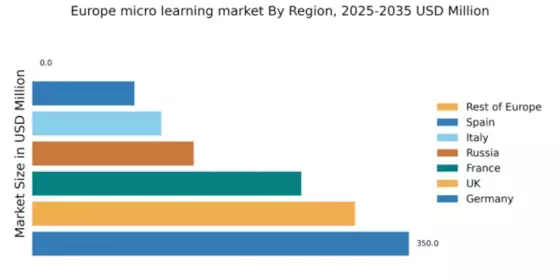
Germany : Strong Demand and Innovation Drive Growth

Germany holds a commanding market share of 35% in the European micro learning sector, valued at $350.0 million. Key growth drivers include a robust digital infrastructure, increasing demand for flexible learning solutions, and a strong emphasis on upskilling in the workforce. Government initiatives, such as the Digital Strategy 2025, promote digital education and training, further enhancing market potential. The industrial landscape is evolving, with a focus on technology and innovation, fostering a conducive environment for micro learning solutions.

UK : Diverse Offerings and High Engagement

The UK micro learning market accounts for 30% of the European share, valued at $300.0 million. Growth is driven by a high demand for personalized learning experiences and the increasing adoption of mobile learning platforms. The UK government supports digital skills initiatives, enhancing accessibility to learning resources. The market is characterized by a strong emphasis on corporate training and professional development, reflecting a culture of continuous learning.

France : Emphasis on Quality and Accessibility

France captures 25% of the European micro learning market, valued at $250.0 million. The growth is fueled by a strong focus on educational reform and the integration of technology in learning. Government policies, such as the National Digital Strategy, aim to enhance digital literacy and accessibility. The demand for micro learning is particularly strong in urban areas, where businesses seek efficient training solutions to upskill employees.

Russia : Growth Potential in Diverse Sectors

Russia holds a 15% share of the European micro learning market, valued at $150.0 million. The market is driven by increasing internet penetration and a growing demand for online education. Government initiatives to promote digital education are gaining traction, fostering a supportive environment for micro learning. Key sectors include technology, finance, and healthcare, where tailored learning solutions are increasingly sought after.

Italy : Focus on Corporate Training Solutions

Italy represents 12% of the European micro learning market, valued at $120.0 million. The growth is propelled by a rising demand for corporate training and professional development. Government support for digital education initiatives is enhancing the learning landscape. Major cities like Milan and Rome are key markets, with a competitive landscape featuring both local and international players offering diverse learning solutions.

Spain : Adoption Driven by Flexibility Needs

Spain accounts for 9.5% of the European micro learning market, valued at $95.0 million. The market is experiencing growth due to the increasing need for flexible learning options among professionals. Government initiatives aimed at improving digital skills are contributing to market expansion. Key cities like Madrid and Barcelona are central to the competitive landscape, with various players offering innovative learning platforms.

Rest of Europe : Exploring New Market Opportunities

The Rest of Europe currently shows no significant market share in micro learning, valued at $0.0 million. However, there is potential for growth as digital education becomes a priority across various nations. Emerging markets are beginning to recognize the importance of micro learning for workforce development. As infrastructure improves and digital literacy increases, opportunities for market entry and expansion will arise.

Europe Micro Learning Market Regional Image

Key Players and Competitive Insights

The micro learning market in Europe is characterized by a dynamic competitive landscape, driven by the increasing demand for flexible and efficient learning solutions. Key players are actively innovating and expanding their offerings to capture market share. Companies such as LinkedIn Learning (US), Udemy (US), and Alison (IE) are at the forefront, each adopting distinct strategies that shape the competitive environment. LinkedIn Learning (US) focuses on integrating its platform with professional networking capabilities, enhancing user engagement through personalized learning paths. In contrast, Udemy (US) emphasizes a vast course catalog, appealing to diverse learner needs, while Alison (IE) leverages its free course offerings to attract a broad audience, positioning itself as an accessible option in the market.

The business tactics employed by these companies reflect a moderately fragmented market structure, where localized strategies and supply chain optimization play crucial roles. For instance, companies are increasingly localizing content to cater to regional preferences, thereby enhancing user experience and satisfaction. This localized approach, combined with strategic partnerships, allows these players to strengthen their market presence and respond effectively to competitive pressures.

In October 2025, LinkedIn Learning (US) announced a partnership with a leading European university to co-develop specialized courses aimed at enhancing digital skills among professionals. This collaboration not only expands LinkedIn Learning's course offerings but also reinforces its commitment to aligning with educational institutions, thereby enhancing its credibility and reach in the European market. Such strategic moves are likely to bolster user acquisition and retention, positioning the company favorably against competitors.

In September 2025, Udemy (US) launched a new initiative aimed at integrating AI-driven personalized learning experiences into its platform. This strategic pivot towards AI technology is indicative of a broader trend within the industry, where companies are leveraging advanced technologies to enhance learning outcomes. By tailoring content to individual learning styles, Udemy (US) aims to improve user engagement and satisfaction, potentially leading to increased course completion rates and customer loyalty.

In August 2025, Alison (IE) expanded its offerings by introducing a subscription model that provides users with access to premium content and features. This strategic shift not only diversifies Alison's revenue streams but also positions it to compete more effectively against platforms that rely heavily on course fees. By offering a subscription model, Alison (IE) may attract a larger user base, particularly among those seeking continuous learning opportunities without the burden of high costs.

As of November 2025, the competitive trends in the micro learning market are increasingly defined by digitalization, sustainability, and the integration of AI technologies. Strategic alliances are becoming more prevalent, as companies recognize the value of collaboration in enhancing their service offerings. Looking ahead, competitive differentiation is likely to evolve, with a shift from price-based competition towards innovation, technology integration, and supply chain reliability. Companies that can effectively leverage these trends will likely secure a competitive edge in this rapidly evolving landscape.

Key Companies in the Europe Micro Learning Market market include

Industry Developments

Recent developments in the Europe Micro Learning Market indicate a significant rise in demand for bite-sized educational content driven by the increasing need for efficient skill development among professionals. In June 2023, Adobe Captivate announced enhancements to its authoring capabilities, aligning with the market's shift towards personalized learning experiences. 

SAP Litmos has reported notable growth in user engagement, particularly among corporate clients seeking flexible training solutions. Moreover, notable advancements in technologies utilized by platforms such as EdApp and Moodle are enhancing mobile learning experiences. The market has also seen sustained growth, with industry valuations exceeding 1.5 Billion Euros as organizations invest in e-learning platforms to adapt to the evolving workforce landscape.

Future Outlook

Europe Micro Learning Market Future Outlook

The micro learning market is projected to grow at a 22.31% CAGR from 2024 to 2035, driven by technological advancements, increasing demand for flexible learning, and enhanced learner engagement.

New opportunities lie in:

  • Development of AI-driven personalized learning platforms
  • Integration of micro learning into corporate training programs
  • Expansion of mobile learning applications for on-the-go access

By 2035, the micro learning market is expected to be robust, reflecting substantial growth and innovation.

Market Segmentation

Europe Micro Learning Market User Type Outlook

  • Individuals
  • Educational Institutions
  • Corporate Organizations

Europe Micro Learning Market Application Outlook

  • Corporate Training
  • Academic Learning
  • Personal Development
  • Compliance Training

Europe Micro Learning Market Content Type Outlook

  • Video
  • Text
  • Audio
  • Interactive

Europe Micro Learning Market Deployment Mode Outlook

  • Cloud-Based
  • On-Premises

Report Scope

MARKET SIZE 20241265.9(USD Million)
MARKET SIZE 20251548.32(USD Million)
MARKET SIZE 203511600.75(USD Million)
COMPOUND ANNUAL GROWTH RATE (CAGR)22.31% (2024 - 2035)
REPORT COVERAGERevenue Forecast, Competitive Landscape, Growth Factors, and Trends
BASE YEAR2024
Market Forecast Period2025 - 2035
Historical Data2019 - 2024
Market Forecast UnitsUSD Million
Key Companies Profiled["LinkedIn Learning (US)", "Udemy (US)", "Skillshare (US)", "Coursera (US)", "EdApp (AU)", "TalentLMS (US)", "Grovo (US)", "Alison (IE)", "Mindflash (US)"]
Segments CoveredApplication, Content Type, Deployment Mode, User Type
Key Market OpportunitiesIntegration of artificial intelligence in micro learning platforms enhances personalized learning experiences.
Key Market DynamicsRising demand for flexible learning solutions drives innovation in micro learning platforms across Europe.
Countries CoveredGermany, UK, France, Russia, Italy, Spain, Rest of Europe

Leave a Comment

FAQs

What is the expected market size of the Europe Micro Learning Market in 2024?

The Europe Micro Learning Market is expected to be valued at 1.52 billion USD in 2024.

What is the projected market size of the Europe Micro Learning Market by 2035?

By 2035, the Europe Micro Learning Market is projected to reach approximately 13.92 billion USD.

What is the expected CAGR for the Europe Micro Learning Market from 2025 to 2035?

The expected compound annual growth rate (CAGR) for the Europe Micro Learning Market is 22.318% from 2025 to 2035.

Which region is anticipated to have the largest market share in the Europe Micro Learning Market by 2035?

Germany is anticipated to have the largest market share, valued at approximately 3.19 billion USD by 2035.

What is the expected market value of Corporate Training within the Europe Micro Learning Market in 2035?

The Corporate Training segment is expected to reach a market value of 4.5 billion USD by 2035.

Who are the key competitors in the Europe Micro Learning Market?

Key competitors in the market include Adobe Captivate, SAP Litmos, LinkedIn Learning, Alison, and Coursera among others.

What is the expected market value of Academic Learning in the Europe Micro Learning Market by 2035?

The Academic Learning segment is projected to be valued at 3.15 billion USD by 2035.

What is the growth expectation for the Personal Development segment in the Europe Micro Learning Market?

The Personal Development segment is expected to grow to 2.7 billion USD by 2035.

What is the expected market size of Compliance Training in the Europe Micro Learning Market for 2024?

The Compliance Training market size is expected to be 0.37 billion USD in 2024.

What will be the market value for the UK in the Europe Micro Learning Market by 2035?

The UK market is expected to be valued at approximately 2.75 billion USD by 2035.

Download Free Sample

Kindly complete the form below to receive a free sample of this Report

Compare Licence

×
Features License Type
Single User Multiuser License Enterprise User
Price $4,950 $5,950 $7,250
Maximum User Access Limit 1 User Upto 10 Users Unrestricted Access Throughout the Organization
Free Customization
Direct Access to Analyst
Deliverable Format
Platform Access
Discount on Next Purchase 10% 15% 15%
Printable Versions