×
Request Free Sample ×

Kindly complete the form below to receive a free sample of this Report

* Please use a valid business email

Leading companies partner with us for data-driven Insights

clients tt-cursor
Hero Background

Europe Programmatic Advertising Market

ID: MRFR/ICT/44848-HCR
200 Pages
Aarti Dhapte
October 2025

Europe Programmatic Advertising Market Research Report By Type (Movement-based advertising, Movement-based publicizing) and By Industry (Shopper products, Retail, Restaurants)- Forecast to 2035

Share:
Download PDF ×

We do not share your information with anyone. However, we may send you emails based on your report interest from time to time. You may contact us at any time to opt-out.

Europe Programmatic Advertising Market Infographic
Purchase Options

Europe Programmatic Advertising Market Summary

As per MRFR analysis, the programmatic advertising market size was estimated at 202.95 USD Billion in 2024. The programmatic advertising market is projected to grow from 232.11 USD Billion in 2025 to 888.84 USD Billion by 2035, exhibiting a compound annual growth rate (CAGR) of 14.37% during the forecast period 2025 - 2035.

Key Market Trends & Highlights

The Europe programmatic advertising market is experiencing robust growth driven by technological advancements and evolving consumer behaviors.

  • Germany remains the largest market for programmatic advertising, showcasing a steady increase in digital ad spend.
  • The UK is emerging as the fastest-growing region, with a notable rise in programmatic investments across various platforms.
  • There is a marked increase in the adoption of AI technologies, enhancing targeting and efficiency in ad placements.
  • The growth of digital media consumption and advancements in data analytics are key drivers propelling the market forward.

Market Size & Forecast

2024 Market Size 202.95 (USD Billion)
2035 Market Size 888.84 (USD Billion)
CAGR (2025 - 2035) 14.37%

Major Players

Google (US), Amazon (US), Facebook (US), The Trade Desk (US), Adobe (US), AppNexus (US), Rubicon Project (US), Criteo (FR), Sizmek (US)

Europe Programmatic Advertising Market Trends

The programmatic advertising market is currently experiencing a transformative phase, characterized by rapid technological advancements and evolving consumer behaviors. In recent years, the integration of artificial intelligence and machine learning has enhanced the efficiency of ad placements, allowing for more precise targeting and improved return on investment. Advertisers are increasingly leveraging data analytics to understand audience preferences, which in turn drives more personalized advertising experiences. This shift towards data-driven strategies appears to be reshaping the landscape, as brands seek to optimize their marketing efforts in a highly competitive environment. Moreover, privacy regulations and consumer concerns regarding data security are influencing the programmatic advertising market. As legislation becomes more stringent, companies are adapting their practices to ensure compliance while still delivering effective advertising solutions. The emphasis on transparency and ethical data usage is likely to foster trust between consumers and brands, potentially leading to higher engagement rates. As the market continues to evolve, stakeholders must remain agile, embracing innovation while navigating the complexities of regulatory frameworks and consumer expectations.

Increased Adoption of AI Technologies

The integration of artificial intelligence in the programmatic advertising market is becoming more prevalent. AI technologies facilitate real-time bidding and enhance targeting capabilities, allowing advertisers to reach specific audiences more effectively. This trend indicates a shift towards automation, which may streamline operations and improve campaign performance.

Focus on Data Privacy and Compliance

With the rise of data privacy concerns, the programmatic advertising market is witnessing a heightened focus on compliance with regulations. Advertisers are adapting their strategies to align with legal requirements, ensuring that consumer data is handled responsibly. This trend suggests a growing emphasis on transparency and ethical practices in advertising.

Emergence of Connected TV Advertising

The popularity of connected TV platforms is reshaping the programmatic advertising market. As more consumers shift to streaming services, advertisers are exploring opportunities to engage audiences through targeted ads on these platforms. This trend indicates a potential expansion of programmatic strategies into new media channels.

Europe Programmatic Advertising Market Drivers

Rise of Mobile Advertising

The surge in mobile device usage across Europe is a pivotal driver for the programmatic advertising market. As more consumers access content via smartphones and tablets, advertisers are increasingly focusing on mobile advertising strategies. In 2025, mobile advertising is projected to account for over 50% of total digital ad spending in Europe, highlighting the importance of mobile-optimized programmatic solutions. This shift presents an opportunity for advertisers to engage with consumers in real-time, leveraging location-based targeting and personalized messaging. The programmatic advertising market is expected to capitalize on this trend, as brands seek to enhance their mobile presence and connect with audiences in a more meaningful way.

Advancements in Data Analytics

The programmatic advertising market is significantly influenced by advancements in data analytics technologies. Enhanced data collection and analysis capabilities allow advertisers to gain deeper insights into consumer behavior and preferences. In 2025, it is projected that the use of big data in advertising will increase by over 30%, leading to more targeted and personalized advertising strategies. This trend enables advertisers to optimize their campaigns in real-time, improving return on investment (ROI). As data-driven decision-making becomes more prevalent, the demand for programmatic advertising solutions that leverage these analytics is expected to grow. This evolution not only enhances the effectiveness of advertising but also fosters a more engaging experience for consumers.

Growth of Digital Media Consumption

The rapid increase in digital media consumption across Europe is a primary driver for the programmatic advertising market. As consumers increasingly engage with online content, advertisers are compelled to allocate more resources to digital platforms. In 2025, it is estimated that digital advertising spending in Europe will reach approximately €100 billion, with programmatic channels capturing a substantial share. This shift towards digital is not merely a trend; it reflects a fundamental change in consumer behavior. The programmatic advertising market is poised to benefit from this growth, as advertisers seek to optimize their campaigns through automated buying and real-time bidding. Consequently, the demand for programmatic solutions is likely to rise, enabling brands to reach their target audiences more effectively and efficiently.

Regulatory Changes and Compliance Needs

The evolving regulatory landscape in Europe is a significant driver for the programmatic advertising market. With increasing scrutiny on data privacy and consumer protection, advertisers must adapt their strategies to comply with regulations such as the General Data Protection Regulation (GDPR). In 2025, it is expected that compliance-related expenditures in the advertising sector will rise by approximately 15%. This necessitates the adoption of programmatic solutions that prioritize transparency and data security. As brands navigate these regulatory challenges, the demand for compliant programmatic advertising solutions is likely to increase, driving innovation and fostering trust between consumers and advertisers.

Integration of Programmatic with Traditional Media

The integration of programmatic advertising with traditional media channels is emerging as a crucial driver for the programmatic advertising market. As advertisers seek to create cohesive marketing strategies, the blending of digital and traditional media is becoming increasingly important. In 2025, it is anticipated that around 25% of traditional media budgets will be allocated to programmatic channels, reflecting a shift in how brands approach advertising. This integration allows for a more holistic view of campaign performance and enables advertisers to reach audiences across multiple touchpoints. Consequently, the programmatic advertising market is likely to see enhanced growth as brands recognize the value of a unified approach to media buying.

Market Segment Insights

By Type: Movement-based advertising (Largest) vs. Movement-based publicizing (Fastest-Growing)

In the Europe programmatic advertising market, Movement-based advertising continues to dominate with a significant market share. This segment enjoys widespread adoption due to its effectiveness in targeting audiences based on real-time movement data. Conversely, Movement-based publicizing, while smaller in market share, is gaining traction as advertisers increasingly recognize its potential for personalized engagement and real-time communication with consumers across various digital platforms. The growth trends for this segment are driven by advancements in technology and data analytics. As advertisers look for innovative ways to reach audiences, the integration of movement-based strategies into advertising campaigns enables more dynamic and contextual ad placements. Moreover, rising consumer demand for interactive and immersive advertising experiences is propelling Movement-based publicizing as the fastest-growing value, attracting investments aimed at enhancing user engagement and maximizing ROI.

Movement-based advertising (Dominant) vs. Movement-based publicizing (Emerging)

Movement-based advertising holds a dominant position within the market as it leverages real-time data to deliver relevant ads that resonate with consumers' immediate behaviors and locations. Its established framework allows advertisers to execute campaigns effectively across various channels, ensuring broad reach and engagement. On the other hand, Movement-based publicizing is emerging as a robust alternative, appealing to brands seeking innovative approaches to connect with their audiences. This segment thrives on the increasing preference for personalized content, ensuring that ads not only reach the right audience but also create memorable interactions. Both segments represent a significant shift towards data-driven marketing strategies, emphasizing the importance of movement-based tactics in engaging modern consumers.

By Industry: Retail (Largest) vs. Restaurants (Fastest-Growing)

In the programmatic advertising market, the distribution of market share among the industry segment values shows that retail leads the way. Retail captures a significant portion of advertising spend, utilizing advanced programmatic strategies to reach target consumers effectively. On the other hand, restaurants have begun to carve out a noteworthy presence, capitalizing on the rising trend of digital engagement and targeted promotions, thereby enhancing their market share in recent years. Growth trends in this segment indicate a robust demand for both retail and restaurant advertising through programmatic channels. The retail sector benefits from the continuous evolution of consumer preferences and the shift towards online shopping, driving higher investments in digital advertising. Meanwhile, the restaurant industry is experiencing rapid expansion in online ordering and delivery services, which fuels the need for innovative programmatic advertising solutions to attract new customers and retain existing ones.

Retail (Dominant) vs. Restaurants (Emerging)

Retail dominates the programmatic advertising space thanks to its large consumer base and substantial advertising budget, which are directed toward reaching potential customers through digital channels. Retailers leverage sophisticated data analytics to refine their targeting strategies, ensuring their promotional messages resonate with the right audience. In contrast, restaurants represent an emerging segment that is rapidly adopting programmatic advertising to enhance visibility and customer engagement. Restaurants are increasingly using data-driven insights to tailor campaigns that resonate with local consumers, thus providing personalized dining experiences. This shift is powered by innovations in mobile technology and an increasing preference for digital interactions, making restaurants a key player in the evolving landscape of programmatic advertising.

Get more detailed insights about Europe Programmatic Advertising Market

Regional Insights

Germany : Germany's Dominance in Digital Ads

Germany holds a commanding 60.0% market share in the European programmatic advertising landscape, valued at approximately €3.6 billion. Key growth drivers include a robust digital infrastructure, increasing mobile internet penetration, and a shift towards data-driven marketing strategies. Regulatory frameworks, such as the GDPR, have shaped consumer data usage, while government initiatives support digital innovation and advertising technology development. The demand for personalized advertising continues to rise, reflecting changing consumer preferences.

UK : UK's Innovative Advertising Landscape

The UK boasts a 50.0% market share in programmatic advertising, translating to around €2.5 billion. Growth is fueled by a strong e-commerce sector, high smartphone usage, and a focus on data analytics. The UK government has implemented policies to enhance digital skills and support tech startups, fostering a conducive environment for programmatic growth. Consumer behavior is increasingly leaning towards online shopping, driving demand for targeted advertising solutions.

France : France's Growth in Programmatic Market

France captures a 35.0% share of the programmatic advertising market, valued at approximately €1.8 billion. The growth is driven by a vibrant tech ecosystem, increasing investment in digital marketing, and a rise in mobile advertising. Regulatory measures, including the CNIL's guidelines on data protection, influence market dynamics. The French government promotes digital transformation initiatives, enhancing the advertising landscape.

Russia : Russia's Diverse Advertising Landscape

Russia holds a 25.0% market share in programmatic advertising, valued at around €1.2 billion. Key growth drivers include a large online audience and increasing internet penetration. However, regulatory challenges and geopolitical factors impact market dynamics. The Russian government has initiated programs to support digital advertising, while local players like Yandex are gaining traction against international competitors.

Italy : Italy's Evolving Market Dynamics

Italy accounts for a 15.0% share of the programmatic advertising market, valued at approximately €750 million. Growth is driven by increasing digital media consumption and a shift towards online retail. Government initiatives aimed at enhancing digital literacy and infrastructure are pivotal. The competitive landscape features both local and international players, with cities like Milan emerging as key advertising hubs.

Spain : Spain's Rising Programmatic Market

Spain captures a 10.0% market share in programmatic advertising, valued at around €500 million. The market is driven by a growing digital audience and increased investment in online advertising. Regulatory frameworks are evolving to support digital marketing practices. Major cities like Madrid and Barcelona are central to the advertising ecosystem, with local firms and international players competing for market share.

Rest of Europe : Varied Landscape Across Europe

The Rest of Europe holds a 7.95% market share in programmatic advertising, valued at approximately €400 million. Growth is uneven, with some countries rapidly adopting digital advertising while others lag. Regulatory environments vary significantly, impacting market entry for international players. Local dynamics are influenced by cultural factors and economic conditions, creating unique opportunities for tailored advertising solutions.
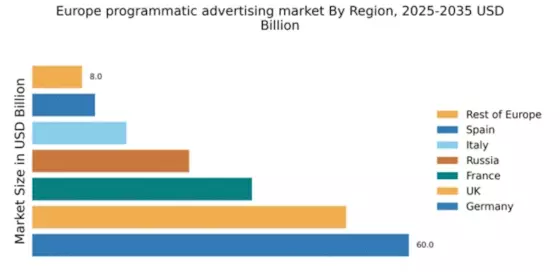
Europe Programmatic Advertising Market Regional Image

Key Players and Competitive Insights

The programmatic advertising market in Europe is characterized by a dynamic competitive landscape, driven by rapid technological advancements and evolving consumer behaviors. Major players such as Google (US), Amazon (US), and Criteo (FR) are at the forefront, leveraging their extensive data capabilities and innovative technologies to enhance advertising effectiveness. Google (US) continues to dominate through its robust advertising ecosystem, focusing on integrating AI-driven solutions to optimize ad placements. Meanwhile, Amazon (US) is strategically expanding its advertising services, capitalizing on its vast e-commerce platform to offer targeted advertising solutions. Criteo (FR), with its emphasis on performance marketing, is enhancing its offerings through partnerships and technological upgrades, thereby shaping a competitive environment that increasingly prioritizes data-driven decision-making and personalized advertising experiences.

The business tactics employed by these companies reflect a concerted effort to optimize operations and enhance market presence. The competitive structure of the market appears moderately fragmented, with a mix of established giants and emerging players. This fragmentation allows for diverse strategies, as companies localize their offerings and optimize supply chains to meet regional demands. The collective influence of these key players fosters an environment where innovation and agility are paramount, driving continuous evolution in advertising methodologies.

In October 2025, Google (US) announced the launch of its new AI-powered advertising platform, designed to enhance real-time bidding capabilities and improve ad targeting precision. This strategic move underscores Google's commitment to maintaining its leadership position by harnessing cutting-edge technology to deliver superior advertising solutions. The introduction of this platform is likely to attract more advertisers seeking effective ways to engage consumers in a highly competitive digital landscape.

In September 2025, Amazon (US) expanded its advertising services by integrating new analytics tools that provide advertisers with deeper insights into consumer behavior. This initiative not only enhances the effectiveness of ad campaigns but also positions Amazon as a formidable competitor in the programmatic space. By offering advanced analytics, Amazon (US) is likely to strengthen its value proposition, appealing to brands looking for data-driven advertising solutions.

In August 2025, Criteo (FR) entered into a strategic partnership with a leading European retail chain to enhance its programmatic advertising capabilities. This collaboration aims to leverage the retail chain's customer data to deliver more personalized ad experiences. Such partnerships are indicative of a broader trend where companies are increasingly seeking synergies to enhance their service offerings and drive growth in a competitive market.

As of November 2025, the competitive trends in the programmatic advertising market are heavily influenced by digitalization, sustainability, and the integration of AI technologies. Strategic alliances are becoming more prevalent, as companies recognize the need to collaborate to enhance their technological capabilities and market reach. Looking ahead, competitive differentiation is expected to evolve, shifting from traditional price-based competition to a focus on innovation, technological advancements, and supply chain reliability. This transition suggests that companies that prioritize these aspects will likely emerge as leaders in the programmatic advertising landscape.

Key Companies in the Europe Programmatic Advertising Market market include

Industry Developments

Recently, the Europe Programmatic Advertising Market has seen significant developments, particularly in the face of evolving regulations and technological advancements. Companies like AdRoll and The Trade Desk are investing in enhanced privacy measures to comply with increasingly stringent European data protection laws, which directly impact programmatic buying strategies. In September 2023, Criteo announced a partnership with PubMatic to streamline supply chain efficiencies, offering advertisers improved transparency in their programmatic campaigns. 

This aligns with ongoing efforts to increase accountability within the advertising sector. Furthermore, MediaMath has reported a growth in its market valuation following the introduction of its new AI-driven advertising product in Europe, which is reshaping analytical approaches for marketers.Mergers and acquisitions have also been notable; in July 2023, Index Exchange acquired the European Division of a leading ad-tech firm, enhancing its footprint in the market, while Taboola reported a strategic alliance with the Rubicon Project to expand its service offerings in Europe.

This active consolidation reflects the competitive nature of the programmatic advertising landscape. Over the last two years, investment in programmatic technologies among key players like Smart AdServer and Viant Technology has increased, illustrating a dynamic and evolving market environment within Europe.


Future Outlook

Europe Programmatic Advertising Market Future Outlook

The programmatic advertising market is projected to grow at a 14.37% CAGR from 2024 to 2035, driven by advancements in AI, data analytics, and increased digital ad spending.

New opportunities lie in:

  • Integration of AI-driven bidding algorithms for real-time optimization.
  • Expansion of programmatic audio advertising to capture new audiences.
  • Development of privacy-compliant data solutions to enhance targeting capabilities.

By 2035, the programmatic advertising market is expected to achieve substantial growth and innovation.

Market Segmentation

Europe Programmatic Advertising Market Type Outlook

  • Movement-based advertising
  • Movement-based publicizing

Europe Programmatic Advertising Market Industry Outlook

  • Shopper products
  • Retail
  • Restaurants

Report Scope

MARKET SIZE 2024202.95(USD Billion)
MARKET SIZE 2025232.11(USD Billion)
MARKET SIZE 2035888.84(USD Billion)
COMPOUND ANNUAL GROWTH RATE (CAGR)14.37% (2024 - 2035)
REPORT COVERAGERevenue Forecast, Competitive Landscape, Growth Factors, and Trends
BASE YEAR2024
Market Forecast Period2025 - 2035
Historical Data2019 - 2024
Market Forecast UnitsUSD Billion
Key Companies Profiled["Google (US)", "Amazon (US)", "Facebook (US)", "The Trade Desk (US)", "Adobe (US)", "AppNexus (US)", "Rubicon Project (US)", "Criteo (FR)", "Sizmek (US)"]
Segments CoveredType, Industry
Key Market OpportunitiesIntegration of artificial intelligence enhances targeting efficiency in the programmatic advertising market.
Key Market DynamicsRegulatory changes and technological advancements drive rapid evolution in the programmatic advertising market.
Countries CoveredGermany, UK, France, Russia, Italy, Spain, Rest of Europe

Leave a Comment

FAQs

What is the expected market size of the Europe Programmatic Advertising Market in 2024?

The Europe Programmatic Advertising Market is expected to be valued at 11.0 billion USD in 2024.

What will be the market value of the Europe Programmatic Advertising Market by 2035?

By 2035, the Europe Programmatic Advertising Market is projected to reach a value of 1090.0 billion USD.

What is the expected compound annual growth rate (CAGR) for the Europe Programmatic Advertising Market from 2025 to 2035?

The expected CAGR for the Europe Programmatic Advertising Market from 2025 to 2035 is 51.865%.

What market size is attributed to movement-based advertising in the Europe Programmatic Advertising Market for 2024?

Movement-based advertising is valued at 4.4 billion USD in the Europe Programmatic Advertising Market for 2024.

What will be the valuation of movement-based publicizing in the Europe Programmatic Advertising Market by 2035?

By 2035, movement-based publicizing will be valued at 648.0 billion USD within the Europe Programmatic Advertising Market.

What are the major players in the Europe Programmatic Advertising Market?

Key players in the Europe Programmatic Advertising Market include AdRoll, The Trade Desk, MediaMath, and Criteo.

What opportunities exist within the Europe Programmatic Advertising Market?

Opportunities in the Europe Programmatic Advertising Market include advancements in technology and increasing digital ad spending.

How has the global market environment impacted the Europe Programmatic Advertising Market?

The global market environment has created both challenges and opportunities in the Europe Programmatic Advertising Market landscape.

What challenges could affect the growth of the Europe Programmatic Advertising Market?

Challenges that may affect growth include regulatory changes and data privacy concerns.

What is the growth potential for movement-based advertising in the Europe Programmatic Advertising Market from 2024 to 2035?

Movement-based advertising is expected to grow significantly from 4.4 billion USD in 2024 to 442.0 billion USD by 2035.

Download Free Sample

Kindly complete the form below to receive a free sample of this Report

Compare Licence

×
Features License Type
Single User Multiuser License Enterprise User
Price $4,950 $5,950 $7,250
Maximum User Access Limit 1 User Upto 10 Users Unrestricted Access Throughout the Organization
Free Customization
Direct Access to Analyst
Deliverable Format
Platform Access
Discount on Next Purchase 10% 15% 15%
Printable Versions