×
Request Free Sample ×

Kindly complete the form below to receive a free sample of this Report

* Please use a valid business email

Leading companies partner with us for data-driven Insights

clients tt-cursor
Hero Background

Europe Reclaimed Rubber Market

ID: MRFR/CnM/45935-HCR
200 Pages
Chitranshi Jaiswal
October 2025

Europe Reclaimed Rubber Market Research Report By Type (Whole Tire Reclaim, Butyl Reclaim, Etylene Propylene Diene Monomer, Drab & Colored, Others), By Application (Tire, Non-Tire), By Tire (Inner Liner, Inner Tubes, Tire Side Walls, Tire Plies, Tire Treads & Retreads), By Non-Tire (Conveyor Belts, Molded Goods, Adhesives, Footwear, Matting, Profiles, Roofing) andBy Regional (Germany, UK, France, Russia, Italy, Spain, Rest of Europe)- Forecast to 2035

Share:
Download PDF ×

We do not share your information with anyone. However, we may send you emails based on your report interest from time to time. You may contact us at any time to opt-out.

Europe Reclaimed Rubber Market Infographic
Purchase Options

Europe Reclaimed Rubber Market Summary

As per MRFR analysis, the reclaimed rubber market size was estimated at 810.0 USD Million in 2024. The Europe reclaimed rubber market is projected to grow from 879.34 USD Million in 2025 to 2000.0 USD Million by 2035, exhibiting a compound annual growth rate (CAGR) of 8.56% during the forecast period 2025 - 2035.

Key Market Trends & Highlights

The Europe reclaimed rubber market is experiencing a robust shift towards sustainability and innovation.

  • Germany remains the largest market for reclaimed rubber, driven by strong industrial demand and sustainability initiatives.
  • The UK is emerging as the fastest-growing region, reflecting increasing consumer awareness and regulatory support for eco-friendly products.
  • Technological advancements in recycling processes are enhancing the efficiency and quality of reclaimed rubber, appealing to various industries.
  • Key market drivers include the growing demand for eco-friendly products and rising raw material costs, which are pushing manufacturers towards sustainable alternatives.

Market Size & Forecast

2024 Market Size 810.0 (USD Million)
2035 Market Size 2000.0 (USD Million)
CAGR (2025 - 2035) 8.56%

Major Players

Continental AG (DE), Michelin (FR), Goodyear Tire & Rubber Company (US), Bridgestone Corporation (JP), Pirelli & C. S.p.A. (IT), Trelleborg AB (SE), Balkrishna Industries Limited (IN), Ecovyst Inc. (US), Reclaimed Rubber Company (US)

Europe Reclaimed Rubber Market Trends

The reclaimed rubber market is currently experiencing a notable transformation, driven by increasing environmental awareness and regulatory pressures. As industries seek sustainable alternatives, the demand for reclaimed rubber is on the rise. This material, derived from used tires and other rubber products, offers a viable solution for reducing waste and conserving resources. The market is characterized by a growing number of manufacturers who are investing in advanced technologies to enhance the quality and performance of reclaimed rubber. This shift not only supports circular economy initiatives but also aligns with the broader goals of reducing carbon footprints across various sectors. In addition, the reclaimed rubber market is witnessing a diversification of applications. Traditionally utilized in tire manufacturing, reclaimed rubber is now finding its way into various sectors, including construction, automotive, and consumer goods. This expansion is indicative of the material's versatility and potential to meet the evolving needs of different industries. Furthermore, collaborations between manufacturers and research institutions are fostering innovation, leading to the development of new products that leverage the unique properties of reclaimed rubber. As the market continues to evolve, it appears poised for sustained growth, driven by both environmental considerations and technological advancements.

Sustainability Initiatives

The reclaimed rubber market is increasingly influenced by sustainability initiatives. Companies are prioritizing eco-friendly practices, which include sourcing reclaimed rubber to minimize waste. This trend aligns with the European Union's commitment to reducing landfill waste and promoting recycling, thereby enhancing the appeal of reclaimed rubber in various applications.

Technological Advancements

Technological advancements play a crucial role in the reclaimed rubber market. Innovations in processing techniques are improving the quality and performance of reclaimed rubber, making it more competitive with virgin materials. These advancements are essential for meeting the stringent quality standards set by industries, particularly in automotive and construction sectors.

Regulatory Support

Regulatory support is shaping the reclaimed rubber market landscape. Governments are implementing policies that encourage the use of recycled materials, including reclaimed rubber. This regulatory framework not only promotes environmental sustainability but also incentivizes manufacturers to adopt reclaimed rubber in their production processes.

Europe Reclaimed Rubber Market Drivers

Rising Raw Material Costs

The escalating costs of raw materials, particularly natural rubber, are driving manufacturers to explore reclaimed rubber as a viable alternative. The reclaimed rubber market benefits from this trend, as companies seek to mitigate the impact of fluctuating prices. With natural rubber prices having increased by over 30% in the past few years, the economic viability of reclaimed rubber becomes more appealing. This shift not only helps manufacturers reduce production costs but also aligns with sustainability goals. As a result, the reclaimed rubber market is expected to expand, with an increasing number of companies investing in technologies to enhance the quality and performance of reclaimed rubber products. This trend indicates a potential shift in the competitive landscape, favoring those who can effectively utilize reclaimed materials.

Supportive Government Policies

Government policies aimed at promoting recycling and waste reduction are playing a crucial role in the reclaimed rubber market. In Europe, various initiatives and regulations are being implemented to encourage the use of recycled materials, including reclaimed rubber. For example, the European Union's Circular Economy Action Plan emphasizes the importance of recycling and aims to increase the recycling rate of materials. Such policies not only create a favorable environment for the reclaimed rubber market but also incentivize manufacturers to invest in sustainable practices. As a result, the market is expected to grow, driven by both regulatory support and the increasing recognition of the environmental benefits associated with reclaimed rubber. This alignment between policy and industry objectives is likely to foster innovation and investment in the sector.

Innovations in Recycling Technologies

Advancements in recycling technologies are significantly influencing the reclaimed rubber market. Innovative processes are being developed to enhance the quality and performance of reclaimed rubber, making it a more attractive option for manufacturers. For instance, new methods of devulcanization are improving the properties of reclaimed rubber, allowing it to be used in high-performance applications. This technological progress is crucial, as it addresses previous limitations associated with reclaimed rubber, such as durability and elasticity. As a result, the reclaimed rubber market is likely to see increased adoption across various sectors, including automotive and construction, where performance standards are stringent. The ongoing research and development efforts in this area suggest a promising future for reclaimed rubber as a competitive material.

Expanding Applications Across Industries

The expanding applications of reclaimed rubber across various industries are a significant driver for the reclaimed rubber market. Traditionally used in tires, reclaimed rubber is now finding its way into diverse sectors such as construction, footwear, and consumer goods. This diversification is largely attributed to the material's cost-effectiveness and environmental benefits. For instance, the construction industry is increasingly utilizing reclaimed rubber in flooring and insulation materials, capitalizing on its durability and soundproofing properties. As industries continue to explore the potential of reclaimed rubber, the market is poised for growth. The reclaimed rubber market is likely to benefit from this trend, as manufacturers adapt their offerings to meet the evolving needs of different sectors, thereby broadening the scope of reclaimed rubber applications.

Growing Demand for Eco-Friendly Products

The increasing consumer preference for eco-friendly products is a pivotal driver in the reclaimed rubber market. As awareness of environmental issues rises, manufacturers are compelled to adopt sustainable practices. This shift is reflected in the growing market for reclaimed rubber, which is projected to reach approximately €1.5 billion by 2026 in Europe. Companies are increasingly integrating reclaimed rubber into their product lines, responding to consumer demand for sustainable alternatives. This trend is further supported by the European Union's commitment to reducing waste and promoting circular economy principles, which encourages the use of recycled materials. Consequently, the reclaimed rubber market is likely to experience robust growth as businesses align their strategies with consumer expectations for sustainability.

Market Segment Insights

By Type: Whole Tire Reclaim (Largest) vs. Butyl Reclaim (Fastest-Growing)

In the Europe reclaimed rubber market, Whole Tire Reclaim holds a significant portion of the market share, reflecting its broad application in various sectors, particularly in tire manufacturing. This type of reclaim benefits from established supply chains and robust demand, showcasing its dominance in the overall market distribution. Meanwhile, Butyl Reclaim, while not the largest segment, is rapidly gaining traction due to its excellent air retention properties and increasing use in sectors such as automotive and healthcare. The growth trends in the segment are notably influenced by sustainability initiatives and increasing environmental regulations, pushing manufacturers to seek reclaimed rubber as a viable alternative to virgin materials. As industries strive to reduce their carbon footprint, the demand for Butyl Reclaim is expected to surge, marking it as the fastest-growing segment. Other types, such as Ethylene Propylene Diene Monomer and Drab & Colored, also contribute to market dynamics but exhibit slower growth compared to Whole Tire and Butyl Reclaim.

Whole Tire Reclaim: Dominant vs. Butyl Reclaim: Emerging

Whole Tire Reclaim is characterized by its extensive use of processed scrap tires, making it essential for meeting the growing demand for recycled materials in tire production and other applications. This segment is recognized for its cost-effectiveness and the ability to provide quality rubber for diverse uses. In contrast, Butyl Reclaim is emerging rapidly due to its unique properties, such as low permeability to air and gases, which enhance its applications in specialized products like sealants and liners. The market position of Butyl Reclaim is bolstered by innovation and a stronger emphasis on circular economy principles, positioning it favorably for future growth in an eco-conscious market.

By Application: Tire (Largest) vs. Non-Tire (Fastest-Growing)

In the Europe reclaimed rubber market, the Tire segment commands the largest market share due to its extensive use in automotive applications. With a significant demand fueled by the increasing automotive production and tire replacement rates, the Tire segment remains a key area of focus for manufacturers looking to integrate reclaimed rubber into their products. In contrast, the Non-Tire segment, although smaller in share, is rapidly gaining ground, primarily driven by the growth in the manufacturing of diverse products such as footwear, mats, and industrial components. The growth trends in this market show that in addition to environmental sustainability, innovation in product development is playing a crucial role. The Non-Tire application is experiencing accelerated growth, attributed to the rising awareness of reclaimed rubber's benefits across various industries. This push is further reinforced by regulatory policies that encourage sustainable practices, suggesting a promising future for reclaimed rubber applications beyond tires.

Tire (Dominant) vs. Non-Tire (Emerging)

The Tire segment is known for its robust dominance in the reclaimed rubber market due to its established applications and consistent demand. It is characterized by a high level of technological advancement in recycling processes, which enhances the quality of reclaimed rubber suitable for tire manufacturing. In contrast, the Non-Tire segment is emerging rapidly, appealing to sectors such as construction, sports, and consumer goods. Its versatility and eco-friendly attributes are driving innovation and expanding its reach into new markets. Although currently less dominant, the Non-Tire segment is positioned for significant growth, supported by increasing interest in sustainable materials and products.

Get more detailed insights about Europe Reclaimed Rubber Market

Regional Insights

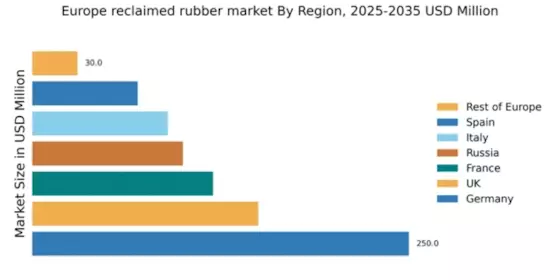
Germany : Strong Demand and Innovation Drive Growth

Key markets include major cities like Stuttgart, Munich, and Berlin, where automotive and manufacturing industries thrive. The competitive landscape features significant players such as Continental AG and Trelleborg AB, which are investing in innovative technologies. Local dynamics favor a business environment that encourages sustainability, with reclaimed rubber being utilized in tire manufacturing, construction, and consumer goods.

UK : Sustainability Initiatives Boost Market

Key markets include London, Birmingham, and Manchester, where industrial activities are concentrated. The competitive landscape features players like Goodyear Tire & Rubber Company and Michelin, which are focusing on sustainable practices. The local market is characterized by a growing emphasis on eco-friendly products, with reclaimed rubber being used in tires, flooring, and various industrial applications.

France : Innovative Solutions in Reclaimed Rubber

Key markets include Paris, Lyon, and Marseille, where industrial activities are robust. Major players like Michelin are leading the charge in innovation and sustainability. The competitive landscape is evolving, with a focus on developing high-quality reclaimed rubber products for tires and other applications. The local business environment is supportive of green initiatives, enhancing the market's growth potential.

Russia : Industrial Development Fuels Demand

Key markets include Moscow and St. Petersburg, where industrial activities are concentrated. The competitive landscape features local players and international companies like Bridgestone Corporation. The business environment is gradually improving, with a focus on sustainability and innovation. Reclaimed rubber is increasingly being used in tire manufacturing and construction materials, reflecting a shift towards greener practices.

Italy : Reclaimed Rubber in High Demand

Key markets include Milan, Turin, and Bologna, where industrial activities are concentrated. Major players like Pirelli & C. S.p.A. are investing in sustainable practices and innovative technologies. The competitive landscape is characterized by a mix of local and international companies, with reclaimed rubber being utilized in tires, flooring, and other industrial applications. The local business environment is supportive of green initiatives, fostering market growth.

Spain : Reclaimed Rubber Adoption on Rise

Key markets include Madrid and Barcelona, where industrial activities are concentrated. The competitive landscape features local players and international companies, with a focus on sustainable practices. The local market dynamics favor eco-friendly products, with reclaimed rubber being used in tires, construction materials, and consumer goods. The business environment is evolving, with increasing support for green initiatives.

Rest of Europe : Regional Variations in Demand

Key markets include various countries with emerging industries. The competitive landscape is diverse, featuring a mix of local and international players. The business environment varies significantly, with some regions facing challenges in infrastructure and regulatory support. Reclaimed rubber is being utilized in various applications, reflecting the unique market dynamics of each country.
Europe Reclaimed Rubber Market Regional Image

Key Players and Competitive Insights

The reclaimed rubber market in Europe is characterized by a dynamic competitive landscape, driven by increasing demand for sustainable materials and stringent environmental regulations. Key players such as Continental AG (DE), Michelin (FR), and Bridgestone Corporation (JP) are actively positioning themselves through innovation and strategic partnerships. These companies are focusing on enhancing their product offerings and expanding their market reach, which collectively shapes a competitive environment that is increasingly focused on sustainability and technological advancement.

In terms of business tactics, companies are localizing manufacturing to reduce transportation costs and optimize supply chains. The market appears moderately fragmented, with several key players exerting influence over pricing and product development. This structure allows for a diverse range of products and innovations, as companies strive to differentiate themselves in a competitive landscape.

In October 2025, Continental AG (DE) announced a partnership with a leading recycling technology firm to enhance its reclaimed rubber production capabilities. This strategic move is likely to bolster Continental's commitment to sustainability while improving the efficiency of its manufacturing processes. By integrating advanced recycling technologies, the company aims to reduce waste and lower production costs, thereby enhancing its competitive edge in the market.

In September 2025, Michelin (FR) launched a new line of high-performance tires incorporating reclaimed rubber, which reflects its ongoing commitment to sustainability. This initiative not only aligns with consumer preferences for eco-friendly products but also positions Michelin as a leader in innovation within the reclaimed rubber sector. The introduction of these tires is expected to attract environmentally conscious consumers and strengthen Michelin's market share.

In August 2025, Bridgestone Corporation (JP) expanded its European operations by acquiring a local reclaimed rubber manufacturer. This acquisition is anticipated to enhance Bridgestone's supply chain efficiency and increase its production capacity. By integrating local expertise and resources, Bridgestone aims to better serve the European market and respond to the growing demand for sustainable tire solutions.

As of November 2025, current trends in the reclaimed rubber market include a strong emphasis on digitalization, sustainability, and the integration of artificial intelligence in production processes. Strategic alliances among key players are shaping the competitive landscape, fostering innovation and collaboration. Looking ahead, it appears that competitive differentiation will increasingly rely on technological advancements and supply chain reliability, moving away from traditional price-based competition. Companies that prioritize innovation and sustainability are likely to emerge as leaders in this evolving market.

Key Companies in the Europe Reclaimed Rubber Market market include

Industry Developments

The Europe Reclaimed Rubber Market is witnessing significant developments, particularly with increased demand for sustainable materials driven by the European Union's Green Deal and circular economy initiatives. Companies like Greengo and Liberty Tire Recycling are enhancing their production capabilities to meet the growing need for eco-friendly alternatives in the tire and automotive sectors.

In July 2023, Bolder Industries expanded its operations in Europe to take advantage of the region's push towards recycling and sustainability. Additionally, Trelleborg and Michelin have been involved in strategic partnerships to innovate in reclaimed rubber technologies.

In September 2023, Goodyear Tire and Rubber Company announced a collaboration with Ecore International aimed at developing new applications for reclaimed rubber in flooring solutions. Mergers and acquisitions are also shaping the landscape, such as Continental AG's acquisition of a stake in a small European startup focusing on tire recycling, disclosed in May 2023, which enhances its sustainability portfolio.

The market is expected to grow significantly as companies invest in Research and Development and innovative practices, with estimations suggesting a valuation increase driven by heightened regulatory frameworks and consumer awareness. Trends from the past few years indicate a strong transition towards sustainable practices, keeping Europe at the forefront of the reclaimed rubber industry.

Future Outlook

Europe Reclaimed Rubber Market Future Outlook

The reclaimed rubber market is projected to grow at 8.56% CAGR from 2024 to 2035, driven by increasing demand for sustainable materials and regulatory support.

New opportunities lie in:

  • Development of advanced recycling technologies for higher quality reclaimed rubber.
  • Expansion into automotive and construction sectors for diverse applications.
  • Partnerships with manufacturers for customized reclaimed rubber solutions.

By 2035, the reclaimed rubber market is expected to achieve substantial growth and innovation.

Market Segmentation

Europe Reclaimed Rubber Market Type Outlook

  • Whole Tire Reclaim
  • Butyl Reclaim
  • Ethylene Propylene Diene Monomer
  • Drab & Colored
  • Others

Europe Reclaimed Rubber Market Application Outlook

  • Tire
  • Non-Tire

Report Scope

MARKET SIZE 2024810.0(USD Million)
MARKET SIZE 2025879.34(USD Million)
MARKET SIZE 20352000.0(USD Million)
COMPOUND ANNUAL GROWTH RATE (CAGR)8.56% (2024 - 2035)
REPORT COVERAGERevenue Forecast, Competitive Landscape, Growth Factors, and Trends
BASE YEAR2024
Market Forecast Period2025 - 2035
Historical Data2019 - 2024
Market Forecast UnitsUSD Million
Key Companies Profiled["Continental AG (DE)", "Michelin (FR)", "Goodyear Tire & Rubber Company (US)", "Bridgestone Corporation (JP)", "Pirelli & C. S.p.A. (IT)", "Trelleborg AB (SE)", "Balkrishna Industries Limited (IN)", "Ecovyst Inc. (US)", "Reclaimed Rubber Company (US)"]
Segments CoveredType, Application
Key Market OpportunitiesGrowing demand for sustainable materials drives innovation in the reclaimed rubber market.
Key Market DynamicsRising demand for sustainable materials drives innovation and competition in the reclaimed rubber market.
Countries CoveredGermany, UK, France, Russia, Italy, Spain, Rest of Europe

Leave a Comment

FAQs

What is the expected market size of the Europe Reclaimed Rubber Market in 2024?

The Europe Reclaimed Rubber Market is expected to be valued at 810.0 USD Million in 2024.

What is the projected market size of the Europe Reclaimed Rubber Market by 2035?

By 2035, the Europe Reclaimed Rubber Market is projected to reach a valuation of 2000.0 USD Million.

What is the expected CAGR for the Europe Reclaimed Rubber Market from 2025 to 2035?

The market is anticipated to grow at a CAGR of 8.564% from 2025 to 2035.

Which region is expected to hold the largest market share in the Europe Reclaimed Rubber Market in 2024?

Germany is expected to hold the largest market share, valued at 225.0 USD Million in 2024.

What will be the market value of the UK within the Europe Reclaimed Rubber Market in 2035?

The UK market is projected to be valued at approximately 446.033 USD Million by 2035.

Who are the key players in the Europe Reclaimed Rubber Market?

Major players include Greengo, Pirelli, Trelleborg, Continental AG, and Bolder Industries among others.

What type of reclaimed rubber is projected to have the highest growth by 2035?

Whole Tire Reclaim is expected to significantly grow, reaching an estimated 800.0 USD Million by 2035.

What are the expected market values for Butyl Reclaim in 2024 and 2035?

The Butyl Reclaim segment is valued at 180.0 USD Million in 2024 and expected to reach 400.0 USD Million by 2035.

How is the France market segment expected to grow by 2035?

The France segment is expected to increase from 150.0 USD Million in 2024 to approximately 357.398 USD Million by 2035.

What is the projected market value for Drab & Colored reclaimed rubber by 2035?

The market value for Drab & Colored reclaimed rubber is anticipated to grow to around 350.0 USD Million by 2035.

Download Free Sample

Kindly complete the form below to receive a free sample of this Report

Compare Licence

×
Features License Type
Single User Multiuser License Enterprise User
Price $4,950 $5,950 $7,250
Maximum User Access Limit 1 User Upto 10 Users Unrestricted Access Throughout the Organization
Free Customization
Direct Access to Analyst
Deliverable Format
Platform Access
Discount on Next Purchase 10% 15% 15%
Printable Versions