Europe Robo Advisory Software Market
Europe Robo Advisory Software Market Summary
As per Market Research Future analysis, the Europe robo advisory-software market size was estimated at 778.15 USD Million in 2024. The Europe robo advisory-software market is projected to grow from 900.4 USD Million in 2025 to 3873.85 USD Million by 2035, exhibiting a compound annual growth rate (CAGR) of 15.7% during the forecast period 2025 - 2035
Key Market Trends & Highlights
The Europe robo advisory-software market is experiencing a transformative shift towards personalized and sustainable investment solutions.
- The market is witnessing a rise in personalized investment solutions, particularly in Germany, which is the largest market.
- Integration of advanced technologies is becoming increasingly prevalent, enhancing user experience and operational efficiency.
- There is a notable focus on sustainable investing, reflecting a broader trend towards ethical financial practices in the UK, the fastest-growing region.
- Key market drivers include the growing demand for cost-effective financial services and increased financial literacy among consumers.
Market Size & Forecast
| 2024 Market Size | 778.15 (USD Million) |
| 2035 Market Size | 3873.85 (USD Million) |
| CAGR (2025 - 2035) | 15.71% |
Major Players
Betterment (US), Wealthfront (US), Schwab Intelligent Portfolios (US), Fidelity Go (US), Acorns (US), M1 Finance (US), Nutmeg (GB), Scalable Capital (DE), Moneyfarm (IT)
Europe Robo Advisory Software Market Trends
The robo advisory-software market is currently experiencing a notable transformation, driven by advancements in technology and changing consumer preferences. Individuals increasingly seek personalized financial solutions, leading to a surge in demand for automated investment platforms. This shift is characterized by a growing inclination towards digital interfaces that offer tailored advice, enabling users to manage their investments with greater ease and efficiency. Furthermore, regulatory frameworks in Europe are evolving, which may influence the operational landscape for robo advisory services. These developments suggest a potential for increased competition among providers as they strive to enhance their offerings and attract a broader client base. Additionally, the integration of artificial intelligence and machine learning into robo advisory platforms appears to reshape the user experience. By leveraging data analytics, these systems can provide more accurate predictions and recommendations, thereby improving investment outcomes. The emphasis on sustainability and socially responsible investing is also gaining traction as consumers become more conscious of their financial choices. Overall, the current state of the robo advisory-software market indicates a dynamic environment where innovation and consumer demand are likely to drive future growth and diversification.
Rise of Personalized Investment Solutions
There is a growing trend towards personalized investment solutions within the robo advisory-software market. Consumers are increasingly seeking platforms that offer tailored financial advice based on individual risk profiles and investment goals. This shift is prompting providers to enhance their algorithms and user interfaces to deliver more customized experiences.
Integration of Advanced Technologies
The incorporation of advanced technologies, such as artificial intelligence and machine learning, is becoming prevalent in the robo advisory-software market. These technologies enable platforms to analyze vast amounts of data, leading to improved investment strategies and more accurate predictions, thereby enhancing user satisfaction.
Focus on Sustainable Investing
Sustainable investing is gaining momentum in the robo advisory-software market, as consumers show a preference for socially responsible investment options. This trend is encouraging platforms to develop features that allow users to align their portfolios with their values, reflecting a broader societal shift towards sustainability.
Europe Robo Advisory Software Market Drivers
Increased Financial Literacy Among Consumers
The robo advisory-software market in Europe is benefiting from a rise in financial literacy among consumers. As educational initiatives and digital resources become more prevalent, individuals are becoming more informed about investment options and financial planning. This increased awareness is leading to a greater acceptance of robo advisory services, as consumers feel more confident in utilizing technology for their financial needs. Reports suggest that around 60% of European consumers are now familiar with robo advisory services, a significant increase from previous years. This trend indicates a shift in consumer behavior, where individuals are more willing to explore automated solutions for investment management, thereby propelling the growth of the robo advisory-software market.
Technological Advancements in Data Analytics
Technological advancements in data analytics are playing a pivotal role in shaping the robo advisory-software market in Europe. Enhanced data processing capabilities allow robo advisors to offer more personalized investment strategies based on individual risk profiles and financial goals. The integration of artificial intelligence and machine learning enables these platforms to analyze vast amounts of data, leading to improved decision-making and investment outcomes. As a result, the market is witnessing a shift towards more sophisticated robo advisory solutions that can cater to diverse investor needs. This trend is likely to attract a broader audience, including those who may have previously relied on traditional advisory services.
Rising Interest in Ethical and Impact Investing
The robo advisory-software market in Europe is increasingly influenced by a rising interest in ethical and impact investing. Consumers are becoming more conscious of the social and environmental implications of their investments, prompting robo advisors to incorporate sustainable investment options into their offerings. Reports indicate that approximately 30% of European investors are now prioritizing ESG (Environmental, Social, and Governance) criteria in their investment decisions. This shift is compelling robo advisory platforms to adapt their algorithms and investment strategies to align with these values. Consequently, the market is likely to see a proliferation of products that cater to socially responsible investing, thereby enhancing the appeal of robo advisory services among ethically-minded investors.
Regulatory Support for Digital Financial Services
The regulatory landscape in Europe is evolving to support the growth of the robo advisory-software market. Authorities are increasingly recognizing the importance of digital financial services and are implementing frameworks that facilitate innovation while ensuring consumer protection. For instance, the European Union's MiFID II regulations aim to enhance transparency and investor protection, which indirectly benefits robo advisors by legitimizing their operations. This regulatory support is crucial as it fosters trust among consumers, encouraging them to engage with automated investment platforms. As a result, the market is likely to see an influx of new entrants and innovations, further driving competition and enhancing service offerings.
Growing Demand for Cost-Effective Financial Services
The robo advisory-software market in Europe is experiencing a notable surge in demand for cost-effective financial services. As traditional financial advisory services often entail high fees, consumers are increasingly seeking affordable alternatives. Robo advisors typically charge lower fees, often around 0.25% to 0.50% of assets under management, compared to the 1% to 2% charged by traditional advisors. This shift towards cost efficiency is particularly appealing to younger investors and those with smaller portfolios. The trend indicates a growing acceptance of automated solutions, which are perceived as both accessible and efficient. Consequently, the robo advisory-software market is likely to expand as more individuals recognize the value of low-cost investment management solutions.
Market Segment Insights
By Deployment Type: Cloud-Based (Largest) vs. On-Premise (Fastest-Growing)
In the deployment type segment, Cloud-Based solutions have emerged as the largest segment, capitalizing on the growing preference for remote access and scalability among users. On-Premise solutions hold a respectable market share as well, but they are increasingly seen as traditional in comparison to their cloud counterparts. Organizations gravitate towards Cloud-Based options due to the ease of integration and reduced IT overhead, which amplifies their market presence. The growth trends indicate that while Cloud-Based solutions remain dominant, On-Premise solutions are experiencing rapid growth. This surge is primarily driven by enterprises seeking enhanced data control and security, making them more appealing to sectors that are sensitive to regulatory compliance. Hybrid solutions, attracting interest as well, cater to organizations wanting to balance the benefits of both Cloud-Based and On-Premise methodologies, underpinning their increasing adoption in the advisory landscape.
Cloud-Based (Dominant) vs. On-Premise (Emerging)
Cloud-Based deployment is widely regarded as the dominant force in the robo advisory-software market, benefiting from its flexibility, scalability, and lower entry costs for clients. It allows for continuous updates and improvements without the need for substantial internal infrastructure. On-Premise solutions, while traditionally slower to adapt, are emerging strongly due to the heightened demand for customized solutions that offer greater data privacy and control. This segment is particularly favored by financial institutions that prioritize stringent regulatory frameworks. As they adapt to modern demands, On-Premise options are becoming increasingly attractive, especially within sectors that require tailored functionality.
By End User: Individual Investors (Largest) vs. Wealth Management Firms (Fastest-Growing)
In the robo advisory-software market, Individual Investors constitute the largest segment, capturing significant market share due to their rising interest in automated investment solutions. In contrast, Institutional Investors and Financial Advisors follow, but their market presence remains less pronounced compared to the dominant Individual Investors. Wealth Management Firms are increasingly adopting robo advisory solutions, reflecting a shift towards technology-driven investment strategies. The growth trends in this segment are notably influenced by several key factors. Individual Investors are consistently drawn to the accessibility and cost-effectiveness of robo advisors, while Wealth Management Firms are leveraging technology to enhance service delivery and client engagement. This digital transformation is facilitating their transition towards more comprehensive and personalized financial services, hence driving their rapid growth as a segment. Furthermore, increasing digital literacy among the population is pushing more users to embrace robo advisory platforms for investment management.
Individual Investors (Dominant) vs. Wealth Management Firms (Emerging)
Individual Investors dominate the robo advisory-software market due to their high engagement and adoption rates of automated investment platforms. This segment benefits from the ability to access diversified investment options with lower fees and reduced reliance on traditional financial advisors. The rise of mobile technology and online investment tools has empowered individual investors, making it easier for them to manage their portfolios autonomously. On the other hand, Wealth Management Firms represent an emerging segment within this market, rapidly incorporating robo advisory services to complement their offerings. These firms are focusing on integrating advanced algorithms and analytics into their service models, ensuring personalized investment strategies for clients while maintaining a competitive edge in an evolving landscape.
By Investment Type: Equities (Largest) vs. Cryptocurrencies (Fastest-Growing)
Within the investment type segment of the robo advisory-software market, equities dominate the landscape, holding the largest share among investors. Bonds and real estate also play significant roles; however, they lag behind equities in terms of market presence. Cryptocurrencies, while a smaller segment overall, are rapidly gaining traction due to growing interest and acceptance among younger investors, marking a dynamic shift in portfolio preferences. Growth trends illustrate a clear trajectory towards digital assets, particularly cryptocurrencies, as technological advancements and a younger demographic drive demand for innovative investment solutions. Increased financial literacy and accessibility of robo advisory platforms have empowered more individuals to explore equities and cryptocurrencies. This dual growth is shaping the investment environment, with equities remaining the cornerstone while cryptocurrencies challenge traditional paradigms.
Equities: Traditional (Dominant) vs. Cryptocurrencies (Emerging)
Equities, as a traditional investment class, continue to serve as the backbone of many portfolios, providing individuals with a sense of stability and potential for growth. They offer robust returns driven by market performance and investor sentiment. On the other hand, cryptocurrencies represent an emerging and volatile investment class characterized by rapid price fluctuations and speculative interest. This sector attracts a tech-savvy demographic eager to leverage blockchain technology and digital finance trends. As regulatory frameworks evolve and educational resources expand, the potential for cryptocurrencies to gain a more substantial position in the market grows, contrasting with the established nature of equities.
By Features: Portfolio Management (Largest) vs. Automated Investment (Fastest-Growing)
In the robo advisory software sector, portfolio management currently holds the largest market share, reflecting the demand for tailored investment strategies among users. Following closely, robo-advisory platforms and risk assessment tools also capture significant shares, contributing to the overall diversification of service offerings within this competitive landscape. The automated investment segment is emerging rapidly, highlighting a shift towards more efficient and user-friendly financial solutions. Growth trends in this segment are driven by increasing consumer adoption of digital financial services, with a particular emphasis on automated investment solutions that streamline the investment process. Furthermore, innovations in artificial intelligence and machine learning are enhancing risk assessment capabilities, making these platforms more appealing. As consumers seek optimal investment strategies with minimal effort, the demand for automated systems is expected to rise, aiding their fast-paced growth.
Portfolio Management: Dominant vs. Automated Investment: Emerging
Portfolio management features dominate the market due to their critical role in providing tailored investment strategies that attract a diverse range of investors. These features enable users to manage assets effectively and are highly valued for their personalized approach. Automated investment capabilities are emerging as a strong contender, characterized by their ability to simplify the investment process and offer users a hands-off approach to wealth management. The increasing reliance on technology and automation makes these features particularly attractive to a younger demographic that prefers seamless, efficient solutions. With advancements in algorithms and data analytics, automated investment systems are expected to become more sophisticated, further driving their popularity and market penetration.
Regional Insights
Germany : Strong Growth and Innovation Hub
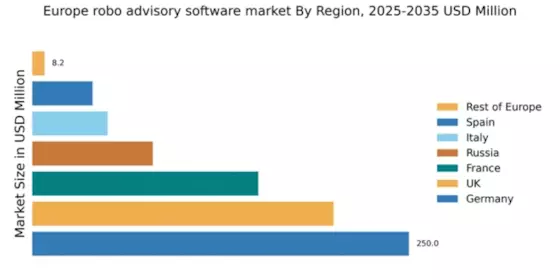
Germany holds a commanding market share of 250.0 USD Million, representing approximately 35% of the European robo advisory market. Key growth drivers include a robust fintech ecosystem, increasing digital adoption, and favorable regulatory frameworks that encourage innovation. The demand for automated investment solutions is rising, driven by a younger, tech-savvy population seeking efficient wealth management options. Government initiatives supporting digital finance further bolster this growth, alongside significant infrastructure investments in technology and data security.
UK : Innovation Meets Tradition in Finance
The UK robo advisory market is valued at 200.0, accounting for about 28% of the European landscape. Growth is fueled by a blend of traditional financial institutions and innovative startups, creating a competitive environment. The demand for personalized investment solutions is on the rise, particularly among millennials and Gen Z. Regulatory support from the Financial Conduct Authority (FCA) ensures consumer protection while promoting innovation, making the UK a favorable market for robo advisory services.
France : Growth Driven by Digital Transformation
France's robo advisory market is valued at 150.0, representing roughly 21% of the European market. The growth is driven by increasing digitalization and a shift towards self-directed investment among consumers. Regulatory frameworks are evolving to support fintech innovations, while government initiatives promote financial literacy. The demand for sustainable investment options is also gaining traction, reflecting changing consumer preferences towards ESG criteria.
Russia : Robo Advisory Gaining Traction
Russia's robo advisory market is valued at 80.0, making up about 11% of the European market. Key growth drivers include a rising middle class and increasing internet penetration. Demand for automated investment solutions is growing, particularly among younger investors. However, regulatory challenges and economic volatility pose risks. The government is working on improving the investment climate, which could enhance market conditions for robo advisory services in the future.
Italy : Cultural Factors Shape Investment Trends
Italy's robo advisory market is valued at 50.0, representing about 7% of the European market. Growth is hindered by cultural preferences for traditional banking and investment methods. However, increasing awareness of digital solutions is slowly changing consumer behavior. Regulatory bodies are beginning to adapt to the fintech landscape, promoting innovation while ensuring consumer protection. The demand for tailored investment solutions is emerging, particularly among younger demographics.
Spain : Market Evolving with Consumer Needs
Spain's robo advisory market is valued at 40.0, accounting for approximately 6% of the European market. The growth is driven by increasing financial literacy and a shift towards digital investment platforms. Regulatory support from the Comisión Nacional del Mercado de Valores (CNMV) is fostering a more favorable environment for fintech innovations. The demand for low-cost investment solutions is rising, particularly among millennials seeking to build wealth efficiently.
Rest of Europe : Diverse Opportunities Across Regions
The Rest of Europe holds a market value of 8.15, representing a small fraction of the overall market. Growth potential varies significantly across countries, influenced by local regulations and consumer preferences. Some regions are embracing digital investment solutions, while others remain cautious. The competitive landscape is fragmented, with local players emerging alongside established international firms. Regulatory environments are evolving, which could enhance market opportunities in the future.
Key Players and Competitive Insights
Key Companies in the Europe Robo Advisory Software Market include
Industry Developments
Recent developments in the Europe Robo Advisory Software Market have seen substantial activity. Notable growth has been observed among companies such as Wealthsimple, which expanded its services in the region, enhancing its appeal to consumers seeking digital investment solutions. Selma Finance continues to gain traction in the Swiss market, catering to users who appreciate personalized investment options.
Furthermore, Nutmeg secured significant investments, allowing it to innovate and refine its platform, while MoneyFarm has reported a boost in user engagement due to its user-friendly interface. In terms of mergers and acquisitions, Fidelity International has been expanding its portfolio, acquiring smaller fintech firms to bolster its technological capabilities in the robo-advisory space.
Major events over the last couple of years include the strategic collaboration between Scalable Capital and Saxo Bank in April 2021, aimed at enhancing their investment offerings. The market valuation of robo-advisory solutions has increased significantly, indicating a growing consumer trust in these platforms for wealth management. This evolving landscape is indicative of a robust and competitive market environment across Europe, encouraging continued innovation and service expansion.
Future Outlook
Europe Robo Advisory Software Market Future Outlook
The robo advisory-software market is projected to grow at a 15.71% CAGR from 2025 to 2035, driven by technological advancements, increasing demand for automated investment solutions, and regulatory support.
New opportunities lie in:
- Integration of AI-driven analytics for personalized investment strategies.
- Expansion into underserved markets with tailored robo advisory solutions.
- Partnerships with financial institutions to enhance service offerings and reach.
By 2035, the market is expected to achieve substantial growth, solidifying its position as a key player in financial services.
Market Segmentation
Europe Robo Advisory Software Market End User Outlook
- Individual Investors
- Institutional Investors
- Wealth Management Firms
- Financial Advisors
Europe Robo Advisory Software Market Features Outlook
- Portfolio Management
- Robo-Advisory Platforms
- Risk Assessment
- Automated Investment
Europe Robo Advisory Software Market Deployment Type Outlook
- On-Premise
- Cloud-Based
- Hybrid
Europe Robo Advisory Software Market Investment Type Outlook
- Equities
- Bonds
- Real Estate
- Cryptocurrencies
Report Scope
| MARKET SIZE 2024 | 778.15(USD Million) |
| MARKET SIZE 2025 | 900.4(USD Million) |
| MARKET SIZE 2035 | 3873.85(USD Million) |
| COMPOUND ANNUAL GROWTH RATE (CAGR) | 15.71% (2025 - 2035) |
| REPORT COVERAGE | Revenue Forecast, Competitive Landscape, Growth Factors, and Trends |
| BASE YEAR | 2024 |
| Market Forecast Period | 2025 - 2035 |
| Historical Data | 2019 - 2024 |
| Market Forecast Units | USD Million |
| Key Companies Profiled | Betterment (US), Wealthfront (US), Schwab Intelligent Portfolios (US), Fidelity Go (US), Acorns (US), M1 Finance (US), Nutmeg (GB), Scalable Capital (DE), Moneyfarm (IT) |
| Segments Covered | Deployment Type, End User, Investment Type, Features |
| Key Market Opportunities | Integration of artificial intelligence enhances personalization in the robo advisory-software market. |
| Key Market Dynamics | Rising demand for automated investment solutions drives innovation and competition in the robo advisory-software market. |
| Countries Covered | Germany, UK, France, Russia, Italy, Spain, Rest of Europe |
FAQs
What was the market valuation of the Europe robo advisory-software market in 2024?
The market valuation was $778.15 Million in 2024.
What is the projected market valuation for the Europe robo advisory-software market by 2035?
The projected valuation for 2035 is $3873.85 Million.
What is the expected CAGR for the Europe robo advisory-software market during the forecast period 2025 - 2035?
The expected CAGR is 15.71% during the forecast period 2025 - 2035.
Which deployment type had the highest valuation in 2024?
The Cloud-Based deployment type had the highest valuation at $466.89 Million in 2024.
What are the key end-user segments in the Europe robo advisory-software market?
Key end-user segments include Individual Investors, Institutional Investors, Wealth Management Firms, and Financial Advisors.
Which investment type showed the highest valuation in 2024?
Cryptocurrencies showed the highest valuation at $328.15 Million in 2024.
What features are commonly offered by robo advisory platforms?
Common features include Portfolio Management, Robo-Advisory Platforms, Risk Assessment, and Automated Investment.
Who are the leading players in the Europe robo advisory-software market?
Leading players include Betterment, Wealthfront, Schwab Intelligent Portfolios, Fidelity Go, Acorns, M1 Finance, Nutmeg, Scalable Capital, and Moneyfarm.
What was the valuation of Financial Advisors as an end-user segment in 2024?
The valuation of Financial Advisors as an end-user segment was $312.4 Million in 2024.
How does the market for robo advisory-software appear to be evolving in Europe?
The market appears to be evolving rapidly, with a projected growth to $3873.85 Million by 2035, indicating strong demand.
Kindly complete the form below to receive a free sample of this Report
Customer Stories
“This is really good guys. Excellent work on a tight deadline. I will continue to use you going forward and recommend you to others. Nice job”
“Thanks. It’s been a pleasure working with you, please use me as reference with any other Intel employees.”
“Thanks for sending the report it gives us a good global view of the Betaïne market.”
“Thank you, this will be very helpful for OQS.”
“We found the report very insightful! we found your research firm very helpful. I'm sending this email to secure our future business.”
“I am very pleased with how market segments have been defined in a relevant way for my purposes (such as "Portable Freezers & refrigerators" and "last-mile"). In general the report is well structured. Thanks very much for your efforts.”
“I have been reading the first document or the study, ,the Global HVAC and FP market report 2021 till 2026. Must say, good info! I have not gone in depth at all parts, but got a good indication of the data inside!”
“We got the report in time, we really thank you for your support in this process. I also thank to all of your team as they did a great job.”