×
Request Free Sample ×

Kindly complete the form below to receive a free sample of this Report

* Please use a valid business email

Leading companies partner with us for data-driven Insights

clients tt-cursor
Hero Background

Europe Robot Software Market

ID: MRFR/ICT/59866-HCR
200 Pages
Aarti Dhapte
October 2025

Europe Robot Software Market Research Report By Vertical (BFSI, Retail & E-commerce, Government, Healthcare, Logistics, Manufacturing, IT & Telecommunication), By Robot Type (Industrial Robots, Service Robots), By Deployment (On-premise, On-cloud), By Organization Size (Small & Medium Enterprises, Large Enterprises) and By Regional (Germany, UK, France, Russia, Italy, Spain, Rest of Europe)- Forecast to 2035

Share:
Download PDF ×

We do not share your information with anyone. However, we may send you emails based on your report interest from time to time. You may contact us at any time to opt-out.

Europe Robot Software Market Infographic
Purchase Options

Europe Robot Software Market Summary

As per MRFR analysis, the Europe robot software market size was estimated at 2100.0 USD Million in 2024. The robot software market is projected to grow from 2611.77 USD Million in 2025 to 23120.0 USD Million by 2035, exhibiting a compound annual growth rate (CAGR) of 24.37% during the forecast period 2025 - 2035.

Key Market Trends & Highlights

The Europe robot software market is experiencing robust growth driven by technological advancements and increasing automation.

  • Germany remains the largest market for robot software, showcasing a strong demand for automation solutions.
  • The UK is emerging as the fastest-growing region, reflecting a heightened interest in innovative robotic applications.
  • There is a notable trend towards interoperability and integration, as companies seek to enhance system compatibility.
  • The surge in manufacturing automation and the rising demand for collaborative robots are key drivers propelling market expansion.

Market Size & Forecast

2024 Market Size 2100.0 (USD Million)
2035 Market Size 23120.0 (USD Million)
CAGR (2025 - 2035) 24.37%

Major Players

ABB (CH), Siemens (DE), Rockwell Automation (US), KUKA (DE), Fanuc (JP), Yaskawa Electric (JP), Intuitive Surgical (US), Cognex (US), Omron (JP)

Europe Robot Software Market Trends

the robot software market is evolving dynamically, driven by advancements in artificial intelligence and automation technologies. As industries increasingly adopt robotic solutions, the demand for sophisticated software that enhances operational efficiency and productivity is on the rise. This trend is particularly evident in sectors such as manufacturing, logistics, and healthcare, where automation is becoming integral to business strategies. The integration of machine learning algorithms and data analytics into robotic systems is enabling organizations to optimize processes, reduce costs, and improve service delivery. Furthermore, the growing emphasis on sustainability and energy efficiency is prompting companies to invest in innovative software solutions that align with environmental goals. In addition, the regulatory landscape in Europe is evolving to support the safe deployment of robotic technologies. Governments are implementing frameworks that encourage research and development while ensuring compliance with safety standards. This regulatory support is likely to foster innovation and attract investment in the robot software market. As organizations seek to remain competitive, the focus on developing user-friendly interfaces and enhancing interoperability among different robotic systems is becoming increasingly important. Overall, the current trajectory of the robot software market suggests a robust growth potential, driven by technological advancements and supportive policies.

Increased Adoption of AI Technologies

The integration of artificial intelligence into robotic systems is transforming the capabilities of automation. Companies are increasingly utilizing AI-driven software to enhance decision-making processes, enabling robots to perform complex tasks with greater accuracy and efficiency.

Focus on Interoperability and Integration

As businesses deploy various robotic solutions, the need for seamless integration among different systems is becoming paramount. Software that facilitates interoperability is essential for maximizing the potential of robotic technologies across diverse applications.

Emphasis on Regulatory Compliance and Safety

With the rise of automation, regulatory bodies are establishing guidelines to ensure the safe use of robots. Compliance with these regulations is crucial for companies, driving the development of software that adheres to safety standards while promoting innovation.

Europe Robot Software Market Drivers

Surge in Manufacturing Automation

the robot software market in Europe is experiencing a notable surge in demand due to increasing automation in manufacturing processes. Industries are increasingly adopting robotic solutions to enhance productivity and reduce operational costs. According to recent data, the automation market in Europe is projected to grow at a CAGR of 10% from 2025 to 2030. This growth is driven by the need for efficiency and precision in production lines, where robot software plays a crucial role in controlling and optimizing robotic systems. As manufacturers seek to remain competitive, the integration of advanced robot software becomes essential, leading to a robust expansion of the market. The trend towards smart factories further amplifies this demand, as companies invest in technologies that enable real-time data analysis and adaptive manufacturing processes.

Rising Demand for Collaborative Robots

The increasing interest in collaborative robots, or cobots, significantly impacts the robot software market in Europe. These robots are designed to work alongside human operators, enhancing productivity while ensuring safety. The market for cobots is expected to grow by approximately 25% annually, reflecting a shift in how industries approach automation. Companies are increasingly recognizing the benefits of integrating cobots into their workflows, as they can be easily programmed and deployed in various applications. This trend necessitates the development of sophisticated robot software that can facilitate seamless human-robot interaction. As industries strive for greater flexibility and efficiency, the demand for collaborative robot solutions continues to rise, driving innovation within the robot software market.

Expansion of E-commerce and Logistics Automation

The rapid expansion of e-commerce in Europe significantly impacts the robot software market, particularly in logistics and supply chain automation. With online shopping becoming increasingly prevalent, companies are investing in automated solutions to streamline their operations and enhance delivery efficiency. The logistics sector is projected to grow by 20% over the next five years, driven by the need for faster and more reliable order fulfillment. This growth necessitates the implementation of advanced robot software that can manage inventory, optimize routing, and facilitate automated picking and packing processes. As e-commerce continues to thrive, the demand for sophisticated robotic solutions in logistics is likely to propel the robot software market forward, creating new avenues for innovation and growth.

Advancements in Robotics Research and Development

Ongoing advancements in robotics research and development are pivotal for the growth of the robot software market in Europe. Research institutions and private companies are investing heavily in developing cutting-edge technologies that enhance the capabilities of robotic systems. This investment is reflected in the increasing number of patents filed in the robotics sector, which has seen a rise of over 15% in recent years. Innovations in artificial intelligence, machine learning, and sensor technologies are enabling robots to perform more complex tasks with higher accuracy. Consequently, the demand for advanced robot software that can leverage these technologies is on the rise. As the landscape of robotics evolves, the robot software market is likely to benefit from these advancements, leading to more sophisticated and capable robotic solutions.

Growing Focus on Sustainability and Green Technologies

the robot software market in Europe is influenced by a growing focus on sustainability and green technologies. As industries strive to reduce their carbon footprint, there is a rising demand for robotic solutions that promote energy efficiency and resource conservation. The European Union has set ambitious targets for reducing greenhouse gas emissions, which encourages companies to adopt sustainable practices. This shift is likely to drive the development of robot software that optimizes energy consumption and minimizes waste during manufacturing processes. Furthermore, the integration of eco-friendly technologies in robotics is expected to create new opportunities within the market, as businesses seek to align with environmental regulations and consumer preferences for sustainable products.

Market Segment Insights

By Vertical: BFSI (Largest) vs. Healthcare (Fastest-Growing)

The market share distribution among the various segments within the robot software domain in Europe shows that BFSI (Banking, Financial Services, and Insurance) holds the largest portion. This is attributed to the rising adoption of automation in financial operations, risk management, and customer service enhancements. Other notable segments include Retail & e-commerce, Government, and Logistics, which collectively contribute significantly to the overall market, indicative of the growing shift towards digital transformation across these industries. On the other hand, the Healthcare segment is recognized as the fastest-growing division, primarily driven by increased demand for automation in patient management, diagnostics, and operational efficiencies. Factors contributing to this growth include advancements in AI technologies, rising investments in healthcare infrastructure, and the urgent need for efficient healthcare delivery systems, especially in the wake of the recent global health challenges.

BFSI (Dominant) vs. Healthcare (Emerging)

the BFSI segment extensively utilizes robot software to enhance operational efficiency and deliver better customer service. Financial institutions are increasingly integrating robots for handling transactions, risk assessments, and regulatory compliance, making it a dominant force in the market. Conversely, the Healthcare segment, while emerging, is experiencing rapid growth due to the pressing need for automation in clinical processes, robotic surgeries, and patient care solutions. This rising trend is fueled by technological advancements and the necessity for more efficient and accurate healthcare delivery, positioning Healthcare as a critical player in the evolving landscape of robot software.

By Type: Industrial Robots (Largest) vs. Service Robots (Fastest-Growing)

In the Europe robot software market, the segment distribution showcases that Industrial Robots hold a significant share, dominating the landscape. This category includes various applications across manufacturing, assembly, and quality control, making it a vital part of industry operations. In contrast, Service Robots, while smaller in market share, are rapidly gaining traction with applications spanning healthcare, hospitality, and domestic tasks. This growth indicates an evolving landscape where automation in service sectors is becoming increasingly relevant. The growth trends indicate that while Industrial Robots continue to be the stalwart of the market due to established usage and processes, Service Robots are emerging as the fastest-growing segment. Factors driving this include advancements in AI and machine learning, increasing labor costs, and rising consumer demand for automation in personal and professional services. As technology evolves, the service robot market is expected to experience exponential growth, reshaping how services are delivered across various sectors.

Industrial Robots: Dominant vs. Service Robots: Emerging

Industrial Robots are characterized by their extensive utilization in manufacturing and production environments, featuring high levels of precision and efficiency. They are integral to sectors such as automotive, electronics, and consumer goods, enabling companies to enhance productivity and reduce operational costs. On the other hand, Service Robots, recognized as the emerging segment, are rapidly transforming industries like healthcare and hospitality by automating tasks that require interaction and assistance. With their diverse applications, including telepresence and cleaning, Service Robots are marked by innovation and adaptability, catering to the growing demand for intelligent solutions in everyday operations. This dynamic presents opportunities for growth as both segments continue to evolve and diversify.

By Deployment: On-premise (Largest) vs. On-cloud (Fastest-Growing)

The deployment segment in the robot software market is characterized by a split between on-premise and on-cloud solutions. On-premise systems continue to dominate, capturing a significant share due to their robustness and control, making them a preferred choice for industries requiring stringent security measures. In contrast, on-cloud solutions are gaining traction owing to their flexibility and lower implementation costs, appealing particularly to smaller enterprises looking to scale. Growth trends indicate that while on-premise remains the stabilizing force, on-cloud deployments are expected to outpace their counterpart in the coming years. This shift is primarily driven by the increased adoption of IoT and AI technologies, which leverage cloud infrastructure for enhanced capabilities. The growing emphasis on remote operations and real-time data processing further fuels the demand for on-cloud solutions, positioning them as the future of robotic software deployment.

Deployment: On-premise (Dominant) vs. On-cloud (Emerging)

On-premise deployment in robot software is characterized by high control, security, and reliability, making it the preferred option for industries such as manufacturing and logistics. These systems allow companies to maintain extensive internal networks and customize software according to their specific needs. Conversely, on-cloud deployments represent an emerging trend, offering scalability, cost-effectiveness, and ease of integration with other cloud-based services. This model is increasingly appealing to small and medium enterprises that seek to innovate without the upfront costs traditionally associated with on-premise solutions. The agility and adaptive nature of on-cloud solutions align well with the fast-evolving technology landscape, presenting a compelling case for future growth.

By Organization Size: Small and Medium Size Enterprises (Largest) vs. Large Enterprises (Fastest-Growing)

In the Europe robot software market, the distribution of market share shows that Small and Medium Size Enterprises (SMEs) hold a significant portion of the overall market, reflecting their adaptability in adopting robotic technologies. Large Enterprises, while smaller in share compared to SMEs, are gaining momentum as they heavily invest in sophisticated and automated solutions to enhance their operational efficiency and competitiveness. The growth trends indicate that Large Enterprises are the fastest-growing segment as they increasingly recognize the benefits of automation in large-scale operations. Factors driving this growth include technological advancements, cost savings, and the need for enhanced productivity, which prompt these enterprises to pivot towards robust robot software solutions. On the other hand, SMEs continue to thrive by leveraging affordable robot software that can improve their processes without massive capital outlay, ensuring their relevance in a fast-evolving market landscape.

SMEs (Dominant) vs. Large Enterprises (Emerging)

Small and Medium Size Enterprises (SMEs) play a dominant role in the Europe robot software market, characterized by their agility and willingness to adopt new technologies to streamline operations. SMEs are leveraging affordable solutions that cater to specific needs, allowing them to stay competitive against larger counterparts. This segment benefits from customized offerings that directly address unique challenges faced by smaller organizations. Conversely, Large Enterprises are emerging as a valuable segment, driven by substantial investments in advanced robot software aimed at increasing efficiency and productivity. Their focus on large-scale implementation of robotic solutions signals a shift towards greater automation, setting the stage for significant advancements in operational capabilities.

Get more detailed insights about Europe Robot Software Market

Regional Insights

Germany : Strong industrial base drives growth

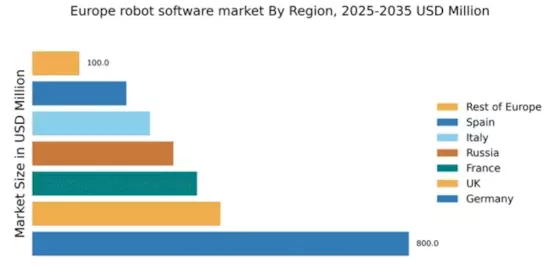
Germany holds a commanding 40% market share in the European robot software market, valued at $800.0 million. Key growth drivers include a robust manufacturing sector, particularly in automotive and machinery, alongside increasing automation demands. Government initiatives, such as Industry 4.0, promote digital transformation, while stringent regulations ensure safety and efficiency in industrial operations. The country’s advanced infrastructure supports rapid deployment of robotic solutions.

UK : Investment fuels market expansion

The UK commands a 20% market share, valued at $400.0 million, driven by significant investments in robotics and AI technologies. Demand is rising in sectors like healthcare and logistics, where automation enhances efficiency. Government support through funding programs and innovation grants fosters a favorable environment for startups and established firms alike. The UK's regulatory framework encourages safe and effective use of robotic technologies.

France : Strong focus on industrial automation

France holds a 17.5% market share, valued at $350.0 million, with growth fueled by diverse applications in manufacturing, healthcare, and agriculture. The French government promotes automation through initiatives like the 'France 2030' plan, which aims to boost technological innovation. Demand for robotics is particularly strong in urban areas like Paris and Lyon, where industrial modernization is a priority.

Russia : Industrial modernization drives growth

With a 15% market share valued at $300.0 million, Russia's robot software market is expanding as industries modernize. Key growth drivers include government initiatives aimed at enhancing technological capabilities and increasing foreign investments. Major cities like Moscow and St. Petersburg are focal points for robotics adoption, particularly in manufacturing and logistics sectors, where efficiency is paramount.

Italy : Heritage meets modern technology

Italy captures a 12.5% market share, valued at $250.0 million, with a strong emphasis on robotics in manufacturing. The Italian government supports automation through various initiatives, enhancing competitiveness in sectors like automotive and textiles. Cities such as Milan and Turin are key markets, where traditional industries are increasingly integrating robotic solutions to improve productivity and reduce costs.

Spain : Robust growth in robotics adoption

Spain holds a 10% market share, valued at $200.0 million, with significant growth in sectors like automotive and agriculture. Government policies promoting digital transformation and sustainability are driving demand for robotic solutions. Key markets include Barcelona and Madrid, where local firms are increasingly adopting automation to enhance operational efficiency and meet global standards.

Rest of Europe : Diverse opportunities across regions

The Rest of Europe accounts for a 5% market share, valued at $100.0 million, characterized by a fragmented landscape with varying levels of robotics adoption. Countries like Belgium and the Netherlands are emerging markets, driven by innovation and investment in automation. Local regulations and government initiatives play a crucial role in shaping the market dynamics, fostering growth in specific sectors such as logistics and healthcare.

Europe Robot Software Market Regional Image

Key Players and Competitive Insights

The robot software market exhibits a dynamic competitive landscape characterized by rapid technological advancements and increasing demand across various sectors. Key growth drivers include the rising adoption of automation in manufacturing, logistics, and healthcare, alongside the integration of artificial intelligence (AI) and machine learning capabilities. Major players such as ABB (CH), Siemens (DE), and KUKA (DE) are strategically positioned to leverage these trends. ABB (CH) focuses on innovation through its digital solutions, enhancing operational efficiency and sustainability. Siemens (DE) emphasizes regional expansion and partnerships, particularly in smart manufacturing, while KUKA (DE) is known for its strong emphasis on robotics in industrial applications, which collectively shapes a competitive environment that is increasingly reliant on technological differentiation.

Key business tactics within the market include localizing manufacturing to reduce costs and optimize supply chains, which is particularly relevant given the current geopolitical climate. The competitive structure appears moderately fragmented, with a mix of established players and emerging startups. The collective influence of these key players fosters an environment where innovation and strategic partnerships are paramount for maintaining market share and driving growth.

In September 2025, ABB (CH) announced a partnership with a leading AI firm to enhance its robot software capabilities, aiming to integrate advanced machine learning algorithms into its existing platforms. This strategic move is likely to bolster ABB's competitive edge by enabling more adaptive and intelligent robotic solutions, thereby addressing the growing demand for smart automation in various industries.

In October 2025, Siemens (DE) unveiled a new software suite designed to optimize production processes through real-time data analytics. This initiative not only reinforces Siemens' commitment to digital transformation but also positions the company as a frontrunner in providing comprehensive solutions that enhance operational efficiency for its clients. The introduction of this software suite may significantly impact the competitive dynamics by setting new standards for performance and reliability in robot software applications.

In August 2025, KUKA (DE) expanded its product line by launching a new series of collaborative robots (cobots) equipped with advanced safety features and user-friendly interfaces. This development reflects KUKA's strategic focus on enhancing human-robot collaboration, which is increasingly vital in modern manufacturing environments. The introduction of these cobots could potentially reshape market expectations regarding safety and usability, thereby influencing customer preferences and competitive positioning.

As of November 2025, current trends in the robot software market are heavily influenced by digitalization, sustainability, and the integration of AI technologies. Strategic alliances are becoming increasingly important, as companies seek to combine their strengths to innovate and meet evolving customer demands. The competitive landscape is likely to shift from traditional price-based competition towards a focus on technological innovation, reliability, and supply chain resilience. This evolution suggests that companies will need to continuously adapt their strategies to maintain a competitive advantage in an ever-changing market.

Key Companies in the Europe Robot Software Market market include

Industry Developments

The Europe Robot Software Market has recently been witnessing significant advancements and notable trends. In October 2023, NVIDIA announced enhancements to its AI-driven robot operating system, promoting greater efficiency in industrial automation. Fanuc launched new software solutions aimed at improving robotic performance, thereby driving demand across various sectors. A key acquisition in this market was reported in September 2023 when Siemens announced the purchase of a controlling stake in a robotic software start-up, reinforcing its commitment to expanding its digital services in automation.

In terms of market valuation growth, companies such as KUKA and ABB have reported substantial increases in their software sales, prompted by the need for advanced automation solutions among manufacturers in Europe. Over the past two to three years, Universal Robots significantly boosted its market presence by expanding its product range, particularly in collaborative robots. Meanwhile, Rockwell Automation and SICK AG have increasingly collaborated to enhance sensor integration in robotic systems. With ongoing investments in Research and Development, the Europe Robot Software Market is positioned for continued growth amidst rising demand for automation and smart manufacturing technologies.


Future Outlook

Europe Robot Software Market Future Outlook

The robot software market is projected to grow at a 24.37% CAGR from 2024 to 2035, driven by advancements in AI, automation, and increased demand for efficiency.

New opportunities lie in:

  • Development of AI-driven predictive maintenance software for industrial robots.
  • Integration of robotic process automation in supply chain management.
  • Creation of customizable software solutions for specific industry needs.

By 2035, the robot software market is expected to achieve substantial growth and innovation.

Market Segmentation

Europe Robot Software Market Type Outlook

  • Industrial Robots
  • Service Robots

Europe Robot Software Market Vertical Outlook

  • BFSI
  • Retail & e-commerce
  • Government
  • Healthcare
  • Logistics
  • Manufacturing
  • IT & Telecommunication

Europe Robot Software Market Deployment Outlook

  • On-premise
  • On-cloud

Europe Robot Software Market Organization Size Outlook

  • Small and Medium Size Enterprises
  • Large Enterprises

Report Scope

MARKET SIZE 20242100.0(USD Million)
MARKET SIZE 20252611.77(USD Million)
MARKET SIZE 203523120.0(USD Million)
COMPOUND ANNUAL GROWTH RATE (CAGR)24.37% (2024 - 2035)
REPORT COVERAGERevenue Forecast, Competitive Landscape, Growth Factors, and Trends
BASE YEAR2024
Market Forecast Period2025 - 2035
Historical Data2019 - 2024
Market Forecast UnitsUSD Million
Key Companies Profiled["ABB (CH)", "Siemens (DE)", "Rockwell Automation (US)", "KUKA (DE)", "Fanuc (JP)", "Yaskawa Electric (JP)", "Intuitive Surgical (US)", "Cognex (US)", "Omron (JP)"]
Segments CoveredVertical, Type, Deployment, Organization Size
Key Market OpportunitiesIntegration of artificial intelligence in robot software enhances automation efficiency and operational flexibility.
Key Market DynamicsRising demand for automation drives innovation in robot software, influenced by regulatory standards and competitive pressures.
Countries CoveredGermany, UK, France, Russia, Italy, Spain, Rest of Europe

Leave a Comment

FAQs

What is the expected market size of the Europe Robot Software Market by 2024?

The Europe Robot Software Market is expected to be valued at 2.1 USD Billion by the year 2024.

What will the value of the Europe Robot Software Market be in 2035?

The market is projected to reach 23.1 USD Billion by the year 2035.

What is the expected CAGR for the Europe Robot Software Market during the forecast period from 2025 to 2035?

The expected CAGR for the Europe Robot Software Market from 2025 to 2035 is 24.367%.

Which vertical in the Europe Robot Software Market shows significant growth potential?

The Healthcare vertical is anticipated to grow from 0.6 USD Billion in 2024 to 7.2 USD Billion by 2035.

What are the market values for the BFSI segment in the Europe Robot Software Market by 2035?

The BFSI segment is expected to be valued at 3.5 USD Billion in 2035.

Which region is expected to dominate the Europe Robot Software Market by 2035?

Germany is projected to dominate the market with a value of 8.1 USD Billion by 2035.

What will be the market size of the UK in the Europe Robot Software Market by 2035?

The market size for the UK is anticipated to reach 5.9 USD Billion by 2035.

Who are the key players in the Europe Robot Software Market?

Major players include NVIDIA, Fanuc, Siemens, and Rockwell Automation among others.

What challenges might the Europe Robot Software Market face in the coming years?

The market may face challenges from regulatory hurdles and technological integration.

What growth drivers are influencing the Europe Robot Software Market?

Increased automation and advancements in AI technology are key growth drivers for the market.

Download Free Sample

Kindly complete the form below to receive a free sample of this Report

Compare Licence

×
Features License Type
Single User Multiuser License Enterprise User
Price $4,950 $5,950 $7,250
Maximum User Access Limit 1 User Upto 10 Users Unrestricted Access Throughout the Organization
Free Customization
Direct Access to Analyst
Deliverable Format
Platform Access
Discount on Next Purchase 10% 15% 15%
Printable Versions