×
Request Free Sample ×

Kindly complete the form below to receive a free sample of this Report

Leading companies partner with us for data-driven Insights

clients tt-cursor
Hero Background

Europe Smart Grid Networking Market

ID: MRFR/ICT/63062-HCR
200 Pages
Aarti Dhapte
October 2025

Europe Smart Grid Networking Market Research Report By Hardware (Cables, Controllers, Routers, Smart Meter, Switches) and By Regional (Germany, UK, France, Russia, Italy, Spain, Rest of Europe)- Forecast to 2035

Share:
Download PDF ×

We do not share your information with anyone. However, we may send you emails based on your report interest from time to time. You may contact us at any time to opt-out.

Europe Smart Grid Networking Market Infographic
Purchase Options

Europe Smart Grid Networking Market Summary

As per MRFR analysis, the Europe smart grid-networking market size was estimated at 5.16 USD Billion in 2024.. The Europe smart grid-networking market is projected to grow from 5.69 USD Billion in 2025 to 15.21 USD Billion by 2035, exhibiting a compound annual growth rate (CAGR) of 10.32% during the forecast period 2025 - 2035.

Key Market Trends & Highlights

The Europe smart grid-networking market is poised for substantial growth driven by technological advancements and regulatory support.

  • Germany remains the largest market for smart grid networking, reflecting robust investment in infrastructure.
  • The UK is emerging as the fastest-growing region, showcasing a rapid adoption of advanced technologies.
  • There is a heightened focus on cybersecurity measures to protect smart grid systems from potential threats.
  • Regulatory support for smart grids and rising demand for renewable energy are key drivers propelling market expansion.

Market Size & Forecast

2024 Market Size 5.16 (USD Billion)
2035 Market Size 15.21 (USD Billion)

Major Players

Siemens (DE), General Electric (US), Schneider Electric (FR), Itron (US), Honeywell (US), Cisco Systems (US), ABB (CH), Landis+Gyr (CH), Eaton (US)

Europe Smart Grid Networking Market Trends

The smart grid-networking market is currently experiencing a transformative phase. This is driven by the increasing demand for efficient energy management and the integration of renewable energy sources.. This shift is largely influenced by regulatory frameworks that promote sustainability and energy efficiency across various sectors. As governments prioritize the reduction of carbon emissions, investments in smart grid technologies are becoming more prevalent. The deployment of advanced metering infrastructure and real-time data analytics is enhancing the operational efficiency of energy distribution networks. Furthermore, the rise of electric vehicles and distributed energy resources is reshaping the landscape, necessitating robust networking solutions to manage the complexities of modern energy systems. In addition, the smart grid-networking market is witnessing a surge in innovation, with various stakeholders exploring new technologies such as artificial intelligence and blockchain. These advancements are expected to improve grid reliability and security while enabling better consumer engagement. The collaboration between public and private sectors is also fostering an environment conducive to research and development, which may lead to the emergence of new business models. Overall, the current trends indicate a promising future for the smart grid-networking market, as it adapts to the evolving energy landscape and addresses the challenges posed by climate change and urbanization.

Increased Investment in Infrastructure

There is a notable trend towards heightened investment in smart grid infrastructure. This is driven by the need for modernization of aging energy systems and the integration of renewable energy sources. Governments and utility companies are allocating resources to enhance grid resilience and efficiency, which may lead to improved service delivery and reduced operational costs.

Adoption of Advanced Technologies

The smart grid-networking market is seeing a significant adoption of advanced technologies such as IoT and AI. These technologies facilitate real-time monitoring and data analysis, enabling utilities to optimize energy distribution and enhance customer engagement. The integration of these innovations is likely to transform traditional energy management practices.

Focus on Cybersecurity Measures

As the smart grid-networking market expands, there is an increasing emphasis on cybersecurity. The interconnected nature of smart grids makes them vulnerable to cyber threats, prompting stakeholders to invest in robust security measures. This focus on safeguarding critical infrastructure is essential for maintaining consumer trust and ensuring the reliability of energy services.

Europe Smart Grid Networking Market Drivers

Regulatory Support for Smart Grids

The regulatory landscape in Europe is increasingly supportive of smart grid initiatives, which is a crucial driver for the smart grid-networking market. Governments are implementing policies that promote the integration of renewable energy sources and enhance grid reliability. For instance, the European Union has set ambitious targets for reducing greenhouse gas emissions by at least 55% by 2030. This regulatory framework encourages investments in smart grid technologies, which are essential for managing distributed energy resources. The smart grid-networking market is projected to grow significantly as utilities and energy providers align their strategies with these regulations, potentially reaching a market value of €50 billion by 2027. This supportive environment fosters innovation and collaboration among stakeholders, further propelling the market forward.

Rising Demand for Renewable Energy

The increasing demand for renewable energy sources is a pivotal driver for the smart grid-networking market. As Europe aims to transition to a low-carbon economy, the integration of solar, wind, and other renewable energies into the grid becomes imperative. The European Commission estimates that renewable energy could account for over 60% of the EU's electricity generation by 2030. This shift necessitates advanced smart grid solutions to manage the variability and decentralization of energy production. Consequently, the smart grid-networking market is expected to expand, with investments in technologies that facilitate real-time monitoring and control of energy flows. This trend not only supports sustainability goals but also enhances energy security and resilience across the region.

Investment in Energy Storage Solutions

Investment in energy storage solutions is emerging as a critical driver for the smart grid-networking market. As the integration of renewable energy sources increases, the need for effective energy storage becomes paramount to ensure grid stability and reliability. Europe is witnessing a surge in investments in battery storage technologies, which are essential for balancing supply and demand. The European Battery Alliance aims to establish a competitive battery industry in Europe, with projections indicating that the energy storage market could reach €20 billion by 2030. This investment not only supports the smart grid-networking market but also enhances the overall resilience of the energy infrastructure, enabling a smoother transition to a sustainable energy future.

Increased Consumer Awareness and Engagement

Consumer awareness regarding energy consumption and sustainability is on the rise, serving as a significant driver for the smart grid-networking market. European consumers are becoming more informed about their energy usage and are increasingly seeking ways to reduce their carbon footprint. This shift in consumer behavior is prompting utilities to adopt smart grid technologies that provide real-time data and insights into energy consumption patterns. The smart grid-networking market is likely to see a surge in demand for solutions that empower consumers to make informed decisions about their energy use. This trend not only enhances customer satisfaction but also supports the overall efficiency of the energy system, potentially leading to a market growth of €30 billion by 2028.

Technological Advancements in Communication

Technological advancements in communication technologies are significantly influencing the smart grid-networking market. Innovations such as 5G and Internet of Things (IoT) are enhancing the capabilities of smart grids, enabling faster data transmission and improved connectivity. These technologies facilitate real-time monitoring and management of energy resources, which is essential for optimizing grid performance. The smart grid-networking market is likely to benefit from these advancements, as they allow for better integration of distributed energy resources and enhance consumer engagement. As a result, the market could see a compound annual growth rate (CAGR) of around 15% over the next five years, driven by the need for more efficient and responsive energy systems.

Market Segment Insights

By Hardware: Smart Meters (Largest) vs. Switches (Fastest-Growing)

In the hardware segment of the smart grid networking market, Smart Meters hold a significant position, capturing the largest share among various components. This dominance can be attributed to their essential role in energy management and billing, closely followed by Switches, which are gaining traction due to the increasing demand for enhanced connectivity and real-time data transmission. Other components such as Cables, Controllers, and Routers, while important, lag behind in market share, as their applications become more diversified and integrated into broader smart grid solutions. Growth trends indicate a robust expansion for smart grid hardware, driven by the increasing need for energy efficiency and reliable infrastructure in Europe. The surge in renewable energy sources and decentralization of energy generation is fuelling the adoption of Smart Meters, while Switches are emerging as crucial elements in modernizing grid systems. Innovations in connectivity protocols and advancements in IoT technology further underpin this growth, creating enhanced functionalities and capabilities within the hardware segment.

Smart Meters: Dominant vs. Switches: Emerging

Smart Meters are characterized by their ability to provide real-time monitoring and automated meter reading, making them invaluable in modern energy management systems. They facilitate accurate billing and empower consumers with detailed insights into their energy consumption patterns. As a result, they have become the cornerstone of the hardware segment in the smart grid networking market. On the other hand, Switches are emerging rapidly, driven by the need for high-speed data transfer and the integration of smart technologies. Their ability to support various communication protocols makes them increasingly important as grid networks evolve. Together, these hardware components play a pivotal role in enhancing the reliability and efficiency of energy distribution in Europe.

By Software: Network Performance Monitoring (Largest) vs. Network Security Management (Fastest-Growing)

In the Europe smart grid-networking market, the software segment is primarily dominated by Network Performance Monitoring, capturing the largest market share due to its critical role in ensuring optimal operation of smart grid systems. Following closely are other key values such as Network Device Management and Network Configuration Management, though they hold comparatively smaller portions of the overall market. The increasing complexity of networks also amplifies the need for robust solutions like IP Address Management and Network Traffic Management, which are essential for effective resource utilization. Growth trends in this segment are being significantly driven by the increasing adoption of IoT technologies and the need for enhanced network security solutions. Network Security Management is emerging as the fastest-growing area within the software segment due to escalating cybersecurity threats and the necessity to protect sensitive grid data. Additionally, advancements in AI and machine learning are aiding in the development of sophisticated monitoring tools that enable predictive maintenance and real-time analytics, further propelling market growth.

Network Performance Monitoring (Dominant) vs. Network Security Management (Emerging)

Network Performance Monitoring is recognized as the dominant software category due to its vital functions in tracking, measuring, and optimizing the performance of smart grid networks. Its solutions are essential for predicting potential failures and ensuring seamless connectivity, which is crucial in maintaining the integrity of power distribution systems. On the other hand, Network Security Management is positioned as an emerging force, rapidly gaining traction in response to increasing cybersecurity threats facing smart grid infrastructure. It focuses on safeguarding networks from unauthorized access and cyber-attacks, thus ensuring the security and resilience of critical services. Both segments complement each other and are pivotal for the evolution of more secure, efficient, and reliable smart grid systems.

By Services: Consulting (Largest) vs. Network Maintenance & Support (Fastest-Growing)

The market share distribution for the services segment reflects a strong preference for Consulting, which maintains the largest share among segment values. Network Maintenance & Support is emerging notably, driven by the need for ongoing support in the dynamic landscape of smart grid technologies. Other services like Network Planning and Design & Integration also hold a significant share, collectively depicting a diversified service portfolio that meets various client needs. Growth trends in the services segment are primarily fueled by increasing investments in advanced smart grid solutions. The push for efficiency and reliability drives demand for professional services, particularly in risk & security assessments. As utilities strive to upgrade and maintain sophisticated networks, the need for expert consulting and maintenance services is expanding. The rapid evolution of technology is also propelling Network Maintenance & Support as firms prioritize resilience against potential disruptions.

Consulting (Dominant) vs. Network Maintenance & Support (Emerging)

Consulting in the services segment stands as the dominant force, catering to organizations looking to strategize their smart grid implementations. This segment emphasizes expert advisory services tailored to address unique operational challenges faced by utilities. Conversely, Network Maintenance & Support represents an emerging trend, with increasing emphasis on proactive upkeep and troubleshooting within smart grid frameworks. This shift reflects the industry's recognition of the necessity for sustained performance and reliability. Both segments are pivotal, with Consulting driving initial strategic directions and Network Maintenance & Support ensuring continued operational integrity, thus together enabling a comprehensive service ecosystem aimed at enhancing smart grid implementations.

Get more detailed insights about Europe Smart Grid Networking Market

Regional Insights

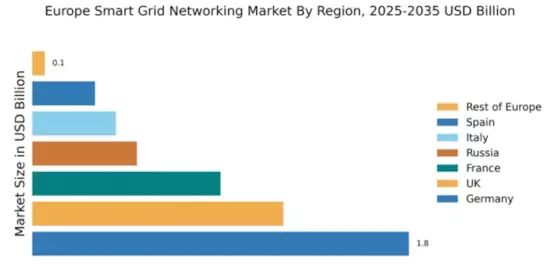
The Europe Smart Grid Networking Market exhibits robust growth across its various regional segments, driven by advancements in technology and an increasing emphasis on energy efficiency. Germany is notable for its strong commitment to renewable energy and infrastructure development, thus taking a leading role in smart grid initiatives. The UK follows closely with significant investments in smart metering and grid modernization efforts aimed at enhancing renewable integration. 

France's focus on nuclear energy also emphasizes the need for a reliable smart grid system to manage demand effectively.Russia, with its vast geographic expanse, presents unique challenges and opportunities, particularly in rural connectivity and enhancing grid resilience. Italy stands out with its initiatives aimed at reducing carbon footprints through innovative smart grid solutions. 

Spain's involvement in smart grid technology further elevates its role within the European context, primarily through pilot projects focusing on efficiency and sustainability. Overall, the region showcases a diverse landscape with varying priorities, yet all share a common goal: enhancing grid reliability, sustainability, and efficiency, positioning Europe at the forefront of global smart grid development.The Europe Smart Grid Networking Market segmentation reflects these unique attributes, creating considerable opportunities for investment and growth within the region.

Europe Smart Grid Networking Market Regional Image

Key Players and Competitive Insights

The smart grid-networking market in Europe is characterized by a dynamic competitive landscape, driven by the increasing demand for energy efficiency, sustainability, and digital transformation. Key players such as Siemens (DE), Schneider Electric (FR), and ABB (CH) are at the forefront, each adopting distinct strategies to enhance their market positioning. Siemens (DE) focuses on innovation through its digital grid solutions, aiming to integrate advanced technologies into existing infrastructures. Schneider Electric (FR) emphasizes partnerships and collaborations, particularly in renewable energy sectors, to expand its service offerings. ABB (CH) is leveraging its expertise in automation and electrification to develop smart grid solutions that enhance operational efficiency. Collectively, these strategies contribute to a competitive environment that is increasingly oriented towards technological advancement and sustainability.

In terms of business tactics, companies are localizing manufacturing and optimizing supply chains to enhance responsiveness to market demands. The competitive structure of the market appears moderately fragmented, with several key players exerting influence over various segments. This fragmentation allows for a diverse range of solutions, catering to different regional needs and regulatory frameworks, while also fostering innovation through competition.

In October 2025, Siemens (DE) announced a strategic partnership with a leading European utility provider to develop a new smart grid platform aimed at enhancing grid resilience and integrating renewable energy sources. This collaboration is significant as it not only strengthens Siemens' position in the market but also aligns with the growing emphasis on sustainability and energy transition across Europe. The partnership is expected to facilitate the deployment of advanced grid management technologies, thereby improving operational efficiencies.

In September 2025, Schneider Electric (FR) launched a new suite of digital solutions designed to optimize energy consumption in commercial buildings. This initiative reflects Schneider's commitment to digital transformation and energy efficiency, addressing the increasing regulatory pressures for sustainability. The introduction of these solutions is likely to enhance Schneider's competitive edge by providing customers with actionable insights to reduce energy costs and carbon footprints.

In November 2025, ABB (CH) unveiled its latest smart grid technology, which incorporates AI-driven analytics to predict energy demand and optimize grid performance. This innovation is crucial as it positions ABB as a leader in integrating artificial intelligence into smart grid solutions, potentially setting new standards for operational efficiency. The ability to leverage AI for predictive analytics may significantly enhance grid reliability and responsiveness, catering to the evolving needs of energy consumers.

As of November 2025, current competitive trends in the smart grid-networking market are heavily influenced by digitalization, sustainability initiatives, and the integration of AI technologies. Strategic alliances are increasingly shaping the landscape, enabling companies to pool resources and expertise to tackle complex challenges. Looking ahead, competitive differentiation is likely to evolve from traditional price-based competition towards a focus on innovation, technological advancements, and supply chain reliability. This shift underscores the importance of developing robust, sustainable solutions that meet the demands of a rapidly changing energy landscape.
Key Companies in the Europe Smart Grid Networking Market market include

Industry Developments

The Europe Smart Grid Networking Market has seen significant developments recently, particularly with the growing focus on energy efficiency and sustainability. Companies like Siemens, ABB, and Schneider Electric are actively investing in advanced technologies to support the transition to smart grids. 

In September 2023, Cisco announced a new partnership with a European energy provider aimed at integrating IoT solutions into their infrastructure to enhance grid management. Moreover, in July 2023, Moxa launched a new series of networking products designed specifically for energy management applications to support digital transformation in utilities.

Current affairs also reflect a strong interest in mergers and acquisitions, with Itron completing its acquisition of a subsidiary from Landis+Gyr in June 2023 to expand its market presence. Additionally, in December 2022, Oracle acquired a smart metering company operating in Europe, which is anticipated to enhance its data analytics offering in the energy sector. The market's valuation has been positively impacted by these technological advancements and collaborations, predicting a robust growth trajectory, driven by increasing demand for smart energy solutions across the region.


Future Outlook

Europe Smart Grid Networking Market Future Outlook

The smart grid-networking market is projected to grow at a 10.32% CAGR from 2024 to 2035, driven by technological advancements, regulatory support, and increasing energy efficiency demands.

New opportunities lie in:

  • Development of advanced metering infrastructure solutions
  • Integration of AI-driven analytics for grid optimization
  • Expansion of cybersecurity services for smart grid protection

By 2035, the market is expected to achieve substantial growth, positioning itself as a leader in energy innovation.

Market Segmentation

Europe Smart Grid Networking Market Hardware Outlook

  • Cables
  • Controllers
  • Routers
  • Smart Meters
  • Switches
  • Others

Europe Smart Grid Networking Market Services Outlook

  • Consulting
  • Network Planning
  • Design & Integration
  • Network Risk & Security Assessment
  • Network Maintenance & Support
  • Others

Europe Smart Grid Networking Market Software Outlook

  • Network Performance Monitoring
  • IP Address Management
  • Network Traffic Management
  • Network Device Management
  • Network Configuration Management
  • Network Security Management
  • Others

Report Scope

MARKET SIZE 2024 5.16(USD Billion)
MARKET SIZE 2025 5.69(USD Billion)
MARKET SIZE 2035 15.21(USD Billion)
COMPOUND ANNUAL GROWTH RATE (CAGR) 10.32% (2024 - 2035)
REPORT COVERAGE Revenue Forecast, Competitive Landscape, Growth Factors, and Trends
BASE YEAR 2024
Market Forecast Period 2025 - 2035
Historical Data 2019 - 2024
Market Forecast Units USD Billion
Key Companies Profiled ["Siemens (DE)", "General Electric (US)", "Schneider Electric (FR)", "Itron (US)", "Honeywell (US)", "Cisco Systems (US)", "ABB (CH)", "Landis+Gyr (CH)", "Eaton (US)"]
Segments Covered Hardware, Software, Services
Key Market Opportunities Integration of advanced analytics and IoT solutions enhances efficiency in the smart grid-networking market.
Key Market Dynamics Growing regulatory support and technological advancements drive innovation in the smart grid-networking market.
Countries Covered Germany, UK, France, Russia, Italy, Spain, Rest of Europe

Leave a Comment

FAQs

What is the projected market size for the Europe Smart Grid Networking Market in 2024?

The Europe Smart Grid Networking Market is projected to be valued at 4.3 billion USD in 2024.

What is the expected market value for the Europe Smart Grid Networking Market by 2035?

By 2035, the market is expected to reach a value of 12.67 billion USD.

What is the anticipated CAGR for the Europe Smart Grid Networking Market from 2025 to 2035?

The expected CAGR for the Europe Smart Grid Networking Market during the forecast period is 10.323%.

Which region is expected to dominate the Europe Smart Grid Networking Market by 2035?

Germany is expected to dominate the market, reaching a value of 3.22 billion USD by 2035.

What market size is projected for Smart Meter hardware in the Europe Smart Grid Networking Market by 2035?

The market size for Smart Meter hardware is projected to reach 3.2 billion USD by 2035.

Who are the key players in the Europe Smart Grid Networking Market?

Major players in the market include Moxa, Oracle, Siemens, Eaton, Itron, and ABB.

What is the expected market size for Cables hardware in the Europe Smart Grid Networking Market by 2024?

The market size for Cables hardware is expected to be valued at 1.2 billion USD in 2024.

What are the projected market values of the UK for the Europe Smart Grid Networking Market by 2035?

The UK market is expected to reach a value of 2.6 billion USD by 2035.

What challenges are faced by the Europe Smart Grid Networking Market?

Key challenges include regulatory hurdles and the integration of new technologies.

What growth opportunities exist in the Europe Smart Grid Networking Market?

Opportunities exist in the development of advanced infrastructure and smart city initiatives.

Download Free Sample

Kindly complete the form below to receive a free sample of this Report

Compare Licence

×
Features License Type
Single User Multiuser License Enterprise User
Price $4,950 $5,950 $7,250
Maximum User Access Limit 1 User Upto 10 Users Unrestricted Access Throughout the Organization
Free Customization
Direct Access to Analyst
Deliverable Format
Platform Access
Discount on Next Purchase 10% 15% 15%
Printable Versions