×
Request Free Sample ×

Kindly complete the form below to receive a free sample of this Report

Leading companies partner with us for data-driven Insights

clients tt-cursor
Hero Background

Europe Software Defined Perimeter Market

ID: MRFR/ICT/62648-HCR
200 Pages
Aarti Dhapte
October 2025

Europe Software Defined Perimeter Market Research Report By Deployment (Cloud, On-Premise), By Enterprise Type (SMEs, Large Enterprises) and By Regional (Germany, UK, France, Russia, Italy, Spain, Rest of Europe) - Forecast to 2035

Share:
Download PDF ×

We do not share your information with anyone. However, we may send you emails based on your report interest from time to time. You may contact us at any time to opt-out.

Europe Software Defined Perimeter Market Infographic
Purchase Options

Europe Software Defined Perimeter Market Summary

As per MRFR analysis, the Europe software defined-perimeter market Size was estimated at 2907.5 USD Million in 2024. The Europe software defined-perimeter market is projected to grow from 3234.59 USD Million in 2025 to 9392.0 USD Million by 2035, exhibiting a compound annual growth rate (CAGR) of 11.25% during the forecast period 2025 - 2035.

Key Market Trends & Highlights

The Europe software defined-perimeter market is experiencing robust growth driven by regulatory compliance and the need for enhanced security measures.

  • Germany remains the largest market for software defined-perimeter solutions, reflecting a strong emphasis on regulatory compliance and data protection.
  • The UK is emerging as the fastest-growing region, driven by increasing remote work and cloud integration demands.
  • Rising awareness of cyber threats is prompting organizations across Europe to adopt more sophisticated security frameworks.
  • Key market drivers include the increased demand for secure access solutions and the widespread adoption of zero trust security models.

Market Size & Forecast

2024 Market Size 2907.5 (USD Million)
2035 Market Size 9392.0 (USD Million)

Major Players

Cisco Systems (US), Palo Alto Networks (US), VMware (US), Zscaler (US), Cloudflare (US), Fortinet (US), Check Point Software Technologies (IL), Akamai Technologies (US)

Europe Software Defined Perimeter Market Trends

The software defined-perimeter market is currently experiencing notable growth, driven by the increasing demand for enhanced security measures in network environments. Organizations are increasingly adopting this technology to mitigate risks associated with unauthorized access and data breaches. The shift towards remote work and cloud-based services has further accelerated the need for robust security frameworks. As businesses prioritize safeguarding sensitive information, the software defined-perimeter market is poised to expand significantly in the coming years. This trend is particularly evident in Europe, where regulatory compliance and data protection laws are becoming more stringent, compelling organizations to invest in advanced security solutions. In addition to security concerns, the software defined-perimeter market is influenced by the rising complexity of IT infrastructures. Organizations are integrating various technologies, which necessitates a cohesive security approach. The adoption of software defined-perimeter solutions allows for a more streamlined and efficient management of security protocols. Furthermore, the increasing awareness of cyber threats among businesses is prompting a proactive stance towards security investments. As a result, the software defined-perimeter market is likely to witness sustained growth, with organizations in Europe leading the charge towards more secure network environments.

Regulatory Compliance and Data Protection

The software defined-perimeter market is significantly shaped by the stringent regulatory landscape in Europe. Organizations are compelled to adhere to laws such as the General Data Protection Regulation (GDPR), which mandates robust data protection measures. This regulatory pressure drives the adoption of software defined-perimeter solutions, as they offer enhanced security features that align with compliance requirements.

Remote Work and Cloud Integration

The shift towards remote work and the increasing reliance on cloud services are pivotal factors influencing the software defined-perimeter market. As businesses transition to hybrid work models, the need for secure access to cloud applications becomes paramount. Software defined-perimeter solutions facilitate secure connections, ensuring that remote employees can access necessary resources without compromising security.

Rising Cyber Threat Awareness

There is a growing awareness of cyber threats among organizations in Europe, which is propelling investments in security technologies. The software defined-perimeter market benefits from this heightened vigilance, as businesses seek to protect their networks from sophisticated attacks. This trend indicates a proactive approach to cybersecurity, with organizations prioritizing the implementation of advanced security measures.

Europe Software Defined Perimeter Market Drivers

Expansion of Cloud Services

The rapid expansion of cloud services in Europe is a pivotal factor driving the software defined-perimeter market. As businesses increasingly migrate their operations to the cloud, the need for secure access to cloud resources becomes paramount. Software defined-perimeter technologies offer a framework that ensures secure connections to cloud environments, thereby addressing potential vulnerabilities. The software defined-perimeter market is poised for growth, with cloud security spending projected to exceed €20 billion by 2028. This trend indicates a robust demand for solutions that can seamlessly integrate with cloud infrastructures while providing enhanced security measures to protect sensitive data.

Growing Regulatory Pressures

Regulatory pressures in Europe are a significant driver for the software defined-perimeter market. With the introduction of stringent data protection regulations, such as the General Data Protection Regulation (GDPR), organizations are compelled to adopt advanced security measures to ensure compliance. The software defined-perimeter market is witnessing increased investments as companies seek to align their security practices with regulatory requirements. It is estimated that compliance-related expenditures in the European cybersecurity sector will reach €10 billion by 2027. This financial commitment underscores the urgency for organizations to implement software defined-perimeter solutions that facilitate compliance while enhancing overall security posture.

Adoption of Zero Trust Security Models

The shift towards zero trust security models significantly influences the software defined-perimeter market in Europe. Organizations are increasingly recognizing that traditional perimeter-based security is insufficient in the face of sophisticated cyber threats. The zero trust approach, which assumes that threats could be internal or external, necessitates robust authentication and authorization mechanisms. This paradigm shift is reflected in the software defined-perimeter market, where solutions that support zero trust principles are gaining traction. Recent surveys indicate that over 60% of European enterprises are planning to implement zero trust architectures by 2026, further driving the demand for software defined-perimeter technologies that align with these security frameworks.

Rising Awareness of Cybersecurity Risks

The growing awareness of cybersecurity risks among European organizations is a crucial driver for the software defined-perimeter market. As high-profile data breaches and cyberattacks continue to make headlines, businesses are increasingly prioritizing cybersecurity investments. The software defined-perimeter market is benefiting from this heightened awareness, as organizations seek to implement comprehensive security solutions that can effectively mitigate risks. Recent studies suggest that nearly 70% of European companies plan to increase their cybersecurity budgets in the coming years. This trend reflects a proactive approach to cybersecurity, further fueling the demand for software defined-perimeter technologies that offer robust protection against evolving threats.

Increased Demand for Secure Access Solutions

The software defined-perimeter market in Europe experiences heightened demand for secure access solutions, driven by the need for organizations to protect sensitive data. As cyber threats evolve, businesses are increasingly adopting software defined-perimeter technologies to ensure secure remote access for employees. According to recent data, the European market for secure access solutions is projected to grow at a CAGR of 15% from 2025 to 2030. This growth is indicative of a broader trend where organizations prioritize security measures to safeguard their digital assets. The software defined-perimeter market is thus positioned to benefit from this increasing focus on secure access, as companies seek to mitigate risks associated with unauthorized access and data breaches.

Market Segment Insights

By Deployment Model: Cloud (Largest) vs. Hybrid (Fastest-Growing)

The distribution of market share among deployment models showcases that the Cloud segment currently leads the market due to its scalability and flexibility, appealing to a wide range of organizations. On-Premises solutions remain relevant primarily in sectors requiring stringent data control and compliance, while Hybrid models are gaining traction due to their ability to combine both deployment advantages. Growth trends indicate that the Hybrid model is the fastest-growing segment as companies seek to balance on-premises control with the flexibility of cloud solutions. Factors driving this shift include increasing data security concerns and the demand for more adaptable IT infrastructures in a rapidly evolving landscape, leading to organizations leveraging both environments to optimize their operations.

Cloud (Dominant) vs. On-Premises (Emerging)

In the Europe software defined-perimeter market, the Cloud deployment model stands out as a dominant force, providing organizations with unparalleled scalability and operational efficiency. It allows businesses to leverage vast resources without the need for heavy upfront investments in physical infrastructure. In contrast, the On-Premises model, while traditionally viewed as reliable for sensitive data operations, is becoming an emerging choice as companies look for enhanced security measures and regulatory compliance. However, these businesses are increasingly eyeing hybrid solutions that combine the best of both worlds, signaling a gradual shift towards more versatile deployment strategies that can cater to diverse operational needs.

By Solution Type: Identity and Access Management (Largest) vs. Endpoint Security (Fastest-Growing)

The market share distribution among the solution types reveals that Identity and Access Management holds the largest portion, driven by increasing cyber threats and the necessity for secure access controls. Network Security and Application Security follow, showcasing significant contributions to the overall landscape, although at a smaller scale than Identity and Access Management. Endpoint Security, while traditionally viewed as less dominant, demonstrates impressive growth as organizations increasingly adopt remote work and mobile device usage, necessitating comprehensive endpoint protection. Growth trends within this segment indicate a shift toward integrated solutions that encompass multiple layers of security. The rising complexity of cyber threats, coupled with regulatory pressures and increased awareness among organizations regarding data privacy, are key drivers for the expansion of these solutions. Moreover, advancements in AI and machine learning are enhancing the capabilities of security systems, enabling them to adapt and respond to new threats in real-time, further propelling the demand for Endpoint Security solutions.

Identity and Access Management (Dominant) vs. Endpoint Security (Emerging)

Identity and Access Management (IAM) serves as a cornerstone in the software defined-perimeter landscape, providing robust authentication protocols and control over user permissions. As organizations recognize the critical importance of managing digital identities, IAM has solidified its position as a dominant solution type within the market. Conversely, Endpoint Security is emerging rapidly, driven by the proliferation of remote working arrangements and the increasing attack surface presented by mobile devices. This segment emphasizes not only the necessity for fundamental protection measures but also integrates advanced threat detection and response capabilities, offering businesses a proactive stance against evolving cyber challenges. Together, these two segments reflect the diverse security needs organizations face in a highly digital environment.

By Organization Size: Small and Medium Enterprises (Largest) vs. Large Enterprises (Fastest-Growing)

In the software defined-perimeter market, Small and Medium Enterprises (SMEs) dominate the segment with a significant market share due to their increasing reliance on digital solutions and cloud-based services. The adaptability of SMEs to adopt new technologies rapidly has led to a substantial share in the market, facilitating flexible security measures tailored to their operational needs. On the other hand, Large Enterprises are identified as the fastest-growing segment, driven by the escalating demand for sophisticated security systems to safeguard vast infrastructures. Their need for comprehensive security solutions amidst evolving cyber threats is fostering accelerated growth within this segment, highlighting a trend towards investment in advanced security technologies.

Small and Medium Enterprises (Dominant) vs. Large Enterprises (Emerging)

Small and Medium Enterprises play a pivotal role in the organization size segment, characterized by their flexibility and ability to implement software defined-perimeter strategies effectively. Their market presence reflects a growing emphasis on cost-effective security solutions that align with their dynamic operational models. Conversely, Large Enterprises, while emerging rapidly, focus on integrating these solutions into their extensive networks. Their scale demands robust security measures, which further drives technological innovations and tailored solutions in the software defined-perimeter market, ultimately indicating a shift towards greater security investments as part of their digital transformation strategies.

By End User Industry: BFSI (Largest) vs. Healthcare (Fastest-Growing)

The End User Industry segment within the software defined-perimeter market showcases a diverse distribution of market share. The Banking, Financial Services, and Insurance (BFSI) sector holds the largest share, driven by the critical need for security in financial transactions and data management. Government and IT & Telecom sectors also represent significant portions of the market, while Retail is emerging as a notable player, leveraging software defined-perimeter solutions for enhanced security in e-commerce and customer data protection. In terms of growth trends, the Healthcare sector is witnessing the fastest expansion as organizations prioritize patient data security amidst increasing cyber threats. Enhanced remote work capabilities and the rise of telehealth services further fuel this growth. BFSI remains stable due to continuous regulatory compliance and a focus on protection against rising fraud cases. Innovations in security technologies and increasing awareness among enterprises are key drivers across all segments, shaping a competitive landscape.

BFSI (Dominant) vs. Healthcare (Emerging)

In the software defined-perimeter market, the BFSI sector stands as the dominant force, characterized by its substantial investment in cybersecurity measures to protect sensitive financial data. This sector’s emphasis on regulatory compliance and risk management has made it a frontrunner in adopting advanced security technologies. In contrast, the Healthcare sector is marking its emergence, propelled by the increasing digitalization of patient records and telemedicine. Healthcare organizations are rapidly adopting software defined-perimeter solutions to safeguard patient data from breaches. As both segments evolve, BFSI focuses on stringent security frameworks, while Healthcare seeks flexible solutions to integrate new technologies without compromising safety. Together, they represent the dynamic interplay of dominance and growth within the market.

Get more detailed insights about Europe Software Defined Perimeter Market

Regional Insights

Germany : Strong Demand and Innovation Hub

Germany holds a dominant position in the European software defined-perimeter market, accounting for approximately 30% of the total market share with a value of $950.0 million. Key growth drivers include a robust industrial base, increasing cybersecurity threats, and government initiatives promoting digital transformation. The demand for secure remote access solutions is rising, driven by the shift to hybrid work models and stringent data protection regulations like the GDPR, which encourage businesses to invest in advanced security measures.

UK : Innovation and Investment Surge

The UK software defined-perimeter market is valued at $700.0 million, representing about 23% of the European market. Growth is fueled by increasing cyber threats and a strong push for digital transformation across sectors. The UK government has implemented various initiatives to enhance cybersecurity resilience, including the National Cyber Security Strategy, which promotes investment in innovative security technologies. The demand for secure cloud services is particularly high, reflecting a shift in consumption patterns.

France : Focus on Compliance and Security

France's market for software defined-perimeter solutions is valued at $500.0 million, capturing around 17% of the European market. Growth is driven by stringent compliance requirements, particularly in finance and healthcare sectors, alongside increasing awareness of cybersecurity risks. The French government has launched initiatives to bolster national cybersecurity capabilities, including funding for innovative tech startups. This regulatory environment fosters a strong demand for advanced security solutions.

Russia : Focus on Local Solutions and Security

The Russian market for software defined-perimeter solutions is valued at $350.0 million, accounting for about 12% of the European market. Key growth drivers include rising cyber threats and a push for local data sovereignty. The government has implemented regulations to promote domestic cybersecurity solutions, which has led to increased demand for local providers. The market is characterized by a focus on compliance with national security laws and a growing interest in cloud security solutions.

Italy : Investment in Digital Infrastructure

Italy's software defined-perimeter market is valued at $250.0 million, representing approximately 8% of the European market. Growth is driven by increasing investments in digital infrastructure and a rising awareness of cybersecurity risks among businesses. The Italian government has introduced initiatives to enhance cybersecurity resilience, particularly in critical sectors like finance and healthcare. This regulatory support is fostering demand for advanced security solutions across various industries.

Spain : Focus on Innovation and Compliance

Spain's market for software defined-perimeter solutions is valued at $200.0 million, capturing around 7% of the European market. The growth is driven by increasing cyber threats and a strong emphasis on compliance with EU regulations. The Spanish government has launched initiatives to promote cybersecurity awareness and investment in innovative technologies. This environment is fostering demand for secure access solutions, particularly in sectors like finance and telecommunications.

Rest of Europe : Varied Growth Across Regions

The Rest of Europe market for software defined-perimeter solutions is valued at $257.5 million, accounting for about 9% of the total European market. Growth varies significantly across countries, driven by local regulations and market maturity. Countries like the Netherlands and Sweden are leading in innovation, while others are focusing on compliance and security. The competitive landscape includes both local and international players, with a growing emphasis on tailored solutions for specific industries.
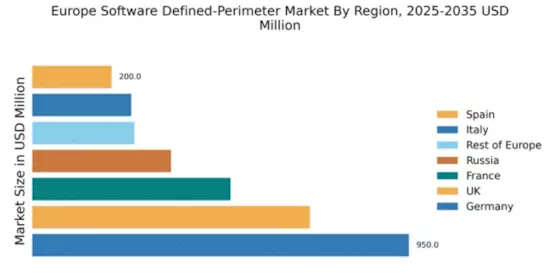
Europe Software Defined Perimeter Market Regional Image

Key Players and Competitive Insights

The software defined-perimeter market is currently characterized by a dynamic competitive landscape, driven by the increasing demand for secure remote access and the growing complexity of cyber threats. Major players such as Cisco Systems (US), Palo Alto Networks (US), and Zscaler (US) are strategically positioned to leverage their technological expertise and innovative solutions. Cisco Systems (US) focuses on enhancing its security portfolio through continuous innovation and strategic partnerships, while Palo Alto Networks (US) emphasizes its cloud-native security offerings to address the evolving needs of enterprises. Zscaler (US), on the other hand, is concentrating on expanding its global footprint and enhancing its platform capabilities, which collectively shapes a competitive environment that is increasingly focused on advanced security solutions and customer-centric approaches.

The market structure appears moderately fragmented, with a mix of established players and emerging startups. Key business tactics such as localizing services and optimizing supply chains are becoming increasingly important as companies seek to enhance their operational efficiency and responsiveness to market demands. The collective influence of these key players is significant, as they not only drive innovation but also set industry standards that smaller competitors often strive to meet.

In October 2025, Cisco Systems (US) announced a strategic partnership with a leading cloud service provider to enhance its software defined-perimeter solutions. This collaboration aims to integrate advanced security features into cloud environments, thereby providing customers with a more robust security posture. The strategic importance of this partnership lies in its potential to expand Cisco's market reach and reinforce its position as a leader in the cybersecurity domain.

In September 2025, Palo Alto Networks (US) launched a new AI-driven security platform designed to automate threat detection and response. This initiative reflects the company's commitment to leveraging artificial intelligence to enhance its security offerings. The introduction of this platform is likely to strengthen Palo Alto's competitive edge by providing customers with faster and more effective security solutions, thereby addressing the growing sophistication of cyber threats.

In August 2025, Zscaler (US) expanded its operations into several European markets, aiming to capitalize on the increasing demand for secure remote access solutions. This expansion is strategically significant as it allows Zscaler to tap into new customer segments and enhance its service delivery capabilities. By establishing a stronger presence in Europe, Zscaler is positioning itself to better compete with local and global players in the software defined-perimeter market.

As of November 2025, current competitive trends indicate a strong focus on digitalization, sustainability, and the integration of AI technologies. Strategic alliances are increasingly shaping the landscape, as companies recognize the value of collaboration in driving innovation and enhancing service offerings. Looking ahead, competitive differentiation is likely to evolve from traditional price-based competition to a focus on innovation, technological advancements, and supply chain reliability. This shift underscores the importance of agility and responsiveness in meeting the diverse needs of customers in an ever-changing market.

Key Companies in the Europe Software Defined Perimeter Market market include

Industry Developments

The Europe Software Defined Perimeter Market has seen significant developments recently, with companies like Zscaler, VMware, and Cisco expanding their presence through innovative product launches and strategic partnerships. In August 2023, Zscaler announced enhancements to its platform aimed at improving security and scalability for European enterprises. 

This aligns with a broader trend where businesses are increasingly adopting Software Defined Perimeter solutions due to heightened cybersecurity threats across the region. In a notable merger, NetSkope acquired a cybersecurity firm in July 2023, bolstering its capacity to offer cutting-edge security services to the European market. Moreover, Fortinet expanded its product suite in October 2023 to include advanced threat detection tailored for European regulatory requirements. 

The market valuation of several key players, including Check Point Software and Palo Alto Networks, has also increased significantly, reflecting a surge in demand for Software Defined Perimeter technologies, particularly in sectors such as finance and government, which are under strict data protection regulations. The rising need for remote work solutions and secure access frameworks continues to drive growth in this sector.


Future Outlook

Europe Software Defined Perimeter Market Future Outlook

The software defined-perimeter market is projected to grow at 11.25% CAGR from 2024 to 2035, driven by increasing cybersecurity threats and the demand for secure remote access solutions.

New opportunities lie in:

  • Development of AI-driven security analytics platforms
  • Integration of software defined-perimeter with IoT security frameworks
  • Expansion of managed security service offerings for SMEs

By 2035, the market is expected to achieve substantial growth, positioning itself as a leader in cybersecurity solutions.

Market Segmentation

Europe Software Defined Perimeter Market Solution Type Outlook

  • Identity and Access Management
  • Network Security
  • Application Security
  • Endpoint Security

Europe Software Defined Perimeter Market Deployment Model Outlook

  • Cloud
  • On-Premises
  • Hybrid

Europe Software Defined Perimeter Market End User Industry Outlook

  • BFSI
  • Government
  • Healthcare
  • IT and Telecom
  • Retail

Europe Software Defined Perimeter Market Organization Size Outlook

  • Small and Medium Enterprises
  • Large Enterprises

Report Scope

MARKET SIZE 2024 2907.5(USD Million)
MARKET SIZE 2025 3234.59(USD Million)
MARKET SIZE 2035 9392.0(USD Million)
COMPOUND ANNUAL GROWTH RATE (CAGR) 11.25% (2024 - 2035)
REPORT COVERAGE Revenue Forecast, Competitive Landscape, Growth Factors, and Trends
BASE YEAR 2024
Market Forecast Period 2025 - 2035
Historical Data 2019 - 2024
Market Forecast Units USD Million
Key Companies Profiled ["Cisco Systems (US)", "Palo Alto Networks (US)", "VMware (US)", "Zscaler (US)", "Cloudflare (US)", "Fortinet (US)", "Check Point Software Technologies (IL)", "Akamai Technologies (US)"]
Segments Covered Deployment Model, Solution Type, Organization Size, End User Industry
Key Market Opportunities Growing demand for secure remote access solutions drives innovation in the software defined-perimeter market.
Key Market Dynamics Rising regulatory pressures drive demand for software defined-perimeter solutions in enhancing cybersecurity frameworks across Europe.
Countries Covered Germany, UK, France, Russia, Italy, Spain, Rest of Europe

Leave a Comment

FAQs

What is the projected market size of the Europe Software Defined Perimeter Market in 2024?

The Europe Software Defined Perimeter Market is expected to be valued at 3.28 USD Billion in 2024.

What will be the value of the Europe Software Defined Perimeter Market by 2035?

By 2035, the Europe Software Defined Perimeter Market is anticipated to reach a value of 10.36 USD Billion.

What is the expected compound annual growth rate for the Europe Software Defined Perimeter Market from 2025 to 2035?

The expected CAGR for the Europe Software Defined Perimeter Market from 2025 to 2035 is 11.022%.

Which region is expected to dominate the Software Defined Perimeter Market in Europe?

Germany is anticipated to dominate the Software Defined Perimeter Market within Europe, with a projected value of 2.38 USD Billion by 2035.

What is the expected market size for cloud deployment in the Europe Software Defined Perimeter Market by 2035?

The market size for cloud deployment in the Europe Software Defined Perimeter Market is projected to be 5.1 USD Billion by 2035.

Which major companies are key players in the Europe Software Defined Perimeter Market?

Key players in the Europe Software Defined Perimeter Market include Zscaler, VMware, Proofpoint, and Cisco among others.

What is the anticipated value of on-premise deployment in the Europe Software Defined Perimeter Market by 2035?

On-premise deployment in the Europe Software Defined Perimeter Market is expected to be valued at 5.26 USD Billion by 2035.

How does the Software Defined Perimeter Market growth vary by region within Europe?

By 2035, the market values in key regions are projected to be 2.38 USD Billion for Germany, 2.18 USD Billion for the UK, and 1.95 USD Billion for France.

What market size can we expect for the Software Defined Perimeter Market in the UK in 2024?

In 2024, the Software Defined Perimeter Market in the UK is expected to be valued at 0.68 USD Billion.

What challenges and opportunities are present in the Europe Software Defined Perimeter Market?

The market presents challenges such as data security concerns and opportunities driven by increasing cloud adoption and digital transformation.

Download Free Sample

Kindly complete the form below to receive a free sample of this Report

Compare Licence

×
Features License Type
Single User Multiuser License Enterprise User
Price $4,950 $5,950 $7,250
Maximum User Access Limit 1 User Upto 10 Users Unrestricted Access Throughout the Organization
Free Customization
Direct Access to Analyst
Deliverable Format
Platform Access
Discount on Next Purchase 10% 15% 15%
Printable Versions