×
Request Free Sample ×

Kindly complete the form below to receive a free sample of this Report

* Please use a valid business email

Leading companies partner with us for data-driven Insights

clients tt-cursor
Hero Background

Europe Sports Analytics Market

ID: MRFR/ICT/42934-HCR
200 Pages
Garvit Vyas
October 2025

Europe Sports Analytics Market Research Report By Component Outlook (Solution, Service), By Sport Outlook (Football, Cricket, Baseball, Rugby, Others), By Deployment Outlook (Cloud, On-Premise), By Type Outlook (On-Field, Off-Field) andBy Application Outlook (Team Performance Analysis, Video Analysis, Health Assessment, Data Interpretation Analysis, Fan Engagement Digital Experience Analysis, Others)- Forecast to 2035

Share:
Download PDF ×

We do not share your information with anyone. However, we may send you emails based on your report interest from time to time. You may contact us at any time to opt-out.

Europe Sports Analytics Market Infographic
Purchase Options

Europe Sports Analytics Market Summary

As per MRFR analysis, the Europe sports analytics market size was estimated at 441.79 USD Million in 2024. The Europe sports analytics market is projected to grow from 562.18 USD Million in 2025 to 6256.93 USD Million by 2035, exhibiting a compound annual growth rate (CAGR) of 27.25% during the forecast period 2025 - 2035.

Key Market Trends & Highlights

The Europe sports analytics market is experiencing robust growth driven by technological advancements and evolving consumer expectations.

  • Germany remains the largest market for sports analytics, showcasing a strong demand for innovative solutions.
  • The UK is emerging as the fastest-growing region, reflecting a heightened interest in data-driven decision-making in sports.
  • There is a notable trend towards enhanced fan engagement strategies, leveraging analytics to create personalized experiences.
  • Key market drivers include growing investment in sports technology and rising demand for performance analytics, which are shaping the industry's future.

Market Size & Forecast

2024 Market Size 441.79 (USD Million)
2035 Market Size 6256.93 (USD Million)
CAGR (2025 - 2035) 27.25%

Major Players

SAS Institute (US), IBM (US), SAP (DE), Oracle (US), STATS Perform (US), Catapult Sports (AU), Zebra Technologies (US), Krossover (US), Hudl (US)

Europe Sports Analytics Market Trends

The sports analytics market is evolving due to technological advancements and increasing demand for data-driven decision-making. Organizations are increasingly leveraging analytics to enhance performance, optimize strategies, and improve fan engagement. This trend is particularly evident in professional leagues and clubs, where data analysis is becoming integral to training regimens and game strategies. The integration of artificial intelligence and machine learning into analytics tools is further transforming how teams analyze player performance and opponent strategies. As a result, The sports analytics market is expected to grow significantly as stakeholders recognize the value of data for competitive advantages. Moreover, the emphasis on fan experience is reshaping the landscape of the sports analytics market. Teams and organizations are utilizing analytics to tailor experiences for fans, enhancing engagement through personalized content and targeted marketing strategies. This shift not only fosters loyalty but also drives revenue through improved ticket sales and merchandise. The collaboration between technology providers and sports organizations is likely to intensify, leading to innovative solutions that cater to the evolving needs of both teams and fans. As the market continues to mature, the focus on ethical data usage and privacy will also become increasingly important, ensuring that the benefits of analytics are realized without compromising individual rights.

Increased Adoption of AI Technologies

The integration of artificial intelligence in the sports analytics market is becoming more prevalent. Teams are utilizing AI to analyze vast amounts of data, enabling them to make informed decisions regarding player performance and game strategies. This trend suggests a shift towards more sophisticated analytical tools that can provide deeper insights.

Enhanced Fan Engagement Strategies

Organizations are increasingly focusing on utilizing analytics to improve fan engagement. By analyzing fan behavior and preferences, teams can create personalized experiences that enhance loyalty and drive revenue. This trend indicates a growing recognition of the importance of fan-centric approaches in the sports industry.

Focus on Data Privacy and Ethics

As the sports analytics market expands, there is a rising emphasis on data privacy and ethical considerations. Stakeholders are becoming more aware of the need to handle data responsibly, ensuring compliance with regulations while still leveraging analytics for competitive advantage. This trend highlights the balancing act between innovation and ethical responsibility.

Europe Sports Analytics Market Drivers

Expansion of E-Sports Analytics

The emergence of e-sports has introduced a new dimension to the sports analytics market in Europe. As e-sports gain popularity, the demand for analytics tailored to this sector is rapidly increasing. By 2025, the e-sports analytics market is projected to grow by over 30%, reflecting the increasing interest from both players and sponsors. This growth is attributed to the need for performance analysis, player scouting, and fan engagement strategies within the e-sports community. Traditional sports organizations are also beginning to explore synergies with e-sports, further driving the need for comprehensive analytics solutions. The expansion of e-sports analytics is likely to create new opportunities for innovation and collaboration, positioning it as a key driver in the overall sports analytics market. As the lines between traditional and digital sports continue to blur, the demand for specialized analytics will likely intensify.

Increased Focus on Injury Prevention

In the sports analytics market, there is a growing emphasis on injury prevention strategies, which is becoming a critical driver for innovation. As of 2025, it is estimated that approximately 40% of sports organizations in Europe will invest in analytics solutions specifically designed to monitor player health and predict injury risks. This focus on injury prevention is driven by the understanding that maintaining player availability is essential for team success. Advanced analytics tools that analyze player biomechanics, workload, and recovery patterns are gaining traction among teams. By leveraging these insights, organizations aim to implement proactive measures that minimize injury occurrences. This trend not only enhances player welfare but also contributes to improved team performance. Consequently, the increased focus on injury prevention is likely to propel growth in the sports analytics market, as stakeholders seek to adopt data-driven approaches to safeguard athlete health.

Growing Investment in Sports Technology

The sports analytics market in Europe is experiencing a surge in investment as organizations recognize the value of data-driven decision-making. In 2025, the market is projected to reach approximately €1.5 billion, reflecting a compound annual growth rate (CAGR) of around 20% over the next five years. This influx of capital is primarily directed towards advanced analytics platforms, wearable technologies, and performance optimization tools. As teams and leagues increasingly rely on analytics to enhance player performance and fan experience, the demand for innovative solutions continues to rise. Furthermore, partnerships between tech companies and sports organizations are becoming more prevalent, fostering an environment conducive to technological advancements. This growing investment landscape is likely to propel the sports analytics market forward, enabling stakeholders to leverage data for competitive advantage.

Regulatory Support for Data Utilization

In Europe, regulatory frameworks are evolving to support the utilization of data in the sports analytics market. The European Union's initiatives aimed at promoting digital innovation and data sharing are likely to enhance the capabilities of sports organizations. By 2025, it is anticipated that compliance with data protection regulations will become more streamlined, allowing for greater access to valuable data insights. This regulatory support may encourage sports entities to adopt analytics solutions that improve operational efficiency and fan engagement. Moreover, as regulations become more favorable, the potential for collaboration between data providers and sports organizations increases, fostering a more robust analytics ecosystem. Consequently, this supportive regulatory environment is expected to drive growth in the sports analytics market, enabling stakeholders to harness data effectively while adhering to legal standards.

Rising Demand for Performance Analytics

The sports analytics market in Europe is witnessing a notable increase in demand for performance analytics, driven by the need for teams to gain a competitive edge. As of 2025, it is estimated that around 60% of professional sports teams in Europe will utilize performance analytics tools to assess player metrics and game strategies. This trend is largely influenced by the growing emphasis on data-driven coaching and training methodologies. Coaches and sports scientists are increasingly relying on analytics to optimize player performance, reduce injury risks, and enhance overall team effectiveness. The integration of performance analytics into training regimens is likely to become a standard practice, further solidifying its role in the sports analytics market. As teams seek to maximize their potential, the demand for sophisticated analytics solutions is expected to rise, driving innovation and investment in this sector.
Market Segment Insights

By Deployment: Cloud (Largest) vs. On-Premise (Fastest-Growing)

In the sports analytics market, the deployment landscape is significantly shaped by the prevalence of cloud solutions, which capture the largest market share. This model provides flexibility, accessibility, and cost-effectiveness, allowing sports organizations to leverage advanced analytics without substantial upfront investments. Conversely, on-premise solutions are gaining traction as they offer enhanced security and control over sensitive data, appealing to organizations with stringent compliance requirements. The growth trajectory of on-premise solutions is spurred by the increasing demand for high data security and customization capabilities. As sports entities look to harness analytics for competitive advantage, the need for tailored solutions is prompting increased investments in on-premise technology. Meanwhile, cloud deployment continues to thrive as organizations seek efficient, scalable solutions to accommodate growing data from diverse sources.

Cloud (Dominant) vs. On-Premise (Emerging)

The cloud deployment model stands out as the dominant force in the sports analytics market due to its unparalleled scalability and flexibility. Organizations can easily adapt to changes in data volume without incurring significant infrastructural costs. This model facilitates real-time data processing and analysis, making it a preferred choice for teams and organizations looking to gain immediate insights. In contrast, on-premise solutions, although emerging, are increasingly attractive to organizations prioritizing data security and customization. They allow for bespoke analytics tailored to specific operational needs while providing the stringent data governance required by certain entities. As both deployment methods evolve, their unique strengths cater to diverse demands in the sector.

By Component: Software (Largest) vs. Services (Fastest-Growing)

The Component segment of the sports analytics market shows a distinct distribution of market share, with Software leading as the largest part of the segment. This dominance stems from the increasing reliance on data analytics to enhance player performance and game strategies. In contrast, Services are emerging as a significant player, capturing the attention of organizations looking for expert assistance in adopting sophisticated analytics solutions. Growth trends indicate that the demand for Services is rapidly increasing, making it the fastest-growing portion of the segment. This trend is largely driven by the growing complexity of sports data and the need for comprehensive analysis. As organizations prioritize data-driven decision-making, the requirement for consulting, implementation, and support services continues to rise, indicating a promising future for this segment.

Software: Dominant vs. Services: Emerging

Software solutions in the sports analytics landscape are characterized by advanced capabilities that facilitate data collection, processing, and visualization, making them essential for teams aiming to leverage analytics for competitive advantage. They enable real-time insights and strategic decision-making, thus forming a core part of modern sports management. On the other hand, Services encompass a range of offerings from consulting to training and support, aimed at helping sports organizations integrate complex analytics tools into their operations. As more teams recognize the value of bespoke analytics solutions, the demand for Services is rapidly increasing, positioning them as an emerging force within the market.

By Sport: Football (Largest) vs. Cricket (Fastest-Growing)

In the Europe sports analytics market, Football holds the largest share, significantly surpassing other sports in terms of analytics adoption, fan engagement, and sponsorship interests. The popularity of Football analytics stems from extensive data collection on player performance, tactics, and game strategies, driving investment from clubs and governing bodies alike. Cricket follows as a rapidly growing segment, gaining momentum through major tournaments and an expanding fan base, particularly in nations with emerging cricketing cultures. The growth trends within the Football analytics segment are supported by increasing technological advancements such as AI and machine learning, enabling deeper insights into player and game analytics. Conversely, Cricket's rise can be attributed to enhanced media coverage and the introduction of innovative analytics solutions, fostering a greater understanding of player performance and team strategies. The integration of analytics within coaching methodologies and broadcasting further stimulates interest and investment across both segments.

Football: Dominant vs. Cricket: Emerging

Football remains the dominant segment within the Europe sports analytics market due to its massive global following and substantial investments from clubs and sponsors. The analytics used in Football emphasize player statistics, match analysis, and tactical evaluations, providing teams with actionable insights to enhance performance and strategic decision-making. In contrast, Cricket represents the emerging force, propelled by its growing audience and recent technological investments in analytics. The focus on player metrics, fan engagement, and dramatic improvements in data visualization are crucial in Cricket's analytics framework, allowing teams to optimize performance and maximize their reach across diverse demographics. Both segments, while distinct, showcase the transformative impact of analytics in sports.

By Type: On-Field (Largest) vs. Off-Field (Fastest-Growing)

In the sports analytics market, the On-Field segment holds the largest share due to its critical importance in enhancing athlete performance and game strategy. Coaches and teams are increasingly leveraging data analytics to analyze player movements, optimize training regimens, and make informed in-game decisions. As technology advances, this segment continues to dominate market share, driven by rising investments in data collection and analysis tools. Conversely, the Off-Field segment is emerging as the fastest-growing segment as organizations recognize the need for robust analytics solutions for fan engagement, marketing strategies, and operational efficiencies. This growth is propelled by the increasing focus on analyzing viewer preferences and enhancing customer experiences, making Off-Field analytics vital for maximizing revenue streams and broadening market appeal.

On-Field: Dominant vs. Off-Field: Emerging

The On-Field segment is characterized by its reliance on real-time data collection, analytical tools, and technology integration in the sports environment. It encompasses solutions such as player tracking systems, performance analysis software, and interactive analytics platforms that enable teams to optimize gameplay and enhance athlete wellness. As a dominant force in the market, the On-Field sector benefits from continuous innovations and high demand for technologies that support performance enhancement. In contrast, the Off-Field segment focuses on analytics related to fan engagement, audience demographic insights, and marketing effectiveness. With an increasing emphasis on data-driven decisions outside of game moments, Off-Field analytics is rapidly gaining traction as it allows organizations to personalize experiences and generate new revenue streams, solidifying its position as an emerging player in the industry.

By Application: Team Performance Analysis (Largest) vs. Video analysis (Fastest-Growing)

In the sports analytics market, Team Performance Analysis holds a significant share, leading the application segment with its crucial role in enhancing team strategies and outcomes. Video analysis follows closely, exhibiting rapid growth due to its increasing adoption across various sports disciplines, driven by advancements in technology and the need for detailed performance evaluation. The growth trends in this segment are primarily fueled by the rising importance of data-driven decision-making in sports organizations. Health assessment and data interpretation are also gaining traction, as teams seek to optimize player health and performance. Additionally, fan engagement & digital experience analysis is emerging, reflecting a shift towards enhancing spectator interaction and satisfaction in sports events.

Team Performance Analysis (Dominant) vs. Health assessment (Emerging)

Team Performance Analysis serves as the backbone of strategic planning for sports teams, allowing them to dissect performance metrics and improve tactics based on real-time data. Its established presence makes it the dominant force in the application segment, as many organizations rely on its insights to shape their training regimens and game plans. In contrast, Health assessment is emerging as a vital component, focusing on player wellness and injury prevention. As awareness of athlete health increases, more teams are adopting analytics tools that assess physical conditions and predict potential issues. This shift not only supports player longevity but also enhances overall team performance, highlighting a growing trend towards comprehensive athlete care in the sports analytics industry.

Get more detailed insights about Europe Sports Analytics Market

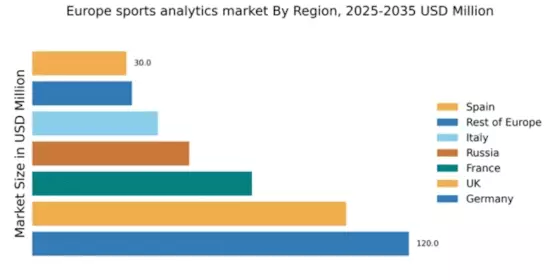
Regional Insights

Germany : Germany's Dominance in Analytics

Germany holds a commanding market share of 120.0, representing a significant portion of Europe's sports analytics landscape. Key growth drivers include a robust sports culture, increasing investment in technology, and a focus on data-driven decision-making. Demand trends show a rising interest in performance analytics among professional sports teams, supported by government initiatives promoting digital transformation in sports. Infrastructure development, particularly in cities like Munich and Berlin, enhances the market's potential.

UK : UK's Innovative Sports Landscape

The UK sports analytics market is valued at 100.0, driven by a vibrant sports industry and a growing emphasis on data analytics. Key growth factors include the increasing adoption of wearable technology and analytics platforms by teams and organizations. The UK government supports this trend through initiatives aimed at enhancing sports performance and participation. Cities like London and Manchester are pivotal, hosting numerous sports teams and analytics firms, fostering a competitive environment.

France : France's Growing Analytics Market

France's sports analytics market is valued at 70.0, with growth fueled by a strong sports culture and increasing investment in technology. Demand for analytics is rising among both professional and amateur sports organizations, driven by a focus on performance improvement. Government initiatives promoting sports innovation and digital transformation are also key growth drivers. Major cities like Paris and Lyon are central to this market, hosting several analytics firms and sports organizations.

Russia : Russia's Evolving Sports Analytics Scene

Russia's sports analytics market is valued at 50.0, with growth driven by increasing interest in data analytics among sports teams and organizations. The demand for performance analytics is rising, supported by government initiatives aimed at enhancing sports performance. Key cities like Moscow and St. Petersburg are central to this market, with a growing number of analytics firms emerging. The competitive landscape includes both local and international players, contributing to a dynamic business environment.

Italy : Italy's Passion for Sports Analytics

Italy's sports analytics market is valued at 40.0, driven by a rich sports culture and increasing adoption of analytics technologies. Demand trends indicate a growing interest in performance analytics among football clubs and other sports organizations. Government initiatives supporting sports innovation and technology adoption are key growth drivers. Cities like Milan and Turin are significant markets, with a competitive landscape featuring both local and international analytics firms.

Spain : Spain's Sports Analytics Evolution

Spain's sports analytics market is valued at 30.0, with growth driven by a strong focus on performance improvement in sports. The demand for analytics is increasing among professional teams, particularly in football. Government initiatives promoting sports technology and innovation are also contributing to market growth. Key cities like Barcelona and Madrid are central to this market, hosting numerous sports organizations and analytics firms, creating a competitive environment.

Rest of Europe : Emerging Markets in Europe

The Rest of Europe sports analytics market is valued at 31.79, with diverse growth opportunities across various countries. Key growth drivers include increasing interest in sports performance analytics and government support for digital transformation in sports. Demand trends vary, with some countries focusing on specific sports or technologies. The competitive landscape includes a mix of local and international players, contributing to a dynamic business environment across the region.

Europe Sports Analytics Market Regional Image

Key Players and Competitive Insights

The sports analytics market is currently characterized by a dynamic competitive landscape, driven by technological advancements and an increasing demand for data-driven decision-making in sports. Key players such as SAS Institute (US), IBM (US), and SAP (DE) are strategically positioned to leverage their extensive data analytics capabilities. SAS Institute (US) focuses on innovation through advanced analytics and machine learning, while IBM (US) emphasizes partnerships with sports organizations to enhance fan engagement and performance analysis. SAP (DE) is actively pursuing digital transformation initiatives, integrating its analytics solutions with cloud technologies to provide real-time insights. Collectively, these strategies foster a competitive environment that prioritizes technological innovation and customer-centric solutions.

In terms of business tactics, companies are increasingly localizing their operations to better serve regional markets, optimizing supply chains to enhance efficiency. The market structure appears moderately fragmented, with a mix of established players and emerging startups. This fragmentation allows for diverse offerings, yet the influence of key players remains substantial, as they set industry standards and drive technological advancements.

In October 2025, IBM (US) announced a partnership with a leading European football league to implement AI-driven analytics for player performance evaluation. This strategic move is likely to enhance the league's competitive edge by providing teams with actionable insights, thereby improving player development and game strategies. Such collaborations indicate a trend towards integrating AI technologies into traditional sports analytics, potentially reshaping how teams approach performance metrics.

In September 2025, SAP (DE) launched a new cloud-based analytics platform tailored for sports organizations, aimed at streamlining data management and enhancing operational efficiency. This initiative underscores SAP's commitment to digital transformation, allowing sports entities to harness data more effectively. The platform's capabilities may significantly improve decision-making processes, thereby influencing competitive dynamics within the market.

In November 2025, STATS Perform (US) unveiled a new suite of predictive analytics tools designed for real-time game analysis. This development is indicative of a broader trend towards real-time data utilization in sports, enabling teams to make informed decisions during matches. The introduction of such tools may enhance the strategic capabilities of teams, further intensifying competition in the analytics space.

As of November 2025, current trends in the sports analytics market include a pronounced focus on digitalization, sustainability, and the integration of AI technologies. Strategic alliances are increasingly shaping the competitive landscape, as companies collaborate to enhance their technological offerings. Looking ahead, competitive differentiation is expected to evolve, with a shift from price-based competition towards innovation, technological advancement, and supply chain reliability. This transition may redefine how companies position themselves in the market, emphasizing the importance of cutting-edge solutions over traditional pricing strategies.

Key Companies in the Europe Sports Analytics Market market include

Industry Developments

The Europe Sports Analytics Market has seen a surge in interest, particularly following the 2022 FIFA World Cup, where companies like Sportradar and Stats Perform showcased their capabilities in data analytics for enhanced performance insights and fan engagement. In August 2023, Catapult Sports announced a collaboration with a prominent European football league to deliver advanced performance-tracking technologies, strengthening their market position.

Additionally, in September 2023, Genius Sports expanded its partnership with the UK’s national governing body for rugby, aiming to enhance data integrity and analytics capabilities within the sport. The market has been impacted positively by increasing investments, leading to a more substantial valuation of analytics companies. Furthermore, Zebra Technologies made headlines in May 2023 with its acquisition of a European sports analytics firm, aiming to broaden its footprint in the analytics landscape.

Over the last few years, companies like IBM and Opta have dedicated extensive resources to enhance their analytics offerings, leading to significant growth in client subscriptions and demand across various sports, including football and basketball, thereby creating a vibrant ecosystem for sports analytics in Europe.

Future Outlook

Europe Sports Analytics Market Future Outlook

The sports analytics market is projected to grow at a 27.25% CAGR from 2024 to 2035, driven by technological advancements, increased data availability, and demand for performance optimization.

New opportunities lie in:

  • Development of AI-driven predictive analytics tools for player performance enhancement.
  • Integration of real-time data analytics in fan engagement platforms.
  • Creation of subscription-based analytics services for amateur sports organizations.

By 2035, the sports analytics market is expected to be robust, driven by innovation and strategic partnerships.

Market Segmentation

Europe Sports Analytics Market Type Outlook

  • On-Field
  • Off-Field

Europe Sports Analytics Market Sport Outlook

  • Football
  • Cricket
  • Baseball
  • Rugby
  • Others

Europe Sports Analytics Market Component Outlook

  • Software
  • Services

Europe Sports Analytics Market Deployment Outlook

  • Cloud
  • On-Premise

Europe Sports Analytics Market Application Outlook

  • Team Performance Analysis
  • Video analysis
  • Health assessment
  • Data interpretation & analysis
  • Fan engagement & digital experience analysis
  • Others

Report Scope

MARKET SIZE 2024 441.79(USD Million)
MARKET SIZE 2025 562.18(USD Million)
MARKET SIZE 2035 6256.93(USD Million)
COMPOUND ANNUAL GROWTH RATE (CAGR) 27.25% (2024 - 2035)
REPORT COVERAGE Revenue Forecast, Competitive Landscape, Growth Factors, and Trends
BASE YEAR 2024
Market Forecast Period 2025 - 2035
Historical Data 2019 - 2024
Market Forecast Units USD Million
Key Companies Profiled ["SAS Institute (US)", "IBM (US)", "SAP (DE)", "Oracle (US)", "STATS Perform (US)", "Catapult Sports (AU)", "Zebra Technologies (US)", "Krossover (US)", "Hudl (US)"]
Segments Covered Deployment, Component, Sport, Type, Application
Key Market Opportunities Integration of artificial intelligence in performance analysis and fan engagement presents a key opportunity.
Key Market Dynamics Growing demand for data-driven decision-making in sports enhances competitive strategies and performance analysis across Europe.
Countries Covered Germany, UK, France, Russia, Italy, Spain, Rest of Europe

Leave a Comment

FAQs

What is the projected market size of the Europe Sports Analytics Market in 2024?

The Europe Sports Analytics Market is expected to be valued at 441.79 million USD in 2024.

What will be the market size of the Europe Sports Analytics Market by 2035?

By 2035, the Europe Sports Analytics Market is projected to reach 5295.63 million USD.

What is the expected CAGR for the Europe Sports Analytics Market from 2025 to 2035?

The CAGR for the Europe Sports Analytics Market is expected to be 25.333% from 2025 to 2035.

What are the major players in the Europe Sports Analytics Market?

Key players include Inside Sports, Wyscout, Catapult Sports, and Sportradar among others.

What is the market value for the solution segment of the Europe Sports Analytics Market in 2024?

The solution segment is valued at 132.47 million USD in 2024.

What will be the market value for the service segment of the Europe Sports Analytics Market in 2035?

The service segment is projected to grow to 3715.19 million USD by 2035.

What is the anticipated market growth rate for the Europe Sports Analytics Market?

The market is expected to experience significant growth with a CAGR of 25.333% over the forecast period.

What are the emerging trends in the Europe Sports Analytics Market?

Emerging trends include the increasing use of data-driven decision-making and AI technologies in sports.

What are the growth drivers for the Europe Sports Analytics Market?

Key growth drivers include rising investment in sports technology and demand for performance analytics.

How will the Europe Sports Analytics Market be impacted by current global scenarios and conflicts?

Current global scenarios may influence market dynamics, affecting investment and partnership opportunities.

Download Free Sample

Kindly complete the form below to receive a free sample of this Report

Compare Licence

×
Features License Type
Single User Multiuser License Enterprise User
Price $4,950 $5,950 $7,250
Maximum User Access Limit 1 User Upto 10 Users Unrestricted Access Throughout the Organization
Free Customization
Direct Access to Analyst
Deliverable Format
Platform Access
Discount on Next Purchase 10% 15% 15%
Printable Versions