×
Request Free Sample ×

Kindly complete the form below to receive a free sample of this Report

Leading companies partner with us for data-driven Insights

clients tt-cursor
Hero Background

Europe Telecom Analytics Market

ID: MRFR/ICT/62046-HCR
200 Pages
Aarti Dhapte
October 2025

Europe Telecom Analytics Market Research Report By Analytics Type (Customer Analytics, Network Analytics, Subscriber Analytics, Location Analytics, Price Analytics, Service Analytic), By Solution (Customer Management, Network Management, Marketing Management, Sales & Distribution, Others), By Services (Professional Services, Managed Services), By Deployment Models (On-Premise, Cloud-Based) and By Regional (Germany, UK, France, Russia, Italy, Spain, Rest of Europe)-Forecast to 2035

Share:
Download PDF ×

We do not share your information with anyone. However, we may send you emails based on your report interest from time to time. You may contact us at any time to opt-out.

Europe Telecom Analytics Market Infographic
Purchase Options

Europe Telecom Analytics Market Summary

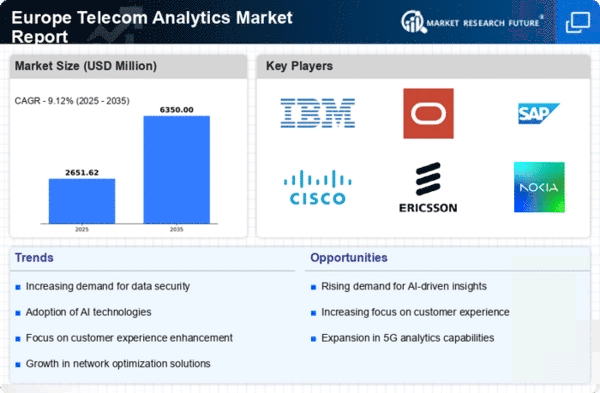
As per MRFR analysis, the Europe telecom analytics market Size was estimated at 2430.0 USD Million in 2024. The telecom analytics market is projected to grow from 2651.62 USD Million in 2025 to 6350.0 USD Million by 2035, exhibiting a compound annual growth rate (CAGR) of 9.12% during the forecast period 2025 - 2035.

Key Market Trends & Highlights

The Europe telecom analytics market is experiencing robust growth driven by technological advancements and evolving consumer demands.

  • The adoption of AI and Machine Learning technologies is transforming analytics capabilities across the telecom sector.
  • Germany remains the largest market, while the UK is recognized as the fastest-growing region in telecom analytics.
  • A heightened focus on customer experience is prompting telecom companies to leverage data analytics for improved service delivery.
  • Key market drivers include the growing demand for data-driven insights and the integration of IoT technologies, which are reshaping operational strategies.

Market Size & Forecast

2024 Market Size 2430.0 (USD Million)
2035 Market Size 6350.0 (USD Million)

Major Players

IBM (US), Oracle (US), SAP (DE), Cisco (US), Ericsson (SE), Nokia (FI), Amdocs (IL), TIBCO Software (US), ZTE (CN)

Europe Telecom Analytics Market Trends

The telecom analytics market is currently experiencing a transformative phase, driven by the increasing demand for data-driven decision-making among telecom operators. As the industry evolves, operators are leveraging advanced analytics to enhance customer experience, optimize network performance, and improve operational efficiency. The integration of artificial intelligence and machine learning technologies into analytics platforms appears to be a key factor in this evolution, enabling more accurate predictions and insights. Furthermore, regulatory frameworks in Europe are fostering an environment conducive to innovation, encouraging telecom companies to adopt analytics solutions that comply with data protection laws while maximizing their business potential. In addition, the growing emphasis on customer-centric strategies is reshaping the landscape of the telecom analytics market. Companies are increasingly focusing on understanding customer behavior and preferences, which is likely to lead to more personalized services and targeted marketing efforts. This shift not only enhances customer satisfaction but also drives revenue growth for telecom operators. As the market continues to mature, the collaboration between telecom providers and technology partners is expected to intensify, facilitating the development of more sophisticated analytics tools tailored to the unique challenges faced by the industry. Overall, the telecom analytics market is poised for substantial growth, reflecting the broader trends of digital transformation and data utilization in the telecommunications sector.

Adoption of AI and Machine Learning

The integration of artificial intelligence and machine learning technologies into analytics platforms is becoming increasingly prevalent. This trend enables telecom operators to derive deeper insights from vast amounts of data, facilitating improved decision-making and operational efficiency.

Focus on Customer Experience

Telecom companies are placing greater emphasis on enhancing customer experience through analytics. By understanding customer behavior and preferences, operators can offer personalized services, which may lead to increased customer satisfaction and loyalty.

Regulatory Compliance and Innovation

The evolving regulatory landscape in Europe is encouraging telecom operators to adopt analytics solutions that comply with data protection laws. This compliance not only mitigates risks but also drives innovation, as companies seek to leverage analytics for competitive advantage.

Europe Telecom Analytics Market Drivers

Rising Cybersecurity Concerns

The telecom analytics market in Europe is increasingly shaped by rising cybersecurity concerns. With the growing frequency of cyber threats, telecom operators are compelled to invest in analytics solutions that enhance their security posture. By analyzing network data, operators can detect anomalies and potential security breaches in real-time. In 2025, it is anticipated that spending on cybersecurity analytics within the telecom sector will exceed €1 billion, highlighting the urgency of addressing these threats. This focus on cybersecurity not only protects sensitive customer data but also reinforces trust in telecom services, thereby driving growth in the telecom analytics market.

Integration of IoT Technologies

The integration of Internet of Things (IoT) technologies significantly influences the telecom analytics market in Europe. As IoT devices proliferate, telecom operators are compelled to adopt analytics solutions that can manage and interpret the data generated by these devices. In 2025, it is estimated that there will be over 1 billion connected IoT devices in Europe, creating an immense volume of data that requires sophisticated analytics for effective management. This trend not only enhances operational efficiency but also enables telecom companies to develop innovative services and products tailored to the evolving needs of consumers. Consequently, the integration of IoT technologies is a critical driver for growth in the telecom analytics market.

Growing Demand for Data-Driven Insights

The telecom analytics market in Europe experiences a notable surge in demand for data-driven insights. As telecom operators strive to enhance operational efficiency and customer satisfaction, the need for advanced analytics solutions becomes increasingly apparent. In 2025, the market is projected to reach approximately €3 billion, reflecting a compound annual growth rate (CAGR) of around 15% from previous years. This growth is primarily driven by the necessity to analyze vast amounts of data generated by mobile and fixed-line networks. By leveraging analytics, telecom companies can identify trends, optimize network performance, and tailor services to meet customer needs, thereby solidifying their competitive edge in the telecom analytics market.

Increased Focus on Network Optimization

The telecom analytics market in Europe is significantly impacted by the increased focus on network optimization. As competition intensifies, telecom operators are prioritizing the enhancement of network performance to ensure seamless connectivity and service delivery. By employing advanced analytics, operators can monitor network traffic, identify bottlenecks, and predict potential failures. This proactive approach is expected to reduce operational costs by up to 20% while improving customer satisfaction. In 2025, the market for network optimization analytics is projected to account for a substantial share of the overall telecom analytics market, reflecting the critical need for efficient network management.

Regulatory Pressures and Compliance Needs

The telecom analytics market in Europe is influenced by regulatory pressures and compliance needs. As governments implement stricter regulations regarding data privacy and protection, telecom operators must adopt analytics solutions that ensure compliance. This necessity is particularly pronounced with the General Data Protection Regulation (GDPR), which mandates stringent data handling practices. In 2025, compliance-related analytics solutions are expected to constitute a significant portion of the telecom analytics market, as operators seek to avoid hefty fines and reputational damage. Consequently, the emphasis on regulatory compliance serves as a vital driver for growth in the telecom analytics market.


Market Segment Insights

By Type: Customer Analytics (Largest) vs. Network Analytics (Fastest-Growing)

In the telecom analytics segment, Customer Analytics holds the largest share, reflecting its critical role in understanding consumer behavior and preferences. This segment helps telecom operators tailor their services to enhance customer satisfaction and retention. Conversely, Network Analytics, while still significant, is emerging swiftly, driven by the need for efficient network management and optimization, particularly with the rise of 5G technologies. Growth trends indicate that the demand for Subscriber Analytics and Location Analytics is also rising, propelled by the increasing focus on personalized services and location-based marketing. Service Analytics is gaining traction as providers look to refine their service delivery processes. The overall movement in this segment is toward harnessing data-driven insights to innovate service offerings and improve operational efficiency.

Customer Analytics (Dominant) vs. Network Analytics (Emerging)

Customer Analytics is characterized by its comprehensive understanding of user behavior, allowing telecom companies to create targeted marketing strategies and personalized offerings. This segment has become essential in cultivating customer loyalty and increasing revenue streams. However, Network Analytics is becoming increasingly important, especially as telecom networks grow in complexity. This segment employs various data metrics to enhance network performance, manage traffic, and preemptively address potential issues. Both segments are integral to the overall analytics landscape, but while Customer Analytics is dominant, Network Analytics is rapidly emerging as a crucial player in the telecom analytics arena.

By Solution: Customer Management (Largest) vs. Network Management (Fastest-Growing)

The market share distribution among key segment values in the telecom analytics market reveals that Customer Management leads the pack with a significant share. This dominance is attributed to the increasing focus on enhancing customer experiences and effective relationship management, which continue to drive demand for analytics solutions tailored for customer insights. On the other hand, Network Management is swiftly gaining traction, fueled by the rapid advancements in network technologies and reliability requirements. This segment's growth reflects a shift towards more integrated network solutions and the need for real-time analytics to ensure optimal performance. Several factors are propelling the growth of the Solution segment in the telecom analytics landscape. The digital transformation initiatives taken by telecom operators emphasize the collection and analysis of data for improved operational efficiencies. Additionally, the rise of 5G technology and the escalating complexity of networks contribute to the robust demand for advanced analytics tools. As operators seek to enhance their service offerings and maintain a competitive edge, the analytics solutions that cater to both customer and network management are expected to witness significant growth in the coming years.

Customer Management: Dominant vs. Network Management: Emerging

In the telecom analytics landscape, Customer Management stands out as the dominant segment, characterized by its focus on understanding customer behavior and preferences. This segment leverages extensive data analysis to provide insights into customer needs, enabling telecom companies to develop personalized services and improve retention rates. Conversely, Network Management is emerging as a crucial segment, driven by the increasing complexity of network infrastructures and the need for performance optimization. As telecom operators explore new technologies, such as 5G, the demand for advanced analytics in network management is surging. Together, these segments illustrate the dual approach needed in the telecom analytics market, balancing customer-centric strategies with robust network performance analytics.

By Services: Managed Services (Largest) vs. Professional Services (Fastest-Growing)

In the Services segment, Managed Services holds a significant market share, primarily due to its ability to optimize operations and reduce costs for telecom companies. This segment appeals to businesses looking for comprehensive solutions that encompass network management and ongoing support, thus cementing its position as a critical component in the market. In contrast, Professional Services, while currently a smaller share, is rapidly gaining traction as companies increasingly seek specialized consulting and implementation services to navigate complex technology landscapes. The growth trends in the Services segment are shaped by the continued digital transformation within the telecom industry. As service providers adopt new technologies, such as cloud solutions and AI-driven analytics, the demand for Professional Services is expected to surge, making it the fastest-growing area within this segment. Managed Services will continue to thrive as telecom providers focus on core competencies while outsourcing specialized functions to enhance efficiency and service delivery.

Managed Services (Dominant) vs. Professional Services (Emerging)

Managed Services is recognized as the dominant force in the Services segment, providing operational efficiencies through comprehensive solutions such as network monitoring, cybersecurity, and IT support. This offering allows telecom providers to focus on strategic initiatives while relying on expert guidance for day-to-day operations. On the other hand, Professional Services represents an emerging opportunity driven by increasing complexity in telecom infrastructure and the need for tailored solutions. This segment offers specialized expertise in areas such as system integration, strategy consulting, and training, catering to companies' specific demands for innovation and agility in a competitive landscape.

By Deployment Models: Cloud-Based (Largest) vs. On-Premise (Fastest-Growing)

In the Deployment Models segment, Cloud-Based solutions have carved out the largest market share due to their flexibility, scalability, and cost-effectiveness compared to On-Premise solutions. Cloud-Based deployments are increasingly favored by telecom companies looking to stay agile and innovative in a competitive landscape, capturing a significant portion of the market amidst growing technological advancements. On the other hand, On-Premise deployment models are experiencing a resurgence as organizations seek enhanced control over their data and infrastructure. This segment is the fastest-growing due to the rising need for stringent data privacy and security measures, which have prompted companies to invest in robust on-premise solutions. The trend indicates a balanced approach where companies are leveraging both models to maximize efficiency and security.

Deployment Models: Cloud-Based (Dominant) vs. On-Premise (Emerging)

Cloud-Based deployment models dominate the Deployment Models segment in the Europe telecom analytics market, offering unparalleled scalability and operational efficiency. These solutions enable telecom operators to rapidly adapt to market demands and innovate services without the heavy initial investment associated with on-premise setups. Conversely, On-Premise models are emerging as they provide enhanced control over sensitive data and compliance with regional regulations, appealing especially to larger enterprises with specific security needs. As data governance becomes crucial, the shift toward On-Premise solutions suggests a strategic pivot towards hybrid models that combine the benefits of both deployments, allowing telecom players to optimize their analytics operations.

Get more detailed insights about Europe Telecom Analytics Market

Regional Insights

Germany : Strong Growth and Innovation Landscape

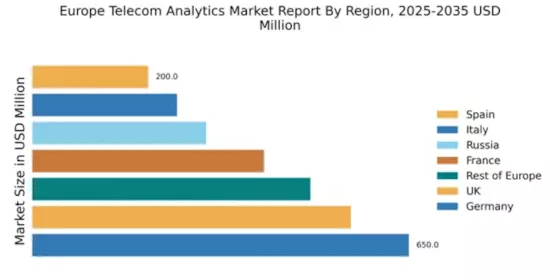
Germany holds a commanding market share of 32.5% in the telecom analytics sector, valued at $650.0 million. Key growth drivers include the rapid adoption of 5G technology, increasing demand for data analytics, and robust government initiatives promoting digital transformation. Regulatory policies favoring innovation and investment in infrastructure further bolster market growth, while industrial development in cities like Berlin and Munich enhances consumption patterns.

UK : Innovation and Investment Drive Growth

The UK telecom analytics market is valued at $550.0 million, representing 27.5% of the European market. Growth is driven by increasing mobile data consumption and the rise of IoT applications. Government initiatives, such as the Digital Strategy, aim to enhance connectivity and support innovation. The competitive landscape is characterized by strong investments in infrastructure, particularly in London and Manchester, where demand for advanced analytics solutions is surging.

France : Strong Demand and Regulatory Support

France's telecom analytics market is valued at $400.0 million, accounting for 20% of the European market. Key growth drivers include the expansion of 5G networks and increasing consumer demand for personalized services. Regulatory support from ARCEP encourages innovation and investment in telecom infrastructure. Major cities like Paris and Lyon are pivotal markets, with a competitive landscape featuring players like Orange and SAP, focusing on enhancing customer experience through analytics.

Russia : Market Expansion Amid Challenges

Russia's telecom analytics market is valued at $300.0 million, representing 15% of the European market. Growth is driven by increasing mobile penetration and the demand for data-driven decision-making. Government initiatives aimed at digital economy development support market expansion. Key cities like Moscow and St. Petersburg are central to this growth, with local players and international firms like Ericsson competing in a challenging regulatory environment.

Italy : Investment and Innovation Fuel Growth

Italy's telecom analytics market is valued at $250.0 million, making up 12.5% of the European market. Growth is propelled by investments in digital infrastructure and the increasing use of analytics in telecommunications. Government initiatives, such as the National Plan for 5G, support this trend. Key markets include Milan and Rome, where major players like Telecom Italia and Nokia are enhancing their analytics capabilities to meet rising consumer demands.

Spain : Strong Demand and Competitive Edge

Spain's telecom analytics market is valued at $200.0 million, accounting for 10% of the European market. The growth is driven by the increasing adoption of mobile services and the demand for enhanced customer insights. Regulatory support from the CNMC fosters a competitive environment. Key cities like Madrid and Barcelona are central to market dynamics, with major players such as Telefónica and Cisco focusing on innovative analytics solutions to capture market share.

Rest of Europe : Varied Markets with Unique Dynamics

The Rest of Europe telecom analytics market is valued at $480.0 million, representing 24% of the overall market. Growth is driven by varying demand across countries, influenced by local regulations and infrastructure development. Countries like the Netherlands and Sweden are notable for their advanced telecom sectors. The competitive landscape features both local and international players, with a focus on sector-specific applications in finance and healthcare analytics.

Europe Telecom Analytics Market Regional Image

Key Players and Competitive Insights

The telecom analytics market in Europe is characterized by a dynamic competitive landscape, driven by the increasing demand for data-driven decision-making and enhanced customer experiences. Key players such as IBM (US), Oracle (US), and Ericsson (SE) are strategically positioned to leverage their technological expertise and extensive portfolios. IBM (US) focuses on innovation through its AI-driven analytics solutions, while Oracle (US) emphasizes cloud-based offerings to enhance operational efficiency. Ericsson (SE) is actively pursuing partnerships to expand its 5G analytics capabilities, indicating a collective shift towards advanced analytics solutions that cater to evolving market needs.

The market structure appears moderately fragmented, with a mix of established players and emerging startups. Key business tactics include localizing manufacturing and optimizing supply chains to enhance responsiveness to regional demands. The influence of major players is significant, as their strategic initiatives often set industry benchmarks, thereby shaping competitive dynamics and encouraging innovation across the sector.

In September 2025, IBM (US) announced a partnership with a leading European telecom operator to deploy its AI-powered analytics platform, aimed at improving network performance and customer satisfaction. This collaboration underscores IBM's commitment to enhancing operational efficiencies through advanced analytics, potentially positioning it as a leader in the telecom analytics space. The strategic importance of this partnership lies in its potential to drive significant improvements in service delivery and operational agility.

In October 2025, Oracle (US) launched a new suite of cloud-based analytics tools tailored for telecom operators, designed to facilitate real-time data analysis and decision-making. This move reflects Oracle's strategy to capitalize on the growing trend of digital transformation within the telecom sector. By providing operators with enhanced analytical capabilities, Oracle aims to strengthen its market position and drive customer loyalty through improved service offerings.

In August 2025, Ericsson (SE) expanded its analytics portfolio by acquiring a startup specializing in machine learning algorithms for network optimization. This acquisition is indicative of Ericsson's focus on integrating cutting-edge technologies to enhance its analytics capabilities. The strategic significance of this move lies in its potential to provide telecom operators with more sophisticated tools for managing network performance, thereby fostering greater operational efficiency and customer satisfaction.

As of November 2025, current trends in the telecom analytics market include a pronounced emphasis on digitalization, sustainability, and the integration of AI technologies. Strategic alliances are increasingly shaping the competitive landscape, as companies seek to combine their strengths to deliver comprehensive solutions. Looking ahead, competitive differentiation is likely to evolve, with a shift from price-based competition towards innovation, technological advancements, and supply chain reliability becoming paramount.

Key Companies in the Europe Telecom Analytics Market market include

Industry Developments

Nokia and Deutsche Telekom's T Wholesale collaborated in February 2025 to provide developers with access to network APIs (e.g., SIM switch, number verification) through Nokia's Network-as-Code platform, thereby enabling telco integration and automation.

In late 2024, Deutsche Telekom collaborated with Nokia (and Fujitsu) to establish a multi-vendor Open RAN network in Germany, which encompassed more than 3,000 sites.

The network was equipped with AI-enabled monitoring through Nokia's MantaRay NM solution.BT Group will maintain a strategic, multi-year partnership with Google Cloud from 2022 onward, incorporating AI, ML, data analytics, and cloud infrastructure into its telecom operations and customer experience systems.

Future Outlook

Europe Telecom Analytics Market Future Outlook

The Telecom Analytics Market is projected to grow at a 9.12% CAGR from 2024 to 2035, driven by increasing data consumption, IoT integration, and demand for enhanced customer insights.

New opportunities lie in:

  • Development of AI-driven predictive maintenance tools for network optimization.
  • Implementation of real-time analytics platforms for customer experience enhancement.
  • Creation of tailored analytics solutions for emerging 5G applications.

By 2035, the telecom analytics market is expected to achieve substantial growth and innovation.

Market Segmentation

Europe Telecom Analytics Market Type Outlook

  • Customer Analytics
  • Network Analytics
  • Subscriber Analytics
  • Location Analytics
  • Price Analytics
  • Service Analytics

Europe Telecom Analytics Market Services Outlook

  • Professional Services
  • Managed Services

Europe Telecom Analytics Market Solution Outlook

  • Customer Management
  • Network Management
  • Marketing Management
  • Sales & Distribution
  • Others

Europe Telecom Analytics Market Deployment Models Outlook

  • On-Premise
  • Cloud-Based

Report Scope

MARKET SIZE 20242430.0(USD Million)
MARKET SIZE 20252651.62(USD Million)
MARKET SIZE 20356350.0(USD Million)
COMPOUND ANNUAL GROWTH RATE (CAGR)9.12% (2024 - 2035)
REPORT COVERAGERevenue Forecast, Competitive Landscape, Growth Factors, and Trends
BASE YEAR2024
Market Forecast Period2025 - 2035
Historical Data2019 - 2024
Market Forecast UnitsUSD Million
Key Companies Profiled["IBM (US)", "Oracle (US)", "SAP (DE)", "Cisco (US)", "Ericsson (SE)", "Nokia (FI)", "Amdocs (IL)", "TIBCO Software (US)", "ZTE (CN)"]
Segments CoveredType, Solution, Services, Deployment Models
Key Market OpportunitiesIntegration of artificial intelligence in telecom analytics enhances customer experience and operational efficiency.
Key Market DynamicsGrowing demand for data-driven insights drives innovation and competition in the telecom analytics market.
Countries CoveredGermany, UK, France, Russia, Italy, Spain, Rest of Europe

Leave a Comment

FAQs

What is the expected market size of the Europe Telecom Analytics Market in 2024?

The Europe Telecom Analytics Market is expected to be valued at 3.04 billion USD in 2024.

What is the projected market size of the Europe Telecom Analytics Market by 2035?

By 2035, the Europe Telecom Analytics Market is anticipated to reach a valuation of 21.45 billion USD.

What is the expected compound annual growth rate (CAGR) for the Europe Telecom Analytics Market from 2025 to 2035?

The expected CAGR for the Europe Telecom Analytics Market from 2025 to 2035 is 19.428%.

Which regional market is expected to have the highest value in 2035?

Germany is projected to have the highest market value in 2035, estimated at 5.1 billion USD.

What are the projected values for Customer Analytics in 2024 and 2035?

Customer Analytics is valued at 0.76 billion USD in 2024 and is expected to reach 5.41 billion USD by 2035.

How much is Network Analytics expected to grow from 2024 to 2035?

Network Analytics is projected to increase from 0.6 billion USD in 2024 to 4.27 billion USD by 2035.

Who are the major players in the Europe Telecom Analytics Market?

Key players in the market include Nokia, Telenor, Vodafone, BT Group, and Huawei among others.

What is the expected value of Subscriber Analytics in 2024 and 2035?

Subscriber Analytics is expected to be valued at 0.5 billion USD in 2024 and grow to 3.56 billion USD by 2035.

How does the market size for Price Analytics change from 2024 to 2035?

Price Analytics is projected to grow from 1.19 billion USD in 2024 to 5.35 billion USD in 2035.

What is the expected market value for Italy in 2035?

The market value for Italy is expected to reach 2.9 billion USD by 2035.

Download Free Sample

Kindly complete the form below to receive a free sample of this Report

Compare Licence

×
Features License Type
Single User Multiuser License Enterprise User
Price $4,950 $5,950 $7,250
Maximum User Access Limit 1 User Upto 10 Users Unrestricted Access Throughout the Organization
Free Customization
Direct Access to Analyst
Deliverable Format
Platform Access
Discount on Next Purchase 10% 15% 15%
Printable Versions