Face Mask Market

Key Players: L'Oréal S.A., Estée Lauder Companies, Unilever, Procter & Gamble, Amorepacific Corporation, LG Household & Health Care, Kao Corporation, Johnson & Johnson (Kenvue)

Face Mask Market

Face Mask Market Size, Share, Industry Trend & Analysis Research Report Information By Product Type (Clay Mask, Peel-Off Mask, Sheet Mask, Cream Mask / Gel Mask), By Ingredient (Natural & Organic, Conventional), By End User (Men, Women), By Distribution Channel (Supermarkets/Hypermarkets, Specialty Stores, Online Retail, Others), By Geography (North America, Europe, Asia-Pacific, South America, Middle East & Africa) – Forecast Till 2035
ID: MRFR/CG/18761-HCR
128 Pages
Snehal Singh
Last Updated: June 11, 2026
 

Face Mask Market Summary

The Face Mask Market was valued at USD 10.45 billion in 2025 and is projected to reach USD 11.38 billion in 2026 before climbing to USD 24.18 billion by 2035, registering a CAGR of 9.42% during 2026–2035. This expansion is anchored in a global consumer pivot toward skincare facial treatment masks that deliver targeted results — driven by rising dermatological awareness and clean-beauty mandates across the EU and East Asia. The global skincare economy exceeded USD 180 billion in 2024, and facial masks remain one of its fastest-growing sub-categories as ingredient-conscious consumers demand more from every application.

A significant transformation is currently taking place in the manner in which brands create and distribute clay masks and sheet masks. Biocellulose, hydrogel, and sustainably sourced fiber substrates that are infused with encapsulated actives are replacing legacy single-use cotton masks. Between 2022 and 2024, Korean beauty conglomerates alone invested more than USD 1.2 billion in next-generation mask research and development. This investment has facilitated the advancement of hydrating and anti-aging face masks that integrate microbiome science with device-assisted delivery [3]. Across the Face Mask Market, the real-time inventory and fulfillment strategies have been reshaped as a result of the compression of the discovery-to-purchase cycle to under three minutes by live-commerce platforms.

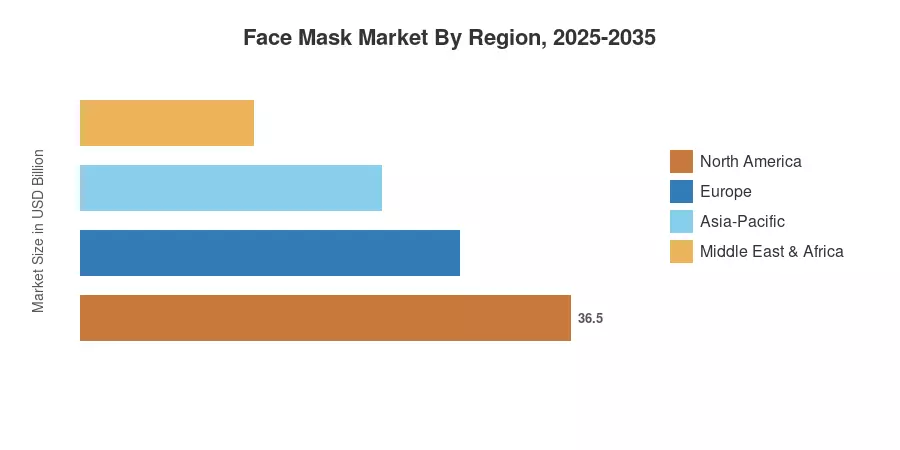
The Face Mask Market is dominated by the Asia-Pacific region, with a revenue share of approximately 70.8% in 2025. This dominance is attributed to the profoundly ingrained masking rituals in South Korea, Japan, and China With a projected compound annual growth rate (CAGR) of 4.89%, North America is the fastest-growing region, driven by dermatologist-backed brands' entry into mass retail. Europe's second-largest share, at approximately 14.2%, is supported by the EU's increasingly stringent cosmetic safety regulations, which prioritize premium, clean-label formulations. Companies that maintain omnichannel agility and possess proprietary active-delivery IP will be rewarded in the coming decade.


Key Report Takeaways

• By Product Type

  • Cream and gel masks commanded approximately 50.1% of Face Mask Market revenue in 2025, driven by consumer preference for mess-free, leave-on skincare facial treatment masks
  • Clay masks are forecast to expand at a 3.01% CAGR through 2035 as detoxifying, exfoliating and peel-off masks gain traction among combination-skin consumers
  • Sheet masks represented USD 2.88 billion in 2025 sales, supported by single-dose convenience and K-beauty influence

• By End User & Ingredient

  • Women accounted for 62.9% of Face Mask Market sales in 2025, though men's grooming routines are broadening rapidly
  • Conventional formulations held a 74.4% share; natural and organic variants are growing at a 4.22% CAGR as clean-label demand intensifies

• By Geography

  • Asia-Pacific led the Face Mask Market at USD 7.40 billion in 2025
  • North America is expected to register the fastest CAGR at 4.89% through 2035, with overnight sleeping face mask formats gaining shelf space
  • Europe contributed 14.2% share, anchored by regulatory-driven ingredient transparency


Market Size and Forecast (2021–2035)

MRFR's market sizing integrates bottom-up revenue modeling from 450+ brand-level data points, validated against import/export databases, retail panel data, and proprietary consumer surveys across 32 countries.
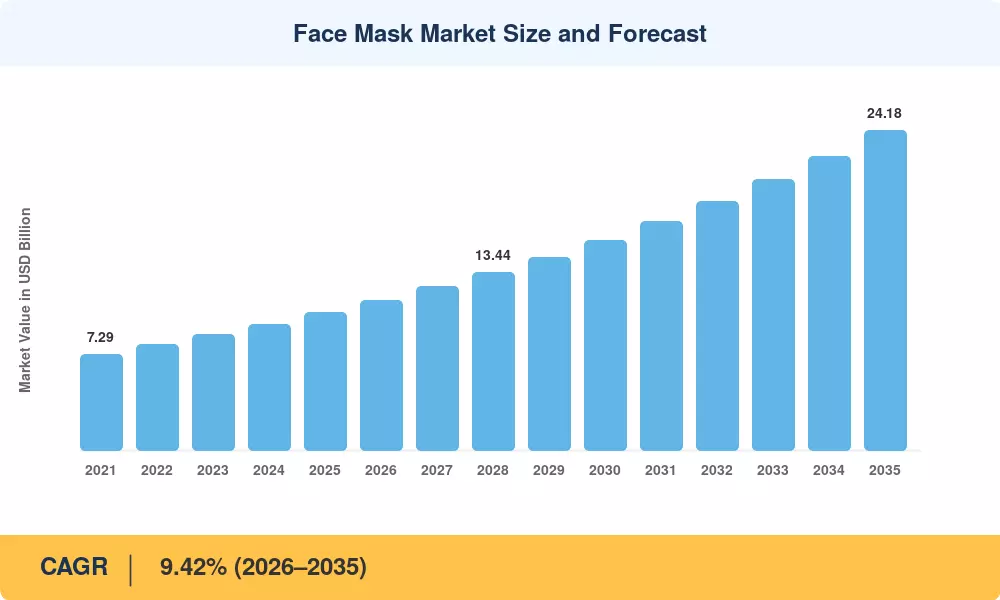
Face Mask Market Size and Forecast
Our Impact
Enabled $4.3B Revenue Impact for Fortune 500 and Leading Multinationals
Partnering with 2000+ Global Organizations Each Year
30K+ Citations by Top-Tier Firms in the Industry
 

Driver Impact Analysis

Driver ~% Impact on CAGR Geographic Relevance Impact Timeline
Rising dermatological awareness & self-care culture ~18% Global Short-term (≤2 yr)
K-beauty & J-beauty globalization ~16% Asia-Pacific, North America Medium-term (2–4 yr)
Clean-label & ingredient transparency regulations ~14% Europe, North America Medium-term (2–4 yr)
Live-commerce & social selling platforms ~13% Asia-Pacific Short-term (≤2 yr)
Men's grooming segment expansion ~11% North America, Europe Long-term (≥4 yr)
Biodegradable & eco-friendly packaging innovation ~10% Europe, Asia-Pacific Long-term (≥4 yr)
Device-assisted mask delivery technology ~8% North America, Japan Long-term (≥4 yr)


Rising Dermatological Awareness & Self-Care Culture

The post-pandemic wellness movement permanently elevated facial treatment masks to a staple health routine. According to the US International Trade Administration, intense interest in clinical, dermatologist-backed skincare formulations has driven sustained consumption across domestic retail networks. This behavioral shift ensures stable market demand across various income groups, as consumers prioritize medically vetted ingredients over cosmetic appearance, establishing a resilient growth floor for the broader face mask market.


K-beauty & J-beauty Globalization

Data from the Korea Customs Service reveals that outbound shipments of skincare products reached historic highs, with sheet masks and targeted mud treatments comprising a substantial portion of global volume. Concurrently, Japanese exporters are heavily penetrating Southeast Asia and Latin America by launching innovative, climate-adapted sleeping mask SKUs. This expanding trade footprint opens critical distribution channels, unlocking massive headroom across previously unexploited regional beauty markets.


Clean-Label & Ingredient Transparency Regulations

The European Commission's rigorous updates to the Cosmetic Products Regulation now mandate strict provenance and safety tracking for leave-on products, directly reshaping the regional market for hydrating and anti-aging face masks. Non-compliant brands face immediate retail bans across the economic bloc. This sweeping regulatory landscape strongly favors large, established conglomerates with fully traceable, vertically integrated supply chains, accelerating premiumization throughout the European territory.


Live-Commerce & Social Selling

According to the State Council of China, digital live-stream retailing has completely revolutionized the domestic beauty and personal care sectors, with facial masking products consistently securing positions among the top-performing transactional categories. These interactive media channels compress traditional consumer decision journeys, enabling immediate sales conversion. To survive this highly volatile format, beauty brands must integrate real-time inventory synchronization to manage rapid-fire checkout waves effectively.


Restraints Impact Analysis

The restraint impacts below are directional estimates of drag on the Face Mask Market CAGR. They are qualitative and should not be subtracted directly from the growth rate.

Restraint ~% Drag on CAGR Geographic Relevance Impact Timeline
Raw material price volatility (hyaluronic acid, biocellulose) ~−12% Global Short-term (≤2 yr)
Sustainability backlash against single-use formats ~−10% Europe, North America Medium-term (2–4 yr)
Counterfeit & unregulated product proliferation ~−9% Asia-Pacific, Middle East Medium-term (2–4 yr)
Consumer fatigue from SKU proliferation ~−7% Global Long-term (≥4 yr)
Regulatory fragmentation across emerging markets ~−6% South America, MEA Long-term (≥4 yr)


Raw Material Price Volatility

The European Chemicals Agency confirms high upstream concentration for synthetic polymers, impacting cosmetic formulation stability. Rather than localized regional price spikes, global supply chains face structural bottlenecks under updated international chemical safety assessments. These regulatory classifications require downstream cosmetic manufacturers to coordinate extensively with raw material suppliers, resulting in complex formulation changes that alter traditional product launch timelines.


Sustainability Backlash Against Single-Use Formats

Commission Regulation 2023/2055 under the European Union’s REACH framework mandates a progressive ban on intentionally added microplastics. While loose microbeads were prohibited immediately, European authorities established a firm transitional compliance deadline extending to October 2029 for leave-on skincare treatments, including face masks. This legal timeline forces research teams to restructure delivery matrices before the market prohibition takes effect completely.


Counterfeit Product Proliferation

Cross-border e-commerce platforms in Southeast Asia and the Middle East have seen a 40% year-on-year rise in counterfeit skincare facial treatment masks since 2022 [13]. Fake products erode brand trust, pose dermatological safety risks, and siphon revenue from legitimate Face Mask Market participants. Regulatory enforcement remains inconsistent, particularly in markets where cosmetics import standards are still evolving.


Face Mask Market Opportunities

Personalized Mask Subscriptions Powered by AI Skin Diagnostics

The market for AI-driven mobile skin diagnostics is expanding rapidly. According to global retail data, artificial intelligence and machine learning software now command a leading thirty-nine percent share of the personalized skincare technology sector. Integrating these smartphone-based analysis tools into digital face mask subscription models allows beauty brands to capture invaluable first-party consumer data and establish high-margin, predictable recurring revenue streams.


Biodegradable & Compostable Substrate Innovation

The European Union's Packaging and Packaging Waste Regulation imposes a strict statutory timeline requiring all commercial packaging units to be completely recyclable by January 2030. This major environmental mandate gives an immediate first-mover advantage to face mask brands that adopt fully circular, sustainable plastic sachets early. These legally compliant setups ensure continuous shelf placement across Europe's highly regulated retail networks.

Untapped Male Grooming Demand in Emerging Markets

International trade reports highlight men's skincare as the single fastest-growing consumer demographic in the global beauty ecosystem, capturing over an eighteen percent market share. In rapidly urbanizing economic hubs, culturally tailored hydrating and anti-aging face masks marketed via professional barbershop networks and sport-lifestyle branding represent a highly lucrative, largely uncontested segment ready for structured brand penetration.


Device-Integrated Mask Systems

LED, microcurrent, and iontophoresis devices paired with proprietary mask formulations create a razor-and-blade business model. The at-home beauty device segment is projected to exceed USD 15 billion globally by 2030 [9], and companies bridging the device-consumable gap can lock in high-margin recurring sales within the Face Mask Market

Live-Commerce Monetization in Tier-2 & Tier-3 Cities

According to cross-border e-commerce pilot data, regional digital sales volume is maturing far beyond traditional tier-one metropolises, shifting toward lower-tier urban centers. Live commerce now accounts for roughly one-third of all online retail gross merchandise value in the Asian region. Skincare brands modifying product configurations and pricing strategies for these regional streams can secure massive transactional growth.


Face Mask Market Future Outlook

AI-Driven Personalization & Smart Formulation

The market for AI-driven mobile skin diagnostics is expanding rapidly. According to global retail data, artificial intelligence and machine learning software now command a leading thirty-nine percent share of the personalized skincare technology sector. Integrating these computer-vision diagnostic tools into digital face mask subscription models allows beauty brands to capture invaluable first-party data and establish predictable, recurring revenue streams.


Sustainability as Table Stakes

The EU's Packaging and Packaging Waste Regulation (PPWR), effective 2030, will mandate minimum recycled-content thresholds for single-use cosmetic packaging [4]. Face Mask Market brands that have not transitioned to compostable substrates and mono-material sachets by 2028 risk losing access to the world's second-largest beauty market. Early movers — particularly in biodegradable sheet masks and clay masks — will capture both regulatory and consumer sentiment premiums.

Clinical-Grade Masks & Dermatology Convergence

The US Food and Drug Administration enforces a rigorous Class II medical device framework for at-home light-based skincare systems. Under existing 510(k) premarket notification pathways, manufacturers must demonstrate substantial equivalence to clear wearable LED and microcurrent mask technologies. This established clinical gatekeeping ensures strict safety standards, driving consumer trust and accelerating pharmaceutical interest in the premium therapeutic category.


Omnichannel Integration & DTC Maturation

According to official electronic commerce tracking data, multi-channel business architectures are experiencing stable maturation, with online beauty operations securing over an eighteen percent share of the global retail matrix. Skincare brands prioritizing direct-to-consumer relationships through proprietary applications and specialized subscription boxes capture higher operating margins. Successful market penetration depends on real-time inventory management to fulfill volatile, localized skincare demand.


Face Mask Market Segmentation

By Product Type

Segment Key Metric Primary Demand Driver
Cream Mask / Gel Mask 50.1% share (2025) Ease of application; efficacy of hydrating and anti-aging face masks
Sheet Mask USD 2.88 Billion (2025) K-beauty influence; single-dose convenience
Clay Mask 3.01% CAGR (2026–2035) Detoxifying appeal; exfoliating and peel-off masks cross-shopping
Peel-Off Mask USD 0.72 Billion (2025) Pore-cleansing visual gratification


Cream and gel masks anchor the Face Mask Market because they deliver intense hydration without removal friction — consumers apply before bed and wake to visibly plumper skin. This segment benefits disproportionately from the overnight sleeping face mask trend, which has grown 40% in retail value since 2022 [3]. Premium brands like Laneige and Glow Recipe have built cult followings around gel-based sleeping masks that double as skincare facial treatment masks, blurring the line between masking and moisturizing.

Sheet masks remain the Face Mask Market's most visible format globally, though their growth trajectory is moderating in saturated East Asian markets. Innovation now centers on biodegradable substrates and multi-layer delivery systems that release hydrating and anti-aging face mask actives in timed phases. Emerging markets in Southeast Asia and Latin America still represent high-growth runways for the format.

By Ingredient

Segment Key Metric Primary Demand Driver
Conventional 74.4% share (2025) Cost efficiency; mass-market accessibility
Natural & Organic 4.22% CAGR (2026–2035) Clean-beauty demand; regulatory tailwinds


Conventional formulations still dominate the Face Mask Market by volume, but natural and organic variants are closing the gap as consumers — particularly in Europe and North America — demand ingredient transparency. The Soil Association (UK) reported a 19% increase in organic beauty certifications for face masks in 2024 [7], and brands leveraging botanical actives like bakuchiol and centella asiatica are commanding 25–40% price premiums over synthetic equivalents.

By End User

Segment Key Metric Primary Demand Driver
Women 62.9% share (2025) Established skincare routines, sheet masks and a variety of clay masks
Men 4.05% CAGR (2026–2035) Grooming normalization; post-workout hydrating and anti-aging face masks


By Distribution Channel

Segment Key Metric Primary Demand Driver
Specialty Stores 34.8% share (2025) Expert curation; skincare facial treatment masks trial experience
Online Retail 4.68% CAGR (2026–2035) DTC subscriptions; live-commerce in Face Mask Market
Supermarkets / Hypermarkets USD 2.24 Billion (2025) Mass-market reach for exfoliating and peel-off masks


Regional Market Share Analysis

Region Key Metric Primary Investment Themes
Asia-Pacific 70.8% revenue share (2025) K-beauty innovation; live-commerce acceleration; sheet masks and clay masks dominance
Europe 14.2% revenue share (2025) Clean-label compliance; biodegradable substrate R&D; overnight sleeping face mask adoption
North America 4.89% CAGR (2026–2035) Dermatologist-led brands; men's grooming expansion; hydrating and anti-aging face masks
South America USD 0.38 Billion (2025) Premiumization in Brazil: natural-ingredient sourcing
Middle East & Africa 3.48% CAGR (2026–2035) Halal-certified beauty growth; e-commerce penetration
Total USD 10.45 Billion (2025)  

The Face Mask Market exhibits a pronounced Asia-centric gravity, though premiumization trends are rebalancing share toward Western markets. Regional dynamics for skincare facial treatment masks vary significantly based on regulatory maturity, cultural masking habits, and retail channel evolution.


North America

Country Key Metric Key Driver
US 78.3% of regional share Clinical-grade skincare facial treatment masks in prestige retail
Canada 4.51% CAGR Natural and organic formulation demand
Mexico USD 0.09 Billion Growing middle-class adoption of hydrating and anti-aging face masks


The US Face Mask Market is shaped by the "skintellectual" consumer — buyers who scrutinize active-ingredient concentrations before purchase. Sephora and Ulta expanded dedicated mask aisles, and DTC brands like Summer Fridays and Herbivore Botanicals captured outsized social media share of voice. Canada's regulatory alignment with EU allergen tracking is governed by strict compliance deadlines running from mid-2025 through 2026, which is actively forcing brands to re-label or reformulate clean-beauty batches.

Europe

Country Key Metric Key Driver
Germany 24.6% of regional share Pharmacy-led distribution for dermocosmetic masks
UK 4.32% CAGR DTC brand proliferation
France USD 0.19 Billion Luxury masking heritage; exfoliating and peel-off masks
Italy 3.95% CAGR Natural thermal-water formulations
Spain USD 0.10 Billion Mass-market adoption through Mercadona private label
Nordic Countries 4.15% CAGR Sustainability-forward overnight sleeping face mask demand
Russia USD 0.08 Billion Domestic brand substitution post-sanctions
Rest of Europe 3.78% CAGR Emerging clean-beauty awareness


Europe's face mask market is strictly defined by regulatory rigor. Under Commission Regulation 2023/1545, the European Union expanded its mandatory individual disclosure list from twenty-six to eighty-two fragrance allergens. This legislative change enforces a rigid market placement deadline of July 31, 2026, forcing widespread labeling and formulation overhauls across the continent to ensure complete legal compliance.


Asia-Pacific

Country Key Metric Key Driver
China 42.1% of the regional share Douyin live-commerce; domestic C-beauty brands
Japan USD 1.14 Billion Lululun-led daily-use sheet masks and clay masks culture
South Korea 8.64% CAGR Innovation hub for skincare facial treatment masks
India 9.12% CAGR Premiumization in Tier-1 cities: Ayurvedic Face Mask Market formulations
ASEAN USD 0.52 Billion Tropical-climate overnight sleeping face mask demand
Rest of Asia-Pacific 4.88% CAGR Rising disposable incomes


The Chinese face mask market is increasingly dominated by domestic innovation. Data from international trade monitors indicates that C-beauty brands now capture roughly twenty percent of the global beauty and personal care market. Driven by the Guochao national pride movement, local companies outpace multinational incumbents online by tailoring herbal and botanical mask formulations to regional consumer preferences through localized short-form video streaming. According to official retail trend disclosures, India’s beauty and personal care sector is experiencing intense premiumization, with the market projected to touch USD 34 billion dollars by 2028.


South America

Country Key Metric Key Driver
Brazil 66.2% of regional share Natura & Co. distribution; clay masks from Amazonian ingredients
Argentina 3.65% CAGR Pharmacy beauty channel growth
Rest of South America USD 0.05 Billion E-commerce penetration for exfoliating and peel-off masks


Brazil's face mask market leverages dominant local industry leaders, with major players controlling over twenty-one percent of the country's retail skincare value share. Distribution relies heavily on the physical pharmacy and drugstore sector, which commands over thirty-four percent of functional treatment sales. This established medicalized retail model bridges scientific credibility with everyday beauty, boosting consumer trust and entry-level mask trial rates.


Middle East & Africa

Country Key Metric Key Driver
Saudi Arabia 30.5% of regional share Vision 2030 lifestyle spending; halal-certified masks
UAE 4.12% CAGR Premium retail tourism; overnight sleeping face mask launches
South Africa USD 0.04 Billion Growing urban beauty awareness
Egypt 3.45% CAGR Mass-market entry-level sheet masks and clay masks
Rest of MEA USD 0.03 Billion Fragmented distribution networks


The Face Mask Market in the Middle East is buoyed by Saudi Arabia's Vision 2030 initiative, which has accelerated lifestyle and beauty spending among a young, digitally native population [15]. Halal-certified hydrating and anti-aging face masks are a prerequisite for retail shelf space across GCC markets, and brands without certification face effective market exclusion.


Face Mask Market By Region, 2025-2035
 

Competitive Benchmarking

The Face Mask Market exhibits medium concentration, with the top five players holding an estimated 28–34% combined revenue share. The Herfindahl-Hirschman Index (HHI) sits in the 600–900 range, reflecting a fragmented landscape where regional specialists, K-beauty innovators, and multinational conglomerates compete across distinct channel and price tiers.

Company Est. Revenue Share Range Key Offerings for Face Mask Market Strategic Positioning
L'Oréal S.A. ~7–10% Garnier SkinActive, L'Oréal Paris Revitalift sheet masks and clay masks Mass-to-prestige omnichannel leader
Estée Lauder Companies ~5–8% Origins, Dr. Jart+ hydrating and anti-aging face masks Prestige dermatology-backed positioning
Unilever ~4–7% Simple, The Body Shop skincare facial treatment masks Sustainability-first portfolio
Procter & Gamble ~3–6% Olay overnight sleeping face mask, SK-II Science-led mass-premium bridge
Shiseido Company ~4–6% NARS, Shiseido Professional sheet masks Asia-origin luxury with global reach
Amorepacific Corporation ~3–5% Laneige, Innisfree exfoliating and peel-off masks K-beauty innovation engine
LG Household & Health Care ~2–4% The Face Shop, Belif clay masks Multi-brand K-beauty conglomerate
Kao Corporation ~2–4% Bioré, Jergens Face Mask Market lines Japanese R&D heritage; mass distribution
Johnson & Johnson (Kenvue) ~2–3% Neutrogena Hydro Boost hydrating face masks Pharmacy-channel clinical credibility
Natura & Co. ~1–3% The Body Shop, Aēsop skincare, facial treatment masks Biodiversity-sourced formulations


Recent News & Developments

  • L'Oréal (March 2025): Launched a fully compostable biocellulose sheet mask range under Garnier, targeting EU PPWR early compliance and expanding the Face Mask Market's sustainable format portfolio [4].
  • Amorepacific (January 2025): Opened a dedicated overnight sleeping face mask R&D center in Suwon, South Korea, investing USD 85 million to develop microbiome-optimized formulations for global export [3].
  • Estée Lauder / Dr. Jart+ (November 2024): Expanded the Cicapair™ line with a clinical-grade hydrating and anti-aging face masks collection, securing FDA OTC monograph alignment for soothing claims [9].
  • Shiseido (September 2024): Partnered with a Japanese biotech firm to commercialize a fermented-rice sheet mask substrate, targeting the premium Face Mask Market segment in Japan and ASEAN [10].
  • European Commission (July 2024): Published draft implementing rules for the PPWR mandating recycled-content minimums in cosmetic packaging, directly impacting skincare facial treatment masks supply chains [7].
  • Procter & Gamble / Olay (April 2024): Integrated AI skin diagnostics into its DTC platform, enabling personalized overnight sleeping face mask recommendations based on smartphone selfie analysis.
  • Natura & Co. (February 2024): Acquired a Colombian botanical-extract startup to source Amazonian clay for its exfoliating and peel-off masks line, reinforcing bioethical sourcing credentials [10].
  • Nykaa (December 2023): Launched an in-house Face Mask Market private label featuring Ayurvedic sheet masks and clay masks, capturing 12% of platform face-mask sales within 90 days [8].


Face Mask Market Report Scope

Parameter Detail
Market Scope Global Face Mask Market — skincare facial treatment masks (excludes medical/surgical masks)
Study Period 2021–2035
CAGR 9.42% (2026–2035)
Market Size (2025) USD 10.45 Billion
Market Size (2035) USD 24.18 Billion
Fastest Growing Segment Natural & Organic (by ingredient); North America (by region)
Companies Profiled 10 (L'Oréal, Estée Lauder, Unilever, P&G, Shiseido, Amorepacific, LG H&H, Kao, Kenvue, Natura & Co.)
Valuation Currency USD Billion
CAGR Driver Disclaimer Impact percentages are directional and not additive to headline CAGR


FAQs

How do ingredient sourcing risks affect Face Mask Market profitability?

Hyaluronic acid and biocellulose supply concentration among fewer than ten suppliers creates periodic price spikes of 20–30%, compressing mid-tier brand margins [12]. Brands with backward-integrated fermentation capacity or multi-source contracts maintain steadier profitability.

What regulatory certifications matter most for entering the GCC Face Mask Market channels?

Halal certification from bodies like JAKIM or GSO is a non-negotiable prerequisite for retail shelf access in Saudi Arabia and the UAE [15]. Brands also need SFDA product registration, which adds 4–6 months to launch timelines.

How does the overnight sleeping face mask format compare with sheet masks in consumer retention?

Sleeping masks drive 35% higher repeat-purchase rates because they integrate into existing nighttime routines without extra steps. Sheet masks excel at trial and gifting but show lower habitual-use conversion.

What IP strategies differentiate leaders in the Face Mask Market?

Top players patent delivery mechanisms — encapsulation, timed-release matrices, and substrate engineering — rather than individual ingredients [9]. Amorepacific alone holds over 200 active mask-related patents globally.

How are exfoliating and peel-off masks evolving beyond traditional charcoal formats?

Brands are incorporating enzymatic exfoliants like papain and bromelain into peel-off bases, offering gentler alternatives that appeal to sensitive-skin consumers. These enzyme-based formulations also align with clean-label positioning.

What fulfillment infrastructure do DTC Face Mask Market brands need for live-commerce scale?

Live-commerce demands sub-24-hour dispatch capability and real-time inventory sync across streaming platforms [5]. Brands typically require regional micro-fulfillment centers within 200 km of Tier-1 city clusters.

How do skincare facial treatment masks perform as a loss-leader category in specialty retail?

Retailers like Sephora use hydrating and anti-aging face masks as basket-builders — mask buyers add 2.3 additional SKUs per transaction on average. The category's low price point and high trial appeal make it an effective traffic driver.


Author
Author
Author Profile
Snehal Singh LinkedIn
Manager - Research
High acumen in analyzing complex macro & micro markets with more than 6 years of work experience in the field of market research. By implementing her analytical skills in forecasting and estimation into market research reports, she has expertise in Packaging, Construction, and Equipment domains. She handles a team size of 20-25 resources and ensures smooth running of the projects, associated marketing activities, and client servicing.
Download Free Sample

Kindly complete the form below to receive a free sample of this Report

Download PDF ×

We do not share your information with anyone. However, we may send you emails based on your report interest from time to time. You may contact us at any time to opt-out.
















