Facial Recognition Market (2026 - 2035)

ID: MRFR/SEM/0742-CR
110 Pages
Ankit Gupta
Last Updated: July 22, 2026
Facial Recognition Market Size, Share and Research Report By Technology (3D Facial Recognition, 2D Facial Recognition, Thermal Imaging, Skin Texture Analysis, Others), By Service (Consulting, Cloud-Based Services), By Components (Hardware, Software), By End-User (Government, BFSI, Commercial Retail, Automotive, Others) And By Region (North America, Europe, Asia-Pacific, And Rest Of The World) – Industry Forecast Till 2035
Facial Recognition Market
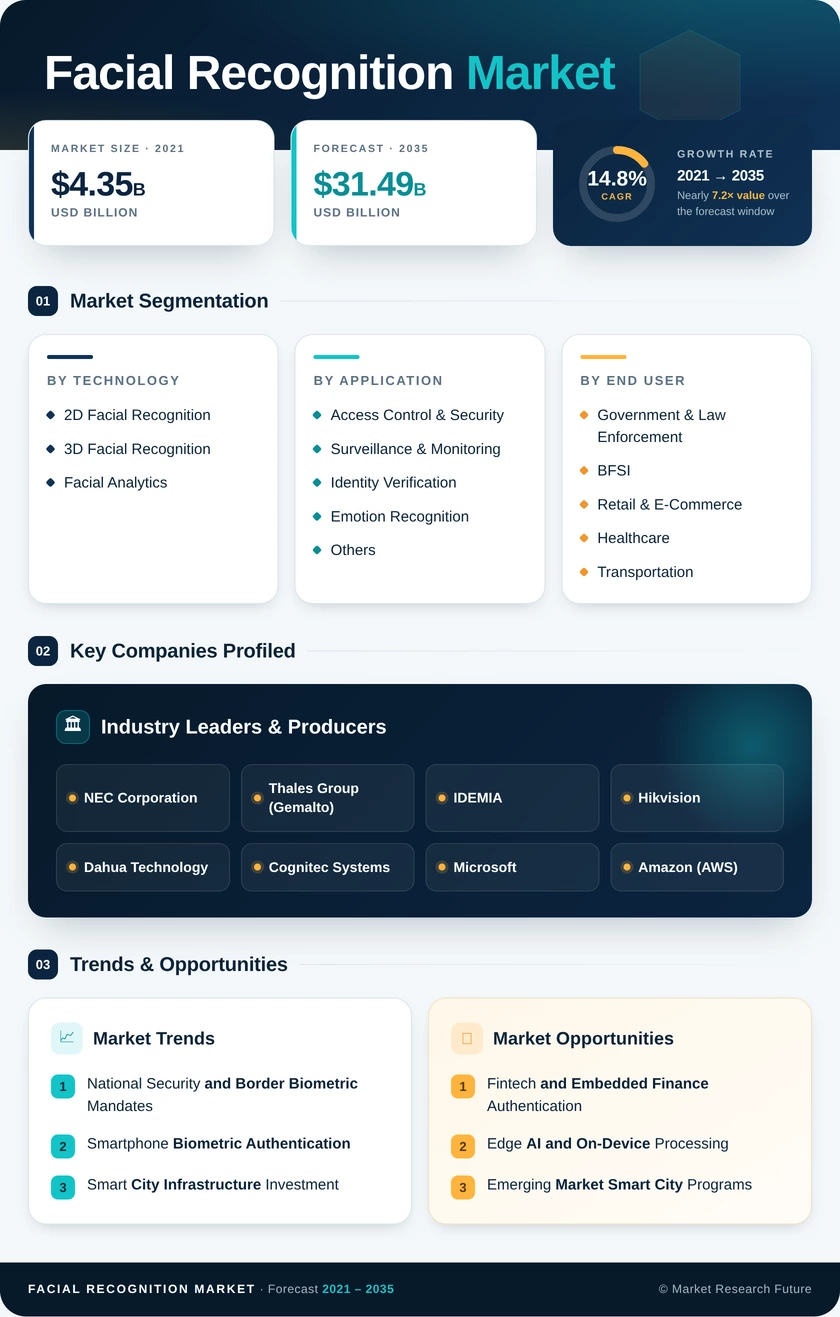
Market Size
Forecast Period2026-2035
CAGR (2026-2035)14.8%
2025 Market SizeUSD 7.92 Billion
2035 Market SizeUSD 31.49 Billion
Key Players
NEC Corporation
Thales Group
IDEMIA
Hikvision
Dahua Technology
Cognitec Systems
Opportunities
  • Fintech and Embedded Finance Authentication
  • Edge AI and On-Device Processing
  • Emerging Market Smart City Programs
  1. 1 Market Overview |
    1. 1.1 Study Assumptions & Market Definition |
    2. 1.2 Scope of the Study |
    3. 1.3 Research Methodology
  2. 2 Market Summary & Key Takeaways
  3. 3 Market Dynamics |
    1. 3.1 Market Drivers Analysis | |
      1. 3.1.1 National Security & Border Biometric Mandates | |
      2. 3.1.2 Smartphone Biometric Authentication Proliferation | |
      3. 3.1.3 Smart City and Public Safety Infrastructure Investment | |
      4. 3.1.4 Digital Banking KYC and Anti-Fraud Regulation | |
      5. 3.1.5 Airport and Transportation Hub Automation | |
      6. 3.1.6 Retail Customer Analytics and Loss Prevention | |
      7. 3.1.7 Healthcare Patient Identification and Telemedicine |
    2. 3.2 Market Restraints Analysis | |
      1. 3.2.1 Privacy Regulation and Public Backlash | |
      2. 3.2.2 Algorithmic Bias and Demographic Accuracy Gaps | |
      3. 3.2.3 Fragmented Regulatory Standards Across Jurisdictions | |
      4. 3.2.4 High Infrastructure Cost for 3D Sensor Deployment | |
      5. 3.2.5 Cybersecurity Risk of Biometric Data Breaches |
    3. 3.3 Market Opportunity Analysis | |
      1. 3.3.1 Fintech and Embedded Finance Authentication | |
      2. 3.3.2 Edge AI and On-Device Processing | |
      3. 3.3.3 Emerging Market Smart City Programs | |
      4. 3.3.4 Healthcare Patient Identification | |
      5. 3.3.5 Data Monetization through Anonymized Analytics |
    4. 3.4 Industry Value Chain Analysis |
    5. 3.5 Porter's Five Forces Analysis
  4. 4 Global Facial Recognition Market Size & Forecast (2021–2035) |
    1. 4.1 Historical Market Size (2021–2025) |
    2. 4.2 Current & Forecast Market Size (2026–2035) |
    3. 4.3 Market Size by Revenue (USD Billion) |
    4. 4.4 Year-over-Year Growth Analysis
  5. 5 Segmentation Analysis |
    1. 5.1 By Technology | |
      1. 5.1.1 2D Facial Recognition | |
      2. 5.1.2 3D Facial Recognition | |
      3. 5.1.3 Facial Analytics |
    2. 5.2 By Application | |
      1. 5.2.1 Access Control & Security | |
      2. 5.2.2 Surveillance & Monitoring | |
      3. 5.2.3 Identity Verification | |
      4. 5.2.4 Emotion Recognition | |
      5. 5.2.5 Others |
    3. 5.3 By End User | |
      1. 5.3.1 Government & Law Enforcement | |
      2. 5.3.2 BFSI | |
      3. 5.3.3 Retail & E-Commerce | |
      4. 5.3.4 Healthcare | |
      5. 5.3.5 Transportation | |
      6. 5.3.6 Others
  6. 6 Regional Analysis |
    1. 6.1 North America | |
      1. 6.1.1 United States | |
      2. 6.1.2 Canada | |
      3. 6.1.3 Mexico |
    2. 6.2 Europe | |
      1. 6.2.1 United Kingdom | |
      2. 6.2.2 Germany | |
      3. 6.2.3 France | |
      4. 6.2.4 Rest of Europe |
    3. 6.3 Asia-Pacific | |
      1. 6.3.1 China | |
      2. 6.3.2 India | |
      3. 6.3.3 Japan | |
      4. 6.3.4 South Korea | |
      5. 6.3.5 Rest of Asia-Pacific |
    4. 6.4 South America | |
      1. 6.4.1 Brazil | |
      2. 6.4.2 Argentina | |
      3. 6.4.3 Rest of South America |
    5. 6.5 Middle East & Africa | |
      1. 6.5.1 UAE | |
      2. 6.5.2 Saudi Arabia | |
      3. 6.5.3 South Africa | |
      4. 6.5.4 Rest of Middle East & Africa
  7. 7 Competitive Landscape |
    1. 7.1 Market Share Analysis (2025) |
    2. 7.2 Competitive Benchmarking Matrix |
    3. 7.3 Company Profiles | |
      1. 7.3.1 NEC Corporation | |
      2. 7.3.2 Thales Group | |
      3. 7.3.3 IDEMIA | |
      4. 7.3.4 Hikvision | |
      5. 7.3.5 Dahua Technology | |
      6. 7.3.6 Cognitec Systems | |
      7. 7.3.7 Microsoft | |
      8. 7.3.8 Amazon (AWS) | |
      9. 7.3.9 Megvii (Face++) | |
      10. 7.3.10 Aware, Inc.
  8. 8 Future Outlook & Strategic Recommendations (2026–2035) |
    1. 8.1 AI-Native Biometric Platforms |
    2. 8.2 Regulatory Harmonization and Trust Frameworks |
    3. 8.3 Privacy-Preserving Computation |
    4. 8.4 Autonomous Systems Integration
  9. 9 Recent Developments & News
  10. 10 Frequently Asked Questions (FAQs)
  11. 11 Report Scope & Methodology |
    1. 11.1 Study Period & Base Year |
    2. 11.2 Data Sources & Citations |
    3. 11.3 Abbreviations
  12. 12 LIST OF TABLES |
  13. TABLE 1 Global Facial Recognition Market Size & Forecast, by Revenue (USD Billion), 2021–2035 |
  14. TABLE 2 Global Facial Recognition Market — Year-over-Year Growth Analysis, 2021–2035 |
  15. TABLE 3 Global Facial Recognition Market — Driver Impact Analysis |
  16. TABLE 4 Global Facial Recognition Market — Restraints Impact Analysis |
  17. TABLE 5 Global Facial Recognition Market Size, by Technology, 2021–2035 (USD Billion) |
  18. TABLE 6 Global Facial Recognition Market Size, by Application, 2021–2035 (USD Billion) |
  19. TABLE 7 Global Facial Recognition Market Size, by End User, 2021–2035 (USD Billion) |
  20. TABLE 8 Global Facial Recognition Market Size, by Region, 2021–2035 (USD Billion) |
  21. TABLE 9 North America Facial Recognition Market Size, by Country, 2021–2035 (USD Billion) |
  22. TABLE 10 Europe Facial Recognition Market Size, by Country, 2021–2035 (USD Billion) |
  23. TABLE 11 Asia-Pacific Facial Recognition Market Size, by Country, 2021–2035 (USD Billion) |
  24. TABLE 12 South America Facial Recognition Market Size, by Country, 2021–2035 (USD Billion) |
  25. TABLE 13 Middle East & Africa Facial Recognition Market Size, by Country, 2021–2035 (USD Billion) |
  26. TABLE 14 North America Facial Recognition Market Size, by Technology, 2021–2035 (USD Billion) |
  27. TABLE 15 North America Facial Recognition Market Size, by Application, 2021–2035 (USD Billion) |
  28. TABLE 16 North America Facial Recognition Market Size, by End User, 2021–2035 (USD Billion) |
  29. TABLE 17 Europe Facial Recognition Market Size, by Technology, 2021–2035 (USD Billion) |
  30. TABLE 18 Europe Facial Recognition Market Size, by Application, 2021–2035 (USD Billion) |
  31. TABLE 19 Europe Facial Recognition Market Size, by End User, 2021–2035 (USD Billion) |
  32. TABLE 20 Asia-Pacific Facial Recognition Market Size, by Technology, 2021–2035 (USD Billion) |
  33. TABLE 21 Asia-Pacific Facial Recognition Market Size, by Application, 2021–2035 (USD Billion) |
  34. TABLE 22 Asia-Pacific Facial Recognition Market Size, by End User, 2021–2035 (USD Billion) |
  35. TABLE 23 South America Facial Recognition Market Size, by Technology, 2021–2035 (USD Billion) |
  36. TABLE 24 South America Facial Recognition Market Size, by Application, 2021–2035 (USD Billion) |
  37. TABLE 25 South America Facial Recognition Market Size, by End User, 2021–2035 (USD Billion) |
  38. TABLE 26 Middle East & Africa Facial Recognition Market Size, by Technology, 2021–2035 (USD Billion) |
  39. TABLE 27 Middle East & Africa Facial Recognition Market Size, by Application, 2021–2035 (USD Billion) |
  40. TABLE 28 Middle East & Africa Facial Recognition Market Size, by End User, 2021–2035 (USD Billion) |
  41. TABLE 29 Competitive Benchmarking Matrix — Global Facial Recognition Market, 2025 |
  42. TABLE 30 Company Profiles — Key Players, Global Facial Recognition Market |
  43. TABLE 31 Recent Developments & Strategic Announcements, 2023–2025 |
  44. TABLE 32 Report Scope & Methodology Summary |
  45. TABLE 33 Detailed Sources and Citations
  46. 13 LIST OF FIGURES |
  47. FIGURE 1 Global Facial Recognition Market Dynamics — Drivers, Restraints, and Opportunities |
  48. FIGURE 2 Industry Value Chain Analysis — Facial Recognition Market |
  49. FIGURE 3 Porter's Five Forces Analysis — Facial Recognition Market |
  50. FIGURE 4 Global Facial Recognition Market Size & Trend (USD Billion), 2021–2035 |
  51. FIGURE 5 Global Facial Recognition Market Share, by Technology (%), 2025 |
  52. FIGURE 6 Global Facial Recognition Market Share, by Application (%), 2025 |
  53. FIGURE 7 Global Facial Recognition Market Share, by End User (%), 2025 |
  54. FIGURE 8 Global Facial Recognition Market Share, by Region (%), 2025 |
  55. FIGURE 9 North America Facial Recognition Market Share, by Country (%), 2025 |
  56. FIGURE 10 Europe Facial Recognition Market Share, by Country (%), 2025 |
  57. FIGURE 11 Asia-Pacific Facial Recognition Market Share, by Country (%), 2025 |
  58. FIGURE 12 South America Facial Recognition Market Share, by Country (%), 2025 |
  59. FIGURE 13 Middle East & Africa Facial Recognition Market Share, by Country (%), 2025 |
  60. FIGURE 14 Competitive Landscape — Market Share Analysis, 2025 |
  61. FIGURE 15 Competitive Landscape — Company Positioning Matrix

Segmentation Quick Reference

DimensionSub-SegmentsDominant SegmentFastest Growing Segment
By Technology2D Facial Recognition, 3D Facial Recognition, Facial Analytics2D Facial Recognition3D Facial Recognition
By ApplicationAccess Control & Security, Surveillance & Monitoring, Identity Verification, Emotion Recognition, OthersAccess Control & SecurityEmotion Recognition
By End UserGovernment & Law Enforcement, BFSI, Retail & E-Commerce, Healthcare, Transportation, OthersGovernment & Law EnforcementHealthcare


Market Segmentation Overview

By Technology

Sub-SegmentKey Trend
2D Facial RecognitionUbiquitous deployment via existing CCTV and IP camera networks; cost optimization through cloud-based matching
3D Facial RecognitionRapid adoption in banking and border control due to superior anti-spoofing capability; declining sensor costs
Facial AnalyticsGrowing demand in retail and automotive for age estimation, sentiment analysis, and attention tracking


2D systems continue to anchor the installed base, but 3D technology is gaining share as depth-sensing hardware costs decline below USD 50 per unit. Facial analytics represents the most nascent segment, with growth concentrated in retail customer experience and automotive cabin monitoring applications.

By Application

Sub-SegmentKey Trend
Access Control & SecurityConvergence of physical and logical access; integration with enterprise identity platforms
Surveillance & MonitoringSmart city mandates and public safety programs driving large-scale camera network deployments
Identity VerificationDigital banking KYC and government e-ID programs creating high-volume verification demand
Emotion RecognitionEarly-stage adoption in retail analytics, automotive driver monitoring, and call center quality assurance
OthersSocial media filters, entertainment, and augmented reality applications


Access control remains the largest application segment, while identity verification is adding the most absolute revenue annually. Emotion recognition, though small, exhibits the highest growth rate as automotive and retail use cases mature.

By End User

Sub-SegmentKey Trend
Government & Law EnforcementLong procurement cycles but high contract values; national-scale deployments in border and public safety
BFSIAnti-fraud regulation driving biometric-first KYC workflows; ATM and mobile app integration
Retail & E-CommerceLoss prevention, personalized marketing, and frictionless checkout driving adoption
HealthcarePatient identification, telemedicine verification, and prescription dispensing authentication
TransportationAirport biometric boarding, transit fare systems, and vehicle cabin monitoring
OthersEducation campus security, hospitality check-in, and entertainment venue access


Government procurement provides the revenue foundation, while BFSI and healthcare represent the fastest-expanding verticals as digital transformation accelerates biometric adoption across financial and clinical workflows.


Download PDF ×

We do not share your information with anyone. However, we may send you emails based on your report interest from time to time. You may contact us at any time to opt-out.