×
Hero Background
English
Chinese
French
Japanese
Korean
German
Spanish

Fast Moving Consumer Goods Market Analysis

ID: MRFR/CG/10445-CR
128 Pages
Snehal Singh
December 2024

Fast-moving consumer goods Market Research Report: Information by Type (Food & Beverages, Tobacco Products, Beauty & Personal Care, Healthcare, Home Care, Electronics, Office Supplies), Production Type (Inhouse, Contract Based), Distribution Channel (Store Based, Non-Store Based) Forecast Till 2032

Share:
Download PDF ×

We do not share your information with anyone. However, we may send you emails based on your report interest from time to time. You may contact us at any time to opt-out.

Fast Moving Consumer Goods Market Infographic
Purchase Options

Market Analysis

In-depth Analysis of Fast Moving Consumer Goods Market Industry Landscape

The fast-moving consumer goods (FMCG) market is influenced by a myriad of factors that shape its dynamics and growth patterns. One of the primary drivers of this market is consumer behavior and purchasing habits. FMCG products are everyday essentials that consumers purchase frequently, such as food and beverages, personal care items, household products, and toiletries. The demand for these products is largely driven by factors such as population growth, urbanization, income levels, and lifestyle changes. As populations grow and urbanize, there is an increased need for convenience and accessibility, driving the demand for FMCG products that are readily available in supermarkets, convenience stores, and online platforms.

Moreover, changing consumer preferences and trends significantly impact the FMCG market. Consumers today are increasingly health-conscious and environmentally aware, driving the demand for organic, natural, and sustainable products. As a result, FMCG companies are innovating to meet these changing preferences by offering healthier alternatives, eco-friendly packaging, and transparency in sourcing and production processes. Additionally, evolving dietary habits, such as the rise of plant-based diets and the demand for functional foods, influence the product offerings in the FMCG market, with companies introducing new products to cater to these trends.

Another crucial factor influencing the FMCG market is competition and market saturation. FMCG products often face intense competition from both established players and new entrants vying for market share. As a result, companies must differentiate their products through branding, marketing, product quality, and innovation to stand out in a crowded marketplace. Furthermore, the proliferation of private label brands and the rise of e-commerce have disrupted traditional retail channels, offering consumers more choices and driving further competition among FMCG manufacturers and retailers.

Technological advancements also play a significant role in shaping the FMCG market. The advent of e-commerce and digital technologies has transformed the way consumers shop for FMCG products, enabling them to purchase goods online with the click of a button. This shift towards online shopping has led to the rise of direct-to-consumer brands, subscription services, and digital marketing strategies aimed at reaching consumers through various online channels. Additionally, data analytics and artificial intelligence are increasingly being utilized by FMCG companies to gain insights into consumer behavior, optimize supply chains, and personalize marketing efforts.

Furthermore, economic factors such as inflation, GDP growth, and consumer confidence influence the FMCG market. During periods of economic downturn, consumers may cut back on discretionary spending and opt for lower-priced FMCG products or private label brands. Conversely, during times of economic prosperity, consumers may be more willing to splurge on premium or indulgent FMCG products. Therefore, FMCG companies must be attuned to economic fluctuations and adjust their strategies accordingly to maintain market share and profitability.

Government regulations and policies also impact the FMCG market, particularly in areas such as food safety, labeling requirements, advertising standards, and environmental regulations. Compliance with these regulations is essential for FMCG companies to ensure product quality, safety, and legality, as well as to build trust and credibility with consumers. Additionally, taxation policies, trade agreements, and tariffs can affect the cost of raw materials, production, and distribution, thereby influencing pricing strategies and market dynamics within the FMCG sector.


Author
Snehal Singh
Assistant Manager - Research

High acumen in analyzing complex macro & micro markets with more than 6 years of work experience in the field of market research. By implementing her analytical skills in forecasting and estimation into market research reports, she has expertise in Packaging, Construction, and Equipment domains. She handles a team size of 20-25 resources and ensures smooth running of the projects, associated marketing activities, and client servicing.

Leave a Comment

FAQs

How much is Global Fast-moving consumer goods in 2023?

Global Fast-moving consumer goods accounted for Euro 10,703.32 Bn

What is the growth rate of Global Fast-moving consumer goods?

The growth rate of Global Fast-moving consumer goods is 6.7%. % CAGR.

Who are the key players in Global Fast-moving consumer goods?

Mondelēz International, Inc., Mars Incorporated, The Walt Disney Company, The Coca-Cola Nestle SA, PepsiCo Inc, Coca Cola, Unilever, Tyson Foods, P & G, JBS, Kraft Heinz.

Which Category led the Global Fast-moving consumer goods?

Food & Beverages led Global Fast-moving consumer goods.

Market Summary

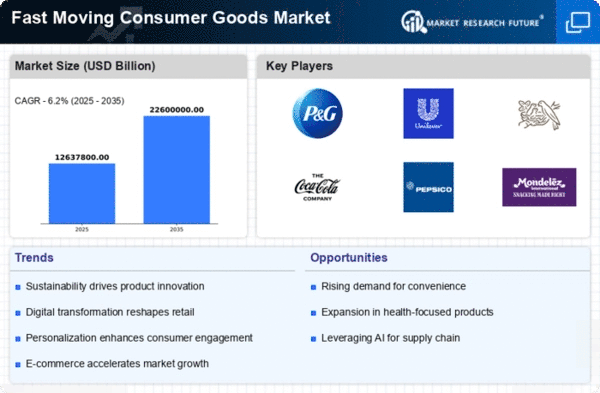
As per MRFR analysis, the Fast Moving Consumer Goods Market was estimated at 11900000.0 USD Billion in 2024. The Fast Moving Consumer Goods industry is projected to grow from 12635000.0 USD Billion in 2025 to 22600000.0 USD Billion by 2035, exhibiting a compound annual growth rate (CAGR) of 6.2 during the forecast period 2025 - 2035.

Key Market Trends & Highlights

The Fast Moving Consumer Goods Market is experiencing a dynamic shift towards health-conscious and sustainable products, driven by evolving consumer preferences.

  • The North American market remains the largest, characterized by a strong demand for health and wellness products. Asia-Pacific is the fastest-growing region, with rapid expansion in e-commerce and online retail channels. Beverages continue to dominate the market, while personal care products are witnessing the fastest growth due to changing consumer habits. Rising disposable incomes and an increased focus on sustainability are key drivers influencing market trends.

Market Size & Forecast

2024 Market Size 11900000.0 (USD Billion)
2035 Market Size 22600000.0 (USD Billion)
CAGR (2025 - 2035) 6.2%
Largest Regional Market Share in 2024 North America

Major Players

<p>Procter &amp; Gamble (US), Unilever (GB), Nestle (CH), PepsiCo (US), Coca-Cola (US), Mondelez International (US), Johnson &amp; Johnson (US), Colgate-Palmolive (US), Reckitt Benckiser (GB), Kimberly-Clark (US)</p>

Market Trends

The Fast Moving Consumer Goods Market is currently experiencing a dynamic evolution, driven by shifting consumer preferences and technological advancements. As individuals become increasingly health-conscious, there is a noticeable demand for products that align with wellness trends. This shift is prompting manufacturers to innovate and reformulate their offerings, focusing on natural ingredients and sustainable practices. Additionally, the rise of e-commerce is reshaping the landscape, allowing consumers to access a wider array of products conveniently. Retailers are adapting to this change by enhancing their online presence and optimizing supply chains to meet the growing expectations for quick delivery and seamless shopping experiences. Moreover, the Fast Moving Consumer Goods Market is witnessing a surge in personalized marketing strategies. Brands are leveraging data analytics to understand consumer behavior better, tailoring their messaging and product recommendations accordingly. This approach not only fosters brand loyalty but also enhances customer satisfaction. As sustainability continues to gain traction, companies are increasingly prioritizing eco-friendly packaging and ethical sourcing, reflecting a broader societal shift towards environmental responsibility. Overall, the Fast Moving Consumer Goods Market appears poised for continued growth, characterized by innovation, consumer-centric strategies, and a commitment to sustainability.

Health and Wellness Focus

There is a growing emphasis on health and wellness within the Fast Moving Consumer Goods Market. Consumers are increasingly seeking products that promote well-being, leading to a rise in demand for organic, natural, and functional items. This trend encourages manufacturers to reformulate existing products and develop new offerings that align with health-conscious consumer preferences.

E-commerce Expansion

The Fast Moving Consumer Goods Market is experiencing a significant shift towards e-commerce. As online shopping becomes more prevalent, brands are enhancing their digital platforms to provide consumers with convenient access to a diverse range of products. This trend necessitates improvements in logistics and supply chain management to ensure timely delivery and customer satisfaction.

Sustainability Initiatives

Sustainability is becoming a central theme in the Fast Moving Consumer Goods Market. Companies are increasingly adopting eco-friendly practices, such as sustainable sourcing and biodegradable packaging. This shift reflects a growing consumer demand for environmentally responsible products, prompting brands to integrate sustainability into their core business strategies.

Fast Moving Consumer Goods Market Market Drivers

Rising Urbanization

The Global Fast Moving Consumer Goods Industry is experiencing a notable surge due to the rapid urbanization occurring worldwide. As more individuals migrate to urban areas, the demand for convenience products increases. Urban consumers tend to favor ready-to-eat meals, personal care items, and household goods, which are characteristic of the fast-moving consumer goods sector. In 2024, the market is valued at approximately 335 USD Billion, reflecting the growing purchasing power and changing lifestyles of urban populations. This trend is expected to continue, with urbanization projected to drive further growth in the sector.

Market Segment Insights

By Product Type: Beverages (Largest) vs. Personal Care (Fastest-Growing)

<p>The Fast Moving Consumer Goods Market exhibits a dynamic distribution of market share among its product types. Beverages hold the largest share, driven by consumer preference for convenient and on-the-go options. Food products closely follow, reflecting core consumer needs, while Personal Care is rapidly gaining traction due to increasing awareness of self-care and hygiene. Household and Health Care products, although significant, occupy smaller portions of this diverse market.</p>

<p>Beverages (Dominant) vs. Personal Care (Emerging)</p>

<p>Beverages, as the dominant segment in the Fast Moving Consumer Goods Market, encompass a wide variety of products including carbonated drinks, juices, and bottled water. This segment thrives on established consumer habits and ongoing innovations. In contrast, Personal Care is recognized as an emerging segment, gaining momentum with trends centering around natural ingredients and sustainability. While Personal Care is expanding its market presence rapidly, driven by a shift towards wellness and personal grooming, Beverages maintain their lead through strong brand loyalty and expansive distribution networks.</p>

By Distribution Channel: Supermarkets (Largest) vs. Online Retail (Fastest-Growing)

<p>In the Fast Moving Consumer Goods (FMCG) market, Supermarkets hold the largest market share due to their extensive product range and one-stop shopping convenience. They account for a substantial proportion of sales, as consumers tend to prefer the physical presence and the ability to evaluate products directly. Conversely, Online Retail has been gaining momentum, appealing to the tech-savvy and convenience-driven consumer segments who prioritize quick and easy shopping experiences. This shift in consumer behavior significantly contributes to the rising share of online platforms in the FMCG distribution landscape. The growth trends indicate a robust increase in the online retail segment, driven by technological advancements and the proliferation of e-commerce platforms. The pandemic accelerated this trend, as consumers sought to minimize in-store visits and embrace home delivery options. As a result, Online Retail is poised to continue its expansion, integrating innovations such as personalized marketing and faster logistics solutions to meet evolving consumer preferences alongside the sustained dominance of Supermarkets.</p>

<p>Supermarkets (Dominant) vs. Online Retail (Emerging)</p>

<p>Supermarkets remain the dominant force in the FMCG distribution channel, offering diverse product assortments, competitive pricing, and customer loyalty programs. Their physical presence allows consumers to engage with products directly, fostering a sense of trust and reliability. Conversely, Online Retail, while currently an emerging segment, is rapidly evolving due to increased internet penetration and mobile accessibility. Online platforms offer convenience, competitive pricing, and a wider variety of options, appealing particularly to younger consumers who value efficiency. As technology continues to develop, Online Retail's capability to provide personalized shopping experiences and quick delivery will likely enhance its position in the market.</p>

By Consumer Demographics: Age Group (Largest) vs. Income Level (Fastest-Growing)

<p>The Fast Moving Consumer Goods (FMCG) market is significantly shaped by consumer demographics. Among the various age groups, younger consumers aged 18-34 are the largest segment, accounting for a notable portion of the total market share. This demographic gravitates towards convenience, digital shopping, and sustainability, influencing brand strategies. In contrast, the emerging income level segment reflects rapid growth, particularly among middle-income consumers who are increasingly seeking premium product offerings and are willing to spend more on quality.</p>

<p>Age Group: 18-34 (Dominant) vs. Income Level: Middle-Income (Emerging)</p>

<p>The 18-34 age group remains the dominant force in the FMCG market, driven by their propensity for online shopping and trend-focused preferences. This segment seeks immediate satisfaction through product availability and convenience in purchasing processes, thereby becoming key targets for brands emphasizing innovation and eco-friendly practices. Conversely, the middle-income segment is emerging rapidly, characterized by consumers seeking better value and higher quality goods. This group shows tendencies toward brand loyalty and premium product consumption, particularly in health-related and organic categories, driving growth and reshaping market dynamics.</p>

By Packaging Type: Plastic (Largest) vs. Biodegradable (Fastest-Growing)

<p>In the Fast Moving Consumer Goods Market, plastic packaging has established itself as the largest segment, dominating the market due to its versatility, durability, and cost-effectiveness. This is followed by glass, metal, paper, and biodegradable options, which together create a diverse packaging landscape. Consumers' varying preferences and the growing demand for convenient packaging solutions have contributed to the significant market share of these materials, especially plastic, which remains a common choice for manufacturers across the FMCG sector.</p>

<p>Plastic (Dominant) vs. Biodegradable (Emerging)</p>

<p>Plastic packaging is well-known for its lightweight nature and barrier properties, making it a dominant choice for a wide range of products, including food, beverages, and personal care items. Its adaptability to various shapes and sizes also contributes to its popularity. On the other hand, biodegradable packaging is emerging rapidly as a preferred alternative among environmentally conscious consumers. It is gaining traction due to increasing regulatory pressure to reduce plastic waste and a growing commitment to sustainability. As brands seek to enhance their eco-friendly image, biodegradable packaging solutions are expected to expand significantly within the market.</p>

By Usage Frequency: Daily (Largest) vs. Seasonal (Fastest-Growing)

<p>The Fast Moving Consumer Goods (FMCG) market shows a diverse distribution of usage frequency among consumers. The daily usage segment holds the largest share, as consumers increasingly favor products that provide convenience and rapid consumption. Weekly and monthly segments follow, catering to specific shopping behaviors, while occasional and seasonal usages connect with special moments and trends. Such an array of usage frequencies reflects consumer lifestyles and purchasing habits, influencing how brands strategize their product launches and marketing efforts. Recent trends indicate a growing shift towards seasonal usage, particularly among younger demographics who seek novelty and limited edition products during festive periods. This change is driven by social media influences and aggressive marketing tactics that highlight unique offerings. Additionally, the occasional usage segment also witnesses significant traction, as consumers lean towards impulse purchases or products that fit sporadic needs, further diversifying the market landscape in FMCG.</p>

<p>Usage Frequency: Daily (Dominant) vs. Seasonal (Emerging)</p>

<p>In the usage frequency segment of the FMCG market, daily usage stands out as the dominant force, primarily driven by the necessity for constant replenishment and everyday convenience. This exceeds traditional expectations, as consumers increasingly turn to quick-to-consume products. Brands aligned with daily needs, such as snack foods and household essentials, carve a significant niche, ensuring consistent demand. Conversely, seasonal usage emerges as an exciting trend, marked by limited-time offerings that respond to consumer desire for variety and novelty. Often propelled by promotional strategies or festive campaigns, brands that capitalize on seasonal trends engage emerging consumer bases, particularly among millennials and Gen Z shoppers, thereby injecting dynamism into the market, where each segment complements the others.</p>

Get more detailed insights about Fast Moving Consumer Goods (FMCG) Market Research Report-Global Forecast till 2035

Regional Insights

North America : Market Leader in FMCG

North America continues to lead the Fast Moving Consumer Goods (FMCG) market, holding a significant share of 5000.0 million. Key growth drivers include a robust economy, high consumer spending, and a strong retail infrastructure. The demand for convenience products and health-conscious options is rising, supported by favorable regulations that promote innovation and sustainability in the FMCG sector. The competitive landscape is characterized by major players such as Procter & Gamble, PepsiCo, and Coca-Cola, which dominate the market. The U.S. remains the largest contributor, with Canada and Mexico also showing strong growth. The presence of established brands and a focus on e-commerce are further enhancing market dynamics, ensuring North America's continued leadership in the FMCG sector.


Europe : Diverse and Competitive Market

Europe's FMCG market, valued at 3500.0 million, is driven by diverse consumer preferences and a strong emphasis on sustainability. Regulatory frameworks across the EU encourage innovation and eco-friendly practices, which are increasingly influencing purchasing decisions. The demand for organic and locally sourced products is on the rise, reflecting a shift towards healthier lifestyles among consumers. Leading countries like Germany, France, and the UK are at the forefront of this market, with key players such as Unilever and Nestle making significant contributions. The competitive landscape is marked by a mix of global giants and local brands, fostering a dynamic environment. The region's focus on digital transformation and e-commerce is reshaping how consumers engage with FMCG products, enhancing accessibility and convenience.

Asia-Pacific : Emerging Market Potential

The Asia-Pacific region, with a market size of 2900.0 million, is witnessing rapid growth in the FMCG sector, driven by urbanization, rising disposable incomes, and changing consumer lifestyles. The demand for convenience and health-oriented products is increasing, supported by favorable government policies that encourage foreign investment and innovation in the FMCG space. Countries like China, India, and Japan are leading the charge, with a mix of local and international brands competing for market share. Key players such as Nestle and Coca-Cola are expanding their presence, leveraging e-commerce and digital marketing strategies to reach a broader audience. The competitive landscape is vibrant, with a focus on adapting to local tastes and preferences, ensuring sustained growth in this dynamic market.

Middle East and Africa : Untapped Market Opportunities

The Middle East and Africa (MEA) region, valued at 600.0 million, presents significant growth potential in the FMCG market. Key drivers include a young population, increasing urbanization, and rising disposable incomes. The demand for packaged and convenience foods is on the rise, supported by government initiatives aimed at boosting local production and reducing import dependency. Leading countries such as South Africa, Nigeria, and the UAE are witnessing a surge in FMCG consumption, with both local and international brands vying for market share. The competitive landscape is evolving, with companies focusing on innovation and adapting to regional preferences. The presence of key players like Unilever and Coca-Cola is notable, as they invest in expanding their footprint in this promising market.

Key Players and Competitive Insights

The Fast Moving Consumer Goods Market is characterized by intense competition and rapid evolution, driven by changing consumer preferences, technological advancements, and sustainability concerns. Major players such as Procter & Gamble (US), Unilever (GB), and Nestle (CH) are strategically positioned to leverage innovation and digital transformation. Procter & Gamble (US) focuses on enhancing its product portfolio through sustainable practices, while Unilever (GB) emphasizes its commitment to reducing plastic waste. Nestle (CH) is increasingly investing in health and wellness products, reflecting a broader trend towards healthier consumer choices. Collectively, these strategies not only enhance their market presence but also shape the competitive landscape by setting benchmarks for sustainability and innovation.

Key business tactics within the market include localizing manufacturing and optimizing supply chains to enhance efficiency and responsiveness to consumer demands. The competitive structure appears moderately fragmented, with a mix of large multinational corporations and smaller niche players. The influence of key players is substantial, as they often dictate market trends and consumer expectations, thereby creating a dynamic environment where agility and adaptability are paramount.

In November 2025, Unilever (GB) announced a partnership with a leading technology firm to develop AI-driven supply chain solutions aimed at reducing operational costs and improving product availability. This strategic move underscores Unilever's commitment to leveraging technology for enhanced efficiency, potentially setting a new standard for operational excellence in the industry. The integration of AI into supply chain management may not only streamline processes but also provide valuable insights into consumer behavior, thereby enabling more targeted marketing strategies.

In October 2025, Nestle (CH) launched a new line of plant-based products, responding to the growing consumer demand for sustainable and health-conscious options. This initiative reflects Nestle's strategic pivot towards plant-based nutrition, which is likely to resonate with environmentally conscious consumers. By expanding its product offerings in this segment, Nestle positions itself as a leader in the health and wellness space, potentially capturing a larger market share as consumer preferences continue to shift.

In September 2025, Procter & Gamble (US) unveiled its latest sustainability initiative, aiming to achieve 100% recyclable or reusable packaging by 2030. This ambitious goal not only aligns with global sustainability trends but also enhances the company's brand image among eco-conscious consumers. By prioritizing sustainability, Procter & Gamble (US) is likely to strengthen its competitive edge, as consumers increasingly favor brands that demonstrate environmental responsibility.

As of December 2025, current competitive trends indicate a pronounced shift towards digitalization, sustainability, and AI integration within the Fast Moving Consumer Goods Market. Strategic alliances are increasingly shaping the landscape, enabling companies to pool resources and expertise to address complex challenges. Looking ahead, competitive differentiation is expected to evolve, with a greater emphasis on innovation and technology rather than solely on price. The focus on supply chain reliability and sustainability will likely become critical factors in maintaining market leadership.

Key Companies in the Fast Moving Consumer Goods Market market include

Industry Developments

Future Outlook

Fast Moving Consumer Goods Market Future Outlook

<p>The Fast Moving Consumer Goods Market is projected to grow at a 6.2% CAGR from 2024 to 2035, driven by e-commerce expansion, sustainability trends, and innovation in product offerings.</p>

New opportunities lie in:

  • <p>Development of AI-driven inventory management systems</p>
  • <p>Expansion of private label product lines in emerging markets</p>
  • <p>Investment in sustainable packaging solutions to enhance brand loyalty</p>

<p>By 2035, the market is expected to achieve robust growth, reflecting evolving consumer preferences and technological advancements.</p>

Market Segmentation

Fast Moving Consumer Goods Market Product Type Outlook

  • Beverages
  • Food
  • Personal Care
  • Household Care
  • Health Care

Fast Moving Consumer Goods Market Packaging Type Outlook

  • Plastic
  • Glass
  • Metal
  • Paper
  • Biodegradable

Fast Moving Consumer Goods Market Usage Frequency Outlook

  • Daily
  • Weekly
  • Monthly
  • Occasional
  • Seasonal

Fast Moving Consumer Goods Market Distribution Channel Outlook

  • Supermarkets
  • Convenience Stores
  • Online Retail
  • Pharmacies
  • Specialty Stores

Fast Moving Consumer Goods Market Consumer Demographics Outlook

  • Age Group
  • Income Level
  • Gender
  • Family Size
  • Lifestyle

Report Scope

MARKET SIZE 2024 11900000.0(USD Billion)
MARKET SIZE 2025 12635000.0(USD Billion)
MARKET SIZE 2035 22600000.0(USD Billion)
COMPOUND ANNUAL GROWTH RATE (CAGR) 6.2% (2024 - 2035)
REPORT COVERAGE Revenue Forecast, Competitive Landscape, Growth Factors, and Trends
BASE YEAR 2024
Market Forecast Period 2025 - 2035
Historical Data 2019 - 2024
Market Forecast Units USD Billion
Key Companies Profiled Procter & Gamble (US), Unilever (GB), Nestle (CH), PepsiCo (US), Coca-Cola (US), Mondelez International (US), Johnson & Johnson (US), Colgate-Palmolive (US), Reckitt Benckiser (GB), Kimberly-Clark (US)
Segments Covered Product Type, Distribution Channel, Consumer Demographics, Packaging Type, Usage Frequency
Key Market Opportunities Integration of sustainable packaging solutions to meet evolving consumer preferences in the Fast Moving Consumer Goods Market.
Key Market Dynamics Shifting consumer preferences towards sustainability drive innovation and competition in the Fast Moving Consumer Goods sector.
Countries Covered North America, Europe, APAC, South America, MEA

FAQs

How much is Global Fast-moving consumer goods in 2023?

Global Fast-moving consumer goods accounted for Euro 10,703.32 Bn

What is the growth rate of Global Fast-moving consumer goods?

The growth rate of Global Fast-moving consumer goods is 6.7%. % CAGR.

Who are the key players in Global Fast-moving consumer goods?

Mondelēz International, Inc., Mars Incorporated, The Walt Disney Company, The Coca-Cola Nestle SA, PepsiCo Inc, Coca Cola, Unilever, Tyson Foods, P &amp; G, JBS, Kraft Heinz.

Which Category led the Global Fast-moving consumer goods?

Food &amp; Beverages led Global Fast-moving consumer goods.

  1. EXECUTIVE SUMMARY 16
    1. MARKET ATTRACTIVENESS ANALYSIS 18
      1. GLOBAL FAST MOVING CONSUMER GOODS MARKET, BY TYPE 19
      2. GLOBAL FAST MOVING CONSUMER GOODS MARKET, BY PRODUCTION TYPE 20
      3. GLOBAL FAST MOVING CONSUMER GOODS MARKET, BY DISTRIBUTION CHANNEL 21
      4. GLOBAL FAST MOVING CONSUMER GOODS MARKET, BY REGION 22
  2. MARKET INTRODUCTION 23
    1. DEFINITION 23
    2. SCOPE OF THE STUDY 23
    3. RESEARCH OBJECTIVE 23
    4. MARKET STRUCTURE 24
    5. KEY BUYING CRITERIA 25
  3. RESEARCH METHODOLOGY 26
    1. RESEARCH PROCESS 26
    2. PRIMARY RESEARCH 27
    3. SECONDARY RESEARCH 28
    4. MARKET SIZE ESTIMATION 29
    5. FORECAST MODEL 30
    6. LIST OF ASSUMPTIONS & LIMITATIONS 31
  4. MARKET DYNAMICS 32
    1. INTRODUCTION 32
    2. DRIVERS 33
      1. GROWTH OF THE ORGANIZED RETAIL SECTOR IN THE ASIA-PACIFIC REGION 33
      2. RISING MIDDLE-CLASS POPULATION ACROSS THE GLOBE 34
      3. TREND OF DIGITALIZATION IN RURAL MARKETS 35
      4. DRIVERS IMPACT ANALYSIS 36
    3. RESTRAINT 36
      1. SHIFT IN CONSUMER PREFERENCE TOWARD SUSTAINABILITY 36
      2. RISE OF COUNTERFEIT AND FAKE GOODS PRESENCE IN THE MARKET 37
      3. RESTRAINT IMPACT ANALYSIS 39
    4. OPPORTUNITIES 39
      1. STRONG PENETRATION OF E-COMMERCE CHANNEL 39
      2. FAVORABLE GOVERNMENT POLICIES IN KEY EMERGING ECONOMIES 40
    5. CHALLENGES 41
      1. REGION-SPECIFIC REGULATIONS AND STRINGENT TAX REGIME 41
  5. MARKET FACTOR ANALYSIS 43
    1. VALUE CHAIN ANALYSIS 43
      1. RAW MATERIAL PROCUREMENT 44
      2. PROCESSING 44
      3. PACKING 45
      4. RAW MATERIAL PROCUREMENT 45
      5. PROCESSING 45
      6. PACKING 46
    2. SUPPLY CHAIN ANALYSIS 46
      1. RAW MATERIAL SOURCING 48
      2. MANUFACTURING 48
      3. DISTRIBUTION 48
      4. END-USER 48
    3. PORTER''S FIVE FORCES MODEL 49
      1. THREAT OF NEW ENTRANTS 50
      2. BARGAINING POWER OF SUPPLIERS 50
      3. THREAT OF SUBSTITUTES 50
      4. BARGAINING POWER OF BUYERS 51
      5. INTENSITY OF RIVALRY 51
    4. COUNTRY-WISE OVERVIEW OF FMCG COMPANIES THAT HAS LESS THAN 500 STORES 52
      1. ASIA-PACIFIC 52
      2. EUROPE 53
      3. AFRICA 53
    5. IMPACT OF COVID-19 ON THE GLOBAL FAST MOVING CONSUMER GOODS (FMCG) MARKET 54
      1. IMPACT ON RAW MATERIAL AVAILABILITY & PRODUCTION 54
      2. IMPACT ON CONSUMER BUYING BEHAVIOUR 55
      3. IMPACT ON ONLINE VS STORE-BASED SALES 55
      4. IMPACT ON PRICING 55
  6. GLOBAL FAST MOVING CONSUMER GOODS MARKET, BY TYPE 56
    1. OVERVIEW 56
      1. GLOBAL FAST MOVING CONSUMER GOODS MARKET ESTIMATES & FORECAST, BY TYPE, 2018–2032 57
    2. FOOD AND BEVERAGES 58
      1. FOOD AND BEVERAGES: MARKET ESTIMATES & FORECAST, BY REGION, 2018–2032 59
    3. TOBACCO & TOBACCO PRODUCTS 60
      1. TOBACCO & TOBACCO PRODUCTS: MARKET ESTIMATES & FORECAST, BY REGION, 2018–2032 60
    4. BEAUTY & PERSONAL CARE 60
      1. BEAUTY & PERSONAL CARE: MARKET ESTIMATES & FORECAST, BY REGION, 2018–2032 62
    5. HEALTHCARE 62
      1. HEALTHCARE: MARKET ESTIMATES & FORECAST, BY REGION, 2018–2032 63
    6. HOME CARE 63
      1. HOME CARE: MARKET ESTIMATES & FORECAST, BY REGION, 2018–2032 63
    7. ELECTRONICS 64
      1. ELECTRONICS: MARKET ESTIMATES & FORECAST, BY REGION, 2018–2032 64
    8. OFFICE SUPPLIES 64
      1. OFFICE SUPPLIES: MARKET ESTIMATES & FORECAST, BY REGION, 2018–2032 65
  7. GLOBAL FAST MOVING CONSUMER GOODS MARKET, BY PRODUCTION TYPE 66
    1. OVERVIEW 66
      1. GLOBAL FAST MOVING CONSUMER GOODS MARKET ESTIMATES & FORECAST, BY PRODUCTION TYPE, 2018–2032 67
    2. INHOUSE 67
      1. INHOUSE: MARKET ESTIMATES & FORECAST, BY REGION, 2018–2032 67
    3. CONTRACT BASED 68
      1. CONTRACT BASED: MARKET ESTIMATES & FORECAST, BY REGION, 2018–2032 68
  8. GLOBAL FAST MOVING CONSUMER GOODS MARKET, BY DISTRIBUTION CHANNEL 69
    1. OVERVIEW 69
      1. GLOBAL FAST MOVING CONSUMER GOODS MARKET ESTIMATES & FORECAST, BY DISTRIBUTION CHANNEL, 2018–2032 70
    2. STORE-BASED 70
      1. STORE-BASED: MARKET ESTIMATES & FORECAST, BY REGION, 2018–2032 71
    3. NON-STORE BASED 71
      1. NON-STORE BASED: MARKET ESTIMATES & FORECAST, BY REGION, 2018–2032 71
  9. GLOBAL FAST MOVING CONSUMER GOODS MARKET, BY REGION 73
    1. OVERVIEW 73
    2. EUROPE 74
      1. GERMANY 76
      2. FRANCE 78
      3. ITALY 79
      4. SPAIN 80
      5. UK 81
      6. REST OF EUROPE 82
    3. ASIA-PACIFIC 84
      1. JAPAN 86
      2. CHINA 87
      3. INDIA 88
      4. AUSTRALIA & NEW ZEALAND 90
      5. REST OF ASIA-PACIFIC 91
    4. AFRICA 93
      1. SOUTH AFRICA 95
      2. NIGERIA 96
      3. GHANA 97
      4. KENYA 98
      5. REST OF AFRICA 100
  10. COMPETITIVE LANDSCAPE 102
    1. INTRODUCTION 102
      1. MARKET STRATEGY ANALYSIS 102
      2. MARKET SHARE ANALYSIS (%), 2022 102
    2. COMPETITIVE BENCHMARKING 103
      1. INTRODUCTION 103
      2. PRODUCT PORTFOLIO 104
      3. REGIONAL PRESENCE 104
      4. STRATEGIC ALLIANCES 104
      5. INDUSTRY EXPERIENCES 104
    3. KEY DEVELOPMENTS & GROWTH STRATEGIES 105
      1. EXPANSION 105
      2. NEW PRODUCT LAUNCH 105
      3. EXPANSION 106
  11. COMPANY PROFILES 107
    1. NESTLÉ S.A. 107
      1. COMPANY OVERVIEW 107
      2. FINANCIAL OVERVIEW 108
      3. PRODUCTS OFFERED 109
      4. KEY DEVELOPMENTS 109
      5. KEY STRATEGIES 110
    2. PEPSICO, INC 111
      1. COMPANY OVERVIEW 111
      2. FINANCIAL OVERVIEW 112
      3. PRODUCTS OFFERED 113
      4. KEY DEVELOPMENTS 113
      5. SWOT ANALYSIS 114
      6. KEY STRATEGIES 114
    3. COCA COLA 115
      1. COMPANY OVERVIEW 115
      2. FINANCIAL OVERVIEW 116
      3. PRODUCTS OFFERED 116
      4. KEY DEVELOPMENTS 117
      5. SWOT ANALYSIS 118
      6. KEY STRATEGIES 118
    4. UNILEVER 119
      1. COMPANY OVERVIEW 119
      2. FINANCIAL OVERVIEW 120
      3. PRODUCTS OFFERED 120
      4. KEY DEVELOPMENTS 122
      5. SWOT ANALYSIS 122
      6. KEY STRATEGIES 122
    5. TYSON FOODS 123
      1. COMPANY OVERVIEW 123
      2. FINANCIAL OVERVIEW 124
      3. PRODUCTS OFFERED 124
      4. KEY DEVELOPMENTS 125
      5. SWOT ANALYSIS 125
      6. KEY STRATEGIES 126
    6. PROCTER & GAMBLE CO. 127
      1. COMPANY OVERVIEW 127
      2. FINANCIAL OVERVIEW 128
      3. PRODUCTS OFFERED 129
      4. KEY DEVELOPMENTS 129
      5. SWOT ANALYSIS 130
      6. KEY STRATEGIES 130
    7. L''ORÉAL SA 131
      1. COMPANY OVERVIEW 131
      2. FINANCIAL OVERVIEW 132
      3. PRODUCTS OFFERED 133
      4. KEY DEVELOPMENTS 133
      5. SWOT ANALYSIS 134
      6. KEY STRATEGIES 134
    8. ANHEUSER-BUSCH INBEV 135
      1. COMPANY OVERVIEW 135
      2. FINANCIAL OVERVIEW 136
      3. PRODUCTS OFFERED 137
      4. KEY DEVELOPMENTS 138
      5. SWOT ANALYSIS 138
      6. KEY STRATEGIES 139
    9. JBS FOODS 140
      1. COMPANY OVERVIEW 140
      2. FINANCIAL OVERVIEW 140
      3. PRODUCTS OFFERED 141
      4. KEY DEVELOPMENTS 141
      5. SWOT ANALYSIS 142
      6. KEY STRATEGIES 142
    10. KRAFT HEINZ 143
      1. COMPANY OVERVIEW 143
      2. FINANCIAL OVERVIEW 144
      3. PRODUCTS OFFERED 145
      4. KEY DEVELOPMENTS 145
      5. SWOT ANALYSIS 146
      6. KEY STRATEGIES 146
  12. APPENDIX 147
    1. ORGANIZATIONS & ASSOCIATIONS 147
    2. RELATED REPORTS 148
  13. LIST OF TABLES
  14. PRIMARY INTERVIEWS 27
  15. LIST OF ASSUMPTIONS & LIMITATIONS 31
  16. GLOBAL FAST MOVING CONSUMER GOODS MARKET ESTIMATES & FORECAST, BY TYPE, 2018–2032 (BILLION EUROS) 57
  17. FOOD AND BEVERAGES: MARKET ESTIMATES & FORECAST, BY REGION, 2018–2032 (BILLION EUROS) 59
  18. TOBACCO & TOBACCO PRODUCTS: MARKET ESTIMATES & FORECAST, BY REGION, 2018–2032 (BILLION EUROS) 60
  19. BEAUTY & PERSONAL CARE: MARKET ESTIMATES & FORECAST, BY REGION, 2018–2032 (BILLION EUROS) 62
  20. HEALTHCARE: MARKET ESTIMATES & FORECAST, BY REGION, 2018–2032 (BILLION EUROS) 63
  21. HOME CARE: MARKET ESTIMATES & FORECAST, BY REGION, 2018–2032 (BILLION EUROS) 63
  22. ELECTRONICS: MARKET ESTIMATES & FORECAST, BY REGION, 2018–2032 (BILLION EUROS) 64
  23. OFFICE SUPPLIES: MARKET ESTIMATES & FORECAST, BY REGION, 2018–2032 (BILLION EUROS) 65
  24. GLOBAL FAST MOVING CONSUMER GOODS MARKET ESTIMATES & FORECAST, BY PRODUCTION TYPE, 2018–2032 (BILLION EUROS) 67
  25. INHOUSE: MARKET ESTIMATES & FORECAST, BY REGION, 2018–2032 (BILLION EUROS) 67
  26. CONTRACT BASED: MARKET ESTIMATES & FORECAST, BY REGION, 2018–2032 (BILLION EUROS) 68
  27. GLOBAL FAST MOVING CONSUMER GOODS MARKET ESTIMATES & FORECAST, BY DISTRIBUTION CHANNEL, 2018–2032 (BILLION EUROS) 70
  28. STORE-BASED: MARKET ESTIMATES & FORECAST, BY REGION, 2018–2032 (BILLION EUROS) 71
  29. NON-STORE BASED: MARKET ESTIMATES & FORECAST, BY REGION, 2018–2032 (BILLION EUROS) 71
  30. GLOBAL FAST MOVING CONSUMER GOODS MARKET ESTIMATES & FORECAST, BY REGION, 2018–2032 (BILLION EUROS) 74
  31. EUROPE: FAST MOVING CONSUMER GOODS MARKET ESTIMATES & FORECAST, BY COUNTRY, 2018–2032 (BILLION EUROS) 75
  32. EUROPE: FAST MOVING CONSUMER GOODS MARKET, BY TYPE, 2018–2032 (BILLION EUROS) 75
  33. EUROPE: FAST MOVING CONSUMER GOODS MARKET, BY PRODUCTION TYPE, 2018–2032 (BILLION EUROS) 76
  34. EUROPE: FAST MOVING CONSUMER GOODS MARKET, BY DISTRIBUTION CHANNEL, 2018–2032 (BILLION EUROS) 76
  35. GERMANY: FAST MOVING CONSUMER GOODS MARKET, BY TYPE, 2018–2032 (BILLION EUROS) 76
  36. GERMANY: FAST MOVING CONSUMER GOODS MARKET, BY PRODUCTION TYPE, 2018–2032 (BILLION EUROS) 77
  37. GERMANY: FAST MOVING CONSUMER GOODS MARKET, BY DISTRIBUTION CHANNEL, 2018–2032 (BILLION EUROS) 77
  38. FRANCE: FAST MOVING CONSUMER GOODS MARKET, BY TYPE, 2018–2032 (BILLION EUROS) 78
  39. FRANCE: FAST MOVING CONSUMER GOODS MARKET, BY PRODUCTION TYPE, 2018–2032 (BILLION EUROS) 78
  40. FRANCE: FAST MOVING CONSUMER GOODS MARKET, BY DISTRIBUTION CHANNEL, 2018–2032 (BILLION EUROS) 79
  41. ITALY: FAST MOVING CONSUMER GOODS MARKET, BY TYPE, 2018–2032 (BILLION EUROS) 79
  42. ITALY: FAST MOVING CONSUMER GOODS MARKET, BY PRODUCTION TYPE, 2018–2032 (BILLION EUROS) 80
  43. ITALY: FAST MOVING CONSUMER GOODS MARKET, BY DISTRIBUTION CHANNEL, 2018–2032 (BILLION EUROS) 80
  44. SPAIN: FAST MOVING CONSUMER GOODS MARKET, BY TYPE, 2018–2032 (BILLION EUROS) 80
  45. SPAIN: FAST MOVING CONSUMER GOODS MARKET, BY PRODUCTION TYPE, 2018–2032 (BILLION EUROS) 81
  46. SPAIN: FAST MOVING CONSUMER GOODS MARKET, BY DISTRIBUTION CHANNEL, 2018–2032 (BILLION EUROS) 81
  47. UK: FAST MOVING CONSUMER GOODS MARKET, BY TYPE, 2018–2032 (BILLION EUROS) 81
  48. UK: FAST MOVING CONSUMER GOODS MARKET, BY PRODUCTION TYPE, 2018–2032 (BILLION EUROS) 82
  49. UK: FAST MOVING CONSUMER GOODS MARKET, BY DISTRIBUTION CHANNEL, 2018–2032 (BILLION EUROS) 82
  50. REST OF EUROPE: FAST MOVING CONSUMER GOODS MARKET, BY TYPE, 2018–2032 (BILLION EUROS) 82
  51. REST OF EUROPE: FAST MOVING CONSUMER GOODS MARKET, BY PRODUCTION TYPE, 2018–2032 (BILLION EUROS) 83
  52. REST OF EUROPE: FAST MOVING CONSUMER GOODS MARKET, BY DISTRIBUTION CHANNEL, 2018–2032 (BILLION EUROS) 83
  53. ASIA-PACIFIC: FAST MOVING CONSUMER GOODS MARKET ESTIMATES & FORECAST, BY COUNTRY, 2018–2032 (BILLION EUROS) 85
  54. ASIA-PACIFIC: FAST MOVING CONSUMER GOODS MARKET, BY TYPE, 2018–2032 (BILLION EUROS) 85
  55. ASIA-PACIFIC: FAST MOVING CONSUMER GOODS MARKET, BY PRODUCTION TYPE, 2018–2032 (BILLION EUROS) 86
  56. ASIA-PACIFIC: FAST MOVING CONSUMER GOODS MARKET, BY DISTRIBUTION CHANNEL, 2018–2032 (BILLION EUROS) 86
  57. JAPAN: FAST MOVING CONSUMER GOODS MARKET, BY TYPE, 2018–2032 (BILLION EUROS) 86
  58. JAPAN: FAST MOVING CONSUMER GOODS MARKET, BY PRODUCTION TYPE, 2018–2032 (BILLION EUROS) 87
  59. JAPAN: FAST MOVING CONSUMER GOODS MARKET, BY DISTRIBUTION CHANNEL, 2018–2032 (BILLION EUROS) 87
  60. CHINA: FAST MOVING CONSUMER GOODS MARKET, BY TYPE, 2018–2032 (BILLION EUROS) 87
  61. CHINA: FAST MOVING CONSUMER GOODS MARKET, BY PRODUCTION TYPE, 2018–2032 (BILLION EUROS) 88
  62. CHINA: FAST MOVING CONSUMER GOODS MARKET, BY DISTRIBUTION CHANNEL, 2018–2032 (BILLION EUROS) 88
  63. INDIA: FAST MOVING CONSUMER GOODS MARKET, BY TYPE, 2018–2032 (BILLION EUROS) 88
  64. INDIA: FAST MOVING CONSUMER GOODS MARKET, BY PRODUCTION TYPE, 2018–2032 (BILLION EUROS) 89
  65. INDIA: FAST MOVING CONSUMER GOODS MARKET, BY DISTRIBUTION CHANNEL, 2018–2032 (BILLION EUROS) 89
  66. AUSTRALIA & NEW ZEALAND: FAST MOVING CONSUMER GOODS MARKET, BY TYPE, 2018–2032 (BILLION EUROS) 90
  67. AUSTRALIA & NEW ZEALAND: FAST MOVING CONSUMER GOODS MARKET, BY PRODUCTION TYPE, 2018–2032 (BILLION EUROS) 90
  68. AUSTRALIA & NEW ZEALAND: FAST MOVING CONSUMER GOODS MARKET, BY DISTRIBUTION CHANNEL, 2018–2032 (BILLION EUROS) 91
  69. REST OF ASIA-PACIFIC: FAST MOVING CONSUMER GOODS MARKET, BY TYPE, 2018–2032 (BILLION EUROS) 91
  70. REST OF ASIA-PACIFIC: FAST MOVING CONSUMER GOODS MARKET, BY PRODUCTION TYPE, 2018–2032 (BILLION EUROS) 92
  71. REST OF ASIA-PACIFIC: FAST MOVING CONSUMER GOODS MARKET, BY DISTRIBUTION CHANNEL, 2018–2032 (BILLION EUROS) 92
  72. AFRICA: FAST MOVING CONSUMER GOODS MARKET ESTIMATES & FORECAST, BY COUNTRY, 2018–2032 (BILLION EUROS) 94
  73. AFRICA: FAST MOVING CONSUMER GOODS MARKET, BY TYPE, 2018–2032 (BILLION EUROS) 94
  74. AFRICA: FAST MOVING CONSUMER GOODS MARKET, BY PRODUCTION TYPE, 2018–2032 (BILLION EUROS) 95
  75. AFRICA: FAST MOVING CONSUMER GOODS MARKET, BY DISTRIBUTION CHANNEL, 2018–2032 (BILLION EUROS) 95
  76. SOUTH AFRICA: FAST MOVING CONSUMER GOODS MARKET, BY TYPE, 2018–2032 (BILLION EUROS) 95
  77. SOUTH AFRICA: FAST MOVING CONSUMER GOODS MARKET, BY PRODUCTION TYPE, 2018–2032 (BILLION EUROS) 96
  78. SOUTH AFRICA: FAST MOVING CONSUMER GOODS MARKET, BY DISTRIBUTION CHANNEL, 2018–2032 (BILLION EUROS) 96
  79. NIGERIA: FAST MOVING CONSUMER GOODS MARKET, BY TYPE, 2018–2032 (BILLION EUROS) 96
  80. NIGERIA: FAST MOVING CONSUMER GOODS MARKET, BY PRODUCTION TYPE, 2018–2032 (BILLION EUROS) 97
  81. NIGERIA: FAST MOVING CONSUMER GOODS MARKET, BY DISTRIBUTION CHANNEL, 2018–2032 (BILLION EUROS) 97
  82. GHANA: FAST MOVING CONSUMER GOODS MARKET, BY TYPE, 2018–2032 (BILLION EUROS) 97
  83. GHANA: FAST MOVING CONSUMER GOODS MARKET, BY PRODUCTION TYPE, 2018–2032 (BILLION EUROS) 98
  84. GHANA: FAST MOVING CONSUMER GOODS MARKET, BY DISTRIBUTION CHANNEL, 2018–2032 (BILLION EUROS) 98
  85. KENYA: FAST MOVING CONSUMER GOODS MARKET, BY TYPE, 2018–2032 (BILLION EUROS) 98
  86. KENYA: FAST MOVING CONSUMER GOODS MARKET, BY PRODUCTION TYPE, 2018–2032 (BILLION EUROS) 99
  87. KENYA: FAST MOVING CONSUMER GOODS MARKET, BY DISTRIBUTION CHANNEL, 2018–2032 (BILLION EUROS) 99
  88. REST OF AFRICA: FAST MOVING CONSUMER GOODS MARKET, BY TYPE, 2018–2032 (BILLION EUROS) 100
  89. REST OF AFRICA: FAST MOVING CONSUMER GOODS MARKET, BY PRODUCTION TYPE, 2018–2032 (BILLION EUROS) 100
  90. REST OF AFRICA: FAST MOVING CONSUMER GOODS MARKET, BY DISTRIBUTION CHANNEL, 2018–2032 (BILLION EUROS) 101
  91. EXPANSION 105
  92. NEW PRODUCT LAUNCH 105
  93. EXPANSION 106
  94. NESTLÉ S.A.: PRODUCTS OFFERED 109
  95. TATE & LYLE: KEY DEVELOPMENTS 109
  96. PEPSICO INC.: PRODUCTS OFFERED 113
  97. PEPSICO INC.: KEY DEVELOPMENTS 113
  98. COCA COLA: PRODUCTS OFFERED 116
  99. COCA COLA: KEY DEVELOPMENTS 117
  100. UNILEVER: PRODUCTS OFFERED 120
  101. UNILEVER: KEY DEVELOPMENTS 122
  102. TYSON FOODS: PRODUCTS OFFERED 124
  103. TYSON FOODS: KEY DEVELOPMENTS 125
  104. PROCTER & GABLE CO.: PRODUCTS OFFERED 129
  105. PROCTER & GAMBLE CO.: KEY DEVELOPMENTS 129
  106. L''ORÉAL SA: PRODUCTS OFFERED 133
  107. L''ORÉAL SA: KEY DEVELOPMENTS 133
  108. ANHEUSER-BUSCH INBEV: PRODUCTS OFFERED 137
  109. ANHEUSER-BUSCH INBEV: KEY DEVELOPMENTS 138
  110. JBS FOODS: PRODUCTS OFFERED 141
  111. KRAFT HEINZ: PRODUCTS OFFERED 145
  112. KRAFT HEINZ: KEY DEVELOPMENTS 145
  113. LIST OF FIGURES
  114. MARKET SYNOPSIS 17
  115. MARKET ATTRACTIVENESS ANALYSIS: GLOBAL FAST MOVING CONSUMER GOODS MARKET, 2022 18
  116. GLOBAL FAST MOVING CONSUMER GOODS MARKET ANALYSIS, BY TYPE, 2022 19
  117. GLOBAL FAST MOVING CONSUMER GOODS MARKET ANALYSIS, BY PRODUCTION TYPE, 2022 20
  118. GLOBAL FAST MOVING CONSUMER GOODS MARKET ANALYSIS, BY DISTRIBUTION CHANNEL, 2022 21
  119. GLOBAL FAST MOVING CONSUMER GOODS MARKET ANALYSIS, BY REGION, 2022 22
  120. GLOBAL FAST MOVING CONSUMER GOODS MARKET: STRUCTURE 24
  121. KEY BUYING CRITERIA FOR FAST MOVING CONSUMER GOODS 25
  122. RESEARCH PROCESS 26
  123. TOP-DOWN & BOTTOM-UP APPROACHES 29
  124. MARKET DYNAMICS OVERVIEW 32
  125. SHARE OF ORGANIZED AND UNORGANIZED RETAIL SECTOR IN INDIA 33
  126. GLOBAL MIDDLE-CLASS POPULATION GROWTH BETWEEN 2010 TO 2030 34
  127. SHARE OF POPULATION USING INTERNET IN RURAL AREAS, 2022 35
  128. DRIVERS IMPACT ANALYSIS: GLOBAL FAST MOVING CONSUMER GOODS (FMCG) MARKET 36
  129. KEY REASONS DETERMINANT IN THE CONSUMPTION OF SUSTAINABLE PRODUCTS IN KEY COUNTRIES (2022) 37
  130. GLOBAL LOSS IN MARKET VALUE OF SALE OF VARIOUS PRODUCTS DUE TO SUPPLY OF COUNTERFEIT AND FAKE GOODS IN THE GLOBAL MARKET 38
  131. RESTRAINT IMPACT ANALYSIS: GLOBAL FAST MOVING CONSUMER GOODS (FMCG) MARKET 39
  132. GLOBAL E-COMMERCE REVENUE GENERATED, REGION-WISE, IN 2022 40
  133. SUSTAINABLE POLICIES INTRODUCED ACROSS THE GLOBE, COUNTRY-WISE CATEGORIES 41
  134. VALUE CHAIN: GLOBAL FAST MOVING CONSUMER GOODS (FMCG) MARKET 43
  135. GLOBAL FAST MOVING CONSUMER GOODS (FMCG) MARKET: SUPPLY CHAIN ANALYSIS 46
  136. PORTER''S FIVE FORCES ANALYSIS OF THE GLOBAL FAST MOVING CONSUMER GOODS (FMCG) MARKET 49
  137. GLOBAL FAST MOVING CONSUMER GOODS MARKET, BY TYPE, 2022 (% SHARE) 56
  138. GLOBAL FAST MOVING CONSUMER GOODS MARKET, BY TYPE, 2018–2032 (BILLION EUROS) 57
  139. GLOBAL FAST MOVING CONSUMER GOODS MARKET, BY PRODUCTION TYPE, 2022 (% SHARE) 66
  140. GLOBAL FAST MOVING CONSUMER GOODS MARKET, BY PRODUCTION TYPE, 2018–2032 (BILLION EUROS) 66
  141. GLOBAL FAST MOVING CONSUMER GOODS MARKET, BY DISTRBUTION CHANNEL, 2022 (% SHARE) 69
  142. GLOBAL FAST MOVING CONSUMER GOODS MARKET, BY DISTRIBUTION CHANNEL, 2018–2032 (BILLION EUROS) 70
  143. GLOBAL FAST MOVING CONSUMER GOODS MARKET, BY REGION, 2018–2032 (BILLION EUROS) 73
  144. GLOBAL FAST MOVING CONSUMER GOODS MARKET, BY REGION, 2022 (% SHARE) 73
  145. EUROPE: FAST MOVING CONSUMER GOODS MARKET SHARE, BY COUNTRY, 2022 (% SHARE) 74
  146. ASIA-PACIFIC: FAST MOVING CONSUMER GOODS MARKET SHARE, BY COUNTRY, 2022 (% SHARE) 84
  147. AFRICA: FAST MOVING CONSUMER GOODS MARKET SHARE, BY COUNTRY, 2022 (% SHARE) 93
  148. MARKET SHARE ANALYSIS (%), 2022 102
  149. BENCHMARKING OF MAJOR COMPETITORS 103
  150. NESTLÉ S.A.: FINANCIAL OVERVIEW SNAPSHOT 108
  151. NESTLÉ S.A: SWOT ANALYSIS 110
  152. PEPSICO INC.: FINANCIAL OVERVIEW SNAPSHOT 112
  153. PEPSICO INC.: SWOT ANALYSIS 114
  154. COCA-COLA: FINANCIAL OVERVIEW SNAPSHOT 116
  155. COCA COLA: SWOT ANALYSIS 118
  156. UNILEVER: FINANCIAL OVERVIEW SNAPSHOT 120
  157. UNILEVER: SWOT ANALYSIS 122
  158. TYSON FOODS: FINANCIAL OVERVIEW SNAPSHOT 124
  159. TYSON FOODS: SWOT ANALYSIS 125
  160. PROCTER & GAMBLE CO.: FINANCIAL OVERVIEW SNAPSHOT 128
  161. PROCTER & GAMBLE CO.: SWOT ANALYSIS 130
  162. L''ORÉAL SA: FINANCIAL OVERVIEW SNAPSHOT 132
  163. L''ORÉAL SA: SWOT ANALYSIS 134
  164. ANHEUSER-BUSCH INBEV: FINANCIAL OVERVIEW 136
  165. ANHEUSER-BUSCH INBEV: SWOT ANALYSIS 138
  166. JBS FOODS: FINANCIAL OVERVIEW SNAPSHOT 140
  167. JBS FOODS: SWOT ANALYSIS 142
  168. KRAFT HEINZ: FINANCIAL OVERVIEW SNAPSHOT 144
  169. KRAFT HEINZ: SWOT ANALYSIS 146

Fast-moving consumer goods Market Segmentation 

Fast-moving consumer goods (FMCG) Product Type Outlook (Euro Bn, 2018-2032)

  • Food & Beverages
    • Food
    • Confectionary
    • Beers
    • Liquors & Spirits
    • Wine
    • Softdrinks
    • Other Beverages
    • Cereals, Grains, and Wheat
  • Tobacco Products
  • Beauty & Personal Care
  • Healthcare
  • Home Care
  • Electronics
  • Office Supplies

Fast-moving consumer goods (FMCG) Production Type Outlook (Euro Bn, 2018-2032)

  • Inhouse
  • Contract Based

Fast-moving consumer goods (FMCG) Distribution channel Outlook (Euro Bn, 2018-2032)

  • Store-Based


  • Non-Store Based

Fast-moving consumer goods (FMCG) Regional Outlook (Euro Bn, 2018-2032)

  • Europe Outlook (Euro Bn, 2018-2032)
    • Europe Fast-moving consumer goods (FMCG) Type
      • Food & Beverages
        • Food
        • Confectionary
        • Beers
        • Liquors & Spirits
        • Wine
        • Softdrinks
        • Other Beverages
        • Cereals, Grains, and Wheat
      • Tobacco & Tobacco Products
      • Beauty & Personal Care
      • Healthcare
      • Home Care
      • Electronics
      • Office Supplies
    • Europe Fast-moving consumer goods (FMCG) by Production Type
      • Inhouse
      • Contract Based
    • Europe Fast-moving consumer goods (FMCG) by Distribution Channel
      • Store-Based
      • Non-Store Based
    • Germany Outlook (Euro Bn, 2018-2032)
      • Germany Fast-moving consumer goods (FMCG) Type
        • Food & Beverages
          • Food
          • Confectionary
          • Beers
          • Liquors & Spirits
          • Wine
          • Softdrinks
          • Other Beverages
          • Cereals, Grains, and Wheat
        • Tobacco & Tobacco Products
        • Beauty & Personal Care
        • Healthcare
        • Home Care
        • Electronics
        • Office Supplies
      • Germany Fast-moving consumer goods (FMCG) by Production Type
        • Inhouse
        • Contract Based
      • Germany Fast-moving consumer goods (FMCG) by Distribution Channel
        • Store-Based
        • Non-Store Based


  • France Outlook (Euro Bn, 2018-2032)
    • France Fast-moving consumer goods (FMCG) Type
      • Food & Beverages
        • Food
        • Confectionary
        • Beers
        • Liquors & Spirits
        • Wine
        • Softdrinks
        • Other Beverages
        • Cereals, Grains, and Wheat
      • Tobacco & Tobacco Products
      • Beauty & Personal Care
      • Healthcare
      • Home Care
      • Electronics
      • Office Supplies
    • France Fast-moving consumer goods (FMCG) by Production Type
      • Inhouse
      • Contract Based
    • France Fast-moving consumer goods (FMCG) by Distribution Channel
      • Store-Based
      • Non-Store Based


  • Italy Outlook (Euro Bn, 2018-2032)
    • Italy Fast-moving consumer goods (FMCG) Type
      • Food & Beverages
        • Food
        • Confectionary
        • Beers
        • Liquors & Spirits
        • Wine
        • Softdrinks
        • Other Beverages
        • Cereals, Grains, and Wheat
      • Tobacco & Tobacco Products
      • Beauty & Personal Care
      • Healthcare
      • Home Care
      • Electronics
      • Office Supplies
    • Italy Fast-moving consumer goods (FMCG) by Production Type
      • Inhouse
      • Contract Based
    • Italy Fast-moving consumer goods (FMCG) by Distribution Channel
      • Store-Based
      • Non-Store Based


  • Spain Outlook (Euro Bn, 2018-2032)
    • Spain Fast-moving consumer goods (FMCG) Type
      • Food & Beverages
        • Food
        • Confectionary
        • Beers
        • Liquors & Spirits
        • Wine
        • Softdrinks
        • Other Beverages
        • Cereals, Grains, and Wheat
      • Tobacco & Tobacco Products
      • Beauty & Personal Care
      • Healthcare
      • Home Care
      • Electronics
      • Office Supplies
    • Spain Fast-moving consumer goods (FMCG) by Production Type
      • Inhouse
      • Contract Based
    • Spain Fast-moving consumer goods (FMCG) by Distribution Channel
      • Store-Based
      • Non-Store Based


  • UK Outlook (Euro Bn, 2018-2032)
    • UK Fast-moving consumer goods (FMCG) Type
      • Food & Beverages
        • Food
        • Confectionary
        • Beers
        • Liquors & Spirits
        • Wine
        • Softdrinks
        • Other Beverages
        • Cereals, Grains, and Wheat
      • Tobacco & Tobacco Products
      • Beauty & Personal Care
      • Healthcare
      • Home Care
      • Electronics
      • Office Supplies
    • UK Fast-moving consumer goods (FMCG) by Production Type
      • Inhouse
      • Contract Based
    • UK Fast-moving consumer goods (FMCG) by Distribution Channel
      • Store-Based
      • Non-Store Based
    • Rest of Europe Outlook (Euro Bn, 2018-2032)
      • Rest of Europe Fast-moving consumer goods (FMCG) Type
        • Food & Beverages
          • Food
          • Confectionary
          • Beers
          • Liquors & Spirits
          • Wine
          • Softdrinks
          • Other Beverages
          • Cereals, Grains, and Wheat
        • Tobacco & Tobacco Products
        • Beauty & Personal Care
        • Healthcare
        • Home Care
        • Electronics
        • Office Supplies
      • Rest of Europe Fast-moving consumer goods (FMCG) by Production Type
        • Inhouse
        • Contract Based
      • Rest of Europe Fast-moving consumer goods (FMCG) by Distribution Channel
        • Store-Based
        • Non-Store Based
      • Asia Pacific Outlook (Euro Bn, 2018-2032)
        • Asia Pacific Fast-moving consumer goods (FMCG) Type
          • Food & Beverages
            • Food
            • Confectionary
            • Beers
            • Liquors & Spirits
            • Wine
            • Softdrinks
            • Other Beverages
            • Cereals, Grains, and Wheat
          • Tobacco & Tobacco Products
          • Beauty & Personal Care
          • Healthcare
          • Home Care
          • Electronics
          • Office Supplies
        • Asia Pacific Fast-moving consumer goods (FMCG) by Production Type
          • Inhouse
          • Contract Based
        • Asia Pacific Fast-moving consumer goods (FMCG) by Distribution Channel
          • Store-Based
          • Non-Store Based
        • Japan Outlook (Euro Bn, 2018-2032)
          • Japan Fast-moving consumer goods (FMCG) Type
            • Food & Beverages
              • Food
              • Confectionary
              • Beers
              • Liquors & Spirits
              • Wine
              • Softdrinks
              • Other Beverages
              • Cereals, Grains, and Wheat
            • Tobacco & Tobacco Products
            • Beauty & Personal Care
            • Healthcare
            • Home Care
            • Electronics
            • Office Supplies
          • Japan Fast-moving consumer goods (FMCG) by Production Type
            • Inhouse
            • Contract Based
          • Japan Fast-moving consumer goods (FMCG) by Distribution Channel
            • Store-Based
            • Non-Store Based


  • China Outlook (Euro Bn, 2018-2032)
    • China Fast-moving consumer goods (FMCG) Type
      • Food & Beverages
        • Food
        • Confectionary
        • Beers
        • Liquors & Spirits
        • Wine
        • Softdrinks
        • Other Beverages
        • Cereals, Grains, and Wheat
      • Tobacco & Tobacco Products
      • Beauty & Personal Care
      • Healthcare
      • Home Care
      • Electronics
      • Office Supplies
    • China Fast-moving consumer goods (FMCG) by Production Type
      • Inhouse
      • Contract Based
    • China Fast-moving consumer goods (FMCG) by Distribution Channel
      • Store-Based
      • Non-Store Based


  • India Outlook (Euro Bn, 2018-2032)
    • India Fast-moving consumer goods (FMCG) Type
      • Food & Beverages
        • Food
        • Confectionary
        • Beers
        • Liquors & Spirits
        • Wine
        • Softdrinks
        • Other Beverages
        • Cereals, Grains, and Wheat
      • Tobacco & Tobacco Products
      • Beauty & Personal Care
      • Healthcare
      • Home Care
      • Electronics
      • Office Supplies
    • India Fast-moving consumer goods (FMCG) by Production Type
      • Inhouse
      • Contract Based
    • India Fast-moving consumer goods (FMCG) by Distribution Channel
      • Store-Based
      • Non-Store Based


  • Rest of Asia Pacific Outlook (Euro Bn, 2018-2032)
    • Rest of Asia Pacific Fast-moving consumer goods (FMCG) Type
      • Food & Beverages
        • Food
        • Confectionary
        • Beers
        • Liquors & Spirits
        • Wine
        • Softdrinks
        • Other Beverages
        • Cereals, Grains, and Wheat
      • Tobacco & Tobacco Products
      • Beauty & Personal Care
      • Healthcare
      • Home Care
      • Electronics
      • Office Supplies
    • Rest of Asia Pacific Fast-moving consumer goods (FMCG) by Production Type
      • Inhouse
      • Contract Based
    • Rest of Asia Pacific Fast-moving consumer goods (FMCG) by Distribution Channel
      • Store-Based
      • Non-Store Based


  • Africa Outlook (Euro Bn, 2018-2032)
    • Africa Fast-moving consumer goods (FMCG) Type
      • Food & Beverages
        • Food
        • Confectionary
        • Beers
        • Liquors & Spirits
        • Wine
        • Softdrinks
        • Other Beverages
        • Cereals, Grains, and Wheat
      • Tobacco & Tobacco Products
      • Beauty & Personal Care
      • Healthcare
      • Home Care
      • Electronics
      • Office Supplies
    • Africa Fast-moving consumer goods (FMCG) by Production Type
      • Inhouse
      • Contract Based
    • Africa Fast-moving consumer goods (FMCG) by Distribution Channel
      • Store-Based
      • Non-Store Based


  • South Africa Outlook (Euro Bn, 2018-2032)
    • South Africa Fast-moving consumer goods (FMCG) Type
      • Food & Beverages
        • Food
        • Confectionary
        • Beers
        • Liquors & Spirits
        • Wine
        • Softdrinks
        • Other Beverages
        • Cereals, Grains, and Wheat
      • Tobacco & Tobacco Products
      • Beauty & Personal Care
      • Healthcare
      • Home Care
      • Electronics
      • Office Supplies
    • South Africa Fast-moving consumer goods (FMCG) by Production Type
      • Inhouse
      • Contract Based
    • South Africa Fast-moving consumer goods (FMCG) by Distribution Channel
      • Store-Based
      • Non-Store Based


  • Nigeria Outlook (Euro Bn, 2018-2032)
    • Nigeria Fast-moving consumer goods (FMCG) Type
      • Food & Beverages
        • Food
        • Confectionary
        • Beers
        • Liquors & Spirits
        • Wine
        • Softdrinks
        • Other Beverages
        • Cereals, Grains, and Wheat
      • Tobacco & Tobacco Products
      • Beauty & Personal Care
      • Healthcare
      • Home Care
      • Electronics
      • Office Supplies
    • Nigeria Fast-moving consumer goods (FMCG) by Production Type
      • Inhouse
      • Contract Based
    • Nigeria Fast-moving consumer goods (FMCG) by Distribution Channel
      • Store-Based
      • Non-Store Based


  • Ghana Outlook (Euro Bn, 2018-2032)
    • Ghana Fast-moving consumer goods (FMCG) Type
      • Food & Beverages
        • Food
        • Confectionary
        • Beers
        • Liquors & Spirits
        • Wine
        • Softdrinks
        • Other Beverages
        • Cereals, Grains, and Wheat
      • Tobacco & Tobacco Products
      • Beauty & Personal Care
      • Healthcare
      • Home Care
      • Electronics
      • Office Supplies
    • Ghana Fast-moving consumer goods (FMCG) by Production Type
      • Inhouse
      • Contract Based
    • Ghana Fast-moving consumer goods (FMCG) by Distribution Channel
      • Store-Based
      • Non-Store Based


  • Rest of Africa Outlook (Euro Bn, 2018-2032)
    • Rest of Africa Fast-moving consumer goods (FMCG) Type
      • Food & Beverages
        • Food
        • Confectionary
        • Beers
        • Liquors & Spirits
        • Wine
        • Softdrinks
        • Other Beverages
        • Cereals, Grains, and Wheat
      • Tobacco & Tobacco Products
      • Beauty & Personal Care
      • Healthcare
      • Home Care
      • Electronics
      • Office Supplies
    • Rest of Africa Fast-moving consumer goods (FMCG) by Production Type
      • Inhouse
      • Contract Based
    • Rest of Africa Fast-moving consumer goods (FMCG) by Distribution Channel
      • Store-Based
      • Non-Store Based
Infographic

Free Sample Request

Kindly complete the form below to receive a free sample of this Report

Get Free Sample

Customer Strories

Compare Licence

×
Features License Type
Single User Multiuser License Enterprise User
Price $4,950 $5,950 $7,250
Maximum User Access Limit 1 User Upto 10 Users Unrestricted Access Throughout the Organization
Free Customization
Direct Access to Analyst
Deliverable Format
Platform Access
Discount on Next Purchase 10% 15% 15%
Printable Versions