Fdi Perspective Of Big Data Technology Market
Fdi Perspective Of Big Data Technology Market Summary
As per Market Research Future analysis, the FDI Perspective of Big Data Technology Market was estimated at 57.34 USD Billion in 2024. The Big Data Technology industry is projected to grow from 61.32 USD Billion in 2025 to 119.95 USD Billion by 2035, exhibiting a compound annual growth rate (CAGR) of 6.94% during the forecast period 2025 - 2035
Key Market Trends & Highlights
The FDI perspective of the Big Data Technology Market indicates a robust growth trajectory driven by regional dynamics and sectoral advancements.
- North America remains the largest market for Big Data technology, showcasing substantial investments in data security.
- Asia-Pacific is emerging as the fastest-growing region, propelled by the rapid adoption of advanced analytics and cloud services.
- The healthcare segment leads in market size, while the telecommunications sector is experiencing the fastest growth due to increasing data demands.
- Key market drivers include the rising demand for data-driven decision making and government initiatives supporting data privacy and compliance.
Market Size & Forecast
| 2024 Market Size | 57.34 (USD Billion) |
| 2035 Market Size | 119.95 (USD Billion) |
| CAGR (2025 - 2035) | 6.94% |
Major Players
IBM (US), Microsoft (US), Oracle (US), SAP (DE), Amazon (US), Google (US), Salesforce (US), Teradata (US), Cloudera (US)
Fdi Perspective Of Big Data Technology Market Trends
The FDI Perspective of Big Data Technology Market is currently experiencing a transformative phase, characterized by an increasing influx of foreign direct investment. This trend appears to be driven by the growing recognition of big data's potential to enhance decision-making processes across various sectors. Investors are increasingly drawn to regions that demonstrate robust technological infrastructure and favorable regulatory environments, which seem to facilitate the adoption of big data solutions. Furthermore, the integration of artificial intelligence and machine learning with big data analytics is likely to attract additional investments, as companies seek to leverage these technologies for competitive advantage. Moreover, the demand for data-driven insights is expanding, prompting businesses to invest in advanced analytics capabilities. This shift indicates a broader understanding of the strategic importance of data in driving innovation and operational efficiency. As organizations continue to prioritize data-centric strategies, the FDI Perspective of Big Data Technology Market is poised for sustained growth. The interplay between technological advancements and investment opportunities suggests a dynamic landscape, where adaptability and foresight will be crucial for stakeholders aiming to capitalize on emerging trends.
Increased Investment in Data Security
There is a noticeable trend towards heightened investment in data security measures within the FDI Perspective of Big Data Technology Market. As concerns regarding data breaches and privacy regulations intensify, companies are prioritizing secure data management practices. This focus on security not only protects sensitive information but also builds trust with consumers and partners, thereby enhancing the overall market appeal.
Emergence of Regional Data Hubs
The establishment of regional data hubs is becoming increasingly prevalent in the FDI Perspective of Big Data Technology Market. These hubs serve as centralized locations for data storage and processing, facilitating collaboration among businesses and fostering innovation. By concentrating resources and expertise, these hubs are likely to attract foreign investments, further driving market growth.
Integration of Advanced Analytics
The integration of advanced analytics tools is gaining traction within the FDI Perspective of Big Data Technology Market. Organizations are increasingly adopting sophisticated analytical techniques to derive actionable insights from vast datasets. This trend suggests a shift towards more data-driven decision-making processes, which could enhance operational efficiency and competitive positioning in various industries.
Fdi Perspective Of Big Data Technology Market Drivers
Government Initiatives and Support
Government initiatives play a crucial role in shaping the FDI Perspective of Big Data Technology Market. Many governments are actively promoting the adoption of big data technologies through favorable policies, tax incentives, and funding for research and development. For instance, several countries have established innovation hubs and data centers to attract foreign investment in big data. These initiatives not only enhance the technological landscape but also create a conducive environment for international companies to invest. The commitment of governments to digital transformation is likely to result in increased foreign direct investment, as firms seek to capitalize on supportive regulatory frameworks and access to local talent.
Growth of Cloud Computing Services
The proliferation of cloud computing services significantly impacts the FDI Perspective of Big Data Technology Market. As organizations increasingly migrate to cloud-based solutions, the demand for big data analytics tools hosted on these platforms is expected to rise. The cloud computing market is projected to grow to USD 832 billion by 2025, indicating a robust environment for big data technologies. This growth presents opportunities for foreign investors to enter markets with scalable solutions that cater to diverse business needs. Consequently, the integration of big data analytics with cloud services is likely to attract substantial foreign direct investment, as companies seek to leverage the flexibility and cost-effectiveness of cloud technologies.
Rising Demand for Data-Driven Decision Making
The FDI Perspective of Big Data Technology Market is increasingly influenced by the rising demand for data-driven decision making across various sectors. Organizations are recognizing the value of leveraging big data analytics to enhance operational efficiency and improve customer experiences. This trend is evidenced by a projected increase in investment in big data technologies, which is expected to reach USD 274 billion by 2025. As companies seek to harness insights from vast datasets, foreign direct investment in big data technology firms is likely to surge, fostering innovation and competitive advantage. This demand is not limited to traditional sectors; emerging industries such as healthcare and finance are also adopting big data solutions, further driving FDI in this market.
Increased Focus on Data Privacy and Compliance
The heightened focus on data privacy and compliance is reshaping the FDI Perspective of Big Data Technology Market. With the implementation of stringent data protection regulations, companies are compelled to invest in technologies that ensure compliance and safeguard consumer data. This trend is particularly evident in regions where regulations such as GDPR are in effect, prompting organizations to seek advanced big data solutions that align with legal requirements. As firms prioritize data privacy, foreign direct investment in compliance-focused big data technologies is likely to grow, as international investors recognize the potential for developing solutions that address these critical challenges.
Emergence of Artificial Intelligence and Machine Learning
The integration of artificial intelligence (AI) and machine learning (ML) into big data analytics is transforming the FDI Perspective of Big Data Technology Market. These technologies enable organizations to derive deeper insights from data, automate processes, and enhance predictive capabilities. The AI market is anticipated to reach USD 190 billion by 2025, which suggests a growing intersection between AI and big data. As companies invest in AI-driven analytics, foreign direct investment is likely to increase, as international firms seek to collaborate with local tech companies to develop innovative solutions. This synergy between AI, ML, and big data analytics could lead to a more dynamic investment landscape.
Market Segment Insights
By Application: Healthcare (Largest) vs. Telecommunications (Fastest-Growing)
The Application segment in the FDI Perspective of the Big Data Technology Market is primarily dominated by the Healthcare sector, which has managed to capture a significant portion of the market share. Telecommunication, while not as large, is rapidly gaining ground due to its increasing reliance on data analytics for network management and consumer engagement. Other sectors such as Banking, Retail, and Manufacturing also play crucial roles but lag behind these two in both market presence and growth.
Healthcare (Dominant) vs. Telecommunications (Emerging)
Healthcare is the dominant player in the application segment due to its extensive adoption of big data technologies for patient management, predictive analytics, and operational efficiency. This sector leverages vast amounts of data from electronic health records, clinical trials, and patient interactions to improve outcomes and streamline processes. Conversely, Telecommunications presents itself as an emerging player, fueled by the demand for real-time analytics and improved customer experiences. With the rise of mobile data consumption and the increasing importance of personalized services, telcos are investing heavily in big data solutions to enhance their customer engagement strategies and optimize their network operations.
By Deployment Type: Cloud (Largest) vs. Hybrid (Fastest-Growing)
In the FDI Perspective of the Big Data Technology Market, the deployment type segment shows a diverse distribution among On-Premises, Cloud, and Hybrid solutions. Currently, Cloud solutions dominate the market due to their scalability, flexibility, and cost-effectiveness, attracting businesses of all sizes. On-Premises solutions, while traditionally favored for data control, are gradually losing market share as organizations shift towards more agile solutions. Hybrid deployment, representing a mix of both, is also gaining traction among firms looking to balance the benefits of cloud and on-premises infrastructures. The growth trends within this segment are driven by the increasing data requirements and the need for real-time analytics. Enterprises are rapidly adopting Cloud solutions for their ability to offer processed data at scale, leading to better decision-making. The Hybrid model is emerging as a solution to accommodate specific regulatory constraints while still providing the flexibility of the Cloud, making it the fastest-growing deployment type. Hence, organizations are transitioning toward these newer deployment strategies to facilitate innovation and operational efficiency.
Deployment Type: Cloud (Dominant) vs. Hybrid (Emerging)
The Cloud deployment type is characterized by its dominant market presence, offering services that enhance data accessibility and enable businesses to leverage big data analytics with minimal upfront investment. Organizations can scale their resources quickly and efficiently in response to changing demands. In contrast, the Hybrid deployment type is gaining interest as businesses seek a balanced approach, allowing them to utilize on-premises resources where necessary while taking advantage of cloud capabilities for additional workloads. This approach not only mitigates risks associated with total cloud reliance but also allows firms to customize their data strategies effectively. Both deployment types reflect the trend towards increased flexibility and innovation in managing big data technology, highlighting the need for organizations to adapt to the evolving business landscape.

By Component: Software (Largest) vs. Services (Fastest-Growing)
The FDI Perspective of the Big Data Technology Market showcases a diverse distribution among its components, with software emerging as the largest segment. Software solutions dominate the market, driven by increasing demand for advanced analytics and data management capabilities. In contrast, hardware plays a crucial supportive role, while services, encompassing consulting and integration, are rapidly gaining traction as organizations prioritize holistic solutions for big data implementation. Growth in the component segment is propelled by the relentless proliferation of data and the need for organizations to leverage this data for strategic insights. The advent of emerging technologies such as AI and machine learning is further catalyzing the demand for services, marking them as the fastest-growing aspect of the market. This evolution reflects a shifting focus toward comprehensive solutions that encompass software, hardware, and integrated services to harness big data effectively.
Software (Dominant) vs. Services (Emerging)
In the FDI Perspective of the Big Data Technology Market, Software is acknowledged as the dominant force driving innovation and capabilities. It offers extensive functionalities that cater to various industries, empowering organizations to analyze massive data sets efficiently. With enhanced features such as predictive analytics and real-time processing, software solutions are pivotal for businesses aiming to stay competitive. Conversely, the Services segment is emerging strongly, reflecting the increasing necessity for specialized support in implementing big data strategies. Consulting firms and technology service providers are expanding their offerings, ensuring that organizations can navigate the complexities of big data technology. This trend illustrates a growing recognition of the importance of not only having the right tools but also the expertise to utilize them effectively.
By Technology: Artificial Intelligence (Largest) vs. Machine Learning (Fastest-Growing)
The 'FDI Perspective of Big Data Technology Market' reveals a diverse distribution of market share across various technologies, with Artificial Intelligence leading significantly. AI not only facilitates advanced data processing but also provides predictive insights, positioning it as the largest player in this segment. In contrast, Machine Learning is gaining traction rapidly, attracting investments due to its ability to automate and enhance data analytics processes, making it the fastest-growing technology. The rising necessity for data-driven decision-making is propelling these technologies forward.
Technology: Artificial Intelligence (Dominant) vs. Machine Learning (Emerging)
Artificial Intelligence is a dominant force within the Big Data Technology Market, characterized by its capabilities in natural language processing, computer vision, and automation, enabling businesses to derive actionable insights from massive datasets. This segment exhibits a robust competitive edge as organizations leverage AI tools to streamline operations and improve customer interactions. Conversely, Machine Learning is emerging as a pivotal technology, primarily due to its adaptive learning capabilities which enhance predictive modeling and pattern recognition. With an increasing emphasis on real-time analytics and personalized experiences, Machine Learning's role is evolving rapidly, making it essential for organizations aiming to stay ahead in the market.
By End-Use: Large Enterprises (Largest) vs. Small and Medium Enterprises (Fastest-Growing)
In the FDI Perspective of the Big Data Technology Market, Large Enterprises dominate the market, holding a significant share driven by their extensive data needs and financial capabilities. These organizations leverage big data technologies for enhanced decision-making and operational efficiency, establishing themselves as the primary consumers of such technologies. On the other hand, Small and Medium Enterprises (SMEs) are rapidly gaining traction in this landscape, primarily due to the increasing availability of affordable big data solutions tailored to their requirements. This shift is indicative of a market that is becoming increasingly accessible to smaller organizations, who are beginning to recognize the value of data analytics in driving growth and competitiveness. The growth trend in big data technology for SMEs is fueled by advancements in cloud-based solutions, which reduce the cost barrier for smaller firms. Additionally, there is a rising awareness of data-driven decision-making benefits, leading to greater investments in big data initiatives among SMEs. As these businesses increasingly adopt big data technologies, we can expect to see innovative applications and unique use cases emerging, contributing significantly to the overall market growth. Moreover, these trends underscore a shift towards democratization of data analytics, making it crucial for large enterprises to adapt and evolve in response to the growing capabilities of SMEs.
End-Use: Large Enterprises (Dominant) vs. Small and Medium Enterprises (Emerging)
Large Enterprises are characterized by their substantial resources, comprehensive infrastructure, and a dedicated focus on harnessing big data for strategic advantages. Their dominance in the market is a result of significant investments in technology and human capital, allowing for advanced data analytics and innovative applications. These organizations utilize big data to optimize supply chains, improve customer engagement, and drive research and development initiatives. Conversely, Small and Medium Enterprises (SMEs) represent an emerging segment that is rapidly gaining momentum within the big data landscape. As SMEs increasingly recognize the strategic importance of data, they are adopting scalable and cost-effective solutions that enable them to leverage analytics for improved operational efficiency and competitive advantage. The agility of SMEs allows for quicker implementation of new technologies, fostering a vibrant ecosystem of innovation and collaboration in the big data sector.
Regional Insights
North America : Innovation and Investment Hub
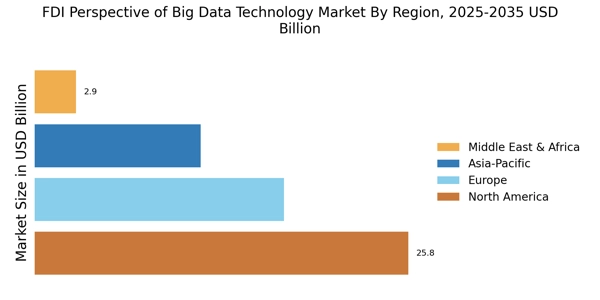
North America is the largest market for Big Data technology, holding approximately 45% of the global share. The region's growth is driven by rapid technological advancements, increasing data generation, and a strong focus on data analytics across various sectors. Regulatory support, such as data protection laws, further catalyzes investment in this domain. The U.S. and Canada are the primary contributors, with the U.S. alone accounting for about 40% of the market share. The competitive landscape is dominated by major players like IBM, Microsoft, and Amazon, which are continuously innovating to enhance their offerings. The presence of numerous startups and established firms fosters a vibrant ecosystem for Big Data solutions. Additionally, government initiatives aimed at promoting digital transformation and data-driven decision-making are expected to bolster market growth in the coming years.
Europe : Emerging Data Analytics Powerhouse
Europe is witnessing significant growth in the Big Data technology market, holding around 30% of the global share. The region benefits from a robust regulatory framework, including the General Data Protection Regulation (GDPR), which encourages responsible data usage and fosters consumer trust. Countries like Germany and the UK are leading the charge, with Germany accounting for approximately 12% of the market share, driven by its strong industrial base and focus on digitalization. The competitive landscape features key players such as SAP and Oracle, alongside a growing number of local startups. The European market is characterized by a strong emphasis on data privacy and security, which influences the adoption of Big Data solutions. Collaborative initiatives between governments and private sectors are also enhancing the region's capabilities in data analytics and technology innovation.
Asia-Pacific : Rapidly Growing Technology Landscape
Asia-Pacific is rapidly emerging as a significant player in the Big Data technology market, holding approximately 20% of the global share. The region's growth is fueled by increasing internet penetration, mobile device usage, and a burgeoning middle class. Countries like China and India are at the forefront, with China alone contributing about 15% to the market share, driven by its vast population and data generation capabilities. Government initiatives promoting digital transformation are also key growth drivers. The competitive landscape is diverse, with both The FDI Perspective of Big Data Technology share. Companies like Alibaba and Tencent are making substantial investments in Big Data technologies. The region's unique challenges, such as data privacy concerns and varying regulatory environments, are shaping the strategies of key players as they navigate this dynamic market.
Middle East and Africa : Emerging Market with Potential
The Middle East and Africa (MEA) region is gradually emerging in the Big Data technology market, holding about 5% of the global share. The growth is driven by increasing digital transformation initiatives and investments in technology infrastructure. Countries like South Africa and the UAE are leading the market, with the UAE focusing on becoming a regional tech hub. Government support for innovation and data-driven policies is expected to enhance market growth in the coming years. The competitive landscape is still developing, with a mix of local and international players. Companies are increasingly recognizing the value of data analytics in improving operational efficiency and customer engagement. As the region continues to invest in technology and education, the potential for growth in the Big Data sector remains significant, attracting foreign direct investment and partnerships.
Key Players and Competitive Insights
Key Companies in the Fdi Perspective Of Big Data Technology Market include
Industry Developments
The Global FDI Perspective of the Big Data Technology Market has seen significant recent developments, particularly concerning major players like Google, IBM, and Microsoft. Increasing investments in artificial intelligence and machine learning have driven growth in this market, enhancing the value proposition of big data solutions. Companies are steadily ramping up their data capabilities, notably with IBM expanding its AI and analytics portfolio to serve enterprise needs better and Microsoft investing heavily in its Azure cloud platform to capture more market share in big data analytics.
There have been noteworthy mergers and acquisitions, with DataRobot recently acquiring a smaller AI analytics firm to enhance its product offerings in machine learning. Oracle's acquisition of a startup focused on data integration is another example of strategic moves to strengthen its data capabilities. Snowflake's recent partnership with major telecommunications firms also underscores growing trends in big data utilization. The market valuation for these companies is expected to rise as they innovate and expand their offerings, ultimately propelling the global landscape of big data technology forward.
Acquisitions and partnerships are reshaping the competitive dynamics as stakeholders seek to leverage unique talents and technology synergies.
Future Outlook
Fdi Perspective Of Big Data Technology Market Future Outlook
The FDI Perspective of Big Data Technology Market is projected to grow at a 6.94% CAGR from 2025 to 2035, driven by advancements in analytics, cloud computing, and increasing data generation.
New opportunities lie in:
- Development of AI-driven analytics platforms for real-time decision-making.
- Expansion of data privacy compliance solutions for global enterprises.
- Investment in edge computing infrastructure to enhance data processing capabilities.
By 2035, the market is expected to be robust, reflecting substantial growth and innovation.
Market Segmentation
Fdi Perspective Of Big Data Technology Market End-Use Outlook
- Large Enterprises
- Small and Medium Enterprises
Fdi Perspective Of Big Data Technology Market Component Outlook
- Software
- Hardware
- Services
Fdi Perspective Of Big Data Technology Market Technology Outlook
- Artificial Intelligence
- Machine Learning
- Data Mining
- Data Analytics
Fdi Perspective Of Big Data Technology Market Application Outlook
- Healthcare
- Banking
- Retail
- Telecommunications
- Manufacturing
Fdi Perspective Of Big Data Technology Market Deployment Type Outlook
- On-Premises
- Cloud
- Hybrid
Report Scope
| MARKET SIZE 2024 | 57.34(USD Billion) |
| MARKET SIZE 2025 | 61.32(USD Billion) |
| MARKET SIZE 2035 | 119.95(USD Billion) |
| COMPOUND ANNUAL GROWTH RATE (CAGR) | 6.94% (2025 - 2035) |
| REPORT COVERAGE | Revenue Forecast, Competitive Landscape, Growth Factors, and Trends |
| BASE YEAR | 2024 |
| Market Forecast Period | 2025 - 2035 |
| Historical Data | 2019 - 2024 |
| Market Forecast Units | USD Billion |
| Key Companies Profiled | IBM (US), Microsoft (US), Oracle (US), SAP (DE), Amazon (US), Google (US), Salesforce (US), Teradata (US), Cloudera (US) |
| Segments Covered | Application, Deployment Type, Component, Technology, End Use, Regional |
| Key Market Opportunities | Emerging regulatory frameworks enhance foreign investment in the FDI Perspective of Big Data Technology Market. |
| Key Market Dynamics | Rising foreign direct investment in big data technology driven by regulatory support and technological advancements. |
| Countries Covered | North America, Europe, APAC, South America, MEA |
FAQs
What is the projected market valuation of the FDI Perspective of Big Data Technology Market by 2035?
The projected market valuation is expected to reach 119.95 USD Billion by 2035.
What was the overall market valuation of the FDI Perspective of Big Data Technology Market in 2024?
The overall market valuation was 57.34 USD Billion in 2024.
What is the expected CAGR for the FDI Perspective of Big Data Technology Market during the forecast period 2025 - 2035?
The expected CAGR during this period is 6.94%.
Which companies are considered key players in the FDI Perspective of Big Data Technology Market?
Key players include IBM, Microsoft, Oracle, SAP, Amazon, Google, Salesforce, Teradata, and Cloudera.
What are the projected valuations for the Healthcare segment in the FDI Perspective of Big Data Technology Market?
The projected valuations for the Healthcare segment range from 10.0 to 20.0 USD Billion.
How does the Cloud deployment type compare to On-Premises in terms of market valuation?
The Cloud deployment type is projected to range from 25.0 to 55.0 USD Billion, whereas On-Premises ranges from 20.0 to 40.0 USD Billion.
What is the expected market valuation for the Artificial Intelligence technology segment by 2035?
The expected market valuation for the Artificial Intelligence segment is projected to range from 15.0 to 30.0 USD Billion.
What are the projected valuations for the Manufacturing end-use segment in the FDI Perspective of Big Data Technology Market?
The projected valuations for the Manufacturing end-use segment range from 18.34 to 41.95 USD Billion.
What is the market valuation range for the Services component in the FDI Perspective of Big Data Technology Market?
How do the valuations for Large Enterprises compare to Small and Medium Enterprises in the market?
Kindly complete the form below to receive a free sample of this Report
Customer Stories
“This is really good guys. Excellent work on a tight deadline. I will continue to use you going forward and recommend you to others. Nice job”
“Thanks. It’s been a pleasure working with you, please use me as reference with any other Intel employees.”
“Thanks for sending the report it gives us a good global view of the Betaïne market.”
“Thank you, this will be very helpful for OQS.”
“We found the report very insightful! we found your research firm very helpful. I'm sending this email to secure our future business.”
“I am very pleased with how market segments have been defined in a relevant way for my purposes (such as "Portable Freezers & refrigerators" and "last-mile"). In general the report is well structured. Thanks very much for your efforts.”
“I have been reading the first document or the study, ,the Global HVAC and FP market report 2021 till 2026. Must say, good info! I have not gone in depth at all parts, but got a good indication of the data inside!”
“We got the report in time, we really thank you for your support in this process. I also thank to all of your team as they did a great job.”