Feature Extraction Market
Feature Extraction Market Summary
As per Market Research Future analysis, the Feature Extraction Market Size was estimated at 2.615 USD Billion in 2024. The Feature Extraction industry is projected to grow from USD 2.87 Billion in 2025 to USD 7.256 Billion by 2035, exhibiting a compound annual growth rate (CAGR) of 9.72% during the forecast period 2025 - 2035
Key Market Trends & Highlights
The Feature Extraction Market is experiencing robust growth driven by technological advancements and increasing data demands.
- The market is witnessing increased adoption of AI technologies, particularly in North America, which remains the largest market.
- Cloud-based solutions are expanding rapidly, especially in the Asia-Pacific region, which is recognized as the fastest-growing area.
- Image Processing continues to dominate the market, while Natural Language Processing is emerging as the fastest-growing segment.
- Rising demand for data analytics and advancements in machine learning algorithms are key drivers propelling market growth.
Market Size & Forecast
| 2024 Market Size | 2.615 (USD Billion) |
| 2035 Market Size | 7.256 (USD Billion) |
| CAGR (2025 - 2035) | 9.72% |
Major Players
IBM (US), Microsoft (US), Google (US), Amazon (US), SAP (DE), Oracle (US), Siemens (DE), TIBCO Software (US), Alteryx (US)
Feature Extraction Market Trends
The Feature Extraction Market is currently experiencing a dynamic evolution, driven by advancements in artificial intelligence and machine learning technologies. Organizations across various sectors are increasingly recognizing the value of extracting meaningful information from vast datasets. This trend is particularly evident in industries such as healthcare, finance, and retail, where data-driven decision-making is paramount. As businesses strive to enhance operational efficiency and gain competitive advantages, the demand for sophisticated feature extraction techniques continues to rise. Furthermore, the integration of cloud computing solutions is facilitating easier access to powerful analytical tools, thereby broadening the market's reach. In addition to technological advancements, the Feature Extraction Market is also influenced by the growing emphasis on data privacy and security. As regulations become more stringent, companies are compelled to adopt feature extraction methods that not only optimize data usage but also ensure compliance with legal standards. This dual focus on innovation and regulation suggests a complex landscape where organizations must navigate challenges while leveraging opportunities. Overall, the Feature Extraction Market appears poised for continued growth, with emerging trends likely to shape its trajectory in the coming years.
Increased Adoption of AI Technologies
The integration of artificial intelligence in feature extraction processes is becoming more prevalent. Organizations are leveraging AI to automate data analysis, which enhances accuracy and efficiency. This trend indicates a shift towards more intelligent systems capable of processing complex datasets.
Focus on Data Privacy and Compliance
As data regulations tighten globally, there is a heightened focus on ensuring that feature extraction methods comply with legal standards. Companies are increasingly prioritizing solutions that not only extract valuable insights but also safeguard sensitive information.
Expansion of Cloud-Based Solutions
The rise of cloud computing is transforming the Feature Extraction Market by providing scalable and accessible tools for data analysis. This trend allows organizations of all sizes to utilize advanced feature extraction techniques without significant upfront investments.
Feature Extraction Market Drivers
Integration of IoT Devices
The proliferation of Internet of Things (IoT) devices is a significant driver for the Feature Extraction Market. As more devices become interconnected, the volume of data generated is escalating rapidly. This surge necessitates advanced feature extraction techniques to process and analyze the data effectively. Industries such as manufacturing, healthcare, and smart cities are leveraging IoT data to optimize operations and enhance service delivery. The IoT market is projected to reach USD 1.1 trillion by 2026, indicating a substantial opportunity for the Feature Extraction Market to provide solutions that can handle the complexities of IoT data. This integration fosters innovation and drives the demand for efficient feature extraction methodologies.
Rising Demand for Data Analytics
The Feature Extraction Market is experiencing a notable surge in demand for data analytics solutions. Organizations across various sectors are increasingly recognizing the value of extracting meaningful insights from vast datasets. This trend is driven by the need for data-driven decision-making, which enhances operational efficiency and competitive advantage. According to recent estimates, the data analytics market is projected to reach USD 274 billion by 2025, indicating a robust growth trajectory. As businesses strive to harness the power of big data, the Feature Extraction Market plays a crucial role in enabling effective data analysis, thereby facilitating informed strategic planning and execution.
Emphasis on Enhanced Data Security
As data breaches and cyber threats become more prevalent, the Feature Extraction Market is experiencing an increased emphasis on enhanced data security measures. Organizations are prioritizing the protection of sensitive information, which necessitates the implementation of robust feature extraction techniques that can identify and mitigate potential risks. The Feature Extraction Market is projected to reach USD 345 billion by 2026, reflecting the critical importance of safeguarding data. This focus on security drives the demand for feature extraction solutions that not only analyze data but also ensure compliance with regulatory standards. Consequently, the Feature Extraction Market is adapting to meet these security challenges, thereby fostering trust and reliability in data handling.
Growing Need for Real-Time Data Processing
In an era where timely information is paramount, the Feature Extraction Market is witnessing a growing need for real-time data processing solutions. Organizations are increasingly required to analyze data as it is generated to make swift decisions that can impact their operations and customer satisfaction. This trend is particularly evident in sectors such as finance, healthcare, and e-commerce, where real-time insights can lead to competitive advantages. The market for real-time analytics is expected to grow significantly, with estimates suggesting it could reach USD 30 billion by 2025. This demand propels the Feature Extraction Market to innovate and develop solutions that facilitate immediate data analysis and feature extraction.
Advancements in Machine Learning Algorithms
The evolution of machine learning algorithms significantly influences the Feature Extraction Market. Innovations in deep learning and neural networks have enhanced the capability to extract features from complex datasets, including images, text, and audio. These advancements allow for more accurate predictions and classifications, which are essential for various applications such as natural language processing and computer vision. The machine learning market is anticipated to grow to USD 117 billion by 2027, underscoring the increasing reliance on sophisticated algorithms. Consequently, the Feature Extraction Market is poised to benefit from these technological advancements, as organizations seek to implement cutting-edge solutions to improve their analytical capabilities.
Market Segment Insights
By Application: Image Processing (Largest) vs. Natural Language Processing (Fastest-Growing)
In the Feature Extraction Market, the application segments showcase varied distributions in terms of market share. Image Processing is the leading segment, attributed to its extensive use in various industries such as healthcare, automotive, and security. Meanwhile, Natural Language Processing is emerging rapidly, propelled by advancements in artificial intelligence and machine learning, indicating a notable shift towards leveraging textual data for insights.
Image Processing (Dominant) vs. Natural Language Processing (Emerging)
Image Processing stands out as the dominant application in the Feature Extraction Market, characterized by its utilization in image recognition and analysis across sectors ranging from consumer electronics to surveillance systems. Its market presence is solidified by the continuous demand for sophisticated imaging solutions. Conversely, Natural Language Processing represents an emerging segment, fueled by the need for data-driven decision-making and automated interpretation of human language. The rise of chatbots, virtual assistants, and sentiment analysis tools underscores its rapid growth and integration into business processes, driving the demand for accurate and efficient text processing solutions.
By Technique: Machine Learning (Largest) vs. Deep Learning (Fastest-Growing)
The Feature Extraction Market showcases a diverse range of techniques with distinct market share distributions. Currently, Machine Learning stands out as the largest segment, drawing significant attention due to its established methodologies and widespread applications across various industries. In contrast, Deep Learning has emerged as a crucial player, experiencing rapid growth attributed to its advanced capabilities in processing complex datasets, which are increasingly demanded in sectors like image and speech recognition. Growth trends in the Feature Extraction Market are heightened by the ongoing digital transformation and surging data volume. Businesses are increasingly looking toward innovative techniques to extract valuable insights from unstructured data. Machine Learning continues to leverage its robust frameworks, while Deep Learning is accelerating its adoption due to advancements in neural networks and hardware capabilities. The convergence of these technologies is likely to shape future market dynamics significantly.
Machine Learning (Dominant) vs. Dimensionality Reduction (Emerging)
Machine Learning remains the dominant technique in the Feature Extraction Market. It is characterized by its robust algorithms that adaptively learn from data, making it universally applicable across various domains such as finance, healthcare, and marketing. The ability to improve performance over time through training enhances its appeal, ensuring continuous adoption. On the other hand, Dimensionality Reduction is an emerging technique that aims to reduce the number of features in a dataset while preserving essential information. It is gaining traction as organizations seek to enhance data processing efficiency without losing critical insights. As data complexities escalate, the relevance of Dimensionality Reduction in optimizing Machine Learning applications is poised to grow.
By Deployment Mode: Cloud-Based (Largest) vs. Hybrid (Fastest-Growing)
The Deployment Mode segment in the Feature Extraction Market reveals a significant preference for Cloud-Based solutions, which dominate the landscape with more organizations opting for its scalability and flexibility. On-Premises solutions, while reliable, are increasingly viewed as less adaptable to the rapid technological transformations occurring within the industry. Hybrid models are emerging as a versatile alternative, offering a compelling blend of on-site security and cloud agility that resonates with modern enterprise needs. Growth trends within this segment indicate that the adoption of Cloud-Based platforms will continue to fuel its market share, driven by factors such as reduced operational costs and improved accessibility. Meanwhile, Hybrid deployment is capturing attention as it allows organizations to tailor solutions that meet specific requirements, thus addressing concerns about data security and compliance. The shift towards remote work and digital transformation initiatives further accelerates the demand in this arena.
Cloud-Based (Dominant) vs. On-Premises (Emerging)
Cloud-Based deployment stands out as the dominant force in the Feature Extraction Market, catering primarily to businesses seeking agility and cost-effectiveness in their operations. This model enables users to access robust feature extraction tools without the burden of maintaining and upgrading on-premises infrastructure. In contrast, the On-Premises deployment is emerging as a viable option for organizations with stringent data security and compliance requirements. While it offers greater control over data management, it often involves higher upfront costs and maintenance. The appeal of On-Premises solutions is growing among industries like finance and healthcare, where data sensitivity is paramount. Together, these deployment modes highlight the market's diversified approach towards satisfying varying organizational needs.
By End Use: Healthcare (Largest) vs. Automotive (Fastest-Growing)
In the Feature Extraction Market, the 'End Use' segment is characterized by diverse applications across various sectors. Within this landscape, the Healthcare sector holds the largest market share, propelled by the increasing need for advanced medical diagnostics and personalized healthcare solutions. The Automotive sector, while smaller, is rapidly growing as manufacturers seek enhanced data analytics capabilities to improve safety and fuel efficiency through innovative technologies.
Healthcare: Diagnostics (Dominant) vs. Automotive: Driver Assistance (Emerging)
The Healthcare sector, particularly the diagnostics sub-segment, stands out as a dominant player in the Feature Extraction Market. This segment leverages advanced algorithms and data processing techniques to extract relevant features from medical images and patient records, fostering better disease detection and management. In contrast, the Automotive sector, with a focus on Driver Assistance features, is emerging as a significant player. Automakers are increasingly integrating feature extraction capabilities into their systems to enhance safety and improve the driving experience, positioning this segment for rapid growth in the coming years.
Regional Insights
North America : Innovation and Technology Hub
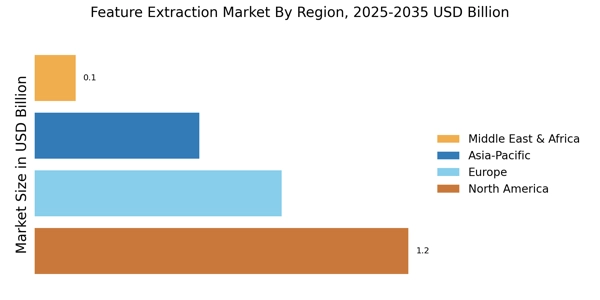
North America is the largest market for feature extraction, holding approximately 45% of the global share. The region's growth is driven by rapid technological advancements, increasing demand for data analytics, and supportive regulatory frameworks. The presence of major tech companies and a robust startup ecosystem further fuel market expansion. The U.S. leads this market, followed closely by Canada, which contributes around 15% to the overall market share. The competitive landscape in North America is dominated by key players such as IBM, Microsoft, and Google, who are continuously innovating to enhance their offerings. The region benefits from a strong focus on research and development, with significant investments in AI and machine learning technologies. This competitive environment fosters collaboration between established firms and emerging startups, driving further growth in the feature extraction market.
Europe : Emerging Data Analytics Powerhouse
Europe is witnessing significant growth in the feature extraction market, accounting for approximately 30% of the global share. The region's demand is driven by increasing data generation, stringent data protection regulations, and a growing emphasis on AI technologies. Countries like Germany and the UK are at the forefront, with Germany holding about 12% of the market share, while the UK follows closely with around 10%. Regulatory support, particularly from the EU, is a key catalyst for this growth. Leading countries in Europe are investing heavily in AI and data analytics, with major players like SAP and Siemens leading the charge. The competitive landscape is characterized by a mix of established firms and innovative startups, fostering a dynamic environment for feature extraction solutions. The region's focus on sustainability and ethical AI practices further enhances its attractiveness for investment and development in this sector.
Asia-Pacific : Rapidly Growing Market Potential
Asia-Pacific is rapidly emerging as a significant player in the feature extraction market, holding approximately 20% of the global share. The region's growth is fueled by increasing digital transformation initiatives, a surge in data generation, and government support for AI technologies. China and India are the leading countries, with China contributing around 12% to the market, while India is gaining traction with its growing tech ecosystem and innovation in data analytics. The competitive landscape in Asia-Pacific is evolving, with both multinational corporations and local startups vying for market share. Key players like TIBCO Software and Alteryx are expanding their presence in the region, capitalizing on the growing demand for advanced analytics solutions. The region's diverse industries, including finance, healthcare, and manufacturing, are increasingly adopting feature extraction technologies to enhance decision-making and operational efficiency.
Middle East and Africa : Emerging Market with Potential
The Middle East and Africa (MEA) region is gradually developing its feature extraction market, currently holding about 5% of the global share. The growth is driven by increasing investments in digital transformation, a rise in data-driven decision-making, and government initiatives aimed at enhancing technological capabilities. Countries like South Africa and the UAE are leading the market, with South Africa contributing approximately 2% to the overall share, while the UAE is focusing on becoming a regional tech hub. The competitive landscape in MEA is characterized by a mix of local and international players, with increasing collaboration between governments and private sectors to foster innovation. Key players are beginning to establish a foothold in the region, recognizing the potential for growth in sectors such as finance, healthcare, and logistics. As the region continues to invest in technology and infrastructure, the feature extraction market is expected to expand significantly in the coming years.

Key Players and Competitive Insights
Key Companies in the Feature Extraction Market include
Industry Developments
Recent developments in the Feature Extraction Market have been marked by significant advancements and strategic initiatives from leading companies. Hewlett Packard Enterprise and Google have been integrating AI into their feature extraction tools, enhancing automation and accuracy for better data insights. Microsoft has announced partnerships aimed at optimizing cloud-based feature extraction solutions, allowing for more extensive data processing capabilities. NVIDIA’s latest GPU technology is setting new benchmarks for feature extraction speeds, which is crucial for industries like autonomous driving and medical imaging.

In terms of mergers and acquisitions, there have been no widely reported transactions recently among the specific companies of interest, suggesting a period of stability or internal focus.
However, growth in market valuations for companies like Amazon and IBM reflects increasing demand for advanced analytics tools, driving investments in feature extraction technologies. The competitive landscape is evolving as companies like Oracle and SAP continue to innovate, responding to the pressing need for data-driven decision-making across various sectors. As organizations increasingly recognize the value of extracting meaningful insights from large datasets, the Feature Extraction Market is poised for continued expansion.
Future Outlook
Feature Extraction Market Future Outlook
The Feature Extraction Market is projected to grow at a 9.72% CAGR from 2025 to 2035, driven by advancements in AI, big data analytics, and increasing demand for automation.
New opportunities lie in:
- Integration of AI-driven feature extraction tools in cloud platforms.
- Development of industry-specific feature extraction solutions for healthcare.
- Expansion into emerging markets with tailored feature extraction services.
By 2035, the Feature Extraction Market is expected to be robust, reflecting substantial growth and innovation.
Market Segmentation
Feature Extraction Market End Use Outlook
- Healthcare
- Automotive
- Retail
- Telecommunications
- Finance
Feature Extraction Market Technique Outlook
- Statistical Methods
- Machine Learning
- Deep Learning
- Dimensionality Reduction
Feature Extraction Market Application Outlook
- Image Processing
- Natural Language Processing
- Speech Recognition
- Video Analysis
Feature Extraction Market Deployment Mode Outlook
- On-Premises
- Cloud-Based
- Hybrid
Report Scope
| MARKET SIZE 2024 | 2.615(USD Billion) |
| MARKET SIZE 2025 | 2.87(USD Billion) |
| MARKET SIZE 2035 | 7.256(USD Billion) |
| COMPOUND ANNUAL GROWTH RATE (CAGR) | 9.72% (2025 - 2035) |
| REPORT COVERAGE | Revenue Forecast, Competitive Landscape, Growth Factors, and Trends |
| BASE YEAR | 2024 |
| Market Forecast Period | 2025 - 2035 |
| Historical Data | 2019 - 2024 |
| Market Forecast Units | USD Billion |
| Key Companies Profiled | IBM (US), Microsoft (US), Google (US), Amazon (US), SAP (DE), Oracle (US), Siemens (DE), TIBCO Software (US), Alteryx (US) |
| Segments Covered | Application, Technique, Deployment Mode, End Use, Regional |
| Key Market Opportunities | Integration of artificial intelligence enhances capabilities in the Feature Extraction Market. |
| Key Market Dynamics | Rising demand for advanced analytics drives innovation and competition in the Feature Extraction Market. |
| Countries Covered | North America, Europe, APAC, South America, MEA |
FAQs
What is the projected market valuation of the Feature Extraction Market by 2035?
The Feature Extraction Market is projected to reach a valuation of 7.256 USD Billion by 2035.
What was the market valuation of the Feature Extraction Market in 2024?
In 2024, the Feature Extraction Market had a valuation of 2.615 USD Billion.
What is the expected CAGR for the Feature Extraction Market during the forecast period 2025 - 2035?
The expected CAGR for the Feature Extraction Market during the forecast period 2025 - 2035 is 9.72%.
Which companies are considered key players in the Feature Extraction Market?
Key players in the Feature Extraction Market include IBM, Microsoft, Google, Amazon, SAP, Oracle, Siemens, TIBCO Software, and Alteryx.
What are the main application segments of the Feature Extraction Market?
The main application segments include Image Processing, Natural Language Processing, Speech Recognition, and Video Analysis.
How does the deployment mode affect the Feature Extraction Market?
The deployment modes, including On-Premises, Cloud-Based, and Hybrid, are crucial, with Cloud-Based expected to grow significantly.
What is the valuation range for the Image Processing segment in the Feature Extraction Market?
The valuation for the Image Processing segment ranges from 0.785 to 2.145 USD Billion.
Which end-use sectors are driving growth in the Feature Extraction Market?
The end-use sectors driving growth include Healthcare, Automotive, Retail, Telecommunications, and Finance.
What is the projected growth for the Speech Recognition segment by 2035?
The Speech Recognition segment is expected to grow from 0.785 to 2.145 USD Billion by 2035.
How does the performance of the Deep Learning technique compare to others in the Feature Extraction Market?
The Deep Learning technique is projected to have a valuation range of 0.785 to 2.145 USD Billion, indicating strong growth potential.
Kindly complete the form below to receive a free sample of this Report
Customer Stories
“This is really good guys. Excellent work on a tight deadline. I will continue to use you going forward and recommend you to others. Nice job”
“Thanks. It’s been a pleasure working with you, please use me as reference with any other Intel employees.”
“Thanks for sending the report it gives us a good global view of the Betaïne market.”
“Thank you, this will be very helpful for OQS.”
“We found the report very insightful! we found your research firm very helpful. I'm sending this email to secure our future business.”
“I am very pleased with how market segments have been defined in a relevant way for my purposes (such as "Portable Freezers & refrigerators" and "last-mile"). In general the report is well structured. Thanks very much for your efforts.”
“I have been reading the first document or the study, ,the Global HVAC and FP market report 2021 till 2026. Must say, good info! I have not gone in depth at all parts, but got a good indication of the data inside!”
“We got the report in time, we really thank you for your support in this process. I also thank to all of your team as they did a great job.”