Author

Aarti Dhapte

Financial Cloud Market Size, Share and Research Report By Component (solution, and services), By Cloud Type (Public Cloud and Private Cloud), By Organization size (Sub-industry (Banking and financial services, and insurance), And By Region (North America, Europe, Asia-Pacific, And Rest Of The World) – Industry Forecast Till 2035
As per Market Research Future analysis, the Financial Cloud Market Size was estimated at 54.74 USD Billion in 2024. The Financial Cloud industry is projected to grow from 60.98 USD Billion in 2025 to 179.49 USD Billion by 2035, exhibiting a compound annual growth rate (CAGR) of 11.4% during the forecast period 2025 - 2035
The Financial Cloud Market is experiencing robust growth driven by technological advancements and evolving customer needs.
| 2024 Market Size | 54.74 (USD Billion) |
| 2035 Market Size | 179.49 (USD Billion) |
| CAGR (2025 - 2035) | 11.4% |
Amazon Web Services (US), Microsoft Azure (US), IBM Cloud (US), Oracle Cloud (US), Google Cloud (US), Salesforce (US), SAP (DE), Alibaba Cloud (CN), FIS (US), Intuit (US)
Our Impact
Enabled $4.3B Revenue Impact for Fortune 500 and Leading Multinationals
Partnering with 2000+ Global Organizations Each Year
30K+ Citations by Top-Tier Firms in the Industry
The Financial Cloud Market is currently experiencing a transformative phase, characterized by a growing inclination towards digitalization among financial institutions. This shift is driven by the need for enhanced operational efficiency, improved customer experiences, and the ability to leverage advanced analytics. As organizations increasingly adopt cloud-based solutions, they are discovering the potential for scalability and flexibility that these platforms offer. Furthermore, the integration of artificial intelligence and machine learning into financial services is reshaping traditional practices, enabling firms to make data-driven decisions and optimize their offerings. In addition, regulatory compliance remains a critical concern for stakeholders in the Financial Cloud Market. Institutions are compelled to ensure that their cloud solutions adhere to stringent regulations while maintaining data security and privacy. This has led to a surge in demand for cloud providers that can demonstrate robust compliance frameworks. As the market evolves, collaboration between technology providers and financial institutions is likely to intensify, fostering innovation and driving the development of tailored solutions that meet the unique needs of the sector.
The Financial Cloud Market is witnessing the emergence of strategic partnerships between traditional financial institutions and fintech companies. These collaborations aim to leverage the agility and innovation of fintech firms while benefiting from the established infrastructure of traditional banks. Such partnerships often involve the integration of cloud-based solutions to enhance service offerings and streamline operations. It is projected that by 2026, partnerships between banks and fintechs could account for over 40 percent of the financial services market. This trend not only drives cloud adoption but also fosters a collaborative ecosystem within the Financial Cloud Market, encouraging the development of innovative financial products and services.
The Financial Cloud Market experiences a notable surge in demand for cost efficiency among financial institutions. As organizations strive to optimize their operational expenditures, the adoption of cloud solutions becomes increasingly attractive. Financial institutions are drawn to the potential for reduced infrastructure costs and the ability to scale resources according to their needs. Reports indicate that the financial services sector could save up to 30 percent on IT costs by migrating to cloud-based solutions. This trend is likely to continue as firms seek to enhance their financial performance while maintaining competitive advantages. The Financial Cloud Market thus benefits from this growing emphasis on cost-effective solutions, which may drive further innovation and investment in cloud technologies.
In the Financial Cloud Market, regulatory compliance and data governance emerge as critical drivers. Financial institutions face stringent regulations regarding data protection and privacy, necessitating robust cloud solutions that ensure compliance. The increasing complexity of regulations, such as GDPR and others, compels organizations to adopt cloud services that offer enhanced security and compliance features. It is estimated that compliance-related costs can account for up to 10 percent of a financial institution's operational budget. Consequently, the demand for cloud solutions that facilitate compliance and data governance is likely to grow, positioning the Financial Cloud Market as a key player in helping organizations navigate these challenges effectively.
The Financial Cloud Market is significantly influenced by the rise of digital transformation initiatives across financial services. As institutions seek to modernize their operations and enhance customer experiences, cloud technologies play a pivotal role. The shift towards digital banking, mobile payments, and online investment platforms necessitates scalable and flexible cloud solutions. Recent studies suggest that nearly 70 percent of financial institutions are prioritizing digital transformation, with cloud adoption being a central component. This trend not only drives demand for cloud services but also fosters innovation within the Financial Cloud Market, as firms explore new ways to leverage technology for improved service delivery.
In the Financial Cloud Market, there is an increasing focus on customer-centric solutions that enhance user experience. Financial institutions are recognizing the importance of tailoring services to meet the evolving needs of their clients. Cloud technologies enable organizations to gather and analyze customer data effectively, allowing for personalized offerings and improved service delivery. The ability to deploy customer-centric applications rapidly is becoming a competitive advantage. As a result, the demand for cloud solutions that support these initiatives is likely to rise, further propelling growth within the Financial Cloud Market. This shift towards customer-centricity may also encourage innovation in product development and service design.
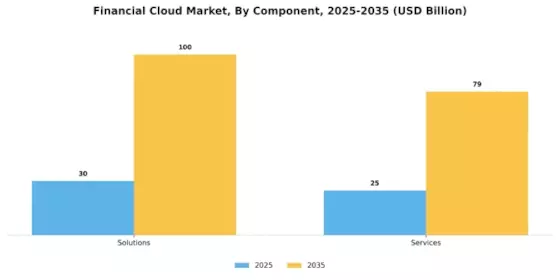
In the Financial Cloud Market, the component segment reveals a clear distribution of market presence between Solutions and Services. Solutions have emerged as the largest contributor to the market, leveraging established technologies and infrastructures in financial institutions. Meanwhile, Services, particularly managed services and consulting, are gaining traction due to their flexibility and adaptability to evolving market needs. This shift illustrates a transition toward more dynamic service-oriented approaches in financial cloud offerings.
Solutions: Infrastructure (Dominant) vs. Services: Consulting (Emerging)
Within the Solutions segment, infrastructure plays a dominant role, providing essential capabilities that underpin financial operations. This component is characterized by robust scalability, security, and compliance features, catering to the stringent requirements of financial organizations. On the other hand, the Services segment is witnessing rapid growth in consulting, reflecting an emerging demand for strategic guidance in cloud adoption. Consulting services enable financial institutions to navigate the complexities of cloud technology, ensuring optimized implementations and yielding considerable business advantages.
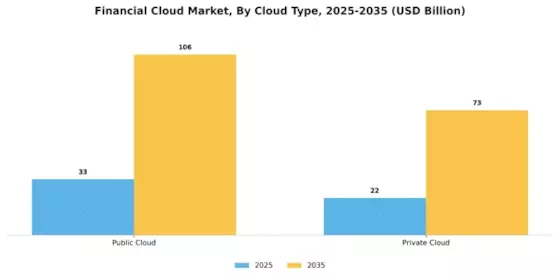
The Financial Cloud Market exhibits a distinct distribution between Public and Private Cloud segments. The Public Cloud holds the largest share due to its widespread adoption among financial institutions seeking cost-effective and scalable solutions. This segment is favored for its flexibility and accessibility, allowing organizations to optimize operations and reduce costs effectively. On the other hand, the Private Cloud segment is emerging rapidly as businesses prioritize data security and regulatory compliance, which are critical in the financial sector.
Cloud Type: Public (Dominant) vs. Private (Emerging)
The Public Cloud segment is characterized by its ability to provide extensive resources and services, making it the dominant force in the Financial Cloud Market. It caters to various financial entities, from startups to large banks, offering reliable infrastructure and software solutions that reduce IT overhead. Conversely, the Private Cloud is gaining traction as an emerging choice for firms focusing on enhanced security and control over sensitive financial data. This shift is driven by increasing regulatory requirements and a rising concern for data breaches, positioning the Private Cloud as a compelling alternative for organizations that require tailored solutions.
In the Financial Cloud Market, the distribution among organization sizes reveals a distinct preference for Banking and Financial Services. This segment holds the largest market share, largely due to the high demand for cloud-based solutions that enhance operational efficiency, scalability, and compliance in a heavily regulated environment. The need for secure, reliable data management in banking drives a substantial portion of investments in financial cloud technologies. Conversely, the Insurance segment, although smaller in market share, is rapidly gaining attention as companies seek innovative ways to improve customer experiences and streamline underwriting processes through cloud solutions.
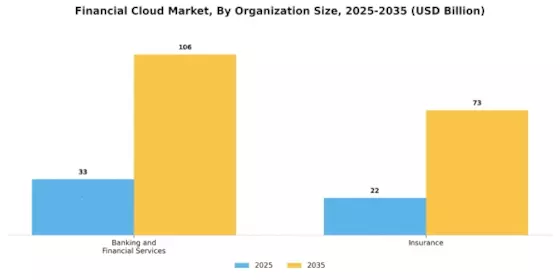
Banking and Financial Services: Dominant vs. Insurance: Emerging
Banking and Financial Services dominate the Financial Cloud Market by leveraging cutting-edge cloud technologies to optimize operations and maintain regulatory compliance. This segment is characterized by a large number of customers and critical financial transactions, necessitating robust security measures and advanced analytics. In contrast, the Insurance segment is emerging as a key player, driven by the increasing adoption of cloud solutions for automation, data analytics, and customer engagement. This shift not only allows insurers to enhance their service offerings but also to reduce operational risks and costs, making them more competitive in a dynamic market.
Get more detailed insights about Financial Cloud Market Request Free Sample
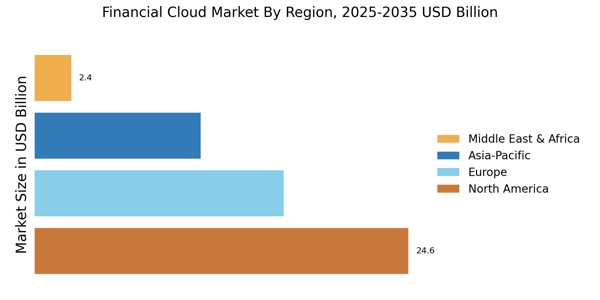
North America is the largest market for financial cloud solutions, holding approximately 45% of the global market share. The region's growth is driven by increasing demand for digital transformation, regulatory compliance, and enhanced security measures. The presence of major tech companies and financial institutions further fuels this growth, with a strong focus on innovation and customer-centric solutions. The United States is the leading country in this region, with significant contributions from Canada. Key players such as Amazon Web Services, Microsoft Azure, and IBM Cloud dominate the landscape, offering a range of services tailored to financial institutions. The competitive environment is characterized by rapid technological advancements and strategic partnerships, ensuring continuous evolution in service offerings.
Europe is witnessing significant growth in the financial cloud market, accounting for approximately 30% of the global share. The region's expansion is driven by stringent regulatory frameworks, such as GDPR, which encourage financial institutions to adopt cloud solutions for enhanced data security and compliance. Additionally, the increasing demand for cost-effective and scalable solutions is propelling market growth across various countries. Leading countries in Europe include Germany, the UK, and France, where major players like SAP and Oracle Cloud are making substantial investments. The competitive landscape is marked by a mix of established firms and emerging startups, fostering innovation. The European market is characterized by a strong emphasis on data privacy and security, shaping the offerings of cloud service providers.
Asia-Pacific is rapidly emerging as a significant player in the financial cloud market, holding around 20% of the global market share. The region's growth is fueled by increasing digitalization, a burgeoning fintech sector, and supportive government initiatives aimed at promoting cloud adoption. Countries like China and India are at the forefront, leveraging cloud technology to enhance financial services and improve customer experiences. China, led by Alibaba Cloud, is a key player in this market, while India is witnessing a surge in cloud adoption among financial institutions. The competitive landscape is diverse, with both local and international players vying for market share. The region's focus on innovation and technology-driven solutions is reshaping the financial services landscape, making it a hotbed for investment and development.
The Middle East and Africa region is gradually emerging in the financial cloud market, currently holding about 5% of the global share. The growth is primarily driven by digital transformation initiatives, increasing internet penetration, and a rising number of fintech startups. Countries like the UAE and South Africa are leading the charge, with governments actively promoting cloud adoption to enhance financial services and improve operational efficiency. In the UAE, significant investments in technology infrastructure are paving the way for cloud solutions in the financial sector. South Africa is also witnessing a growing interest in cloud services among banks and financial institutions. The competitive landscape is evolving, with both local and international players entering the market, creating a dynamic environment for innovation and growth.
The Financial Cloud Market is currently characterized by intense competition and rapid growth, driven by the increasing demand for digital transformation and cloud-based solutions among financial institutions. Major players such as Amazon Web Services (US), Microsoft Azure (US), and IBM Cloud (US) are strategically positioning themselves through innovation and partnerships, thereby shaping the competitive landscape. These companies are focusing on enhancing their service offerings, optimizing operational efficiencies, and expanding their The Financial Cloud share. The collective strategies of these key players indicate a trend towards a more integrated and collaborative ecosystem within the financial cloud sector.
In terms of business tactics, companies are increasingly localizing their services to meet regional regulatory requirements and customer preferences. This localization, coupled with supply chain optimization, is essential in a moderately fragmented market where various players vie for dominance. The competitive structure is influenced by the presence of both established giants and emerging players, creating a dynamic environment that fosters innovation and responsiveness to market needs.
In September 2025, Amazon Web Services (US) announced the launch of its new financial services cloud platform, designed to streamline compliance and enhance security for financial institutions. This strategic move is significant as it not only reinforces AWS's commitment to the financial sector but also positions it as a leader in providing tailored solutions that address the unique challenges faced by financial organizations. The introduction of this platform is likely to attract a diverse clientele seeking robust cloud solutions.
In August 2025, Microsoft Azure (US) expanded its partnership with a leading fintech company to enhance its cloud offerings specifically for payment processing. This collaboration is indicative of Azure's strategy to leverage partnerships to bolster its market presence and deliver specialized services that cater to the evolving needs of the financial industry. Such alliances may enhance Azure's competitive edge by providing innovative solutions that are critical in a rapidly changing market.
In July 2025, IBM Cloud (US) unveiled its AI-driven analytics tools aimed at improving risk management for financial institutions. This development underscores IBM's focus on integrating advanced technologies into its cloud services, thereby enabling clients to make data-driven decisions. The strategic importance of this initiative lies in its potential to transform how financial organizations approach risk assessment and management, ultimately leading to more resilient operations.
As of October 2025, the competitive trends in the Financial Cloud Market are increasingly defined by digitalization, sustainability, and the integration of artificial intelligence. Strategic alliances are playing a crucial role in shaping the current landscape, as companies seek to combine their strengths to deliver comprehensive solutions. Looking ahead, it appears that competitive differentiation will evolve from traditional price-based competition to a focus on innovation, technological advancement, and supply chain reliability, suggesting a shift towards a more value-driven market.





The Financial Cloud Market is projected to grow at 11.4% CAGR from 2024 to 2035, driven by digital transformation, regulatory compliance, and enhanced data security.
New opportunities lie in:
By 2035, the Financial Cloud Market is expected to be a cornerstone of financial services innovation.
| MARKET SIZE 2024 | 54.74(USD Billion) |
| MARKET SIZE 2025 | 60.98(USD Billion) |
| MARKET SIZE 2035 | 179.49(USD Billion) |
| COMPOUND ANNUAL GROWTH RATE (CAGR) | 11.4% (2024 - 2035) |
| REPORT COVERAGE | Revenue Forecast, Competitive Landscape, Growth Factors, and Trends |
| BASE YEAR | 2024 |
| Market Forecast Period | 2025 - 2035 |
| Historical Data | 2019 - 2024 |
| Market Forecast Units | USD Billion |
| Key Companies Profiled | Market analysis in progress |
| Segments Covered | Market segmentation analysis in progress |
| Key Market Opportunities | Integration of artificial intelligence and machine learning in Financial Cloud Market solutions enhances operational efficiency and decision-making. |
| Key Market Dynamics | Rising demand for secure data management drives innovation and competition in the Financial Cloud Market. |
| Countries Covered | North America, Europe, APAC, South America, MEA |
The Financial Cloud Market was valued at 54.74 USD Billion in 2024.
The market is projected to reach 179.49 USD Billion by 2035.
The expected CAGR for the Financial Cloud Market during 2025 - 2035 is 11.4%.
Key players include Amazon Web Services, Microsoft Azure, IBM Cloud, Oracle Cloud, Google Cloud, Salesforce, SAP, Alibaba Cloud, FIS, and Intuit.
The market is segmented into Solutions, valued at 30.0 to 100.0 USD Billion, and Services, valued at 24.74 to 79.49 USD Billion.
The market includes Public Cloud, valued at 32.84 to 106.12 USD Billion, and Private Cloud, valued at 21.9 to 73.37 USD Billion.
The market segments include Banking and Financial Services, valued at 32.84 to 106.12 USD Billion, and Insurance, valued at 21.9 to 73.37 USD Billion.
The growth appears driven by increasing demand for scalable solutions and enhanced security features in financial services.
The Financial Cloud Market shows robust growth potential, particularly with a projected increase to 179.49 USD Billion by 2035.
These companies lead the market by offering innovative solutions and extensive service portfolios that cater to financial institutions.


Research Methodology on Financial Cloud Market
The research methodology adopted for the financial cloud market report is a blend of primary and secondary research. To garner qualitative and quantitative insights into the report and to understand the overall opportunities and growth dynamics, primary and secondary data sources were used. Primary data sources include industry surveys, interviews conducted with experts, and suppliers while secondary sources include company annual reports, factsheets, press releases from market participants, agency associations, and industry data from trusted repositories.
A mixture of top-down and bottom-up approaches are used to reach the overall size of the global financial cloud market and for the sub-segments. The Market Research Future analysts have used primary research in collecting and validating the data from different sources such as annual reports, industry forums, and directories to name a few. Secondary research included company profiles and markets of financial cloud services.
Secondary research data was further dissected through the usage of both qualitative and quantitative methodologies. Investment options and some quantitative data were studied using SWOT analysis and Porter’s five forces model. Quality check is a centralized metric focused on verifying the data and being sure of the authenticity of the information confirmed by the sources.
A particular approach was undertaken to gather reliable and accurate data that would assist in a more comprehensive market analysis. A twofold approach is represented in the study process. Primary research usually deals with contacting the industry personnel and carrying out other informal conversations with stakeholders in the market to understand their opinions and outlook in the past and present scenarios. Secondary research is to collate the data mainly from the printed source of the material.
In the research process, we have set up a strong panel of primary and secondary data sources which represent the most important points of view in the financial cloud market. The secondary research includes a whole range of sources that gave us the necessary market information to expand our findings.
It is also necessary to mention here that primary and secondary research also involves in-depth interviews and conversations with key stakeholders in the financial cloud market. Informal conversations were held with operations and production personnel, other experts, and channel partners over the telephone as well as by face-to-face meetings, after that, the various opinion of the participants reformulated in tabular form.
Confirmation capability was further verified utilizing internal and independent verification sources.
Finally, the data is assembled and analysed to arrive at the overall market size. In order to finalize the overall market size, the data triangulation procedure was applied which involves analyzing data from both secondary and primary sources and deriving the market size.
The data from both primary and secondary sources are analyzed and verified by the internal research process used in the report. Then, the analyzed data is arranged in the report.
The services offered for primary research:
♦ Primary survey
♦ Insurance surveys
♦ Expert opinion
♦ Support
The services offered for secondary research:
♦ Official sources
♦ Previously published reports
♦ Analyst reviews
♦ Trade data
♦ Market intelligence databases
The key players in the financial cloud market, their company profiles, recent activities, and financial overview were mentioned in detail. In addition, their contact information, capacity and production information shared, pricing and gross margins, and so on were also analyzed. A PESTEL analysis is employed to get a comprehensive outlook on the economic situation of the financial cloud market. Lastly, the market is segmented according to category and region.
Kindly complete the form below to receive a free sample of this Report

“This is really good guys. Excellent work on a tight deadline. I will continue to use you going forward and recommend you to others. Nice job”


“Thanks. It’s been a pleasure working with you, please use me as reference with any other Intel employees.”


“Thanks for sending the report it gives us a good global view of the Betaïne market.”


“Thank you, this will be very helpful for OQS.”


“We found the report very insightful! we found your research firm very helpful. I'm sending this email to secure our future business.”


“I am very pleased with how market segments have been defined in a relevant way for my purposes (such as "Portable Freezers & refrigerators" and "last-mile"). In general the report is well structured. Thanks very much for your efforts.”


“I have been reading the first document or the study, ,the Global HVAC and FP market report 2021 till 2026. Must say, good info! I have not gone in depth at all parts, but got a good indication of the data inside!”


“We got the report in time, we really thank you for your support in this process. I also thank to all of your team as they did a great job.”


“The Automotive 48V ECU Components Procurement Intelligence Study” was a complex project, but the Market Research Future (MRFR) team handled it with quality, agility, and customer-centricity. They delivered all requested data on time and within the agreed scope. The team, including Shubhendra Anand and Rahul Gotadki, was always readily available to clarify questions and swiftly implement necessary adjustments, driving the project to a successful conclusion within a very demanding timeframe.
I would also like to specifically commend Akshay Agarwal for his responsiveness and support at every stage—from our initial inquiry on May 6th through to final delivery on June 18th. His dedication made the entire process seamless.”



