Download Free Sample
Kindly complete the form below to receive a free sample of this Report
Financial Crisis Management Services Market Size, Share and Trends Analysis Research Report Information By Client Type (Corporations, Government, Non-Profits, Financial Institutions), By Crisis Type (Fraud, Market Crash, Liquidity Crisis, Reputation Damage), By Service Type (Consulting, Training, Simulation, Assessment), By Industry Focus (Banking, Insurance, Investment, Real Estate), By Engagement Model (Retainer, Project-Based, On-Demand), And By Region – Market Forecast Till 2035.
As per MRFR analysis, the Financial Crisis Management Services Market was estimated at 18.0 USD Billion in 2024. The Financial Crisis Management Services industry is projected to grow from 18.86 USD Billion in 2025 to 30.0 USD Billion by 2035, exhibiting a compound annual growth rate (CAGR) of 4.75% during the forecast period 2025 - 2035.
The Financial Crisis Management Services Market is experiencing a dynamic shift towards tailored solutions and technological integration.
| 2024 Market Size | 18.0 (USD Billion) |
| 2035 Market Size | 30.0 (USD Billion) |
| CAGR (2025 - 2035) | 4.75% |
McKinsey & Company (US), Boston Consulting Group (US), Bain & Company (US), Deloitte (US), PwC (UK), KPMG (NL), Ernst & Young (UK), Oliver Wyman (US), Accenture (IE)
Our Impact
Enabled $4.3B Revenue Impact for Fortune 500 and Leading Multinationals
Partnering with 2000+ Global Organizations Each Year
30K+ Citations by Top-Tier Firms in the Industry
The Financial Crisis Management Services Market is currently experiencing a notable evolution, driven by the increasing complexity of global financial systems and the rising frequency of economic disruptions. Organizations are increasingly recognizing the necessity of robust crisis management strategies to navigate potential financial turmoil. This market encompasses a range of services, including risk assessment, strategic planning, and recovery solutions, which are tailored to meet the unique needs of various sectors. As businesses face heightened scrutiny from stakeholders and regulatory bodies, the demand for expert guidance in crisis management appears to be on the rise. Moreover, the Financial Crisis Management Services Market is likely to witness a shift towards more integrated and technology-driven solutions. The advent of advanced analytics and artificial intelligence is transforming how organizations approach crisis management, enabling them to anticipate challenges and respond more effectively. This trend suggests a growing reliance on data-driven insights to inform decision-making processes. As the landscape continues to evolve, firms that adapt to these changes and leverage innovative tools may find themselves better positioned to mitigate risks and enhance resilience in the face of financial crises.
Organizations are increasingly seeking customized crisis management services that address their specific vulnerabilities. This trend indicates a shift from one-size-fits-all approaches to more personalized strategies, allowing businesses to effectively manage unique challenges.
The incorporation of advanced technologies, such as artificial intelligence and big data analytics, is reshaping the Financial Crisis Management Services Market. These tools enable organizations to predict potential crises and develop proactive strategies, enhancing overall preparedness.
As regulatory frameworks become more stringent, there is a growing emphasis on compliance within the Financial Crisis Management Services Market. Companies are prioritizing governance structures that not only meet legal requirements but also foster transparency and accountability.
The Financial Crisis Management Services Market appears to be driven by increasing economic uncertainty across various sectors. As businesses face unpredictable market conditions, the demand for crisis management services intensifies. Companies are seeking expert guidance to navigate financial distress, which has led to a notable increase in service adoption. In recent years, the market has seen a growth rate of approximately 8% annually, indicating a robust need for strategic financial planning and risk assessment. Organizations are increasingly aware that proactive measures can mitigate potential losses, thus driving the demand for specialized services in the Financial Crisis Management Services Market.
The Financial Crisis Management Services Market is experiencing a heightened focus on risk management strategies. Organizations are increasingly recognizing the importance of identifying and mitigating financial risks before they escalate into crises. This shift in perspective has led to a surge in demand for crisis management services that offer comprehensive risk assessments and tailored solutions. In 2025, the market is projected to reach a valuation of over $10 billion, reflecting the growing investment in risk management initiatives. As businesses strive to enhance their resilience against potential financial disruptions, the role of crisis management services becomes increasingly pivotal within the Financial Crisis Management Services Market.
The Financial Crisis Management Services Market is witnessing a surge in awareness regarding the importance of financial health among organizations. As businesses strive for sustainability and long-term success, there is a growing recognition of the need for effective financial management practices. This awareness is driving the demand for crisis management services that provide insights into financial performance and strategic planning. In 2025, it is expected that organizations will allocate more resources towards financial health assessments, further propelling the growth of the market. The emphasis on maintaining robust financial health positions crisis management services as vital components in the Financial Crisis Management Services Market.
The Financial Crisis Management Services Market is significantly influenced by the growing complexity of financial regulations. As regulatory frameworks evolve, organizations are compelled to adapt their financial strategies to remain compliant. This complexity necessitates expert intervention, leading to an increased reliance on crisis management services. In 2025, it is estimated that compliance-related expenditures will account for nearly 15% of total operational costs for many firms. Consequently, the demand for services that ensure adherence to these regulations is likely to rise, positioning crisis management firms as essential partners in navigating the intricate landscape of financial compliance within the Financial Crisis Management Services Market.
The Financial Crisis Management Services Market is being transformed by technological advancements that enhance crisis response capabilities. Innovations such as data analytics, artificial intelligence, and machine learning are enabling organizations to predict potential financial crises more accurately. These technologies facilitate real-time monitoring and analysis, allowing for timely interventions. As a result, firms are increasingly integrating these technological solutions into their crisis management strategies. By 2025, it is anticipated that technology-driven services will constitute a significant portion of the market, underscoring the importance of adopting advanced tools in the Financial Crisis Management Services Market.
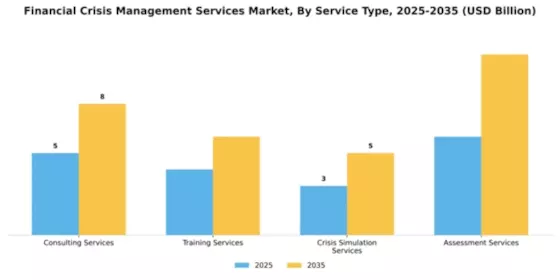
In the Financial Crisis Management Services Market, Consulting Services hold the largest share, widely recognized for their strategic guidance and tailored solutions to businesses facing potential financial turmoil. Training Services and Assessment Services follow closely, providing critical support in equipping organizations with essential skills and knowledge to manage crises effectively. Crisis Simulation Services, while smaller in market share, are rapidly gaining traction as companies recognize the value of real-time scenario practice in preparing for unforeseen events.
Crisis Simulation: Consulting Services (Dominant) vs. Assessment Services (Emerging)
Consulting Services are the cornerstone of financial crisis management, offering expert advice that helps organizations navigate complex challenges. Their established reputation and extensive experience have made them the dominant force in the market. On the other hand, Assessment Services are emerging as a valuable offering, focusing on evaluating organizational vulnerabilities and providing actionable insights. Their role is increasingly pivotal as companies seek to understand their risk profiles better. While Consulting Services emphasize strategy development, Assessment Services focus on data-driven evaluations, creating a balanced approach to crisis management. Their combination enhances the overall resilience of organizations.
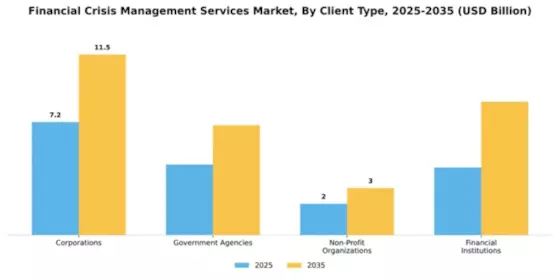
In the Financial Crisis Management Services Market, the client type segment showcases varied distribution, with corporations holding the largest share. Corporations leverage these services to mitigate risks during economic downturns, ensuring their operational continuity and financial stability. Government agencies, while not the largest contributors, are experiencing significant growth as they increasingly recognize the need for strategic counseling in times of financial crisis, pushing them into a more prominent position within the market.
Corporations (Dominant) vs. Government Agencies (Emerging)
Corporations represent the dominant force in the Financial Crisis Management Services Market, primarily because they possess the resources and infrastructure to adopt comprehensive crisis management frameworks. Their focus on maintaining financial health during turbulent times drives investments in these services. On the other hand, Government Agencies are emerging as significant players, marked by their growing budget allocations for crisis management. The increase in public awareness around financial accountability and transparency contributes to this shift, leading them to enhance their capabilities and services in response to economic uncertainties. Both segments highlight a robust interplay between strategic planning and crisis response.
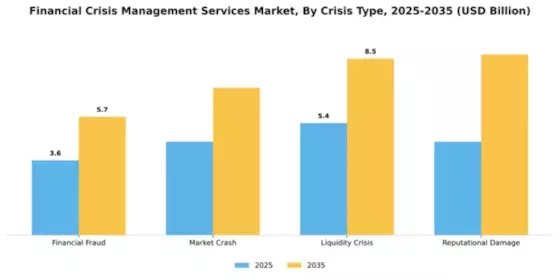
In the Financial Crisis Management Services Market, Financial Fraud accounts for the largest share among the segment types, reflecting its persistent relevance and prevalence in today's financial landscape. As organizations face increasing threats from cybercrime and internal misconduct, services addressing financial fraud are paramount. Meanwhile, the Market Crash segment is rapidly gaining traction, indicating a heightened awareness of external economic vulnerabilities that can disrupt operations. This growing concern for market stability is prompting businesses to invest more in crisis management services tailored to navigating market fluctuations.
Financial Fraud (Dominant) vs. Market Crash (Emerging)
Financial Fraud stands out as the dominant segment in the Financial Crisis Management Services Market. Its prominence can be attributed to the rising incidences of cybercrime, scams, and financial malfeasance across sectors. Organizations, both large and small, are increasingly prioritizing strategies to mitigate these threats, ensuring they have robust defenses and response plans. On the other hand, Market Crash services are an emerging area of focus as companies recognize the potential risks posed by economic downturns. The increasing volatility in global markets has led to a surge in demand for consultation services that can equip businesses to withstand sudden financial shocks, therefore making it a critical segment moving forward.
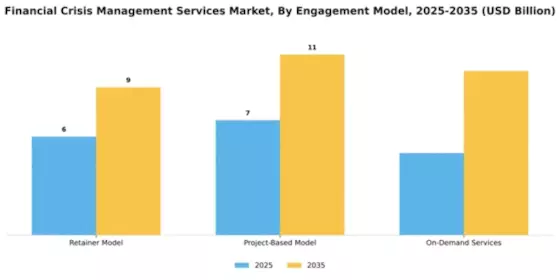
In the Financial Crisis Management Services Market, the engagement model segment displays a diverse distribution of market share among key models. The Retainer Model dominates the landscape, accounting for the substantial majority of the revenue, as businesses prefer this model for its predictability in ongoing support. Following closely, the Project-Based Model has been gaining traction due to its flexibility and capacity to adapt to specific client needs, although it holds a smaller share compared to the Retainer Model. On-Demand Services, while innovative, represent a lesser segment within this market, providing spurted demand based on immediate requirements rather than longer-term engagements. Growth trends in the engagement model segment of financial crisis management services reflect a shift in client preferences for tailored solutions. As businesses navigate uncertainties, the Project-Based Model is becoming increasingly appealing for organizations seeking targeted interventions without long-term commitments, which aligns well with the agile business frameworks. Additionally, as digital transformation continues to evolve, On-Demand Services are expected to gain momentum, allowing firms to access specialized expertise as needed. This shift highlights a market leaning towards flexibility, responsiveness, and customized support in crisis management solutions.
Retainer Model (Dominant) vs. On-Demand Services (Emerging)
The Retainer Model in the Financial Crisis Management Services Market is characterized by long-term contracts that ensure consistent support and responsiveness from service providers. This model is favored by organizations that require ongoing risk management strategies and a proactive approach to potential crises, thus allowing them to maintain operational stability during turbulent times. Conversely, On-Demand Services represent an emerging trend where businesses can access specific expertise as crises arise without committing to long-term engagements. This model appeals to companies that prioritize flexibility and quick response times, particularly in volatile market conditions. While the Retainer Model offers reliability and depth of service, the On-Demand Services cater to a more reactive approach, enabling organizations to adapt swiftly to changing challenges.
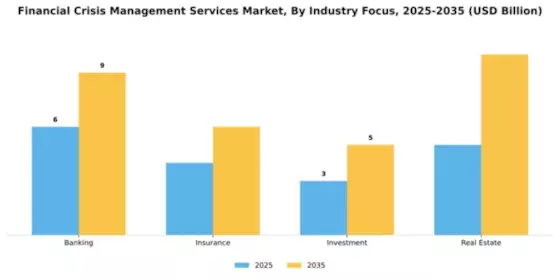
The Financial Crisis Management Services Market shows a diverse market share distribution across various industry focuses, with Banking leading as the largest segment. The Banking industry significantly relies on crisis management services to maintain operational efficiency and regulatory compliance during financial downturns. In contrast, the Insurance sector is rapidly expanding as organizations increasingly seek risk mitigation strategies and enhanced analytics to manage uncertainties effectively. Growth drivers in the Financial Crisis Management Services Market include an increasing awareness of financial risks and the need for robust crisis management frameworks across industries. Insurance is becoming a strong contender due to evolving regulatory landscapes and a heightened focus on customer trust. As companies adapt to economic challenges, the demand for tailored services that address specific sector vulnerabilities is likely to grow, particularly within the Insurance domain.
Banking: Dominant vs. Insurance: Emerging
In the Financial Crisis Management Services Market, Banking stands out as the dominant force owing to its necessity for comprehensive risk management in volatile economic periods. Banks require specialized services to navigate crises, focusing on asset protection and maintaining customer confidence. Conversely, the Insurance sector, while emerging, has been witnessing a meteoric rise due to increased demand for innovative solutions that enhance resilience against financial shocks. This segment is evolving to incorporate advanced analytical solutions and personalization strategies that cater to individual client needs. As businesses face heightened economic uncertainties, Insurance is transforming its offerings, making it a compelling area for investment and growth in the context of crisis management.
Get more detailed insights about Financial Crisis Management Services Market Request Free Sample
North America continues to lead the Financial Crisis Management Services market, holding a significant share of 9.0 in 2025. The region's growth is driven by a robust financial sector, increasing regulatory scrutiny, and a rising demand for risk management solutions. Companies are focusing on enhancing their crisis response strategies, influenced by recent economic fluctuations and the need for sustainable practices. Regulatory frameworks are evolving, pushing organizations to adopt comprehensive crisis management protocols. The competitive landscape in North America is characterized by the presence of major consulting firms such as McKinsey & Company, Boston Consulting Group, and Deloitte. These players are leveraging advanced analytics and technology to offer tailored solutions. The U.S. remains the largest market, followed by Canada, where firms are increasingly investing in crisis management capabilities to navigate economic uncertainties. The focus on innovation and strategic partnerships is expected to further enhance market growth.
Europe's Financial Crisis Management Services market is projected to reach 5.0 by 2025, driven by stringent regulatory requirements and a growing emphasis on compliance. The region is witnessing an increased demand for services that help organizations navigate complex financial landscapes. Factors such as economic recovery post-pandemic and the need for sustainable financial practices are propelling market growth. Regulatory bodies are actively promoting frameworks that enhance crisis preparedness and response capabilities across sectors. Leading countries in this region include the UK, Germany, and France, where firms are increasingly investing in crisis management services. Key players like PwC and KPMG are at the forefront, offering innovative solutions tailored to local regulations. The competitive landscape is marked by a mix of established firms and emerging players, all striving to meet the evolving needs of clients in a dynamic regulatory environment. This focus on compliance and risk management is expected to drive further growth in the coming years.
The Asia-Pacific region is experiencing a burgeoning demand for Financial Crisis Management Services, with a market size of 3.0 projected for 2025. This growth is fueled by rapid economic development, increasing financial literacy, and a heightened awareness of risk management among businesses. Countries in this region are focusing on strengthening their financial systems, leading to a greater need for crisis management solutions. Regulatory bodies are also emphasizing the importance of preparedness in the face of economic uncertainties. Key players in the Asia-Pacific market include local firms and international consultancies, with countries like China, India, and Australia leading the charge. The competitive landscape is evolving, with firms adapting their strategies to cater to diverse market needs. As businesses increasingly recognize the value of crisis management, the region is poised for significant growth, driven by both domestic and foreign investments in this sector.
The Middle East and Africa region is gradually emerging in the Financial Crisis Management Services market, with a projected size of 1.0 by 2025. This growth is primarily driven by increasing economic diversification efforts and the need for robust financial frameworks. Countries in this region are recognizing the importance of crisis management in ensuring financial stability, especially in light of recent economic challenges. Regulatory bodies are beginning to implement guidelines that promote better crisis preparedness among businesses. Leading countries in this region include South Africa and the UAE, where there is a growing presence of both local and international consulting firms. The competitive landscape is characterized by a mix of established players and new entrants, all aiming to capture the emerging opportunities in crisis management services. As awareness of the importance of these services grows, the region is expected to see a steady increase in demand and investment.
The Financial Crisis Management Services Market is characterized by a dynamic competitive landscape, driven by the increasing complexity of global financial systems and the need for robust risk management strategies. Key players such as McKinsey & Company (US), Deloitte (US), and PwC (UK) are strategically positioned to leverage their extensive expertise in crisis management, focusing on innovation and digital transformation to enhance service delivery. These firms are not only expanding their service offerings but are also forming strategic partnerships to bolster their market presence, thereby shaping a competitive environment that emphasizes agility and responsiveness to client needs.In terms of business tactics, companies are increasingly localizing their operations to better serve regional markets, optimizing supply chains to enhance efficiency, and investing in technology to streamline processes. The market appears moderately fragmented, with a mix of large multinational firms and smaller specialized consultancies. The collective influence of these key players fosters a competitive structure that encourages innovation and collaboration, ultimately benefiting clients seeking comprehensive crisis management solutions.In November McKinsey & Company (US) announced a partnership with a leading fintech firm to develop advanced analytics tools aimed at enhancing financial forecasting capabilities for clients. This strategic move underscores McKinsey's commitment to integrating cutting-edge technology into its service offerings, positioning the firm to better address the complexities of financial crises through data-driven insights.In October Deloitte (US) launched a new suite of crisis management services specifically tailored for the healthcare sector, responding to the growing demand for specialized support in navigating financial challenges. This initiative reflects Deloitte's strategic focus on sector-specific solutions, allowing the firm to differentiate itself in a competitive market while addressing the unique needs of healthcare organizations facing financial pressures.In September PwC (UK) expanded its global footprint by acquiring a boutique consultancy specializing in risk management in emerging markets. This acquisition not only enhances PwC's capabilities in crisis management but also signifies a strategic effort to tap into high-growth regions, thereby reinforcing its competitive position in the market.As of December current trends in the Financial Crisis Management Services Market are heavily influenced by digitalization, sustainability, and the integration of artificial intelligence (AI) into service offerings. Strategic alliances are increasingly shaping the landscape, enabling firms to combine resources and expertise to deliver innovative solutions. Looking ahead, competitive differentiation is likely to evolve from traditional price-based competition to a focus on innovation, technology integration, and supply chain reliability, as firms strive to meet the complex demands of clients in an ever-changing financial environment.




The Financial Crisis Management Services Market is projected to grow at a 4.75% CAGR from 2025 to 2035, driven by increasing regulatory demands and the need for risk mitigation strategies.
New opportunities lie in:
By 2035, the market is expected to be robust, reflecting resilience and adaptability to evolving financial challenges.
| MARKET SIZE 2024 | 18.0(USD Billion) |
| MARKET SIZE 2025 | 18.86(USD Billion) |
| MARKET SIZE 2035 | 30.0(USD Billion) |
| COMPOUND ANNUAL GROWTH RATE (CAGR) | 4.75% (2025 - 2035) |
| REPORT COVERAGE | Revenue Forecast, Competitive Landscape, Growth Factors, and Trends |
| BASE YEAR | 2024 |
| Market Forecast Period | 2025 - 2035 |
| Historical Data | 2019 - 2024 |
| Market Forecast Units | USD Billion |
| Key Companies Profiled | McKinsey & Company (US), Boston Consulting Group (US), Bain & Company (US), Deloitte (US), PwC (UK), KPMG (NL), Ernst & Young (UK), Oliver Wyman (US), Accenture (IE) |
| Segments Covered | Service Type, Client Type, Crisis Type, Engagement Model, Industry Focus |
| Key Market Opportunities | Integration of advanced analytics and artificial intelligence in Financial Crisis Management Services Market. |
| Key Market Dynamics | Rising demand for strategic advisory services amid increasing regulatory scrutiny and evolving consumer expectations in financial crisis management. |
| Countries Covered | North America, Europe, APAC, South America, MEA |
The market valuation was 18.0 USD Billion in 2024.
The market is projected to reach 30.0 USD Billion by 2035.
The expected CAGR for the market is 4.75% during the forecast period 2025 - 2035.
Assessment Services, with a projected revenue increase from 6.0 to 11.0 USD Billion, appears to generate the highest revenue.
Corporations are expected to grow from 7.2 to 11.5 USD Billion, surpassing government agencies, which are projected to grow from 4.5 to 7.0 USD Billion.
The primary crisis types include Financial Fraud, Market Crash, Liquidity Crisis, and Reputational Damage, with Liquidity Crisis projected to grow from 5.4 to 8.5 USD Billion.
The Project-Based Model is likely to dominate, with a projected growth from 7.0 to 11.0 USD Billion.
The Banking and Real Estate sectors are expected to drive growth, with Real Estate projected to grow from 5.0 to 10.0 USD Billion.
Key players include McKinsey & Company, Boston Consulting Group, Bain & Company, Deloitte, PwC, KPMG, Ernst & Young, Oliver Wyman, and Accenture.
Trends include increasing demand for comprehensive crisis management solutions and a focus on tailored consulting services from leading firms.


Kindly complete the form below to receive a free sample of this Report

“This is really good guys. Excellent work on a tight deadline. I will continue to use you going forward and recommend you to others. Nice job”


“Thanks. It’s been a pleasure working with you, please use me as reference with any other Intel employees.”


“Thanks for sending the report it gives us a good global view of the Betaïne market.”


“Thank you, this will be very helpful for OQS.”


“We found the report very insightful! we found your research firm very helpful. I'm sending this email to secure our future business.”


“I am very pleased with how market segments have been defined in a relevant way for my purposes (such as "Portable Freezers & refrigerators" and "last-mile"). In general the report is well structured. Thanks very much for your efforts.”


“I have been reading the first document or the study, ,the Global HVAC and FP market report 2021 till 2026. Must say, good info! I have not gone in depth at all parts, but got a good indication of the data inside!”


“We got the report in time, we really thank you for your support in this process. I also thank to all of your team as they did a great job.”


“The Automotive 48V ECU Components Procurement Intelligence Study” was a complex project, but the Market Research Future (MRFR) team handled it with quality, agility, and customer-centricity. They delivered all requested data on time and within the agreed scope. The team, including Shubhendra Anand and Rahul Gotadki, was always readily available to clarify questions and swiftly implement necessary adjustments, driving the project to a successful conclusion within a very demanding timeframe.
I would also like to specifically commend Akshay Agarwal for his responsiveness and support at every stage—from our initial inquiry on May 6th through to final delivery on June 18th. His dedication made the entire process seamless.”



