Download Free Sample
Kindly complete the form below to receive a free sample of this Report
Financial Literacy Education Services Market Size, Share and Trends Analysis Research Report Information By Application (Personal Finance, Investment, Debt, Savings & Budgeting, Retirement Planning), By Content Type (Interactive Modules, Video Tutorials, E-books, Quizzes, Case Studies), By Delivery Method (Online Courses, Workshops, Webinars, Mobile Apps, Printed Materials), By Target Audience (Students, Professionals, Retirees, Low-Income, Small Business Owners), By Certification Level (Basic, Intermediate, Advanced, Professional, Specialized), And By Region – Market Forecast Till 2035.
As per MRFR analysis, the Financial Literacy Education Services Market was estimated at 5.2 USD Billion in 2024. The Financial Literacy Education Services industry is projected to grow from 5.54 USD Billion in 2025 to 10.5 USD Billion by 2035, exhibiting a compound annual growth rate (CAGR) of 6.6% during the forecast period 2025 - 2035.
The Financial Literacy Education Services Market is experiencing robust growth driven by technological advancements and increasing awareness.
| 2024 Market Size | 5.2 (USD Billion) |
| 2035 Market Size | 10.5 (USD Billion) |
| CAGR (2025 - 2035) | 6.6% |
National Endowment for Financial Education (US), Jumpstart Coalition for Personal Financial Literacy (US), Khan Academy (US), Smart About Money (US), Money Management International (US), Council for Economic Education (US), Financial Literacy and Education Commission (US), Practical Money Skills (US)
Our Impact
Enabled $4.3B Revenue Impact for Fortune 500 and Leading Multinationals
Partnering with 2000+ Global Organizations Each Year
30K+ Citations by Top-Tier Firms in the Industry
The Financial Literacy Education Services Market is currently experiencing a notable evolution, driven by a growing recognition of the necessity for financial knowledge among diverse demographics. As individuals increasingly navigate complex financial landscapes, the demand for educational resources that enhance financial understanding appears to be on the rise. This market encompasses a variety of services, including workshops, online courses, and personalized coaching, all aimed at equipping consumers with essential skills for effective money management. Furthermore, the integration of technology into educational platforms seems to facilitate broader access, allowing learners to engage with content at their convenience. In addition, the Financial Literacy Education Services Market is likely influenced by regulatory initiatives that promote financial education as a means to foster economic stability. Governments and organizations are increasingly advocating for programs that address financial illiteracy, particularly among vulnerable populations. This trend suggests a shift towards a more proactive approach in addressing financial challenges, potentially leading to a more informed society. As the market continues to evolve, it may witness further innovations in delivery methods and content, catering to the unique needs of various audiences, thereby enhancing overall financial well-being.
The incorporation of technology into financial literacy education is transforming how information is delivered. Online platforms, mobile applications, and interactive tools are becoming prevalent, allowing learners to access resources anytime and anywhere. This trend indicates a shift towards more engaging and personalized learning experiences.
There appears to be an increasing emphasis on regulatory frameworks that promote financial education. Governments and institutions are recognizing the importance of equipping citizens with financial knowledge, leading to the development of policies that support educational initiatives. This trend may enhance the credibility and reach of financial literacy programs.
The Financial Literacy Education Services Market is witnessing a rise in tailored programs aimed at specific demographics, such as low-income families and young adults. These initiatives are designed to address unique challenges faced by these groups, suggesting a more inclusive approach to financial education.
The alarming rise in consumer debt levels is a pressing concern that drives the Financial Literacy Education Services Market. As individuals grapple with increasing debt, the need for financial education becomes more pronounced. Reports indicate that many consumers lack the necessary skills to manage their finances effectively, leading to poor financial decisions and heightened stress. This situation has prompted a surge in demand for financial literacy programs aimed at equipping individuals with the tools to navigate their financial challenges. Consequently, the Financial Literacy Education Services Market is positioned to grow as more people seek guidance and support in managing their financial obligations.
The emphasis on financial inclusion is a pivotal driver for the Financial Literacy Education Services Market. Efforts to ensure that underserved populations have access to financial services have led to an increased demand for educational programs that promote financial literacy. Organizations and governments are recognizing that financial education is essential for empowering individuals to make informed financial choices. Data suggests that regions focusing on financial inclusion initiatives are witnessing a rise in participation in financial literacy programs. This trend indicates that the Financial Literacy Education Services Market will continue to expand as it addresses the needs of diverse communities and fosters greater economic participation.
Government initiatives aimed at promoting financial literacy are significantly influencing the Financial Literacy Education Services Market. Various countries have implemented policies and programs designed to enhance financial education among citizens. For instance, national campaigns and partnerships with educational institutions have been established to provide resources and training. Statistics indicate that regions with strong government support for financial literacy education tend to exhibit higher levels of financial knowledge among their populations. This trend suggests that as governments continue to prioritize financial literacy, the Financial Literacy Education Services Market will likely see sustained growth and increased funding for educational initiatives.
The rising awareness of the importance of financial literacy is a key driver for the Financial Literacy Education Services Market. As individuals recognize the necessity of understanding financial concepts, the demand for educational services has surged. Reports indicate that a significant portion of the population lacks basic financial knowledge, which has prompted governments and organizations to invest in educational programs. This trend is likely to continue, as more people seek to improve their financial decision-making skills. Consequently, the Financial Literacy Education Services Market is experiencing growth, with various stakeholders aiming to fill the knowledge gap through targeted initiatives and resources.
Technological advancements are transforming the way financial literacy education is delivered, serving as a crucial driver for the Financial Literacy Education Services Market. The proliferation of online learning platforms and mobile applications has made financial education more accessible than ever. Data suggests that e-learning in financial literacy has seen a substantial increase, with many individuals preferring digital formats over traditional classroom settings. This shift not only enhances engagement but also allows for personalized learning experiences. As technology continues to evolve, the Financial Literacy Education Services Market is likely to expand, catering to diverse learning preferences and increasing overall participation.
In the Financial Literacy Education Services Market, the application segment reveals distinct preferences among consumers. Personal Finance Management stands as the largest segment, dominating the market share due to its broad applicability and essential nature for everyday financial decisions. This segment primarily focuses on helping individuals manage their day-to-day finances, budget effectively, and make informed spending choices. In contrast, Investment Education, while smaller in market share, is emerging rapidly as consumers increasingly seek to grow their wealth through understanding investment strategies and opportunities. The growth trends within this segment are primarily driven by a rising awareness of financial literacy's importance, along with increased access to digital education platforms. As more individuals recognize the need to be proactive about their financial futures, Demand for Debt Management and Retirement Planning services has also surged. The overall market is experiencing a significant transformation, supported by technological advancements and an increasing inclination toward financial independence.
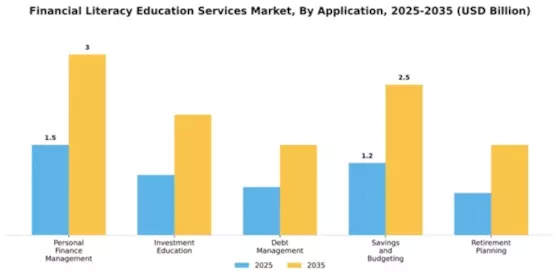
Personal Finance Management (Dominant) vs. Investment Education (Emerging)
Personal Finance Management serves as the cornerstone of the Financial Literacy Education Services Market. It emphasizes skills for budgeting, spending, and saving, empowering individuals to take control of their financial lives. This segment caters to a broad audience, including students, professionals, and families, ensuring that essential financial management skills are accessible to all. On the other hand, Investment Education is emerging due to the growing interest in economic growth through investment. Many individuals now desire a deeper understanding of stocks, bonds, and portfolios, which were once viewed as complex and intimidating. This education helps bridge the gap between basic financial management and sophisticated investment strategies, making it a pivotal segment in cultivating a financially savvy population.
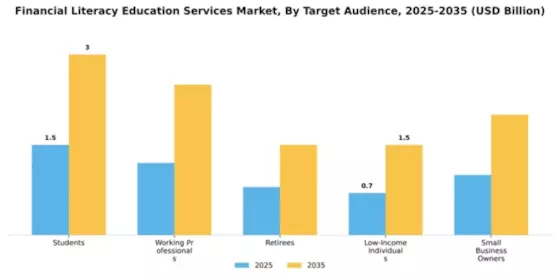
In the Financial Literacy Education Services Market, the target audience is diverse, comprising key segments such as students, working professionals, retirees, low-income individuals, and small business owners. Among these, students represent the largest segment, driven by the increasing emphasis on financial education within academic settings. Working professionals, however, are emerging rapidly, seeking financial literacy programs that enhance their understanding of investment and personal finance management, reflecting a significant shift in workplace learning priorities. The growth trends indicate that students are benefiting from initiatives at educational institutions, which are integrating financial literacy into their curricula. Meanwhile, working professionals are attracted to flexible online courses and workshops that fit into their busy schedules. As the demand for financial literacy continues to rise, these segments are crucial to shaping the market landscape in the coming years.
Students (Dominant) vs. Working Professionals (Emerging)
The students segment holds a dominant position within the Financial Literacy Education Services Market, primarily due to institutional mandates and an increasing awareness of the importance of financial education from a young age. Educational policymakers are keen on integrating financial literacy into school curriculums, thereby ensuring students are equipped with essential skills for future financial stability. On the other hand, working professionals represent an emerging segment, driven by the desire for self-improvement and better financial decision-making. Their increasing participation in online financial courses reflects a proactive approach to personal finance management, often influenced by workplace initiatives and the necessity to manage complex financial situations. The adaptability of programs designed for professionals signifies a critical growth avenue for service providers.
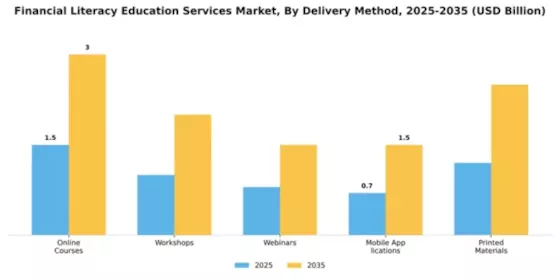
The delivery method segment of the Financial Literacy Education Services Market showcases a diverse range of options catering to various learning preferences. Online Courses dominate the market due to their flexibility and accessibility, appealing to diverse demographics. Workshops, although currently smaller in market share, are gaining traction as they provide interactive and engaging learning experiences. As educational institutions and organizations increasingly adopt both formats, the landscape is evolving to meet the rising demand for accessible financial literacy resources.
Online Courses: Flexible (Dominant) vs. Workshops: Engaging (Emerging)
Online Courses stand out in the Financial Literacy Education Services Market as a dominant delivery method that offers unparalleled flexibility and convenience for learners. They cater to a broad audience, encompassing various age groups and learning styles, allowing individuals to engage with content at their own pace. In contrast, Workshops are emerging as an engaging alternative, focusing on collaborative learning and real-time interaction. This format appeals particularly to those who benefit from hands-on experiences and direct access to experts. With the growing emphasis on practical knowledge, Workshops are increasingly becoming a favored choice among organizations seeking effective training solutions.
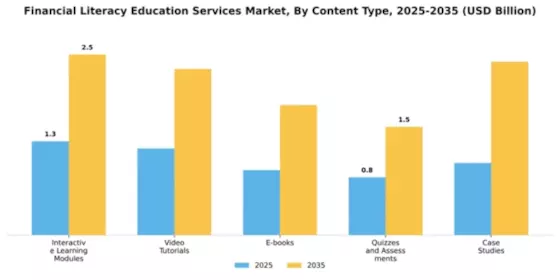
In the Financial Literacy Education Services Market, Interactive Learning Modules command the largest share, appealing to learners through hands-on application and engaging content. These modules allow for customized learning experiences, which are increasingly in demand as individuals seek to improve their financial decision-making abilities. Video Tutorials, on the other hand, have emerged as the fastest-growing segment, capturing attention due to their accessibility and ability to condense complex concepts into easily digestible formats. Their rise reflects the increasing use of digital platforms for learning, particularly among younger audiences. Growth trends in this segment indicate a shift towards more interactive and visual learning formats. As technology evolves, providers are integrating advanced features into Interactive Learning Modules, enhancing user engagement. Additionally, the surging popularity of Video Tutorials is driven by the proliferation of online streaming and mobile accessibility. This trend is supported by a growing recognition that diverse learning formats cater to varying preferences, ensuring that content is not only informative but also stimulating and approachable for all learners.
Interactive Learning Modules (Dominant) vs. Case Studies (Emerging)
Interactive Learning Modules have established themselves as a dominant force in the Financial Literacy Education Services Market. They offer a robust framework for immersing learners in practical scenarios, thereby enhancing their understanding of complex financial concepts. These modules utilize adaptive technology to cater to individual learning styles, making financial literacy accessible to a broader audience. In contrast, Case Studies are an emerging segment, providing real-world contexts that allow learners to apply theoretical knowledge. They help bridge the gap between theory and practice, enhancing analytical skills and critical thinking. While still gaining traction, Case Studies are becoming increasingly valued for their ability to present tangible examples of financial principles in action, making them an important addition to comprehensive educational offerings.
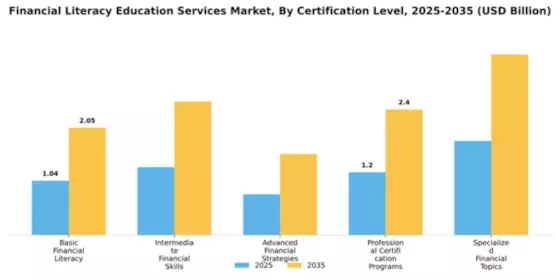
In the Financial Literacy Education Services Market, the Basic Financial Literacy segment holds the largest market share, catering to a wide audience seeking foundational financial knowledge. This accessibility ensures a steady demand, particularly among schools and community organizations striving to enhance elementary financial understanding. Meanwhile, Professional Certification Programs, although smaller in share, are rapidly gaining traction as professionals seek to differentiate themselves in a competitive landscape. These programs focus on specialized knowledge, which appeals to working adults eager to advance their careers. Growth trends indicate a strong uptick in interest in Professional Certification Programs, driven by a growing acknowledgment of the importance of financial literacy in professional settings. Employers are increasingly offering or mandating these programs to strengthen the financial acumen of their workforce. Additionally, the rising complexity of financial markets and the demand for transparency are further propelling individuals toward advanced learning opportunities, ensuring that both segments experience continuous development, albeit at different scales.
Basic Financial Literacy (Dominant) vs. Advanced Financial Strategies (Emerging)
Basic Financial Literacy serves as the cornerstone of financial education, emphasizing essential skills such as budgeting, saving, and understanding credit. This segment targets a diverse range of participants, including students, adults, and underserved communities, making it highly appealing and accessible. Its dominance is rooted in the constant need for foundational financial knowledge across various demographics. In contrast, Advanced Financial Strategies represent an emerging focus, designed for individuals looking to deepen their financial insights and decision-making abilities. These strategies often encompass advanced investment vehicles, tax planning, and long-term wealth management, appealing primarily to professionals and affluent individuals. As financial landscapes evolve, the demand for such advanced knowledge is likely to increase, fostering growth opportunities and enriching the overall financial literacy ecosystem.
Get more detailed insights about Financial Literacy Education Services Market Request Free Sample
North America is the largest market for Financial Literacy Education Services, holding a market size of $2.6B in 2024. The region's growth is driven by increasing awareness of financial literacy's importance, supported by various government initiatives and educational programs. Regulatory bodies are emphasizing the need for improved financial education, which is further fueled by rising consumer demand for financial knowledge and skills. The competitive landscape in North America is robust, featuring key players such as the National Endowment for Financial Education and Khan Academy. The U.S. leads the charge, with numerous organizations dedicated to enhancing financial literacy. Collaborative efforts among educational institutions and non-profits are also prevalent, ensuring a comprehensive approach to financial education across diverse demographics.
Europe is witnessing a growing demand for Financial Literacy Education Services, with a market size of €1.5B in 2024. The region's growth is propelled by increasing regulatory support and initiatives aimed at enhancing financial literacy among citizens. Governments are recognizing the critical role of financial education in fostering economic stability and consumer protection, leading to a surge in funding and resources allocated to educational programs. Leading countries in this sector include the UK, Germany, and France, where various organizations are actively promoting financial literacy. The competitive landscape features both governmental and non-governmental entities, working collaboratively to improve financial education. Notable players include the Money Advice Service in the UK, which emphasizes the importance of financial knowledge for all citizens.
The Asia-Pacific region is experiencing a burgeoning interest in Financial Literacy Education Services, with a market size of $0.9B in 2024. This growth is driven by rapid economic development, increasing disposable incomes, and a rising awareness of the importance of financial management. Governments are beginning to implement policies aimed at enhancing financial literacy, recognizing its role in promoting economic growth and stability across the region. Countries like Australia, Japan, and India are at the forefront of this movement, with various initiatives aimed at improving financial education. The competitive landscape includes both local and international organizations, with a focus on integrating financial literacy into school curricula. Key players are actively collaborating with educational institutions to ensure that financial skills are imparted to younger generations, fostering a financially savvy populace.
The Middle East and Africa region is gradually recognizing the importance of Financial Literacy Education Services, with a market size of $0.2B in 2024. The growth is driven by increasing economic diversification and a push for improved financial management among citizens. Governments are beginning to implement strategies aimed at enhancing financial literacy, which is seen as vital for economic empowerment and stability in the region. Countries such as South Africa and the UAE are leading the charge, with various initiatives aimed at promoting financial education. The competitive landscape is still developing, with a mix of local NGOs and international organizations working to improve financial literacy. Collaborative efforts are essential to ensure that financial education reaches underserved populations, fostering a more financially literate society.
The Financial Literacy Education Services Market is characterized by a dynamic competitive landscape, driven by increasing awareness of financial literacy's importance in personal and professional contexts. Key players are actively engaging in various strategies to enhance their market presence and operational efficiency. For instance, the National Endowment for Financial Education (US) has focused on expanding its digital resources, aiming to reach a broader audience through innovative online platforms. Similarly, Khan Academy (US) has been enhancing its curriculum offerings, integrating interactive tools to facilitate better learning experiences. These strategic initiatives collectively contribute to a more competitive environment, as companies strive to differentiate themselves through educational quality and accessibility.In terms of business tactics, companies are increasingly localizing their content to cater to diverse demographic needs, which appears to be a crucial factor in their operational strategies. The market structure is moderately fragmented, with several organizations vying for influence. This fragmentation allows for a variety of educational approaches, yet the collective influence of major players like the Council for Economic Education (US) and Money Management International (US) is significant, as they set benchmarks for quality and effectiveness in financial literacy education.In November Smart About Money (US) launched a new mobile application designed to provide personalized financial education resources. This strategic move is likely to enhance user engagement and accessibility, reflecting a broader trend towards mobile learning solutions. The app's features, which include budgeting tools and financial goal tracking, may position Smart About Money as a leader in the digital financial education space, appealing particularly to younger audiences who prefer mobile platforms.In October the Jumpstart Coalition for Personal Financial Literacy (US) announced a partnership with several educational institutions to integrate financial literacy into high school curricula nationwide. This initiative underscores the organization's commitment to fostering early financial education, which could have long-term implications for improving financial literacy rates among youth. By collaborating with schools, Jumpstart Coalition is likely to enhance its visibility and credibility, potentially influencing policy changes in educational standards.In September the Financial Literacy and Education Commission (US) released a comprehensive report outlining new strategies for enhancing financial literacy among underserved communities. This report emphasizes the importance of targeted outreach and community-based programs, suggesting a shift towards more inclusive educational practices. The commission's focus on underserved populations may catalyze further initiatives aimed at bridging the financial literacy gap, thereby reshaping the competitive landscape.As of December current trends in the Financial Literacy Education Services Market indicate a strong emphasis on digitalization, with many organizations leveraging technology to enhance learning experiences. The integration of artificial intelligence (AI) into educational tools is becoming increasingly prevalent, allowing for personalized learning pathways. Strategic alliances among key players are also shaping the landscape, as collaborations can lead to resource sharing and enhanced program offerings. Looking ahead, competitive differentiation is likely to evolve, with a shift from price-based competition towards innovation and technological integration. Companies that prioritize reliable supply chains and innovative educational solutions may emerge as leaders in this evolving market.




The Financial Literacy Education Services Market is projected to grow at a 6.6% CAGR from 2025 to 2035, driven by increasing demand for financial education and digital learning platforms.
New opportunities lie in:
By 2035, the market is expected to be robust, reflecting a strong emphasis on financial education globally.
| MARKET SIZE 2024 | 5.2(USD Billion) |
| MARKET SIZE 2025 | 5.54(USD Billion) |
| MARKET SIZE 2035 | 10.5(USD Billion) |
| COMPOUND ANNUAL GROWTH RATE (CAGR) | 6.6% (2025 - 2035) |
| REPORT COVERAGE | Revenue Forecast, Competitive Landscape, Growth Factors, and Trends |
| BASE YEAR | 2024 |
| Market Forecast Period | 2025 - 2035 |
| Historical Data | 2019 - 2024 |
| Market Forecast Units | USD Billion |
| Key Companies Profiled | National Endowment for Financial Education (US), Jumpstart Coalition for Personal Financial Literacy (US), Khan Academy (US), Smart About Money (US), Money Management International (US), Council for Economic Education (US), Financial Literacy and Education Commission (US), Practical Money Skills (US) |
| Segments Covered | Application, Target Audience, Delivery Method, Content Type, Certification Level |
| Key Market Opportunities | Integration of digital platforms enhances accessibility and engagement in the Financial Literacy Education Services Market. |
| Key Market Dynamics | Rising demand for digital financial literacy tools drives innovation and competition in education services. |
| Countries Covered | North America, Europe, APAC, South America, MEA |
The market valuation was 5.2 USD Billion in 2024.
The market is projected to reach 10.5 USD Billion by 2035.
The expected CAGR is 6.6% during the forecast period 2025 - 2035.
Segments such as Personal Finance Management and Savings and Budgeting are anticipated to show substantial growth.
Key players include the National Endowment for Financial Education, Jumpstart Coalition, and Khan Academy, among others.
Delivery methods include online courses, workshops, webinars, and mobile applications.
The market serves various audiences, including students, working professionals, retirees, and small business owners.
Content types include interactive learning modules, video tutorials, and case studies.
Certification levels range from basic financial literacy to advanced financial strategies and professional certification programs.
The market enhances financial literacy, potentially leading to improved financial decision-making and overall economic stability.


Kindly complete the form below to receive a free sample of this Report

“This is really good guys. Excellent work on a tight deadline. I will continue to use you going forward and recommend you to others. Nice job”


“Thanks. It’s been a pleasure working with you, please use me as reference with any other Intel employees.”


“Thanks for sending the report it gives us a good global view of the Betaïne market.”


“Thank you, this will be very helpful for OQS.”


“We found the report very insightful! we found your research firm very helpful. I'm sending this email to secure our future business.”


“I am very pleased with how market segments have been defined in a relevant way for my purposes (such as "Portable Freezers & refrigerators" and "last-mile"). In general the report is well structured. Thanks very much for your efforts.”


“I have been reading the first document or the study, ,the Global HVAC and FP market report 2021 till 2026. Must say, good info! I have not gone in depth at all parts, but got a good indication of the data inside!”


“We got the report in time, we really thank you for your support in this process. I also thank to all of your team as they did a great job.”


“The Automotive 48V ECU Components Procurement Intelligence Study” was a complex project, but the Market Research Future (MRFR) team handled it with quality, agility, and customer-centricity. They delivered all requested data on time and within the agreed scope. The team, including Shubhendra Anand and Rahul Gotadki, was always readily available to clarify questions and swiftly implement necessary adjustments, driving the project to a successful conclusion within a very demanding timeframe.
I would also like to specifically commend Akshay Agarwal for his responsiveness and support at every stage—from our initial inquiry on May 6th through to final delivery on June 18th. His dedication made the entire process seamless.”



