Download Free Sample
Kindly complete the form below to receive a free sample of this Report
Financial System Implementation and Consulting Services Market Research Report Information By End User (Financial Institutions, Government Agencies, Corporates, Non-Profit Organizations), By Technology (Blockchain Technology, Artificial Intelligence, Data Analytics, Robotic Process Automation), By Service Type (Implementation Services, Consulting Services, Support Services, Training Services), By Deployment Model (On-Premises, Cloud-Based, Hybrid) And By Region (North America, Europe, Asia-Pacific, And Rest Of The World) – Market Forecast Till 2035.
As per MRFR analysis, the Financial System Implementation and Consulting Services Market was estimated at 30.0 USD Billion in 2024. The Financial System Implementation and Consulting Services industry is projected to grow from 31.43 USD Billion in 2025 to 50.0 USD Billion by 2035, exhibiting a compound annual growth rate (CAGR) of 4.75% during the forecast period 2025 - 2035.
The Financial System Implementation and Consulting Services Market is experiencing robust growth driven by technological advancements and regulatory demands.
| 2024 Market Size | 30.0 (USD Billion) |
| 2035 Market Size | 50.0 (USD Billion) |
| CAGR (2025 - 2035) | 4.75% |
Deloitte (US), PwC (US), KPMG (US), EY (US), Accenture (IE), IBM (US), Capgemini (FR), Oracle (US), SAP (DE), Tata Consultancy Services (IN)
Our Impact
Enabled $4.3B Revenue Impact for Fortune 500 and Leading Multinationals
Partnering with 2000+ Global Organizations Each Year
30K+ Citations by Top-Tier Firms in the Industry
The Financial System Implementation and Consulting Services Market is currently experiencing a transformative phase, driven by the increasing complexity of financial regulations and the need for organizations to enhance operational efficiency. As businesses strive to adapt to evolving market conditions, the demand for specialized consulting services has surged. This market encompasses a wide range of services, including system integration, process optimization, and compliance advisory, which are essential for organizations aiming to streamline their financial operations. Furthermore, the rise of digital technologies and data analytics is reshaping the landscape, compelling firms to seek expert guidance in implementing innovative financial solutions. In December 2025, the Financial System Implementation and Consulting Services Market appears poised for continued growth. Organizations are increasingly recognizing the value of leveraging external expertise to navigate the intricacies of financial systems. This trend is likely to be fueled by the ongoing digital transformation across industries, as companies prioritize agility and responsiveness in their financial operations. As a result, consulting firms that offer tailored solutions and possess deep industry knowledge may find themselves in a favorable position to capitalize on emerging opportunities within this dynamic market.
Organizations are placing greater emphasis on adhering to financial regulations, which drives demand for consulting services that specialize in compliance. This trend reflects a broader recognition of the importance of risk management and the need for expert guidance in navigating complex regulatory landscapes.
The Financial System Implementation and Consulting Services Market is witnessing a shift towards the integration of advanced technologies, such as artificial intelligence and blockchain. These innovations are enhancing the efficiency and accuracy of financial processes, prompting firms to seek consulting services that can facilitate seamless technology adoption.
There is a growing trend towards the customization of financial solutions to meet the unique needs of organizations. Consulting firms are increasingly offering tailored services that address specific challenges faced by clients, thereby enhancing the overall effectiveness of financial systems.
The Financial System Implementation and Consulting Services Market is witnessing a heightened emphasis on enhanced data analytics capabilities. Organizations are increasingly leveraging data-driven insights to inform strategic decision-making and improve financial performance. The integration of advanced analytics tools within financial systems allows for real-time reporting and predictive modeling, which are essential for effective risk management. Recent surveys suggest that nearly 60 percent of finance leaders consider data analytics a top priority for their organizations. This focus on analytics not only aids in optimizing financial operations but also fosters innovation, thereby contributing to the expansion of the Financial System Implementation and Consulting Services Market.
The Financial System Implementation and Consulting Services Market is significantly influenced by the growing complexity of regulatory requirements. Financial institutions are compelled to adopt robust systems that ensure compliance with evolving regulations, such as anti-money laundering (AML) and data protection laws. The demand for consulting services that assist in navigating these regulatory landscapes is on the rise. Recent statistics indicate that compliance-related expenditures have increased by over 20 percent in the past year alone. This trend underscores the critical role of financial system implementation in helping organizations mitigate risks and avoid substantial penalties, thus driving growth within the Financial System Implementation and Consulting Services Market.
The Financial System Implementation and Consulting Services Market is increasingly shaped by the growing importance of cybersecurity measures. As financial institutions digitize their operations, the risk of cyber threats escalates, necessitating the implementation of robust security protocols. Organizations are investing heavily in cybersecurity solutions to protect sensitive financial data and maintain customer trust. Recent reports indicate that cybersecurity spending in the financial sector has surged by over 30 percent in the last year. This trend highlights the critical need for consulting services that specialize in integrating security measures within financial systems, thereby driving demand within the Financial System Implementation and Consulting Services Market.
The Financial System Implementation and Consulting Services Market is experiencing a significant shift towards cloud-based solutions. Organizations are increasingly adopting cloud technologies to enhance scalability, flexibility, and cost-effectiveness in their financial operations. The transition to cloud-based financial systems allows for seamless integration with other business applications and facilitates remote access to financial data. Recent data suggests that the adoption of cloud solutions in the financial sector has grown by approximately 40 percent over the past year. This trend not only streamlines financial processes but also positions organizations to respond swiftly to market changes, thereby driving growth in the Financial System Implementation and Consulting Services Market.
The Financial System Implementation and Consulting Services Market experiences a notable surge in demand for digital transformation initiatives. Organizations are increasingly recognizing the necessity of modernizing their financial systems to enhance operational efficiency and customer engagement. According to recent data, approximately 70 percent of firms are prioritizing digital transformation, which encompasses the adoption of cloud-based solutions and automation technologies. This trend is driven by the need to streamline processes, reduce costs, and improve data analytics capabilities. As businesses strive to remain competitive, the implementation of advanced financial systems becomes paramount, thereby propelling the growth of the Financial System Implementation and Consulting Services Market.
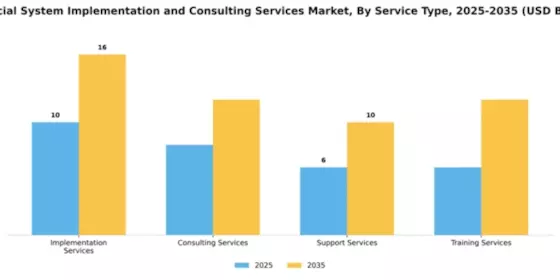
In the Financial System Implementation and Consulting Services Market, the service type segment is delineated into four primary categories: Implementation Services, Consulting Services, Support Services, and Training Services. Among these, Implementation Services hold the largest market share, underscoring their significance in facilitating system integration for clients. Consulting Services maintain a robust presence as well, complementing implementation by offering strategic insights to enhance system utilization. Support and Training Services are also vital, ensuring operational effectiveness post-implementation, although they command a smaller share of the overall market.
Implementation Services (Dominant) vs. Training Services (Emerging)
Implementation Services are a dominant force in the Financial System Implementation and Consulting Services Market, characterized by their critical role in overseeing software deployment, customization, and initial setup of financial systems. As organizations increasingly prioritize technology-driven financial solutions, Implementation Services remain a key focus. Conversely, Training Services are emerging as a rapidly growing segment, gaining importance as companies recognize the need for proficient staff to maximize the value of newly implemented systems. This growth is fueled by the shift towards remote and hybrid working environments, which necessitate tailored training programs to enhance user competency and system engagement.
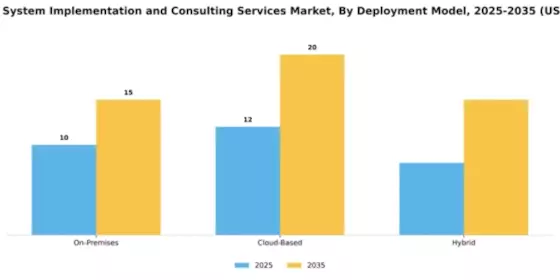
In the Financial System Implementation and Consulting Services Market, cloud-based deployment models hold the largest market share, driven by businesses' increasing preference for flexibility and scalability. Organizations are migrating from traditional on-premises solutions to cloud-based systems, recognizing the operational efficiencies and cost savings they offer. Meanwhile, while on-premises systems still have a significant user base, they are currently the fastest-growing segment as many companies look to establish more secure, localized systems amidst increasing data privacy concerns.
Cloud-Based (Dominant) vs. On-Premises (Emerging)
Cloud-based deployment models are characterized by their flexibility, scalability, and remote accessibility, making them the dominant choice in the Financial System Implementation and Consulting Services Market. Organizations benefit from lower upfront costs and reduced IT maintenance needs. In contrast, on-premises systems are experiencing an emerging resurgence, driven by enterprises seeking greater control over their data and compliance with strict regulatory requirements. Despite being traditionally seen as less adaptable, on-premises solutions are evolving with improved integration capabilities, appealing to businesses that prioritize data sovereignty.
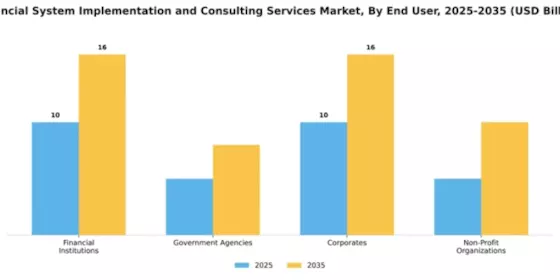
Within the Financial System Implementation and Consulting Services Market, Financial Institutions command the largest share, primarily driven by their continual need for modernized systems to stay competitive and compliant with regulatory standards. This segment includes banks, credit unions, and investment firms that heavily invest in advanced financial technologies to enhance service delivery and operational efficiency. Corporates, on the other hand, constitute the fastest-growing segment, reflecting a shift as companies increasingly recognize the importance of integrated financial systems. With the expansion of digital transformation initiatives, corporates are pursuing sophisticated solutions to manage finances better and optimize their operations, making them a key player in the market's evolution.
Financial Institutions: Banks (Dominant) vs. Corporates (Emerging)
Banks represent the dominant force in the Financial System Implementation and Consulting Services Market. Their established infrastructure and financial heft enable them to adopt cutting-edge technologies with relative ease, solidifying their position as leading clients for consulting services. Conversely, Corporates are emerging as a significant market force. As more businesses transition to automated and integrated financial solutions, the urgency for robust financial systems has surged. Corporate clients often require customized solutions tailored to their unique operational demands, signifying a tremendous growth potential in a landscape that is rapidly shifting towards personalized financial technology.
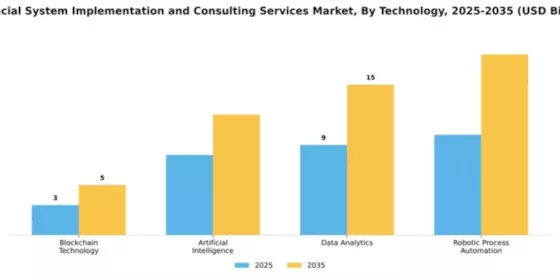
In the Financial System Implementation and Consulting Services Market, Artificial Intelligence (AI) emerges as the dominant technology, commanding a significant share of market activity. AI's capacity to enhance decision-making processes, streamline operations, and reduce costs places it at the forefront, capturing the attention of financial institutions aiming to innovate. Conversely, Blockchain Technology, while currently trailing in overall market share, is recognized as the fastest-growing segment due to its unique ability to ensure security, transparency, and efficiency in transactions. This technology is reshaping payment systems and contract executions through decentralized ledgers, attracting increasing investment and interest. The growth trends for these technologies reflect substantial shifts in the financial landscape, driven primarily by the need for enhanced security and efficiency. As AI continues developing predictive analytics and machine learning models, it engages effectively with vast datasets, improving financial services and customer interactions. Meanwhile, Blockchain's growth is fueled by the rising demand for secure transactions amid escalating cyber threats. This combination of growth drivers is set to propel further innovations in the financial sector, making technology a vital component of strategic planning for financial consultants and institutions alike.
Artificial Intelligence (Dominant) vs. Data Analytics (Emerging)
Artificial Intelligence (AI) plays a pivotal role in the Financial System Implementation and Consulting Services Market, serving as the dominant technology for enhancing operational efficiency and decision-making in financial institutions. Its applications encompass predictive analytics, risk management, and personalized banking solutions, enabling firms to harness large volumes of data to derive actionable insights. In contrast, Data Analytics is seen as an emerging technology, complementing AI by enabling organizations to analyze historical and real-time data to recognize patterns and trends. While AI drives automation and advanced analytics, Data Analytics supports informed decision-making processes. As these technologies converge, financial consulting services benefit significantly, fostering innovation and competitive advantage in a rapidly evolving market.
Get more detailed insights about Financial System Implementation and Consulting Services Market Request Free Sample
North America continues to lead the Financial System Implementation and Consulting Services Market, holding a significant market share of 15.0 in 2024. The region's growth is driven by increasing demand for digital transformation, regulatory compliance, and advanced analytics. Companies are investing heavily in technology to enhance operational efficiency and customer experience, supported by favorable government policies that encourage innovation and investment in financial technologies. The competitive landscape is robust, with key players like Deloitte, PwC, and KPMG dominating the market. The U.S. remains the largest contributor, benefiting from a strong economy and a high concentration of financial institutions. The presence of major firms such as IBM and Accenture further solidifies the region's position, making it a hub for financial consulting services.
Europe's Financial System Implementation and Consulting Services Market is poised for growth, with a market size of 8.0 in 2024. The region is experiencing a surge in demand for compliance with stringent regulations and the adoption of innovative financial technologies. Factors such as the European Union's initiatives to enhance digital finance and sustainability are driving this growth, creating opportunities for consulting services that align with regulatory requirements. Leading countries like Germany, France, and the UK are at the forefront, with a competitive landscape featuring firms like Capgemini and SAP. The presence of established players and a growing number of startups contribute to a dynamic market environment. As organizations seek to modernize their financial systems, the demand for consulting services is expected to rise significantly, positioning Europe as a key player in the global market.
The Asia-Pacific region is witnessing rapid growth in the Financial System Implementation and Consulting Services Market, with a market size of 5.0 in 2024. This growth is fueled by increasing investments in technology, rising consumer demand for digital banking, and government initiatives aimed at enhancing financial inclusion. Countries like India and China are leading the charge, supported by favorable regulatory environments that encourage innovation and investment in financial technologies. The competitive landscape is evolving, with key players such as Tata Consultancy Services and Oracle making significant inroads. The region's diverse market presents both challenges and opportunities, as firms adapt to varying regulatory frameworks and consumer preferences. As the demand for consulting services continues to rise, Asia-Pacific is set to become a major player in the global financial consulting landscape.
The Middle East and Africa region is gradually emerging in the Financial System Implementation and Consulting Services Market, with a market size of 2.0 in 2024. The growth is driven by increasing investments in financial technologies and a growing emphasis on regulatory compliance. Governments are actively promoting digital transformation initiatives, which are expected to enhance the efficiency of financial services and attract foreign investment. Countries like South Africa and the UAE are leading the way, with a competitive landscape that includes both local and international players. The presence of firms like EY and Accenture highlights the region's potential for growth. As businesses seek to modernize their financial systems, the demand for consulting services is anticipated to rise, making this region an attractive market for investment.
The Financial System Implementation and Consulting Services Market is currently characterized by a dynamic competitive landscape, driven by the increasing demand for digital transformation and enhanced financial management solutions. Major players such as Deloitte (US), PwC (US), and Accenture (IE) are strategically positioning themselves through innovation and partnerships, which appear to be pivotal in shaping the market's trajectory. Deloitte (US) emphasizes its focus on integrating advanced analytics and AI into financial systems, while PwC (US) is enhancing its consulting services through strategic alliances with technology firms. Accenture (IE) is also investing heavily in cloud-based solutions, indicating a collective shift towards digitalization that is likely to redefine competitive dynamics in the sector.The market structure is moderately fragmented, with a mix of large multinational corporations and specialized firms. Key players are employing various business tactics, such as localizing services to meet regional demands and optimizing supply chains to enhance efficiency. This competitive structure allows for a diverse range of offerings, which collectively influences market dynamics and fosters innovation among competitors.In November KPMG (US) announced a strategic partnership with a leading fintech company to enhance its financial consulting capabilities. This collaboration is expected to leverage cutting-edge technology to streamline financial processes for clients, thereby positioning KPMG (US) as a frontrunner in providing innovative solutions. The strategic importance of this partnership lies in its potential to attract a broader client base seeking advanced financial management tools.In October IBM (US) launched a new suite of AI-driven financial management tools aimed at small to medium-sized enterprises (SMEs). This initiative reflects IBM's commitment to democratizing access to sophisticated financial solutions, which could significantly enhance operational efficiency for SMEs. The introduction of these tools is likely to strengthen IBM's market position by catering to an underserved segment, thus expanding its reach in the financial consulting landscape.In September Capgemini (FR) expanded its operations in Asia by acquiring a local consulting firm specializing in financial systems. This acquisition is anticipated to bolster Capgemini's presence in the rapidly growing Asian market, allowing it to offer tailored solutions that meet regional needs. The strategic move underscores Capgemini's focus on regional expansion and its commitment to enhancing service delivery in diverse markets.As of December the competitive trends in the Financial System Implementation and Consulting Services Market are increasingly defined by digitalization, sustainability, and AI integration. Strategic alliances are becoming more prevalent, as companies recognize the need to collaborate to enhance their service offerings. Looking ahead, competitive differentiation is likely to evolve from traditional price-based competition to a focus on innovation, technology integration, and supply chain reliability. This shift suggests that companies that prioritize these aspects will be better positioned to thrive in an increasingly complex market.






The Financial System Implementation and Consulting Services Market is projected to grow at a 4.75% CAGR from 2025 to 2035, driven by technological advancements and increasing regulatory compliance demands.
New opportunities lie in:
By 2035, the market is expected to be robust, reflecting sustained growth and innovation.
| MARKET SIZE 2024 | 30.0(USD Billion) |
| MARKET SIZE 2025 | 31.43(USD Billion) |
| MARKET SIZE 2035 | 50.0(USD Billion) |
| COMPOUND ANNUAL GROWTH RATE (CAGR) | 4.75% (2025 - 2035) |
| REPORT COVERAGE | Revenue Forecast, Competitive Landscape, Growth Factors, and Trends |
| BASE YEAR | 2024 |
| Market Forecast Period | 2025 - 2035 |
| Historical Data | 2019 - 2024 |
| Market Forecast Units | USD Billion |
| Key Companies Profiled | Deloitte (US), PwC (US), KPMG (US), EY (US), Accenture (IE), IBM (US), Capgemini (FR), Oracle (US), SAP (DE), Tata Consultancy Services (IN) |
| Segments Covered | Service Type, Deployment Model, End User, Technology |
| Key Market Opportunities | Integration of advanced analytics and artificial intelligence in Financial System Implementation and Consulting Services Market. |
| Key Market Dynamics | Rising demand for digital transformation drives competition in financial system implementation and consulting services. |
| Countries Covered | North America, Europe, APAC, South America, MEA |
The market valuation reached 30.0 USD Billion in 2024.
The market is expected to grow to 50.0 USD Billion by 2035.
The market is projected to experience a CAGR of 4.75% from 2025 to 2035.
Key players include Deloitte, PwC, KPMG, EY, Accenture, IBM, Capgemini, Oracle, SAP, and Tata Consultancy Services.
The main service types include Implementation Services, Consulting Services, Support Services, and Training Services.
Implementation Services generated between 10.0 and 16.0 USD Billion.
Cloud-Based deployment is projected to generate between 12.0 and 20.0 USD Billion.
Financial Institutions and Corporates both show a revenue potential ranging from 10.0 to 16.0 USD Billion.
Technologies such as Artificial Intelligence, Data Analytics, and Robotic Process Automation are driving growth, with revenues projected between 8.0 and 18.0 USD Billion.
The market's growth outlook appears positive, with a projected increase in valuation and a steady CAGR of 4.75% from 2025 to 2035.


Kindly complete the form below to receive a free sample of this Report

“This is really good guys. Excellent work on a tight deadline. I will continue to use you going forward and recommend you to others. Nice job”


“Thanks. It’s been a pleasure working with you, please use me as reference with any other Intel employees.”


“Thanks for sending the report it gives us a good global view of the Betaïne market.”


“Thank you, this will be very helpful for OQS.”


“We found the report very insightful! we found your research firm very helpful. I'm sending this email to secure our future business.”


“I am very pleased with how market segments have been defined in a relevant way for my purposes (such as "Portable Freezers & refrigerators" and "last-mile"). In general the report is well structured. Thanks very much for your efforts.”


“I have been reading the first document or the study, ,the Global HVAC and FP market report 2021 till 2026. Must say, good info! I have not gone in depth at all parts, but got a good indication of the data inside!”


“We got the report in time, we really thank you for your support in this process. I also thank to all of your team as they did a great job.”


“The Automotive 48V ECU Components Procurement Intelligence Study” was a complex project, but the Market Research Future (MRFR) team handled it with quality, agility, and customer-centricity. They delivered all requested data on time and within the agreed scope. The team, including Shubhendra Anand and Rahul Gotadki, was always readily available to clarify questions and swiftly implement necessary adjustments, driving the project to a successful conclusion within a very demanding timeframe.
I would also like to specifically commend Akshay Agarwal for his responsiveness and support at every stage—from our initial inquiry on May 6th through to final delivery on June 18th. His dedication made the entire process seamless.”



