Fire Fighting Chemical Market
Fire Fighting Chemical Market Summary
As per Market Research Future analysis, the Fire Fighting Chemical Market Size was estimated at 10.27 USD Billion in 2024. The Fire Fighting Chemical industry is projected to grow from USD 10.7 Billion in 2025 to USD 16.07 Billion by 2035, exhibiting a compound annual growth rate (CAGR) of 4.15% during the forecast period 2025 - 2035
Key Market Trends & Highlights
The Fire Fighting Chemical Market is experiencing a transformative shift towards sustainable and technologically advanced solutions.
- The market is witnessing a notable shift towards eco-friendly fire suppression solutions, driven by increasing environmental awareness.
- Technological advancements in fire suppression systems are enhancing efficiency and effectiveness, particularly in the foam segment.
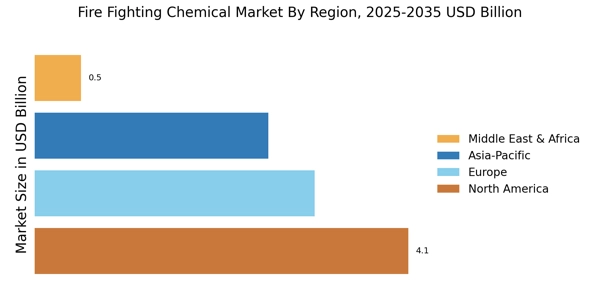
- North America remains the largest market, while the Asia-Pacific region is emerging as the fastest-growing area for fire fighting chemicals.
- Rising incidences of wildfires and urbanization are key drivers propelling investment in fire safety equipment, especially in the industrial segment.
Market Size & Forecast
| 2024 Market Size | 10.27 (USD Billion) |
| 2035 Market Size | 16.07 (USD Billion) |
| CAGR (2025 - 2035) | 4.15% |
Major Players
Tyco Fire Products (US), Kidde (US), 3M (US), Bristol Fire Engineering (GB), National Foam (US), Fireaway (US), Chemguard (US), Buckeye Fire Equipment (US), Fomtec (SE)
Fire Fighting Chemical Market Trends
The Fire Fighting Chemical Market is currently experiencing a dynamic evolution, driven by various factors including technological advancements and increasing awareness regarding fire safety. The demand for innovative fire suppression solutions is on the rise, as industries seek to enhance their safety protocols and comply with stringent regulations. This market encompasses a wide range of products, including foam agents, dry chemicals, and water additives, each designed to combat different types of fires effectively. As environmental concerns gain prominence, there is a noticeable shift towards eco-friendly alternatives, which may reshape product offerings in the near future. Moreover, the Fire Fighting Chemical Market is influenced by the growing industrial sector and urbanization trends. As cities expand and industries proliferate, the need for reliable fire protection systems becomes paramount. This has led to increased investments in fire safety infrastructure, thereby boosting the demand for fire fighting chemicals. Additionally, the market is likely to witness collaborations between manufacturers and regulatory bodies to ensure compliance with safety standards. Overall, the Fire Fighting Chemical Market appears poised for growth, with a focus on sustainability and innovation shaping its future landscape.
Shift Towards Eco-Friendly Solutions
There is a growing trend within the Fire Fighting Chemical Market towards the development and adoption of environmentally friendly fire suppression agents. This shift is largely driven by increasing regulatory pressures and consumer demand for sustainable products. Manufacturers are exploring biodegradable and non-toxic alternatives to traditional chemicals, which may reduce environmental impact while maintaining effectiveness.
Technological Advancements in Fire Suppression
The Fire Fighting Chemical Market is witnessing significant technological innovations aimed at enhancing fire suppression capabilities. Advanced formulations and delivery systems are being developed to improve the efficiency and effectiveness of fire fighting chemicals. These innovations may include smart technologies that allow for real-time monitoring and response, potentially revolutionizing fire safety practices.
Increased Focus on Compliance and Safety Standards
As fire safety regulations become more stringent, there is an increasing emphasis on compliance within the Fire Fighting Chemical Market. Companies are investing in research and development to ensure their products meet evolving safety standards. This trend may lead to enhanced product offerings and greater consumer confidence in fire fighting solutions.
Fire Fighting Chemical Market Drivers
Rising Incidence of Wildfires
The increasing frequency of wildfires, particularly in regions prone to dry conditions, appears to be a major driver for the Fire Fighting Chemical Market. Data indicates that the number of wildfires has surged, leading to heightened demand for effective fire suppression chemicals. In 2023, the economic impact of wildfires was estimated to exceed billions in damages, prompting governments and organizations to invest in advanced firefighting solutions. This trend suggests that the Fire Fighting Chemical Market will continue to expand as stakeholders seek to mitigate the risks associated with wildfires, thereby enhancing the need for innovative chemical formulations that can effectively combat such blazes.
Regulatory Compliance and Safety Standards
The increasing stringency of regulatory compliance and safety standards is a significant driver for the Fire Fighting Chemical Market. Governments and regulatory bodies are implementing stricter guidelines for fire safety, compelling industries to adopt compliant fire fighting chemicals. In 2023, compliance-related expenditures in the fire safety sector were estimated to rise by 8%, reflecting the urgency for organizations to align with these regulations. This trend indicates that the Fire Fighting Chemical Market will likely experience growth as companies seek to ensure compliance while enhancing their fire safety measures.
Urbanization and Infrastructure Development
Rapid urbanization and ongoing infrastructure development are likely to contribute significantly to the Fire Fighting Chemical Market. As cities expand, the complexity of fire risks increases, necessitating advanced firefighting solutions. The construction of high-rise buildings and industrial facilities has been linked to a rise in fire incidents, which in turn drives the demand for specialized fire fighting chemicals. In 2023, the construction sector's growth was projected at 5%, further indicating a potential increase in the need for effective fire suppression systems. This evolving landscape suggests that the Fire Fighting Chemical Market must adapt to meet the challenges posed by urban environments.
Increased Investment in Fire Safety Equipment
The growing emphasis on fire safety across various sectors is a crucial driver for the Fire Fighting Chemical Market. Organizations are increasingly investing in fire safety equipment and training, which includes the procurement of advanced fire fighting chemicals. In 2023, the fire safety equipment market was valued at approximately 10 billion, with a significant portion allocated to chemical agents. This trend indicates a proactive approach to fire prevention and response, suggesting that the Fire Fighting Chemical Market will benefit from heightened awareness and regulatory requirements surrounding fire safety protocols.
Technological Innovations in Fire Suppression
Technological advancements in fire suppression techniques are reshaping the Fire Fighting Chemical Market. Innovations such as the development of new chemical agents and delivery systems are enhancing the effectiveness of firefighting efforts. For instance, the introduction of environmentally friendly fire retardants has gained traction, reflecting a shift towards sustainable solutions. In 2023, the market for these innovative products was projected to grow by 7%, indicating a robust interest in cutting-edge fire fighting chemicals. This evolution suggests that the Fire Fighting Chemical Market must remain agile to incorporate these advancements and meet the demands of modern firefighting.
Market Segment Insights
By Type: Foam (Largest) vs. Dry Chemicals (Fastest-Growing)
The Fire Fighting Chemical Market shows a diverse range of types, with Foam being the largest segment due to its effectiveness in various fire incidents, particularly in aviation and industrial applications. This segment has been gaining preference for its versatility in extinguishing flammable liquid fires, contributing significantly to its market dominance. Conversely, Dry Chemicals are emerging rapidly, with substantial growth fueled by their widespread use in a range of commercial and residential fire extinguishers, making them a preferred choice for quick suppression in critical situations.
Foam (Dominant) vs. Carbon Dioxide (Emerging)
Foam fire fighting chemicals dominate the market due to their ability to create a barrier between the fuel and the oxygen, making them highly effective for tackling flammable liquid fires. They are widely used across various industries, including aviation, manufacturing, and transportation, where fire risks are considerable. In contrast, Carbon Dioxide is emerging as a noteworthy alternative, especially in enclosed spaces such as server rooms and kitchens. While Foam offers extensive coverage and fire suppression capabilities, Carbon Dioxide is favored for its clean extinguishing properties, leaving no residue and being non-conductive, which adds to its appeal in sensitive environments.
By Application: Industrial (Largest) vs. Residential (Fastest-Growing)
In the Fire Fighting Chemical Market, the application segment is divided into Industrial, Commercial, Residential, and Transportation. Among these, the Industrial segment holds the largest market share due to the extensive use of fire-fighting chemicals in manufacturing and processing facilities. In contrast, the Residential segment is witnessing significant growth as more homeowners prioritize safety and investing in advanced fire prevention systems due to increasing awareness and regulatory requirements.
Residential (Emerging) vs. Industrial (Dominant)
The Residential application of fire fighting chemicals is emerging as a pivotal segment, driven by rising safety standards and a growing focus on fire prevention in homes. This segment includes a wide array of products tailored for household use, such as fire extinguishers and fire retardants. On the other hand, the Industrial application remains dominant, characterized by larger-scale usage in factories, warehouses, and construction sites. This segment benefits from established regulations mandating the use of fire safety measures, ensuring a continuous demand for fire fighting chemicals in industries.
By End-use Industry: Oil and Gas (Largest) vs. Power Generation (Fastest-Growing)
The Fire Fighting Chemical Market exhibits a diverse distribution across various end-use industries, with the Oil and Gas sector holding the largest market share. This dominance is attributed to the high incidence of fire hazards in this industry, necessitating robust fire safety measures and advanced firefighting solutions. Following closely, the Power Generation sector also accounts for a significant share, driven by the increasing demand for energy and the regulatory framework that mandates safety protocols to prevent fire-related incidents. As we look towards the future, the market is expected to experience robust growth, particularly in the Power Generation sector, which is emerging as the fastest-growing. The rise in renewable energy projects and grid expansion initiatives are pivotal drivers, leading to higher demand for fire fighting chemicals. Additionally, the growing awareness of safety and environmental regulations across all sectors further accelerates the adoption of specialized fire protection solutions, emphasizing the need for innovative firefighting chemicals.
Oil and Gas: Dominant vs. Power Generation: Emerging
The Oil and Gas sector is a dominant player in the Fire Fighting Chemical Market due to the inherent risks associated with drilling, extraction, and transportation processes, which are susceptible to fires and explosions. This has necessitated the development and application of specialized fire fighting chemicals to ensure safety and compliance with stringent regulations. In contrast, the Power Generation sector is an emerging segment, characterized by rapid growth thanks to the increase in renewable energy sources and advancements in technology. The sector’s focus on enhancing safety standards in plants and facilities fosters the demand for advanced firefighting solutions, establishing a significant shift towards innovative fire fighting chemical formulations that adhere to both performance and environmental considerations.
By Distribution Channel: Direct Sales (Largest) vs. Distributor (Fastest-Growing)
In the Fire Fighting Chemical Market, distribution channels play a pivotal role in shaping accessibility and customer reach. Direct Sales holds the largest share, effectively providing manufacturers with a direct line to customers, ensuring rapid service and tailored solutions. Distributors, on the other hand, contribute significantly to the market by optimizing logistics and extending reach, thereby gaining a substantial stake. Examining growth trends, the Distributors segment is marked as the fastest-growing, driven by rising demand for efficient supply chains and localized services. E-commerce has emerged as a prominent platform, catering to on-demand purchasing behavior, while traditional Retailers face pressure to adapt in a digitized market. The synergy between these channels is crucial for market stability and growth.
Direct Sales (Dominant) vs. E-commerce (Emerging)
In the Fire Fighting Chemical Market, Direct Sales stands as the dominant channel due to its ability to deliver unparalleled customer engagement and service customization. This model allows manufacturers to maintain direct control over product distribution, ensuring clients receive timely solutions tailored to their specific needs. Conversely, E-commerce has emerged as a burgeoning channel, leveraging technology to reach broader audiences and streamline purchasing processes. As consumers increasingly shift towards online solutions, the E-commerce segment is rapidly evolving, presenting numerous opportunities for market players. Its growth is supported by enhanced digital marketing strategies and improved user experiences, positioning E-commerce as a significant player in the future landscape of the Fire Fighting Chemical Market sector.
Regional Insights
North America : Market Leader in Innovation
North America is the largest market for fire fighting chemicals, holding approximately 40% of the global share. The region's growth is driven by stringent safety regulations, increasing industrialization, and a rising number of fire incidents. The demand for advanced fire suppression systems is also on the rise, fueled by technological innovations and government initiatives promoting safety standards. The United States is the leading country in this market, with key players like Tyco Fire Products, Kidde, and 3M dominating the landscape. The competitive environment is characterized by continuous product development and strategic partnerships. Canada also plays a significant role, contributing to the market with its own set of regulations and safety standards, further enhancing the regional market dynamics.
Europe : Regulatory Framework Driving Growth
Europe is witnessing significant growth in the fire fighting chemical market, holding around 30% of the global share. The region's growth is propelled by stringent EU regulations on fire safety and environmental standards, which mandate the use of effective fire suppression agents. Additionally, the increasing focus on safety in both residential and commercial sectors is driving demand for innovative fire fighting solutions. Leading countries in this region include Germany, the UK, and France, where companies like Bristol Fire Engineering and Fomtec are making substantial contributions. The competitive landscape is marked by a mix of established players and emerging startups, all striving to meet the evolving regulatory requirements and customer expectations. This dynamic environment fosters innovation and enhances market growth.
Asia-Pacific : Rapid Growth in Emerging Markets
Asia-Pacific is rapidly emerging as a significant player in the fire fighting chemical market, accounting for approximately 25% of the global share. The region's growth is driven by urbanization, industrial expansion, and increasing awareness of fire safety. Countries like China and India are witnessing a surge in demand for fire fighting chemicals due to their growing infrastructure and industrial sectors, supported by government initiatives promoting safety standards. China is the largest market in this region, with a competitive landscape featuring both local and international players. Companies are focusing on product innovation and compliance with local regulations to capture market share. The presence of key players like Chemguard and Buckeye Fire Equipment further enhances the competitive dynamics, making Asia-Pacific a focal point for future growth in fire safety solutions.
Middle East and Africa : Emerging Market Potential
The Middle East and Africa region is gradually emerging in the fire fighting chemical market, holding about 5% of the global share. The growth is primarily driven by increasing industrial activities, urbanization, and a rising awareness of fire safety regulations. Countries like the UAE and South Africa are leading the way, with governments implementing stricter safety standards to mitigate fire risks in various sectors. In this region, the competitive landscape is characterized by a mix of local and international players, with companies focusing on tailored solutions to meet specific regional needs. The presence of key players is growing, and partnerships with local firms are becoming common to enhance market penetration. This evolving landscape presents significant opportunities for growth in fire safety solutions across the region.
Key Players and Competitive Insights
Key Companies in the Fire Fighting Chemical Market include
Industry Developments
The fire fighting chemical market is anticipated to reach USD 13.66 billion by 2032, exhibiting a CAGR of 4.15% during the forecast period (2024-2032). Rising incidences of fire accidents, coupled with increasing industrialization and urbanization, are primarily driving market growth. Governments worldwide are implementing stringent regulations to enhance fire safety, further augmenting demand for fire fighting chemicals. Technological advancements, such as the development of eco-friendly and effective extinguishing agents, are also contributing to market expansion. Key industry participants are focusing on strategic collaborations, acquisitions, and product innovations to gain a competitive edge.
Notable recent developments include the acquisition of Tyco Fire Protection Products by Johnson Controls in 2020 and the launch of 3M's Novec 1230 Fire Protection Fluid in 2021.
Future Outlook
Fire Fighting Chemical Market Future Outlook
The Fire Fighting Chemical Market is projected to grow at a 4.15% CAGR from 2025 to 2035, driven by technological advancements, regulatory changes, and increasing fire safety awareness.
New opportunities lie in:
- Development of eco-friendly fire retardants for commercial use.
- Integration of IoT in fire suppression systems for real-time monitoring.
- Expansion of training programs for effective chemical application in firefighting.

By 2035, the market is expected to be robust, reflecting increased investment and innovation.
Market Segmentation
Fire Fighting Chemical Market Type Outlook
- Wet Chemicals
- Dry Chemicals
- Carbon Dioxide
- Foam
- Water Mist
Fire Fighting Chemical Market Application Outlook
- Industrial
- Commercial
- Residential
- Transportation
Fire Fighting Chemical Market End-use Industry Outlook
- Oil and Gas
- Power Generation
- Automotive
- Aerospace
- Chemical Processing
Fire Fighting Chemical Market Distribution Channel Outlook
- Direct Sales
- Distributors
- Retailers
- E-commerce
Report Scope
| MARKET SIZE 2024 | 10.27(USD Billion) |
| MARKET SIZE 2025 | 10.7(USD Billion) |
| MARKET SIZE 2035 | 16.07(USD Billion) |
| COMPOUND ANNUAL GROWTH RATE (CAGR) | 4.15% (2025 - 2035) |
| REPORT COVERAGE | Revenue Forecast, Competitive Landscape, Growth Factors, and Trends |
| BASE YEAR | 2024 |
| Market Forecast Period | 2025 - 2035 |
| Historical Data | 2019 - 2024 |
| Market Forecast Units | USD Billion |
| Key Companies Profiled | Tyco Fire Products (US), Kidde (US), 3M (US), Bristol Fire Engineering (GB), National Foam (US), Fireaway (US), Chemguard (US), Buckeye Fire Equipment (US), Fomtec (SE) |
| Segments Covered | Type, Application, End-use Industry, Distribution Channel, Regional |
| Key Market Opportunities | Integration of eco-friendly agents in the Fire Fighting Chemical Market enhances sustainability and regulatory compliance. |
| Key Market Dynamics | Rising demand for eco-friendly fire fighting chemicals drives innovation and regulatory compliance in the market. |
| Countries Covered | North America, Europe, APAC, South America, MEA |
FAQs
What is the current valuation of the Fire Fighting Chemical Market as of 2024?
The Fire Fighting Chemical Market was valued at 10.27 USD Billion in 2024.
What is the projected market valuation for the Fire Fighting Chemical Market in 2035?
The market is projected to reach a valuation of 16.07 USD Billion by 2035.
What is the expected CAGR for the Fire Fighting Chemical Market during the forecast period 2025 - 2035?
The expected CAGR for the Fire Fighting Chemical Market during the forecast period 2025 - 2035 is 4.15%.
Which segment of fire fighting chemicals had the highest valuation in 2024?
In 2024, the Foam segment had the highest valuation at 3.09 USD Billion.
What is the projected valuation for the Dry Chemicals segment by 2035?
The Dry Chemicals segment is projected to reach a valuation of 3.25 USD Billion by 2035.
Which application segment is expected to grow the most by 2035?
The Transportation application segment is expected to grow significantly, reaching 6.57 USD Billion by 2035.
What is the valuation of the Chemical Processing end-use industry segment in 2024?
The Chemical Processing end-use industry segment was valued at 3.27 USD Billion in 2024.
How does the distribution channel of E-commerce compare in valuation from 2024 to 2035?
The E-commerce distribution channel is expected to grow from 2.56 USD Billion in 2024 to 4.39 USD Billion by 2035.
Who are the key players in the Fire Fighting Chemical Market?
Key players in the market include Tyco Fire Products, Kidde, 3M, and Bristol Fire Engineering, among others.
What is the projected growth for the Industrial application segment by 2035?
Kindly complete the form below to receive a free sample of this Report
Customer Stories
“This is really good guys. Excellent work on a tight deadline. I will continue to use you going forward and recommend you to others. Nice job”
“Thanks. It’s been a pleasure working with you, please use me as reference with any other Intel employees.”
“Thanks for sending the report it gives us a good global view of the Betaïne market.”
“Thank you, this will be very helpful for OQS.”
“We found the report very insightful! we found your research firm very helpful. I'm sending this email to secure our future business.”
“I am very pleased with how market segments have been defined in a relevant way for my purposes (such as "Portable Freezers & refrigerators" and "last-mile"). In general the report is well structured. Thanks very much for your efforts.”
“I have been reading the first document or the study, ,the Global HVAC and FP market report 2021 till 2026. Must say, good info! I have not gone in depth at all parts, but got a good indication of the data inside!”
“We got the report in time, we really thank you for your support in this process. I also thank to all of your team as they did a great job.”