Firefighting and Rescue Equipment Market Size, Share and Trends Analysis Research Report Information By End Use (Municipal, Industrial, Wildland, Military), By Technology (Water-Based, Foam-Based, Dry Chemical, Gas-Based), By Application (Fire Suppression, Rescue, Fire Prevention, EMS), By Product Type (Extinguishers, Hoses, Trucks, PPE), By Distribution Channel (Direct, Online, Retail, Wholesale), And By Region – Market Forecast Till 2035.
Forecast Period
2025 - 2035
CAGR
3.78%
2024 Market Size
$ 10.5 Billion
2035 Market Size
$ 15.8 Billion
MRO● Updated April 7, 2026Report ID: MRFR/MRO/64978-HCR|Pages: 200|Author: Shubham Munde
Firefighting and Rescue Equipment Market Summary
As per MRFR analysis, the Firefighting and Rescue Equipment Market was estimated at 10.5 USD Billion in 2024. The firefighting and rescue equipment industry is projected to grow from 10.9 USD Billion in 2025 to 15.8 USD Billion by 2035, exhibiting a compound annual growth rate (CAGR) of 3.78% during the forecast period 2025 - 2035.
Key Market Trends & Highlights
The Firefighting and Rescue Equipment Market is poised for substantial growth driven by technological advancements and increasing safety regulations.
North America remains the largest market for firefighting and rescue equipment, reflecting a robust demand for advanced fire suppression technologies.
The Asia-Pacific region is emerging as the fastest-growing market, fueled by rapid urbanization and infrastructure development.
Fire suppression equipment continues to dominate the market, while rescue operations are witnessing the fastest growth due to heightened emergency response needs.
Key market drivers include technological advancements in firefighting equipment and increased investment in emergency services, enhancing overall safety and efficiency.
Market Size & Forecast
2024 Market Size
10.5 (USD Billion)
2035 Market Size
15.8 (USD Billion)
CAGR (2025 - 2035)
3.78%
Major Players
Tyco International (US), Honeywell International (US), 3M (US), E-ONE (US), Draegerwerk AG (DE), MSA Safety (US), Elkhart Brass (US), Fire Equipment Manufacturing (US), Ziamatic Corp (US), Cleveland Fire Equipment (US)
Our Impact
Enabled $4.3B Revenue Impact for Fortune 500 and Leading Multinationals
Partnering with 2000+ Global Organizations Each Year
30K+ Citations by Top-Tier Firms in the Industry
Firefighting and Rescue Equipment Market Trends
The Firefighting and Rescue Equipment Market is currently experiencing a transformative phase, driven by advancements in technology and an increasing emphasis on safety protocols. Innovations in materials and design are enhancing the efficiency and effectiveness of firefighting gear, while the integration of smart technologies is revolutionizing operational capabilities. This evolution is not merely a response to existing challenges but also a proactive approach to future-proofing firefighting operations. As environmental concerns gain prominence, the market is witnessing a shift towards sustainable practices, with manufacturers exploring eco-friendly materials and energy-efficient solutions. Moreover, the growing frequency of natural disasters and urbanization is amplifying the demand for robust firefighting and rescue solutions. Governments and organizations are investing in modernizing their fleets and equipment to ensure preparedness for emergencies. This trend indicates a broader recognition of the critical role that advanced firefighting tools play in safeguarding lives and property. As the landscape evolves, collaboration between public and private sectors is likely to foster innovation and enhance the overall effectiveness of firefighting strategies.
Technological Advancements
The Firefighting and Rescue Equipment Market is witnessing a surge in technological innovations, particularly in the development of smart firefighting gear. These advancements include the integration of sensors and communication devices that enhance situational awareness and improve response times during emergencies.
Sustainability Initiatives
There is a growing trend towards sustainability within the Firefighting and Rescue Equipment Market. Manufacturers are increasingly focusing on eco-friendly materials and energy-efficient technologies, reflecting a commitment to reducing environmental impact while maintaining high performance.
Increased Investment in Infrastructure
The demand for modern firefighting and rescue equipment is prompting significant investments in infrastructure. Governments and organizations are prioritizing the acquisition of advanced tools and vehicles to bolster their emergency response capabilities, ensuring readiness for various scenarios.
Firefighting and Rescue Equipment Market Drivers
Increased Investment in Emergency Services
The Firefighting and Rescue Equipment Market is witnessing increased investment in emergency services, driven by the rising frequency of natural disasters and urbanization. Governments and private sectors are allocating more resources to enhance firefighting capabilities, which includes upgrading equipment and training personnel. For instance, recent data indicates that funding for fire departments has increased by over 10% in several regions, reflecting a commitment to improving public safety. This influx of capital allows for the procurement of advanced firefighting tools and technologies, ultimately leading to more effective emergency response. As investments continue to rise, the market is poised for substantial growth, ensuring that firefighting services are adequately equipped to handle emerging challenges.
Sustainability Initiatives in Firefighting
Sustainability initiatives are gaining traction within the Firefighting and Rescue Equipment Market, as organizations increasingly prioritize environmentally friendly practices. The shift towards sustainable materials and energy-efficient equipment is becoming a focal point for manufacturers. For example, the use of biodegradable fire retardants and recyclable materials in equipment production is on the rise. This trend not only reduces the environmental impact but also aligns with broader global efforts to combat climate change. As a result, companies that embrace sustainability are likely to gain a competitive edge, appealing to environmentally conscious consumers and organizations. The market for sustainable firefighting equipment is expected to expand, reflecting a growing commitment to eco-friendly practices.
Growing Awareness of Fire Safety Regulations
The Firefighting and Rescue Equipment Market is significantly influenced by the growing awareness of fire safety regulations across various sectors. As industries and municipalities become more cognizant of the risks associated with fire hazards, compliance with safety standards is increasingly prioritized. This heightened awareness drives demand for advanced firefighting equipment that meets regulatory requirements. For example, the implementation of stricter building codes and fire safety regulations has led to a surge in the adoption of fire suppression systems and personal protective equipment. Consequently, manufacturers are responding by innovating and enhancing their product offerings to align with these regulations. This trend is likely to sustain market growth as organizations strive to ensure safety and compliance.
Rising Urbanization and Infrastructure Development
The Firefighting and Rescue Equipment Market is being propelled by rising urbanization and infrastructure development. As urban areas expand, the complexity of firefighting operations increases, necessitating advanced equipment and strategies. The construction of high-rise buildings and densely populated areas presents unique challenges for fire safety, prompting a demand for specialized firefighting tools. Recent statistics suggest that urban areas are projected to grow by over 60% in the next two decades, which will likely lead to an increased need for effective firefighting solutions. Consequently, manufacturers are focusing on developing equipment tailored to urban environments, such as high-pressure hoses and aerial ladders. This trend indicates a robust growth trajectory for the market as urbanization continues to shape the landscape of firefighting.
Technological Advancements in Firefighting Equipment
The Firefighting and Rescue Equipment Market is experiencing a notable transformation due to rapid technological advancements. Innovations such as drones for aerial surveillance, thermal imaging cameras, and automated firefighting systems are becoming increasingly prevalent. These technologies enhance situational awareness and improve response times during emergencies. For instance, the integration of IoT devices allows for real-time monitoring of equipment status, which is crucial for effective firefighting operations. Furthermore, the market is projected to grow at a compound annual growth rate of approximately 5.5% over the next few years, driven by these advancements. As fire departments adopt more sophisticated tools, the overall efficiency and effectiveness of firefighting efforts are likely to improve significantly.
Market Segment Insights
By Application: Fire Suppression (Largest) vs. Rescue Operations (Fastest-Growing)
The Firefighting and Rescue Equipment Market is primarily segmented into Fire Suppression, Rescue Operations, Fire Prevention, and Emergency Medical Services. Fire Suppression remains the largest segment, driven by the continuous need for advanced firefighting technologies and equipment. In contrast, Rescue Operations is witnessing rapid growth, attributed to increased incidences of emergencies requiring specialized rescue gear and training, as well as an emphasis on quicker response times in crisis situations.
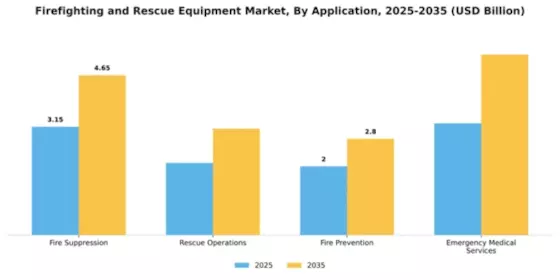
Fire Suppression (Dominant) vs. Rescue Operations (Emerging)
Fire Suppression is the dominant application within the Firefighting and Rescue Equipment Market, recognized for its critical role in controlling and extinguishing fires through various methods and technologies. This segment encompasses a wide range of equipment, including fire extinguishers, foam systems, and sprinkler systems, which are essential for effective firefighting strategies. On the other hand, Rescue Operations, which includes equipment and tools designed for saving lives during emergencies such as natural disasters and accidents, is an emerging segment with significant growth potential. This growth is fueled by innovations in personal protective equipment (PPE) and the rising demand for training and preparedness programs, thereby enhancing operational efficiency during rescue missions.
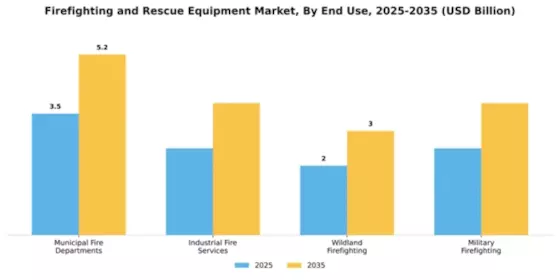
By End Use: Municipal Fire Departments (Largest) vs. Industrial Fire Services (Fastest-Growing)
The firefighting and rescue equipment market is significantly influenced by the various end-use applications, notably Municipal Fire Departments and Industrial Fire Services. Municipal Fire Departments account for a substantial share of the market, driven by consistent government funding and infrastructure expenditures. In contrast, Industrial Fire Services represent a growing segment, as industries increasingly emphasize safety measures and compliance, leading to higher demand for advanced firefighting equipment.
Municipal Fire Departments (Dominant) vs. Industrial Fire Services (Emerging)
Municipal Fire Departments are the cornerstone of urban firefighting efforts, equipped with a wide range of firefighting technologies and trained personnel. Their established nature makes them the dominant force in the market, benefiting from continuous investments in equipment and training. On the other hand, Industrial Fire Services, emerging as a crucial segment, respond to specific industry challenges, including compliance with regulatory standards and safety protocols. They are rapidly adopting innovative firefighting technologies, thus contributing to an accelerating growth trend in response to the increasing number of industrial facilities needing specialized equipment.
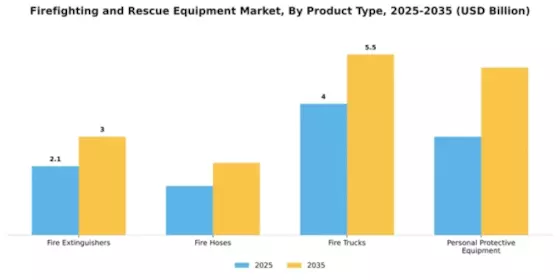
By Product Type: Fire Trucks (Largest) vs. Fire Extinguishers (Fastest-Growing)
The Firefighting and Rescue Equipment Market is predominantly driven by the fire trucks segment, which holds the largest market share due to the necessity for larger-scale firefighting operations and municipal fire departments. In contrast, fire extinguishers have emerged as the fastest-growing segment, driven by increasing awareness of fire safety in both residential and commercial sectors. This market shift is largely influenced by regulatory changes and an emphasis on personal safety measures, contributing to robust growth in fire extinguisher sales.
Fire Trucks (Dominant) vs. Fire Extinguishers (Emerging)
The fire trucks segment remains the dominant force in the market, characterized by heavy investments from governmental and corporate entities to enhance public safety. Fire trucks are essential for managing large scale fires, equipped with advanced technology for rapid response and maneuverability. On the other hand, fire extinguishers represent an emerging segment, gaining momentum owing to rising consumer awareness and stringent fire safety regulations. These portable devices are becoming increasingly sophisticated, offering features such as smart technology for user alerts, thus making them vital in homes and businesses. This evolving landscape highlights the divergent yet complementary roles of these two product types in enhancing overall fire safety.
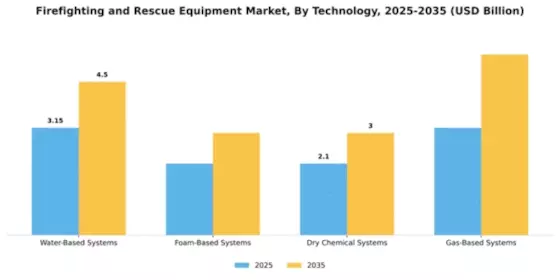
By Technology: Water-Based Systems (Largest) vs. Foam-Based Systems (Fastest-Growing)
In the Firefighting and Rescue Equipment Market, the water-based systems segment constitutes the largest share, significantly influencing overall market dynamics. This segment's prominence is driven by its widespread application and the reliability it offers in diverse firefighting scenarios. Foam-based systems are emerging rapidly, capturing attention for their efficiency in certain fire types, especially in industrial and aviation firefighting, thus contributing to a dynamic segment landscape.
Technology: Water-Based Systems (Dominant) vs. Foam-Based Systems (Emerging)
Water-based systems have established themselves as the dominant technology in firefighting due to their versatility and effectiveness against common fires. These systems include traditional hoses, sprinklers, and water tanks, which are essential in structural firefighting operations. In contrast, foam-based systems are emerging as a vital alternative, particularly in specialized environments like chemical plants and airports where flammable liquids pose significant risks. The growing recognition of foam's capabilities in suppressing flammable liquid fires is spurring innovation and adoption, positioning foam systems as a key player in contemporary firefighting strategies.
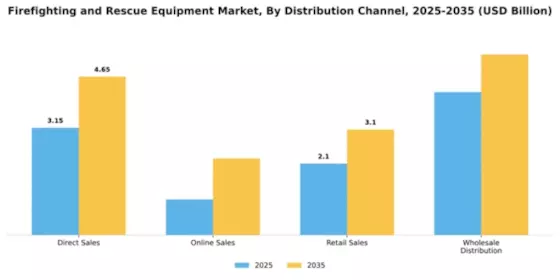
By Distribution Channel: Direct Sales (Largest) vs. Online Sales (Fastest-Growing)
In the Firefighting and Rescue Equipment Market, the distribution channels reflect diverse purchasing preferences among customers. Direct Sales currently dominate the market, leveraging established relationships with industry professionals and organizations that require reliability and immediate access to equipment. Online Sales, although smaller in comparison, are gaining rapid traction by appealing to a broader audience and offering convenience for purchasing firefighting equipment from the comfort of home.
Direct Sales (Dominant) vs. Online Sales (Emerging)
Direct Sales in the Firefighting and Rescue Equipment Market signifies a stronghold, as many institutions prefer face-to-face transactions for essential life-saving equipment. This segment benefits from trust and established rapport with clients, ensuring customer loyalty and repeat orders. Conversely, Online Sales are quickly emerging as a significant channel among consumers looking for competitive pricing and a wider selection. The growing emphasis on digital transformation within industries facilitates this growth, as buyers seek online platforms for their purchasing needs, enhancing accessibility and convenience.
Get more detailed insights about Firefighting and Rescue Equipment MarketRequest Free Sample
Regional Insights
North America : Market Leader in Fire Safety
North America continues to lead the Firefighting and Rescue Equipment Market, holding a significant market share of 5.25 in 2024. The growth is driven by stringent safety regulations, increased funding for fire departments, and advancements in technology. The demand for innovative firefighting solutions is on the rise, particularly in urban areas where fire risks are higher. Regulatory bodies are emphasizing the need for modern equipment to enhance safety and efficiency. The competitive landscape in North America is robust, featuring key players such as Tyco International, Honeywell International, and MSA Safety. The U.S. is the largest market, with states investing heavily in firefighting infrastructure. The presence of established manufacturers and a focus on R&D for advanced firefighting technologies further solidify the region's market position. The ongoing trend towards smart firefighting solutions is expected to drive future growth.
Europe : Emerging Market with Growth Potential
Europe's Firefighting and Rescue Equipment Market is valued at 3.0, reflecting a growing emphasis on safety regulations and environmental sustainability. The region is witnessing increased investments in firefighting technologies, driven by government initiatives aimed at enhancing public safety. The European Union's regulations on fire safety equipment are catalyzing demand, as countries strive to meet compliance standards and improve emergency response capabilities. Leading countries in this market include Germany, France, and the UK, where major players like Draegerwerk AG and 3M are prominent. The competitive landscape is characterized by a mix of established firms and innovative startups focusing on eco-friendly solutions. The market is expected to expand as governments prioritize funding for fire safety initiatives, ensuring a steady demand for advanced firefighting equipment.
Asia-Pacific : Rapidly Growing Market Segment
The Asia-Pacific region, with a market size of 2.5, is rapidly emerging in the Firefighting and Rescue Equipment Market. The growth is fueled by urbanization, increasing industrial activities, and heightened awareness of fire safety. Governments are investing in modern firefighting technologies to address the rising incidents of fire-related emergencies. Regulatory frameworks are evolving to support the adoption of advanced equipment, enhancing overall safety standards in the region. Countries like China, India, and Japan are leading the charge, with significant contributions from local manufacturers and international players. The competitive landscape is becoming increasingly dynamic, with companies focusing on innovation and cost-effective solutions. The presence of key players such as Honeywell and 3M further strengthens the market, as they introduce cutting-edge technologies tailored to regional needs.
Middle East and Africa : Emerging Market with Challenges
The Middle East and Africa region, with a market size of 0.75, is gradually developing in the Firefighting and Rescue Equipment Market. The growth is primarily driven by increasing urbanization and infrastructure development, particularly in the Gulf Cooperation Council (GCC) countries. Governments are recognizing the need for advanced firefighting solutions to protect investments in infrastructure and ensure public safety. Regulatory frameworks are being established to enhance fire safety standards across the region. Leading countries include the UAE and South Africa, where investments in firefighting equipment are on the rise. The competitive landscape is characterized by a mix of local and international players, with companies focusing on tailored solutions for specific regional challenges. The presence of key players is growing, but the market still faces challenges related to funding and regulatory compliance, which could impact future growth.
Key Players and Competitive Insights
The Firefighting and Rescue Equipment Market is characterized by a dynamic competitive landscape, driven by technological advancements, regulatory changes, and an increasing emphasis on safety and efficiency. Key players such as Tyco International (US), Honeywell International (US), and Draegerwerk AG (DE) are at the forefront, each adopting distinct strategies to enhance their market positioning. Tyco International (US) focuses on innovation in firefighting technologies, particularly in smart firefighting systems that integrate IoT capabilities. Meanwhile, Honeywell International (US) emphasizes digital transformation, leveraging data analytics to improve operational efficiency and safety in firefighting operations. Draegerwerk AG (DE) is noted for its commitment to sustainability, developing eco-friendly firefighting equipment that aligns with global environmental standards. Collectively, these strategies contribute to a competitive environment that prioritizes innovation and responsiveness to market demands.The market structure appears moderately fragmented, with numerous players vying for market share. Key business tactics include localizing manufacturing to reduce costs and optimize supply chains, which is particularly relevant in the context of rising material costs and logistical challenges. The influence of major players is significant, as they not only set industry standards but also drive technological advancements that smaller companies may struggle to match.In November Tyco International (US) announced the launch of a new line of smart firefighting drones designed to enhance situational awareness during emergencies. This strategic move is likely to position Tyco as a leader in integrating advanced technology into firefighting operations, potentially reducing response times and improving safety outcomes. The introduction of such innovative solutions may reshape operational protocols within the industry.In October Honeywell International (US) unveiled a partnership with a leading software firm to develop AI-driven analytics tools for fire departments. This collaboration aims to enhance predictive maintenance and resource allocation, which could lead to more efficient firefighting strategies. The strategic importance of this partnership lies in its potential to revolutionize how fire departments manage their resources, ultimately improving response times and operational effectiveness.In September Draegerwerk AG (DE) launched a new range of environmentally friendly firefighting foams that comply with stringent EU regulations. This initiative not only underscores Draegerwerk's commitment to sustainability but also positions the company favorably in a market increasingly focused on eco-conscious solutions. The strategic importance of this launch is evident as it aligns with global trends towards sustainability, potentially attracting environmentally aware customers.As of December current competitive trends in the Firefighting and Rescue Equipment Market are heavily influenced by digitalization, sustainability, and the integration of AI technologies. Strategic alliances are becoming increasingly vital, as companies seek to leverage complementary strengths to enhance their offerings. The competitive differentiation is likely to evolve from traditional price-based competition towards a focus on innovation, technological advancements, and supply chain reliability. This shift suggests that companies that prioritize R&D and sustainable practices may gain a competitive edge in the future.

Key Companies in the Firefighting and Rescue Equipment Market include
Future Outlook
Firefighting and Rescue Equipment Market Future Outlook
The Firefighting and Rescue Equipment Market is projected to grow at a 3.78% CAGR from 2025 to 2035, driven by technological advancements, increasing safety regulations, and rising demand for efficient emergency response solutions.
New opportunities lie in:
Integration of IoT for real-time monitoring and data analytics Development of eco-friendly firefighting agents Expansion of training simulators for enhanced firefighter preparedness
By 2035, the market is expected to be robust, driven by innovation and increased investment in safety technologies.
Market Segmentation
firefighting-and-rescue-equipment-market End Use Outlook
Municipal Fire Departments
Industrial Fire Services
Wildland Firefighting
Military Firefighting
firefighting-and-rescue-equipment-market Technology Outlook
Water-Based Systems
Foam-Based Systems
Dry Chemical Systems
Gas-Based Systems
firefighting-and-rescue-equipment-market Application Outlook
Fire Suppression
Rescue Operations
Fire Prevention
Emergency Medical Services
firefighting-and-rescue-equipment-market Product Type Outlook
Fire Extinguishers
Fire Hoses
Fire Trucks
Personal Protective Equipment
firefighting-and-rescue-equipment-market Distribution Channel Outlook
Direct Sales
Online Sales
Retail Sales
Wholesale Distribution
Report Scope
MARKET SIZE 2024
10.5(USD Billion)
MARKET SIZE 2025
10.9(USD Billion)
MARKET SIZE 2035
15.8(USD Billion)
COMPOUND ANNUAL GROWTH RATE (CAGR)
3.78% (2025 - 2035)
REPORT COVERAGE
Revenue Forecast, Competitive Landscape, Growth Factors, and Trends
BASE YEAR
2024
Market Forecast Period
2025 - 2035
Historical Data
2019 - 2024
Market Forecast Units
USD Billion
Key Companies Profiled
Tyco International (US), Honeywell International (US), 3M (US), E-ONE (US), Draegerwerk AG (DE), MSA Safety (US), Elkhart Brass (US), Fire Equipment Manufacturing (US), Ziamatic Corp (US), Cleveland Fire Equipment (US)
Segments Covered
Application, End Use, Product Type, Technology, Distribution Channel
Key Market Opportunities
Integration of advanced technology in firefighting and rescue equipment enhances operational efficiency and safety.
Key Market Dynamics
Technological advancements and regulatory changes drive innovation and competition in the firefighting and rescue equipment market.
Countries Covered
North America, Europe, APAC, South America, MEA
Table of Contents
SECTION I: EXECUTIVE SUMMARY AND KEY HIGHLIGHTS |
1.1 EXECUTIVE SUMMARY | |
1.1.1 Market Overview | |
1.1.2 Key Findings | |
1.1.3 Market Segmentation | |
1.1.4 Competitive Landscape | |
1.1.5 Challenges and Opportunities | |
1.1.6 Future Outlook 2
SECTION II: SCOPING, METHODOLOGY AND MARKET STRUCTURE |
2.1 MARKET INTRODUCTION | |
2.1.1 Definition | |
2.1.2 Scope of the study | | |
2.1.2.1 Research Objective | | |
2.1.2.2 Assumption | | |
2.1.2.3 Limitations |
2.2 RESEARCH METHODOLOGY | |
2.2.1 Overview | |
2.2.2 Data Mining | |
2.2.3 Secondary Research | |
2.2.4 Primary Research | | |
2.2.4.1 Primary Interviews and Information Gathering Process | | |
2.2.4.2 Breakdown of Primary Respondents | |
2.2.5 Forecasting Model | |
2.2.6 Market Size Estimation | | |
2.2.6.1 Bottom-Up Approach | | |
2.2.6.2 Top-Down Approach | |
2.2.7 Data Triangulation | |
2.2.8 Validation 3
SECTION III: QUALITATIVE ANALYSIS |
3.1 MARKET DYNAMICS | |
3.1.1 Overview | |
3.1.2 Drivers | |
3.1.3 Restraints | |
3.1.4 Opportunities |
3.2 MARKET FACTOR ANALYSIS | |
3.2.1 Value chain Analysis | |
3.2.2 Porter's Five Forces Analysis | | |
3.2.2.1 Bargaining Power of Suppliers | | |
3.2.2.2 Bargaining Power of Buyers | | |
3.2.2.3 Threat of New Entrants | | |
3.2.2.4 Threat of Substitutes | | |
3.2.2.5 Intensity of Rivalry | |
3.2.3 COVID-19 Impact Analysis | | |
3.2.3.1 Market Impact Analysis | | |
3.2.3.2 Regional Impact | | |
3.2.3.3 Opportunity and Threat Analysis 4
SECTION IV: QUANTITATIVE ANALYSIS |
4.1 Medical Device, BY Application (USD Billion) | |
4.1.1 Fire Suppression | |
4.1.2 Rescue Operations | |
4.1.3 Fire Prevention | |
4.1.4 Emergency Medical Services |
4.2 Medical Device, BY End Use (USD Billion) | |
4.2.1 Municipal Fire Departments | |
4.2.2 Industrial Fire Services | |
4.2.3 Wildland Firefighting | |
4.2.4 Military Firefighting |
4.3 Medical Device, BY Product Type (USD Billion) | |
4.3.1 Fire Extinguishers | |
4.3.2 Fire Hoses | |
4.3.3 Fire Trucks | |
4.3.4 Personal Protective Equipment |
4.4 Medical Device, BY Technology (USD Billion) | |
4.4.1 Water-Based Systems | |
4.4.2 Foam-Based Systems | |
4.4.3 Dry Chemical Systems | |
4.4.4 Gas-Based Systems |
4.5 Medical Device, BY Distribution Channel (USD Billion) | |
4.5.1 Direct Sales | |
4.5.2 Online Sales | |
4.5.3 Retail Sales | |
4.5.4 Wholesale Distribution |
4.6 Medical Device, BY Region (USD Billion) | |
4.6.1 North America | | |
4.6.1.1 US | | |
4.6.1.2 Canada | |
4.6.2 Europe | | |
4.6.2.1 Germany | | |
4.6.2.2 UK | | |
4.6.2.3 France | | |
4.6.2.4 Russia | | |
4.6.2.5 Italy | | |
4.6.2.6 Spain | | |
4.6.2.7 Rest of Europe | |
4.6.3 APAC | | |
4.6.3.1 China | | |
4.6.3.2 India | | |
4.6.3.3 Japan | | |
4.6.3.4 South Korea | | |
4.6.3.5 Malaysia | | |
4.6.3.6 Thailand | | |
4.6.3.7 Indonesia | | |
4.6.3.8 Rest of APAC | |
4.6.4 South America | | |
4.6.4.1 Brazil | | |
4.6.4.2 Mexico | | |
4.6.4.3 Argentina | | |
4.6.4.4 Rest of South America | |
4.6.5 MEA | | |
4.6.5.1 GCC Countries | | |
4.6.5.2 South Africa | | |
4.6.5.3 Rest of MEA 5
SECTION V: COMPETITIVE ANALYSIS |
5.1 Competitive Landscape | |
5.1.1 Overview | |
5.1.2 Competitive Analysis | |
5.1.3 Market share Analysis | |
5.1.4 Major Growth Strategy in the Medical Device | |
5.1.5 Competitive Benchmarking | |
5.1.6 Leading Players in Terms of Number of Developments in the Medical Device | |
5.1.7 Key developments and growth strategies | | |
5.1.7.1 New Product Launch/Service Deployment | | |
5.1.7.2 Merger & Acquisitions | | |
5.1.7.3 Joint Ventures | |
5.1.8 Major Players Financial Matrix | | |
5.1.8.1 Sales and Operating Income | | |
5.1.8.2 Major Players R&D Expenditure. 2023 |
5.2 Company Profiles | |
5.2.1 Tyco International (US) | | |
5.2.1.1 Financial Overview | | |
5.2.1.2 Products Offered | | |
5.2.1.3 Key Developments | | |
5.2.1.4 SWOT Analysis | | |
5.2.1.5 Key Strategies | |
5.2.2 Honeywell International (US) | | |
5.2.2.1 Financial Overview | | |
5.2.2.2 Products Offered | | |
5.2.2.3 Key Developments | | |
5.2.2.4 SWOT Analysis | | |
5.2.2.5 Key Strategies | |
5.2.3 3M (US) | | |
5.2.3.1 Financial Overview | | |
5.2.3.2 Products Offered | | |
5.2.3.3 Key Developments | | |
5.2.3.4 SWOT Analysis | | |
5.2.3.5 Key Strategies | |
5.2.4 E-ONE (US) | | |
5.2.4.1 Financial Overview | | |
5.2.4.2 Products Offered | | |
5.2.4.3 Key Developments | | |
5.2.4.4 SWOT Analysis | | |
5.2.4.5 Key Strategies | |
5.2.5 Draegerwerk AG (DE) | | |
5.2.5.1 Financial Overview | | |
5.2.5.2 Products Offered | | |
5.2.5.3 Key Developments | | |
5.2.5.4 SWOT Analysis | | |
5.2.5.5 Key Strategies | |
5.2.6 MSA Safety (US) | | |
5.2.6.1 Financial Overview | | |
5.2.6.2 Products Offered | | |
5.2.6.3 Key Developments | | |
5.2.6.4 SWOT Analysis | | |
5.2.6.5 Key Strategies | |
5.2.7 Elkhart Brass (US) | | |
5.2.7.1 Financial Overview | | |
5.2.7.2 Products Offered | | |
5.2.7.3 Key Developments | | |
5.2.7.4 SWOT Analysis | | |
5.2.7.5 Key Strategies | |
5.2.8 Fire Equipment Manufacturing (US) | | |
5.2.8.1 Financial Overview | | |
5.2.8.2 Products Offered | | |
5.2.8.3 Key Developments | | |
5.2.8.4 SWOT Analysis | | |
5.2.8.5 Key Strategies | |
5.2.9 Ziamatic Corp (US) | | |
5.2.9.1 Financial Overview | | |
5.2.9.2 Products Offered | | |
5.2.9.3 Key Developments | | |
5.2.9.4 SWOT Analysis | | |
5.2.9.5 Key Strategies | |
5.2.10 Cleveland Fire Equipment (US) | | |
5.2.10.1 Financial Overview | | |
5.2.10.2 Products Offered | | |
5.2.10.3 Key Developments | | |
5.2.10.4 SWOT Analysis | | |
5.2.10.5 Key Strategies |
5.3 Appendix | |
5.3.1 References | |
5.3.2 Related Reports 6 LIST OF FIGURES |
6.1 MARKET SYNOPSIS |
6.2 NORTH AMERICA MARKET ANALYSIS |
6.3 US MARKET ANALYSIS BY APPLICATION |
6.4 US MARKET ANALYSIS BY END USE |
6.5 US MARKET ANALYSIS BY PRODUCT TYPE |
6.6 US MARKET ANALYSIS BY TECHNOLOGY |
6.7 US MARKET ANALYSIS BY DISTRIBUTION CHANNEL |
6.8 CANADA MARKET ANALYSIS BY APPLICATION |
6.9 CANADA MARKET ANALYSIS BY END USE |
6.10 CANADA MARKET ANALYSIS BY PRODUCT TYPE |
6.11 CANADA MARKET ANALYSIS BY TECHNOLOGY |
6.12 CANADA MARKET ANALYSIS BY DISTRIBUTION CHANNEL |
6.13 EUROPE MARKET ANALYSIS |
6.14 GERMANY MARKET ANALYSIS BY APPLICATION |
6.15 GERMANY MARKET ANALYSIS BY END USE |
6.16 GERMANY MARKET ANALYSIS BY PRODUCT TYPE |
6.17 GERMANY MARKET ANALYSIS BY TECHNOLOGY |
6.18 GERMANY MARKET ANALYSIS BY DISTRIBUTION CHANNEL |
6.19 UK MARKET ANALYSIS BY APPLICATION |
6.20 UK MARKET ANALYSIS BY END USE |
6.21 UK MARKET ANALYSIS BY PRODUCT TYPE |
6.22 UK MARKET ANALYSIS BY TECHNOLOGY |
6.23 UK MARKET ANALYSIS BY DISTRIBUTION CHANNEL |
6.24 FRANCE MARKET ANALYSIS BY APPLICATION |
6.25 FRANCE MARKET ANALYSIS BY END USE |
6.26 FRANCE MARKET ANALYSIS BY PRODUCT TYPE |
6.27 FRANCE MARKET ANALYSIS BY TECHNOLOGY |
6.28 FRANCE MARKET ANALYSIS BY DISTRIBUTION CHANNEL |
6.29 RUSSIA MARKET ANALYSIS BY APPLICATION |
6.30 RUSSIA MARKET ANALYSIS BY END USE |
6.31 RUSSIA MARKET ANALYSIS BY PRODUCT TYPE |
6.32 RUSSIA MARKET ANALYSIS BY TECHNOLOGY |
6.33 RUSSIA MARKET ANALYSIS BY DISTRIBUTION CHANNEL |
6.34 ITALY MARKET ANALYSIS BY APPLICATION |
6.35 ITALY MARKET ANALYSIS BY END USE |
6.36 ITALY MARKET ANALYSIS BY PRODUCT TYPE |
6.37 ITALY MARKET ANALYSIS BY TECHNOLOGY |
6.38 ITALY MARKET ANALYSIS BY DISTRIBUTION CHANNEL |
6.39 SPAIN MARKET ANALYSIS BY APPLICATION |
6.40 SPAIN MARKET ANALYSIS BY END USE |
6.41 SPAIN MARKET ANALYSIS BY PRODUCT TYPE |
6.42 SPAIN MARKET ANALYSIS BY TECHNOLOGY |
6.43 SPAIN MARKET ANALYSIS BY DISTRIBUTION CHANNEL |
6.44 REST OF EUROPE MARKET ANALYSIS BY APPLICATION |
6.45 REST OF EUROPE MARKET ANALYSIS BY END USE |
6.46 REST OF EUROPE MARKET ANALYSIS BY PRODUCT TYPE |
6.47 REST OF EUROPE MARKET ANALYSIS BY TECHNOLOGY |
6.48 REST OF EUROPE MARKET ANALYSIS BY DISTRIBUTION CHANNEL |
6.49 APAC MARKET ANALYSIS |
6.50 CHINA MARKET ANALYSIS BY APPLICATION |
6.51 CHINA MARKET ANALYSIS BY END USE |
6.52 CHINA MARKET ANALYSIS BY PRODUCT TYPE |
6.53 CHINA MARKET ANALYSIS BY TECHNOLOGY |
6.54 CHINA MARKET ANALYSIS BY DISTRIBUTION CHANNEL |
6.55 INDIA MARKET ANALYSIS BY APPLICATION |
6.56 INDIA MARKET ANALYSIS BY END USE |
6.57 INDIA MARKET ANALYSIS BY PRODUCT TYPE |
6.58 INDIA MARKET ANALYSIS BY TECHNOLOGY |
6.59 INDIA MARKET ANALYSIS BY DISTRIBUTION CHANNEL |
6.60 JAPAN MARKET ANALYSIS BY APPLICATION |
6.61 JAPAN MARKET ANALYSIS BY END USE |
6.62 JAPAN MARKET ANALYSIS BY PRODUCT TYPE |
6.63 JAPAN MARKET ANALYSIS BY TECHNOLOGY |
6.64 JAPAN MARKET ANALYSIS BY DISTRIBUTION CHANNEL |
6.65 SOUTH KOREA MARKET ANALYSIS BY APPLICATION |
6.66 SOUTH KOREA MARKET ANALYSIS BY END USE |
6.67 SOUTH KOREA MARKET ANALYSIS BY PRODUCT TYPE |
6.68 SOUTH KOREA MARKET ANALYSIS BY TECHNOLOGY |
6.69 SOUTH KOREA MARKET ANALYSIS BY DISTRIBUTION CHANNEL |
6.70 MALAYSIA MARKET ANALYSIS BY APPLICATION |
6.71 MALAYSIA MARKET ANALYSIS BY END USE |
6.72 MALAYSIA MARKET ANALYSIS BY PRODUCT TYPE |
6.73 MALAYSIA MARKET ANALYSIS BY TECHNOLOGY |
6.74 MALAYSIA MARKET ANALYSIS BY DISTRIBUTION CHANNEL |
6.75 THAILAND MARKET ANALYSIS BY APPLICATION |
6.76 THAILAND MARKET ANALYSIS BY END USE |
6.77 THAILAND MARKET ANALYSIS BY PRODUCT TYPE |
6.78 THAILAND MARKET ANALYSIS BY TECHNOLOGY |
6.79 THAILAND MARKET ANALYSIS BY DISTRIBUTION CHANNEL |
6.80 INDONESIA MARKET ANALYSIS BY APPLICATION |
6.81 INDONESIA MARKET ANALYSIS BY END USE |
6.82 INDONESIA MARKET ANALYSIS BY PRODUCT TYPE |
6.83 INDONESIA MARKET ANALYSIS BY TECHNOLOGY |
6.84 INDONESIA MARKET ANALYSIS BY DISTRIBUTION CHANNEL |
6.85 REST OF APAC MARKET ANALYSIS BY APPLICATION |
6.86 REST OF APAC MARKET ANALYSIS BY END USE |
6.87 REST OF APAC MARKET ANALYSIS BY PRODUCT TYPE |
6.88 REST OF APAC MARKET ANALYSIS BY TECHNOLOGY |
6.89 REST OF APAC MARKET ANALYSIS BY DISTRIBUTION CHANNEL |
6.90 SOUTH AMERICA MARKET ANALYSIS |
6.91 BRAZIL MARKET ANALYSIS BY APPLICATION |
6.92 BRAZIL MARKET ANALYSIS BY END USE |
6.93 BRAZIL MARKET ANALYSIS BY PRODUCT TYPE |
6.94 BRAZIL MARKET ANALYSIS BY TECHNOLOGY |
6.95 BRAZIL MARKET ANALYSIS BY DISTRIBUTION CHANNEL |
6.96 MEXICO MARKET ANALYSIS BY APPLICATION |
6.97 MEXICO MARKET ANALYSIS BY END USE |
6.98 MEXICO MARKET ANALYSIS BY PRODUCT TYPE |
6.99 MEXICO MARKET ANALYSIS BY TECHNOLOGY |
6.100 MEXICO MARKET ANALYSIS BY DISTRIBUTION CHANNEL |
6.101 ARGENTINA MARKET ANALYSIS BY APPLICATION |
6.102 ARGENTINA MARKET ANALYSIS BY END USE |
6.103 ARGENTINA MARKET ANALYSIS BY PRODUCT TYPE |
6.104 ARGENTINA MARKET ANALYSIS BY TECHNOLOGY |
6.105 ARGENTINA MARKET ANALYSIS BY DISTRIBUTION CHANNEL |
6.106 REST OF SOUTH AMERICA MARKET ANALYSIS BY APPLICATION |
6.107 REST OF SOUTH AMERICA MARKET ANALYSIS BY END USE |
6.108 REST OF SOUTH AMERICA MARKET ANALYSIS BY PRODUCT TYPE |
6.109 REST OF SOUTH AMERICA MARKET ANALYSIS BY TECHNOLOGY |
6.110 REST OF SOUTH AMERICA MARKET ANALYSIS BY DISTRIBUTION CHANNEL |
6.111 MEA MARKET ANALYSIS |
6.112 GCC COUNTRIES MARKET ANALYSIS BY APPLICATION |
6.113 GCC COUNTRIES MARKET ANALYSIS BY END USE |
6.114 GCC COUNTRIES MARKET ANALYSIS BY PRODUCT TYPE |
6.115 GCC COUNTRIES MARKET ANALYSIS BY TECHNOLOGY |
6.116 GCC COUNTRIES MARKET ANALYSIS BY DISTRIBUTION CHANNEL |
6.117 SOUTH AFRICA MARKET ANALYSIS BY APPLICATION |
6.118 SOUTH AFRICA MARKET ANALYSIS BY END USE |
6.119 SOUTH AFRICA MARKET ANALYSIS BY PRODUCT TYPE |
6.120 SOUTH AFRICA MARKET ANALYSIS BY TECHNOLOGY |
6.121 SOUTH AFRICA MARKET ANALYSIS BY DISTRIBUTION CHANNEL |
6.122 REST OF MEA MARKET ANALYSIS BY APPLICATION |
6.123 REST OF MEA MARKET ANALYSIS BY END USE |
6.124 REST OF MEA MARKET ANALYSIS BY PRODUCT TYPE |
6.125 REST OF MEA MARKET ANALYSIS BY TECHNOLOGY |
6.126 REST OF MEA MARKET ANALYSIS BY DISTRIBUTION CHANNEL |
6.127 KEY BUYING CRITERIA OF MEDICAL DEVICE |
6.128 RESEARCH PROCESS OF MRFR |
6.129 DRO ANALYSIS OF MEDICAL DEVICE |
6.130 DRIVERS IMPACT ANALYSIS: MEDICAL DEVICE |
6.131 RESTRAINTS IMPACT ANALYSIS: MEDICAL DEVICE |
6.132 SUPPLY / VALUE CHAIN: MEDICAL DEVICE |
6.133 MEDICAL DEVICE, BY APPLICATION, 2024 (% SHARE) |
6.134 MEDICAL DEVICE, BY APPLICATION, 2024 TO 2035 (USD Billion) |
6.135 MEDICAL DEVICE, BY END USE, 2024 (% SHARE) |
6.136 MEDICAL DEVICE, BY END USE, 2024 TO 2035 (USD Billion) |
6.137 MEDICAL DEVICE, BY PRODUCT TYPE, 2024 (% SHARE) |
6.138 MEDICAL DEVICE, BY PRODUCT TYPE, 2024 TO 2035 (USD Billion) |
6.139 MEDICAL DEVICE, BY TECHNOLOGY, 2024 (% SHARE) |
6.140 MEDICAL DEVICE, BY TECHNOLOGY, 2024 TO 2035 (USD Billion) |
6.141 MEDICAL DEVICE, BY DISTRIBUTION CHANNEL, 2024 (% SHARE) |
6.142 MEDICAL DEVICE, BY DISTRIBUTION CHANNEL, 2024 TO 2035 (USD Billion) |
6.143 BENCHMARKING OF MAJOR COMPETITORS 7 LIST OF TABLES |
7.1 LIST OF ASSUMPTIONS | |
7.1.1 |
7.2 North America MARKET SIZE ESTIMATES; FORECAST | |
7.2.1 BY APPLICATION, 2025-2035 (USD Billion) | |
7.2.2 BY END USE, 2025-2035 (USD Billion) | |
7.2.3 BY PRODUCT TYPE, 2025-2035 (USD Billion) | |
7.2.4 BY TECHNOLOGY, 2025-2035 (USD Billion) | |
7.2.5 BY DISTRIBUTION CHANNEL, 2025-2035 (USD Billion) |
7.3 US MARKET SIZE ESTIMATES; FORECAST | |
7.3.1 BY APPLICATION, 2025-2035 (USD Billion) | |
7.3.2 BY END USE, 2025-2035 (USD Billion) | |
7.3.3 BY PRODUCT TYPE, 2025-2035 (USD Billion) | |
7.3.4 BY TECHNOLOGY, 2025-2035 (USD Billion) | |
7.3.5 BY DISTRIBUTION CHANNEL, 2025-2035 (USD Billion) |
7.4 Canada MARKET SIZE ESTIMATES; FORECAST | |
7.4.1 BY APPLICATION, 2025-2035 (USD Billion) | |
7.4.2 BY END USE, 2025-2035 (USD Billion) | |
7.4.3 BY PRODUCT TYPE, 2025-2035 (USD Billion) | |
7.4.4 BY TECHNOLOGY, 2025-2035 (USD Billion) | |
7.4.5 BY DISTRIBUTION CHANNEL, 2025-2035 (USD Billion) |
7.5 Europe MARKET SIZE ESTIMATES; FORECAST | |
7.5.1 BY APPLICATION, 2025-2035 (USD Billion) | |
7.5.2 BY END USE, 2025-2035 (USD Billion) | |
7.5.3 BY PRODUCT TYPE, 2025-2035 (USD Billion) | |
7.5.4 BY TECHNOLOGY, 2025-2035 (USD Billion) | |
7.5.5 BY DISTRIBUTION CHANNEL, 2025-2035 (USD Billion) |
7.6 Germany MARKET SIZE ESTIMATES; FORECAST | |
7.6.1 BY APPLICATION, 2025-2035 (USD Billion) | |
7.6.2 BY END USE, 2025-2035 (USD Billion) | |
7.6.3 BY PRODUCT TYPE, 2025-2035 (USD Billion) | |
7.6.4 BY TECHNOLOGY, 2025-2035 (USD Billion) | |
7.6.5 BY DISTRIBUTION CHANNEL, 2025-2035 (USD Billion) |
7.7 UK MARKET SIZE ESTIMATES; FORECAST | |
7.7.1 BY APPLICATION, 2025-2035 (USD Billion) | |
7.7.2 BY END USE, 2025-2035 (USD Billion) | |
7.7.3 BY PRODUCT TYPE, 2025-2035 (USD Billion) | |
7.7.4 BY TECHNOLOGY, 2025-2035 (USD Billion) | |
7.7.5 BY DISTRIBUTION CHANNEL, 2025-2035 (USD Billion) |
7.8 France MARKET SIZE ESTIMATES; FORECAST | |
7.8.1 BY APPLICATION, 2025-2035 (USD Billion) | |
7.8.2 BY END USE, 2025-2035 (USD Billion) | |
7.8.3 BY PRODUCT TYPE, 2025-2035 (USD Billion) | |
7.8.4 BY TECHNOLOGY, 2025-2035 (USD Billion) | |
7.8.5 BY DISTRIBUTION CHANNEL, 2025-2035 (USD Billion) |
7.9 Russia MARKET SIZE ESTIMATES; FORECAST | |
7.9.1 BY APPLICATION, 2025-2035 (USD Billion) | |
7.9.2 BY END USE, 2025-2035 (USD Billion) | |
7.9.3 BY PRODUCT TYPE, 2025-2035 (USD Billion) | |
7.9.4 BY TECHNOLOGY, 2025-2035 (USD Billion) | |
7.9.5 BY DISTRIBUTION CHANNEL, 2025-2035 (USD Billion) |
7.10 Italy MARKET SIZE ESTIMATES; FORECAST | |
7.10.1 BY APPLICATION, 2025-2035 (USD Billion) | |
7.10.2 BY END USE, 2025-2035 (USD Billion) | |
7.10.3 BY PRODUCT TYPE, 2025-2035 (USD Billion) | |
7.10.4 BY TECHNOLOGY, 2025-2035 (USD Billion) | |
7.10.5 BY DISTRIBUTION CHANNEL, 2025-2035 (USD Billion) |
7.11 Spain MARKET SIZE ESTIMATES; FORECAST | |
7.11.1 BY APPLICATION, 2025-2035 (USD Billion) | |
7.11.2 BY END USE, 2025-2035 (USD Billion) | |
7.11.3 BY PRODUCT TYPE, 2025-2035 (USD Billion) | |
7.11.4 BY TECHNOLOGY, 2025-2035 (USD Billion) | |
7.11.5 BY DISTRIBUTION CHANNEL, 2025-2035 (USD Billion) |
7.12 Rest of Europe MARKET SIZE ESTIMATES; FORECAST | |
7.12.1 BY APPLICATION, 2025-2035 (USD Billion) | |
7.12.2 BY END USE, 2025-2035 (USD Billion) | |
7.12.3 BY PRODUCT TYPE, 2025-2035 (USD Billion) | |
7.12.4 BY TECHNOLOGY, 2025-2035 (USD Billion) | |
7.12.5 BY DISTRIBUTION CHANNEL, 2025-2035 (USD Billion) |
7.13 APAC MARKET SIZE ESTIMATES; FORECAST | |
7.13.1 BY APPLICATION, 2025-2035 (USD Billion) | |
7.13.2 BY END USE, 2025-2035 (USD Billion) | |
7.13.3 BY PRODUCT TYPE, 2025-2035 (USD Billion) | |
7.13.4 BY TECHNOLOGY, 2025-2035 (USD Billion) | |
7.13.5 BY DISTRIBUTION CHANNEL, 2025-2035 (USD Billion) |
7.14 China MARKET SIZE ESTIMATES; FORECAST | |
7.14.1 BY APPLICATION, 2025-2035 (USD Billion) | |
7.14.2 BY END USE, 2025-2035 (USD Billion) | |
7.14.3 BY PRODUCT TYPE, 2025-2035 (USD Billion) | |
7.14.4 BY TECHNOLOGY, 2025-2035 (USD Billion) | |
7.14.5 BY DISTRIBUTION CHANNEL, 2025-2035 (USD Billion) |
7.15 India MARKET SIZE ESTIMATES; FORECAST | |
7.15.1 BY APPLICATION, 2025-2035 (USD Billion) | |
7.15.2 BY END USE, 2025-2035 (USD Billion) | |
7.15.3 BY PRODUCT TYPE, 2025-2035 (USD Billion) | |
7.15.4 BY TECHNOLOGY, 2025-2035 (USD Billion) | |
7.15.5 BY DISTRIBUTION CHANNEL, 2025-2035 (USD Billion) |
7.16 Japan MARKET SIZE ESTIMATES; FORECAST | |
7.16.1 BY APPLICATION, 2025-2035 (USD Billion) | |
7.16.2 BY END USE, 2025-2035 (USD Billion) | |
7.16.3 BY PRODUCT TYPE, 2025-2035 (USD Billion) | |
7.16.4 BY TECHNOLOGY, 2025-2035 (USD Billion) | |
7.16.5 BY DISTRIBUTION CHANNEL, 2025-2035 (USD Billion) |
7.17 South Korea MARKET SIZE ESTIMATES; FORECAST | |
7.17.1 BY APPLICATION, 2025-2035 (USD Billion) | |
7.17.2 BY END USE, 2025-2035 (USD Billion) | |
7.17.3 BY PRODUCT TYPE, 2025-2035 (USD Billion) | |
7.17.4 BY TECHNOLOGY, 2025-2035 (USD Billion) | |
7.17.5 BY DISTRIBUTION CHANNEL, 2025-2035 (USD Billion) |
7.18 Malaysia MARKET SIZE ESTIMATES; FORECAST | |
7.18.1 BY APPLICATION, 2025-2035 (USD Billion) | |
7.18.2 BY END USE, 2025-2035 (USD Billion) | |
7.18.3 BY PRODUCT TYPE, 2025-2035 (USD Billion) | |
7.18.4 BY TECHNOLOGY, 2025-2035 (USD Billion) | |
7.18.5 BY DISTRIBUTION CHANNEL, 2025-2035 (USD Billion) |
7.19 Thailand MARKET SIZE ESTIMATES; FORECAST | |
7.19.1 BY APPLICATION, 2025-2035 (USD Billion) | |
7.19.2 BY END USE, 2025-2035 (USD Billion) | |
7.19.3 BY PRODUCT TYPE, 2025-2035 (USD Billion) | |
7.19.4 BY TECHNOLOGY, 2025-2035 (USD Billion) | |
7.19.5 BY DISTRIBUTION CHANNEL, 2025-2035 (USD Billion) |
7.20 Indonesia MARKET SIZE ESTIMATES; FORECAST | |
7.20.1 BY APPLICATION, 2025-2035 (USD Billion) | |
7.20.2 BY END USE, 2025-2035 (USD Billion) | |
7.20.3 BY PRODUCT TYPE, 2025-2035 (USD Billion) | |
7.20.4 BY TECHNOLOGY, 2025-2035 (USD Billion) | |
7.20.5 BY DISTRIBUTION CHANNEL, 2025-2035 (USD Billion) |
7.21 Rest of APAC MARKET SIZE ESTIMATES; FORECAST | |
7.21.1 BY APPLICATION, 2025-2035 (USD Billion) | |
7.21.2 BY END USE, 2025-2035 (USD Billion) | |
7.21.3 BY PRODUCT TYPE, 2025-2035 (USD Billion) | |
7.21.4 BY TECHNOLOGY, 2025-2035 (USD Billion) | |
7.21.5 BY DISTRIBUTION CHANNEL, 2025-2035 (USD Billion) |
7.22 South America MARKET SIZE ESTIMATES; FORECAST | |
7.22.1 BY APPLICATION, 2025-2035 (USD Billion) | |
7.22.2 BY END USE, 2025-2035 (USD Billion) | |
7.22.3 BY PRODUCT TYPE, 2025-2035 (USD Billion) | |
7.22.4 BY TECHNOLOGY, 2025-2035 (USD Billion) | |
7.22.5 BY DISTRIBUTION CHANNEL, 2025-2035 (USD Billion) |
7.23 Brazil MARKET SIZE ESTIMATES; FORECAST | |
7.23.1 BY APPLICATION, 2025-2035 (USD Billion) | |
7.23.2 BY END USE, 2025-2035 (USD Billion) | |
7.23.3 BY PRODUCT TYPE, 2025-2035 (USD Billion) | |
7.23.4 BY TECHNOLOGY, 2025-2035 (USD Billion) | |
7.23.5 BY DISTRIBUTION CHANNEL, 2025-2035 (USD Billion) |
7.24 Mexico MARKET SIZE ESTIMATES; FORECAST | |
7.24.1 BY APPLICATION, 2025-2035 (USD Billion) | |
7.24.2 BY END USE, 2025-2035 (USD Billion) | |
7.24.3 BY PRODUCT TYPE, 2025-2035 (USD Billion) | |
7.24.4 BY TECHNOLOGY, 2025-2035 (USD Billion) | |
7.24.5 BY DISTRIBUTION CHANNEL, 2025-2035 (USD Billion) |
7.25 Argentina MARKET SIZE ESTIMATES; FORECAST | |
7.25.1 BY APPLICATION, 2025-2035 (USD Billion) | |
7.25.2 BY END USE, 2025-2035 (USD Billion) | |
7.25.3 BY PRODUCT TYPE, 2025-2035 (USD Billion) | |
7.25.4 BY TECHNOLOGY, 2025-2035 (USD Billion) | |
7.25.5 BY DISTRIBUTION CHANNEL, 2025-2035 (USD Billion) |
7.26 Rest of South America MARKET SIZE ESTIMATES; FORECAST | |
7.26.1 BY APPLICATION, 2025-2035 (USD Billion) | |
7.26.2 BY END USE, 2025-2035 (USD Billion) | |
7.26.3 BY PRODUCT TYPE, 2025-2035 (USD Billion) | |
7.26.4 BY TECHNOLOGY, 2025-2035 (USD Billion) | |
7.26.5 BY DISTRIBUTION CHANNEL, 2025-2035 (USD Billion) |
7.27 MEA MARKET SIZE ESTIMATES; FORECAST | |
7.27.1 BY APPLICATION, 2025-2035 (USD Billion) | |
7.27.2 BY END USE, 2025-2035 (USD Billion) | |
7.27.3 BY PRODUCT TYPE, 2025-2035 (USD Billion) | |
7.27.4 BY TECHNOLOGY, 2025-2035 (USD Billion) | |
7.27.5 BY DISTRIBUTION CHANNEL, 2025-2035 (USD Billion) |
7.28 GCC Countries MARKET SIZE ESTIMATES; FORECAST | |
7.28.1 BY APPLICATION, 2025-2035 (USD Billion) | |
7.28.2 BY END USE, 2025-2035 (USD Billion) | |
7.28.3 BY PRODUCT TYPE, 2025-2035 (USD Billion) | |
7.28.4 BY TECHNOLOGY, 2025-2035 (USD Billion) | |
7.28.5 BY DISTRIBUTION CHANNEL, 2025-2035 (USD Billion) |
7.29 South Africa MARKET SIZE ESTIMATES; FORECAST | |
7.29.1 BY APPLICATION, 2025-2035 (USD Billion) | |
7.29.2 BY END USE, 2025-2035 (USD Billion) | |
7.29.3 BY PRODUCT TYPE, 2025-2035 (USD Billion) | |
7.29.4 BY TECHNOLOGY, 2025-2035 (USD Billion) | |
7.29.5 BY DISTRIBUTION CHANNEL, 2025-2035 (USD Billion) |
7.30 Rest of MEA MARKET SIZE ESTIMATES; FORECAST | |
7.30.1 BY APPLICATION, 2025-2035 (USD Billion) | |
7.30.2 BY END USE, 2025-2035 (USD Billion) | |
7.30.3 BY PRODUCT TYPE, 2025-2035 (USD Billion) | |
7.30.4 BY TECHNOLOGY, 2025-2035 (USD Billion) | |
7.30.5 BY DISTRIBUTION CHANNEL, 2025-2035 (USD Billion) |
What is the current valuation of the Firefighting and Rescue Equipment Market?
As of 2024, the market valuation stands at 10.5 USD Billion.
What is the projected market size for the Firefighting and Rescue Equipment Market by 2035?
The market is expected to reach a valuation of 15.8 USD Billion by 2035.
What is the expected CAGR for the Firefighting and Rescue Equipment Market during the forecast period 2025 - 2035?
The market is anticipated to grow at a CAGR of 3.78% from 2025 to 2035.
Which application segment is projected to have the highest growth in the Firefighting and Rescue Equipment Market?
Fire Suppression is projected to grow from 3.15 USD Billion in 2024 to 4.65 USD Billion by 2035.
What are the key product types in the Firefighting and Rescue Equipment Market?
Key product types include Fire Extinguishers, Fire Hoses, Fire Trucks, and Personal Protective Equipment.
Which distribution channel is expected to dominate the Firefighting and Rescue Equipment Market?
Wholesale Distribution is projected to grow from 4.2 USD Billion in 2024 to 5.3 USD Billion by 2035.
What is the expected growth for Emergency Medical Services within the market?
Emergency Medical Services is expected to increase from 3.25 USD Billion in 2024 to 5.25 USD Billion by 2035.
Who are the leading companies in the Firefighting and Rescue Equipment Market?
Key players include Tyco International, Honeywell International, 3M, and Draegerwerk AG.
What is the projected growth for the Industrial Fire Services segment?
Industrial Fire Services is expected to grow from 2.5 USD Billion in 2024 to 3.8 USD Billion by 2035.
How does the market for Fire Trucks compare to other product types?
Fire Trucks are projected to grow from 4.0 USD Billion in 2024 to 5.5 USD Billion by 2035, indicating strong demand.

Author
Author
Shubham Munde
Team Lead - Research
Shubham brings over 7 years of expertise in Market Intelligence and Strategic Consulting, with a strong focus on the Automotive, Aerospace, and Defense sectors. Backed by a solid foundation in semiconductors, electronics, and software, he has successfully delivered high-impact syndicated and custom research on a global scale. His core strengths include market sizing, forecasting, competitive intelligence, consumer insights, and supply chain mapping. Widely recognized for developing scalable growth strategies, Shubham empowers clients to navigate complex markets and achieve a lasting competitive edge. Trusted by start-ups and Fortune 500 companies alike, he consistently converts challenges into strategic opportunities that drive sustainable growth.
No country-specific reports available for this market.
Customer Stories
“This is really good guys. Excellent work on a tight deadline. I will continue to use you going forward and recommend you to others. Nice job”

Noah MalgeriCo-Founder
“Thanks. It’s been a pleasure working with you, please use me as reference with any other Intel employees.”
Joseph AguayoSales Operations & Pricing Manager
“Thanks for sending the report it gives us a good global view of the Betaïne market.”
Peter Groot koerkampAccount and Business Manager
“Thank you, this will be very helpful for OQS.”

La Terria DoddProgram Support Specialist
“We found the report very insightful! we found your research firm very helpful. I'm sending this email to secure our future business.”

Younghwan ChoiSenior Retail Manager
“I am very pleased with how market segments have been defined in a relevant way for my purposes (such as "Portable Freezers & refrigerators" and "last-mile").
In general the report is well structured. Thanks very much for your efforts.”

Mark IrwinManagement Consultant
“I have been reading the first document or the study, ,the Global HVAC and FP market report 2021 till 2026. Must say, good info! I have not gone in depth at all parts, but got a good indication of the data inside!”

Rob KooikerGroup Product Manager HVAC & Fire Protection GMA
“We got the report in time, we really thank you for your support in this process. I also thank to all of your team as they did a great job.”

Akif MorogluStrategy & Business Development Director
“The Automotive 48V ECU Components Procurement Intelligence Study” was a complex project, but the Market Research Future (MRFR) team handled it with quality, agility, and customer-centricity. They delivered all requested data on time and within the agreed scope. The team, including Shubhendra Anand and Rahul Gotadki, was always readily available to clarify questions and swiftly implement necessary adjustments, driving the project to a successful conclusion within a very demanding timeframe.
I would also like to specifically commend Akshay Agarwal for his responsiveness and support at every stage—from our initial inquiry on May 6th through to final delivery on June 18th. His dedication made the entire process seamless.”

Guilherme Gomes MartinsProduct Management Director