Download Free Sample
Kindly complete the form below to receive a free sample of this Report
Fleet Maintenance Services Market Research Report Information By End User (Transportation Companies, Logistics Providers, Government Agencies, Construction Firms), By Service Type (Preventive Maintenance, Corrective Maintenance, Predictive Maintenance, Fleet Management Software), By Vehicle Type (Light Duty Vehicles, Heavy Duty Vehicles, Commercial Vehicles, Passenger Vehicles), By Maintenance Approach (In-House Maintenance, Outsourced Maintenance, Mobile Maintenance, Fleet Maintenance Contracts) And By Region (North America, Europe, Asia-Pacific, And Rest Of The World) – Market Forecast Till 2035.
As per MRFR analysis, the Fleet Maintenance Services Market Size was estimated at 66.5 USD Billion in 2024. The Fleet Maintenance Services industry is projected to grow from 68.36 USD Billion in 2025 to 90.0 USD Billion by 2035, exhibiting a compound annual growth rate (CAGR) of 2.79% during the forecast period 2025 - 2035.
The Fleet Maintenance Services Market is experiencing a transformative shift towards advanced maintenance strategies and sustainability.
| 2024 Market Size | 66.5 (USD Billion) |
| 2035 Market Size | 90.0 (USD Billion) |
| CAGR (2025 - 2035) | 2.79% |
Fleetcor Technologies (US), Teletrac Navman (US), Element Fleet Management (CA), Wheels, Inc. (US), ARI Fleet Management (US), Donlen Corporation (US), Geotab Inc. (CA), Omnicare (US)
Our Impact
Enabled $4.3B Revenue Impact for Fortune 500 and Leading Multinationals
Partnering with 2000+ Global Organizations Each Year
30K+ Citations by Top-Tier Firms in the Industry
The Fleet Maintenance Services Market is currently experiencing a transformative phase, driven by advancements in technology and an increasing emphasis on operational efficiency. Companies are increasingly recognizing the value of proactive maintenance strategies, which not only enhance vehicle longevity but also reduce unexpected breakdowns. This shift towards predictive maintenance, facilitated by data analytics and IoT technologies, appears to be reshaping the landscape of fleet management. Furthermore, the growing focus on sustainability and environmental regulations is prompting organizations to adopt greener practices, thereby influencing service offerings within the market. In addition, the Fleet Maintenance Services Market is witnessing a rise in demand for integrated solutions that encompass a wide range of services, from routine inspections to complex repairs. This trend suggests that businesses are seeking comprehensive packages that streamline operations and minimize downtime. As the market evolves, the integration of artificial intelligence and machine learning into maintenance processes may further enhance decision-making capabilities, allowing for more tailored and efficient service delivery. Overall, the Fleet Maintenance Services Market is poised for continued growth, driven by innovation and a commitment to improving fleet performance.
The Fleet Maintenance Services Market is increasingly leaning towards predictive maintenance strategies. This approach utilizes data analytics and IoT technologies to anticipate potential issues before they escalate, thereby minimizing downtime and repair costs. Companies are investing in advanced diagnostic tools that enable real-time monitoring of vehicle conditions, which enhances overall fleet reliability.
Sustainability is becoming a central theme within the Fleet Maintenance Services Market. Organizations are adopting eco-friendly practices in response to regulatory pressures and consumer demand for greener solutions. This trend includes the use of alternative fuels, energy-efficient technologies, and waste reduction strategies, which collectively contribute to a more sustainable fleet operation.
There is a noticeable shift towards comprehensive service packages in the Fleet Maintenance Services Market. Businesses are increasingly seeking all-inclusive solutions that cover a wide array of maintenance needs, from routine checks to emergency repairs. This trend indicates a preference for streamlined operations, allowing companies to focus on core activities while ensuring their fleets remain in optimal condition.
Cost efficiency remains a pivotal driver in the Fleet Maintenance Services Market. Fleet operators are under constant pressure to minimize operational costs while maximizing vehicle uptime. This has led to a growing preference for outsourcing maintenance services to specialized providers who can offer economies of scale and expertise. Data suggests that companies that utilize fleet maintenance services can achieve a reduction in overall maintenance costs by approximately 20 percent. As businesses seek to optimize their budgets, the demand for cost-effective fleet maintenance solutions is expected to rise, further propelling market growth.
The Fleet Maintenance Services Market is witnessing an increase in fleet size and complexity, driven by the expansion of e-commerce and logistics sectors. As companies scale their operations, they require more vehicles, which in turn necessitates more comprehensive maintenance services. The growing complexity of modern fleets, which often include a mix of electric, hybrid, and traditional vehicles, adds to the demand for specialized maintenance solutions. This trend indicates a potential market expansion, as fleet operators seek reliable partners to manage their diverse maintenance needs effectively.
The Fleet Maintenance Services Market is significantly influenced by stringent regulatory compliance and safety standards imposed by various authorities. These regulations mandate regular inspections, maintenance, and reporting, compelling fleet operators to invest in reliable maintenance services. The increasing focus on safety and environmental regulations has led to a heightened demand for comprehensive fleet maintenance solutions. For instance, the implementation of the Electronic Logging Device (ELD) mandate has necessitated more rigorous maintenance practices. As a result, the market for fleet maintenance services is projected to expand, driven by the need for compliance and enhanced safety measures.
The Fleet Maintenance Services Market is experiencing a surge in technological advancements that enhance operational efficiency. Innovations such as telematics, IoT, and AI-driven analytics are transforming how fleet maintenance is conducted. These technologies enable real-time monitoring of vehicle health, predictive maintenance scheduling, and data-driven decision-making. According to recent data, the integration of these technologies can reduce maintenance costs by up to 30 percent, thereby increasing the profitability of fleet operations. As companies increasingly adopt these technologies, the demand for advanced fleet maintenance services is likely to grow, indicating a robust market trajectory.
Sustainability has become a crucial consideration in the Fleet Maintenance Services Market. As organizations strive to reduce their carbon footprint, there is a growing emphasis on eco-friendly maintenance practices. This includes the use of sustainable materials, waste reduction strategies, and energy-efficient technologies. The market is responding to this shift by offering services that align with sustainability goals. Companies that adopt green maintenance practices not only enhance their corporate image but also comply with emerging environmental regulations. This trend is likely to drive the demand for innovative fleet maintenance services that prioritize sustainability.
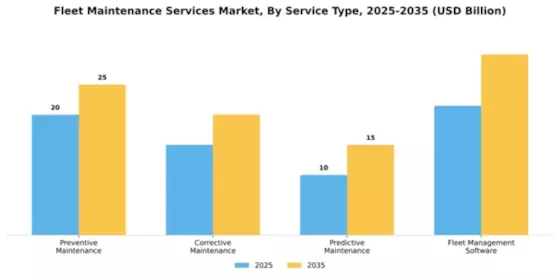
In the Fleet Maintenance Services Market, Preventive Maintenance holds the largest share among service types. This segment focuses on regular inspections and scheduled repairs, enabling fleet operators to minimize downtime and maintain optimal vehicle performance. On the other hand, Corrective Maintenance and Fleet Management Software also play significant roles, but with comparatively less market presence. The distribution emphasizes the importance of proactive approaches to fleet management, drawing operators to invest in reliable preemptive measures. Growth trends in the Fleet Maintenance Services Market are significantly influenced by technological advancements and an increasing emphasis on data-driven decision-making. Predictive Maintenance, leveraging IoT and analytics, is emerging as the fastest-growing segment as operators seek to forecast potential equipment failures and reduce costs. The integration of Fleet Management Software further enhances operational efficiency and real-time monitoring, driving demand for comprehensive and strategic maintenance solutions that cater to future fleet operations.
Preventive Maintenance (Dominant) vs. Predictive Maintenance (Emerging)
Preventive Maintenance is a well-established and dominant segment in the Fleet Maintenance Services Market, characterized by its systematic and scheduled approach to vehicle upkeep. Fleet operators implementing preventive strategies can significantly reduce the risk of unplanned breakdowns, thereby enhancing overall operational efficiency. In contrast, Predictive Maintenance—while still emerging—shows immense potential due to its innovative use of data analytics and real-time monitoring technologies. This segment empowers fleet managers to preemptively address maintenance needs based on actual vehicle performance data, thus optimizing maintenance schedules and reducing operational costs. The synergy between these two segments reflects a shift towards a more dynamic and proactive maintenance culture within the fleet management sector.
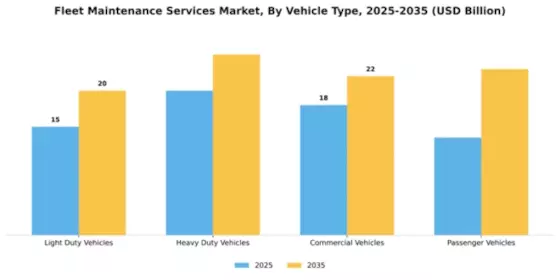
In the Fleet Maintenance Services Market, Light Duty Vehicles dominate the market share, given their widespread usage in urban settings and personal transportation. This segment benefits from a high frequency of maintenance demands due to their greater number on the roads, providing consistent revenue for service providers. Conversely, Heavy Duty Vehicles, while currently holding a smaller market share, are gaining traction as logistics and transportation industries expand. The steady increase in e-commerce and freight transport is driving maintenance needs for these vehicles.
Light Duty Vehicles (Dominant) vs. Heavy Duty Vehicles (Emerging)
Light Duty Vehicles primarily comprise cars and small trucks, which are typical in personal and light commercial usage. Their maintenance services often include oil changes, tire rotations, and brake services, contributing to a predictable and steady demand in the fleet maintenance sector. Heavy Duty Vehicles, including large trucks and trailers, are emerging due to the increasing freight activities and transportation requirements of the supply chain. Their maintenance is more complex, relying on specialized knowledge and equipment, which represents a growth opportunity for service providers. As these vehicles face stricter regulations and the demand for longer uptime increases, the need for effective and efficient maintenance solutions is steadily rising.
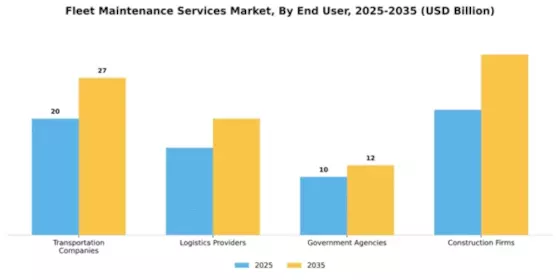
In the Fleet Maintenance Services Market, transportation companies command the largest market share, driven by the need for efficient fleet operations and regulatory compliance. Their investment in maintenance services is critical for minimizing downtime and enhancing service delivery. Meanwhile, logistics providers are rapidly emerging as significant players, reflecting their increasing reliance on advanced fleet management systems to meet customer demands and improve operational efficiency.
Transportation Companies (Dominant) vs. Logistics Providers (Emerging)
Transportation companies are recognized as the dominant force in the Fleet Maintenance Services Market, leveraging extensive fleets that require regular maintenance to ensure reliability and compliance. Their focus on cost-effective operations drives demand for comprehensive maintenance solutions that include preventive and corrective services. On the other hand, logistics providers are viewed as an emerging segment; their growth is steered by the e-commerce surge, requiring agile fleet operations to meet dynamic delivery schedules. This segment emphasizes innovative technology and digital solutions to enhance fleet visibility and performance, thereby fostering competitiveness in a fast-paced market.
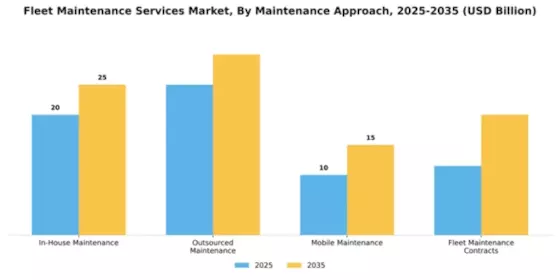
In the Fleet Maintenance Services Market, the distribution of market share across various maintenance approaches showcases a dynamic landscape. In-house maintenance currently leads the sector, holding a substantial share due to its advantages in control, efficiency, and cost management. Conversely, mobile maintenance is swiftly catching up, representing an innovative solution for fleets that prioritize rapid response times and reduced downtime, thus catering to a growing demand for flexibility in service delivery. The growth patterns within this segment underscore significant trends driven by technological advancements and evolving customer preferences. As fleets become more complex and reliant on real-time data, the traditional in-house maintenance approach is being complemented by mobile solutions that offer convenience and accessibility. The diversification of fleet maintenance contracts further reflects an industry shift towards hybrid models that combine the strengths of both in-house and outsourced solutions, indicating a robust path forward for service innovations in the market.
In-House Maintenance (Dominant) vs. Outsourced Maintenance (Emerging)
In-house maintenance is recognized as the dominant approach within the Fleet Maintenance Services Market, primarily due to its ability to provide customized solutions that align closely with a fleet's operational needs. Companies utilizing in-house maintenance benefit from increased operational control, as they can streamline processes, reduce turnaround times, and enhance the quality of service through direct oversight. On the other hand, outsourced maintenance is an emerging trend, appealing to companies seeking cost savings and access to specialized expertise without the overhead of maintaining an internal team. This shift indicates a growing acceptance of outsourcing as a viable strategy to optimize fleet performance, reflecting the need for agility in maintenance solutions as organizations navigate the complexities of modern fleet operations.
Get more detailed insights about Fleet Maintenance Services Market Request Free Sample
North America continues to lead the Fleet Maintenance Services market, holding a significant share of 35.0% in 2024. The growth is driven by increasing demand for efficient fleet management solutions, technological advancements, and stringent regulatory requirements aimed at improving safety and reducing emissions. The region's robust infrastructure and high vehicle density further fuel this demand, making it a key player in the global market. The competitive landscape in North America is characterized by the presence of major players such as Fleetcor Technologies, Teletrac Navman, and Element Fleet Management. These companies leverage innovative technologies and data analytics to enhance service offerings. The U.S. remains the largest market, supported by favorable government policies and a strong focus on sustainability, ensuring continued growth in fleet maintenance services.
Europe's Fleet Maintenance Services market is poised for growth, currently valued at 15.0%. The region is witnessing an increase in demand for fleet optimization and cost-effective maintenance solutions, driven by regulatory pressures to reduce carbon emissions and improve operational efficiency. The European Union's initiatives to promote green logistics and sustainable transport are significant catalysts for market expansion, encouraging investments in advanced fleet technologies. Leading countries in this region include Germany, the UK, and France, where companies are increasingly adopting digital solutions for fleet management. The competitive landscape features key players like ARI Fleet Management and Wheels, Inc., who are innovating to meet the evolving needs of fleet operators. The presence of stringent regulations and a focus on sustainability further enhance the market's growth prospects.
The Asia-Pacific region, with a market size of 12.0%, is rapidly emerging in the Fleet Maintenance Services sector. The growth is fueled by increasing urbanization, rising vehicle ownership, and a growing emphasis on efficient fleet management practices. Governments in countries like China and India are implementing regulations to enhance road safety and reduce environmental impact, which are significant drivers for the market's expansion. Key players in this region include Geotab Inc. and Omnicare, who are focusing on integrating advanced technologies such as IoT and AI into their service offerings. The competitive landscape is evolving, with local companies also entering the market, driven by the demand for cost-effective and reliable fleet maintenance solutions. This dynamic environment presents numerous opportunities for growth and innovation in the sector.
The Middle East and Africa region, valued at 4.5%, is gradually developing its Fleet Maintenance Services market. The growth is primarily driven by increasing investments in infrastructure and a rising number of commercial vehicles. However, challenges such as economic fluctuations and regulatory inconsistencies can hinder market progress. Governments are beginning to recognize the importance of efficient fleet management, which is expected to catalyze future growth. Countries like South Africa and the UAE are leading the way in adopting fleet maintenance solutions, with a focus on improving operational efficiency and reducing costs. The competitive landscape is characterized by a mix of local and international players, who are adapting to the unique market needs. As the region continues to evolve, opportunities for innovation and investment in fleet services are likely to increase.
The Fleet Maintenance Services Market is characterized by a dynamic competitive landscape, driven by technological advancements and an increasing emphasis on operational efficiency. Key players such as Fleetcor Technologies (US), Teletrac Navman (US), and Element Fleet Management (CA) are strategically positioning themselves through innovation and digital transformation. Fleetcor Technologies (US) focuses on integrating advanced telematics solutions to enhance fleet visibility and reduce operational costs, while Teletrac Navman (US) emphasizes real-time data analytics to optimize fleet performance. Element Fleet Management (CA) is leveraging partnerships with technology providers to enhance its service offerings, thereby shaping a competitive environment that prioritizes efficiency and customer satisfaction.The business tactics employed by these companies include localizing service offerings and optimizing supply chains to meet regional demands. The market structure appears moderately fragmented, with several players vying for market share. However, the collective influence of major companies is significant, as they drive innovation and set industry standards. This competitive structure fosters an environment where smaller players must adapt quickly to remain relevant, often leading to strategic collaborations or niche market focus.
In November Fleetcor Technologies (US) announced a partnership with a leading telematics provider to enhance its fleet management platform. This strategic move is likely to bolster Fleetcor's capabilities in data analytics, enabling clients to make more informed decisions regarding fleet operations. Such partnerships are indicative of a broader trend where companies seek to integrate complementary technologies to provide comprehensive solutions.
In October Teletrac Navman (US) launched a new AI-driven predictive maintenance tool aimed at reducing vehicle downtime. This innovation is crucial as it aligns with the growing demand for proactive maintenance solutions, potentially leading to significant cost savings for fleet operators. The introduction of AI into maintenance practices suggests a shift towards more intelligent and automated fleet management systems.
In September Element Fleet Management (CA) expanded its service portfolio by acquiring a software company specializing in electric vehicle (EV) fleet management. This acquisition is strategically important as it positions Element to capitalize on the increasing adoption of EVs, reflecting a broader industry trend towards sustainability and environmental responsibility. Such moves not only enhance service offerings but also align with regulatory pressures for greener fleet solutions.
As of December the competitive trends in the Fleet Maintenance Services Market are increasingly defined by digitalization, sustainability, and AI integration. Strategic alliances are becoming more prevalent, as companies recognize the need to collaborate to enhance their technological capabilities. The competitive differentiation is likely to evolve from traditional price-based competition to a focus on innovation, technology integration, and supply chain reliability. This shift indicates that companies that prioritize these aspects will be better positioned to thrive in an increasingly complex market.



The Fleet Maintenance Services Market is projected to grow at a 2.79% CAGR from 2025 to 2035, driven by technological advancements, increasing vehicle complexity, and a focus on operational efficiency.
New opportunities lie in:
By 2035, the market is expected to be robust, driven by innovation and evolving customer needs.
| MARKET SIZE 2024 | 66.5(USD Billion) |
| MARKET SIZE 2025 | 68.36(USD Billion) |
| MARKET SIZE 2035 | 90.0(USD Billion) |
| COMPOUND ANNUAL GROWTH RATE (CAGR) | 2.79% (2025 - 2035) |
| REPORT COVERAGE | Revenue Forecast, Competitive Landscape, Growth Factors, and Trends |
| BASE YEAR | 2024 |
| Market Forecast Period | 2025 - 2035 |
| Historical Data | 2019 - 2024 |
| Market Forecast Units | USD Billion |
| Key Companies Profiled | Fleetcor Technologies (US), Teletrac Navman (US), Element Fleet Management (CA), Wheels, Inc. (US), ARI Fleet Management (US), Donlen Corporation (US), Geotab Inc. (CA), Omnicare (US) |
| Segments Covered | Service Type, Vehicle Type, End User, Maintenance Approach |
| Key Market Opportunities | Integration of advanced telematics and predictive analytics enhances efficiency in the Fleet Maintenance Services Market. |
| Key Market Dynamics | Rising demand for predictive maintenance technologies enhances operational efficiency in the fleet maintenance services sector. |
| Countries Covered | North America, Europe, APAC, South America, MEA |
The Fleet Maintenance Services Market was valued at 66.5 USD Billion in 2024.
The market is projected to reach 90.0 USD Billion by 2035.
The expected CAGR for the market during 2025 - 2035 is 2.79%.
By 2035, the Fleet Management Software segment is projected to reach 30.0 USD Billion.
In 2025, preventive maintenance is expected to be valued at 25.0 USD Billion, while corrective maintenance is projected at 20.0 USD Billion.
The heavy duty vehicles segment is projected to reach 25.0 USD Billion by 2035.
Transportation companies are expected to grow significantly, with a projected valuation of 27.0 USD Billion by 2035.
Outsourced maintenance is projected to reach 30.0 USD Billion by 2035.
Key players include Fleetcor Technologies, Teletrac Navman, and Element Fleet Management, among others.
Mobile maintenance is expected to reach 15.0 USD Billion by 2035.



Kindly complete the form below to receive a free sample of this Report

“This is really good guys. Excellent work on a tight deadline. I will continue to use you going forward and recommend you to others. Nice job”


“Thanks. It’s been a pleasure working with you, please use me as reference with any other Intel employees.”


“Thanks for sending the report it gives us a good global view of the Betaïne market.”


“Thank you, this will be very helpful for OQS.”


“We found the report very insightful! we found your research firm very helpful. I'm sending this email to secure our future business.”


“I am very pleased with how market segments have been defined in a relevant way for my purposes (such as "Portable Freezers & refrigerators" and "last-mile"). In general the report is well structured. Thanks very much for your efforts.”


“I have been reading the first document or the study, ,the Global HVAC and FP market report 2021 till 2026. Must say, good info! I have not gone in depth at all parts, but got a good indication of the data inside!”


“We got the report in time, we really thank you for your support in this process. I also thank to all of your team as they did a great job.”


“The Automotive 48V ECU Components Procurement Intelligence Study” was a complex project, but the Market Research Future (MRFR) team handled it with quality, agility, and customer-centricity. They delivered all requested data on time and within the agreed scope. The team, including Shubhendra Anand and Rahul Gotadki, was always readily available to clarify questions and swiftly implement necessary adjustments, driving the project to a successful conclusion within a very demanding timeframe.
I would also like to specifically commend Akshay Agarwal for his responsiveness and support at every stage—from our initial inquiry on May 6th through to final delivery on June 18th. His dedication made the entire process seamless.”



