Download Free Sample
Kindly complete the form below to receive a free sample of this Report
Flight Data Monitoring and MRO Services Market Research Report By End Use (Commercial Aviation, Military Aviation, Business Aviation, Helicopter Operations), By Technology (Cloud-Based Solutions, On-Premise Solutions, Artificial Intelligence, Machine Learning), By Application (Flight Data Monitoring, Maintenance Repair Overhaul, Predictive Maintenance, Data Analysis, Regulatory Compliance), By Service Type (Data Acquisition, Data Processing, Data Storage, Data Visualization), By Aircraft Type (Fixed-Wing Aircraft, Rotary-Wing Aircraft, Unmanned Aerial Vehicles) And By Region (North America, Europe, Asia-Pacific, And Rest Of The World) – Market Forecast Till 2035.
As per MRFR analysis, the Flight Data Monitoring and MRO Services Market was estimated at 6.5 USD Billion in 2024. The Flight Data Monitoring and MRO Services industry is projected to grow from 6.79 USD Billion in 2025 to 10.5 USD Billion by 2035, exhibiting a compound annual growth rate (CAGR) of 4.46% during the forecast period 2025 - 2035.
The Flight Data Monitoring and MRO Services Market is poised for substantial growth driven by technological advancements and increasing regulatory demands.
| 2024 Market Size | 6.5 (USD Billion) |
| 2035 Market Size | 10.5 (USD Billion) |
| CAGR (2025 - 2035) | 4.46% |
Honeywell (US), General Electric (US), Airbus (FR), Boeing (US), Rolls-Royce (GB), Safran (FR), Thales (FR), L3Harris Technologies (US), Rockwell Collins (US)
Our Impact
Enabled $4.3B Revenue Impact for Fortune 500 and Leading Multinationals
Partnering with 2000+ Global Organizations Each Year
30K+ Citations by Top-Tier Firms in the Industry
The Flight Data Monitoring and MRO Services Market is currently experiencing a transformative phase, driven by advancements in technology and increasing regulatory requirements. The integration of artificial intelligence and machine learning into flight data analysis is enhancing predictive maintenance capabilities, thereby improving aircraft safety and operational efficiency. Furthermore, the growing emphasis on data-driven decision-making among airlines and maintenance organizations is fostering a culture of continuous improvement. This trend appears to be reshaping the landscape of maintenance, repair, and operations, as stakeholders seek to leverage data analytics for optimizing performance and reducing costs. In addition, the Flight Data Monitoring and MRO Services Market is witnessing a shift towards more sustainable practices. As environmental concerns gain prominence, there is a noticeable push for eco-friendly solutions within the aviation sector. This includes the adoption of green technologies and practices aimed at minimizing the carbon footprint of flight operations. Moreover, the collaboration between manufacturers, service providers, and regulatory bodies seems to be strengthening, facilitating the development of innovative solutions that align with sustainability goals. Overall, the market is poised for growth, driven by technological advancements and a commitment to environmental stewardship.
The incorporation of advanced technologies such as artificial intelligence and machine learning is revolutionizing the Flight Data Monitoring and MRO Services Market. These innovations enhance predictive maintenance, allowing for timely interventions that improve safety and operational efficiency.
There is a growing emphasis on sustainable practices within the Flight Data Monitoring and MRO Services Market. Stakeholders are increasingly adopting eco-friendly technologies and practices to reduce the environmental impact of aviation operations.
The trend towards data-driven decision-making is becoming more pronounced in the Flight Data Monitoring and MRO Services Market. Airlines and maintenance organizations are leveraging data analytics to optimize performance, enhance safety, and reduce operational costs.
Technological advancements are significantly shaping the Flight Data Monitoring and MRO Services Market. Innovations such as artificial intelligence, machine learning, and big data analytics are being integrated into flight data monitoring systems, enhancing predictive maintenance capabilities. These technologies enable airlines to analyze vast amounts of data in real-time, leading to improved decision-making and operational efficiency. The market is expected to witness a compound annual growth rate of approximately 10% as operators adopt these advanced technologies to optimize maintenance schedules and reduce operational costs. This trend highlights the importance of technological integration in driving the growth of the flight data monitoring sector.
The expansion of the aircraft fleet size is a significant driver of the Flight Data Monitoring and MRO Services Market. As airlines continue to grow their fleets to meet increasing passenger demand, the need for effective flight data monitoring and maintenance services becomes more pronounced. The market is anticipated to grow in tandem with the fleet expansion, with estimates suggesting a 5% annual increase in the number of commercial aircraft. This growth necessitates robust flight data monitoring solutions to ensure the safety and reliability of operations. Consequently, the rising fleet size is likely to bolster the demand for MRO services, further propelling market growth.
Safety remains a paramount concern in the aviation sector, propelling the Flight Data Monitoring and MRO Services Market forward. Airlines are increasingly investing in flight data monitoring systems to enhance safety protocols and mitigate risks associated with flight operations. The integration of advanced monitoring technologies allows for real-time tracking of flight parameters, enabling timely interventions in case of anomalies. This focus on safety is expected to drive market growth, with investments in safety-related technologies projected to rise by 20% in the coming years. The commitment to safety not only protects passengers but also strengthens the reputation of airlines in a competitive market.
The Flight Data Monitoring and MRO Services Market is experiencing heightened demand due to stringent regulatory requirements imposed by aviation authorities. These regulations necessitate comprehensive data monitoring and maintenance practices to ensure safety and operational efficiency. As a result, airlines and operators are investing in advanced flight data monitoring systems to comply with these regulations. The market is projected to grow as organizations prioritize adherence to safety standards, with an estimated increase in compliance-related expenditures by 15% over the next five years. This trend underscores the critical role of flight data monitoring in maintaining regulatory compliance and enhancing overall safety in aviation.
The Flight Data Monitoring and MRO Services Market is driven by the increasing demand for operational efficiency among airlines and operators. As competition intensifies, organizations are seeking ways to optimize their operations and reduce costs. Flight data monitoring systems provide valuable insights into aircraft performance, enabling operators to identify inefficiencies and implement corrective measures. This focus on operational efficiency is projected to contribute to a market growth rate of around 12% over the next few years. By leveraging flight data monitoring, airlines can enhance their operational strategies, ultimately leading to improved profitability and customer satisfaction.
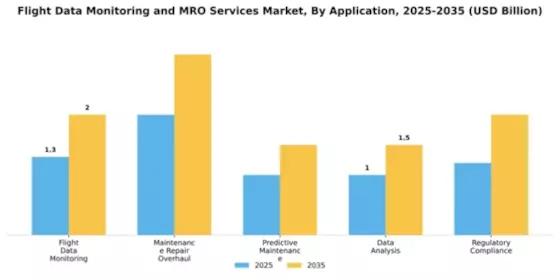
In the Flight Data Monitoring and MRO Services Market, Flight Data Monitoring emerges as the largest segment, due to its crucial role in ensuring flight safety and operational efficiency. Following closely is Predictive Maintenance, which is rapidly gaining traction due to its ability to significantly reduce maintenance costs and downtime. Other notable segments include Maintenance Repair Overhaul, Data Analysis, and Regulatory Compliance, all of which contribute to the overall effectiveness and reliability of aviation operations. The growth trends within this segment are driven by the increasing emphasis on safety, regulatory pressures, and the need for cost-effective maintenance solutions. The surge in the adoption of advanced technologies like artificial intelligence and big data analytics has further fueled the demand for these applications. As airlines and maintenance organizations seek to enhance efficiency and minimize operational disruptions, the focus on Flight Data Monitoring and Predictive Maintenance is expected to intensify in the coming years.
Flight Data Monitoring (Dominant) vs. Data Analysis (Emerging)
Flight Data Monitoring serves as the dominant force within the Flight Data Monitoring and MRO Services Market, characterized by its foundational role in capturing and analyzing flight data to improve safety and operational efficiency. It encompasses a range of functions from capturing flight parameters to performance analysis, thereby providing critical insights that influence aircraft maintenance strategies. On the other hand, Data Analysis is an emerging segment that complements Flight Data Monitoring by offering advanced analytical capabilities. This segment leverages data analytics to extract actionable insights from vast amounts of flight data, enhancing decision-making processes and operational efficiency. The synergy between Flight Data Monitoring and Data Analysis is pivotal, as it not only fosters innovation but also elevates the standards of safety and performance across the aviation industry.
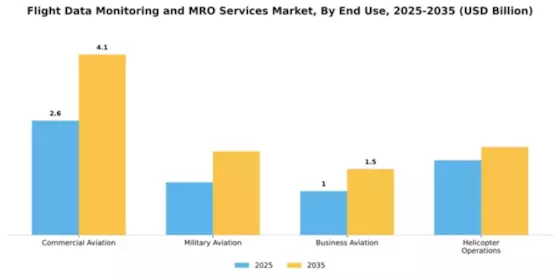
The Flight Data Monitoring and MRO Services Market exhibits a diverse distribution among its end-use segments. Commercial aviation holds a dominant position, driven by the extensive fleet size and the constant need for maintenance, repair, and overhaul services. In contrast, military aviation, while currently a smaller segment, is rapidly growing due to increased defense spending and the modernization of military fleets. These dynamics create a competitive landscape that influences service provisions and growth strategies. Growth trends indicate that commercial aviation will continue to be the largest segment, supported by escalating passenger travel demand and advancements in aircraft technology. Meanwhile, military aviation is poised to witness significant expansion as governments prioritize enhancing their defense capabilities and investing in high-tech monitoring systems. The rise in compliance regulations further encourages both sectors to adopt robust data monitoring solutions that enhance safety and operational efficiency.
Commercial Aviation (Dominant) vs. Helicopter Operations (Emerging)
In the Flight Data Monitoring and MRO Services Market, Commercial Aviation is recognized as the dominant segment due to its substantial share of global air travel and significant investments in fleet operations and maintenance. The emphasis on passenger safety and regulatory compliance drives the demand for advanced monitoring solutions, making it a priority for airlines. On the other hand, Helicopter Operations represent an emerging segment, gaining traction as demand increases in various sectors, including medical transport and tourism. Helicopter operations require specialized monitoring due to unique flight dynamics and operational challenges. This segment’s growth is spurred by advancements in helicopter technology and the expansion of services in urban air mobility, making it a vital area of focus for MRO service providers.
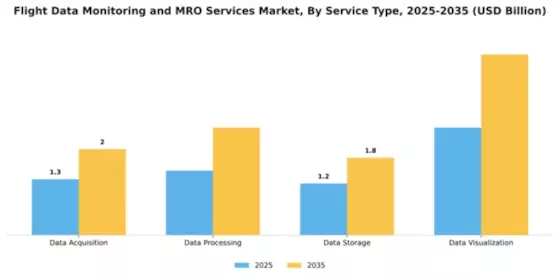
The Flight Data Monitoring and MRO Services Market is primarily dominated by Data Acquisition, which accounts for the largest share. This segment is crucial as it encompasses all processes that gather and record flight data. On the other hand, Data Visualization, while smaller in market share, is gaining traction due to its significance in interpreting data effectively and presenting insights visually to stakeholders.
Data Acquisition (Dominant) vs. Data Visualization (Emerging)
Data Acquisition serves as the backbone of flight data monitoring, delivering essential insights that are critical for operational efficiency and safety. This segment focuses on collecting accurate flight parameters from various sources, ensuring high reliability and precision. In contrast, Data Visualization is an emerging segment that leverages advanced technologies to present data in user-friendly formats. Its growth is driven by the increasing need for intuitive displays and dashboards that help airline operators make timely decisions based on complex data analyses. Both segments are vital, but Data Visualization is quickly becoming essential as organizations strive to enhance data usability.
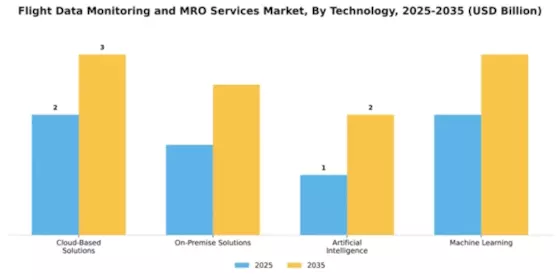
The Flight Data Monitoring and MRO Services Market is significantly shaped by different technological advancements. Among these, Cloud-Based Solutions take the lead, accounting for the largest share of the market. These solutions facilitate seamless data access and storage across various platforms, making them indispensable for operators. In contrast, Artificial Intelligence, while currently a smaller segment, is on the rise due to its growing capabilities in predictive maintenance and operational efficiencies, which are increasingly being adopted by more operators and service providers.
Technology: Cloud-Based Solutions (Dominant) vs. Artificial Intelligence (Emerging)
Cloud-Based Solutions are characterized by their flexibility and scalability, allowing operators to process large volumes of flight data in real time, enhancing operational efficiency and decision-making. They dominate the market due to their ability to reduce costs and improve accessibility of data. On the other hand, Artificial Intelligence is an emerging force in this sector, bringing innovations such as automated analysis and insights derived from big data interactions. AI tools are increasingly recognized for their potential to transform maintenance and operational procedures, thereby driving demand and sustaining growth in this evolving landscape.
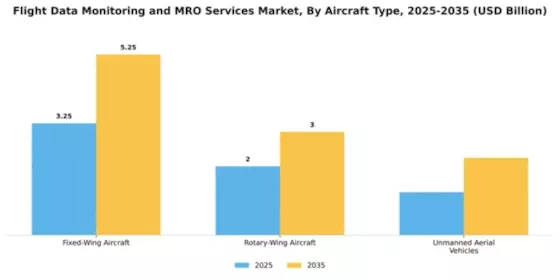
In the Flight Data Monitoring and MRO Services Market, the Fixed-Wing Aircraft segment holds the largest market share, driven by its widespread use in commercial aviation, cargo transport, and military operations. This segment benefits from established maintenance practices and a large operational fleet, making it a crucial player in the overall market dynamics. Conversely, the Unmanned Aerial Vehicles (UAV) segment is recognized as the fastest-growing, fueled by increasing adoption in various applications including surveillance, delivery, and agricultural monitoring, showcasing a shift towards innovative aerial solutions. The growth trends within these segments are significantly influenced by technological advancements and regulatory support. Fixed-Wing Aircraft continue to utilize improved avionics and predictive maintenance technologies, enhancing operational reliability and efficiency. The UAV segment, on the other hand, is experiencing rapid development due to the rise of drone technology, leading to greater efficiencies and the ability to perform tasks previously unattainable within traditional aviation operations. This dynamic interplay indicates a market evolving quickly to embrace new capabilities while still relying on established aircraft types for its foundational operations.
Fixed-Wing Aircraft (Dominant) vs. Unmanned Aerial Vehicles (Emerging)
The Fixed-Wing Aircraft segment is characterized by its established infrastructure and significant user base across various sectors such as commercial air travel, military, and cargo transport. These aircraft are favored for their range, speed, and fuel efficiency, making them indispensable for long-distance flights and high-capacity transport needs. In contrast, the Unmanned Aerial Vehicles (UAV) segment is emerging rapidly, driven by advancements in automation and AI technologies. These UAVs offer remarkable versatility, being able to execute tasks ranging from aerial photography to disaster response and precision agriculture. Their low operational costs and ability to access hard-to-reach areas give UAVs a unique position in modern aviation, making them integral to the evolving landscape of flight data monitoring and MRO services.
Get more detailed insights about Flight Data Monitoring and MRO Services Market Request Free Sample
North America is poised to maintain its leadership in the Flight Data Monitoring and MRO Services Market, holding a significant market share of 3.25 billion. The region benefits from advanced technological infrastructure, a high demand for safety and efficiency in aviation, and stringent regulatory frameworks that promote innovation. The increasing adoption of data analytics and predictive maintenance solutions further drives market growth, ensuring compliance with safety regulations and enhancing operational efficiency. The competitive landscape in North America is robust, featuring key players such as Honeywell, General Electric, and Boeing. These companies are at the forefront of technological advancements, offering cutting-edge solutions that cater to the evolving needs of the aviation sector. The presence of major airlines and a strong military aviation sector also contribute to the region's dominance, making it a hub for MRO services and flight data monitoring solutions.
Europe is witnessing a growing demand for Flight Data Monitoring and MRO Services, with a market size of 1.8 billion. The region's focus on enhancing aviation safety standards and regulatory compliance is a key driver of market growth. Initiatives by the European Union Aviation Safety Agency (EASA) to implement stringent safety regulations are catalyzing investments in advanced monitoring technologies. The increasing emphasis on sustainability and reducing carbon emissions is also shaping the market landscape, pushing for innovative solutions. Leading countries in Europe, such as France, Germany, and the UK, are home to major players like Airbus and Rolls-Royce. The competitive environment is characterized by collaborations and partnerships aimed at enhancing service offerings. The presence of established aerospace manufacturers and a growing number of startups focused on data analytics and monitoring solutions further enriches the market, positioning Europe as a significant player in the global aviation sector.
Asia-Pacific is emerging as a significant player in the Flight Data Monitoring and MRO Services Market, with a market size of 1.5 billion. The region's rapid economic growth, increasing air travel demand, and investments in aviation infrastructure are key growth drivers. Governments are also implementing supportive regulations to enhance safety and operational efficiency, which is further propelling market expansion. The rise of low-cost carriers and the modernization of existing fleets are additional factors contributing to the demand for MRO services. Countries like China, India, and Japan are leading the charge in this region, with a growing number of airlines and aircraft operators. The competitive landscape is becoming increasingly dynamic, with both established players and new entrants vying for market share. Key companies such as Thales and L3Harris Technologies are actively investing in innovative solutions to meet the evolving needs of the aviation industry, ensuring that Asia-Pacific remains a vital market for flight data monitoring and MRO services.
The Middle East and Africa region is gradually developing its Flight Data Monitoring and MRO Services Market, currently valued at 0.95 billion. The growth is driven by increasing air traffic, investments in airport infrastructure, and a rising focus on aviation safety. However, the market faces challenges such as regulatory inconsistencies and varying levels of technological adoption across countries. Governments are beginning to recognize the importance of enhancing aviation safety and operational efficiency, which is expected to drive future growth. Leading countries in this region include the UAE and South Africa, where significant investments in aviation infrastructure are being made. The competitive landscape is characterized by a mix of local and international players, with companies like Safran and Rolls-Royce establishing a presence. As the region continues to develop its aviation capabilities, the demand for advanced MRO services and flight data monitoring solutions is anticipated to grow, presenting opportunities for both established and new market entrants.
The Flight Data Monitoring and MRO Services Market is currently characterized by a dynamic competitive landscape, driven by technological advancements and an increasing emphasis on operational efficiency. Major players such as Honeywell (US), General Electric (US), and Airbus (FR) are strategically positioning themselves through innovation and partnerships. For instance, Honeywell (US) has focused on enhancing its data analytics capabilities, which appears to be a critical factor in improving flight safety and operational performance. Meanwhile, General Electric (US) is investing heavily in digital transformation initiatives, aiming to leverage AI and machine learning to optimize maintenance processes. Airbus (FR) is also actively pursuing collaborations with tech firms to integrate advanced monitoring systems into its aircraft, thereby enhancing its service offerings and competitive edge.The market structure is moderately fragmented, with a mix of established players and emerging companies vying for market share. Key business tactics include localizing manufacturing to reduce costs and optimizing supply chains to enhance service delivery. This competitive environment is shaped by the collective influence of these major players, who are increasingly adopting strategies that emphasize sustainability and technological integration.In November Rolls-Royce (GB) announced a strategic partnership with a leading AI firm to develop predictive maintenance solutions for its aircraft engines. This collaboration is likely to enhance Rolls-Royce's capabilities in flight data monitoring, allowing for more proactive maintenance strategies that could reduce downtime and operational costs for airlines. The integration of AI into their MRO services may also position Rolls-Royce as a leader in the market, as airlines increasingly seek innovative solutions to improve efficiency.In October Thales (FR) launched a new suite of flight data monitoring tools designed to enhance real-time analytics for airlines. This initiative reflects Thales's commitment to digital transformation and positions the company to better meet the evolving needs of the aviation sector. By providing airlines with actionable insights derived from flight data, Thales (FR) aims to improve safety and operational efficiency, thereby strengthening its competitive position in the market.In September Boeing (US) expanded its MRO services through the acquisition of a regional maintenance provider, which is expected to enhance its service capabilities in key markets. This acquisition not only broadens Boeing's operational footprint but also allows for a more integrated approach to flight data monitoring and maintenance services. Such strategic moves indicate a trend towards consolidation in the market, as companies seek to enhance their service offerings and operational efficiencies.As of December the competitive trends in the Flight Data Monitoring and MRO Services Market are increasingly defined by digitalization, sustainability, and the integration of AI technologies. Strategic alliances are becoming more prevalent, as companies recognize the need to collaborate to stay competitive. The shift from price-based competition to a focus on innovation and technology is evident, with firms prioritizing reliability in their supply chains and the development of cutting-edge solutions to differentiate themselves in a crowded marketplace.






The Flight Data Monitoring and MRO Services Market is projected to grow at a 4.46% CAGR from 2025 to 2035, driven by technological advancements and increasing safety regulations.
New opportunities lie in:
By 2035, the market is expected to be robust, driven by innovation and enhanced operational efficiencies.
| MARKET SIZE 2024 | 6.5(USD Billion) |
| MARKET SIZE 2025 | 6.79(USD Billion) |
| MARKET SIZE 2035 | 10.5(USD Billion) |
| COMPOUND ANNUAL GROWTH RATE (CAGR) | 4.46% (2025 - 2035) |
| REPORT COVERAGE | Revenue Forecast, Competitive Landscape, Growth Factors, and Trends |
| BASE YEAR | 2024 |
| Market Forecast Period | 2025 - 2035 |
| Historical Data | 2019 - 2024 |
| Market Forecast Units | USD Billion |
| Key Companies Profiled | Honeywell (US), General Electric (US), Airbus (FR), Boeing (US), Rolls-Royce (GB), Safran (FR), Thales (FR), L3Harris Technologies (US), Rockwell Collins (US) |
| Segments Covered | Application, End Use, Service Type, Technology, Aircraft Type |
| Key Market Opportunities | Integration of advanced analytics and artificial intelligence in Flight Data Monitoring and MRO Services Market. |
| Key Market Dynamics | Technological advancements drive demand for Flight Data Monitoring and MRO Services, enhancing safety and operational efficiency. |
| Countries Covered | North America, Europe, APAC, South America, MEA |
As of 2024, the market valuation stands at 6.5 USD Billion.
The market is expected to reach a valuation of 10.5 USD Billion by 2035.
The market is anticipated to grow at a CAGR of 4.46% from 2025 to 2035.
Key players include Honeywell, General Electric, Airbus, Boeing, Rolls-Royce, Safran, Thales, L3Harris Technologies, and Rockwell Collins.
The primary applications include Flight Data Monitoring, Maintenance Repair Overhaul, Predictive Maintenance, Data Analysis, and Regulatory Compliance.
The market segments by end use include Commercial Aviation, Military Aviation, Business Aviation, and Helicopter Operations.
Key service types encompass Data Acquisition, Data Processing, Data Storage, and Data Visualization.
Technological advancements include Cloud-Based Solutions, On-Premise Solutions, Artificial Intelligence, and Machine Learning.
The market segments by aircraft type into Fixed-Wing Aircraft, Rotary-Wing Aircraft, and Unmanned Aerial Vehicles.
In 2024, the Flight Data Monitoring segment was valued at 1.3 USD Billion.



Kindly complete the form below to receive a free sample of this Report

“This is really good guys. Excellent work on a tight deadline. I will continue to use you going forward and recommend you to others. Nice job”


“Thanks. It’s been a pleasure working with you, please use me as reference with any other Intel employees.”


“Thanks for sending the report it gives us a good global view of the Betaïne market.”


“Thank you, this will be very helpful for OQS.”


“We found the report very insightful! we found your research firm very helpful. I'm sending this email to secure our future business.”


“I am very pleased with how market segments have been defined in a relevant way for my purposes (such as "Portable Freezers & refrigerators" and "last-mile"). In general the report is well structured. Thanks very much for your efforts.”


“I have been reading the first document or the study, ,the Global HVAC and FP market report 2021 till 2026. Must say, good info! I have not gone in depth at all parts, but got a good indication of the data inside!”


“We got the report in time, we really thank you for your support in this process. I also thank to all of your team as they did a great job.”


“The Automotive 48V ECU Components Procurement Intelligence Study” was a complex project, but the Market Research Future (MRFR) team handled it with quality, agility, and customer-centricity. They delivered all requested data on time and within the agreed scope. The team, including Shubhendra Anand and Rahul Gotadki, was always readily available to clarify questions and swiftly implement necessary adjustments, driving the project to a successful conclusion within a very demanding timeframe.
I would also like to specifically commend Akshay Agarwal for his responsiveness and support at every stage—from our initial inquiry on May 6th through to final delivery on June 18th. His dedication made the entire process seamless.”



