×
Request Free Sample ×

Kindly complete the form below to receive a free sample of this Report

* Please use a valid business email

Leading companies partner with us for data-driven Insights

clients tt-cursor
Hero Background

Float Level Switches Market

ID: MRFR/SEM/32360-HCR
128 Pages
Aarti Dhapte
October 2025

Float Level Switches Market Research Report By Type (Magnetic Float Switches, Brep Float Switches, Optical Float Switches, Vibrating Fork Float Switches), By Applications (Water and Wastewater Management, Food and Beverage Industry, Chemical Processing, Oil and Gas Exploration), By End Use Industry (Manufacturing, HVAC, Pharmaceuticals, Power Generation), By Material (Plastic, Stainless Steel, Brass, Aluminum) and By Regional (North America, Europe, South America, Asia Pacific, Middle East and Africa) - Forecast to 2035

Share:
Download PDF ×

We do not share your information with anyone. However, we may send you emails based on your report interest from time to time. You may contact us at any time to opt-out.

Float Level Switches Market Infographic
Purchase Options

Float Level Switches Market Summary

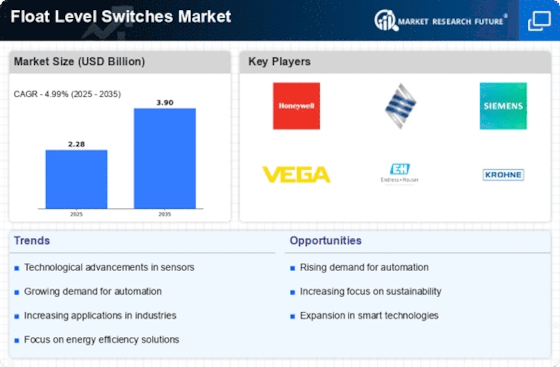
As per MRFR analysis, the Float Level Switches Market Size was estimated at 2.28 USD Billion in 2024. The Float Level Switches industry is projected to grow from 2.394 USD Billion in 2025 to 3.896 USD Billion by 2035, exhibiting a compound annual growth rate (CAGR) of 4.99 during the forecast period 2025 - 2035.

Key Market Trends & Highlights

The Float Level Switches Market is experiencing a dynamic shift towards automation and smart technologies.

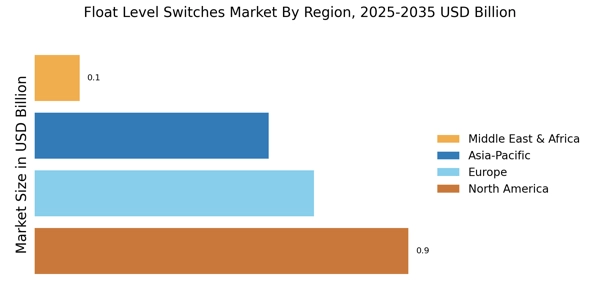
  • North America remains the largest market for float level switches, driven by robust industrial applications.
  • The Asia-Pacific region is emerging as the fastest-growing market, fueled by rapid industrialization and urbanization.
  • Magnetic float switches dominate the market, while optical float switches are witnessing the highest growth rates due to their advanced features.
  • Rising demand in water and wastewater management, along with increasing focus on industrial automation, are key drivers propelling market expansion.

Market Size & Forecast

2024 Market Size 2.28 (USD Billion)
2035 Market Size 3.896 (USD Billion)
CAGR (2025 - 2035) 4.99%

Major Players

Honeywell (US), Emerson (US), Siemens (DE), VEGA Grieshaber KG (DE), Endress+Hauser (CH), KROHNE (DE), LevelSwitch (US), Aplisens S.A. (PL), GROVE (US)

Float Level Switches Market Trends

The Float Level Switches Market is currently experiencing a notable evolution, driven by advancements in technology and increasing demand across various industries. These devices, which are essential for monitoring liquid levels in tanks and containers, are becoming increasingly sophisticated. The integration of smart technologies, such as IoT capabilities, is enhancing their functionality, allowing for real-time monitoring and data analysis. This trend appears to be fostering greater efficiency and safety in operations, particularly in sectors like water treatment, chemicals, and food processing. Moreover, the growing emphasis on automation and process optimization is likely to propel the adoption of float level switches. Industries are increasingly recognizing the value of reliable level measurement solutions to minimize downtime and prevent overflow incidents. As environmental regulations become more stringent, the Float Level Switches Market may also see a shift towards eco-friendly materials and energy-efficient designs. Overall, the market landscape is evolving, with innovations and sustainability considerations shaping future developments.

Integration of Smart Technologies

The Float Level Switches Market is witnessing a trend towards the incorporation of smart technologies. This integration allows for enhanced monitoring capabilities, enabling users to receive real-time data and alerts. Such advancements are likely to improve operational efficiency and reduce the risk of errors in liquid management.

Focus on Automation and Process Optimization

There is a growing emphasis on automation within the Float Level Switches Market. Industries are increasingly adopting automated solutions to streamline operations and enhance productivity. This trend suggests that float level switches will play a crucial role in optimizing processes and minimizing human intervention.

Sustainability and Eco-Friendly Designs

The Float Level Switches Market is also shifting towards sustainability. Manufacturers are exploring eco-friendly materials and energy-efficient designs in response to rising environmental concerns. This trend indicates a potential transformation in product offerings, aligning with global sustainability goals.

Float Level Switches Market Drivers

Growth in Oil and Gas Sector

The Float Level Switches Market is significantly influenced by the expansion of the oil and gas sector. As exploration and production activities increase, the need for reliable level monitoring in various applications, such as storage tanks and separators, becomes paramount. Float level switches are utilized to ensure safe and efficient operations by preventing overflows and maintaining optimal fluid levels. Recent statistics suggest that the oil and gas industry is expected to witness a steady growth rate of around 5% annually, which bodes well for the float level switches market. The critical role these devices play in enhancing safety and operational efficiency positions them as vital components in the industry, thereby driving market growth.

Increasing Focus on Industrial Automation

The Float Level Switches Market is poised for growth due to the increasing focus on industrial automation across various sectors. As industries strive for greater efficiency and reduced operational costs, the adoption of automated systems is becoming more prevalent. Float level switches are integral to these systems, providing accurate level measurement and control in processes such as chemical manufacturing, food and beverage production, and pharmaceuticals. The industrial automation market is anticipated to grow at a rate of approximately 7% annually, which will likely drive demand for float level switches. Their ability to enhance process reliability and minimize human intervention positions them as critical components in automated environments.

Regulatory Compliance and Safety Standards

The Float Level Switches Market is significantly impacted by stringent regulatory compliance and safety standards across various sectors. Industries such as chemicals, pharmaceuticals, and food processing are subject to rigorous regulations that mandate effective level monitoring to prevent spills and ensure safety. Float level switches are essential tools for meeting these compliance requirements, as they provide reliable level detection and control. The increasing emphasis on safety and environmental protection is expected to drive the market, with estimates suggesting a growth rate of around 5% in the coming years. As companies seek to adhere to these regulations, the demand for float level switches will likely continue to rise, reinforcing their importance in maintaining operational integrity.

Rising Demand in Water and Wastewater Management

The Float Level Switches Market is experiencing a notable increase in demand driven by the growing need for efficient water and wastewater management systems. As urbanization accelerates, municipalities are investing in infrastructure to manage water resources effectively. Float level switches play a crucial role in monitoring and controlling water levels in treatment plants, ensuring optimal operation. According to recent data, the water and wastewater sector is projected to grow at a compound annual growth rate of approximately 6% over the next few years. This trend indicates a robust market for float level switches, as they are essential for maintaining operational efficiency and compliance with environmental regulations. The integration of these devices into automated systems further enhances their appeal, making them indispensable in modern water management solutions.

Technological Advancements in Float Level Switches

The Float Level Switches Market is benefiting from continuous technological advancements that enhance the functionality and reliability of these devices. Innovations such as wireless communication, smart sensors, and improved materials are making float level switches more efficient and user-friendly. These advancements allow for better integration with existing systems, facilitating real-time monitoring and control. The market for smart float level switches is projected to grow significantly, with estimates indicating a potential increase of over 8% in the next few years. This trend reflects a broader shift towards automation and smart technologies in various industries, further solidifying the position of float level switches as essential components in modern applications.


Market Segment Insights

By Type: Magnetic Float Switches (Largest) vs. Optical Float Switches (Fastest-Growing)

The Float Level Switches Market exhibits a diverse range of products, with Magnetic Float Switches dominating the landscape due to their reliability and cost-effectiveness. This segment holds the largest market share as many industries, from water management to chemical processing, rely on these switches for effective level control in tanks and reservoirs. In contrast, Optical Float Switches, while currently comprising a lesser portion of the market, are witnessing a remarkable surge in demand due to advancements in technology and the increasing requirement for precision measurement in various applications. Growth trends in the Float Level Switches Market are heavily influenced by industrial automation and the rising standards for efficiency. The demand for Magnetic Float Switches remains steady, but the Optical Float Switches are rapidly gaining traction as industries shift towards more sophisticated solutions. The need for accurate and reliable level measurement is driving innovation, with manufacturers investing in R&D to enhance these products. Moreover, regulatory pressures for safety and efficiency are motivating companies to adopt advanced technologies, further propelling the growth of the Optical Float Switches segment.

Magnetic Float Switches (Dominant) vs. Optical Float Switches (Emerging)

Magnetic Float Switches have long been the backbone of level sensing solutions, favored for their simplicity and adaptability across various industrial applications. Their robust design and ability to operate in harsh environments make them the preferred choice for many sectors. They provide accurate and reliable performance, ensuring fluid levels are monitored effectively. On the other hand, Optical Float Switches represent an emerging technology that utilizes infrared light to detect liquid levels with high precision. While they currently hold a smaller market share, their growing popularity stems from the increasing need for precise measurements and minimal maintenance. As industries transition toward smart and automated monitoring systems, Optical Float Switches are positioned to capitalize on this shift, attracting significant investment and interest.

By Applications: Water and Wastewater Management (Largest) vs. Food and Beverage Industry (Fastest-Growing)

The Float Level Switches Market is witnessing diverse applications across various sectors, with Water and Wastewater Management holding the largest market share. This sector is heavily reliant on efficient float level switches to maintain optimal water levels, prevent overflow, and manage resources effectively. Meanwhile, the Food and Beverage Industry is quickly becoming a significant segment, driven by rising standards for automation and quality control in food processing and beverage production. As industries evolve, the float level switches tailored for Food and Beverage applications are being adopted rapidly, fueled by increased automation and the need for precise level measurements in various processes. Additionally, stringent regulatory requirements for food safety standards are propelling the demand for advanced switch technologies that promise improved accuracy and reliability.

Water and Wastewater Management (Dominant) vs. Oil and Gas Exploration (Emerging)

Water and Wastewater Management remains the dominant application for float level switches, characterized by its extensive need for reliable monitoring in treatment plants, reservoirs, and distribution systems. These switches play a critical role in ensuring compliance with environmental regulations and optimal resource management. Conversely, the Oil and Gas Exploration sector is emerging as a significant player, driven by the industry's focus on safety and efficiency. Float level switches in this sector are crucial for monitoring liquid levels in various drilling and storage applications, helping to prevent hazardous situations and resource wastage. The growing emphasis on automation and safety protocols in oil and gas operations is paving the way for advanced float level switch technologies, offering significant growth potential.

By End Use Industry: Manufacturing (Largest) vs. Pharmaceuticals (Fastest-Growing)

In the Float Level Switches Market, the end use industry segment is primarily dominated by the manufacturing sector, which comprises a significant portion of the total market share. This sector's reliance on precision and automation has led to an increased demand for float level switches, integral for managing liquid levels in various industrial processes. Following manufacturing, the HVAC sector also contributes notably, but it is the pharmaceutical industry that has recently emerged as a key player, with its specific regulatory compliance needs driving the adoption of advanced float level switching solutions.

Manufacturing: Dominant vs. Pharmaceuticals: Emerging

The manufacturing sector is characterized by its extensive use of float level switches across a myriad of applications, from process control to tank level monitoring. This widespread application has cemented its position as the dominant force within the Float Level Switches Market. In contrast, the pharmaceutical sector, while currently smaller, is rapidly evolving. The need for stringent quality assurance, coupled with the growing complexity of manufacturing processes in pharmaceuticals, is driving innovation and demand for float level switches tailored to meet these requirements. The shift towards automation and smart manufacturing in this sector suggests a promising growth trajectory, positioning pharmaceuticals as an emerging player in the market.

By Material: Plastic (Largest) vs. Stainless Steel (Fastest-Growing)

In the Float Level Switches Market, the material segment is predominantly dominated by plastic due to its affordability, lightweight nature, and resistance to corrosion. Plastic float level switches are widely utilized in various applications where cost is a crucial factor. Conversely, stainless steel is emerging rapidly in the market, appealing to industries requiring durability and high-performance standards. Its resistance to harsh environments and longevity makes it an attractive choice for critical applications, driving its growth.

Plastic (Dominant) vs. Stainless Steel (Emerging)

Plastic float level switches are characterized by their lightweight, cost-effectiveness, and excellent resistance to various chemicals. They are particularly suitable for a range of applications, including water treatment, aquariums, and food processing due to their versatility. On the other hand, stainless steel float level switches are recognized for their robustness and ability to function in extreme conditions. Their superior strength and durability make them ideal for oil and gas, chemical processing, and other heavy-duty industries, reflecting the growing trend toward more resilient materials in float level switch applications.

Get more detailed insights about Float Level Switches Market

Regional Insights

North America : Innovation and Demand Surge

North America is the largest market for float level switches, holding approximately 40% of the global market share. The region's growth is driven by increasing automation in industries such as oil and gas, water treatment, and food processing. Regulatory support for safety and efficiency standards further fuels demand, with initiatives promoting advanced monitoring technologies. The United States is the primary contributor, with key players like Honeywell and Emerson leading the market. The competitive landscape is characterized by innovation and strategic partnerships, enhancing product offerings. Canada also plays a significant role, focusing on sustainable practices and technological advancements in industrial applications.

Europe : Regulatory Framework and Growth

Europe is the second-largest market for float level switches, accounting for around 30% of the global market share. The region benefits from stringent regulations aimed at improving safety and environmental standards, which drive the adoption of advanced monitoring solutions. Countries like Germany and the UK are at the forefront, with increasing investments in industrial automation and smart technologies. Germany leads the market, supported by major players such as Siemens and VEGA Grieshaber KG. The competitive landscape is robust, with a focus on innovation and compliance with EU regulations. The presence of established manufacturers and a growing emphasis on sustainability further enhance market dynamics, positioning Europe as a key player in the float level switches market.

Asia-Pacific : Emerging Markets and Opportunities

Asia-Pacific is witnessing rapid growth in the float level switches market, holding approximately 25% of the global market share. The region's expansion is driven by increasing industrialization, urbanization, and rising demand for automation in sectors like manufacturing and water management. Countries such as China and India are leading this growth, supported by government initiatives promoting infrastructure development. China is the largest market in the region, with significant contributions from local manufacturers and international players. The competitive landscape is evolving, with a focus on cost-effective solutions and technological advancements. As industries continue to modernize, the demand for reliable float level switches is expected to surge, creating ample opportunities for market players.

Middle East and Africa : Resource-Rich and Growing Demand

The Middle East and Africa region is emerging as a significant market for float level switches, accounting for about 5% of the global market share. The growth is primarily driven by increasing investments in oil and gas, water management, and infrastructure projects. Countries like Saudi Arabia and South Africa are leading the charge, with government initiatives aimed at enhancing industrial efficiency and sustainability. Saudi Arabia is a key player, with substantial investments in technology and automation. The competitive landscape is characterized by a mix of local and international companies, focusing on innovative solutions tailored to regional needs. As the demand for reliable monitoring systems grows, the float level switches market is poised for expansion in this resource-rich region.

Float Level Switches Market Regional Image

Key Players and Competitive Insights

The Global Float Level Switches Market is characterized by its dynamic and competitive nature, driven by a variety of factors such as technological advancements, increasing demand for automation in industrial applications, and the need for precise fluid management in various sectors. The market features a blend of established players and emerging companies that are striving to differentiate their products and services to capture market share. Innovations in float-level switch technology, including enhanced accuracy and durability in diverse environmental conditions, are gaining traction as the market continues to evolve.

Additionally, the expansion of industries such as water treatment, oil and gas, and chemicals is propelling the demand for float-level switches, making it imperative for companies to focus not only on product quality but also on customer relationships and after-sales service to sustain their competitive advantage.

KROHNE is a prominent player in the Global Float Level Switches Market, recognized for its cutting-edge technology and strong emphasis on research and development. With a well-established presence in various industrial sectors, KROHNE offers a comprehensive portfolio of float-level switch solutions that cater to the specific needs of customers. The company's strengths lie in its ability to provide highly accurate and reliable products, which are essential for maintaining optimal fluid levels in critical applications. Additionally, KROHNE distinguishes itself through its commitment to customer satisfaction, offering tailored solutions and extensive service support.

The company's global footprint further enhances its visibility and reach, enabling it to respond promptly to market demands and maintain a discerning edge over competitors.R.STAHL has carved out a significant niche in the Global Float Level Switches Market, showcasing its expertise in solutions for hazardous locations and demanding industrial environments. 

As a manufacturer known for its robust and dependable float-level switches, R.STAHL emphasizes safety and compliance with industry standards in all its product offerings. The company's strengths include a deep understanding of the unique challenges faced by customers in sectors such as chemicals, pharmaceuticals, and oil and gas, which allows it to deliver specialized solutions that effectively address critical safety and performance requirements. Furthermore, R.STAHL's dedication to innovation and sustainability helps to reinforce its reputation as a reliable partner for clients seeking durable and efficient level sensing technology.

This focus on quality and reliability positions R.STAHL as a significant competitor in the market, attracting clients who prioritize functionality and operational safety in their operations.

Key Companies in the Float Level Switches Market market include

Industry Developments

Recent developments in the Global Float Level Switches Market have showcased a robust growth trajectory, driven largely by advancements in automation technologies and increased adoption in various industries such as water treatment, chemical, and oil and gas. Companies such as Emerson, Honeywell, and ABB are leading the charge with innovative new product launches aimed at enhancing measurement accuracy and reliability. Additionally, the demand for smart float-level switches integrating IoT technology has been rising, reflecting a trend toward more intelligent monitoring systems.

In terms of mergers and acquisitions, KROHNE recently expanded its portfolio through the acquisition of a complementary technology firm, strengthening its market position. R.STAHL has also made strides by acquiring innovative firms focusing on safety technology, which complements its product line. 

Companies are witnessing an uptick in market valuation with strategic collaborations aimed at enhancing operational efficiencies. The landscape remains competitive, with ongoing investments aimed at research and development initiatives to further innovate within the float level switching arena, ensuring companies maintain their edge in a rapidly evolving market. The overall market sentiment is positive as organizations capitalize on rising demand and technological advancements.

Future Outlook

Float Level Switches Market Future Outlook

The Float Level Switches Market is projected to grow at a 4.99% CAGR from 2024 to 2035, driven by industrial automation, water management, and technological advancements.

New opportunities lie in:

  • Integration of IoT for real-time monitoring solutions.
  • Development of eco-friendly float level switches for sustainability.
  • Expansion into emerging markets with tailored product offerings.

By 2035, the Float Level Switches Market is expected to achieve robust growth and increased market penetration.

Market Segmentation

Float Level Switches Market Type Outlook

  • Magnetic Float Switches
  • Brep Float Switches
  • Optical Float Switches
  • Vibrating Fork Float Switches

Float Level Switches Market Material Outlook

  • Plastic
  • Stainless Steel
  • Brass
  • Aluminum

Float Level Switches Market Applications Outlook

  • Water and Wastewater Management
  • Food and Beverage Industry
  • Chemical Processing
  • Oil and Gas Exploration

Float Level Switches Market End Use Industry Outlook

  • Manufacturing
  • HVAC
  • Pharmaceuticals
  • Power Generation

Report Scope

MARKET SIZE 2024 2.28(USD Billion)
MARKET SIZE 2025 2.394(USD Billion)
MARKET SIZE 2035 3.896(USD Billion)
COMPOUND ANNUAL GROWTH RATE (CAGR) 4.99% (2024 - 2035)
REPORT COVERAGE Revenue Forecast, Competitive Landscape, Growth Factors, and Trends
BASE YEAR 2024
Market Forecast Period 2025 - 2035
Historical Data 2019 - 2024
Market Forecast Units USD Billion
Key Companies Profiled Market analysis in progress
Segments Covered Market segmentation analysis in progress
Key Market Opportunities Integration of smart technologies enhances efficiency in the Float Level Switches Market.
Key Market Dynamics Rising demand for automation in industrial processes drives innovation and competition in the Float Level Switches Market.
Countries Covered North America, Europe, APAC, South America, MEA

Leave a Comment

FAQs

What is the projected market valuation for the Float Level Switches Market in 2035?

The Float Level Switches Market is projected to reach a valuation of 3.896 USD Billion by 2035.

What was the market valuation for Float Level Switches in 2024?

In 2024, the Float Level Switches Market was valued at 2.28 USD Billion.

What is the expected CAGR for the Float Level Switches Market from 2025 to 2035?

The expected CAGR for the Float Level Switches Market during the forecast period 2025 - 2035 is 4.99%.

Which companies are considered key players in the Float Level Switches Market?

Key players in the Float Level Switches Market include Honeywell, Emerson, Siemens, VEGA Grieshaber KG, and Endress+Hauser.

What are the main applications of Float Level Switches?

The main applications of Float Level Switches include Water and Wastewater Management, Food and Beverage Industry, Chemical Processing, and Oil and Gas Exploration.

How did the market for Magnetic Float Switches perform in 2024?

In 2024, the market for Magnetic Float Switches was valued at 0.684 USD Billion and is expected to grow to 1.2 USD Billion.

What is the projected growth for the Food and Beverage Industry segment in the Float Level Switches Market?

The Food and Beverage Industry segment is projected to grow from 0.5 USD Billion in 2024 to 0.8 USD Billion by 2035.

What materials are commonly used in the manufacturing of Float Level Switches?

Common materials used in the manufacturing of Float Level Switches include Plastic, Stainless Steel, Brass, and Aluminum.

What was the valuation of the Oil and Gas Exploration segment in 2024?

The Oil and Gas Exploration segment was valued at 0.48 USD Billion in 2024 and is projected to reach 0.89 USD Billion by 2035.

Which end-use industries are driving the demand for Float Level Switches?

The demand for Float Level Switches is driven by end-use industries such as Manufacturing, HVAC, Pharmaceuticals, and Power Generation.

Download Free Sample

Kindly complete the form below to receive a free sample of this Report

Compare Licence

×
Features License Type
Single User Multiuser License Enterprise User
Price $4,950 $5,950 $7,250
Maximum User Access Limit 1 User Upto 10 Users Unrestricted Access Throughout the Organization
Free Customization
Direct Access to Analyst
Deliverable Format
Platform Access
Discount on Next Purchase 10% 15% 15%
Printable Versions