Floor Coatings Market

Key Players: Sherwin-Williams, PPG Industries, RPM International, BASF SE, Sika AG, Akzo Nobel, Nippon Paint Holdings, Asian Paints

Floor Coatings Market

Floor Coatings Market Size, Share & Industry Analysis Research Report By Application (Residential, Commercial, Industrial, Institutional, Retail), By Type (Epoxy, Polyurethane, Polyaspartic, Cementitious, Acrylic), By Technology (Water-Based, Solvent-Based, High Solids, UV-Cured), By End Use (Flooring Systems, Coatings for Parking Lots, Coatings for Warehouses, Coatings for Manufacturing Plants) and By Regional (North America, Europe, South America, Asia Pacific, Middle East and Africa) - Forecast to 2035
ID: MRFR/CnM/1648-HCR
200 Pages
Chitranshi Jaiswal
Last Updated: June 18, 2026

Floor Coatings Market Summary

The Floor Coatings Market reached an estimated USD 10.17 Billion in 2025 and is projected to grow from USD 10.67 Billion in 2026 to USD 16.40 Billion by 2035, registering a CAGR of 4.89% across the forecast window. This expansion is anchored in two powerful catalysts: the accelerating build-out of cold-chain logistics infrastructure — where antimicrobial epoxy floor coatings have become the default specification — and the global wave of EV-battery gigafactory construction, which mandates conductive and electrostatic-dissipative protective flooring systems[2]. Tightening VOC emission regulations across the European Union and Nordic countries continue to redirect formulation budgets toward low-emission, high-performance chemistries.

A genuine technology shift is underway within the Floor Coatings Market. Legacy solvent-borne systems, which dominated specifications for decades, are ceding ground to UV-cured and water-borne formulations that cut facility downtime from days to hours. The EU's revised Decopaint Directive (2024 amendment) now caps VOC content in industrial floor paints at 100 g/L for interior applications, compelling formulators to reformulate or lose access to one of the world's largest coating markets [3]. Investment in UV-cured line capacity across Asia exceeded USD 420 million during 2023–2024 alone, according to industry estimates [4].

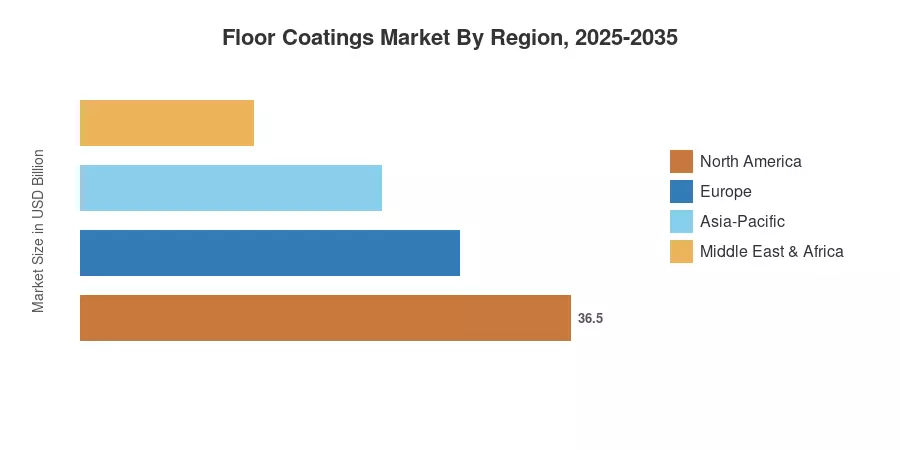
Asia-Pacific commands roughly 41.3% of global Floor Coatings Market revenue, driven by China's warehouse construction boom and India's expanding pharmaceutical manufacturing base. The region also registers the fastest CAGR at 5.14% through 2035. North America holds approximately 24.8% share, buoyed by reshoring-driven industrial construction, while Europe accounts for 22.1%, led by sustainability-linked concrete floor protection mandates. As clean-room and food-grade facility standards tighten worldwide, demand for polyurethane floor coatings and decorative floor coatings in commercial environments will sustain above-average growth across the coming decade.


Key Report Takeaways

• By Product Type

  • Epoxy floor coatings commanded a 53.9% revenue share of the Floor Coatings Market in 2025, reflecting dominant specification in warehousing and manufacturing facilities.
  • Polyurethane floor coatings are forecast to expand at a 5.06% CAGR through 2035, driven by abrasion-resistance requirements in automotive plants.
  • Polyaspartic systems are gaining traction in rapid-return-to-service applications, particularly in retail and healthcare environments.

• By Technology

  • UV-cured formulations captured 37.8% of the Floor Coatings Market share in 2025, reflecting a migration away from solvent-borne surface coating materials.
  • Water-borne systems are expanding at the fastest pace among conventional technologies, supported by regulatory tailwinds in Europe and North America.

• By Region

  • Asia-Pacific accounted for 41.3% of global Floor Coatings Market revenue in 2025, with China and India together representing over 60% of regional demand.
  • North America's industrial floor paints segment is benefiting from over USD 200 billion in committed manufacturing reshoring investments through 2030.


Market Size and Forecast (2021–2035)

MRFR's proprietary estimation framework triangulates supply-side revenue data from publicly listed coatings manufacturers, downstream distributor surveys across 32 countries, and project-level tracking of industrial and commercial construction permits. Historical figures are calibrated to audited annual reports; forecast values apply a compound-growth model adjusted for macroeconomic cyclicality and regulatory phase-in schedules.
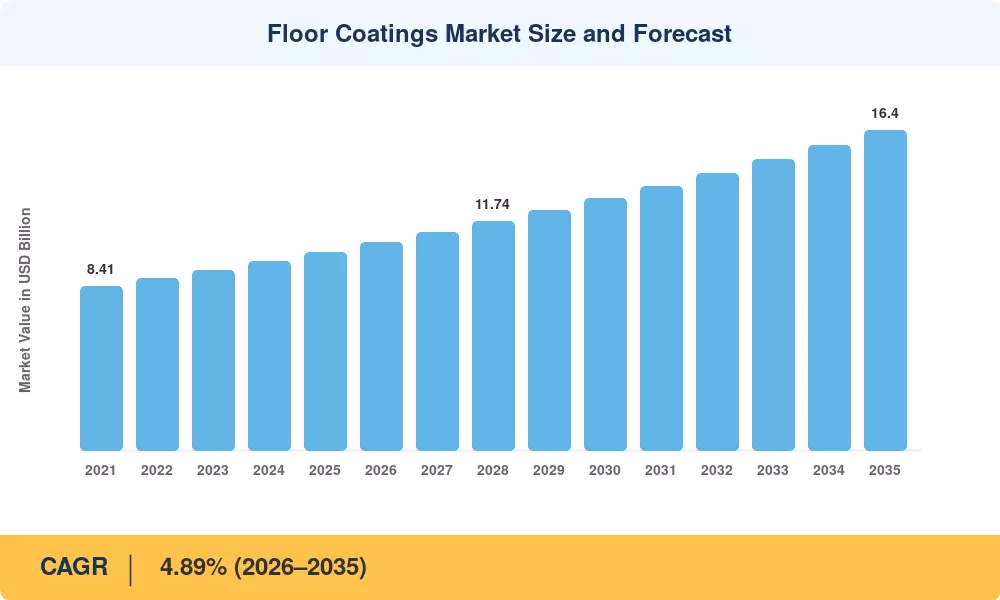
Floor Coatings Market Size and Forecast
Our Impact
Enabled $4.3B Revenue Impact for Fortune 500 and Leading Multinationals
Partnering with 2000+ Global Organizations Each Year
30K+ Citations by Top-Tier Firms in the Industry

Driver Impact Analysis

Driver ~% Impact on CAGR Geographic Relevance Impact Timeline
Cold-chain & logistics real-estate expansion +0.9% Global Short-term (≤2 yr)
EV-battery gigafactory construction wave +0.8% Asia-Pacific, North America Medium-term (2–4 yr)
VOC regulation tightening (EU Decopaint, EPA) +0.7% Europe, North America Medium-term (2–4 yr)
Clean-room & pharmaceutical facility standards +0.6% Asia-Pacific, Europe Long-term (≥4 yr)
UV-cured technology adoption in 24/7 operations +0.5% Global Short-term (≤2 yr)
Retail & hospitality renovation cycle +0.4% North America, Europe Medium-term (2–4 yr)
Antimicrobial and anti slip floor coatings mandates +0.3% Global Long-term (≥4 yr)


Cold-Chain and Logistics Infrastructure Expansion

Global cold-chain logistics capacity expanded by approximately 19% between 2021 and 2024, according to the International Association of Refrigerated Warehouses [2]. These facilities demand antimicrobial epoxy floor coatings rated for continuous thermal cycling between –25 °C and ambient, a specification that has lifted average floor-coating spend per square meter by 35% relative to standard dry warehousing. Amazon, Lineage Logistics, and Americold collectively committed over USD 12 billion to cold-storage construction through 2027, directly enlarging the addressable Floor Coatings Market for high-performance protective flooring systems [2][6].

EV-Battery Gigafactory Build-Out

The global pipeline of announced battery gigafactories exceeded 350 facilities by mid-2024, representing roughly 8 TWh of planned capacity by 2030 [4]. Each gigafactory typically requires 50,000–150,000 m² of conductive or ESD-rated flooring, with specifications favoring polyurethane floor coatings and specialist epoxy floor coatings formulated for chemical splash resistance. BloombergNEF estimates that flooring and surface coating materials represent 2.5–3.0% of total gigafactory fit-out costs, translating into a USD 1.2 Billion cumulative opportunity through 2032 [4].

VOC Regulatory Tightening

Europe's Decopaint Directive revision (effective January 2025) lowered allowable VOC content for industrial floor paints from 140 g/L to 100 g/L, effectively mandating water-borne or UV-cured chemistries for interior applications [3]. The U.S. EPA's proposed Architectural Coatings Rule (2024 draft) follows a similar trajectory. These regulatory shifts reward formulators who have already invested in low-emission concrete floor protection technologies, creating a structural advantage for companies operating vertically integrated water-borne and UV-cured resin platforms [3][13].

Clean-Room and Pharmaceutical Facility Growth

India's Production Linked Incentive (PLI) scheme for pharmaceuticals and medical devices has catalyzed over USD 15 billion in greenfield manufacturing investment since 2021, each facility requiring GMP-grade decorative floor coatings with seamless, non-porous finishes [7]. Similar build-out programs in Vietnam, Indonesia, and Malaysia are extending clean-room floor coating demand across the ASEAN corridor, reinforcing Asia-Pacific's position as the fastest-growing contributor to the global Floor Coatings Market [7][14].


Restraints Impact Analysis

Restraint ~% Impact on CAGR Geographic Relevance Impact Timeline
Raw-material cost volatility (epoxy resins, TDI) –0.5% Global Short-term (≤2 yr)
Certified installer shortage –0.4% North America, Europe Medium-term (2–4 yr)
Supply-chain disruptions for specialty additives –0.3% Global Short-term (≤2 yr)
Lengthy approval cycles for novel chemistries –0.2% Europe Long-term (≥4 yr)
Price sensitivity in emerging-market construction –0.2% South America, MEA Medium-term (2–4 yr)


Raw-Material Cost Volatility

Bisphenol-A epoxy resin prices swung by over 40% between Q1 2022 and Q3 2023, driven by upstream benzene and epichlorohydrin supply disruptions [5]. Toluene diisocyanate (TDI), the primary feedstock for polyurethane floor coatings, experienced similar volatility. These swings compress margins for mid-tier formulators lacking backward integration and introduce bid-price uncertainty that delays project awards — particularly in cost-sensitive commercial floor coatings segments [5][15].

Certified Installer Shortage

The National Association of Corrosion Engineers (NACE) and SSPC jointly estimated in 2024 that North America faces a shortfall of approximately 18,000 qualified floor-coating applicators, a gap expected to widen by 6% annually through 2030 [9]. In Europe, similar constraints affect Germany and the UK. This shortage extends project timelines, increases labor costs, and occasionally forces facility owners to accept lower-specification durable flooring solutions than originally designed [9].

Supply-Chain Fragility for Specialty Additives

UV photoinitiators, antimicrobial silver-ion additives, and conductive carbon-fiber fillers are sourced from a narrow supplier base concentrated in China and Japan [15]. Any disruption — tariff escalation, logistics bottleneck, or plant outage — ripples through the Floor Coatings Market within weeks, as formulators carry limited safety stock of these high-value inputs [15].


Floor Coatings Market Opportunities

Bio-Based and Circular-Economy Resin Platforms

Plant-derived epoxy resins (cashew nutshell liquid, lignin-based systems) already meet 85–90% of the performance of petrochemical-grade resins in concrete floor protection applications [8]. Early mover formulators can leverage premium pricing in sustainability-conscious European and North American markets.


Automated and Robotic Application Systems

Autonomous floor-coating robots that can apply primer, body-coat and topcoat in a single pass directly solve the installation shortage. Companies that license or build robotic applicator platforms can minimize their dependence on labor by 60% and so get into the underserved rural and remote-site segments within the Floor Coatings Market [9].


Emerging-Market Warehouse Modernization

Sub-Saharan Africa and Southeast Asia are seeing a boom in logistics-facility modernization, swapping bare concrete for coated protective flooring solutions. In 2024, Africa’s warehouse building pipeline was more than USD 4.8 billion, while floor coating penetration was less than 30%, indicating a substantial greenfield opportunity [10][14].


Smart and Functional Coatings

From lab to pilot rollout are coatings with IoT-readable wear sensors, self-healing microcapsules, or photocatalytic air-purification layers. These functional surface coating materials are 2-3× more expensive per square meter than standard ornamental floor coatings, therefore providing a value-expansion opportunity for inventive vendors [12].


Data-Driven Specification and Lifecycle Services

Coating manufacturers that integrate digital specification tools, predictive maintenance dashboards, and lifecycle-cost calculators into their sales process can lock in long-term service contracts worth 15–25% of initial project value — a recurring revenue stream largely untapped in the Floor Coatings Market today [11].


Floor Coatings Market Future Outlook

Sustainability and Circular-Economy Formulations

By 2030, the IEA projects that industrial decarbonization mandates will compel coatings manufacturers to disclose Scope 3 emissions across their resin supply chains [8]. Bio-based and recycled-content floor coatings — currently under 3% of global volume — are expected to reach 10–12% penetration by 2035, driven by green-building certification requirements (LEED v5, BREEAM) that award credits for low-carbon protective flooring systems [8][16].

Digitalization of Specification and Application

AI-powered specification engines are already matching facility parameters (traffic type, chemical exposure, temperature range) to optimal coating systems in under 60 seconds, compressing a process that traditionally took weeks of consultant review [11]. Robotic application platforms, paired with real-time thickness and adhesion sensors, will reduce rework rates for epoxy floor coatings by an estimated 40% by 2030, directly addressing the installer shortage restraint [9].

Electrification and Cleanroom Supercycle

The U.S. Department of Energy forecasts that domestic battery manufacturing capacity will reach 1.2 TWh by 2032, while the EU Battery Regulation mandates local cell production for all EV models sold in Europe by 2035 [4][17]. Each facility requires specialized conductive and ESD-rated polyurethane floor coatings, creating a sustained demand wave that underpins above-market-CAGR growth in the Floor Coatings Market for at least the next decade.

Functional and Smart Coating Integration

Self-sensing coatings that monitor structural load, moisture ingress, and surface wear via embedded piezoelectric or capacitive sensors are expected to transition from pilot to commercial deployment by 2028–2030 [12]. These next-generation durable flooring solutions will command premium pricing and open recurring revenue streams through condition-monitoring service contracts, reshaping the competitive landscape toward technology-integrated suppliers.


Floor Coatings Market Segmentation

By Product Type

Segment Key Metric Primary Demand Driver
Epoxy 53.9% revenue share (2025) Warehousing, manufacturing, and food-processing facilities
Polyurethane 5.06% CAGR (2026–2035) Automotive and high-abrasion environments
Polyaspartic USD 0.74 Billion (2025) Rapid-cure retail and healthcare applications
Others 4.52% CAGR (2026–2035) Specialty applications including MMA and acrylic


Epoxy floor coatings dominate the Floor Coatings Market because of their unmatched combination of chemical resistance, adhesion strength, and cost efficiency on concrete substrates. Cold-storage logistics, EV-battery manufacturing, and food-processing facilities all specify epoxy as the baseline chemistry. Polyurethane floor coatings are the fastest-growing product segment by CAGR, favored in automotive assembly where abrasion resistance under forklift traffic outweighs epoxy's chemical-resistance advantage. The segment also benefits from flexible formulations that tolerate thermal movement in outdoor loading docks and parking structures.

By Technology

Segment Key Metric Primary Demand Driver
UV Cured 37.8% revenue share (2025) Zero-downtime 24/7 production environments
Water-Borne 5.21% CAGR (2026–2035) VOC regulation compliance
Solvent-Borne USD 2.48 Billion (2025) Legacy industrial specifications
Powder 4.38% CAGR (2026–2035) Niche metal-substrate applications


UV-cured surface coating materials hold the largest technology share within the Floor Coatings Market, reflecting a decisive shift toward instant-cure systems that allow facilities to resume operations within minutes of application. Water-borne formulations are gaining share at the fastest rate, propelled by the EU Decopaint Directive and EPA draft rules that effectively cap solvent content in industrial floor paints [3][13].

By Floor Material

Segment Key Metric Primary Demand Driver
Concrete 74.8% revenue share (2025) Dominant substrate in industrial and commercial construction
Others (wood, metal, terrazzo) 5.12% CAGR (2026–2035) Renovation and specialty applications


Concrete floor protection accounts for the overwhelming majority of Floor Coatings Market demand because concrete remains the universal substrate in warehouses, factories, and commercial buildings globally. Growth in this segment tracks new industrial construction starts, with Asia-Pacific contributing the largest incremental square-meter volume annually.

By End-Use Industry

Segment Key Metric Primary Demand Driver
Industrial / Institutional 45.1% revenue share (2025) Manufacturing, pharma clean rooms, food processing
Commercial 4.98% CAGR (2026–2035) Retail renovation, hospitality, healthcare
Others (residential, infrastructure) USD 1.42 Billion (2025) Garage and public-infrastructure coatings


The industrial and institutional segment anchors the Floor Coatings Market, driven by stringent hygiene, chemical-resistance, and anti slip floor coatings requirements in pharmaceutical, food-processing, and electronics-manufacturing environments. Commercial applications are growing faster in percentage terms as hospitality chains and healthcare systems upgrade aging facilities with decorative floor coatings that combine aesthetics with durability [11].


Regional Market Share Analysis

Region Key Metric Primary Investment Themes
Asia-Pacific 41.3% revenue share (2025) Gigafactory flooring, cold-chain logistics, pharma clean rooms
North America USD 2.52 Billion (2025) Reshoring, VOC compliance, anti slip floor coatings
Europe 22.1% revenue share (2025) Decopaint compliance, sustainability-linked specs
South America 4.92% CAGR (2026–2035) Warehouse modernization, agro-industrial growth
Middle East & Africa USD 0.55 Billion (2025) Logistics hub development, mega-project flooring
Total USD 10.17 Billion (2025)

The Floor Coatings Market exhibits distinct regional dynamics shaped by construction intensity, regulatory stringency, and raw-material access. Asia-Pacific leads in both absolute size and growth rate, while North America and Europe drive premiumization toward low-VOC and high-performance chemistries.


North America

Country Key Metric Key Driver
United States 78.4% of regional share Reshoring industrial construction; EPA VOC rules
Canada 4.51% CAGR (2026–2035) Cold-storage and food-processing expansion
Mexico USD 0.18 Billion (2025) Nearshoring-driven factory build-out


North America's Floor Coatings Market benefits from over USD 200 billion in committed manufacturing reshoring investments, with semiconductor fabs, EV-battery plants, and pharmaceutical facilities each specifying advanced epoxy floor coatings and polyurethane floor coatings [6]. The U.S. accounts for the lion's share of regional demand, while Mexico's nearshoring corridor along the northern border states is driving rapid growth in industrial floor paints for greenfield automotive and electronics plants.

Europe

Country Key Metric Key Driver
Germany 23.6% of regional share Automotive and chemical-plant refurbishment
United Kingdom 4.68% CAGR (2026–2035) Life-sciences and logistics park expansion
France USD 0.28 Billion (2025) Food-grade and pharmaceutical flooring
Italy 11.2% of regional share Ceramics-industry facility upgrades
Spain 4.55% CAGR (2026–2035) Logistics and cold-chain infrastructure
Nordic Countries USD 0.19 Billion (2025) Strict VOC limits favoring water-borne systems
Russia 7.8% of regional share Heavy-industry and petrochemical plants
Rest of Europe 4.42% CAGR (2026–2035) Eastern European warehouse build-out


The EU's revised Decopaint Directive is the single most influential regulatory catalyst in this region, compelling a market-wide shift to water-borne and UV-cured protective flooring systems [3]. Germany's automotive sector remains the largest end-use vertical for concrete floor protection in Europe, while the UK's life-sciences corridor around the "Golden Triangle" is generating sustained demand for GMP-grade decorative floor coatings.

Asia-Pacific

Country Key Metric Key Driver
China 44.8% of regional share Gigafactory and cold-chain construction
India 5.28% CAGR (2026–2035) PLI-driven pharma and electronics manufacturing
Japan USD 0.52 Billion (2025) Semiconductor fab refurbishment
South Korea 9.6% of regional share Battery and display manufacturing
ASEAN 5.35% CAGR (2026–2035) FDI-driven industrial park development
Rest of Asia-Pacific USD 0.24 Billion (2025) Infrastructure modernization


Asia-Pacific's dominance in the Floor Coatings Market reflects the region's unmatched pace of industrial construction. China alone added over 180 million m² of new logistics warehouse space in 2023, each facility representing a specification opportunity for epoxy floor coatings and durable flooring solutions [4][14]. India's PLI-linked pharmaceutical corridor and ASEAN's electronic-manufacturing hubs ensure that the region will maintain the highest growth rate globally through 2035.

South America

Country Key Metric Key Driver
Brazil 62.5% of regional share Agro-industrial and logistics expansion
Argentina 4.78% CAGR (2026–2035) Mining and food-processing facilities
Rest of South America USD 0.09 Billion (2025) Warehouse modernization


Brazil's agro-industrial complex and expanding e-commerce logistics network drive the bulk of South American demand for industrial floor paints and concrete floor protection. Currency volatility and import dependence for specialty resins remain headwinds, but rising domestic production of water-borne formulations is gradually reducing cost barriers [10].

Middle East & Africa

Country Key Metric Key Driver
Saudi Arabia 31.4% of regional share Vision 2030 mega-projects
UAE 5.15% CAGR (2026–2035) Logistics hub and free-zone development
South Africa USD 0.07 Billion (2025) Mining and manufacturing plant upgrades
Egypt 4.88% CAGR (2026–2035) New Administrative Capital construction
Rest of MEA 26.3% of regional share Infrastructure modernization


Saudi Arabia's NEOM and Red Sea mega-developments are generating large-scale demand for decorative floor coatings and anti slip floor coatings in hospitality and commercial facilities. Across Sub-Saharan Africa, modern logistics facilities increasingly specify surface coating materials for concrete floors that were previously left uncoated, presenting a significant greenfield opportunity for the Floor Coatings Market [10].


Floor Coatings Market By Region, 2025-2035

Competitive Benchmarking

The Floor Coatings Market exhibits low concentration, with an estimated HHI below 600 and the top five players collectively controlling approximately 28–34% of global revenue. The fragmented structure reflects strong regional and local specialists who compete on application expertise, rapid turnaround, and localized regulatory knowledge. Scale advantages accrue primarily through vertically integrated resin production and established applicator networks.

Company Est. Revenue Share Range Key Offerings for Floor Coatings Market Strategic Positioning
Sherwin-Williams ~6–9% Epoxy, polyurethane, and water-borne floor systems Vertically integrated resin and distribution network
PPG Industries ~5–8% High-performance industrial floor paints, anti slip systems Global OEM and maintenance coatings leader
RPM International ~4–7% Stonhard, Tremco brands; seamless flooring Strong institutional and pharma channel
BASF SE ~3–6% Polyurethane and MMA floor coatings; Ucrete brand Chemical integration and R&D scale
Sika AG ~3–6% Concrete floor protection, decorative systems Construction-chemicals channel dominance
Akzo Nobel ~3–5% International brand industrial coatings Sustainability leadership, European footprint
Nippon Paint Holdings ~2–5% Protective and decorative floor coatings Asia-Pacific market penetration
Asian Paints ~2–4% Industrial and commercial flooring solutions India and South Asia distribution depth
Axalta Coating Systems ~2–4% Performance coatings for automotive and industrial Technology-driven formulation capability
Teknos Group ~1–3% Industrial floor paints, powder coatings Nordic sustainability standards expertise


Recent News & Developments


  • BASF and Sika AG (March 2025): BASF and Sika AG have launched a new amine building block for the curing of epoxy resins, which is available on the market as BASF’s Baxxodur EC 151. This product is suitable for flooring applications in production plants, storage and assembly halls and parking decks.


  • Nippon Paint (April 2024): Expanded its Southeast Asian distribution network to cover six ASEAN countries, targeting rapid growth in decorative floor coatings and concrete floor protection for logistics facilities [14].


Floor Coatings Market Report Scope

Parameter Detail
Market Scope Global Floor Coatings Market — product type, technology, floor material, end-use industry, geography
Study Period 2021–2035
CAGR (Forecast) 4.89% (2026–2035)
Market Size (2025) USD 10.17 Billion
Market Size (2035) USD 16.40 Billion
Fastest Growing Segment Water-borne technology (by CAGR); Epoxy (by absolute value)
Companies Profiled 10 (Sherwin-Williams, PPG, RPM International, BASF, Sika, Akzo Nobel, Nippon Paint, Asian Paints, Axalta, Teknos)
Valuation Currency USD Billion


FAQs

What is the typical installed cost per square meter for epoxy versus polyurethane floor coatings in an industrial setting?

Installed costs for epoxy systems range from USD 25–45/m² depending on thickness and substrate prep, while polyurethane floor coatings typically run USD 35–60/m² due to higher raw-material costs and multi-coat requirements[5].

How do UV-cured coatings compare to water-borne systems for facilities that operate around the clock?

UV-cured systems allow foot traffic within minutes of application, making them ideal for 24/7 plants. Water-borne alternatives require 4–8 hours of cure time but carry lower equipment costs [4].

Which certification standards should buyers specify when procuring anti slip floor coatings for food-processing facilities?

Buyers should reference USDA acceptance, NSF/ANSI 51 for food contact, and ASTM D2047 for slip resistance. These ensure compliance with both food-safety and workplace-safety regulations [12][13].

How are conductive floor coatings specified differently for semiconductor clean rooms versus EV-battery dry rooms?

Semiconductor fabs require surface resistivity of 10⁶–10⁹ ohms under ISO Class 5 particulate limits, while battery dry rooms prioritize moisture resistance below 1% dew point alongside ESD dissipation [4][21].

What procurement strategies can reduce exposure to raw-material price volatility in the Floor Coatings Market?

Locking in resin-supply contracts with 12–18-month pricing windows and qualifying dual-source suppliers for TDI and bisphenol-A epoxy feedstocks significantly reduces cost exposure [5][15].

Are bio-based floor coatings durable enough for heavy-traffic industrial environments today?

Current bio-based epoxy formulations achieve 85–90% of petrochemical-grade abrasion and chemical resistance. They are suitable for medium-traffic commercial spaces but not yet for heavy forklift zones [8].

How does the Floor Coatings Market opportunity differ between retrofit projects and new-build construction?

Retrofit projects typically yield 20–30% higher coating spend per square meter due to surface preparation costs, while new-build projects offer larger volume but more competitive pricing[11].


Author
Author
Author Profile
Chitranshi Jaiswal LinkedIn
Team Lead - Research
Chitranshi is a Team Leader in the Chemicals & Materials (CnM) and Energy & Power (EnP) domains, with 6+ years of experience in market research. She leads and mentors teams to deliver cross-domain projects that equip clients with actionable insights and growth strategies. She is skilled in market estimation, forecasting, competitive benchmarking, and both primary & secondary research, enabling her to turn complex data into decision-ready insights. An engineer and MBA professional, she combines technical expertise with strategic acumen to solve dynamic market challenges. Chitranshi has successfully managed projects that support market entry, investment planning, and competitive positioning, while building strong client relationships. Certified in Advanced Excel & Power BI she leverages data-driven approaches to ensure accuracy, clarity, and impactful outcomes.

Research Approach


Secondary Research

The secondary research process involved comprehensive analysis of regulatory databases, industry association publications, technical standards repositories, and authoritative construction and coatings organizations. Key sources included the US Environmental Protection Agency (EPA), Occupational Safety and Health Administration (OSHA), European Chemicals Agency (ECHA), REACH Regulation Database, American Coatings Association (ACA), British Coatings Federation (BCF), World Coatings Council (WCC), China National Coatings Industry Association (CNCIA), ASTM International (D-01 Committee on Paint and Related Coatings), ISO Technical Committee 35 (Paints and Varnishes), US Census Bureau Construction Spending Reports, Eurostat Construction Database, US Bureau of Transportation Statistics (for parking infrastructure), National Bureau of Statistics of China, International Monetary Fund (IMF) Construction Outlook, World Bank Infrastructure Development Reports, and national construction ministry databases from key markets. These sources were used to collect raw material pricing data, regulatory compliance standards (VOC emissions, chemical safety), industrial construction metrics, commercial flooring installation statistics, and environmental technology adoption trends for epoxy, polyurethane, polyaspartic, cementitious, and acrylic coating technologies.


Primary Research

Qualitative and quantitative insights were obtained by interviewing supply-side and demand-side stakeholders during the primary research process. CEOs, VPs of Manufacturing, leaders of R&D, regulatory compliance officers, and commercial directors from specialty chemicals companies, coating formulators, resin manufacturers, and raw material suppliers comprised supply-side sources. The demand-side sources comprised procurement directors from construction firms, facilities managers from warehouse and logistics operators, chief engineers from manufacturing plants, architects who specialize in commercial flooring, and contractors who specialize in industrial floor systems. Market segmentation was validated across water-based, solvent-based, high solids, and UV-cured technologies through primary research. Additionally, product development timelines were confirmed, and insights regarding specification patterns, bid pricing strategies, and project-based procurement dynamics were obtained.

Primary Respondent Breakdown:

By Designation: C-level Primaries (28%), Director Level (35%), Others (37%)

By Region: North America (32%), Europe (30%), Asia-Pacific (28%), Rest of World (10%)


Market Size Estimation

Global market valuation was derived through revenue mapping and application volume analysis. The methodology included:

Identification of over 50 significant manufacturers in North America, Europe, Asia-Pacific, Latin America, and the Middle East and Africa

Product mapping across epoxy, polyurethane, polyaspartic, acrylic, and cementitious coating categories

Technology segmentation analysis covering water-based, solvent-based, high solids, and UV-cured formulations

End-use industry analysis spanning residential flooring systems, commercial parking structures, warehouse facilities, and manufacturing plants

Coverage of manufacturers representing 72-78% of global market share in 2024

Extrapolation using bottom-up (square footage coated × coating thickness × ASP by application) and top-down (manufacturer revenue validation) approaches to derive segment-specific valuations across industrial, commercial, residential, institutional, and retail application sectors

Download Free Sample

Kindly complete the form below to receive a free sample of this Report

Download PDF ×

We do not share your information with anyone. However, we may send you emails based on your report interest from time to time. You may contact us at any time to opt-out.