Download Free Sample
Kindly complete the form below to receive a free sample of this Report
Fluorescence Guided Surgery System Market Research Report By Application (Cancer Surgery, Neurosurgery, Ophthalmic Surgery, Cardiac Surgery), By Type (Radioactive Tracers, Near-Infrared (NIR) Tracers, Visible Light Tracers), By End User (Hospitals, Academic Institutions, Research Laboratories, Clinical Trials), By Imaging Modalities (Fluorescence Endoscopy, Fluorescence Microscopy, Fluorescence-Guided Laparoscopy), By Target Population (Patients with Cancer, Neurosurgical Patients, Ophthalmic Patients, Cardiac Patients) and By Regional (North America, Europe, South America, Asia Pacific, Middle East and Africa) - Growth & Industry Forecast 2025 To 2035
As per MRFR analysis, the Fluorescence Guided Surgery System Size was estimated at 1893.55 USD Million in 2024. The Fluorescence Guided Surgery System industry is projected to grow from 2019.89 in 2025 to 3853.29 by 2035, exhibiting a compound annual growth rate (CAGR) of 6.67% during the forecast period 2025 - 2035.
The Fluorescence Guided Surgery System Market is poised for substantial growth driven by technological advancements and increasing demand for minimally invasive procedures.
| 2024 Market Size | 1893.55 (USD Million) |
| 2035 Market Size | 3853.29 (USD Million) |
| CAGR (2025 - 2035) | 6.67% |
The Fluorescence Guided Surgery System Market is currently experiencing a notable evolution, driven by advancements in imaging technologies and a growing emphasis on precision medicine. Surgeons increasingly rely on fluorescence imaging to enhance visualization during procedures, which appears to improve surgical outcomes and reduce complications. This market is characterized by a diverse range of applications, including oncology, neurosurgery, and cardiovascular surgery, where the ability to differentiate between healthy and diseased tissues is paramount. As healthcare providers seek to adopt innovative solutions, the integration of fluorescence-guided systems into surgical practices is likely to expand, reflecting a broader trend towards minimally invasive techniques and enhanced patient safety. Moreover, the increasing prevalence of cancer and other complex diseases is propelling demand for effective surgical interventions. The Fluorescence Guided Surgery System Market seems poised for growth as stakeholders, including hospitals and surgical centers, invest in advanced technologies that facilitate real-time imaging. Collaborations between technology developers and healthcare institutions may further accelerate the adoption of these systems, fostering an environment where surgical precision is prioritized. As the market continues to evolve, it is essential to monitor regulatory developments and technological advancements that could shape its trajectory in the coming years.
Recent innovations in imaging technologies are enhancing the capabilities of fluorescence guided surgery systems. These advancements enable clearer visualization of tissues, which may lead to improved surgical precision and outcomes.
There is an increasing preference for minimally invasive surgical techniques among patients and healthcare providers. Fluorescence guided surgery systems align with this trend by offering enhanced visualization while reducing recovery times and complications.
The shift towards personalized medicine is influencing the Fluorescence Guided Surgery System Market. Tailoring surgical approaches to individual patient needs may enhance treatment efficacy and patient satisfaction.
The increasing incidence of cancer worldwide is a primary driver for the Global Fluorescence Guided Surgery System Market Industry. As cancer rates continue to rise, the demand for effective surgical interventions is escalating. Fluorescence-guided surgery offers enhanced visualization of malignant tissues, which is crucial for achieving complete tumor resection. This method has been shown to improve surgical outcomes and reduce recurrence rates. The World Health Organization indicates that cancer cases are expected to rise significantly, necessitating advanced surgical techniques. Consequently, the market is poised for substantial growth, aligning with the urgent need for innovative solutions in cancer treatment.
The Global Fluorescence Guided Surgery System Market Industry is experiencing rapid technological advancements that enhance surgical precision and outcomes. Innovations in imaging technologies, such as near-infrared fluorescence imaging, allow surgeons to visualize tumors and critical structures in real-time. This capability significantly reduces the likelihood of residual tumor cells post-surgery, thereby improving patient prognosis. As a result, the market is projected to grow from 1.89 USD Billion in 2024 to 3.85 USD Billion by 2035, reflecting a compound annual growth rate (CAGR) of 6.68% from 2025 to 2035. Such advancements are likely to drive adoption across various surgical specialties globally.
Government support and funding for cancer research and surgical innovations play a crucial role in the growth of the Global Fluorescence Guided Surgery System Market Industry. Various health agencies are investing in research initiatives aimed at improving surgical outcomes through advanced imaging technologies. This financial backing not only facilitates the development of new systems but also encourages clinical trials that validate their efficacy. As governments prioritize healthcare advancements, the market is likely to benefit from increased funding and resources, fostering innovation and adoption of fluorescence-guided surgery systems in clinical practice.
There is a growing awareness and acceptance of fluorescence-guided surgical techniques among healthcare professionals and patients, which is positively influencing the Global Fluorescence Guided Surgery System Market Industry. Educational initiatives and clinical evidence demonstrating the benefits of fluorescence imaging in surgery are fostering greater trust in these technologies. Surgeons are increasingly recognizing the advantages of improved visualization and reduced complications. This shift in perception is likely to lead to higher adoption rates, particularly in oncology and neurosurgery. As healthcare providers embrace these advancements, the market is expected to expand, driven by the demand for safer and more effective surgical options.
The Global Fluorescence Guided Surgery System Market Industry is witnessing significant expansion in emerging economies, where healthcare infrastructure is rapidly improving. Countries in Asia-Pacific and Latin America are increasingly adopting advanced surgical technologies, driven by rising healthcare expenditures and a growing middle class. As these regions enhance their medical facilities and training programs, the demand for fluorescence-guided surgery systems is expected to rise. This trend is indicative of a broader shift towards modern surgical practices, which could lead to increased market penetration and growth opportunities for manufacturers in these regions.
In the Fluorescence Guided Surgery System Market, application segmentation reveals that oncology holds the largest share, driven by the increasing incidence of cancer globally. The demand for precise tumor localization during surgeries is pushing the adoption of fluorescence-guided systems in oncological procedures. Neurosurgery follows as a significant segment, increasingly being recognized for enhancing visualization during complex brain surgeries, thereby gaining traction among healthcare providers and patients alike.
Oncology: Dominant vs. Neurosurgery: Emerging
Oncology remains the dominant application in the fluorescence-guided surgery market, characterized by extensive research and clinical adoption due to its effectiveness in real-time tumor imaging. In contrast, neurosurgery is emerging as a rapidly growing sector, fueled by technological advancements that enhance visualization during intricate brain procedures. The refinement of fluorescent imaging agents and the development of minimally invasive techniques are contributing to its prominence. Both segments are witnessing increased investments and innovations, with oncology leading in volume while neurosurgery captures a larger growth rate.
The Fluorescence Guided Surgery System market showcases a diverse distribution of end-use segments, with hospitals leading in market share due to their larger surgical volumes and budgets. Hospitals utilize these systems for a variety of surgical procedures, enhancing precision and patient outcomes. Following them, ambulatory surgical centers are gaining traction in the market as they adopt fluorescence imaging technologies to improve operational efficiencies and patient safety in outpatient procedures, signifying a shift towards minimally invasive surgery practices.
In terms of growth trends, the ambulatory surgical centers segment is emerging as the fastest-growing due to the increasing demand for outpatient surgeries and advancements in surgical techniques. The focus on patient-centered care, alongside cost-efficiency compared to traditional hospital settings, propels this growth. Research institutions and specialty clinics also play vital roles, but their segments grow at a slower pace compared to hospitals and ambulatory centers, primarily focusing on specialized applications and experimental surgeries.
Hospitals (Dominant) vs. Specialty Clinics (Emerging)
Hospitals represent the dominant players in the Fluorescence Guided Surgery System market, leveraging their established infrastructures, extensive surgical offerings, and access to larger patient populations. Their ability to invest in advanced technologies makes them key adopters of fluorescence imaging systems, utilizing these innovations to improve surgical precision and outcomes across various specialties. On the other hand, specialty clinics, though considered emerging players, are carving out their niche by focusing on specific surgical procedures that benefit greatly from fluorescence guidance, such as oncology and neurosurgery. These clinics are often characterized by higher customization and expertise in targeted areas, allowing them to offer specialized services that attract patients seeking advanced surgical options. Their market presence is expected to grow, particularly with increased emphasis on minimally invasive techniques.
The Fluorescence Guided Surgery System market showcases a diverse array of technologies, with Near-Infrared Fluorescence Imaging holding the largest share among segment values. This technology is favored for its ability to provide real-time imaging capabilities, significantly improving surgical precision. Fluorescent Dyes, while currently a smaller segment, are rapidly gaining traction due to their innovative applications in targeted imaging, making them an attractive choice for many surgical applications.
As healthcare professionals increasingly adopt advanced surgical techniques, the demand for robust imaging modalities continues to rise. The push for minimally invasive surgeries and the integration of technology in operating rooms are significant drivers fueling growth in the Fluorescent Dyes segment. Additionally, technological advancements and an increasing number of clinical applications for both Near-Infrared Fluorescence Imaging and Fluorescent Dyes are likely to reshape the market landscape in the coming years.
Near-Infrared Fluorescence Imaging (Dominant) vs. Optical Imaging Systems (Emerging)
Near-Infrared Fluorescence Imaging is currently the dominant technology in the Fluorescence Guided Surgery System market due to its unparalleled capability to visualize blood flow and tissue perfusion in real time. This technology not only enhances surgical outcomes but also facilitates precise tumor identification, translating to improved patient safety and recovery times. Meanwhile, Optical Imaging Systems are emerging as a promising alternative, driven by advances in optics and imaging technology. These systems offer unique advantages, including cost-effectiveness and versatility in various surgical procedures. As healthcare systems and surgical environments evolve, both technologies are positioned to play pivotal roles, though Near-Infrared Fluorescence Imaging remains at the forefront in terms of implementation and effectiveness.
In the Fluorescence Guided Surgery System Market, the segment of Fluorescence Imaging Systems holds the largest market share, primarily due to its crucial role in enhancing visualization during surgical procedures. This technology allows surgeons to identify and remove cancerous tissues with greater precision. Conversely, Surgical Instruments have emerged as the fastest-growing segment, driven by advancements in technology and an increasing preference for minimally invasive surgical techniques that demand specialized instruments optimized for fluorescence guidance.
Surgical Instruments: Dominant vs. Software Solutions: Emerging
Fluorescence Imaging Systems are vital in modern surgical procedures, enabling improved outcomes through enhanced tissue visualization. With the increasing focus on patient safety and surgical efficacy, these systems have seen robust adoption in clinical settings. In contrast, Software Solutions are an emerging force in the market, complementing hardware innovations by offering data analysis, image processing, and integration capabilities with existing surgical tools. The growth in Software Solutions signifies an essential transition toward more data-driven approaches in surgical planning and intraoperative guidance, making them a valuable asset for enhancing overall surgical workflows.
In the Fluorescence Guided Surgery System market, adult patients represent the largest segment, capturing a significant portion of the overall market share. This dominance is primarily attributed to the higher incidence of surgeries performed on adults compared to pediatric and geriatric patients. Adult patients typically require more complex and varied surgical interventions, leading to increased adoption of fluorescence guided systems that improve surgical outcomes.
On the other hand, the pediatric patient segment is emerging as the fastest-growing area within this market. The rise in the availability of cutting-edge fluorescence guided surgical systems specifically designed for children is fueling this growth. Moreover, advancements in pediatric surgeries and the increasing awareness of the advantages of fluorescence guidance are contributing to an uptick in adoption rates among healthcare providers catering to younger populations.
Adult Patients (Dominant) vs. Geriatric Patients (Emerging)
The adult patient segment remains dominant in the Fluorescence Guided Surgery System market due to the high volume of surgical procedures performed and the complexity of adult health issues that necessitate advanced surgical technologies. Conversely, the geriatric patient segment is emerging, driven by the increasing elderly population and their associated medical needs. Geriatric patients often experience multiple health issues requiring intricate surgical procedures, thus creating a demand for fluorescence guided systems. The technological advancements that cater to the unique needs of elderly patients, including minimally invasive methods and enhanced visualization, are key factors in appealing to this demographic. The market positioning of fluorescence guided systems for geriatric patients is expanding as healthcare facilities seek to cater to this growing age group.
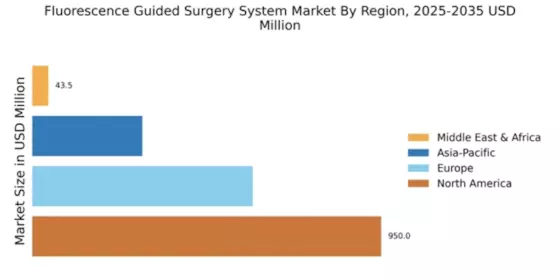
North America is poised to maintain its leadership in the Fluorescence Guided Surgery System market, holding a significant market share of $950.0M in 2024. The region's growth is driven by advanced healthcare infrastructure, increasing adoption of minimally invasive surgeries, and supportive regulatory frameworks. The demand for innovative surgical solutions is further fueled by rising healthcare expenditures and a growing aging population, which necessitates more effective surgical interventions. The competitive landscape in North America is robust, featuring key players such as Medtronic, Stryker, and Novadaq Technologies. These companies are at the forefront of technological advancements, focusing on enhancing surgical outcomes through fluorescence imaging. The presence of established healthcare systems in the US and Canada provides a conducive environment for market expansion, ensuring that North America remains a focal point for innovation in surgical technologies.
Europe is witnessing a growing interest in Fluorescence Guided Surgery Systems, with a market size of $600.0M projected for 2025. The region benefits from stringent regulatory standards that promote the adoption of advanced surgical technologies. Increasing investments in healthcare infrastructure and a rising prevalence of chronic diseases are key drivers of market growth. Additionally, the emphasis on patient safety and improved surgical outcomes is pushing healthcare providers to adopt fluorescence imaging techniques. Leading countries in Europe, such as Germany and the UK, are home to major players like Karl Storz and Olympus Corporation. The competitive landscape is characterized by a mix of established firms and innovative startups, all striving to enhance surgical precision. The European market is also supported by collaborative efforts between healthcare providers and technology developers, fostering an environment conducive to growth and innovation.
The Asia-Pacific region is emerging as a significant player in the Fluorescence Guided Surgery System market, with a projected size of $300.0M by 2025. The growth is driven by increasing healthcare investments, a rising number of surgical procedures, and a growing awareness of advanced surgical technologies. Countries like Japan and China are leading the charge, supported by government initiatives aimed at improving healthcare access and quality. The demand for minimally invasive surgeries is also on the rise, further propelling market growth. The competitive landscape in Asia-Pacific is evolving, with key players such as Hamamatsu Photonics and Olympus Corporation expanding their presence. The region is characterized by a mix of local and international companies, all vying for market share. As healthcare systems modernize and the population ages, the demand for fluorescence-guided surgical solutions is expected to increase, making Asia-Pacific a vital market for future growth.
The Middle East and Africa region is in the nascent stages of adopting Fluorescence Guided Surgery Systems, with a market size of $43.55M anticipated by 2025. The growth is hindered by limited healthcare infrastructure and varying levels of regulatory support across countries. However, increasing investments in healthcare and a rising prevalence of surgical procedures are expected to drive demand. Governments are beginning to recognize the importance of advanced surgical technologies, which may lead to improved regulatory frameworks in the future. Countries like South Africa and the UAE are at the forefront of this market, with efforts to enhance healthcare services. The competitive landscape is still developing, with a few key players beginning to establish a foothold. As awareness of fluorescence imaging grows, the region is likely to see increased collaboration between healthcare providers and technology developers, paving the way for future advancements in surgical solutions.
The Fluorescence Guided Surgery System Market is currently characterized by a dynamic competitive landscape, driven by technological advancements and increasing demand for precision in surgical procedures. Key players such as Medtronic (US), Stryker (US), and Karl Storz (DE) are at the forefront, each adopting distinct strategies to enhance their market presence. Medtronic (US) focuses on innovation through the development of advanced imaging technologies, while Stryker (US) emphasizes strategic partnerships to expand its product offerings. Karl Storz (DE) is leveraging its expertise in endoscopic technology to integrate fluorescence imaging into its surgical systems, thereby enhancing operational efficiency and patient outcomes. Collectively, these strategies contribute to a competitive environment that is increasingly centered around technological innovation and collaborative growth.In terms of business tactics, companies are increasingly localizing manufacturing to reduce costs and optimize supply chains. This approach not only enhances responsiveness to market demands but also mitigates risks associated with global supply chain disruptions. The market structure appears moderately fragmented, with several key players holding substantial market shares, yet leaving room for emerging companies to carve out niches. The collective influence of these established players shapes the competitive dynamics, fostering an environment where innovation and operational excellence are paramount.
In November Medtronic (US) announced the launch of its latest fluorescence imaging system, which integrates artificial intelligence (AI) to enhance real-time surgical decision-making. This strategic move is significant as it positions Medtronic (US) as a leader in the integration of AI within surgical technologies, potentially improving surgical outcomes and operational efficiencies. The introduction of this system is likely to attract attention from healthcare providers seeking cutting-edge solutions to enhance patient care.
In October Stryker (US) entered into a strategic partnership with a leading imaging technology firm to co-develop next-generation fluorescence imaging systems. This collaboration is indicative of Stryker's (US) commitment to expanding its technological capabilities and product portfolio. By leveraging the expertise of its partner, Stryker (US) aims to accelerate the development of innovative solutions that meet the evolving needs of surgeons and healthcare facilities, thereby reinforcing its competitive position in the market.
In September Karl Storz (DE) unveiled a new line of fluorescence-guided surgical instruments designed specifically for minimally invasive procedures. This launch reflects Karl Storz's (DE) strategic focus on enhancing surgical precision and reducing recovery times for patients. By introducing specialized instruments that cater to the growing demand for minimally invasive techniques, Karl Storz (DE) is likely to strengthen its market share and appeal to a broader range of surgical specialties.
As of December the competitive trends within the Fluorescence Guided Surgery System Market are increasingly defined by digitalization, sustainability, and the integration of AI technologies. Strategic alliances are playing a crucial role in shaping the current landscape, enabling companies to pool resources and expertise to drive innovation. Looking ahead, it is anticipated that competitive differentiation will evolve, with a pronounced shift from price-based competition to a focus on technological innovation, reliability in supply chains, and enhanced patient outcomes. This evolution underscores the importance of adaptability and forward-thinking strategies in maintaining a competitive edge in this rapidly advancing market.






Key factors driving market growth include the rising prevalence of cancer, increasing adoption of minimally invasive surgical procedures, and technological advancements in fluorescence imaging techniques.
Recent news developments include the launch of new products such as Stryker's Firefly Fluorescence Imaging System and the approval of novel imaging agents like indocyanine green (ICG) for use in fluorescence-guided surgery. Moreover, strategic partnerships and collaborations between market players are expected to fuel market expansion.
The Fluorescence Guided Surgery System Market is projected to grow at a 6.67% CAGR from 2025 to 2035, driven by technological advancements, increasing surgical applications, and rising demand for minimally invasive procedures.
New opportunities lie in:
By 2035, the market is expected to achieve substantial growth, solidifying its role in modern surgical practices.
| MARKET SIZE 2024 | 1893.55(USD Million) |
| MARKET SIZE 2025 | 2019.89(USD Million) |
| MARKET SIZE 2035 | 3853.29(USD Million) |
| COMPOUND ANNUAL GROWTH RATE (CAGR) | 6.67% (2025 - 2035) |
| REPORT COVERAGE | Revenue Forecast, Competitive Landscape, Growth Factors, and Trends |
| BASE YEAR | 2024 |
| Market Forecast Period | 2025 - 2035 |
| Historical Data | 2019 - 2024 |
| Market Forecast Units | USD Million |
| Key Companies Profiled | Medtronic (US), Stryker (US), Karl Storz (DE), Olympus Corporation (JP), Hamamatsu Photonics (JP), Novadaq Technologies (CA), PerkinElmer (US), NDS Surgical Imaging (US), Leica Microsystems (DE) |
| Segments Covered | Application, End Use, Technology, Product Type, Patient Type |
| Key Market Opportunities | Integration of artificial intelligence in Fluorescence Guided Surgery System enhances precision and efficiency in surgical procedures. |
| Key Market Dynamics | Technological advancements and regulatory changes drive the adoption of Fluorescence Guided Surgery Systems in surgical procedures. |
| Countries Covered | North America, Europe, APAC, South America, MEA |
As of 2024, the market valuation was 1893.55 USD Million.
The market is projected to reach 3853.29 USD Million by 2035.
The expected CAGR for the market from 2025 to 2035 is 6.67%.
The Oncology segment is expected to generate between 500.0 and 1000.0 USD Million.
Hospitals are projected to account for 800.0 to 1600.0 USD Million, significantly higher than ambulatory surgical centers at 400.0 to 800.0 USD Million.
Near-Infrared Fluorescence Imaging and Optical Imaging Systems are key technologies, with projected revenues of 500.0 to 1000.0 USD Million and 600.0 to 1200.0 USD Million, respectively.
Prominent players include Medtronic, Stryker, and Karl Storz, among others.
Surgical instruments are expected to generate between 600.0 and 1200.0 USD Million.


Kindly complete the form below to receive a free sample of this Report

“This is really good guys. Excellent work on a tight deadline. I will continue to use you going forward and recommend you to others. Nice job”


“Thanks. It’s been a pleasure working with you, please use me as reference with any other Intel employees.”


“Thanks for sending the report it gives us a good global view of the Betaïne market.”


“Thank you, this will be very helpful for OQS.”


“We found the report very insightful! we found your research firm very helpful. I'm sending this email to secure our future business.”


“I am very pleased with how market segments have been defined in a relevant way for my purposes (such as "Portable Freezers & refrigerators" and "last-mile"). In general the report is well structured. Thanks very much for your efforts.”


“I have been reading the first document or the study, ,the Global HVAC and FP market report 2021 till 2026. Must say, good info! I have not gone in depth at all parts, but got a good indication of the data inside!”


“We got the report in time, we really thank you for your support in this process. I also thank to all of your team as they did a great job.”


“The Automotive 48V ECU Components Procurement Intelligence Study” was a complex project, but the Market Research Future (MRFR) team handled it with quality, agility, and customer-centricity. They delivered all requested data on time and within the agreed scope. The team, including Shubhendra Anand and Rahul Gotadki, was always readily available to clarify questions and swiftly implement necessary adjustments, driving the project to a successful conclusion within a very demanding timeframe.
I would also like to specifically commend Akshay Agarwal for his responsiveness and support at every stage—from our initial inquiry on May 6th through to final delivery on June 18th. His dedication made the entire process seamless.”



