×
Request Free Sample ×

Kindly complete the form below to receive a free sample of this Report

* Please use a valid business email

Leading companies partner with us for data-driven Insights

clients tt-cursor
Hero Background

Foldable Container Market

ID: MRFR/PCM/23284-HCR
111 Pages
Snehal Singh
October 2025

Foldable Container Market Research Report: By Material (Plastic, Metal, Paperboard), By Capacity (Up to 1,000 Liters, 1,000 to 2,000 Liters, Over 2,000 Liters), By Application (Industrial & Automotive, Food & Beverage, Pharmaceutical & Chemical, Construction & Building), By Design Type (Collapsible, Rigid, Semi-Rigid), By End-User (Logistics & Transportation, Manufacturing, Retail & Distribution, Waste Management) and By Regional (North America, Europe, South America, Asia-Pacific, Middle East and Africa) - Forecast t... read more

Share:
Download PDF ×

We do not share your information with anyone. However, we may send you emails based on your report interest from time to time. You may contact us at any time to opt-out.

Foldable Container Market Infographic
Purchase Options

Foldable Container Market Summary

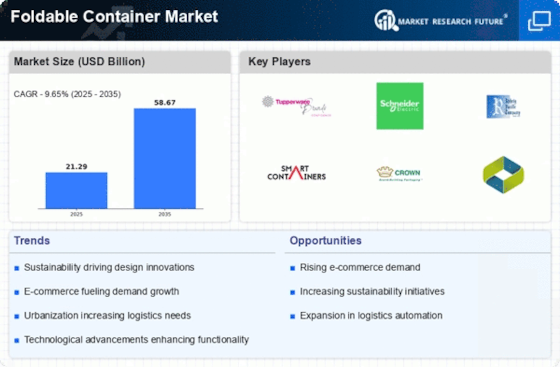
As per MRFR analysis, the Foldable Container Market Size was estimated at 21.29 USD Billion in 2024. The Foldable Container industry is projected to grow from 23.35 USD Billion in 2025 to 58.67 USD Billion by 2035, exhibiting a compound annual growth rate (CAGR) of 9.65 during the forecast period 2025 - 2035.

Key Market Trends & Highlights

The Foldable Container Market is poised for substantial growth driven by sustainability and technological advancements.

  • The market is increasingly oriented towards sustainability, with a notable emphasis on eco-friendly materials and practices.
  • Technological innovations are enhancing the functionality and durability of foldable containers, appealing to diverse industries.
  • North America remains the largest market, while the Asia-Pacific region is emerging as the fastest-growing area for foldable containers.
  • The expansion of e-commerce and cost efficiency are key drivers propelling the demand for foldable containers, particularly in the plastic and over 2,000 liters segments.

Market Size & Forecast

2024 Market Size 21.29 (USD Billion)
2035 Market Size 58.67 (USD Billion)
CAGR (2025 - 2035) 9.65%

Major Players

Tupperware Brands Corporation (US), Schneider Electric (FR), Rehrig Pacific Company (US), Smart Containers (CH), Crown Holdings, Inc. (US), Schoeller Allibert (NL), A. P. Moller - Maersk (DK), Kuehne + Nagel (CH), IFCO Systems (DE)

Foldable Container Market Trends

The Foldable Container Market is currently experiencing a notable transformation, driven by the increasing demand for efficient and sustainable packaging solutions. As businesses seek to optimize logistics and reduce costs, foldable containers offer a practical alternative to traditional packaging. These containers are designed to be lightweight and space-saving, which not only enhances storage efficiency but also minimizes transportation expenses. Furthermore, the growing emphasis on environmental sustainability is prompting companies to adopt foldable containers, as they are often made from recyclable materials and can significantly reduce waste. This shift towards eco-friendly practices appears to be a key factor influencing market dynamics. In addition to sustainability, technological advancements are playing a crucial role in shaping the Foldable Container Market. Innovations in materials and design are leading to the development of more durable and versatile containers that can cater to various industries. The rise of e-commerce and the need for efficient supply chain management are further propelling the adoption of foldable containers. As businesses continue to adapt to changing consumer preferences and operational challenges, the market is likely to witness continued growth. Overall, the Foldable Container Market seems poised for expansion, driven by a combination of sustainability, technological innovation, and evolving market demands.

Sustainability Focus

The emphasis on eco-friendly practices is increasingly influencing the Foldable Container Market. Companies are prioritizing sustainable materials and designs, which align with consumer preferences for environmentally responsible products.

Technological Advancements

Innovations in materials and design are enhancing the functionality and durability of foldable containers. These advancements are enabling better performance across various sectors, thus broadening their application.

E-commerce Growth

The rise of online shopping is driving demand for efficient packaging solutions. Foldable containers are becoming essential for logistics and supply chain management, as they facilitate easier handling and storage.

Foldable Container Market Drivers

Cost Efficiency

Cost efficiency remains a critical driver for the Foldable Container Market. Businesses are increasingly seeking ways to reduce operational costs, and foldable containers present a viable solution. Their ability to collapse when not in use allows for significant savings in storage space and transportation costs. Market analysis indicates that companies utilizing foldable containers can achieve up to 30% savings in logistics expenses compared to traditional rigid containers. This financial incentive is particularly appealing to industries with high shipping volumes, such as retail and manufacturing. As organizations continue to prioritize cost reduction strategies, the demand for foldable containers is expected to rise, further solidifying their position within the Foldable Container Market.

E-commerce Expansion

The rapid expansion of e-commerce is reshaping the logistics landscape, thereby influencing the Foldable Container Market. As online shopping continues to gain traction, the demand for efficient packaging solutions has surged. Foldable containers offer a practical solution for e-commerce businesses, allowing for optimized storage and reduced shipping costs. Recent statistics indicate that e-commerce sales have reached unprecedented levels, prompting retailers to seek innovative packaging options that can accommodate fluctuating demand. The versatility of foldable containers makes them particularly suitable for the dynamic nature of e-commerce, where quick turnaround times are essential. This trend suggests that the growth of e-commerce will significantly impact the Foldable Container Market, driving further adoption and innovation.

Regulatory Compliance

Regulatory compliance is emerging as a significant driver for the Foldable Container Market. Governments worldwide are implementing stricter regulations regarding packaging waste and sustainability. These regulations compel businesses to adopt more sustainable packaging solutions, including foldable containers that minimize waste and promote recycling. Recent legislative trends indicate a growing focus on reducing plastic usage, which aligns with the characteristics of foldable containers. Companies that proactively adapt to these regulations not only avoid potential penalties but also enhance their brand reputation. This regulatory landscape suggests that compliance will continue to be a driving force in the Foldable Container Market, encouraging innovation and the adoption of eco-friendly practices.

Technological Innovations

Technological advancements are likely to play a crucial role in the evolution of the Foldable Container Market. Innovations in materials science and design engineering have led to the development of lightweight yet durable containers that can withstand rigorous handling. The integration of smart technology, such as RFID tracking and IoT capabilities, enhances the functionality of foldable containers, making them more appealing to logistics and supply chain sectors. Market data indicates that the adoption of smart containers is on the rise, with projections suggesting a significant increase in their market share. This technological evolution not only improves operational efficiency but also provides real-time data analytics, which is essential for modern supply chain management. As such, technological innovations are expected to drive growth and transformation within the Foldable Container Market.

Sustainability Initiatives

The increasing emphasis on sustainability appears to be a pivotal driver for the Foldable Container Market. Companies are increasingly adopting eco-friendly practices, leading to a surge in demand for foldable containers made from recyclable materials. This shift not only reduces waste but also aligns with corporate social responsibility goals. According to recent data, the market for sustainable packaging is projected to reach substantial figures, indicating a growing preference for environmentally friendly solutions. As businesses strive to minimize their carbon footprint, the foldable container's ability to reduce transportation costs and storage space further enhances its appeal. This trend suggests that sustainability initiatives will continue to shape the Foldable Container Market, driving innovation and adoption across various sectors.


Market Segment Insights

By Material: Plastic (Largest) vs. Metal (Fastest-Growing)

In the Foldable Container Market, the material segment is primarily composed of plastic, metal, and paperboard. Among these, plastic holds the largest market share due to its versatility, durability, and cost-effectiveness, making it the preferred choice in various applications. Metal, while currently smaller in market share compared to plastic, is gaining attention for its strength and recyclability. Paperboard is typically used for lighter or temporary applications, thereby having a niche market presence.

Plastic (Dominant) vs. Metal (Emerging)

Plastic foldable containers are widely recognized for their durability, lightweight nature, and resistance to environmental factors. This makes them particularly suitable for storage and transportation in diverse sectors including food service and retail. In contrast, metal containers, which serve as an emerging option, are favored for their strength and long-lasting characteristics. While they have a smaller share of the market, they are becoming increasingly popular in industries that require sturdier solutions. The growth of eco-friendly practices is further driving interest in metal due to its recyclability, establishing metal foldable containers as an emerging player in the segment.

By Capacity: Up to 1,000 Liters (Largest) vs. Over 2,000 Liters (Fastest-Growing)

In the Foldable Container Market, the 'Up to 1,000 Liters' segment holds the largest market share, catering to small and medium enterprises that require flexibility and compact storage solutions. This segment's dominance is driven by its suitability for diverse applications, particularly in logistics and food industries where space efficiency is paramount. Meanwhile, the '1,000 to 2,000 Liters' and 'Over 2,000 Liters' segments are growing steadily, with increased adoption in large-scale operations that demand greater capacity. The 'Over 2,000 Liters' segment is the fastest-growing due to the rising trend of automation and advanced supply chain solutions, where larger containers become essential for transporting bulk materials. This growth is further supported by increasing demand for sustainable packaging alternatives and innovations in foldable container designs that enhance durability and ease of use. As businesses strive for efficiency, we can expect more investments in larger foldable containers that address logistical challenges effectively.

Up to 1,000 Liters (Dominant) vs. Over 2,000 Liters (Emerging)

The 'Up to 1,000 Liters' segment is characterized by its popularity among businesses needing compact and versatile storage options. These containers deliver significant advantages in terms of space utilization and transport efficiency, making them ideal for various sectors, including food and beverage, pharmaceuticals, and consumer goods. On the other hand, the 'Over 2,000 Liters' segment represents an emerging trend driven by the needs of larger corporations and industries where automation is becoming increasingly prevalent. These containers are designed to facilitate bulk handling, thus appealing to large-scale operations such as manufacturing and construction. As the shift towards integrated supply chain practices accelerates, both segments will play vital roles in shaping the future of the Foldable Container Market.

By Application: Food & Beverage (Largest) vs. Pharmaceutical & Chemical (Fastest-Growing)

In the Foldable Container Market, the application segment is dominated by the Food & Beverage industry, which captures the largest share due to its vast requirement for reliable and efficient packaging solutions. This segment benefits from an increasing consumer demand for fresh and safely packaged products, making foldable containers an ideal choice for logistics and storage. On the other hand, industries such as Pharmaceutical and Chemical are also significant, but comparatively smaller in share. They utilize foldable containers for their safety features and ease of transportation, which are crucial in these sectors. The growth trends for this segment indicate an upward trajectory with the Food & Beverage sector expected to maintain its leading position. However, the Pharmaceutical & Chemical sectors are emerging rapidly, driven by increasing regulatory compliance, which mandates safer packaging solutions, and a burgeoning online distribution model that requires efficient storage options. Notably, innovation in materials and design in foldable containers is also propelling this growth, as businesses seek eco-friendly and cost-effective solutions.

Food & Beverage: Dominant vs. Pharmaceutical & Chemical: Emerging

The Food & Beverage application remains dominant in the Foldable Container Market, characterized by its significant operational needs for safety, freshness, and efficiency in packaging. The high volume of products requiring storage and transportation in this sector means that foldable containers are preferred due to their versatility and practicality, allowing for easy assembly and disassembly. In contrast, the Pharmaceutical & Chemical application is considered emerging in this market space. This growth is spurred by the rising need for compliant and specialized packaging solutions, which demand robust and safe designs. The reliance on foldable containers in this sector underlines the necessary combination of durability and lightweight properties, making them an attractive choice for companies navigating the intricacies of regulatory requirements and distribution logistics.

By Design Type: Collapsible (Largest) vs. Rigid (Fastest-Growing)

The Foldable Container Market is characterized by three main design types: collapsible, rigid, and semi-rigid containers. Collapsible containers currently hold the largest market share, primarily due to their space-saving design and ease of handling and transportation. In contrast, rigid containers are gaining significant traction as they cater to industries requiring enhanced durability and protection for goods, thus ensuring their rapid growth in market demand. Growth trends in the Foldable Container Market indicate a robust shift towards innovative designs that provide better functional capabilities. The rising focus on sustainability and space efficiency is fueling the popularity of collapsible containers, while the need for robust solutions in logistics drives the increased adoption of rigid containers. Emerging applications across various sectors, including e-commerce and retail, contribute to this evolving landscape.

Collapsible (Dominant) vs. Rigid (Emerging)

Collapsible containers are recognized for their versatility and commendable space efficiency, which allows for easy storage and transportation when not in use. This design type is particularly favored in the e-commerce and food industries, where quick assembly and disassembly are critical. On the other hand, rigid containers are emerging as a vital component in markets that prioritize security and product integrity. Their sturdy construction offers exceptional protection, making them suitable for heavy-duty applications. This segment is witnessing increasing adoption among manufacturers who seek reliable and efficient packaging solutions. The competition between collapsible and rigid containers is shaped by the evolving needs of end-users, highlighting a dynamic shift in consumer preferences towards design innovations in the foldable container market.

By End-User: Logistics Transportation (Largest) vs. Waste Management (Fastest-Growing)

The Foldable Container Market shows robust market share distribution across various end-user segments. Logistics Transportation takes the lead as the largest segment, driven by the increasing demand for efficient and cost-effective shipping solutions. Meanwhile, Retail Distribution and Manufacturing also contribute significantly, but their market shares remain lower in comparison to the aforementioned sectors.

Logistics Transportation (Dominant) vs. Waste Management (Emerging)

Logistics Transportation is the dominant force in the Foldable Container Market, characterized by its critical role in streamlining supply chains and reducing logistical costs. This segment benefits from the ongoing trend towards sustainable practices, which favors foldable containers for their reusability and space-saving features. On the other hand, Waste Management is emerging rapidly as a fast-growing sector due to rising environmental concerns and an increasing focus on recycling and waste reduction. Foldable containers are gaining traction here as they optimize collection and transportation processes, making them a strategic choice for companies looking to enhance operational efficiency while addressing sustainability objectives.

Get more detailed insights about Foldable Container Market

Regional Insights

North America : Market Leader in Innovation

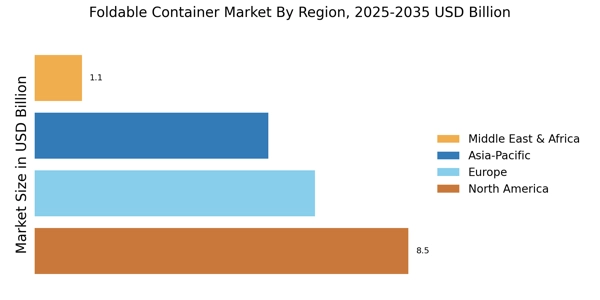
North America is the largest market for foldable containers, holding approximately 40% of the global market share. The region's growth is driven by increasing demand for sustainable packaging solutions and the rise of e-commerce. Regulatory support for eco-friendly materials further catalyzes market expansion. The U.S. and Canada are the primary contributors, with significant investments in logistics and supply chain efficiency. The competitive landscape in North America is robust, featuring key players like Tupperware Brands Corporation and Rehrig Pacific Company. These companies are innovating to meet consumer demands for versatility and sustainability. The presence of established logistics firms enhances distribution networks, making foldable containers a preferred choice for businesses aiming to optimize space and reduce costs. The market is expected to continue its upward trajectory as companies adapt to changing consumer preferences.

Europe : Sustainability and Efficiency Focus

Europe is witnessing significant growth in the foldable container market, accounting for approximately 30% of the global share. The region's emphasis on sustainability and circular economy principles drives demand for reusable packaging solutions. Regulatory frameworks, such as the EU's Single-Use Plastics Directive, encourage businesses to adopt eco-friendly alternatives, further boosting market potential. Germany and France are the largest markets, leading in innovation and adoption of foldable containers. Leading countries in Europe are Germany, France, and the Netherlands, where companies like Schoeller Allibert and IFCO Systems are prominent. The competitive landscape is characterized by a mix of established players and innovative startups focusing on sustainable materials and designs. The presence of strong logistics networks and a growing e-commerce sector are key factors contributing to the market's expansion. As businesses seek to enhance operational efficiency, foldable containers are becoming increasingly popular.

Asia-Pacific : Emerging Market with High Potential

Asia-Pacific is emerging as a significant player in the foldable container market, holding around 25% of the global market share. The region's rapid industrialization and urbanization are key growth drivers, alongside increasing demand for efficient logistics solutions. Countries like China and India are leading the charge, supported by government initiatives aimed at enhancing supply chain efficiency and reducing waste. The market is expected to grow as businesses adopt innovative packaging solutions to meet consumer demands. China is the largest market in the region, with a strong presence of local manufacturers and international players like Schneider Electric and Smart Containers. The competitive landscape is evolving, with companies focusing on product innovation and sustainability. As e-commerce continues to expand, the demand for foldable containers is set to rise, driven by the need for cost-effective and space-saving packaging solutions. The region's growth potential is substantial, making it a focal point for industry investments.

Middle East and Africa : Growing Demand for Versatile Solutions

The Middle East and Africa region is gradually developing its foldable container market, currently holding about 5% of the global share. The growth is primarily driven by increasing trade activities and the need for efficient logistics solutions. Countries like South Africa and the UAE are at the forefront, with government initiatives aimed at improving supply chain infrastructure. The market is expected to grow as businesses recognize the benefits of foldable containers in reducing costs and enhancing operational efficiency. In this region, the competitive landscape is still emerging, with a mix of local and international players. Companies are beginning to invest in foldable container solutions to meet the rising demand from various sectors, including retail and agriculture. The presence of key players like A. P. Moller - Maersk and Kuehne + Nagel is helping to drive market growth. As awareness of sustainable packaging increases, the adoption of foldable containers is likely to gain momentum in the coming years.

Foldable Container Market Regional Image

Key Players and Competitive Insights

The Foldable container market's major players are focusing on providing different types of products and services to meet the diverse needs of the customers. The major players in this market are Schoeller Allibert, Rehrig Pacific, Nefab Packaging, Buckhorn, and Duravant. These players are investing in the Foldable Container Market, which is expected to be competitive in the future. The players are also focusing on adopting the latest technologies to improve the efficiency and productivity of their operations.

The Foldable Container Market, which is expected to be competitive in the future, is likely to be highly competitive with the entry of new players and the expansion of existing players.A major player in the Foldable Container Market is Schoeller Allibert. The company is a leading manufacturer of reusable plastic containers, pallets, and crates. It provides a wide of foldable containers, which includes large foldable containers, small foldable containers, and collapsible containers. The company also provides foldable containers, which are designed to be durable, lightweight, and easy to use.

There is also a strong  presence, which is operating in more than 50 countries. Schoeller Allibert, which has a strong distribution network, is able to deliver its products quickly and efficiently to customers. The company is also committed to innovation, and it invests in research and development.Rehrig Pacific is another major player in the Foldable Container Market, which is a leading manufacturer of custom plastic containers and pallets. The company provides a wide range of foldable containers, which include, for example, plastic foldable containers, corrugated foldable containers, and metal foldable containers.

Rehrig Pacific also provides foldable containers, which are strong, lightweight and durable. The company also has a strong manufacturing base with 18 manufacturing facilities in North America and Europe. It also has a strong customer base that consists of major retailers, manufacturers, and distributors.

Key Companies in the Foldable Container Market market include

Industry Developments

The  foldable container market is projected to grow from USD 17.71 billion in 2023 to USD 40.56 billion by 2032, exhibiting a CAGR of 9.65% during the forecast period. This growth can be attributed to the increasing demand for foldable containers from various industries such as automotive, food and beverage, and healthcare.Recent news developments in the market include the launch of new products and technologies by key players. For instance, in January 2023, Schoeller Allibert introduced its new generation of foldable large containers (FLCs) called the Magnum Optimum.

These FLCs are designed to meet the needs of the automotive industry and offer improved durability and space utilization.Other current affairs in the market include the growing adoption of sustainable packaging solutions. Foldable containers are becoming increasingly popular as they offer a cost-effective and environmentally friendly alternative to traditional packaging materials. This trend is expected to continue in the coming years, driven by the increasing demand for sustainable packaging from consumers and businesses alike.

Future Outlook

Foldable Container Market Future Outlook

The Foldable Container Market is projected to grow at a 9.65% CAGR from 2024 to 2035, driven by sustainability trends, cost efficiency, and technological advancements.

New opportunities lie in:

  • Expansion into e-commerce logistics solutions
  • Development of smart foldable containers with IoT integration
  • Partnerships with sustainable packaging firms for eco-friendly products

By 2035, the market is expected to be robust, driven by innovation and strategic partnerships.

Market Segmentation

Foldable Container Market Capacity Outlook

  • Up to 1,000 Liters
  • 1,000 to 2,000 Liters
  • Over 2,000 Liters

Foldable Container Market End-User Outlook

  • Logistics Transportation
  • Manufacturing
  • Retail Distribution
  • Waste Management

Foldable Container Market Material Outlook

  • Plastic
  • Metal
  • Paperboard

Foldable Container Market Application Outlook

  • Industrial Automotive
  • Food Beverage
  • Pharmaceutical Chemical
  • Construction Building

Foldable Container Market Design Type Outlook

  • Collapsible
  • Rigid
  • Semi-Rigid

Report Scope

MARKET SIZE 202421.29(USD Billion)
MARKET SIZE 202523.35(USD Billion)
MARKET SIZE 203558.67(USD Billion)
COMPOUND ANNUAL GROWTH RATE (CAGR)9.65% (2024 - 2035)
REPORT COVERAGERevenue Forecast, Competitive Landscape, Growth Factors, and Trends
BASE YEAR2024
Market Forecast Period2025 - 2035
Historical Data2019 - 2024
Market Forecast UnitsUSD Billion
Key Companies ProfiledMarket analysis in progress
Segments CoveredMarket segmentation analysis in progress
Key Market OpportunitiesGrowing demand for sustainable packaging solutions drives innovation in the Foldable Container Market.
Key Market DynamicsRising demand for sustainable packaging solutions drives innovation and competition in the foldable container market.
Countries CoveredNorth America, Europe, APAC, South America, MEA

Leave a Comment

FAQs

What is the current valuation of the Foldable Container Market?

The Foldable Container Market was valued at 21.29 USD Billion in 2024.

What is the projected market size for the Foldable Container Market by 2035?

The market is projected to reach 58.67 USD Billion by 2035.

What is the expected CAGR for the Foldable Container Market during the forecast period?

The expected CAGR for the Foldable Container Market from 2025 to 2035 is 9.65%.

Which materials dominate the Foldable Container Market?

Plastic, metal, and paperboard are the primary materials, with plastic valued at 23.45 USD Billion in 2035.

What are the key applications of foldable containers?

Key applications include industrial automotive, food and beverage, pharmaceutical, and construction, with food and beverage projected at 16.5 USD Billion by 2035.

How does the capacity of foldable containers affect market valuation?

Containers with a capacity of 1,000 to 2,000 liters are expected to reach 22.0 USD Billion by 2035.

What design types are prevalent in the Foldable Container Market?

The market features collapsible, rigid, and semi-rigid designs, with rigid containers projected to be valued at 23.45 USD Billion by 2035.

Who are the leading companies in the Foldable Container Market?

Key players include Tupperware Brands Corporation, Schneider Electric, and Rehrig Pacific Company, among others.

What end-user segments are driving the Foldable Container Market?

Logistics transportation, manufacturing, and retail distribution are significant end-user segments, with logistics projected at 13.5 USD Billion by 2035.

How does the market's growth potential influence investment opportunities?

The robust growth potential, indicated by a projected valuation increase to 58.67 USD Billion by 2035, suggests favorable investment opportunities.

Download Free Sample

Kindly complete the form below to receive a free sample of this Report

Compare Licence

×
Features License Type
Single User Multiuser License Enterprise User
Price $4,950 $ $7,250
Maximum User Access Limit 1 User Upto 10 Users Unrestricted Access Throughout the Organization
Free Customization
Direct Access to Analyst
Deliverable Format
Platform Access
Discount on Next Purchase 10% 15% 15%
Printable Versions