Research Methodology on Food Additives Market
1. Introduction
The Market Research Future report “Food Additives Market Research Report - Global Forecast to 2030” provides an in-depth analysis of the global food additives market. It elaborates on market dynamics, market segmentation and the competitive landscape in the market. The study aims to provide a comprehensive overview of the global food additives market which is anticipated to witness substantial growth during the forecast period (2023-2030).
2. Research Objectives
- To understand the global food additives market comprehensively and provide an accurate forecast of the market size (value and volume-based) over the forecast period.
- To understand the role of food additives in the industry.
- To examine the trends and drivers impacting the global food additives market.
- To analyze the revenue potential for different types of food additives and analyze the trends in terms of pricing and market share over the forecast period.
- To analyze the production and trade of food additives globally.
- To study technology trends and their impact on the global food additives market.
- To identify the key market players in the global food additives market.
3. Research Methodology
The research methodology adopted for analyzing the global food additives market is a combination of primary and secondary research. This includes collecting information from published journals, reports, press releases, magazines, books, industry association reports, databases, expert opinions and other sources. All the sources have been judiciously used to draw insight from the data. Furthermore, an in-depth analysis of the collected data was undertaken in order to identify relevant key market trends and estimate market size and set up the forecast.
Primary Research: Primary research includes collecting data from out of Germany using a survey and interviews with market experts, opinions of industry stakeholders, and key opinion leaders. Additionally, primary research includes a thorough analysis of the secondary data collected from our secondary sources.
Secondary Research: Secondary research includes collecting information from published reports, press releases, journals, books, magazines, industry association reports, databases, and other sources. The secondary research approach further includes analysis of the collected data, understanding trends, finding patterns, and forming conclusions. Secondary data is collected to further validate our primary research.
4. Market Segmentation
The Global Food Additives Market has been segmented into product, type, end-user, and region.
- By product, the market has been classified into sweeteners, preservatives, colourants, texturizers, emulsifiers, and others.
- By type, the market has been classified into synthetic and natural.
- By end user, the market has been segmented into bakery, dairy & frozen desserts, meat & poultry, snacks & beverages, convenience foods, and others.
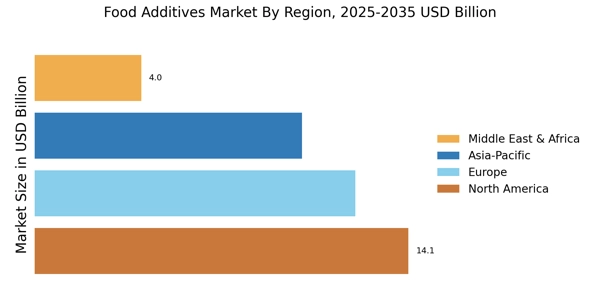
- By region, the market has been segmented into North America, Europe, Asia-Pacific, and the rest of the world.
5. Data Collection & Analysis
Data for the report have been collected by using primary and secondary sources.
The primary research sources included a survey of key stakeholders in the food additives industry and interviews with experts in food additives and food science. The survey was conducted to collect data on food additives types, production, pricing, and use.
Secondary sources included published reports, journals, and press releases. The different types of data collected from these sources helped to build an understanding of the market, identify critical trends, and set up the forecast basis.
The data collected was then analysed using various analytical techniques such as Factor Analysis, Regression Analysis, and Time Series Analysis. The analysis highlighted the key drivers and trends affecting the industry.
6. Findings & Insights
The findings and insights from the report highlight that the global food additives market is anticipated to witness significant growth, driven primarily by the increased acceptance of convenience food and packaged food.
The market is also witnessing an increased demand for natural food additives due to rising health awareness among consumers. The market is further driven by support from regulatory organisations such as the Food and Drug Administration (FDA).
7. Conclusions & Projections
The report concludes that the global food additives market is forecasted to witness substantial growth during the period 2023–2030. The increased acceptance of convenience food and increased demand for natural food additives are identified as the two primary drivers of the market.
The report also provides an in-depth analysis and forecast of the different segments in the market. It is anticipated that the sweeteners market segment will grow at the highest rate, followed by preservatives, colourants, texturizers, and emulsifiers.
The report also provides an analysis of the competitive landscape. It identifies key players in the market and provides an analysis of their strategies. Finally, the report presents a projection of the future outlook of the market, with a special focus on the market segments with the highest growth potential.