×
Request Free Sample ×

Kindly complete the form below to receive a free sample of this Report

* Please use a valid business email

Leading companies partner with us for data-driven Insights

clients tt-cursor
Hero Background

Food Processing Market

ID: MRFR/FnB/7116-HCR
90 Pages
Snehal Singh
February 2026

Food Processing Market Size, Share, Industry Trend & Analysis Research Report Information by Equipment Type (Cleaning, Sorting, & Grading Equipment, Cutting, Peeling & Grinding Equipment, Mixers & Blenders, Extrusion Equipment, Thermal Equipment, Homogenizers, and Other Equipment), Category (Semi-Automated and Fully Automated), Application (Bakery & Confectionery, Dairy Products, Meat, Poultry, & Seafood Products, Fruit & Vegetable, Beverages and others) and Region (North America, Europe, Asia-Pacific and Rest of the World) - Forecast till 2030

Share:
Download PDF ×

We do not share your information with anyone. However, we may send you emails based on your report interest from time to time. You may contact us at any time to opt-out.

Food Processing Market Infographic
Purchase Options

Food Processing Market Summary

As per Market Research Future analysis, the Food Processing Market was estimated at 163.79 USD Billion in 2024. The Food Processing industry is projected to grow from 183.15 USD Billion in 2025 to 559.76 USD Billion by 2035, exhibiting a compound annual growth rate (CAGR) of 11.82% during the forecast period 2025 - 2035

Key Market Trends & Highlights

The Food Processing Market is currently experiencing a dynamic shift towards health-conscious and sustainable practices.

  • Health-conscious choices are increasingly influencing consumer preferences in food processing.
  • Sustainability initiatives are becoming integral to production processes, particularly in North America.
  • Technological advancements are driving efficiency, especially in the mixers and blenders segment.
  • Rising demand for convenience foods and increased focus on health and nutrition are key market drivers shaping the industry.

Market Size & Forecast

2024 Market Size 163.79 (USD Billion)
2035 Market Size 559.76 (USD Billion)
CAGR (2025 - 2035) 11.82%

Major Players

Nestle (CH), PepsiCo (US), Cargill (US), Tyson Foods (US), Unilever (GB), General Mills (US), Kraft Heinz (US), Danone (FR), Mondelez International (US)

Our Impact
Enabled $4.3B Revenue Impact for Fortune 500 and Leading Multinationals
Partnering with 2000+ Global Organizations Each Year
30K+ Citations by Top-Tier Firms in the Industry

Food Processing Market Trends

The food processing market is undergoing rapid transformation driven by evolving consumer lifestyles, technological innovation, and regulatory oversight. Growing scrutiny around marketing of processed food and increasing awareness related to ultra processed foods legal marketing campaigns are influencing product formulation and labeling strategies. At the same time, legal and regulatory discussions linked to ultra processed foods lawsuit legal marketing campaigns, ultra processed foods lawsuit marketing, and ultra processed foods mass tort marketing campaigns are encouraging manufacturers to focus on transparency and cleaner ingredients. Technological advancements in the food beverage processing equipment market are enabling improved efficiency, consistency, and safety across production lines, strengthening the overall food processing equipment market. Overall, the Food Processing Market appears poised for continued growth, driven by evolving consumer demands and a commitment to innovation and sustainability.


Health-Conscious Choices


Consumers are increasingly shifting toward healthier alternatives, boosting demand for products produced using advanced preservation techniques. Growth in the high pressure processing foods market, non thermal food processing market, and fermented processed food market reflects rising preference for nutrient retention and clean-label foods.


Additionally, rising consumption of dried processed food market and frozen processed food market products supports long-term shelf stability without compromising quality.


Sustainability Initiatives


Sustainability is becoming a core strategy within the food processing market, with manufacturers adopting energy-efficient machinery and waste-reduction practices. Innovations in the hygienic easy to clean food processing equipment market and the food processing seals market are helping companies comply with strict food safety regulations while lowering operational costs.


Technological Advancements


Automation, artificial intelligence, and smart monitoring systems are transforming the food processing machinery market. Components such as the global food processing blades market and gas fired food processing boiler market play a crucial role in improving thermal efficiency and operational reliability across processing facilities.

Food Processing Market Drivers

Globalization and Market Expansion

The Food Processing Market is significantly influenced by globalization, which facilitates the expansion of food products across borders. This trend allows food processors to tap into new markets and diversify their product offerings. Data suggests that international trade in processed foods is expected to grow by approximately 7% over the next few years, driven by increasing consumer demand for diverse culinary experiences. As companies expand their reach, they must navigate various regulatory environments and cultural preferences, which can be both a challenge and an opportunity. The Food Processing Market must strategically position itself to capitalize on these global opportunities while ensuring compliance with local regulations. This globalization trend is likely to reshape the competitive landscape of the industry.

Rising Demand for Convenience Foods

The Food Processing Market is experiencing a notable increase in the demand for convenience foods. This trend is largely driven by the fast-paced lifestyles of consumers who seek quick meal solutions without compromising on quality. According to recent data, the convenience food segment is projected to grow at a compound annual growth rate of approximately 4.5% over the next five years. This growth is indicative of a broader shift in consumer preferences towards ready-to-eat and easy-to-prepare food options. As a result, food processors are adapting their product lines to meet these evolving demands, thereby enhancing their market presence. The Food Processing Market must continue to innovate in this area to capture the attention of busy consumers who prioritize convenience.

Increased Focus on Health and Nutrition

The Food Processing Market is witnessing a significant shift towards health and nutrition as consumers become more aware of the impact of their dietary choices. This trend is reflected in the rising demand for organic, low-calorie, and nutrient-dense food products. Market data suggests that the health food segment is expected to grow by around 6% annually, driven by a growing population that prioritizes wellness. Food processors are responding by reformulating existing products and introducing new offerings that align with health-conscious consumer preferences. This focus on health not only caters to consumer demands but also positions companies favorably in a competitive market landscape. The Food Processing Market must continue to adapt to these trends to remain relevant and successful.

Sustainability and Environmental Concerns

Sustainability has emerged as a pivotal driver in the Food Processing Market, as consumers and regulators alike demand more environmentally friendly practices. The industry is increasingly adopting sustainable sourcing, waste reduction, and eco-friendly packaging solutions. Recent studies indicate that companies implementing sustainable practices can enhance their brand image and potentially increase market share by up to 10%. This shift towards sustainability is not merely a trend but a necessary adaptation to changing consumer expectations and regulatory pressures. As the Food Processing Market evolves, companies that prioritize sustainability are likely to gain a competitive advantage, appealing to a growing segment of environmentally conscious consumers. The integration of sustainable practices is becoming essential for long-term success.

Technological Innovations in Food Processing

Technological advancements are playing a crucial role in shaping the Food Processing Market. Innovations such as automation, artificial intelligence, and advanced food preservation techniques are enhancing efficiency and product quality. For instance, the adoption of AI in supply chain management is streamlining operations and reducing waste, which is particularly important in a market that is increasingly focused on sustainability. Furthermore, data indicates that investments in food processing technology are expected to rise by 5% annually, reflecting the industry's commitment to modernization. These technological innovations not only improve production processes but also enable food processors to meet the growing consumer demand for high-quality, safe, and nutritious products. The Food Processing Market must leverage these advancements to maintain a competitive edge.
Market Segment Insights

Food Processing Market Type Insights

The  Food Processing Market segmentation, based on type, includes Cleaning, Sorting, & Grading Equipment, Cutting, Peeling & Grinding Equipment, Mixers & Blenders, Extrusion Equipment, Thermal Equipment, Homogenizers, and Other Equipment. The Extrusion Equipment segment held the majority share in 2021 of the  Food Processing Market revenue. There is growing demand throughout the food and drink industry for this type of equipment because it’s capable of producing nutritious and safe food and drinks that the world will pay a premium for.

Extrusion equipment plays a vital role in food processing because it ensures that each item of food is uniform both in terms of shape and size. This is crucial when making dry cereals and refined bread.

Food Processing Market Category Insights

By category, the market is segmented into semi-automated and fully automated systems. Fully automated solutions dominate the food & beverage processing equipment market, as manufacturers seek higher throughput, reduced labor dependency, and improved quality control. The reason is that more and more food processing companies are investing in more sophisticated and technologically advanced food processing equipment. Food processing equipment replaces human labor. Thus, it processes more food in less time. Companies save in terms of labor costs.

Food Processing Market Application Insights

Figure 2:  Food Processing Market, by Category, 2021 & 2030 (USD Billion)Source: Secondary Research, Primary Research, Market Research Future Database and Analyst Review

Get more detailed insights about Food Processing Market

Regional Insights

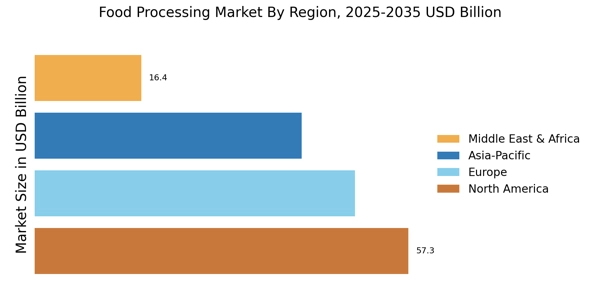
North America : Market Leader in Food Processing Market

North America is the largest market for food processing, accounting for approximately 35% of the global market share. Key growth drivers include increasing consumer demand for convenience foods, health-conscious products, and technological advancements in food processing techniques. Regulatory support from agencies like the FDA ensures food safety and quality, further boosting market growth. The United States leads the region, with major players like PepsiCo, Cargill, and Tyson Foods dominating the landscape. Canada also plays a significant role, focusing on organic and sustainable food processing. The competitive environment is characterized by innovation and mergers, as companies strive to meet evolving consumer preferences and regulatory standards.

Europe : Innovation and Sustainability Focus

The Europe food processing market is driven by sustainability mandates and innovation. Countries such as France and the UK significantly contribute to growth, strengthening the France food processing market and UK food processing market. The region is driven by a strong emphasis on sustainability, health, and innovation in food products. Regulatory frameworks, such as the EU Food Law, promote food safety and environmental sustainability, encouraging companies to adopt eco-friendly practices. Leading countries include Germany, France, and the UK, with significant contributions from companies like Unilever and Danone. The competitive landscape is marked by a shift towards plant-based products and clean label trends, as consumers increasingly seek transparency in food sourcing and processing. The presence of established brands and innovative startups fosters a dynamic market environment.

Asia-Pacific : Emerging Market Potential

Asia-Pacific dominates global revenue share, supported by rapid industrialization and urbanization. Strong investments in China and India are accelerating the China food processing market. Government initiatives aimed at enhancing food security and safety regulations are also pivotal in shaping the market landscape. China and India are the leading countries in this region, with significant investments in food technology and processing infrastructure. Major players like Nestle and Mondelez International are expanding their operations to cater to the growing demand. The competitive landscape is evolving, with local companies emerging alongside global giants, creating a vibrant market atmosphere.

Middle East and Africa : Untapped Market Opportunities

The Middle East and Africa region is an emerging market in food processing, holding about 10% of the global market share. The growth is driven by increasing population, urbanization, and a rising middle class demanding processed and packaged foods. Regulatory bodies are working to improve food safety standards, which is crucial for market expansion. Countries like South Africa and the UAE are leading the charge, with investments in food processing technologies and infrastructure. The competitive landscape is characterized by both local and international players, with a focus on adapting products to meet regional tastes and preferences. This region presents significant opportunities for growth as consumer demand continues to rise.

Food Processing Market Regional Image

Key Players and Competitive Insights

The Food Processing Market is currently characterized by a dynamic competitive landscape, driven by factors such as increasing consumer demand for convenience foods, health-conscious products, and sustainable practices. Major players like Nestlé (CH), PepsiCo (US), and Cargill (US) are strategically positioning themselves through innovation and regional expansion. Nestlé (CH) focuses on enhancing its product portfolio with plant-based alternatives, while PepsiCo (US) emphasizes its commitment to sustainability through eco-friendly packaging initiatives. Cargill (US) is investing in supply chain optimization to improve efficiency and reduce waste, collectively shaping a competitive environment that prioritizes adaptability and consumer-centric strategies. Key business tactics within the Food Processing Market include localizing manufacturing and optimizing supply chains to meet regional demands. The market appears moderately fragmented, with a mix of large multinational corporations and smaller regional players. The collective influence of key players fosters a competitive structure that encourages innovation and responsiveness to consumer trends, thereby enhancing overall market resilience. In August 2025, Nestlé (CH) announced a significant investment in a new plant-based food facility in Switzerland, aimed at expanding its production capacity for meat alternatives. This strategic move not only aligns with the growing consumer preference for plant-based diets but also positions Nestlé (CH) as a leader in the sustainable food sector. The facility is expected to enhance supply chain efficiency and reduce carbon emissions, reflecting the company's commitment to sustainability. In September 2025, PepsiCo (US) launched a new line of snacks made from upcycled ingredients, showcasing its dedication to sustainability and waste reduction. This initiative not only caters to environmentally conscious consumers but also differentiates PepsiCo (US) in a competitive market increasingly focused on sustainability. The move is likely to enhance brand loyalty and attract a new customer base, reinforcing PepsiCo's (US) market position. In July 2025, Cargill (US) entered a strategic partnership with a tech startup to integrate artificial intelligence into its supply chain management. This collaboration aims to enhance predictive analytics and improve inventory management, potentially leading to significant cost savings and operational efficiencies. By leveraging technology, Cargill (US) is positioning itself to respond more effectively to market fluctuations and consumer demands. As of October 2025, the Food Processing Market is witnessing trends such as digitalization, sustainability, and the integration of artificial intelligence. Strategic alliances among key players are increasingly shaping the competitive landscape, fostering innovation and collaboration. The shift from price-based competition to a focus on technology, supply chain reliability, and product innovation is likely to define future competitive differentiation, as companies strive to meet evolving consumer expectations and regulatory standards.

Key Companies in the Food Processing Market include

Industry Developments

September 2021: GEA Group AG  has launched a solution called Batch2Flow. The novel solution is developed to enhance the security of the food production process, curtail the consumption of cleaning chemicals, and reduce the usage of water and power consumption to provide economic benefits to the customers.

Future Outlook

Food Processing Market Future Outlook

The Food Processing Market is projected to grow at an 11.82% CAGR from 2025 to 2035, driven by technological advancements, increasing consumer demand for convenience, and sustainability initiatives.

New opportunities lie in:

  • Investment in automated food processing technologies to enhance efficiency. Development of plant-based food products to meet rising health trends. Expansion into emerging markets with tailored product offerings.

By 2035, the Food Processing Market is expected to be robust, driven by innovation and evolving consumer preferences.

Market Segmentation

Food Processing Market Type Outlook

  • Cleaning

  • Sorting

  • & Grading Equipment

  • Cutting

  • Peeling & Grinding Equipment

  • Mixers & Blenders

  • Extrusion Equipment

  • Thermal Equipment

  • Homogenizers

  • Other Equipment

Food Processing Market Category Outlook

  • Semi-Automated

  • Fully Automated

Food Processing Market Application Outlook

  • Bakery & Confectionery

  • Dairy Products

  • Meat

  • Poultry

  • & Seafood Products

  • Fruit & Vegetable

  • Beverages

  • Others

Report Scope

MARKET SIZE 2024 163.79(USD Billion)
MARKET SIZE 2025 183.15(USD Billion)
MARKET SIZE 2035 559.76(USD Billion)
COMPOUND ANNUAL GROWTH RATE (CAGR) 11.82% (2025 - 2035)
REPORT COVERAGE Revenue Forecast, Competitive Landscape, Growth Factors, and Trends
BASE YEAR 2024
Market Forecast Period 2025 - 2035
Historical Data 2019 - 2024
Market Forecast Units USD Billion
Key Companies Profiled Nestle (CH), PepsiCo (US), Cargill (US), Tyson Foods (US), Unilever (GB), General Mills (US), Kraft Heinz (US), Danone (FR), Mondelez International (US)
Segments Covered Equipment Type
Key Market Opportunities Adoption of automation and smart technologies enhances efficiency in the Food Processing Market.
Key Market Dynamics Technological advancements and shifting consumer preferences drive innovation and competition in the food processing sector.
Countries Covered North America, Europe, APAC, South America, MEA

Market Highlights

Author
Snehal Singh
Assistant Manager - Research

High acumen in analyzing complex macro & micro markets with more than 6 years of work experience in the field of market research. By implementing her analytical skills in forecasting and estimation into market research reports, she has expertise in Packaging, Construction, and Equipment domains. She handles a team size of 20-25 resources and ensures smooth running of the projects, associated marketing activities, and client servicing.

Leave a Comment

FAQs

What is the current valuation of the Food Processing Market as of 2024?

The Food Processing Market was valued at 163.79 USD Billion in 2024.

What is the projected market valuation for the Food Processing Market in 2035?

The market is projected to reach 559.76 USD Billion by 2035.

What is the expected CAGR for the Food Processing Market during the forecast period 2025 - 2035?

The expected CAGR for the Food Processing Market during 2025 - 2035 is 11.82%.

Who are the key players in the Food Processing Market?

Key players include Nestle, PepsiCo, Cargill, Tyson Foods, Unilever, General Mills, Kraft Heinz, Danone, and Mondelez International.

What segment of the Food Processing Market includes Thermal Equipment and what was its valuation in 2024?

The Thermal Equipment segment was valued at 35.0 USD Billion in 2024.

How does the valuation of Fully Automated equipment compare to Semi-Automated equipment in the Food Processing Market?

Fully Automated equipment had a valuation of 98.79 USD Billion, whereas Semi-Automated equipment was valued at 65.0 USD Billion in 2024.

What was the valuation of the Meat, Poultry, & Seafood Products segment in 2024?

The Meat, Poultry, & Seafood Products segment was valued at 35.0 USD Billion in 2024.

Research Approach

Secondary Research

The secondary research process involved comprehensive analysis of regulatory filings, trade statistics, industry databases, and technical standards repositories. Key sources included the US Food and Drug Administration (FDA) Food Code and 21 CFR Part 110 regulations, US Department of Agriculture (USDA) National Agricultural Statistics Service (NASS) and Economic Research Service (ERS), European Food Safety Authority (EFSA) scientific opinions and guidance documents, Food and Agriculture Organization (FAO) FAOSTAT database and food safety guidelines, World Health Organization (WHO) Global Foodborne Infections Network, Codex Alimentarius Commission standards, Global Food Safety Initiative (GFSI) benchmark requirements, PMMI – The Association for Packaging and Processing Technologies market reports, Food Processing Equipment Suppliers Association (FPESA) industry data, European Committee of Manufacturers of Food Processing Machinery (CECOMAF) statistics, UNIDO (United Nations Industrial Development Organization) industrial statistics, World Bank Manufacturing Value Added database, OECD Agricultural Outlook, EU Eurostat Prodcom database for machinery manufacturing, US Census Bureau Annual Survey of Manufactures, Occupational Safety and Health Administration (OSHA) food manufacturing safety data, and national food processing associations from key markets including China Food and Packaging Machinery Industry Association (CFPMA) and Japan Food Machinery Manufacturers' Association (Fooma). These sources were utilized to collect production capacity data, regulatory compliance requirements, trade flow analysis, and technology adoption trends across cleaning/sorting/grading, cutting/peeling/grinding, mixing/blending, extrusion, thermal processing, and homogenization equipment categories.

Primary Research

Qualitative and quantitative insights were obtained by interviewing supply-side and demand-side stakeholders during the primary research process. The supply-side sources consisted of CEOs, VPs of Engineering, regulatory compliance officers, and sales directors from food processing equipment manufacturers, OEMs, and automation solution providers. Plant managers, operations directors, procurement leaders, and chief engineers from multinational food processing companies, dairy cooperatives, meat processing facilities, bakery production plants, and beverage manufacturing units comprised demand-side sources. Equipment segmentation was validated across fully automated and semi-automated categories, technology adoption timelines were confirmed, and intelligence was gathered on capital expenditure cycles, maintenance expenditure patterns, and sanitation regulation compliance costs through primary research.

Primary Respondent Breakdown:

By Designation: C-level Primaries (30%), Director Level (35%), Others (35%)

By Region: North America (38%), Europe (25%), Asia-Pacific (27%), Rest of World (10%)

Market Size Estimation

Global market valuation was derived through production unit analysis and installed base evaluation. The methodology included:

Identification of over 60 significant equipment manufacturers in North America, Europe, Asia-Pacific, and Latin America

Equipment mapping across pre-processing (cleaning, sorting, grading, cutting, peeling), processing (mixing, blending, extruding, thermal treatment, homogenizing), and post-processing categories

Analysis of reported and modeled annual revenues specific to food processing machinery portfolios

Coverage of manufacturers representing 65-70% of global market share in 2024

Extrapolation using bottom-up (unit shipments × ASP by equipment type and country) and top-down (manufacturer revenue validation) approaches to derive segment-specific valuations for dairy processing, bakery/confectionery production, meat/poultry/seafood processing, beverage manufacturing, and fruits/vegetables processing applications.

Download Free Sample

Kindly complete the form below to receive a free sample of this Report

Compare Licence

×
Features License Type
Single User Multiuser License Enterprise User
Price $4,950 $5,950 $7,250
Maximum User Access Limit 1 User Upto 10 Users Unrestricted Access Throughout the Organization
Free Customization
Direct Access to Analyst
Deliverable Format
Platform Access
Discount on Next Purchase 10% 15% 15%
Printable Versions