×
Request Free Sample ×

Kindly complete the form below to receive a free sample of this Report

* Please use a valid business email

Leading companies partner with us for data-driven Insights

clients tt-cursor
Hero Background

Food Service Market

ID: MRFR/FnB/10075-HCR
128 Pages
Harshita Gorade
October 2025

Global Food Service Market Research Report By Service Type (Full-Service Restaurants, Quick Service Restaurants, Cafeterias, Food Trucks, Catering Services), By End Use (Residential, Commercial, Institutional), By Food Type (Fast Food, Casual Dining, Fine Dining, Street Food, Catering Menu), By Distribution Channel (Online Ordering, In-Store Dining, Drive-Thru, Home Delivery) and By Regional (North America, Europe, South America, Asia Pacific, Middle East and Africa) - Forecast to 2035.

Share:
Download PDF ×

We do not share your information with anyone. However, we may send you emails based on your report interest from time to time. You may contact us at any time to opt-out.

Food Service Market Infographic
Purchase Options

Food Service Market Summary

As per MRFR analysis, the Food Service Market was estimated at 3034.47 USD Billion in 2024. The Food Service industry is projected to grow from 3383.5 USD Billion in 2025 to 10050.63 USD Billion by 2035, exhibiting a compound annual growth rate (CAGR) of 11.5 during the forecast period 2025 - 2035.

Key Market Trends & Highlights

The Food Service Market is experiencing a dynamic shift towards sustainability and health-conscious offerings, driven by evolving consumer preferences and technological advancements.

  • North America remains the largest market for food service, characterized by a strong demand for full service dining experiences.
  • Asia-Pacific is emerging as the fastest-growing region, with limited service establishments gaining popularity among consumers.
  • Health-conscious offerings are increasingly prioritized, with vegetarian options leading the market while vegan selections are rapidly expanding.
  • Evolving consumer preferences and a focus on sustainability are key drivers propelling growth in both full service and limited service segments.

Market Size & Forecast

2024 Market Size 3034.47 (USD Billion)
2035 Market Size 10050.63 (USD Billion)
CAGR (2025 - 2035) 11.5%

Major Players

McDonald's (US), Starbucks (US), Yum! Brands (US), Restaurant Brands International (CA), Darden Restaurants (US), Chipotle Mexican Grill (US), Domino's Pizza (US), Wendy's (US), Panera Bread (US)

Food Service Market Trends

The Food Service Market is currently experiencing a dynamic transformation, driven by evolving consumer preferences and technological advancements. As individuals increasingly seek convenience and quality, the demand for diverse dining options continues to rise. This shift is reflected in the growing popularity of delivery services, meal kits, and plant-based offerings, which cater to a wide array of dietary needs and preferences. Furthermore, sustainability has emerged as a pivotal concern, prompting establishments to adopt eco-friendly practices and source local ingredients. This trend not only appeals to environmentally conscious consumers but also enhances the overall dining experience. In addition to these shifts, the Food Service Market is witnessing a surge in digitalization. The integration of technology into operations, such as mobile ordering and contactless payments, streamlines processes and enhances customer satisfaction. Moreover, the rise of social media influences dining choices, as consumers increasingly rely on online reviews and recommendations. As the market continues to evolve, it appears poised for further growth, with innovative concepts and strategies likely to shape its future landscape.

Sustainability Initiatives

The Food Service Market is increasingly prioritizing sustainability, with many establishments adopting eco-friendly practices. This includes sourcing local ingredients, reducing waste, and implementing energy-efficient operations. Such initiatives not only appeal to environmentally conscious consumers but also contribute to a positive brand image.

Digital Transformation

The integration of technology within the Food Service Market is reshaping customer interactions and operational efficiency. Mobile ordering, contactless payments, and online reservations are becoming standard practices, enhancing convenience for consumers and streamlining processes for businesses.

Health-Conscious Offerings

There is a noticeable shift towards health-conscious menu options within the Food Service Market. Consumers are increasingly seeking nutritious meals that cater to various dietary preferences, including plant-based and gluten-free options. This trend reflects a broader awareness of health and wellness.

Food Service Market Drivers

Health and Wellness Trends

The Global Food Service Market Industry is increasingly influenced by health and wellness trends, as consumers become more health-conscious. There is a growing preference for nutritious and organic food options, prompting food service providers to adapt their menus accordingly. Restaurants are incorporating plant-based dishes and healthier alternatives to cater to this demand. This shift not only enhances customer satisfaction but also aligns with broader societal trends towards healthier living. As the market evolves, it is expected to reflect these changes, potentially leading to a compound annual growth rate of 3.42% from 2025 to 2035.

Globalization of Culinary Trends

The globalization of culinary trends profoundly influences the Global Food Service Market Industry. As cultures intermingle, consumers are exposed to diverse cuisines, leading to a demand for international flavors and dining experiences. This trend encourages food service providers to innovate and diversify their offerings, incorporating global dishes into their menus. The market's anticipated growth, reaching 4.49 USD Billion in 2024, reflects the increasing consumer interest in exploring new culinary experiences. This globalization not only enhances customer engagement but also fosters competition among food service providers to deliver unique and authentic dining experiences.

Rising Consumer Demand for Convenience

The Global Food Service Market Industry experiences a notable increase in consumer demand for convenience-driven dining options. This trend is largely fueled by busy lifestyles, as consumers seek quick and accessible meal solutions. Fast-casual dining establishments and food delivery services are gaining traction, reflecting a shift in consumer preferences. In 2024, the market is projected to reach 4.49 USD Billion, indicating a robust appetite for convenient food service options. This demand is expected to continue growing, as consumers increasingly prioritize speed and efficiency in their dining experiences.

Expansion of Delivery and Takeout Services

The expansion of delivery and takeout services significantly impacts the Global Food Service Market Industry. With the rise of third-party delivery platforms, restaurants are increasingly offering delivery options to reach a wider audience. This trend is particularly pronounced in urban areas, where convenience is paramount. The market's growth trajectory, with an expected value of 6.5 USD Billion by 2035, suggests that delivery and takeout services will continue to play a crucial role in shaping consumer dining habits. This shift not only meets consumer demands but also provides restaurants with new revenue streams.

Technological Advancements in Food Service

Technological innovations play a pivotal role in shaping the Global Food Service Market Industry. The integration of advanced technologies such as mobile ordering, contactless payments, and artificial intelligence enhances operational efficiency and customer experience. For instance, restaurants adopting AI-driven analytics can optimize menu offerings based on consumer preferences. As the industry embraces these technologies, it is likely to attract a broader customer base. The anticipated growth from 2024 to 2035, with a projected market value of 6.5 USD Billion, underscores the importance of technology in driving market expansion.
Market Segment Insights

By Service Type: Full Service (Largest) vs. Limited Service (Fastest-Growing)

The Food Service Market showcases a diverse array of service types, with Full Service leading the market share. Full Service establishments are favored by consumers for reasons including the comprehensive dining experience they offer. Limited Service outlets, while smaller in share, have been gaining traction as quick-service dining becomes more appealing to busy consumers seeking convenience. Growth trends in this sector reveal that Limited Service options are rapidly expanding, driven by changing consumer preferences towards speed and affordability. Meanwhile, Full Service restaurants continue to thrive by enhancing customer experience and adapting menus to cater to evolving dietary trends, fostering a dynamic shift in consumer dining habits.

Full Service (Dominant) vs. Limited Service (Emerging)

Full Service restaurants are characterized by providing a complete dining experience, including waiter service, extensive menu options, and a comfortable ambiance, making them a popular choice for social gatherings and special occasions. Their customer base appreciates the personal touch and quality service, positioning them as a mainstay in the Food Service Market. On the other hand, Limited Service dining has emerged as a significant player, focusing on quick, efficient service and lower price points. These establishments appeal to a growing demographic seeking convenience over formality, particularly among younger consumers and busy professionals, making them a vital segment in the evolving landscape of food services.

By Food Type: Vegetarian (Largest) vs. Vegan (Fastest-Growing)

In the Food Service Market, the Vegetarian segment dominates, accounting for a substantial portion of overall market share. This segment has steadily gained traction due to the increasing consumer preference for plant-based diets, driven by health and environmental concerns. Non-Vegetarian options continue to have a loyal consumer base, supported by traditional food preferences, while Gluten-Free and Organic segments, though smaller, are carving out their own niches in response to specific dietary needs. The growth trends in the Food Service Market indicate a significant shift toward healthier and more conscious eating habits. The Vegan segment is emerging as the fastest-growing area, fueled by rising awareness of animal welfare and sustainable food practices. Additionally, the surge in health-focused dining experiences and innovative plant-based menu offerings are propelling demand across all segments, particularly among younger consumers who prioritize nutrition and ethical considerations in their food choices.

Vegetarian: Dominant vs. Vegan: Emerging

The Vegetarian segment stands as a cornerstone of the Food Service Market, characterized by its broad appeal across various demographics and its integration into mainstream dining establishments. It includes a diverse range of options, from salads and vegetable-based dishes to global cuisines that prioritize meat alternatives. With increasing emphasis on health, the segment has benefitted from growing consumer awareness of the benefits associated with plant-based diets. In contrast, the Vegan segment, though smaller, is rapidly gaining traction as consumers seek more ethical and environmentally friendly meal options. This segment showcases innovative culinary creations, highlighting adaptability in menu designs. As food service providers expand their offerings to include refined vegan choices, the segment is expected to flourish, driven by a younger audience seeking both healthful and conscientious eating experiences.

By Consumer Type: Individual (Largest) vs. Family (Fastest-Growing)

In the Food Service Market, the consumer type segment exhibits a diverse distribution, with 'Individual' dominating the market share significantly. This segment appeals to a wide range of consumers seeking convenience and quality. Following closely is 'Family', which caters to larger groups looking for budget-friendly and communal dining options. Other segments such as 'Corporate', 'Institutional', and 'Tourist' also play important roles, although they represent a smaller portion of the market. The diverse preferences across these segments drive the dynamics of the food service landscape.

Individual (Dominant) vs. Family (Emerging)

The 'Individual' segment is a dominant force in the Food Service Market, characterized by quick-service meals, takeout options, and diverse menu offerings that cater to solo diners. This segment thrives on the demand for convenience and personalization, making it a go-to choice for busy individuals. In contrast, the 'Family' segment is emerging rapidly, driven by the increased trend of shared meals and family-friendly dining experiences. This segment emphasizes value and experience, appealing to families seeking to dine together. The growth in this segment is fueled by the rising number of families and their desire for bonding moments over meals.

By Distribution Channel: Online (Largest) vs. Food Delivery Services (Fastest-Growing)

In the Food Service Market, the distribution channel landscape is diverse, with online platforms holding the largest share. This segment has transformed how consumers interact with food service providers, with many preferring the convenience of ordering online rather than through traditional offline channels. Meanwhile, food delivery services are rapidly gaining traction, effectively reshaping consumer behavior and preferences as users seek quick and hassle-free meal options.

Online (Dominant) vs. Food Delivery Services (Emerging)

Online distribution channels are a dominant force in the Food Service Market, providing comprehensive solutions that cater to consumer demands for swift access to food services. These platforms allow customers to browse vast menus, providing a level of choice and convenience that traditional offline methods cannot match. In contrast, food delivery services are emerging as significant players, taking advantage of technological advancements like mobile applications and real-time tracking to enhance user satisfaction. Their rapid growth is driven by shifting consumer habits favoring convenience and immediacy, positioning them as a vital component of the future food service landscape.

Get more detailed insights about Food Service Market

Regional Insights

North America : Market Leader in Food Service

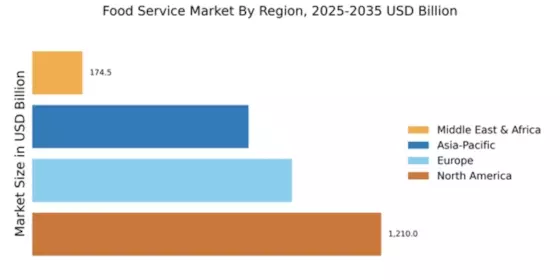
North America continues to lead The Food Service, holding a significant share of 1210.0 million. The growth is driven by increasing consumer demand for convenience, the rise of delivery services, and a focus on health-conscious options. Regulatory support for food safety and quality standards further enhances market stability and growth potential. The region's diverse culinary landscape also contributes to its robust market dynamics. The competitive landscape is characterized by major players such as McDonald's, Starbucks, and Yum! Brands, which dominate the market with innovative offerings and extensive networks. The U.S. remains the largest market, while Canada also shows promising growth. The presence of established brands and a strong consumer base ensures that North America will maintain its leadership position in the food service sector.

Europe : Emerging Trends in Food Service

Europe's food service market is valued at 900.0 million, driven by evolving consumer preferences and a shift towards sustainable dining options. The region is witnessing a rise in plant-based menus and eco-friendly practices, supported by regulations aimed at reducing food waste and promoting sustainability. These trends are reshaping the market landscape, encouraging innovation and adaptation among food service providers. Leading countries like the UK, Germany, and France are at the forefront of this transformation, with a mix of traditional and modern dining experiences. Key players such as Restaurant Brands International and Darden Restaurants are expanding their footprints, leveraging local tastes and preferences. The competitive environment is dynamic, with a focus on quality and sustainability, positioning Europe as a significant player in The Food Service.

Asia-Pacific : Rapid Growth and Innovation

The Asia-Pacific food service market, valued at 750.0 million, is experiencing rapid growth driven by urbanization, rising disposable incomes, and changing lifestyles. Consumers are increasingly seeking diverse dining options, including fast-casual and delivery services. Regulatory frameworks are evolving to support food safety and quality, further enhancing consumer confidence and market growth. Countries like China, Japan, and India are leading the charge, with a mix of local and international brands competing for market share. Key players such as Domino's Pizza and Wendy's are expanding their presence, adapting to local tastes and preferences. The competitive landscape is vibrant, with a focus on innovation and customer experience, positioning Asia-Pacific as a key player in The Food Service.

Middle East and Africa : Untapped Potential in Food Service

The Middle East and Africa food service market, valued at 174.47 million, is on the cusp of significant growth, driven by increasing urbanization and a young population. The demand for diverse culinary experiences is rising, supported by government initiatives to boost tourism and hospitality sectors. Regulatory frameworks are gradually improving, focusing on food safety and quality standards, which are essential for market expansion. Countries like the UAE and South Africa are leading the market, with a growing number of international brands entering the region. The competitive landscape is evolving, with local players also gaining traction. Key players are focusing on innovation and adapting to local tastes, creating a dynamic environment that promises substantial growth opportunities in the food service sector.

Key Players and Competitive Insights

The Food Service Market is characterized by a dynamic competitive landscape, driven by evolving consumer preferences, technological advancements, and a growing emphasis on sustainability. Major players such as McDonald's (US), Starbucks (US), and Yum! Brands (US) are strategically positioned to leverage these trends. McDonald's (US) continues to innovate its menu offerings while enhancing its digital ordering capabilities, thereby appealing to a tech-savvy customer base. Starbucks (US) focuses on expanding its footprint in emerging markets, coupled with a commitment to ethical sourcing and environmental sustainability. Yum! Brands (US), with its diverse portfolio of brands, emphasizes regional adaptation and menu localization, which allows it to cater to local tastes effectively. Collectively, these strategies not only enhance their market presence but also intensify competition within the sector.

Key business tactics employed by these companies include supply chain optimization and localized manufacturing, which are essential in maintaining operational efficiency and responsiveness to market demands. The competitive structure of the Food Service Market appears moderately fragmented, with a mix of large multinational corporations and smaller, niche players. The influence of key players is substantial, as they set industry standards and trends that smaller entities often follow, thereby shaping the overall market dynamics.

In November 2025, McDonald's (US) announced a partnership with a leading tech firm to enhance its mobile app functionalities, aiming to streamline the customer experience through personalized recommendations and loyalty rewards. This strategic move is likely to bolster customer engagement and drive sales, particularly among younger demographics who prioritize convenience and technology integration in their dining experiences.

In October 2025, Starbucks (US) unveiled its ambitious plan to achieve net-zero carbon emissions by 2030, which includes investing in renewable energy sources and sustainable packaging solutions. This initiative not only aligns with global sustainability goals but also positions Starbucks (US) as a leader in corporate responsibility, potentially attracting environmentally conscious consumers and enhancing brand loyalty.

In September 2025, Yum! Brands (US) expanded its delivery services through a collaboration with a prominent logistics company, aiming to enhance its reach and efficiency in food delivery. This strategic action reflects the growing consumer preference for convenience and on-demand services, allowing Yum! Brands (US) to capture a larger share of the market while responding to changing consumer behaviors.

As of December 2025, current competitive trends in the Food Service Market are heavily influenced by digitalization, sustainability initiatives, and the integration of artificial intelligence (AI) in operations. Strategic alliances are increasingly shaping the landscape, enabling companies to pool resources and expertise to enhance their competitive edge. Looking ahead, it appears that competitive differentiation will evolve from traditional price-based strategies to a focus on innovation, technology adoption, and supply chain reliability, as companies strive to meet the demands of a more discerning consumer base.

Key Companies in the Food Service Market market include

Industry Developments

Recent developments in the Global Food Service Market have indicated significant shifts and trends among key players. In September 2023, Chipotle Mexican Grill announced its plans to increase its footprint with a focus on opening new locations in urban areas, a strategy aligned with rising demand for quick-service restaurants. Meanwhile, McDonald's has been emphasizing sustainability, introducing environmentally-friendly packaging across its outlets globally, aligning with consumer preferences for eco-conscious dining options. In August 2023, Yum! Brands acquired a minority stake in a plant-based food company, showcasing its interest in diversifying its menu offerings.

Additionally, Starbucks has been actively expanding its product line with new beverage launches inspired by global flavors, aiming to attract varied consumer demographics. There have been significant investment rounds among companies like Shake Shack, allowing them to enhance their drive-thru services and digital ordering capabilities. Growth in market valuation has been substantial, particularly in the fast-casual segment, reflecting changes in consumer behavior post-COVID-19, with more people opting for delivery and takeout services. Last year, Darden Restaurants reported a successful fiscal year driven by robust sales increases across its brands.

Future Outlook

Food Service Market Future Outlook

The Food Service Market is projected to grow at an 11.5% CAGR from 2024 to 2035, driven by technological advancements, changing consumer preferences, and increased demand for convenience.

New opportunities lie in:

  • Expansion of cloud kitchen models in urban areas
  • Integration of AI-driven inventory management systems
  • Development of plant-based menu options to attract health-conscious consumers

By 2035, the Food Service Market is expected to be robust, reflecting dynamic growth and innovation.

Market Segmentation

Food Service Market Food Type Outlook

  • Vegetarian
  • Non-Vegetarian
  • Vegan
  • Gluten-Free
  • Organic

Food Service Market Service Type Outlook

  • Full Service
  • Limited Service
  • Self-Service
  • Catering
  • Takeaway

Food Service Market Consumer Type Outlook

  • Individual
  • Family
  • Corporate
  • Institutional
  • Tourist

Food Service Market Distribution Channel Outlook

  • Online
  • Offline
  • Mobile Apps
  • Food Delivery Services
  • Direct Sales

Report Scope

MARKET SIZE 20243034.47(USD Billion)
MARKET SIZE 20253383.5(USD Billion)
MARKET SIZE 203510050.63(USD Billion)
COMPOUND ANNUAL GROWTH RATE (CAGR)11.5% (2024 - 2035)
REPORT COVERAGERevenue Forecast, Competitive Landscape, Growth Factors, and Trends
BASE YEAR2024
Market Forecast Period2025 - 2035
Historical Data2019 - 2024
Market Forecast UnitsUSD Billion
Key Companies ProfiledMcDonald's (US), Starbucks (US), Yum! Brands (US), Restaurant Brands International (CA), Darden Restaurants (US), Chipotle Mexican Grill (US), Domino's Pizza (US), Wendy's (US), Panera Bread (US)
Segments CoveredService Type, Food Type, Consumer Type, Distribution Channel
Key Market OpportunitiesIntegration of sustainable practices and technology enhances efficiency in the Food Service Market.
Key Market DynamicsRising consumer demand for sustainable practices drives innovation and competition in the Food Service Market.
Countries CoveredNorth America, Europe, APAC, South America, MEA

Leave a Comment

FAQs

What was at a the expected Market Was at a the Global Food Service Market in 2024?

The Global Food Service Market size was ata 3034.47 Billion USD by 2024

Download Free Sample

Kindly complete the form below to receive a free sample of this Report

Compare Licence

×
Features License Type
Single User Multiuser License Enterprise User
Price $4,950 $5,950 $7,250
Maximum User Access Limit 1 User Upto 10 Users Unrestricted Access Throughout the Organization
Free Customization
Direct Access to Analyst
Deliverable Format
Platform Access
Discount on Next Purchase 10% 15% 15%
Printable Versions