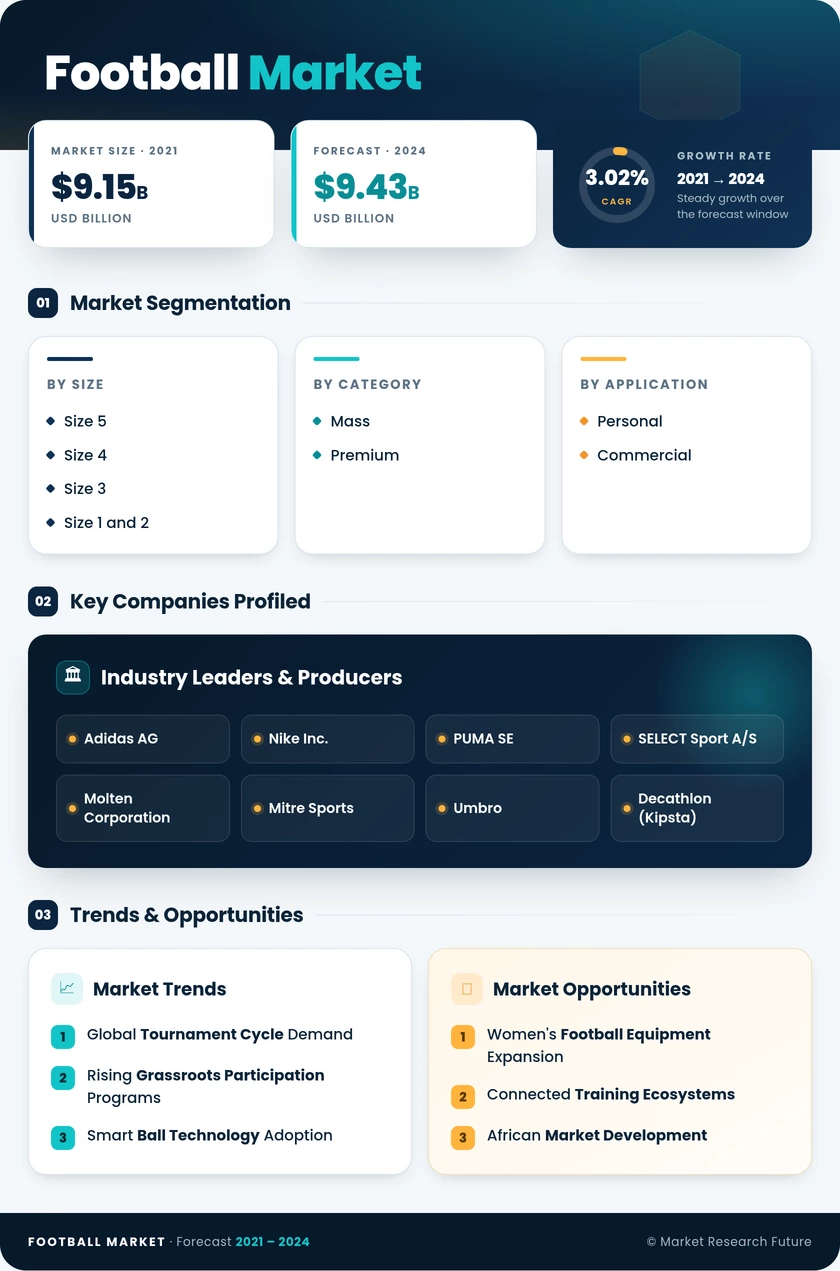
Football Market

ID: MRFR/CG/10467-HCR
128 Pages
Snehal Singh
Last Updated: June 11, 2026
Football Market Size, Share, Industry Trend & Analysis Research Report: By Size (Size 1 and 2, Size 3, Size 4, Size 5), By Category (Mass, Premium), By End Use (Personal, Commercial), By Distribution Channel (Online Stores, Offline Stores), By Geography (North America, Europe, Asia-Pacific, South America, Middle East & Africa) - Forecast to 2035
Download PDF ×

We do not share your information with anyone. However, we may send you emails based on your report interest from time to time. You may contact us at any time to opt-out.

  1. 1 Market Overview |
    1. 1.1 Study Assumptions & Market Definition |
    2. 1.2 Scope of the Study |
    3. 1.3 Research Methodology
  2. 2 Market Summary & Key Takeaways
  3. 3 Market Dynamics |
    1. 3.1 Market Drivers Analysis | |
      1. 3.1.1 Global Tournament Cycle Demand | |
      2. 3.1.2 Rising Grassroots Participation Programs | |
      3. 3.1.3 Smart Ball Technology Adoption | |
      4. 3.1.4 E-commerce Channel Acceleration | |
      5. 3.1.5 Women's Football Investment | |
      6. 3.1.6 Premiumization of Football Training Accessories | |
      7. 3.1.7 Urbanization & Futsal Growth |
    2. 3.2 Market Restraints Analysis | |
      1. 3.2.1 Supply Chain Concentration in Sialkot | |
      2. 3.2.2 Raw Material Price Volatility | |
      3. 3.2.3 Counterfeit Product Proliferation | |
      4. 3.2.4 Consumer Spending Constraints | |
      5. 3.2.5 Environmental Regulation Pressure |
    3. 3.3 Market Opportunity Analysis | |
      1. 3.3.1 Women's Football Equipment Expansion | |
      2. 3.3.2 Connected Training Ecosystems | |
      3. 3.3.3 African Market Development | |
      4. 3.3.4 Sustainable Materials Innovation | |
      5. 3.3.5 Futsal and Small-Sided Formats |
    4. 3.4 Industry Value Chain Analysis |
    5. 3.5 Porter's Five Forces Analysis
  4. 4 Global Football Market Size & Forecast (2021–2035) |
    1. 4.1 Historical Market Size (2021–2025) |
    2. 4.2 Current & Forecast Market Size (2026–2035) |
    3. 4.3 Market Size by Revenue (USD Billion) |
    4. 4.4 Year-over-Year Growth Analysis
  5. 5 Segmentation Analysis |
    1. 5.1 By Size | |
      1. 5.1.1 Size 1 and 2 | |
      2. 5.1.2 Size 3 | |
      3. 5.1.3 Size 4 | |
      4. 5.1.4 Size 5 |
    2. 5.2 By Category | |
      1. 5.2.1 Mass | |
      2. 5.2.2 Premium |
    3. 5.3 By End Use | |
      1. 5.3.1 Personal | |
      2. 5.3.2 Commercial |
    4. 5.4 By Distribution Channel | |
      1. 5.4.1 Online Stores | |
      2. 5.4.2 Offline Stores
  6. 6 Regional Analysis |
    1. 6.1 North America | |
      1. 6.1.1 United States | |
      2. 6.1.2 Canada | |
      3. 6.1.3 Mexico |
    2. 6.2 Europe | |
      1. 6.2.1 Germany | |
      2. 6.2.2 United Kingdom | |
      3. 6.2.3 France | |
      4. 6.2.4 Italy | |
      5. 6.2.5 Spain | |
      6. 6.2.6 Nordic Countries | |
      7. 6.2.7 Russia | |
      8. 6.2.8 Rest of Europe |
    3. 6.3 Asia-Pacific | |
      1. 6.3.1 China | |
      2. 6.3.2 India | |
      3. 6.3.3 Japan | |
      4. 6.3.4 South Korea | |
      5. 6.3.5 ASEAN | |
      6. 6.3.6 Rest of Asia-Pacific |
    4. 6.4 South America | |
      1. 6.4.1 Brazil | |
      2. 6.4.2 Argentina | |
      3. 6.4.3 Rest of South America |
    5. 6.5 Middle East & Africa | |
      1. 6.5.1 Saudi Arabia | |
      2. 6.5.2 UAE | |
      3. 6.5.3 South Africa | |
      4. 6.5.4 Egypt | |
      5. 6.5.5 Rest of MEA
  7. 7 Competitive Landscape |
    1. 7.1 Market Share Analysis (2025) |
    2. 7.2 Competitive Benchmarking Matrix |
    3. 7.3 Company Profiles | |
      1. 7.3.1 Adidas AG | |
      2. 7.3.2 Nike Inc. | |
      3. 7.3.3 PUMA SE | |
      4. 7.3.4 SELECT Sport A/S | |
      5. 7.3.5 Molten Corporation | |
      6. 7.3.6 Mitre Sports | |
      7. 7.3.7 Umbro | |
      8. 7.3.8 Decathlon (Kipsta) | |
      9. 7.3.9 New Balance | |
      10. 7.3.10 Joma Sport
  8. 8 Future Outlook & Strategic Recommendations (2026–2035) |
    1. 8.1 Digital-Physical Integration in Retail |
    2. 8.2 Sustainability-Driven Material Innovation |
    3. 8.3 Data-Enabled Performance Ecosystems |
    4. 8.4 Emerging Market Professionalization
  9. 9 Recent Developments & News
  10. 10 Frequently Asked Questions (FAQs)
  11. 11 Report Scope & Methodology |
    1. 11.1 Study Period & Base Year |
    2. 11.2 Data Sources & Citations |
    3. 11.3 Abbreviations
  12. 12 LIST OF TABLES |
  13. TABLE 1 Global Football Market Size & Forecast, by Revenue (USD Billion), 2021–2035 |
  14. TABLE 2 Global Football Market – Year-over-Year Growth Analysis, 2021–2035 |
  15. TABLE 3 Global Football Market – Driver Impact Analysis |
  16. TABLE 4 Global Football Market – Restraint Impact Analysis |
  17. TABLE 5 Global Football Market Size, by Size, 2021–2035 (USD Billion) |
  18. TABLE 6 Global Football Market Size, by Category, 2021–2035 (USD Billion) |
  19. TABLE 7 Global Football Market Size, by End Use, 2021–2035 (USD Billion) |
  20. TABLE 8 Global Football Market Size, by Distribution Channel, 2021–2035 (USD Billion) |
  21. TABLE 9 Global Football Market Size, by Region, 2021–2035 (USD Billion) |
  22. TABLE 10 North America Football Market Size, by Country, 2021–2035 (USD Billion) |
  23. TABLE 11 Europe Football Market Size, by Country, 2021–2035 (USD Billion) |
  24. TABLE 12 Asia-Pacific Football Market Size, by Country, 2021–2035 (USD Billion) |
  25. TABLE 13 South America Football Market Size, by Country, 2021–2035 (USD Billion) |
  26. TABLE 14 Middle East & Africa Football Market Size, by Country, 2021–2035 (USD Billion) |
  27. TABLE 15 Competitive Benchmarking Matrix – Global Football Market, 2025 |
  28. TABLE 16 Company Profiles – Key Players, Global Football Market |
  29. TABLE 17 Recent Developments & Strategic Announcements, 2023–2025 |
  30. TABLE 18 Report Scope & Methodology Summary |
  31. TABLE 19 Detailed Sources and Citations
  32. 13 LIST OF FIGURES |
  33. FIGURE 1 Global Football Market Dynamics — Drivers, Restraints, and Opportunities |
  34. FIGURE 2 Industry Value Chain Analysis — Football Market |
  35. FIGURE 3 Porter's Five Forces Analysis — Football Market |
  36. FIGURE 4 Global Football Market Size Trend (USD Billion), 2021–2035 |
  37. FIGURE 5 Football Market Share, by Size Segment, 2025 |
  38. FIGURE 6 Football Market Share, by Category, 2025 |
  39. FIGURE 7 Football Market Share, by End Use, 2025 |
  40. FIGURE 8 Football Market Share, by Distribution Channel, 2025 |
  41. FIGURE 9 Football Market Revenue Share, by Region, 2025 |
  42. FIGURE 10 Competitive Landscape — Market Share Distribution, 2025

Segmentation Quick Reference

DimensionSub-SegmentsDominant SegmentFastest Growing Segment
By SizeSize 1 and 2, Size 3, Size 4, Size 5Size 5Size 1 and 2
By CategoryMass, PremiumMassPremium
By End UsePersonal, CommercialPersonalCommercial
By Distribution ChannelOnline Stores, Offline StoresOffline StoresOnline Stores
By GeographyNorth America, Europe, Asia-Pacific, South America, Middle East & AfricaEuropeAsia-Pacific


Market Segmentation Overview

By Size

Sub-SegmentKey Trend
Size 5Professional standard; tournament-cycle demand spikes; smart ball adoption concentrated here
Size 4Youth competitive and futsal regulation; dual-purpose growth driver
Size 3Junior development programs; coaching drill standardization
Size 1 and 2Promotional merchandise, skill-training tools, and the highest volume CAGR


Size 5 footballs remain the foundation of the global Football Market, driven by universal adoption across professional leagues and senior amateur play. The Size 1 and 2 segments are experiencing the fastest growth, fueled by rising demand for branded promotional items and structured skill-development programs at grassroots levels.

By Category

Sub-SegmentKey Trend
MassPVC and machine-stitched balls dominate volume in price-sensitive regions
PremiumThermo-bonded construction, PU covers, sensor integration, driving revenue growth


Mass-market balls account for the majority of unit volume across the Football Market, serving school programs, recreational leagues, and casual play globally. Premium balls capture disproportionate revenue through advanced construction and embedded sensor technology.

By End Use

Sub-SegmentKey Trend
PersonalLargest segment; reflects football's minimal equipment requirements
CommercialFastest-growing, club academy procurement and rental facility professionalization


Personal purchases dominate end-use segmentation within the Football Market, consistent with football's accessibility as the world's most participated-in sport. Commercial procurement is accelerating as professional academies and indoor facilities standardize bulk purchasing.

By Distribution Channel

Sub-SegmentKey Trend
Offline StoresDominant channel; tactile product evaluation is critical for footwear and ball purchases
Online StoresFastest growing loyalty platforms, personalization, and exclusive product launches


Offline retail maintains an overwhelming share in the Football Market due to consumers' preference for hands-on evaluation of soccer cleats and boots and ball characteristics. Online channels are gaining momentum through digital-exclusive drops and customization tools.