Download Free Sample
Kindly complete the form below to receive a free sample of this Report
Force & Torque Sensor Market By Type (Force Sensors (Optical Force Sensor, Piezo-Resistive Force Sensor, Piezo-Electric Force Sensor, Capacitive Force Sensor, Magnetic Force Sensor, Ultrasonic Force Sensor, Electrochemical Force Sensor, Load Cell Sensor, Others), and Torque Sensor (Dynamic Torque Sensor, Joint Torque Sensor, 6 axis force/torque sensor, 4 Axis force/torque sensor, Static Torque Sensor, Others)), By Technology (Force Sensors (Strain Gauge, Thin-Film Sensors, Hydraulic Force Measurement) and Torque Sensor (Surface Acoustic Wave, Magnetoelastic, Optical, Strain Gauge)), By Application (Force Sensors (Traffic Engineering, Process Monitoring, Biomedical, Condition Monitoring, Measuring Equipment, Others) and Torque Sensor (Robotics, Engines. Automotive safety system, Assembly welding, Aircraft flight control, medical devices, Others)), by Region (North America, Europe, Asia-Pacific, Middle East & Africa, and South America) –Industry Forecast Till 2035
As per MRFR analysis, the Force Torque Sensor Market Size was estimated at 13490.1 USD Million in 2024. The Force Torque Sensor industry is projected to grow from 15206.07 in 2025 to 50354.26 by 2035, exhibiting a compound annual growth rate (CAGR) of 12.72% during the forecast period 2025 - 2035.
The Force Torque Sensor Market is poised for substantial growth driven by technological advancements and increasing demand across various sectors.
| 2024 Market Size | 13490.1 (USD Million) |
| 2035 Market Size | 50354.26 (USD Million) |
| CAGR (2025 - 2035) | 12.72% |
The Force Torque Sensor Market is currently experiencing a notable evolution, driven by advancements in technology and increasing demand across various industries. These sensors, which measure force and torque, are becoming integral in applications ranging from robotics to automotive testing. The growing emphasis on automation and precision in manufacturing processes appears to be a significant factor propelling the market forward. Furthermore, the integration of smart technologies and IoT capabilities into sensor systems is likely enhancing their functionality and appeal, suggesting a shift towards more sophisticated solutions. In addition, the rising focus on safety and quality control in production environments seems to be influencing the adoption of force torque sensors. Industries are increasingly recognizing the value of accurate measurements in ensuring product reliability and performance. As a result, the Force Torque Sensor Market is poised for continued growth, with innovations and applications expanding in tandem with evolving industry needs. This dynamic landscape indicates a promising future for stakeholders involved in the development and deployment of these essential measurement tools.
The Force Torque Sensor Market is witnessing a trend towards the incorporation of smart technologies, including IoT and AI. This integration enhances data collection and analysis, allowing for real-time monitoring and improved decision-making processes.
There is a growing demand for force torque sensors within the automotive industry, driven by the need for precise measurements in vehicle testing and development. This trend reflects the industry's commitment to safety and performance.
The market is experiencing a heightened focus on automation and precision in manufacturing. As industries strive for efficiency, the adoption of force torque sensors is likely to increase, facilitating enhanced operational capabilities.
The increasing push for automation across various industries is a primary driver of the Global Force and Torque Sensor Market Industry. As manufacturers strive for enhanced efficiency and precision, the integration of force and torque sensors becomes essential. For instance, in automotive manufacturing, these sensors are utilized to ensure optimal assembly processes. The market is projected to reach 13.5 USD Billion in 2024, reflecting a growing reliance on advanced sensor technologies. This trend is expected to continue as industries adopt smart manufacturing practices, thereby driving the demand for force and torque sensors.
In the Force Torque Sensor Market, the application segments are distributed among Industrial Automation, Robotics, Automotive Testing, Aerospace, and Medical Devices. Industrial Automation holds the largest market share, driven by the increasing demand for efficient manufacturing processes. Robotics follows as a significant contributor, with its own rising share attributed to advancements in automation technology across various industries including manufacturing and healthcare.
Industrial Automation (Dominant) vs. Robotics (Emerging)
Industrial Automation is the dominant application in the Force Torque Sensor Market, characterized by its commitment to enhancing production efficiency and precision in manufacturing processes. This segment benefits from the integration of force torque sensors which offer real-time data for improved operational control and quality assurance. On the other hand, Robotics represents an emerging application, rapidly growing due to increased reliance on automated systems in sectors such as healthcare, logistics, and agriculture. Robotics applications leverage force torque sensors to enhance capabilities in machine learning and adaptive responses, indicating a paradigm shift towards more sophisticated and intelligent automation solutions.
The Force Torque Sensor Market exhibits distinct market share distribution across various end-use segments. Manufacturing holds the largest portion, attributed to the increased automation and demand for precision in production processes. In contrast, Research and Development is witnessing a rapid expansion, fueled by technological advancements and the growing emphasis on innovative applications of force and torque sensors in various industries. As industries evolve, the growth trends reveal a robust trajectory for both Manufacturing and R&D segments. The rise of smart manufacturing and the Internet of Things (IoT) is enhancing the demand for high-accuracy sensors in manufacturing processes. Simultaneously, the focus on research-driven outcomes and collaborations between academia and industry is propelling R&D's growth, positioning it as the fastest-growing area within the market.
Manufacturing (Dominant) vs. Quality Control (Emerging)
Manufacturing is the dominant sector in the Force Torque Sensor Market, characterized by its reliance on precision and efficiency in production. The integration of torque sensors within machinery ensures optimized performance and reduces downtime, leading to more streamlined operations. In contrast, the Quality Control segment is emerging, reflecting a growing awareness of the need for stringent testing and calibration processes in production lines. This segment focuses on obtaining accurate measurements to ensure product reliability and safety, thus enhancing overall quality assurance mechanisms. As industries prioritize quality, the demand for sensor solutions in quality control applications is expected to grow significantly, fostering innovation and adaptation in sensor technology.
In the Force Torque Sensor Market, the technology segment is primarily characterized by its diverse range of sensing technologies. Strain gauge sensorscontinue to dominate the market due to their extensive use in various applications, offering high accuracy and reliability for measuring force and torque. Meanwhile, piezoelectric sensors are gaining recognition as the fastest-growing technology segment, driven by their ability to deliver high-speed measurements and robust performance in dynamic environments. The growth trends in this segment are influenced by the rising demand for automation and precision in industrial applications. Additionally, advancements in sensor technology and miniaturization are propelling the adoption of piezoelectric sensors, which are increasingly preferred for their integration capabilities in modern systems. As industries continue to evolve, the need for accurate and efficient force and torque measurement systems is expected to drive substantial growth across all technology segments.
Technology: Strain Gauge (Dominant) vs. Piezoelectric (Emerging)
Strain gauge sensors are recognized as the dominant technology in the Force Torque Sensor Market, primarily due to their widespread adoption in various industries, including automotive, aerospace, and manufacturing. Their mechanism relies on the deformation of a wire or foil under stress, allowing for precise measurement of force and torque, which is critical in quality control and product testing. On the other hand, piezoelectric sensors, while considered emerging, showcase significant potential due to their unique ability to deliver instantaneous response times and remarkable sensitivity, especially in dynamic applications. The compact design and versatility of piezoelectric sensors make them ideal for modern industrial machines, where traditional sensors might struggle to provide consistent data. As industries adapt to rapid changes in technology, the demand for both strain gauges and piezoelectric sensors is expected to continue growing.
The Force Torque Sensor Market exhibits a diverse array of sensor types, with load cells commanding the largest market share due to their widespread application in weighing and force measurement. Following closely, dynamic force sensors and static force sensors also hold significant portions of the market, while multi-axis sensors are gaining traction in advanced applications. Torque sensors, although not the largest, are experiencing rapid growth as industries increasingly focus on precision and automated manufacturing processes. Growth trends in the Force Torque Sensor segment are propelled by technological advancements and the rising demand for automation in various sectors, including automotive and manufacturing. As industries evolve towards smart technologies, the need for sensors that can accurately measure and relay data is becoming imperative. The trend towards IoT and Industry 4.0 further boosts the demand for more sophisticated sensors, particularly dynamic and multi-axis sensors, which are being adopted for their enhanced capabilities. This drives a competitive landscape as manufacturers innovate to cater to these emerging needs.
Load Cell (Dominant) vs. Dynamic Force Sensor (Emerging)
Load cells are crucial components in force measurement, offering high accuracy and reliability, which solidifies their position as the dominant player in the Force Torque Sensor Market. They are extensively used in industrial scales, material testing, and various automation applications, ensuring consistent performance and measurement reliability. On the other hand, dynamic force sensors are emerging as vital players, particularly in applications requiring real-time measurement and response to varying forces. These sensors provide enhanced data collection capabilities, allowing for better control and automation in processes. With the advent of more sophisticated applications, dynamic force sensors are gaining popularity, reflecting a shift in market demands towards more advanced sensing technologies.
Within the Force Torque Sensor Market, the material segment showcases a diverse landscape, with metal sensors holding the largest share due to their robust performance and reliability in demanding applications. In contrast, plastic sensors are rapidly gaining traction, appealing to applications requiring lightweight and cost-effective solutions. This distribution underlines the importance of adaptability and technology integration in material selection, determining the success of various sensor applications across industries.
Metal (Dominant) vs. Plastic (Emerging)
Metal force torque sensors are renowned for their durability and high precision, making them the go-to choice in heavy-duty and industrial applications. They excel in harsh environments where reliability and longevity are critical. Conversely, plastic sensors are emerging as a viable alternative, favored for their lightweight and versatile nature. They cater to sectors with cost constraints and the need for portability, thereby expanding the market's reach. This dynamic shows a shift towards more innovative materials, balancing performance with economic viability.
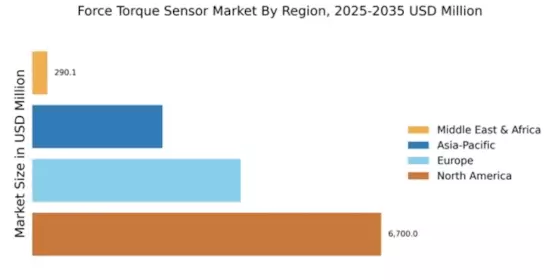
North America is poised to maintain its leadership in the Force Torque Sensor market, holding a significant share of 6700.0. The region's growth is driven by advancements in technology, increasing automation in manufacturing, and stringent safety regulations. The demand for precision measurement tools is rising, particularly in aerospace and automotive sectors, where accuracy is paramount. Regulatory support for innovation further fuels market expansion. The competitive landscape in North America is robust, featuring key players such as Honeywell, FUTEK, and TE Connectivity. These companies are investing heavily in R&D to enhance product offerings and meet evolving customer needs. The U.S. stands out as a major contributor, supported by a strong industrial base and a focus on smart manufacturing solutions. This environment fosters collaboration between industry and academia, driving further advancements in sensor technology.
Europe's Force Torque Sensor market is projected to grow significantly, with a market size of 4000.0. The region benefits from a strong emphasis on industrial automation and the adoption of Industry 4.0 technologies. Regulatory frameworks promoting energy efficiency and sustainability are key drivers, encouraging manufacturers to integrate advanced sensor technologies into their operations. The demand for high-precision sensors is particularly strong in the automotive and manufacturing sectors. Leading countries in Europe include Germany, France, and the UK, where companies like Siemens and HBM are making substantial contributions. The competitive landscape is characterized by a mix of established players and innovative startups, fostering a dynamic environment for growth. The European market is also witnessing increased collaboration between industry and research institutions, enhancing the development of cutting-edge sensor solutions.
The Asia-Pacific region is experiencing rapid growth in the Force Torque Sensor market, with a size of 2500.0. This growth is driven by increasing industrialization, particularly in countries like China and India, where manufacturing sectors are expanding. The demand for automation and precision measurement tools is rising, supported by government initiatives aimed at enhancing manufacturing capabilities. Regulatory frameworks are evolving to promote safety and efficiency in industrial operations. China leads the region in market share, with significant contributions from local manufacturers and global players like Vishay Precision Group. The competitive landscape is becoming increasingly dynamic, with a focus on innovation and cost-effective solutions. As industries in the region continue to modernize, the demand for advanced sensor technologies is expected to grow, positioning Asia-Pacific as a key player in the global market.
The Middle East and Africa (MEA) region presents unique opportunities in the Force Torque Sensor market, with a size of 290.1. The growth is driven by increasing investments in infrastructure and industrial projects, particularly in the Gulf Cooperation Council (GCC) countries. Regulatory initiatives aimed at enhancing safety and efficiency in industrial operations are also contributing to market expansion. The demand for advanced sensor technologies is rising as industries seek to improve operational efficiency. Leading countries in the region include the UAE and South Africa, where there is a growing presence of both local and international players. The competitive landscape is characterized by a mix of established companies and emerging startups, focusing on innovative solutions tailored to regional needs. As the MEA region continues to develop its industrial base, the demand for force torque sensors is expected to increase, driven by ongoing infrastructure projects and technological advancements.
The Force Torque Sensor Market is currently characterized by a dynamic competitive landscape, driven by technological advancements and increasing demand across various sectors, including automotive, aerospace, and industrial automation. Key players such as Honeywell (US), Kistler (CH), and FUTEK (US) are strategically positioned to leverage innovation and expand their market presence. Honeywell (US) focuses on enhancing its product portfolio through continuous research and development, while Kistler (CH) emphasizes precision measurement technologies, which are critical in high-performance applications. FUTEK (US) adopts a customer-centric approach, tailoring solutions to meet specific industry needs, thereby shaping a competitive environment that prioritizes quality and reliability.
In terms of business tactics, companies are increasingly localizing manufacturing to reduce lead times and optimize supply chains. The market structure appears moderately fragmented, with several players vying for market share. This fragmentation allows for a diverse range of products and solutions, fostering competition that drives innovation. The collective influence of these key players is significant, as they not only compete but also collaborate in certain areas, enhancing the overall market dynamics. In November 2025, Kistler (CH) announced the launch of a new line of torque sensors designed for high-precision applications in the automotive sector. This strategic move is likely to strengthen Kistler's position in a rapidly evolving market, as the demand for accurate torque measurement continues to rise with the increasing complexity of automotive systems. By focusing on high-performance solutions, Kistler aims to capture a larger share of the automotive market, which is essential for its growth strategy.
In October 2025, Honeywell (US) unveiled a new digital platform that integrates AI capabilities into its force torque sensors. This initiative is indicative of Honeywell's commitment to digital transformation, allowing for enhanced data analytics and predictive maintenance solutions. The integration of AI not only improves operational efficiency but also positions Honeywell as a leader in the smart sensor market, appealing to industries seeking advanced technological solutions. In September 2025, FUTEK (US) entered into a strategic partnership with a leading robotics manufacturer to develop advanced torque sensors tailored for robotic applications.
This collaboration is expected to enhance FUTEK's product offerings and expand its reach into the growing robotics market. By aligning with a key player in robotics, FUTEK is likely to benefit from shared expertise and resources, further solidifying its competitive edge. As of December 2025, current trends in the Force Torque Sensor Market indicate a strong emphasis on digitalization, sustainability, and AI integration. Strategic alliances are increasingly shaping the competitive landscape, enabling companies to pool resources and innovate more effectively. Looking ahead, competitive differentiation is expected to evolve, with a shift from price-based competition to a focus on innovation, technology, and supply chain reliability. This transition underscores the importance of adaptability and forward-thinking strategies in maintaining a competitive advantage.






The Force Torque Sensor Market is projected to grow at a 12.72% CAGR from 2025 to 2035, driven by advancements in automation, increased demand for precision measurement, and the rise of smart manufacturing.
New opportunities lie in:
By 2035, the Force Torque Sensor Market is expected to achieve substantial growth, reflecting evolving technological demands.
| MARKET SIZE 2024 | 13490.1(USD Million) |
| MARKET SIZE 2025 | 15206.07(USD Million) |
| MARKET SIZE 2035 | 50354.26(USD Million) |
| COMPOUND ANNUAL GROWTH RATE (CAGR) | 12.72% (2025 - 2035) |
| REPORT COVERAGE | Revenue Forecast, Competitive Landscape, Growth Factors, and Trends |
| BASE YEAR | 2024 |
| Market Forecast Period | 2025 - 2035 |
| Historical Data | 2019 - 2024 |
| Market Forecast Units | USD Million |
| Key Companies Profiled | Honeywell (US), Kistler (CH), FUTEK (US), TE Connectivity (US), Applied Measurements (GB), HBM (DE), Vishay Precision Group (US), Siemens (DE), Omega Engineering (US) |
| Segments Covered | Application, End Use, Technology, Sensor Type, Material |
| Key Market Opportunities | Integration of advanced materials and IoT technology enhances performance in the Force Torque Sensor Market. |
| Key Market Dynamics | Rising demand for precision measurement drives innovation and competition in the Force Torque Sensor market. |
| Countries Covered | North America, Europe, APAC, South America, MEA |
The Force Torque Sensor Market was valued at approximately 13490.1 USD Million in 2024.
The market is expected to reach around 50354.26 USD Million by 2035.
The anticipated CAGR for the Force Torque Sensor Market from 2025 to 2035 is 12.72%.
Key applications include Industrial Automation, Robotics, and Medical Devices, with Industrial Automation valued at 4045.03 USD Million in 2024.
Prominent players include Honeywell, Kistler, FUTEK, and TE Connectivity, among others.





Kindly complete the form below to receive a free sample of this Report

“This is really good guys. Excellent work on a tight deadline. I will continue to use you going forward and recommend you to others. Nice job”


“Thanks. It’s been a pleasure working with you, please use me as reference with any other Intel employees.”


“Thanks for sending the report it gives us a good global view of the Betaïne market.”


“Thank you, this will be very helpful for OQS.”


“We found the report very insightful! we found your research firm very helpful. I'm sending this email to secure our future business.”


“I am very pleased with how market segments have been defined in a relevant way for my purposes (such as "Portable Freezers & refrigerators" and "last-mile"). In general the report is well structured. Thanks very much for your efforts.”


“I have been reading the first document or the study, ,the Global HVAC and FP market report 2021 till 2026. Must say, good info! I have not gone in depth at all parts, but got a good indication of the data inside!”


“We got the report in time, we really thank you for your support in this process. I also thank to all of your team as they did a great job.”


“The Automotive 48V ECU Components Procurement Intelligence Study” was a complex project, but the Market Research Future (MRFR) team handled it with quality, agility, and customer-centricity. They delivered all requested data on time and within the agreed scope. The team, including Shubhendra Anand and Rahul Gotadki, was always readily available to clarify questions and swiftly implement necessary adjustments, driving the project to a successful conclusion within a very demanding timeframe.
I would also like to specifically commend Akshay Agarwal for his responsiveness and support at every stage—from our initial inquiry on May 6th through to final delivery on June 18th. His dedication made the entire process seamless.”



