×
Request Free Sample ×

Kindly complete the form below to receive a free sample of this Report

* Please use a valid business email

Leading companies partner with us for data-driven Insights

clients tt-cursor
Hero Background

Forensic Medicine Market

ID: MRFR/HC/39607-HCR
128 Pages
Rahul Gotadki
October 2025

Forensic Medicine Market Research Report By Application (Toxicology, DNA Analysis, Sero-logical Tests, Ballistics, Digital Forensics), By End Use (Hospitals, Crime Laboratories, Academic Institutions, Law Enforcement Agencies), By Product Type (Forensic Kits, Testing Equipment, Reagents and Consumables, Software Solutions), By Technology (PCR Technology, Mass Spectrometry, Chromatography, Immunoassays) and By Regional (North America, Europe, South America, Asia Pacific, Middle East and Africa) - Forecast to 2035

Share:
Download PDF ×

We do not share your information with anyone. However, we may send you emails based on your report interest from time to time. You may contact us at any time to opt-out.

Forensic Medicine Market Infographic
Purchase Options

Forensic Medicine Market Summary

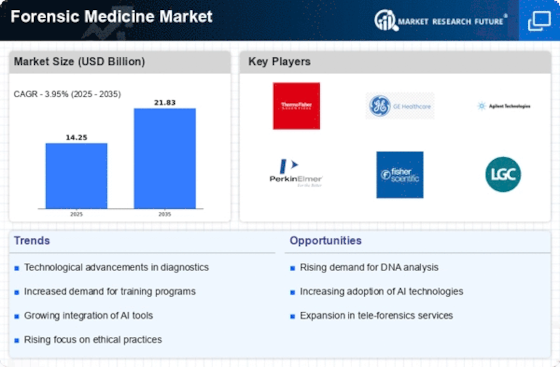
As per MRFR analysis, the Forensic Medicine Market Size was estimated at 14.25 USD Billion in 2024. The Forensic Medicine industry is projected to grow from 14.82 USD Billion in 2025 to 21.83 USD Billion by 2035, exhibiting a compound annual growth rate (CAGR) of 3.95 during the forecast period 2025 - 2035.

Key Market Trends & Highlights

The Forensic Medicine Market is experiencing robust growth driven by technological advancements and increasing demand for forensic services.

  • Technological advancements are revolutionizing forensic methodologies, enhancing accuracy and efficiency.
  • The demand for forensic services is rising, particularly in North America, which remains the largest market.
  • DNA analysis continues to dominate the market, while toxicology is emerging as the fastest-growing segment.
  • Rising crime rates and advancements in forensic technology are key drivers propelling market expansion.

Market Size & Forecast

2024 Market Size 14.25 (USD Billion)
2035 Market Size 21.83 (USD Billion)
CAGR (2025 - 2035) 3.95%

Major Players

Thermo Fisher Scientific (US), GE Healthcare (US), Agilent Technologies (US), PerkinElmer (US), Fisher Scientific (US), LGC Group (GB), Merck KGaA (DE), Bio-Rad Laboratories (US), Qiagen (DE)

Forensic Medicine Market Trends

The Forensic Medicine Market is currently experiencing a dynamic evolution, driven by advancements in technology and an increasing emphasis on legal and criminal justice systems. The integration of innovative techniques, such as DNA analysis and digital forensics, appears to enhance the accuracy and reliability of forensic investigations. Furthermore, the growing awareness of the importance of forensic evidence in legal proceedings suggests a rising demand for specialized forensic services. This trend is likely to be bolstered by the expansion of forensic laboratories and the training of professionals in this field, which may lead to improved outcomes in criminal cases. In addition, the Forensic Medicine Market is influenced by the increasing collaboration between law enforcement agencies and forensic experts. This partnership seems to facilitate the sharing of knowledge and resources, thereby enhancing the overall effectiveness of forensic investigations. Moreover, the rising incidence of violent crimes and the need for efficient crime scene management indicate a potential growth trajectory for the market. As the landscape of forensic medicine continues to evolve, it is essential for stakeholders to remain adaptable and responsive to emerging challenges and opportunities within this critical sector.

Technological Advancements

The Forensic Medicine Market is witnessing a surge in technological innovations, particularly in areas such as DNA sequencing and digital forensics. These advancements are likely to improve the precision of forensic analyses, thereby enhancing the credibility of evidence presented in court.

Increased Demand for Forensic Services

There appears to be a growing demand for forensic services, driven by heightened awareness of the role of forensic evidence in legal proceedings. This trend may lead to the establishment of more specialized forensic laboratories and an increase in the number of trained professionals in the field.

Collaboration Between Agencies

The collaboration between law enforcement and forensic experts seems to be strengthening, facilitating better resource sharing and knowledge exchange. This partnership could enhance the efficiency of investigations and improve the overall effectiveness of forensic practices.

Forensic Medicine Market Drivers

Rising Crime Rates

The Forensic Medicine Market appears to be influenced by the rising crime rates observed in various regions. As crime rates increase, there is a corresponding demand for forensic services to investigate and solve these crimes. For instance, data indicates that violent crime rates have surged in certain urban areas, necessitating enhanced forensic capabilities. This trend suggests that law enforcement agencies are increasingly relying on forensic medicine to provide critical evidence in criminal cases. Consequently, the growth in crime rates is likely to drive investments in forensic technologies and services, thereby expanding the Forensic Medicine Market. Furthermore, the need for accurate and timely forensic analysis is becoming paramount, as it plays a crucial role in ensuring justice and public safety.

Regulatory Changes and Standards

Regulatory changes and the establishment of standards in forensic practices are shaping the Forensic Medicine Market. Governments and professional organizations are increasingly implementing guidelines to ensure the quality and reliability of forensic evidence. These regulations are aimed at enhancing the credibility of forensic findings in legal proceedings, which is essential for maintaining public trust in the justice system. As a result, forensic laboratories and professionals are compelled to adopt best practices and invest in training and certification programs. This shift towards standardized practices is likely to drive growth in the Forensic Medicine Market, as compliance with regulations may require additional resources and technologies. Furthermore, adherence to these standards can improve the overall quality of forensic services, thereby benefiting law enforcement and the judicial system.

Advancements in Forensic Technology

Technological advancements are reshaping the Forensic Medicine Market, leading to more efficient and accurate forensic investigations. Innovations such as DNA sequencing, digital forensics, and advanced imaging techniques are revolutionizing the way forensic evidence is collected and analyzed. For example, the introduction of rapid DNA testing has significantly reduced the time required to obtain results, which is critical in time-sensitive investigations. The market for forensic technology is projected to grow substantially, with estimates suggesting a compound annual growth rate of over 10% in the coming years. This growth is indicative of the increasing reliance on sophisticated forensic tools and methodologies, which enhance the capabilities of forensic professionals and improve the overall effectiveness of the justice system.

Growing Awareness of Forensic Science

The growing awareness of forensic science among the general public and legal professionals is contributing to the expansion of the Forensic Medicine Market. As educational programs and media portrayals of forensic science proliferate, there is a heightened interest in the role of forensic medicine in criminal investigations. This awareness is leading to increased demand for forensic services, as individuals and organizations seek to understand the intricacies of forensic evidence. Moreover, legal practitioners are becoming more knowledgeable about the potential of forensic science to support their cases, which may result in a greater reliance on forensic experts. Consequently, this trend is likely to stimulate growth in the Forensic Medicine Market, as more stakeholders recognize the value of forensic analysis in achieving justice.

Increased Investment in Forensic Research

Increased investment in forensic research is emerging as a key driver for the Forensic Medicine Market. Governments, academic institutions, and private organizations are allocating funds to advance forensic science and develop innovative methodologies. This investment is crucial for addressing complex forensic challenges, such as the analysis of new types of evidence and the integration of technology in forensic practices. Research initiatives are likely to lead to breakthroughs in areas such as toxicology, ballistics, and digital forensics, which can enhance the capabilities of forensic professionals. As a result, the Forensic Medicine Market may experience growth driven by the demand for cutting-edge forensic solutions that stem from ongoing research efforts. The emphasis on research and development is expected to foster collaboration between various stakeholders, further propelling the market forward.

Market Segment Insights

By Application: DNA Analysis (Largest) vs. Toxicology (Fastest-Growing)

In the Forensic Medicine Market, the application segment exhibits a compelling distribution of market share across various fields. DNA Analysis stands out as the predominant application, accounting for the largest share due to its critical role in identifying individuals and solving crimes. Following closely is Toxicology, which, driven by the increasing prevalence of substance abuse cases and environmental concerns, is swiftly gaining traction in forensic investigations. Other notable applications in this segment include Serological Tests, Ballistics, and Digital Forensics, all contributing to the diverse landscape of forensic medicine.

DNA Analysis (Dominant) vs. Toxicology (Emerging)

DNA Analysis serves as a cornerstone of forensic medicine, providing a reliable means for individual identification and evidence matching in criminal cases. It has established itself as the dominant force in forensic applications, owing to its precision and ability to link suspects to crime scenes through genetic material. On the other hand, Toxicology is emerging as a key player, driven by escalating needs for drug testing and poisoning investigations. As synthetic drugs and new substances become prevalent, the emphasis on Toxicology is rising. This application not only aids in criminal cases but also plays a vital role in public health and environmental safety, indicating its expanding significance in the forensic realm.

By End Use: Hospitals (Largest) vs. Crime Laboratories (Fastest-Growing)

The Forensic Medicine Market is primarily segmented into four key end-use sectors: Hospitals, Crime Laboratories, Academic Institutions, and Law Enforcement Agencies. Among these, hospitals dominate the market significantly, offering extensive forensic services that cater to a wide range of medical and legal requirements. Crime laboratories, on the other hand, are showing a remarkable increase in market share as they deal with the surge in forensic investigations, driven by advancements in forensic technologies and techniques.

Hospitals (Dominant) vs. Crime Laboratories (Emerging)

Hospitals play a crucial role in the forensic medicine market, providing vital services such as autopsies, toxicology, and medical examinations. Their established infrastructure and integrated health systems contribute to this dominance. Conversely, crime laboratories represent the emerging facet of this market, driven by innovations in forensic methodologies, such as DNA analysis and digital forensics. As the demand for precise and rapid investigations rises, crime laboratories are adapting quickly, making them a key focus for future growth in forensic medicine.

By Product Type: Forensic Kits (Largest) vs. Testing Equipment (Fastest-Growing)

The forensic medicine market is witnessing significant distribution among its product types. Forensic kits hold the largest market share, primarily due to their essential role in crime scene investigation and evidence collection. In contrast, testing equipment has emerged as the fastest-growing segment, reflecting the increasing demand for accurate and reliable testing solutions in forensic analysis. As forensic science evolves, these product categories are at the forefront of supporting law enforcement efforts and ensuring precise outcomes in criminal investigations. Growth trends in the forensic medicine market are driven by technological advancements and heightened awareness of forensic methodologies. The increasing volume of criminal cases and the need for rapid, efficient analysis bolster the demand for both forensic kits and testing equipment. Additionally, regulatory frameworks emphasizing validated forensic processes fuel investments in software solutions that enhance data management and analysis capabilities, further propelling the market forward.
Forensic Kits: Dominant vs. Testing Equipment: Emerging

Forensic kits are instrumental in the forensic medicine market, serving as comprehensive solutions for crime scene processing and evidence collection. Their dominant position is attributed to their ease of use and necessity for law enforcement professionals, allowing for efficient on-site operations. On the other hand, testing equipment represents an emerging category, rapidly gaining traction as investigations demand more advanced analysis techniques. This includes sophisticated tools for DNA analysis and toxicology, reflecting the industry's response to the intricacies of modern forensic challenges. The synergy between these products enables law enforcement agencies to enhance their investigative capabilities and meet evolving standards in forensic science.

By Technology: PCR Technology (Largest) vs. Mass Spectrometry (Fastest-Growing)

In the Forensic Medicine Market, the technology segment showcases a diverse array of methodologies that greatly influence the accuracy and efficiency of forensic analysis. PCR Technology leads this segment, capturing the largest share due to its critical role in DNA amplification, which is essential for identifying individuals from trace evidence. Meanwhile, Mass Spectrometry is emerging as a crucial player and is recognized for its rapid growth. It offers exceptional sensitivity and precision, making it invaluable in toxicology and drug analysis.

PCR Technology (Dominant) vs. Mass Spectrometry (Emerging)

PCR Technology, being the dominant force in the Forensic Medicine Market, is essential for amplifying DNA from various samples, thereby enabling accurate identification in forensic investigations. Its reliability and established protocols have cemented its status in criminal justice and paternity testing. In contrast, Mass Spectrometry is rapidly emerging, known for its unique capability to provide qualitative and quantitative analysis of complex mixtures. Its technological advancements allow forensic experts to detect and quantify substances at trace levels, positioning it as a pivotal tool for modern forensic laboratories.

Get more detailed insights about Forensic Medicine Market

Regional Insights

North America : Forensic Innovation Leader

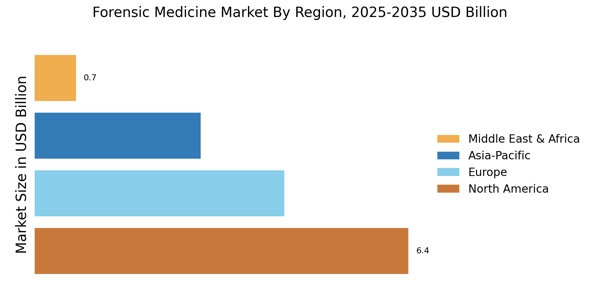
North America is the largest market for forensic medicine, holding approximately 45% of the global share. The region's growth is driven by advancements in technology, increasing crime rates, and a strong focus on forensic research and development. Regulatory support from agencies like the FBI and CDC further catalyzes market expansion, ensuring compliance and innovation in forensic practices. The United States leads the market, with significant contributions from Canada. Key players such as Thermo Fisher Scientific, GE Healthcare, and Agilent Technologies dominate the landscape, providing cutting-edge solutions. The competitive environment is characterized by continuous innovation and strategic partnerships, enhancing the capabilities of forensic medicine across various applications.

Europe : Regulatory Framework Strength

Europe is the second-largest market for forensic medicine, accounting for about 30% of the global share. The region benefits from stringent regulatory frameworks and a growing emphasis on forensic science in criminal investigations. Countries like Germany and the UK are at the forefront, driving demand through investments in forensic technologies and research initiatives, supported by EU regulations that promote standardization and quality assurance. Germany, the UK, and France are leading countries in this sector, with a competitive landscape featuring key players like Merck KGaA and Qiagen. The presence of advanced research institutions and collaborations between public and private sectors further enhance the market's growth potential. The focus on improving forensic methodologies and technologies is expected to drive future advancements in the region.

Asia-Pacific : Emerging Forensic Market

Asia-Pacific is an emerging powerhouse in the forensic medicine market, holding approximately 20% of the global share. The region's growth is fueled by increasing criminal activities, rising awareness of forensic science, and government initiatives to enhance law enforcement capabilities. Countries like China and India are witnessing significant investments in forensic technologies, supported by regulatory frameworks aimed at improving public safety and justice delivery. China and India are the leading countries in this market, with a growing number of forensic laboratories and research institutions. The competitive landscape is evolving, with both local and international players, including Bio-Rad Laboratories and PerkinElmer, expanding their presence. The focus on technological advancements and training for forensic professionals is expected to drive further growth in the region.

Middle East and Africa : Developing Forensic Landscape

The Middle East and Africa region is witnessing a gradual rise in the forensic medicine market, accounting for about 5% of the global share. The growth is driven by increasing crime rates, government investments in law enforcement, and a growing recognition of the importance of forensic science in criminal justice. Countries like South Africa and the UAE are leading the way, with initiatives aimed at enhancing forensic capabilities and infrastructure. South Africa and the UAE are the primary markets, with a focus on developing forensic laboratories and training programs for law enforcement agencies. The competitive landscape is characterized by collaborations between government bodies and private sector players, aiming to improve forensic methodologies. As awareness of forensic science grows, the region is expected to see significant advancements in its forensic capabilities.

Forensic Medicine Market Regional Image

Key Players and Competitive Insights

The Forensic Medicine Market is currently characterized by a dynamic competitive landscape, driven by advancements in technology, increasing demand for forensic analysis, and a growing emphasis on public safety. Key players such as Thermo Fisher Scientific (US), GE Healthcare (US), and Agilent Technologies (US) are at the forefront, leveraging their extensive portfolios to enhance operational capabilities. These companies are strategically positioned to capitalize on emerging trends, focusing on innovation and partnerships to expand their market reach. Their collective efforts contribute to a competitive environment that is increasingly shaped by technological advancements and regulatory requirements.

In terms of business tactics, companies are increasingly localizing manufacturing and optimizing supply chains to enhance efficiency and responsiveness to market demands. The competitive structure of the forensic medicine market appears moderately fragmented, with several key players exerting influence. This fragmentation allows for a diverse range of products and services, fostering innovation while also presenting challenges in terms of market share and customer loyalty.

In August 2025, Thermo Fisher Scientific (US) announced the launch of a new forensic DNA analysis platform designed to streamline the identification process in criminal investigations. This strategic move is likely to enhance their competitive edge by providing law enforcement agencies with faster and more accurate results, thereby addressing the growing demand for efficient forensic solutions. The introduction of this platform underscores the company's commitment to innovation and its focus on meeting the evolving needs of the forensic community.

Similarly, in July 2025, GE Healthcare (US) expanded its partnership with local law enforcement agencies to provide advanced imaging technologies for forensic investigations. This collaboration is indicative of GE's strategy to integrate cutting-edge imaging solutions into forensic applications, potentially improving the accuracy of evidence collection and analysis. Such partnerships not only enhance GE's market presence but also reflect a broader trend of collaboration between technology providers and law enforcement.

In September 2025, Agilent Technologies (US) unveiled a new suite of forensic analysis tools aimed at enhancing the efficiency of toxicology testing. This initiative is significant as it aligns with the increasing focus on public health and safety, particularly in the context of drug-related investigations. By investing in the development of these tools, Agilent is positioning itself as a leader in the forensic toxicology space, which is likely to attract new clients and strengthen existing relationships with forensic laboratories.

As of October 2025, the competitive trends in the forensic medicine market are increasingly defined by digitalization, sustainability, and the integration of artificial intelligence. Strategic alliances are becoming more prevalent, as companies recognize the value of collaboration in driving innovation and enhancing service offerings. Looking ahead, it appears that competitive differentiation will evolve from traditional price-based competition to a focus on technological innovation, reliability in supply chains, and the ability to provide comprehensive solutions tailored to the specific needs of forensic professionals.

Key Companies in the Forensic Medicine Market market include

Industry Developments

The Forensic Medicine Market has seen significant recent developments, with growing demand for advanced diagnostic tools and technologies. Companies such as Roche and Siemens Healthineers are actively enhancing their forensic capabilities, leading to increased investments in research and development. Furthermore, GE Healthcare and Thermo Fisher Scientific are focusing on expanding their product suites in forensic applications, which are crucial for criminal investigations. The emergence of new regulations and standards in forensic practices is also driving innovation among key players like Abbott Laboratories and BioRad Laboratories.

Notably, there have been reports of strategic mergers and acquisitions within the sector, including moves by Agilent Technologies and PerkinElmer to consolidate their market positions. These partnerships aim to leverage combined technologies to deliver more precise forensic analysis, which is essential for law enforcement agencies globally. Additionally, the market is witnessing a steady growth trajectory, attributed to the increasing adoption of forensic applications in healthcare and criminology, enhancing the overall valuation and competitiveness of major participants like Merck Group and Waters Corporation.

Future Outlook

Forensic Medicine Market Future Outlook

The Forensic Medicine Market is projected to grow at a 3.95% CAGR from 2024 to 2035, driven by technological advancements, increasing crime rates, and rising demand for forensic services.

New opportunities lie in:

  • Development of AI-driven forensic analysis tools
  • Expansion of tele-forensic services for remote consultations
  • Investment in advanced training programs for forensic professionals

By 2035, the market is expected to be robust, driven by innovation and increased service demand.

Market Segmentation

Forensic Medicine Market End Use Outlook

  • Hospitals
  • Crime Laboratories
  • Academic Institutions
  • Law Enforcement Agencies

Forensic Medicine Market Technology Outlook

  • PCR Technology
  • Mass Spectrometry
  • Chromatography
  • Immunoassays

Forensic Medicine Market Application Outlook

  • Toxicology
  • DNA Analysis
  • Sero-logical Tests
  • Ballistics
  • Digital Forensics

Forensic Medicine Market Product Type Outlook

  • Forensic Kits
  • Testing Equipment
  • Reagents and Consumables
  • Software Solutions

Report Scope

MARKET SIZE 202414.25(USD Billion)
MARKET SIZE 202514.82(USD Billion)
MARKET SIZE 203521.83(USD Billion)
COMPOUND ANNUAL GROWTH RATE (CAGR)3.95% (2024 - 2035)
REPORT COVERAGERevenue Forecast, Competitive Landscape, Growth Factors, and Trends
BASE YEAR2024
Market Forecast Period2025 - 2035
Historical Data2019 - 2024
Market Forecast UnitsUSD Billion
Key Companies ProfiledMarket analysis in progress
Segments CoveredMarket segmentation analysis in progress
Key Market OpportunitiesIntegration of advanced technologies in forensic analysis enhances accuracy and efficiency in the Forensic Medicine Market.
Key Market DynamicsTechnological advancements and regulatory changes are reshaping competitive dynamics in the forensic medicine market.
Countries CoveredNorth America, Europe, APAC, South America, MEA

Leave a Comment

FAQs

What is the projected market valuation of the Forensic Medicine Market by 2035?

The Forensic Medicine Market is projected to reach a valuation of 21.83 USD Billion by 2035.

What was the market valuation of the Forensic Medicine Market in 2024?

In 2024, the Forensic Medicine Market was valued at 14.25 USD Billion.

What is the expected CAGR for the Forensic Medicine Market during the forecast period 2025 - 2035?

The expected CAGR for the Forensic Medicine Market during the forecast period 2025 - 2035 is 3.95%.

Which segment of the Forensic Medicine Market had the highest valuation in 2024?

In 2024, the Digital Forensics segment had a valuation of 3.1 USD Billion.

What are the key players in the Forensic Medicine Market?

Key players in the Forensic Medicine Market include Thermo Fisher Scientific, GE Healthcare, and Agilent Technologies.

How much is the Toxicology segment projected to grow by 2035?

The Toxicology segment is projected to grow from 2.85 USD Billion in 2024 to 4.25 USD Billion by 2035.

What is the projected valuation for the Reagents and Consumables segment by 2035?

The Reagents and Consumables segment is projected to reach 6.0 USD Billion by 2035.

Which end-use segment is expected to have the highest growth by 2035?

The Law Enforcement Agencies segment is expected to grow from 4.75 USD Billion in 2024 to 7.0 USD Billion by 2035.

What is the projected growth for Software Solutions in the Forensic Medicine Market?

Software Solutions are projected to grow from 3.9 USD Billion in 2024 to 6.58 USD Billion by 2035.

How does the market for Mass Spectrometry technology appear to be evolving?

The Mass Spectrometry technology segment is projected to grow from 4.0 USD Billion in 2024 to 6.0 USD Billion by 2035.

Download Free Sample

Kindly complete the form below to receive a free sample of this Report

Compare Licence

×
Features License Type
Single User Multiuser License Enterprise User
Price $4,950 $5,950 $7,250
Maximum User Access Limit 1 User Upto 10 Users Unrestricted Access Throughout the Organization
Free Customization
Direct Access to Analyst
Deliverable Format
Platform Access
Discount on Next Purchase 10% 15% 15%
Printable Versions