Download Free Sample
Kindly complete the form below to receive a free sample of this Report
France Blockchain Fintech Market Size, Share and Research Report By Application (Payments, Clearing, Settlement, Exchange, Remittance, Smart Contracts, Identity Management, Compliance Management, Know Your Customer, Content Storage Management), By Provider (Application and Solution Providers, Middleware Providers, Infrastructure and Protocols Providers), By Organization Size (Small-Medium Size Enterprises, Large Enterprises) and By Industry Vertical (Banking, Non-banking, Financial Services, Insurance) - Industry Forecast Till 2035
As per Market Research Future analysis, the France blockchain fintech market size was estimated at 146.42 USD Million in 2024.. The France blockchain fintech market is projected to grow from 206.34 USD Million in 2025 to 6372.83 USD Million by 2035, exhibiting a compound annual growth rate (CAGR) of 40.9% during the forecast period 2025 - 2035
The France blockchain fintech market is experiencing robust growth driven by regulatory support and technological advancements.
| 2024 Market Size | 146.42 (USD Million) |
| 2035 Market Size | 6372.83 (USD Million) |
| CAGR (2025 - 2035) | 40.92% |
Binance (MT), Coinbase (US), Ripple (US), Bitfinex (HK), Kraken (US), Gemini (US), BlockFi (US), Bitstamp (LU), eToro (IL)
Our Impact
Enabled $4.3B Revenue Impact for Fortune 500 and Leading Multinationals
Partnering with 2000+ Global Organizations Each Year
30K+ Citations by Top-Tier Firms in the Industry
the blockchain fintech market in France is currently experiencing significant changes, driven by a confluence of technological advancements and regulatory developments.. The French government has shown a proactive stance towards fostering innovation in this sector, implementing frameworks that encourage the adoption of blockchain technologies. This supportive environment appears to be attracting both domestic and international players, leading to a burgeoning ecosystem characterized by startups and established financial institutions exploring decentralized finance solutions. Furthermore, the increasing demand for transparency and security in financial transactions is propelling the integration of blockchain solutions across various sectors, including banking, insurance, and supply chain management. In addition, the rise of digital currencies and the growing interest in tokenization are reshaping the landscape of the blockchain fintech market. French consumers and businesses are becoming more aware of the benefits associated with blockchain applications, such as enhanced efficiency and reduced costs. As a result, there is a noticeable shift towards embracing these technologies, which may lead to a more competitive financial environment. The ongoing collaboration between public and private sectors is likely to further stimulate innovation, positioning France as a key player in the European blockchain landscape. Overall, the current trajectory suggests a promising future for the blockchain fintech market, with potential for significant growth and transformation in the coming years.
The French government is actively promoting blockchain technology through favorable regulations and initiatives. This support encourages innovation and attracts investment, fostering a vibrant ecosystem for startups and established firms alike.
There is a growing trend towards decentralized finance solutions within the blockchain fintech market. Financial institutions are exploring these alternatives to enhance efficiency and reduce operational costs, indicating a shift in traditional financial paradigms.
As awareness of blockchain benefits rises, French consumers are increasingly engaging with blockchain applications. This trend suggests a potential for greater adoption of digital currencies and tokenized assets, reshaping the financial landscape.
The development of a robust regulatory framework is crucial for the blockchain fintech market. In France, regulatory bodies are actively working to create guidelines that foster innovation while ensuring consumer protection. The recent establishment of the French Digital Asset Framework aims to provide clarity for blockchain companies and investors, potentially leading to increased market participation. As regulations become more defined, businesses may feel more confident in adopting blockchain technologies, knowing they operate within a legal framework. This regulatory clarity is likely to attract both domestic and international investments, further stimulating growth in the blockchain fintech market. The balance between innovation and regulation will be pivotal in shaping the future landscape of financial services.
Increased collaboration between traditional financial institutions and blockchain startups is emerging as a significant driver of the blockchain fintech market. In France, partnerships are forming to leverage the strengths of both sectors, with banks exploring blockchain solutions to enhance their service offerings. This trend is indicative of a broader acceptance of blockchain technology within established financial systems. Collaborative initiatives are likely to lead to the development of hybrid solutions that combine the reliability of traditional finance with the innovative capabilities of blockchain. As these partnerships grow, the blockchain fintech market is expected to benefit from shared resources, knowledge, and technology, ultimately leading to more comprehensive financial services for consumers.
Investment in blockchain startups is surging, significantly impacting the blockchain fintech market. In France, venture capital funding for blockchain-related projects has seen a remarkable increase, with reports indicating a rise of over 50% in 2025 compared to the previous year. This influx of capital is fostering innovation and enabling startups to develop cutting-edge solutions that address various financial challenges. As investors recognize the potential of blockchain technology to disrupt traditional financial systems, the market is likely to witness a proliferation of new products and services. This trend not only enhances competition but also encourages collaboration between established financial institutions and emerging blockchain firms, ultimately benefiting consumers and businesses alike.
the blockchain fintech market is experiencing rapid technological advancements that improve transaction efficiency and security.. Innovations such as smart contracts and decentralized applications are becoming increasingly prevalent. In France, the adoption of these technologies is projected to grow, with estimates suggesting that the market could reach €1 billion by 2026. This growth is driven by the need for secure and transparent financial transactions, which blockchain technology inherently provides. As financial institutions and startups alike invest in these technologies, the blockchain fintech market is likely to expand, attracting more users and investors. Furthermore, the integration of artificial intelligence with blockchain solutions may further streamline operations, making the market more appealing to traditional financial entities seeking modernization.
The demand for transparency and security in financial transactions is a key driver of the blockchain fintech market. Consumers and businesses are increasingly concerned about data breaches and fraud, prompting a shift towards blockchain solutions that offer enhanced security features. In France, surveys indicate that over 70% of consumers express a preference for financial services that utilize blockchain technology due to its inherent security benefits. This growing awareness is likely to propel the adoption of blockchain solutions across various sectors, including banking, insurance, and supply chain management. As organizations seek to build trust with their customers, the blockchain fintech market is expected to expand, providing innovative solutions that meet these evolving demands.
In the France blockchain fintech market, the application segment reveals a diverse distribution, with Payments leading as the largest contributor, driven by the high demand for efficient transaction solutions. Following Payments, Exchanges and Remittances showcase significant market presence, while Compliance Management/KYC and Identity Management are gaining traction as essential components of blockchain finance. Each segment plays a crucial role in enhancing transactional trust and transparency. Growth trends indicate that the Payments application is propelled by an increasing shift towards digital transactions, emphasizing seamless user experiences. Smart Contracts are rapidly emerging as the fastest-growing segment, fueled by their potential to automate and streamline contractual agreements, reducing the need for intermediaries. This evolution reflects a broader trend of digital transformation across financial services, positioning blockchain as pivotal in reshaping traditional infrastructures.
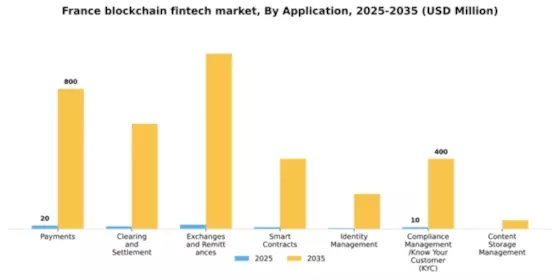
Payments (Dominant) vs. Smart Contracts (Emerging)
Payments represent the dominant application within the France blockchain fintech market, characterized by an extensive adoption across retail and e-commerce sectors. The robust demand for faster and more secure payment solutions drives this prominence, as businesses and consumers alike increasingly rely on blockchain technology to enhance transaction efficiency. In contrast, Smart Contracts are positioned as an emerging application, showcasing innovative capabilities in automating agreements without intermediaries. Their agile nature makes them appealing for various industries, fostering faster transaction times and reduced costs. As both segments evolve, they are set to redefine transaction models and operational efficiencies within the financial landscape.
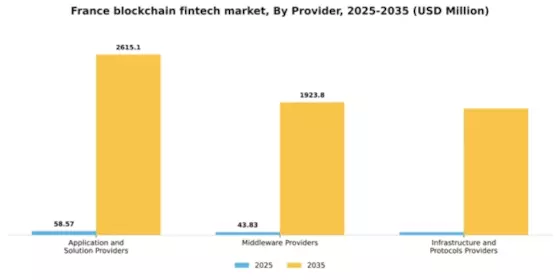
In the France blockchain fintech market, the distribution of market share among segment values shows that Application and Solution Providers dominate the space. They cater to a wide range of functionalities, making them essential for businesses integrating blockchain. Middleware Providers, while not as large in share, are quickly gaining traction, offering innovative solutions that enable seamless blockchain integration and interoperability. The growth trends in this segment are fueled by an increasing demand for blockchain solutions across various industries. As more businesses look to adopt blockchain technology, Middleware Providers are becoming increasingly pivotal, leading to rapid growth driven by technological advancements and the need for enhanced operational efficiency. The transition towards decentralized finance (DeFi) solutions is also spurring investments in middleware technologies, pushing them to the forefront.
Application and Solution Providers (Dominant) vs. Middleware Providers (Emerging)
Application and Solution Providers play a dominant role in the France blockchain fintech market, acting as the backbone for innovative applications that drive business efficiency and transparency. They typically offer comprehensive software solutions that address specific market needs, positioning themselves as trusted partners for enterprises looking to leverage blockchain technology. On the other hand, Middleware Providers are emerging as vital players by facilitating connectivity between blockchain and existing systems. Their solutions promote interoperability and enhance user experience, making them increasingly relevant as businesses seek integrated blockchain solutions. This evolving landscape creates a complementary relationship, where established players support innovation and emerging firms focus on enhancing operational capabilities.
The France blockchain fintech market exhibits a significant distribution of market share between SMALL and MEDIUM-SIZED ENTERPRISES (SMEs) and LARGE ENTERPRISES. SMEs dominate the landscape, leveraging their agility and innovation capabilities to harness blockchain technology effectively. Their ability to integrate blockchain solutions into various business processes grants them a substantial foothold in the market, capturing a larger share compared to their larger counterparts. Conversely, LARGE ENTERPRISES are emerging as the fastest-growing segment within the France blockchain fintech market. These companies are increasingly adopting blockchain for its numerous benefits, including enhanced security and improved transparency. The growth of LARGE ENTERPRISES is driven by their substantial resources, allowing for significant investments in blockchain initiatives, partnerships with fintech startups, and the development of proprietary blockchain solutions, positioning them for rapid expansion in this evolving market.
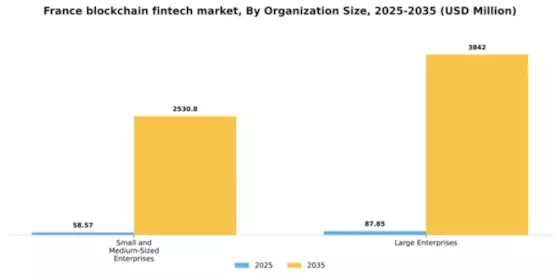
Small and Medium-Sized Enterprises (Dominant) vs. Large Enterprises (Emerging)
Small and Medium-Sized Enterprises (SMEs) in the France blockchain fintech market demonstrate remarkable dynamism and adaptability, making them the dominant force within this segment. They are often at the forefront of innovation as they integrate blockchain technology to streamline operations, reduce costs, and enhance customer trust. SMEs leverage their size to pivot quickly and embrace new technologies, giving them an edge in deploying blockchain solutions tailored to specific industry needs. On the other hand, Large Enterprises are emerging as competitive players, increasingly investing in blockchain technology. Their extensive resources facilitate research and development, enabling them to explore various applications of blockchain, from supply chain management to financial services. As they scale their operations, Large Enterprises are anticipated to capture a growing share of the market.
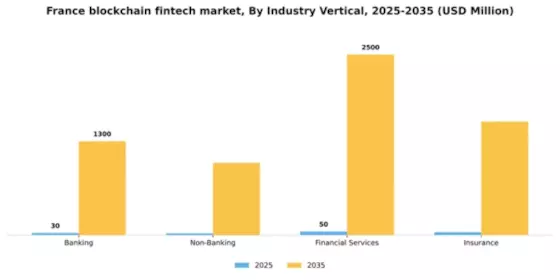
The France blockchain fintech market showcases a diverse distribution among its industry verticals, with banking as the largest segment. This reflects the traditional reliance on banking institutions to integrate blockchain technology for improved security and efficiency in transactions. Non-banking entities, including tech startups and digital platforms, are also gaining traction, indicating a more competitive environment as these players innovate solutions outside conventional banking frameworks. Growth trends in this segment are driven by the increasing adoption of blockchain technology in various financial applications, notably in banking for streamlining processes and reducing fraud. Non-banking sectors are gaining momentum, characterized by innovative approaches to finance that address consumer demands for accessibility and transparency. Factors such as regulatory support and the push for decentralization continue to propel growth, making the France blockchain fintech market a dynamic landscape to watch.
Banking: Dominant vs. Non-Banking: Emerging
In the France blockchain fintech market, the banking sector holds a dominant position due to its established infrastructure and customer base. Traditional financial institutions are actively exploring blockchain applications to enhance transaction security and reduce operational costs. On the other hand, the non-banking segment is emerging rapidly, attracting innovative startups that leverage blockchain to disrupt established norms. These players focus on providing decentralized finance solutions and user-friendly platforms that appeal to a tech-savvy audience. The evolving regulatory landscape is also facilitating growth in non-banking applications, as these entities capitalize on the agility and scalability of blockchain technology to offer tailored solutions in an increasingly digital economy.
Get more detailed insights about France Blockchain Fintech Market Request Free Sample
The blockchain fintech market in France is characterized by a dynamic competitive landscape, driven by rapid technological advancements and increasing consumer demand for decentralized financial solutions. Major players such as Binance (MT), Coinbase (US), and Ripple (US) are at the forefront, each adopting distinct strategies to enhance their market presence. Binance (MT) focuses on innovation through the continuous development of its trading platform, while Coinbase (US) emphasizes regulatory compliance and user-friendly interfaces to attract a broader customer base. Ripple (US) is strategically positioned to facilitate cross-border payments, leveraging its blockchain technology to streamline transactions. Collectively, these strategies contribute to a competitive environment that is both innovative and responsive to market needs. In terms of business tactics, companies are increasingly localizing their operations to better serve the French market. This includes optimizing supply chains and enhancing customer service capabilities. The market structure appears moderately fragmented, with several key players vying for market share. The collective influence of these companies shapes a competitive landscape where agility and adaptability are paramount, allowing them to respond effectively to regulatory changes and consumer preferences. In October 2025, Binance (MT) announced a partnership with a leading French bank to offer integrated crypto services, marking a significant step towards mainstream adoption of blockchain technology in traditional finance. This collaboration is likely to enhance Binance's credibility and expand its user base in France, as it aligns with the growing trend of financial institutions exploring blockchain solutions. The strategic importance of this partnership lies in its potential to bridge the gap between conventional banking and cryptocurrency, fostering greater acceptance among consumers. In September 2025, Coinbase (US) launched a new educational initiative aimed at increasing awareness and understanding of blockchain technology among French consumers. This initiative is particularly relevant as it addresses the knowledge gap that often hinders adoption. By positioning itself as an educator, Coinbase not only enhances its brand reputation but also cultivates a more informed customer base, which could lead to increased transaction volumes and user engagement. In November 2025, Ripple (US) secured a major contract with a European financial institution to facilitate cross-border transactions using its XRP token. This development underscores Ripple's commitment to expanding its footprint in Europe and solidifying its role as a leader in blockchain-based payment solutions. The strategic significance of this contract lies in its potential to enhance transaction efficiency and reduce costs for financial institutions, thereby reinforcing Ripple's competitive advantage in the market. As of November 2025, current trends in the blockchain fintech market include a strong emphasis on digitalization, sustainability, and the integration of artificial intelligence (AI) into financial services. Strategic alliances are increasingly shaping the competitive landscape, as companies recognize the value of collaboration in driving innovation. Looking ahead, competitive differentiation is likely to evolve, with a shift from price-based competition to a focus on technological innovation and supply chain reliability. This transition may redefine how companies position themselves in the market, emphasizing the importance of adaptability and forward-thinking strategies.

The France Blockchain Fintech Market is witnessing significant developments, particularly with major players like Ledger and Ubisoft engaging in innovative projects. In June 2023, Ledger announced a partnership with Ubisoft to enhance blockchain-based gaming experiences, further establishing France as a hub for blockchain innovation.
Devoteam and PwC France are also making strides in digital transformation initiatives, actively integrating blockchain technology into various business models.
Significant market growth can also be traced back to the surge in cryptocurrency adoption and increased regulatory clarity, which aids in fostering a trustworthy environment for investors and businesses alike.
There have been no recent publicly known mergers or acquisitions among the specified companies, keeping the focus on organic growth and strategic partnerships.
Additionally, initiatives like the French government's support for blockchain technology continue to bolster the sector, with programs aimed at enhancing innovation and attracting talent to nurture startups in the blockchain fintech landscape. The developments signify a dynamic environment ripe for future advancements in technology and finance within France.
The blockchain fintech market in France is projected to grow at a remarkable 40.92% CAGR from 2025 to 2035, driven by technological advancements, regulatory support, and increasing demand for decentralized finance solutions.
New opportunities lie in:
By 2035, the blockchain fintech market is expected to be a cornerstone of France's financial landscape.
| MARKET SIZE 2024 | 146.42(USD Million) |
| MARKET SIZE 2025 | 206.34(USD Million) |
| MARKET SIZE 2035 | 6372.83(USD Million) |
| COMPOUND ANNUAL GROWTH RATE (CAGR) | 40.92% (2025 - 2035) |
| REPORT COVERAGE | Revenue Forecast, Competitive Landscape, Growth Factors, and Trends |
| BASE YEAR | 2024 |
| Market Forecast Period | 2025 - 2035 |
| Historical Data | 2019 - 2024 |
| Market Forecast Units | USD Million |
| Key Companies Profiled | Binance (MT), Coinbase (US), Ripple (US), Bitfinex (HK), Kraken (US), Gemini (US), BlockFi (US), Bitstamp (LU), eToro (IL) |
| Segments Covered | Application, Provider, Organization Size, Industry Vertical |
| Key Market Opportunities | Integration of decentralized finance solutions into traditional banking systems presents a transformative opportunity. |
| Key Market Dynamics | Regulatory advancements and technological innovations drive competitive dynamics in the blockchain fintech market. |
| Countries Covered | France |
The overall market valuation was $146.42 Million in 2024.
The projected valuation for 2035 is $6372.83 Million.
The expected CAGR for the market during the forecast period 2025 - 2035 is 40.92%.
Key segments included Payments at $800.0 Million, Exchanges and Remittances at $1000.0 Million, and Compliance Management/KYC at $400.0 Million.
Key players include Binance (MT), Coinbase (US), Ripple (US), and Kraken (US), among others.
The 'Exchanges and Remittances' segment was valued at $1000.0 Million in 2024.
The segment for Small and Medium-Sized Enterprises was valued at $2530.83 Million in 2024.
The 'Financial Services' industry vertical was valued at $2500.0 Million in 2024.
Middleware Providers are projected to grow from $43.83 Million in 2024 to a significantly higher valuation by 2035.
The 'Infrastructure and Protocols Providers' segment was valued at $1833.86 Million in 2024, indicating its crucial role in the market.


Kindly complete the form below to receive a free sample of this Report

“This is really good guys. Excellent work on a tight deadline. I will continue to use you going forward and recommend you to others. Nice job”


“Thanks. It’s been a pleasure working with you, please use me as reference with any other Intel employees.”


“Thanks for sending the report it gives us a good global view of the Betaïne market.”


“Thank you, this will be very helpful for OQS.”


“We found the report very insightful! we found your research firm very helpful. I'm sending this email to secure our future business.”


“I am very pleased with how market segments have been defined in a relevant way for my purposes (such as "Portable Freezers & refrigerators" and "last-mile"). In general the report is well structured. Thanks very much for your efforts.”


“I have been reading the first document or the study, ,the Global HVAC and FP market report 2021 till 2026. Must say, good info! I have not gone in depth at all parts, but got a good indication of the data inside!”


“We got the report in time, we really thank you for your support in this process. I also thank to all of your team as they did a great job.”


“The Automotive 48V ECU Components Procurement Intelligence Study” was a complex project, but the Market Research Future (MRFR) team handled it with quality, agility, and customer-centricity. They delivered all requested data on time and within the agreed scope. The team, including Shubhendra Anand and Rahul Gotadki, was always readily available to clarify questions and swiftly implement necessary adjustments, driving the project to a successful conclusion within a very demanding timeframe.
I would also like to specifically commend Akshay Agarwal for his responsiveness and support at every stage—from our initial inquiry on May 6th through to final delivery on June 18th. His dedication made the entire process seamless.”



