×
Request Free Sample ×

Kindly complete the form below to receive a free sample of this Report

* Please use a valid business email

Leading companies partner with us for data-driven Insights

clients tt-cursor
Hero Background

France Digital Map Market

ID: MRFR/ICT/58609-HCR
200 Pages
Aarti Dhapte
October 2025

France Digital Map Market Research Report By Application (Navigation, Fleet Management, Location-Based Services, Geographic Information System, Urban Planning), By Technology (Cartography, Remote Sensing, GPS Technology, Geospatial Analysis), By End Use (Transportation, Retail, Healthcare, Government) and By Format (2D Maps, 3D Maps, Vector Maps, Raster Maps)- Forecast to 2035

Share:
Download PDF ×

We do not share your information with anyone. However, we may send you emails based on your report interest from time to time. You may contact us at any time to opt-out.

France Digital Map Market Infographic
Purchase Options

France Digital Map Market Summary

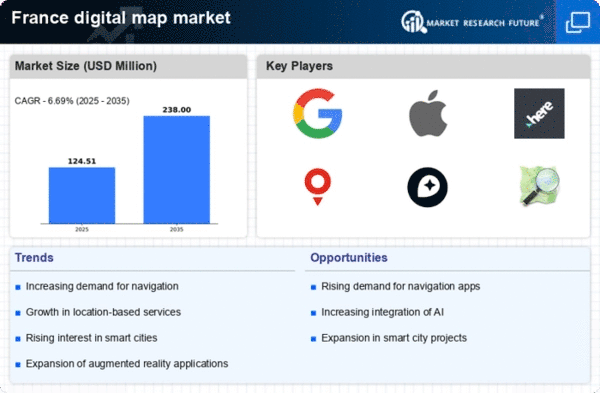
As per MRFR analysis, the digital map market size was estimated at 116.7 USD Million in 2024. The digital map market is projected to grow from 124.51 USD Million in 2025 to 238.0 USD Million by 2035, exhibiting a compound annual growth rate (CAGR) of 6.69% during the forecast period 2025 - 2035.

Key Market Trends & Highlights

The France digital map market is experiencing robust growth driven by technological advancements and urban development initiatives.

  • The integration of AI technologies is transforming the digital map landscape, enhancing accuracy and user experience.
  • Smart city initiatives are driving demand for advanced mapping solutions, particularly in urban areas.
  • Sustainability is becoming a focal point, with digital maps supporting eco-friendly navigation and planning.
  • Key market drivers include the increased demand for navigation solutions and government initiatives for infrastructure development.

Market Size & Forecast

2024 Market Size 116.7 (USD Million)
2035 Market Size 238.0 (USD Million)
CAGR (2025 - 2035) 6.69%

Major Players

Google (US), Apple (US), HERE Technologies (NL), TomTom (NL), Mapbox (US), OpenStreetMap (GB), Esri (US), Navteq (US)

France Digital Map Market Trends

The digital map market in France is currently experiencing a notable transformation, driven by advancements in technology and increasing demand for location-based services. The proliferation of smartphones and the integration of GPS technology into various applications have significantly enhanced the accessibility and utility of digital maps. As urbanization continues to rise, the need for accurate and real-time mapping solutions becomes more pressing. This trend is further supported by government initiatives aimed at improving infrastructure and transportation systems, which rely heavily on precise mapping data. Moreover, the growing emphasis on smart city development in France suggests a shift towards more sophisticated mapping solutions that can support urban planning and management. In addition, the digital map market is witnessing a surge in the adoption of artificial intelligence and machine learning technologies. These innovations enable more efficient data processing and analysis, allowing for the creation of dynamic maps that can adapt to changing conditions. The increasing focus on sustainability and environmental considerations also plays a role in shaping the market, as stakeholders seek to leverage mapping technologies to promote eco-friendly practices. Overall, the digital map market in France appears poised for continued growth, driven by technological advancements and evolving consumer needs.

Integration of AI Technologies

The incorporation of artificial intelligence into mapping solutions is becoming increasingly prevalent. AI enhances data accuracy and enables predictive analytics, which can significantly improve navigation and location-based services.

Rise of Smart City Initiatives

The push towards smart city development is influencing the digital map market. These initiatives require advanced mapping solutions to facilitate urban planning, traffic management, and public service delivery.

Focus on Sustainability

There is a growing emphasis on using digital mapping technologies to support sustainable practices. Stakeholders are exploring ways to utilize mapping for environmental monitoring and resource management.

France Digital Map Market Drivers

Expansion of Location-Based Services

The digital map market in France is significantly influenced by the expansion of location-based services (LBS). As businesses increasingly leverage LBS for targeted marketing and customer engagement, the demand for accurate mapping solutions rises. In 2025, it is estimated that LBS will account for over 30% of the total revenue generated within the digital map market. This growth is attributed to the integration of geolocation technologies in various sectors, including retail, tourism, and transportation. Companies are utilizing digital maps to enhance user experiences by providing personalized recommendations and real-time information. Furthermore, the increasing adoption of augmented reality (AR) applications in navigation and tourism is likely to drive further innovation within the digital map market. As a result, the industry is expected to witness a surge in investments aimed at enhancing the capabilities of mapping solutions to meet the diverse needs of consumers and businesses.

Emergence of Smart Mobility Solutions

The emergence of smart mobility solutions is significantly impacting the digital map market in France. As urban areas grapple with congestion and environmental concerns, there is a growing emphasis on developing integrated transportation systems that promote sustainable mobility. The digital map market is responding to this trend by offering solutions that facilitate multimodal transportation, allowing users to seamlessly transition between various modes of transport. In 2025, it is anticipated that smart mobility solutions will account for approximately 25% of the overall market share within the digital map sector. This shift is driven by the increasing adoption of shared mobility services, such as ride-sharing and bike-sharing, which require accurate mapping for efficient routing and user experience. Consequently, the digital map market is likely to evolve, focusing on enhancing connectivity and accessibility in urban environments.

Rising Popularity of Autonomous Vehicles

The digital map market in France is witnessing a transformative shift due to the rising popularity of autonomous vehicles (AVs). As of 2025, it is projected that the AV market will grow at a CAGR of 15%, creating a substantial demand for high-precision mapping solutions. The digital map market is adapting to this trend by developing specialized maps that provide detailed information on road conditions, traffic patterns, and potential hazards. These maps are essential for the safe operation of AVs, which rely on real-time data to navigate complex environments. Furthermore, partnerships between automotive manufacturers and mapping companies are becoming increasingly common, as they seek to enhance the capabilities of AVs through advanced mapping technologies. This collaboration is likely to drive innovation within the digital map market, positioning it as a critical component of the future transportation ecosystem.

Increased Demand for Navigation Solutions

The digital map market in France experiences heightened demand for navigation solutions, driven by the proliferation of mobile devices and applications. As of 2025, approximately 70% of the population utilizes smartphones, which significantly enhances the need for accurate and real-time mapping services. This trend is further supported by the growing reliance on GPS technology for personal and commercial use. The digital map market is adapting to this demand by offering innovative features such as voice-guided navigation and offline map access, catering to the needs of users in urban and rural areas alike. Additionally, the rise of e-commerce and delivery services necessitates precise mapping solutions to optimize logistics and improve customer satisfaction. Consequently, the digital map market is poised for substantial growth as it aligns with the evolving preferences of consumers and businesses in France.

Government Initiatives for Infrastructure Development

Government initiatives aimed at infrastructure development in France play a crucial role in shaping the digital map market. The French government has committed substantial investments, estimated at €10 billion, towards enhancing transportation networks and urban planning. These initiatives necessitate the use of advanced mapping technologies to facilitate efficient project management and execution. The digital map market is thus positioned to benefit from increased demand for high-resolution maps and geographic information systems (GIS) that support infrastructure projects. Additionally, the integration of smart technologies in urban planning requires accurate mapping solutions to optimize resource allocation and improve public services. As these government initiatives progress, the digital map market is likely to experience growth driven by the need for comprehensive mapping solutions that align with national development goals.


Market Segment Insights

By Application: Navigation (Largest) vs. Fleet Management (Fastest-Growing)

The France digital map market showcases a diverse application landscape, with navigation leading the charge as the largest segment. Its dominance is driven by the increasing reliance on GPS and mapping technologies for personal and professional use. Fleet management, while smaller in share, is rapidly gaining traction as businesses seek efficient routing and tracking solutions. Growth trends in the application segment are influenced by advancements in technology and the increasing demand for real-time data. Location-based services are becoming integral to marketing strategies, enhancing customer engagement. Additionally, Geographic Information Systems are evolving, providing valuable insights for urban planning, which fosters sustainable development and smart city initiatives. These factors contribute to a dynamic and competitive market environment.

Navigation (Dominant) vs. Fleet Management (Emerging)

Navigation, as the dominant segment in the France digital map market, benefits from widespread consumer usage in personal navigation and commercial applications. The proliferation of smartphones and in-car navigation systems has cemented its position, making it essential for daily commuting and travel planning. Conversely, fleet management represents an emerging segment, fueled by the increasing need for logistical efficiency. Companies are investing in digital solutions to optimize routes and reduce operational costs, embracing innovative technologies such as IoT and AI for enhanced tracking and management. As businesses prioritize resource optimization, fleet management applications are expected to grow significantly, complementing the robust navigation solutions already in place.

By Technology: GPS Technology (Largest) vs. Remote Sensing (Fastest-Growing)

In the France digital map market, the market share distribution among the segment values shows that GPS Technology is the largest segment, driven by widespread adoption in consumer and commercial applications. Meanwhile, Remote Sensing is emerging rapidly, gaining traction due to advancements in satellite imaging and data analytics, which enhance the quality and accuracy of digital maps. The Geospatial Analysis segment is also significant but growing at a slower pace compared to the other two. Growth trends in the France digital map market indicate a robust demand for enhanced mapping solutions, influenced by technological innovations. The surge in demand for location-based services and smart city initiatives is propelling the adoption of Geospatial Analysis and Remote Sensing. Additionally, the increasing integration of GPS technology in various sectors, including transportation and logistics, contributes to its dominance in the market.

Technology: GPS Technology (Dominant) vs. Remote Sensing (Emerging)

GPS Technology serves as the dominant force in the France digital map market, characterized by its essential role in navigation and real-time tracking services. This segment is heavily utilized in everyday applications, including personal navigation devices and fleet management. On the other hand, Remote Sensing is positioning itself as an emerging segment, leveraging innovations in aerial and satellite imagery to provide high-resolution mapping capabilities. This technology is becoming crucial in sectors such as urban planning, agriculture, and environmental monitoring, driven by a need for detailed geographic data. The shift toward data-driven decision-making in various industries is further propelling the growth of Remote Sensing, making it a valuable asset in the evolving landscape of digital mapping solutions.

By End Use: Transportation (Largest) vs. Healthcare (Fastest-Growing)

In the France digital map market, the distribution of market share is primarily led by the transportation segment, which captures the majority of user engagement due to the increasing demand for navigation solutions. Following closely is the retail sector, benefitting from location-based services that enhance shopping experiences. The healthcare segment is rapidly gaining traction, driven by the need for accurate location data in patient transport and facilities management. Government applications also complement this landscape, though they hold a smaller share overall. Growth trends in the end use segment of the France digital map market are significantly shaped by advancements in technology and increasing mobile device penetration. The transportation sector continues to thrive as logistics and ride-sharing services expand. Meanwhile, healthcare's growth is fueled by the adoption of telehealth services and the integration of mapping technologies in emergency response scenarios. Retail is witnessing innovations in location analytics, which drive customer engagement, while government utilization is expanding, particularly in urban planning and public safety initiatives.

Transportation: Dominant vs. Healthcare: Emerging

The transportation segment in the France digital map market stands as the dominant player, characterized by a vast user base leveraging mapping solutions for logistics and navigation. This segment benefits from high investment in GPS technology and real-time traffic updates, making it essential for both personal and commercial transport. Conversely, the healthcare segment, deemed emerging, is rapidly evolving, influenced by the integration of digital maps into healthcare delivery systems, particularly for emergency services and patient management. This shift is largely driven by the need for efficient routing in critical situations, indicating a growing acknowledgement of the importance of geo-data in healthcare operations. The interplay between these two segments outlines a comprehensive view of current market dynamics.

By Format: 2D Maps (Largest) vs. 3D Maps (Fastest-Growing)

Among the various formats in the France digital map market, 2D Maps hold the largest market share, catering to a broad audience with their simplicity and reliability. These maps are predominantly utilized for standard navigation, urban planning, and general information dissemination, ensuring their continued prevalence in this competitive sector. In contrast, 3D Maps, while currently holding a smaller portion of the market, are rapidly gaining traction due to advancements in technology and consumer preferences towards more immersive experiences. The growth trends in the format segment are being driven largely by increased smartphone usage and the demand for interactive and visually appealing mapping solutions. Innovative applications of 3D Maps in sectors such as gaming and virtual reality are contributing to their status as the fastest-growing segment. As users seek enhanced experiences, the versatility and advanced features of 3D Maps position them favorably for significant expansion in the upcoming years.

2D Maps (Dominant) vs. 3D Maps (Emerging)

2D Maps are the dominant force in the France digital map market, characterized by their straightforward, easy-to-navigate design that appeals to a wide range of users. Their market presence is well-established, with applications in navigation, geographic education, and logistics, enabling their continued relevance. In contrast, 3D Maps represent a rapidly emerging segment, appealing particularly to tech-savvy users and industries that require detailed spatial representation. The interactive nature of 3D Maps allows for advanced functionalities such as virtual tours and enhanced visualization, making them attractive for real estate, tourism, and urban development sectors. As technological advancements continue to evolve, the competition between these two formats is expected to intensify, with each catering to distinct user needs and preferences.

Get more detailed insights about France Digital Map Market

Key Players and Competitive Insights

The digital map market in France is characterized by a dynamic competitive landscape, driven by rapid technological advancements and increasing demand for location-based services. Major players such as Google (US), HERE Technologies (NL), and TomTom (NL) are at the forefront, each adopting distinct strategies to enhance their market presence. Google (US) continues to leverage its extensive data analytics capabilities to refine its mapping services, focusing on user experience and integration with other Google services. HERE Technologies (NL) emphasizes partnerships with automotive manufacturers to enhance its mapping solutions for autonomous vehicles, while TomTom (NL) is investing in real-time traffic data to improve navigation accuracy. Collectively, these strategies contribute to a competitive environment that is increasingly focused on innovation and user-centric solutions.

Key business tactics within the market include localized service offerings and supply chain optimization, which are essential for meeting the diverse needs of consumers and businesses alike. The competitive structure appears moderately fragmented, with several key players vying for market share. This fragmentation allows for a variety of services and innovations, as companies strive to differentiate themselves through unique offerings and technological advancements.

In October 2025, Google (US) announced the launch of a new feature that integrates augmented reality (AR) into its mapping services, enhancing user navigation experiences. This strategic move is significant as it positions Google (US) at the cutting edge of digital mapping technology, potentially attracting a broader user base and increasing engagement with its platform. The integration of AR is likely to redefine how users interact with maps, making navigation more intuitive and engaging.

In September 2025, HERE Technologies (NL) expanded its partnership with a leading automotive manufacturer to provide advanced mapping solutions for electric vehicles (EVs). This collaboration is crucial as it aligns with the growing trend towards sustainable transportation, allowing HERE Technologies (NL) to tap into the burgeoning EV market. By focusing on the specific needs of EV users, HERE Technologies (NL) enhances its value proposition and strengthens its competitive position.

In August 2025, TomTom (NL) launched a new suite of APIs aimed at developers, facilitating the integration of advanced mapping functionalities into third-party applications. This initiative is strategically important as it opens new revenue streams and fosters innovation within the developer community. By empowering developers, TomTom (NL) not only expands its ecosystem but also enhances its relevance in a rapidly evolving digital landscape.

As of November 2025, current trends in the digital map market include a strong emphasis on digitalization, sustainability, and the integration of artificial intelligence (AI). Strategic alliances are increasingly shaping the competitive landscape, enabling companies to pool resources and expertise to drive innovation. Looking ahead, competitive differentiation is likely to evolve from traditional price-based competition to a focus on technological innovation, reliability of supply chains, and the ability to deliver unique user experiences. This shift underscores the importance of adaptability and forward-thinking strategies in maintaining a competitive edge.

Key Companies in the France Digital Map Market market include

Industry Developments

The France Digital Map Market has recently seen significant activity, with notable developments among key players. OpenStreetMap continues to enhance its community-driven mapping initiatives, leveraging local contributions to improve coverage and accuracy in urban areas. HERE Technologies has made strides in integrating advanced location data services across industries, particularly in transportation and logistics, aligning with France's sustainability goals. Locus Map and Mapbox are also evolving, emphasizing user-friendly mapping solutions for outdoor activities and developer platforms, respectively. In July 2023, TomTom announced a partnership with several local French firms to enhance real-time traffic data, directly impacting navigation systems. 

In terms of mergers and acquisitions, a notable acquisition occurred in April 2023, where GeoIQ was acquired by a leading analytics firm, further strengthening its market presence in France. The combined expertise is expected to drive innovation in location intelligence solutions. Moreover, the ongoing emphasis on enhancing digital infrastructure in France is bolstering the demand for accurate and reliable digital maps, with industry investments increasing to support smart city initiatives and improve public transportation systems. As these companies continue to expand and innovate, the competition within the France Digital Map Market remains robust.

Future Outlook

France Digital Map Market Future Outlook

The digital map market in France is projected to grow at a 6.69% CAGR from 2024 to 2035, driven by advancements in technology, increased demand for navigation solutions, and urbanization.

New opportunities lie in:

  • Integration of AI-driven analytics for real-time data insights.
  • Development of customized mapping solutions for e-commerce logistics.
  • Expansion of augmented reality features in navigation applications.

By 2035, the digital map market is expected to achieve substantial growth and innovation.

Market Segmentation

France Digital Map Market Format Outlook

  • 2D Maps
  • 3D Maps
  • Vector Maps
  • Raster Maps

France Digital Map Market End Use Outlook

  • Transportation
  • Retail
  • Healthcare
  • Government

France Digital Map Market Technology Outlook

  • Cartography
  • Remote Sensing
  • GPS Technology
  • Geospatial Analysis

France Digital Map Market Application Outlook

  • Navigation
  • Fleet Management
  • Location-Based Services
  • Geographic Information System
  • Urban Planning

Report Scope

MARKET SIZE 2024 116.7(USD Million)
MARKET SIZE 2025 124.51(USD Million)
MARKET SIZE 2035 238.0(USD Million)
COMPOUND ANNUAL GROWTH RATE (CAGR) 6.69% (2024 - 2035)
REPORT COVERAGE Revenue Forecast, Competitive Landscape, Growth Factors, and Trends
BASE YEAR 2024
Market Forecast Period 2025 - 2035
Historical Data 2019 - 2024
Market Forecast Units USD Million
Key Companies Profiled Google (US), Apple (US), HERE Technologies (NL), TomTom (NL), Mapbox (US), OpenStreetMap (GB), Esri (US), Navteq (US)
Segments Covered Application, Technology, End Use, Format
Key Market Opportunities Integration of augmented reality features enhances user engagement in the digital map market.
Key Market Dynamics Technological advancements and regulatory changes drive innovation and competition in the digital map market.
Countries Covered France

Leave a Comment

FAQs

What is the expected market value of the France Digital Map Market in 2024?

The France Digital Map Market is expected to be valued at 175.05 million USD in 2024.

What is the projected market size for the France Digital Map Market by 2035?

By 2035, the France Digital Map Market is anticipated to reach a value of 545.0 million USD.

What is the expected compound annual growth rate (CAGR) for the France Digital Map Market from 2025 to 2035?

The expected CAGR for the France Digital Map Market from 2025 to 2035 is 10.876%.

Which application is projected to have the highest market value in 2035?

The Navigation segment is projected to have the highest market value at 223.5 million USD in 2035.

What is the expected market size for the Fleet Management application in 2024?

The Fleet Management application is expected to be valued at 35.0 million USD in 2024.

How much is the Location-Based Services application expected to be worth in 2035?

The Location-Based Services application is anticipated to be valued at 93.0 million USD in 2035.

Who are the major players in the France Digital Map Market?

Major players in the France Digital Map Market include OpenStreetMap, HERE Technologies, Google, TomTom, and Esri.

What is the expected market value for the Geographic Information System application in 2024?

The Geographic Information System application is expected to be valued at 25.05 million USD in 2024.

What challenges does the France Digital Map Market currently face?

The France Digital Map Market faces challenges such as competition among major players and evolving technology demands.

What is the expected growth rate of the Urban Planning application from 2024 to 2035?

The Urban Planning application is expected to grow from 15.0 million USD in 2024 to 41.0 million USD in 2035.

Download Free Sample

Kindly complete the form below to receive a free sample of this Report

Compare Licence

×
Features License Type
Single User Multiuser License Enterprise User
Price $4,950 $5,950 $7,250
Maximum User Access Limit 1 User Upto 10 Users Unrestricted Access Throughout the Organization
Free Customization
Direct Access to Analyst
Deliverable Format
Platform Access
Discount on Next Purchase 10% 15% 15%
Printable Versions