Download Free Sample
Kindly complete the form below to receive a free sample of this Report
Freelancer and Gig Economy Services Market Size, Share and Trends Analysis Research Report Information By Client Type (Small Business, Large Enterprise, Startups, Non-Profit, Individual Consumers), By Skill Level (Entry, Intermediate, Expert, Specialized, Generalist), By Service Type (Writing, Graphic Design, Web Development, Digital Marketing, Consulting), By Payment Model (Hourly, Fixed, Retainer, Commission, Project-Based), By Industry Focus (Technology, Creative Arts, Healthcare, Finance, Education), And By Region – Market Forecast Till 2035.
As per MRFR analysis, the Freelancer and Gig Economy Services Market was estimated at 500.0 USD Billion in 2024. The Freelancer and Gig Economy Services industry is projected to grow from 521.85 USD Billion in 2025 to 800.0 USD Billion by 2035, exhibiting a compound annual growth rate (CAGR) of 4.37% during the forecast period 2025 - 2035.
The Freelancer and Gig Economy Services Market is experiencing dynamic growth driven by technological advancements and changing work preferences.
| 2024 Market Size | 500.0 (USD Billion) |
| 2035 Market Size | 800.0 (USD Billion) |
| CAGR (2025 - 2035) | 4.37% |
Upwork (US), Fiverr (US), Freelancer (AU), Toptal (US), Guru (US), PeoplePerHour (GB), 99designs (AU), TaskRabbit (US), Thumbtack (US)
Our Impact
Enabled $4.3B Revenue Impact for Fortune 500 and Leading Multinationals
Partnering with 2000+ Global Organizations Each Year
30K+ Citations by Top-Tier Firms in the Industry
The Freelancer and Gig Economy Services Market is currently experiencing a notable transformation, driven by evolving workforce dynamics and technological advancements. As more individuals seek flexible work arrangements, the demand for freelance services continues to rise. This shift appears to be influenced by a growing preference for autonomy and the ability to choose projects that align with personal interests and skills. Additionally, businesses are increasingly recognizing the value of tapping into a diverse talent pool, which allows them to access specialized skills without the constraints of traditional employment models. Moreover, the integration of digital platforms has streamlined the process of connecting freelancers with clients, enhancing efficiency and accessibility. These platforms facilitate a wide range of services, from creative endeavors to technical support, thereby broadening the scope of opportunities available in the market. As the landscape evolves, it seems likely that the Freelancer and Gig Economy Services Market will continue to expand, reflecting changing societal norms and the ongoing digital transformation. This evolution may also lead to new challenges, such as ensuring fair compensation and addressing the need for benefits typically associated with full-time employment.
The trend towards remote work is reshaping the Freelancer and Gig Economy Services Market. As organizations embrace flexible work arrangements, freelancers are increasingly sought after for their ability to deliver quality work from any location. This shift not only enhances productivity but also allows businesses to tap into a global talent pool.
There is a noticeable trend towards increased specialization within the Freelancer and Gig Economy Services Market. As competition intensifies, freelancers are focusing on niche areas, offering unique skills and expertise. This specialization enables them to differentiate themselves and attract clients seeking specific services.
The integration of advanced technologies is transforming the Freelancer and Gig Economy Services Market. Digital platforms and tools are streamlining workflows, enhancing communication, and facilitating project management. This technological evolution is likely to improve the overall efficiency of freelance operations, benefiting both freelancers and clients.
The Freelancer and Gig Economy Services Market is characterized by an increasing diversity of skill sets and specializations among freelancers. As industries evolve, the demand for niche skills has risen, prompting freelancers to adapt and specialize in areas such as digital marketing, graphic design, and software development. Recent statistics suggest that specialized freelancers can command higher rates, with some earning up to 50% more than their generalist counterparts. This trend not only benefits freelancers but also provides businesses with access to a broader range of expertise. Companies are increasingly seeking specialized talent to drive innovation and enhance their competitive edge. As the market continues to evolve, the emphasis on specialized skills is expected to grow, further shaping the landscape of the gig economy.
Economic factors are significantly influencing the Freelancer and Gig Economy Services Market. The rise of the gig economy can be attributed to various economic conditions, including the need for supplemental income and the desire for financial independence. Recent surveys indicate that approximately 40% of freelancers engage in gig work to support their primary income, highlighting the economic motivations behind this trend. Additionally, the flexibility of gig work allows individuals to navigate economic uncertainties more effectively. As traditional employment models evolve, the gig economy is likely to expand, providing individuals with alternative income sources. This economic shift is expected to further legitimize freelance work, encouraging more individuals to participate in the market.
The Freelancer and Gig Economy Services Market is experiencing a notable surge in demand for flexible work arrangements. As organizations increasingly recognize the benefits of a flexible workforce, they are turning to freelancers and gig workers to meet their needs. According to recent data, approximately 36% of the workforce is engaged in freelance work, indicating a shift in employment preferences. This trend is driven by the desire for work-life balance, autonomy, and the ability to choose projects that align with individual skills. Companies are also leveraging this flexibility to adapt to changing market conditions, allowing them to scale their workforce up or down as necessary. This growing acceptance of freelance work is likely to continue, further solidifying the role of freelancers in various industries.
The Freelancer and Gig Economy Services Market is witnessing a paradigm shift as corporations increasingly accept and integrate freelance talent into their workforce. This acceptance is driven by the need for agility and cost-effectiveness in a rapidly changing business environment. Data shows that nearly 50% of companies are now utilizing freelancers for various projects, ranging from creative tasks to technical roles. This trend reflects a broader recognition of the value that freelancers bring, including fresh perspectives and specialized skills. As corporations continue to embrace this model, the demand for freelance services is likely to rise, creating new opportunities for both freelancers and businesses. This shift may also lead to the development of more structured frameworks for managing freelance talent within organizations.
Technological advancements are playing a pivotal role in shaping the Freelancer and Gig Economy Services Market. The proliferation of digital platforms has streamlined the process of connecting freelancers with clients, enhancing efficiency and accessibility. Data indicates that the number of online freelancing platforms has increased significantly, with over 50 million freelancers utilizing these services. These platforms offer tools for project management, payment processing, and communication, which facilitate smoother interactions between freelancers and clients. Furthermore, the integration of artificial intelligence and machine learning is expected to enhance the matching process, ensuring that freelancers are paired with projects that suit their skills and preferences. This technological evolution is likely to attract more participants to the gig economy, thereby expanding the market.
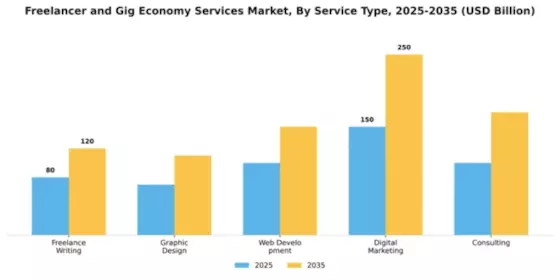
In the Freelancer and Gig Economy Services Market, Freelance Writing holds the largest market share, drawing from a diverse range of clients seeking content creation, from blogs to technical documents. It has established itself as a key component for organizations looking to enhance their online presence, with a consistent demand across various industries. In contrast, Digital Marketing is emerging as the fastest-growing service, driven by the increasing reliance on online platforms for advertising and promotion. Businesses recognize the importance of digital marketing strategies that cater to modern audiences, leading to a surge in demand for skilled freelancers in this field. As the market evolves, several trends are shaping the growth of these segments. Freelance Writing remains integral for businesses focusing on content-driven strategies, with a growing trend toward quality and SEO-optimized writing. Meanwhile, Digital Marketing is influenced by technological advancements and the rise of social media, encouraging freelancers to offer innovative services such as social media management, SEO consultancy, and PPC campaigns. These trends demonstrate a clear shift towards specialized skills that enhance business visibility and engagement in an increasingly competitive online landscape.
Freelance Writing (Dominant) vs. Graphic Design (Emerging)
Freelance Writing is the dominant segment in the Freelancer and Gig Economy Services Market due to its broad applicability and consistent demand across various sectors. It encompasses a wide range of services, including blog writing, copywriting, and technical writing, which are essential for businesses looking to establish and maintain an online presence. Writers are often viewed as crucial contributors to marketing strategies, enabling companies to effectively communicate their messages to target audiences. In contrast, Graphic Design is an emerging service that is rapidly gaining traction, driven by the demand for visually appealing content in digital marketing and branding. As businesses invest more in their online and offline presence, freelancers in graphic design are finding expansive opportunities, driven by trends in branding, user experience, and the need for engaging visual communication.
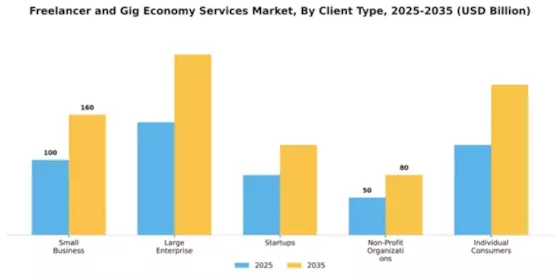
The Freelancer and Gig Economy Services Market exhibits a diverse client base, with Small Businesses taking the largest share due to their increasing reliance on flexible labor solutions. This segment benefits from cost effectiveness and a quicker turnaround for projects, allowing small entities to thrive in a competitive landscape. On the other hand, Startups are rapidly gaining traction, leveraging freelance talent to scale operations without the burden of permanent hires, which offers substantial agility in their growth strategies.
Small Business: Dominant vs. Startups: Emerging
Small Businesses dominate the Freelancer and Gig Economy Services Market by leveraging freelance labor for efficiency and cost-saving advantages. They often utilize platforms to hire freelancers for essential tasks like marketing, design, and technology needs, enabling them to remain agile and competitive. In contrast, Startups, while still emerging, are quickly transforming how they engage with freelance services. Often operating on tight budgets and seeking quick scalability, they prefer freelancers for specialized skills, thus creating a strong dependence on gig workers that fuels their innovative projects and product developments.
In the Freelancer and Gig Economy Services Market, different payment models cater to varied preferences among clients and freelancers. The Hourly Rate model accounts for the largest share, as it allows flexibility and easy calculation of payments based on time invested in projects. Conversely, the Retainer Fee model has emerged as the fastest-growing segment due to rising demand for consistent services and long-term collaborations, enabling freelancers to secure ongoing income while clients enjoy prioritized access to their expertise.
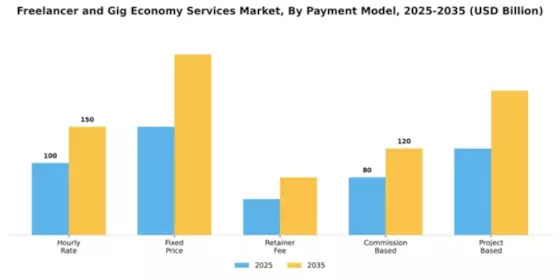
Hourly Rate (Dominant) vs. Retainer Fee (Emerging)
The Hourly Rate payment model remains dominant in the freelance sector, appealing to many clients for its straightforward approach. This model is particularly favored for projects where scope is difficult to define upfront or when tasks require fluctuating time commitments. In contrast, the Retainer Fee model has emerged as a significant trend, providing freelancers with stable income while ensuring clients have their services readily available. This fosters mutual commitment and long-term relationships, making it increasingly popular among companies looking to streamline their hiring process for continuous projects, especially in the wake of an evolving gig economy.
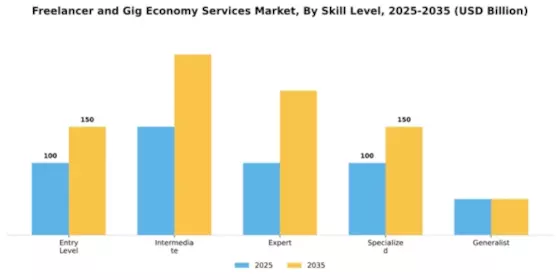
In the Freelancer and Gig Economy Services Market, the distribution of market share among skill levels varies significantly, with Generalist freelancers capturing the largest share. They appeal to a broad audience, offering versatile services across multiple disciplines, which facilitates their widespread demand. On the other hand, Specialized freelancers have been gaining traction: their expertise in niche areas caters to specific client needs, reflecting a growing trend where businesses prioritize skill depth over breadth. Market growth within this segment is driven by the evolving needs of businesses that seek tailored expertise to handle complex tasks. The rise of technology and innovations has also contributed to the demand for Specialized freelancers, as companies are increasingly opting for experts who can provide a strategic advantage. Conversely, the continued relevance of Generalists underlines their ability to adapt and respond to diverse project requirements, ensuring their steady presence in a competitive landscape.
Generalist (Dominant) vs. Specialized (Emerging)
Generalist freelancers stand out in the market for their versatility and wide-ranging skill sets, enabling them to cater to various projects across different industries. Their adaptability allows them to respond to the dynamic needs of clients, making them a preferred choice for businesses needing flexible solutions. In contrast, Specialized freelancers, although in the emerging phase, have carved a niche for themselves by offering expert insights and services in specific areas such as data analysis, digital marketing, or design. This specialization meets the growing demand for high-quality work, particularly in sectors undergoing significant transformations. As firms aim to leverage specialized skills for innovative projects, these freelancers are positioned to ascend in market prominence while enriching the overall service offerings within the gig economy.
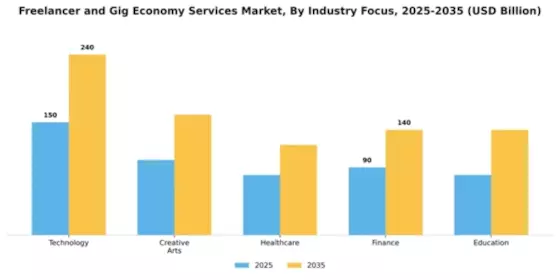
In the Freelancer and Gig Economy Services Market, Technology stands out as the largest segment due to the increasing demand for tech-based solutions and expertise. The growth of digital platforms and businesses relying on software development, IT support, and data analysis has solidified this segment's position. In contrast, the Creative Arts segment, comprising freelance services like graphic design, video editing, and content creation, is rapidly gaining traction, fueled by the rise in content consumption across various media.
Creative Arts: Graphic Design (Dominant) vs. Video Editing (Emerging)
The Creative Arts sector in the Freelancer and Gig Economy Services Market showcases Graphic Design as a dominant player, driven by an ongoing need for branding and marketing materials across industries. Freelance graphic designers are sought after for their skills in creating visually appealing content that elevates brand presence. Meanwhile, Video Editing is an emerging segment, rapidly gaining popularity as video content becomes essential for online engagement and marketing. With the rise of social media and video platforms, freelance video editors are increasingly in demand, reflecting the shift towards video-centric marketing strategies.
Get more detailed insights about Freelancer and Gig Economy Services Market Request Free Sample
North America continues to lead the Freelancer and Gig Economy Services Market, holding a significant market share of $250.0M in 2024. The growth is driven by increasing digitalization, a shift towards remote work, and a rising demand for flexible job opportunities. Regulatory support for gig workers and platforms is also enhancing market dynamics, fostering a conducive environment for innovation and expansion. The competitive landscape is characterized by major players such as Upwork, Fiverr, and Toptal, which dominate the market with their diverse service offerings. The U.S. remains the largest contributor, with a robust infrastructure supporting freelance activities. The presence of numerous platforms facilitates a vibrant ecosystem, catering to various sectors and skill sets, thus driving further growth in the region.
Europe's Freelancer and Gig Economy Services Market is valued at $120.0M, showcasing a growing trend towards freelance work. Factors such as economic recovery, technological advancements, and changing workforce dynamics are driving demand. Regulatory frameworks are evolving to support gig workers, enhancing job security and benefits, which is crucial for market growth in the region. Leading countries like the UK, Germany, and France are at the forefront, with a competitive landscape featuring platforms like PeoplePerHour and 99designs. The market is characterized by a diverse range of services, from creative to technical, catering to a broad audience. The presence of established players and new entrants fosters innovation, making Europe a vibrant hub for freelance services.
The Asia-Pacific region, with a market size of $100.0M, is witnessing rapid growth in the Freelancer and Gig Economy Services Market. Factors such as increasing internet penetration, a young workforce, and a shift towards digital platforms are driving demand. Governments are also recognizing the importance of this sector, implementing policies to support gig workers and enhance their rights, which is crucial for sustainable growth. Countries like Australia, India, and Japan are leading the charge, with platforms such as Freelancer and TaskRabbit gaining traction. The competitive landscape is diverse, with both local and international players vying for market share. The region's unique cultural and economic dynamics create a rich environment for freelance services, fostering innovation and collaboration across various sectors.
The Middle East and Africa region, valued at $30.0M, is gradually emerging in the Freelancer and Gig Economy Services Market. The growth is driven by increasing smartphone usage, a young population, and a rising trend towards freelance work. Governments are beginning to recognize the potential of this sector, implementing supportive regulations to enhance job opportunities and economic diversification. Countries like South Africa and the UAE are leading the market, with a growing number of platforms catering to local needs. The competitive landscape is evolving, with both established and new players entering the market. This region presents unique opportunities for growth, as the demand for flexible work arrangements continues to rise, fostering a vibrant gig economy.
The Freelancer and Gig Economy Services Market is characterized by a dynamic competitive landscape, driven by technological advancements and evolving consumer preferences. Major players such as Upwork (US), Fiverr (US), and Toptal (US) are at the forefront, each adopting distinct strategies to enhance their market positioning. Upwork (US) focuses on expanding its service offerings through innovative features that cater to diverse client needs, while Fiverr (US) emphasizes a user-friendly platform that facilitates quick transactions. Toptal (US), on the other hand, positions itself as a premium service provider, targeting high-end clients with a rigorous vetting process for freelancers. Collectively, these strategies contribute to a competitive environment that is increasingly shaped by the need for specialization and quality assurance.In terms of business tactics, companies are increasingly localizing their services to better meet regional demands, which appears to enhance user engagement and satisfaction. The market structure is moderately fragmented, with numerous players vying for market share, yet a few dominant firms hold significant influence. This competitive structure fosters innovation, as companies strive to differentiate themselves through unique service offerings and enhanced user experiences.In November Upwork (US) announced a strategic partnership with a leading AI firm to integrate advanced machine learning algorithms into its platform. This move is likely to enhance the matching process between freelancers and clients, thereby improving overall efficiency and satisfaction. The integration of AI could potentially streamline operations, allowing Upwork (US) to maintain its competitive edge in a rapidly evolving market.In October Fiverr (US) launched a new subscription model aimed at providing businesses with a more predictable cost structure for freelance services. This initiative may attract a broader client base, particularly small to medium-sized enterprises seeking budget-friendly solutions. By offering subscription services, Fiverr (US) appears to be positioning itself as a go-to platform for ongoing freelance needs, which could lead to increased customer loyalty and retention.In December Toptal (US) expanded its The Freelancer and Gig Economy Services, specifically targeting tech startups in Singapore. This strategic move is indicative of Toptal's commitment to tapping into emerging markets where demand for high-quality freelance talent is on the rise. By establishing a presence in Asia, Toptal (US) may enhance its brand visibility and attract a new clientele, further solidifying its position as a leader in the premium segment of the gig economy.As of December the competitive trends within the Freelancer and Gig Economy Services Market are increasingly defined by digitalization, sustainability, and the integration of AI technologies. Strategic alliances are becoming more prevalent, as companies recognize the value of collaboration in enhancing service offerings and operational efficiency. Looking ahead, competitive differentiation is likely to evolve from traditional price-based competition to a focus on innovation, technological advancements, and supply chain reliability. This shift suggests that companies that prioritize these elements will be better positioned to thrive in an increasingly competitive landscape.






The Freelancer and Gig Economy Services Market is projected to grow at a 4.37% CAGR from 2025 to 2035, driven by technological advancements, increasing remote work, and evolving consumer preferences.
New opportunities lie in:
By 2035, the market is expected to be robust, reflecting diverse service offerings and increased participation.
| MARKET SIZE 2024 | 500.0(USD Billion) |
| MARKET SIZE 2025 | 521.85(USD Billion) |
| MARKET SIZE 2035 | 800.0(USD Billion) |
| COMPOUND ANNUAL GROWTH RATE (CAGR) | 4.37% (2025 - 2035) |
| REPORT COVERAGE | Revenue Forecast, Competitive Landscape, Growth Factors, and Trends |
| BASE YEAR | 2024 |
| Market Forecast Period | 2025 - 2035 |
| Historical Data | 2019 - 2024 |
| Market Forecast Units | USD Billion |
| Key Companies Profiled | Upwork (US), Fiverr (US), Freelancer (AU), Toptal (US), Guru (US), PeoplePerHour (GB), 99designs (AU), TaskRabbit (US), Thumbtack (US) |
| Segments Covered | Service Type, Client Type, Payment Model, Skill Level, Industry Focus |
| Key Market Opportunities | Integration of artificial intelligence tools enhances efficiency in the Freelancer and Gig Economy Services Market. |
| Key Market Dynamics | Rising demand for flexible work arrangements drives innovation and competition in the Freelancer and Gig Economy Services Market. |
| Countries Covered | North America, Europe, APAC, South America, MEA |
The market valuation reached 500.0 USD Billion in 2024.
The market is expected to grow to 800.0 USD Billion by 2035.
The market is projected to experience a CAGR of 4.37% from 2025 to 2035.
Digital Marketing appears to generate the highest revenue, with a valuation range of 150.0 to 250.0 USD Billion.
Small businesses contributed between 100.0 and 160.0 USD Billion in the market.
The Fixed Price payment model likely dominates, with a valuation range of 150.0 to 250.0 USD Billion.
The market includes categories such as Entry Level, Intermediate, Expert, Specialized, and Generalist.
Technology and Creative Arts are among the leading industries, with valuations of 150.0 to 240.0 USD Billion and 100.0 to 160.0 USD Billion, respectively.
Key players include Upwork, Fiverr, Freelancer, Toptal, and others.
Consulting services are valued between 100.0 and 170.0 USD Billion.


Kindly complete the form below to receive a free sample of this Report

“This is really good guys. Excellent work on a tight deadline. I will continue to use you going forward and recommend you to others. Nice job”


“Thanks. It’s been a pleasure working with you, please use me as reference with any other Intel employees.”


“Thanks for sending the report it gives us a good global view of the Betaïne market.”


“Thank you, this will be very helpful for OQS.”


“We found the report very insightful! we found your research firm very helpful. I'm sending this email to secure our future business.”


“I am very pleased with how market segments have been defined in a relevant way for my purposes (such as "Portable Freezers & refrigerators" and "last-mile"). In general the report is well structured. Thanks very much for your efforts.”


“I have been reading the first document or the study, ,the Global HVAC and FP market report 2021 till 2026. Must say, good info! I have not gone in depth at all parts, but got a good indication of the data inside!”


“We got the report in time, we really thank you for your support in this process. I also thank to all of your team as they did a great job.”


“The Automotive 48V ECU Components Procurement Intelligence Study” was a complex project, but the Market Research Future (MRFR) team handled it with quality, agility, and customer-centricity. They delivered all requested data on time and within the agreed scope. The team, including Shubhendra Anand and Rahul Gotadki, was always readily available to clarify questions and swiftly implement necessary adjustments, driving the project to a successful conclusion within a very demanding timeframe.
I would also like to specifically commend Akshay Agarwal for his responsiveness and support at every stage—from our initial inquiry on May 6th through to final delivery on June 18th. His dedication made the entire process seamless.”



