×
Request Free Sample ×

Kindly complete the form below to receive a free sample of this Report

* Please use a valid business email

Leading companies partner with us for data-driven Insights

clients tt-cursor
Hero Background

Frequency Control Timing Device Market

ID: MRFR/SEM/34288-HCR
100 Pages
Aarti Dhapte
October 2025

Frequency Control and Timing Device Market Research Report By Type (Quartz Crystal Oscillators, Atomic Oscillators, MEMS Oscillators, Real-Time Clock ICs), By Application (Telecommunications, Consumer Electronics, Automotive, Industrial Automation), By End Use (Commercial, Residential, Industrial), By Technology (Analog, Digital, Hybrid) and By Regional (North America, Europe, South America, Asia Pacific, Middle East and Africa) - Industry Forecast to 2035

Share:
Download PDF ×

We do not share your information with anyone. However, we may send you emails based on your report interest from time to time. You may contact us at any time to opt-out.

Frequency Control Timing Device Market Infographic
Purchase Options

Frequency Control Timing Device Market Summary

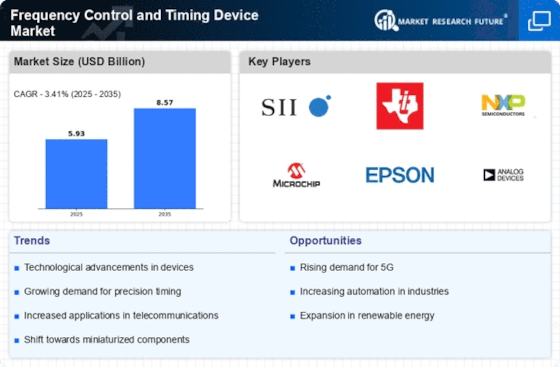
As per MRFR analysis, the Frequency Control and Timing Device Market Size was estimated at 5.928 USD Billion in 2024. The Frequency Control and Timing Device industry is projected to grow from 6.13 in 2025 to 8.574 by 2035, exhibiting a compound annual growth rate (CAGR) of 3.41 during the forecast period 2025 - 2035.

Key Market Trends & Highlights

The Frequency Control and Timing Device Market is poised for substantial growth driven by technological advancements and increasing demand across various sectors.

  • North America remains the largest market for frequency control and timing devices, driven by robust consumer electronics demand.
  • Asia-Pacific is emerging as the fastest-growing region, fueled by rapid advancements in telecommunications and automotive electronics.
  • Quartz crystal oscillators dominate the market, while atomic oscillators are experiencing the fastest growth due to their precision and reliability.
  • Key market drivers include the rising demand for consumer electronics and the expansion of telecommunications infrastructure, which are significantly influencing market dynamics.

Market Size & Forecast

2024 Market Size 5.928 (USD Billion)
2035 Market Size 8.574 (USD Billion)
CAGR (2025 - 2035) 3.41%

Major Players

Seiko Instruments Inc. (JP), Texas Instruments Inc. (US), NXP Semiconductors N.V. (NL), Microchip Technology Inc. (US), Epson Corporation (JP), Analog Devices Inc. (US), STMicroelectronics N.V. (FR), Infineon Technologies AG (DE), Kionix Inc. (US)

Frequency Control Timing Device Market Trends

The Frequency Control and Timing Device Market is currently experiencing a dynamic evolution, driven by advancements in technology and increasing demand across various sectors. The proliferation of electronic devices, coupled with the growing need for precise timing solutions, has led to a surge in the adoption of frequency control components. Industries such as telecommunications, automotive, and consumer electronics are particularly influential in shaping market trends, as they seek to enhance performance and reliability in their products. Furthermore, the integration of Internet of Things (IoT) technologies is likely to propel the market forward, as connected devices require accurate timing mechanisms to function optimally. In addition to technological advancements, the Frequency Control and Timing Device Market is also influenced by regulatory standards and environmental considerations. Manufacturers are increasingly focusing on developing energy-efficient solutions that comply with stringent regulations. This shift not only addresses environmental concerns but also aligns with the growing consumer preference for sustainable products. As the market continues to evolve, it appears poised for growth, with innovations in materials and design likely to play a crucial role in meeting the diverse needs of end-users. Overall, the Frequency Control and Timing Device Market is on a trajectory of transformation, characterized by both challenges and opportunities for stakeholders.

Technological Advancements

The Frequency Control and Timing Device Market is witnessing rapid technological advancements that enhance the performance and efficiency of devices. Innovations in materials and manufacturing processes are enabling the production of more precise and reliable components, which are essential for modern electronic applications. As industries increasingly adopt these advanced solutions, the market is likely to expand, driven by the demand for higher accuracy and lower power consumption.

Integration of IoT

The integration of Internet of Things (IoT) technologies is significantly impacting the Frequency Control and Timing Device Market. As more devices become interconnected, the need for accurate timing solutions becomes paramount. This trend suggests that manufacturers will focus on developing components that can seamlessly integrate with IoT systems, thereby enhancing the overall functionality and performance of connected devices.

Sustainability Initiatives

Sustainability initiatives are becoming increasingly relevant within the Frequency Control and Timing Device Market. Manufacturers are prioritizing the development of energy-efficient products that comply with environmental regulations. This shift not only addresses regulatory pressures but also aligns with consumer preferences for sustainable solutions, indicating a potential growth area for companies that can innovate while maintaining ecological responsibility.

Frequency Control Timing Device Market Drivers

Emergence of Smart Grids

The transition towards smart grids is reshaping the energy sector, creating new opportunities for the Frequency Control and Timing Device Market. Smart grids require precise timing and frequency control to optimize energy distribution and enhance grid reliability. As governments and utilities invest in smart grid technologies, the market for frequency control devices is expected to expand significantly. By 2027, investments in smart grid infrastructure are anticipated to surpass 100 billion USD, indicating a robust demand for timing devices that can support the complex requirements of modern energy systems. This trend underscores the critical role of the Frequency Control and Timing Device Market in facilitating energy efficiency and sustainability.

Growth in Automotive Electronics

The automotive sector is undergoing a transformation, with the integration of advanced electronics in vehicles. The Frequency Control and Timing Device Market is poised to benefit from this trend, as modern vehicles increasingly rely on precise timing devices for various applications, including navigation systems, infotainment, and safety features. The automotive electronics market is projected to reach 400 billion USD by 2026, indicating a substantial opportunity for frequency control devices. This growth reflects a shift towards smarter, more connected vehicles, thereby enhancing the relevance of the Frequency Control and Timing Device Market in the automotive landscape.

Rising Demand for Consumer Electronics

The Frequency Control and Timing Device Market is experiencing a notable surge in demand driven by the proliferation of consumer electronics. As devices such as smartphones, tablets, and wearables become ubiquitous, the need for precise timing and frequency control becomes paramount. In 2025, the consumer electronics sector is projected to reach a valuation exceeding 1 trillion USD, with timing devices playing a crucial role in ensuring optimal performance and functionality. This trend indicates a robust growth trajectory for the Frequency Control and Timing Device Market, as manufacturers seek to enhance device reliability and user experience through advanced timing solutions.

Increased Focus on Industrial Automation

The push towards industrial automation is a key driver for the Frequency Control and Timing Device Market. As industries adopt automation technologies to enhance productivity and efficiency, the need for precise timing devices becomes increasingly critical. The industrial automation market is projected to grow to 300 billion USD by 2026, with timing devices playing a vital role in synchronizing operations and ensuring seamless processes. This growth reflects a broader trend towards smart manufacturing, where the Frequency Control and Timing Device Market is likely to see heightened demand for innovative timing solutions that can support automated systems.

Expansion of Telecommunications Infrastructure

The Frequency Control and Timing Device Market is significantly influenced by the ongoing expansion of telecommunications infrastructure. With the advent of 5G technology, there is an increasing requirement for high-precision timing devices to support faster data transmission and improved connectivity. The telecommunications sector is expected to invest over 300 billion USD in infrastructure development by 2026, which will likely drive demand for frequency control devices. This expansion not only enhances communication capabilities but also propels the Frequency Control and Timing Device Market forward, as companies strive to meet the stringent requirements of next-generation networks.


Market Segment Insights

By Type: Quartz Crystal Oscillators (Largest) vs. Atomic Oscillators (Fastest-Growing)

Within the Frequency Control and Timing Device Market, Quartz Crystal Oscillators hold the largest market share due to their widespread application across various industries, including telecommunications, consumer electronics, and automotive. Their reliability and precision make them the preferred choice for many electronic devices. Atomic Oscillators, while currently a smaller segment, are rapidly gaining traction due to advancements in technology and their ability to provide extremely accurate timing, particularly in high-precision applications such as global navigation systems.

Quartz Crystal Oscillators (Dominant) vs. MEMS Oscillators (Emerging)

Quartz Crystal Oscillators are the dominant force in this market, known for their stability and frequency accuracy, which makes them essential for many electronic systems. Their established manufacturing processes and cost-effectiveness contribute to their leadership. In contrast, MEMS Oscillators are emerging as a strong competitor, offering benefits like a smaller size, lower power consumption, and superior thermal stability. This makes them increasingly appealing for modern applications, particularly in mobile devices and IoT solutions, where space and energy efficiency are paramount.

By Application: Telecommunications (Largest) vs. Automotive (Fastest-Growing)

The Frequency Control and Timing Device Market is significantly dominated by the telecommunications sector, accounting for a substantial portion of the overall market. This sector's prevalent need for precise timing and frequency control in communication systems ensures its leading position. Following telecommunications, the consumer electronics segment holds a notable share, benefiting from the increasing demand for connected devices. In contrast, although it currently occupies a smaller market share, the automotive sector demonstrates a strong potential for growth, driven by the rising integration of advanced technologies in vehicles.

Telecommunications: Established (Dominant) vs. Automotive (Emerging)

Telecommunications stands out as the dominant segment within the Frequency Control and Timing Device Market, characterized by its necessity for high-performance timing solutions in various applications like mobile networks and satellite communications. As the demand for data transmission and connectivity rises globally, this sector continues to thrive. On the other hand, the automotive segment is emerging rapidly, propelled by trends towards electric and autonomous vehicles. The increasing requirement for precise timing devices in driving systems, infotainment, and safety features positions automotive as a burgeoning field with innovative applications, thus complementing the established dominance of telecommunications.

By End Use: Commercial (Largest) vs. Residential (Fastest-Growing)

The Frequency Control and Timing Device Market exhibits a diverse range of end-use applications, primarily categorized into commercial, residential, and industrial segments. Currently, the commercial sector commands the largest market share, driven by increasing demand in telecommunications and consumer electronics. In contrast, the residential segment is experiencing rapid growth, primarily due to the rising adoption of smart home technologies and IoT devices that require precise timing mechanisms.

End Use Comparison: Commercial (Dominant) vs. Residential (Emerging)

The commercial segment stands as the dominant force within the Frequency Control and Timing Device Market, fueled by an increasing reliance on sophisticated technologies in sectors such as telecommunications, aerospace, and automotive. This segment includes a wide range of applications, from wireless transmission to high-precision industrial automation. Conversely, the residential segment is emerging as a key player, spurred by the proliferation of smart devices. Consumers are increasingly opting for technologically advanced home systems that necessitate accurate timing and synchronization. This shift presents significant opportunities for manufacturers to innovate and meet the growing demand for reliable frequency control solutions in residential applications.

By Technology: Digital (Largest) vs. Analog (Fastest-Growing)

In the Frequency Control and Timing Device Market, the technology segment is predominantly governed by digital devices, which have emerged as the largest segment due to their precision, reliability, and increasing adoption in various industrial applications. Digital frequency control devices account for a significant share of the market, driven by advancements in technology that enhance their performance. Conversely, analog devices, while holding a smaller market share, are witnessing rapid growth as they are favored in some specific applications for their simplicity and effectiveness. Growth trends in this segment indicate a strong shift towards digital technologies, fueled by demands for more accurate and efficient timing solutions. As industries continue to modernize and embrace automation, digital devices are gaining traction, positioned as the future of frequency control. However, analog devices are experiencing a revival in certain niche markets, where their distinct characteristics allow them to excel under specific operational conditions, marking them as the fastest-growing category within the segment.

Technology: Digital (Dominant) vs. Analog (Emerging)

Digital technology in the Frequency Control and Timing Device Market is positioned as the dominant segment due to its advanced capabilities and adaptability in a broad range of applications. These devices offer enhanced precision and integration with digital systems, making them indispensable in modern electronic applications. In contrast, analog devices are emerging strongly, appealing particularly in environments where simplicity and straightforward handling are paramount. Their lower manufacturing costs and reliability in specific uses contribute to their resurgence, making them appealing to niche markets. As customers continue to seek balance between cost and performance, both digital and analog technologies are crucial in shaping the market dynamics, catering to diverse requirements and fostering innovation in frequency control solutions.

Get more detailed insights about Frequency Control Timing Device Market

Regional Insights

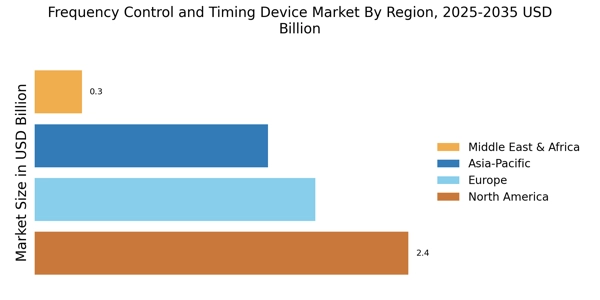
The Frequency Control and Timing Device Market is projected to showcase substantial growth within its regional segment over the coming years. North America stands out as a dominant player, with a market valuation of 2.15 USD Billion in 2023, further increasing to 2.91 USD Billion by 2032, which illustrates its majority holding in the industry. Europe follows closely with a valuation of 1.55 USD Billion in 2023, expected to rise to 2.01 USD Billion in 2032, reflecting its significant role in driving technological advancements.

The APAC region, valued at 1.45 USD Billion in 2023, is projected to grow to 1.98 USD Billion, showcasing a burgeoning demand for frequency control devices aligned with increasing electronic consumption.South America and MEA exhibit smaller, yet notable valuations at 0.25 USD Billion and 0.20 USD Billion respectively in 2023, growing to 0.34 USD Billion and 0.26 USD Billion by 2032, indicating emerging opportunities and incremental market growth in these regions.

Overall, the regional segmentation of the Frequency Control and Timing Device Market highlights key areas of growth and significant opportunities fostered by technological progress and a rising demand for frequency-based applications across various industries.

Frequency Control Timing Device Market Regional Image

Key Players and Competitive Insights

The Frequency Control and Timing Device Market is witnessing significant transformations driven by technological advancements and an ever-increasing demand for precision in various applications, such as communication systems, automotive electronics, industrial automation, and consumer electronics. The competitive landscape is evolving as a result of innovations in frequency control technologies, including oscillators, crystals, and clock timing devices. Key players in the market are focusing on product differentiation, strategic partnerships, and mergers and acquisitions to enhance their market presence and respond to the dynamic needs of customers across different sectors.

Understanding the strengths and strategies of leading companies in this domain provides essential insights into the overall market dynamics.Qualcomm stands out in the Frequency Control and Timing Device Market due to its strong innovation capabilities and extensive investment in research and development. 

The company has established a robust portfolio of timing solutions that cater to various high-performance applications. Its cutting-edge technologies in chipsets and integrated circuits enable precision timing and synchronization, which are essential for industries such as telecommunications and automotive. Qualcomm's strategic collaborations with other technology firms and its position as a leader in the semiconductor space further consolidates its competitiveness. With a focus on expanding its presence in emerging markets and continuous enhancement of product capabilities, Qualcomm maintains a stronghold in this rapidly growing sector.

Analog Devices is another significant player in the Frequency Control and Timing Device Market, known for its high-performance analog, mixed-signal, and digital signal processing technologies. 

The company leverages its comprehensive knowledge of signal processing to create advanced timing solutions that meet the rigorous demands of sectors like aerospace, defense, and telecommunications. Analog Devices is recognized for their dedication to quality and reliability in frequency control products, which enhances their reputation among industry stakeholders. The firm's focus on innovation, customer-centric approach, and strong technical expertise allows it to deliver tailored solutions that address specific application needs, making it a key competitor in the market landscape.

Key Companies in the Frequency Control Timing Device Market market include

Industry Developments

Recent developments in the Frequency Control and Timing Device Market indicate a significant surge in demand due to advancements in telecommunications and electronics. Companies like Qualcomm and Analog Devices are actively working on enhancing their technologies to meet the growing need for precision timing solutions, especially with the expansion of 5G technology and IoT applications. In terms of mergers and acquisitions, ON Semiconductor's acquisition of multiple smaller firms has fortified its position in this sector, signifying a trend toward consolidation to leverage synergies in technology and innovation.

Similarly, Microchip Technology's strategic partnerships aim to enhance its product offerings in the timing device market. Furthermore, STMicroelectronics has been making headway in developing next-generation frequency control components, driven by demand from automotive and industrial sectors. The market valuation of these companies is seeing a positive impact, fueled by increased investments and technological breakthroughs that optimize performance in various applications. As a result, major players like Christie Digital, Texas Instruments, and AVX Corporation are also exploring collaborative opportunities to expand their market share while keeping pace with rapidly evolving consumer needs.

Future Outlook

Frequency Control Timing Device Market Future Outlook

The Frequency Control and Timing Device Market is projected to grow at a 3.41% CAGR from 2024 to 2035, driven by technological advancements and increasing demand in telecommunications.

New opportunities lie in:

  • Development of high-precision timing solutions for 5G networks.
  • Expansion into emerging markets with tailored frequency control products.
  • Integration of IoT capabilities in timing devices for smart applications.

By 2035, the market is expected to achieve robust growth, reflecting evolving technological needs.

Market Segmentation

Frequency Control Timing Device Market Type Outlook

  • Quartz Crystal Oscillators
  • Atomic Oscillators
  • MEMS Oscillators
  • Real-Time Clock ICs

Frequency Control Timing Device Market End Use Outlook

  • Commercial
  • Residential
  • Industrial

Frequency Control Timing Device Market Technology Outlook

  • Analog
  • Digital
  • Hybrid

Frequency Control Timing Device Market Application Outlook

  • Telecommunications
  • Consumer Electronics
  • Automotive
  • Industrial Automation

Report Scope

MARKET SIZE 20245.928(USD Billion)
MARKET SIZE 20256.13(USD Billion)
MARKET SIZE 20358.574(USD Billion)
COMPOUND ANNUAL GROWTH RATE (CAGR)3.41% (2024 - 2035)
REPORT COVERAGERevenue Forecast, Competitive Landscape, Growth Factors, and Trends
BASE YEAR2024
Market Forecast Period2025 - 2035
Historical Data2019 - 2024
Market Forecast UnitsUSD Billion
Key Companies ProfiledMarket analysis in progress
Segments CoveredMarket segmentation analysis in progress
Key Market OpportunitiesIntegration of advanced semiconductor technologies enhances precision in the Frequency Control and Timing Device Market.
Key Market DynamicsTechnological advancements drive demand for precision frequency control and timing devices across various industries.
Countries CoveredNorth America, Europe, APAC, South America, MEA

Leave a Comment

FAQs

What is the projected market valuation for the Frequency Control and Timing Device Market in 2035?

The projected market valuation for the Frequency Control and Timing Device Market in 2035 is 8.574 USD Billion.

What was the overall market valuation for the Frequency Control and Timing Device Market in 2024?

The overall market valuation for the Frequency Control and Timing Device Market in 2024 was 5.928 USD Billion.

What is the expected CAGR for the Frequency Control and Timing Device Market during the forecast period 2025 - 2035?

The expected CAGR for the Frequency Control and Timing Device Market during the forecast period 2025 - 2035 is 3.41%.

Which companies are considered key players in the Frequency Control and Timing Device Market?

Key players in the Frequency Control and Timing Device Market include Seiko Instruments Inc., Texas Instruments Inc., and NXP Semiconductors N.V.

What are the main types of frequency control devices and their market valuations?

The main types include Quartz Crystal Oscillators valued at 3.5 USD Billion, Atomic Oscillators at 1.8 USD Billion, and MEMS Oscillators at 2.2 USD Billion.

How does the telecommunications sector contribute to the Frequency Control and Timing Device Market?

The telecommunications sector contributes significantly, with a market valuation projected to reach 3.5 USD Billion by 2035.

What is the market valuation for industrial applications of frequency control devices?

The market valuation for industrial applications of frequency control devices is expected to grow to 1.874 USD Billion by 2035.

What are the projected valuations for digital technology in the Frequency Control and Timing Device Market?

Digital technology is projected to reach a valuation of 3.5 USD Billion by 2035.

What is the expected growth in the residential end-use segment of the Frequency Control and Timing Device Market?

The residential end-use segment is expected to grow to 2.0 USD Billion by 2035.

How do hybrid technologies perform in the Frequency Control and Timing Device Market?

Hybrid technologies are projected to achieve a market valuation of 2.574 USD Billion by 2035.

Download Free Sample

Kindly complete the form below to receive a free sample of this Report

Compare Licence

×
Features License Type
Single User Multiuser License Enterprise User
Price $4,950 $5,950 $7,250
Maximum User Access Limit 1 User Upto 10 Users Unrestricted Access Throughout the Organization
Free Customization
Direct Access to Analyst
Deliverable Format
Platform Access
Discount on Next Purchase 10% 15% 15%
Printable Versions