×
Hero Background
English
Chinese
French
Japanese
Korean
German
Spanish

Frozen Dessert Market Trends

ID: MRFR/FnB/0991-CR
130 Pages
Varsha More
February 2021

Frozen Dessert Market Research Report Information By Product Type (Ice Cream, Yogurts, Cakes, and Others), By Category (Conventional and Sugar-Free), By Distribution Channel (Store-Based and Non-Store Based), And By Region (North America, Europe, Asia-Pacific, And Rest Of The World) – Market Forecast Till 2035

Share:
Download PDF ×

We do not share your information with anyone. However, we may send you emails based on your report interest from time to time. You may contact us at any time to opt-out.

Frozen Dessert Market Infographic
Purchase Options

Market Trends

Key Emerging Trends in the Frozen Dessert Market

The frozen desserts market is going through dynamic shifts due to changing consumer preferences, healthy living choices, and industry innovations. One notable trend affecting the market is the increased demand for healthier alternatives in frozen desserts. Consumers looking out for well-being are going for products that contain less sugar, reduced fat content, or include plant-based ingredients, among others. However, product innovation has played a remarkable role in the frozen desserts market, where producers introduce new tastes as well as other attributes like textures and formats, which are able to capture customers' interests and make them want more. Unique flavor combinations such as matcha or lavender or groundbreaking fruit infusions gain momentum, thus giving consumers plenty of different options for the gratification of their gustatory sensations. Functional ingredients, including superfoods, antioxidants, and natural sweeteners, make frozen desserts healthier than they would have been, thereby attracting those who want pleasure without counting calorie intake. Current trends in the frozen dessert industry reveal mounting concern about its growing size, driven primarily by excessive sugar and fat levels present within these iced delicacies. Frozen dessert consumption in North America has seen an uptake, with major manufacturers expanding their range of products. One notable reason behind this growth rate attributable to leading industry players is this strategic move. Additionally, the market has experienced an increase in demand for artisanal and premium frozen desserts. Today, high-end quality handcrafted frozen treats are becoming more popular among customers who are willing to pay a premium price for them. They have started to gain popularity due to their original flavor combinations and unique consistencies, which are key features of the enhanced taste and organoleptic attributes of such products as ice-cream parlors. This trend implies that there is a growing desire for indulgence as well as sophistication in consumption. Environmental sustainability has emerged as a significant trend in the Frozen Desserts Market, reflecting consumers' growing awareness of the environmental impact of their food choices. Online sales and direct-to-consumer models are witnessing increased prominence in the Frozen Desserts Market. E-commerce platforms provide consumers with the convenience of ordering frozen desserts from the comfort of their homes, contributing to overall market growth. Health and wellness considerations are influencing the formulation of frozen desserts, with a focus on functional ingredients that offer health benefits beyond traditional indulgence. Probiotics, prebiotics, and ingredients promoting gut health are being incorporated into frozen desserts to meet the demand for products that contribute to overall well-being. This trend aligns with the broader shift toward functional foods that address specific health concerns.

Author
Varsha More
Research Analyst

Experienced business professional with a demonstrated history of working in the CFnB industry. Skilled in market research, and market estimation. Strong professional with a Masters focused in marketing management.

Leave a Comment

FAQs

What is the current valuation of the Frozen Dessert Market as of 2024?

The Frozen Dessert Market was valued at 127.3 USD Billion in 2024.

What is the projected market size for the Frozen Dessert Market in 2035?

The market is projected to reach 229.69 USD Billion by 2035.

What is the expected CAGR for the Frozen Dessert Market during the forecast period 2025 - 2035?

The expected CAGR for the Frozen Dessert Market during 2025 - 2035 is 5.51%.

Which product type holds the largest market share in the Frozen Dessert Market?

Ice Cream holds the largest market share, with a valuation range of 60.0 to 110.0 USD Billion.

How do sugar-free frozen desserts compare to conventional options in terms of market size?

Conventional frozen desserts are valued between 100.0 and 185.0 USD Billion, while sugar-free options range from 27.3 to 44.69 USD Billion.

What are the key distribution channels for frozen desserts?

The primary distribution channels include Store-Based, valued at 80.0 to 145.0 USD Billion, and Non-Store Based, valued at 47.3 to 84.69 USD Billion.

Market Summary

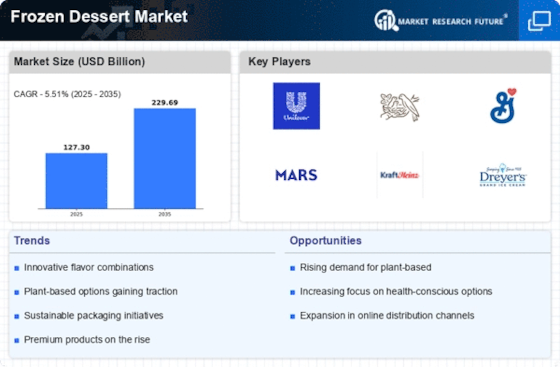
As per MRFR analysis, the Frozen Dessert Market Size was estimated at 127.3 USD Billion in 2024. The Frozen Dessert industry is projected to grow from 134.32 USD Billion in 2025 to 229.69 USD Billion by 2035, exhibiting a compound annual growth rate (CAGR) of 5.51 during the forecast period 2025 - 2035.

Key Market Trends & Highlights

The Frozen Dessert Market is currently experiencing a dynamic shift towards health-conscious and premium offerings.

  • Health-conscious offerings are increasingly influencing consumer preferences in the Frozen Dessert Market. North America remains the largest market, while the Asia-Pacific region is recognized as the fastest-growing area for frozen desserts. Ice cream continues to dominate the market, yet sugar-free options are rapidly gaining traction among health-focused consumers. Innovative flavors and convenience-driven products are key drivers propelling market growth in both conventional and sugar-free segments.

Market Size & Forecast

2024 Market Size 127.3 (USD Billion)
2035 Market Size 229.69 (USD Billion)
CAGR (2025 - 2035) 5.51%
Largest Regional Market Share in 2024 Asia Pacific

Major Players

<p>Unilever (GB), Nestle (CH), General Mills (US), <a href="https://www.marsfoodservices.com/brands-products/brands-and-products">Mars Incorporated</a> (US), Kraft Heinz (US), Dreyer's Grand Ice Cream (US), Blue Bell Creameries (US), Häagen-Dazs (US), Breyers (US)</p>

Market Trends

The Frozen Dessert Market is currently experiencing a dynamic evolution, driven by changing consumer preferences and an increasing demand for innovative products. As health consciousness rises, consumers are gravitating towards options that offer lower sugar content, natural ingredients, and dairy-free alternatives. This shift is prompting manufacturers to explore new formulations and flavors, thereby expanding their product lines to cater to diverse dietary needs. Additionally, the market is witnessing a surge in the popularity of premium and artisanal frozen desserts, which are perceived as indulgent yet sophisticated choices. These trends suggest a potential for growth as brands strive to differentiate themselves in a competitive landscape. Moreover, the Frozen Dessert Market is also influenced by the growing trend of sustainability. Consumers are becoming more aware of environmental issues, leading to a preference for brands that prioritize eco-friendly practices. This includes sustainable sourcing of ingredients, environmentally friendly packaging, and transparent supply chains. As a result, companies are likely to invest in sustainable practices to appeal to this conscientious consumer base. Overall, the Frozen Dessert Market appears poised for continued expansion, with innovation and sustainability at the forefront of its development.

Health-Conscious Offerings

The Frozen Dessert Market is increasingly catering to health-conscious consumers. This trend encompasses the introduction of products with reduced sugar, organic ingredients, and dairy-free options. Manufacturers are responding to the demand for healthier alternatives by reformulating existing products and creating new ones that align with dietary preferences.

Premium and Artisanal Products

There is a noticeable shift towards premium and artisanal frozen desserts within the market. Consumers are seeking unique flavors and high-quality ingredients, which has led to the emergence of small-batch producers. This trend reflects a desire for indulgence and a willingness to pay more for perceived quality.

Sustainability Initiatives

Sustainability is becoming a critical focus in the Frozen Dessert Market. Brands are increasingly adopting eco-friendly practices, such as sustainable sourcing and environmentally responsible packaging. This trend indicates a growing consumer preference for products that align with their values regarding environmental stewardship.

Frozen Dessert Market Market Drivers

Health and Wellness Trends

The Frozen Dessert Market is experiencing a notable shift towards health and wellness. Consumers are increasingly seeking frozen desserts that align with their dietary preferences, such as low-calorie, low-sugar, and dairy-free options. This trend is supported by market data indicating that the sales of healthier frozen dessert alternatives have increased by approximately 25% in recent years. As awareness of health issues rises, brands that innovate to create guilt-free indulgences are likely to capture a larger share of the market. The Frozen Dessert Market is thus evolving to meet the demands of health-conscious consumers, who desire treats that do not compromise their wellness goals.

Innovative Flavors and Ingredients

The Frozen Dessert Market is witnessing a surge in demand for innovative flavors and unique ingredients. Consumers are increasingly seeking out exotic and unconventional options, such as matcha, lavender, and even savory flavors. This trend is driven by a desire for novel culinary experiences and the influence of social media, where visually appealing desserts gain traction. According to recent data, the introduction of new flavors has contributed to a 15% increase in sales within the industry over the past year. As brands experiment with ingredients like superfoods and plant-based alternatives, the Frozen Dessert Market is likely to expand its consumer base, appealing to adventurous eaters and health-conscious individuals alike.

Sustainability and Ethical Sourcing

The Frozen Dessert Market is increasingly influenced by consumer demand for sustainability and ethical sourcing. As awareness of environmental issues grows, consumers are gravitating towards brands that prioritize eco-friendly practices and responsibly sourced ingredients. This trend is reflected in market data, which shows that products marketed as sustainable have seen a 40% increase in sales. Brands that adopt sustainable packaging and transparent sourcing practices are likely to resonate with environmentally conscious consumers. The Frozen Dessert Market is thus evolving to meet these expectations, as companies strive to balance profitability with social responsibility.

Convenience and On-the-Go Consumption

The Frozen Dessert Market is adapting to the fast-paced lifestyle of modern consumers, who increasingly prioritize convenience. Ready-to-eat frozen desserts, such as single-serve cups and portable ice cream bars, are gaining popularity. This shift is reflected in market data, which indicates that products designed for on-the-go consumption have seen a 20% growth in sales. As busy lifestyles become the norm, the demand for quick and easy dessert options is expected to rise. Brands that effectively cater to this need by offering convenient packaging and portion sizes are likely to thrive in the Frozen Dessert Market, appealing to families, young professionals, and students.

Seasonal and Limited-Edition Offerings

The Frozen Dessert Market is capitalizing on the appeal of seasonal and limited-edition products. Brands are increasingly launching special flavors and products tied to holidays or seasonal events, creating a sense of urgency among consumers. This strategy not only boosts sales but also enhances brand loyalty as customers eagerly anticipate new offerings. Market data suggests that limited-edition products can lead to a 30% increase in sales during peak seasons. As the Frozen Dessert Market continues to innovate, the introduction of seasonal flavors is likely to remain a key driver, enticing consumers to try new products and share their experiences.

Market Segment Insights

Frozen Desserts Product Type Insights

<p>The Frozen Desserts market segmentation, based on product type, includes ice cream,</p>

<p>, cakes, and others. The <a href="https://www.marketresearchfuture.com/reports/ice-cream-market-2691">ice cream</a> segment held the majority share in 2022 contributing to around 45-47% in respect to the Frozen Desserts market revenue. Due to ice cream's rising popularity across all generations, the demand for it is significantly rising. The United States ice cream producers produced more than 1.3 billion gallons of ice cream in 2021. According to IDFA's Dairy Delivers, the ice cream industry has a $13.1 billion impact on the American economy, supports 28,800 direct jobs, and generates $1.8 billion in direct wages.</p>

<p>The yogurts segment is anticipated to grow at the fastest CAGR during the forecast period.</p>

Frozen Desserts Category Insights

<p>The Frozen Desserts market segmentation, based on category, includes Conventional and Sugar-Free. The Conventional segment dominated the market in 2022 The demand for the segment would be driven in the forecast period by rising millennial demand for convenience food products along with new launches in this segment with varied flavors to attract customers. Such factors are anticipated to have a positive impact on market growth. Sugar-free is projected to be the faster-growing segment during the forecast period, 2022-2030. Due to their health advantages, handcrafted and <a href="https://www.marketresearchfuture.com/reports/sugar-free-ice-cream-market-24520">sugar-free ice creams</a> are both growing in popularity.</p>

<p>Moreover, the rise of health-conscious consumers looking for a low-carb, low-sugar diet with nutritional advantages will be good for market expansion.</p>

Frozen Desserts Distribution Channel Insights

<p>The Frozen Desserts market data has been bifurcated by distribution channels into store-based and non-store-based. The store-based segment dominated the market in 2022. Numerous cafes and bakeries that sell frozen desserts have opened as a result of the growing trend of buying products from specialty stores. They were forced by current trends to incorporate wholesome desserts into their menus, which has improved their product selection. In addition, several online delivery partners are developing creative ways to deliver frozen desserts to various locations that are just as fresh as their source points. Frozen dessert purchases have increased online sales.</p>

Get more detailed insights about Frozen Dessert Market Research Report - Forecast till 2035

Regional Insights

North America : Market Leader in Frozen Desserts

North America is the largest market for frozen desserts, accounting for approximately 45% of the global market share. The region's growth is driven by increasing consumer demand for premium and innovative frozen dessert options, alongside a rising trend towards healthier alternatives. Regulatory support for food safety and quality standards further catalyzes market expansion, ensuring consumer trust and product integrity. The competitive landscape is characterized by major players such as Unilever, Nestle, and General Mills, which dominate the market with a diverse range of products. The U.S. leads the market, followed by Canada, which contributes significantly to the overall demand. The presence of established brands and continuous product innovation are key factors that maintain the region's leadership in the frozen dessert sector.

Europe : Emerging Trends in Frozen Desserts

Europe is witnessing a significant shift in the frozen dessert market, holding approximately 30% of the global share. The growth is primarily driven by increasing health consciousness among consumers, leading to a demand for low-calorie and organic options. Regulatory frameworks in the EU promote transparency in labeling and ingredient sourcing, which enhances consumer confidence and supports market growth. Leading countries in this region include Germany, France, and the UK, where established brands like Häagen-Dazs and Mars are prominent. The competitive landscape is evolving, with new entrants focusing on niche markets such as vegan and gluten-free frozen desserts. This diversification is crucial for capturing the attention of health-conscious consumers and adapting to changing market dynamics.

Asia-Pacific : Rapid Growth in Emerging Markets

Asia-Pacific is rapidly emerging as a key player in the frozen dessert market, accounting for about 20% of the global share. The region's growth is fueled by rising disposable incomes, urbanization, and changing consumer lifestyles that favor convenience and indulgence. Additionally, government initiatives to improve food distribution and safety standards are enhancing market accessibility and consumer trust. Countries like China, India, and Japan are leading the charge, with local and international brands competing for market share. The presence of key players such as Nestle and Unilever, along with local manufacturers, creates a competitive landscape that is both dynamic and diverse. Innovations in flavors and product offerings tailored to local tastes are essential for capturing the growing consumer base in this region.

Middle East and Africa : Untapped Potential in Frozen Desserts

The Middle East and Africa region is gradually emerging in the frozen dessert market, holding approximately 5% of the global share. The growth is driven by increasing urbanization, a young population, and a growing middle class that is more inclined towards indulgent treats. Regulatory improvements in food safety and quality are also paving the way for market expansion, enhancing consumer confidence in frozen products. Leading countries in this region include South Africa, UAE, and Nigeria, where local and international brands are beginning to establish a foothold. The competitive landscape is characterized by a mix of established players and new entrants, focusing on unique flavors and culturally relevant products. As the market matures, opportunities for growth are significant, particularly in the premium segment of frozen desserts.

Key Players and Competitive Insights

The Major market players are focused on diversifying their product portfolios by investing heavily within their R&D departments. Additionally, players are focused on integrating various market developments such as new product launches, contractual agreements, mergers and acquisitions, increased investments, and collaboration with other companies in the market to widen their presence further. The dominant players in the Frozen Desserts industry further offer to optimize their supply chains to widen their profit margins.

To reduce operating costs, the market leaders in the Frozen Desserts industry are offering their products at a moderate price. During the forecast period, the Frozen Desserts industry has produced highly viable products. The Frozen Desserts market major player such as The Hain Celestial Group (US), Halo Top Creamery (US),

(US), Unilever (UK), Nestlé SA (Switzerland), Kellogg Company (US), DD IP Holder LLC (US), Conagra Brands Inc. (US), London Dairy Co. Ltd (UK), Danone SA (France), Dairy Queen (US), Ferrero (Luxembourg), Daiya Foods Inc. (Canada), Archer Daniels Midland Company (US), Nestlé S.A. (Switzerland), Arla Foods amba (Denmark), and Unilever (UK), and others are working to expand the market demand by investing in research and development activities.

Unilever is a company that manufactures and distributes products in the nutrition, hygiene, and personal care sector. In January 2021, Unilever introduced a few frozen treats namely Breyers, Good Humor, Klondike, Magnum Ice Cream, Popsicle, and Talenti. Breyers Double Chocolate Brownie Batter, Breyers Chocolate Pretzel Swirl, and Breyers Reese's Peanut Butter Snack Cups are all new items under the Breyers brand that complement the existing Breyers and Reese's product line. The portfolio also gains Breyers Coconut Fudge Breeze, a new seasonal flavor.

Archer Daniels Midland is a pioneer in the field of nutrition, using the power of nature to imagine, develop, and combine flavors and ingredients for food and beverages, supplements, animal feed, and more. In August 2022, New Culture, a maker of cheese without using any animals, and Archer Daniels Midland have announced a partnership for strategic development and commercialization. As the company expands its commercial reach, ADM's fermentation and dairy processing operations will assist in producing cheese for New Culture.

Key Companies in the Frozen Dessert Market market include

Industry Developments

On March 15, 2024

, Ben & Jerry’s tapped into an exploding demand for vegan and dairy-free frozen desserts with their introduction of a new range of desserts made from Almond, oat and coconut milk in their existing line.

In February 2024,

Häagen-Dazs and Godiva’s limited-edition releases catered to an audience that seeks luxury frozen treats as the collaboration merged premium chocolates with gelato bases.

In January 2024

, Halo Top Creamery broadened their frozen dessert line with reduced fat and sugar products featuring probiotics and fibers for an audience looking for a healthy sating option.

In December 2023

, Baskin-Robbins ventured into Southeast Asia and the Middle Eastern market with a new strategy of combining western style ice cream with region specific products like matcha and rosewater to cater to the rise in demand for westernised desserts.

In November 2023

, Sorbabes advanced their production through additional funding as they look into launching other exotic rich flavors including dragon fruit in their sorbets and passionfruit in their gelato.

In October of 2023

, Unilever, amongst other brands looking to push the issue of sustainability, announced their concern for the ice cream industry with the usage of biodegradable alternatives in their brand’s such as Magnum and Cornetto. This policy also helps the company to achieve its objective which is to lessen harm to the environment and win over customers who care for the environment.

In September 2023

, Wal mart also launched its own brand of ice creams and ice lollies alongside dairy free products. The line was positioned for budget shoppers without compromising on assortment and value.

In August 2023

, the cold stone creamery introduced a promotional holiday collection of ice creams with pumpkin spice, peppermint mocha, and gingerbread flavors. These were meant to enhance the festive mood and increase seasonal sales.

Future Outlook

Frozen Dessert Market Future Outlook

<p>The Frozen Dessert Market is projected to grow at a 5.51% CAGR from 2024 to 2035, driven by increasing consumer demand for innovative flavors and healthier options.</p>

New opportunities lie in:

  • <p>Expansion of plant-based frozen dessert lines</p><p>Development of personalized frozen dessert subscription services</p><p>Investment in sustainable packaging solutions for frozen products</p>

<p>By 2035, the Frozen Dessert Market is expected to achieve robust growth, reflecting evolving consumer preferences.</p>

Market Segmentation

Frozen Dessert Market Category Outlook

  • Conventional
  • Sugar-Free

Frozen Dessert Market Product Type Outlook

  • Ice Cream
  • Yogurts
  • Cakes
  • Others

Frozen Dessert Market Distribution Channel Outlook

  • Store-Based
  • Non-Store Based

Report Scope

MARKET SIZE 2024127.3(USD Billion)
MARKET SIZE 2025134.32(USD Billion)
MARKET SIZE 2035229.69(USD Billion)
COMPOUND ANNUAL GROWTH RATE (CAGR)5.51% (2024 - 2035)
REPORT COVERAGERevenue Forecast, Competitive Landscape, Growth Factors, and Trends
BASE YEAR2024
Market Forecast Period2025 - 2035
Historical Data2019 - 2024
Market Forecast UnitsUSD Billion
Key Companies ProfiledMarket analysis in progress
Segments CoveredMarket segmentation analysis in progress
Key Market OpportunitiesGrowing demand for plant-based and healthier options in the Frozen Dessert Market presents significant opportunities.
Key Market DynamicsRising consumer demand for plant-based options drives innovation and competition in the frozen dessert market.
Countries CoveredNorth America, Europe, APAC, South America, MEA

FAQs

What is the current valuation of the Frozen Dessert Market as of 2024?

The Frozen Dessert Market was valued at 127.3 USD Billion in 2024.

What is the projected market size for the Frozen Dessert Market in 2035?

The market is projected to reach 229.69 USD Billion by 2035.

What is the expected CAGR for the Frozen Dessert Market during the forecast period 2025 - 2035?

The expected CAGR for the Frozen Dessert Market during 2025 - 2035 is 5.51%.

Which product type holds the largest market share in the Frozen Dessert Market?

Ice Cream holds the largest market share, with a valuation range of 60.0 to 110.0 USD Billion.

How do sugar-free frozen desserts compare to conventional options in terms of market size?

Conventional frozen desserts are valued between 100.0 and 185.0 USD Billion, while sugar-free options range from 27.3 to 44.69 USD Billion.

What are the key distribution channels for frozen desserts?

The primary distribution channels include Store-Based, valued at 80.0 to 145.0 USD Billion, and Non-Store Based, valued at 47.3 to 84.69 USD Billion.

  1. SECTION I: EXECUTIVE SUMMARY AND KEY HIGHLIGHTS
    1. EXECUTIVE SUMMARY
      1. Market Overview
      2. Key Findings
      3. Market Segmentation
      4. Competitive Landscape
      5. Challenges and Opportunities
      6. Future Outlook 2
  2. SECTION II: SCOPING, METHODOLOGY AND MARKET STRUCTURE
    1. MARKET INTRODUCTION
      1. Definition
      2. Scope of the study
    2. RESEARCH METHODOLOGY
      1. Overview
      2. Data Mining
      3. Secondary Research
      4. Primary Research
      5. Forecasting Model
      6. Market Size Estimation
      7. Data Triangulation
      8. Validation 3
  3. SECTION III: QUALITATIVE ANALYSIS
    1. MARKET DYNAMICS
      1. Overview
      2. Drivers
      3. Restraints
      4. Opportunities
    2. MARKET FACTOR ANALYSIS
      1. Value chain Analysis
      2. Porter's Five Forces Analysis
      3. COVID-19 Impact Analysis
  4. SECTION IV: QUANTITATIVE ANALYSIS
    1. Food, Beverages & Nutrition, BY Product Type (USD Billion)
      1. Ice Cream
      2. Yogurts
      3. Cakes
      4. Others
    2. Food, Beverages & Nutrition, BY Category (USD Billion)
      1. Conventional
      2. Sugar-Free
    3. Food, Beverages & Nutrition, BY Distribution Channel (USD Billion)
      1. Store-Based
      2. Non-Store Based
    4. Food, Beverages & Nutrition, BY Region (USD Billion)
      1. North America
      2. Europe
      3. APAC
      4. South America
      5. MEA
  5. SECTION V: COMPETITIVE ANALYSIS
    1. Competitive Landscape
      1. Overview
      2. Competitive Analysis
      3. Market share Analysis
      4. Major Growth Strategy in the Food, Beverages & Nutrition
      5. Competitive Benchmarking
      6. Leading Players in Terms of Number of Developments in the Food, Beverages & Nutrition
      7. Key developments and growth strategies
      8. Major Players Financial Matrix
    2. Company Profiles
      1. Unilever (GB)
      2. Nestle (CH)
      3. General Mills (US)
      4. Mars, Incorporated (US)
      5. Kraft Heinz (US)
      6. Dreyer's Grand Ice Cream (US)
      7. Blue Bell Creameries (US)
      8. Häagen-Dazs (US)
      9. Breyers (US)
    3. Appendix
      1. References
      2. Related Reports 6 LIST OF FIGURES
    4. MARKET SYNOPSIS
    5. NORTH AMERICA MARKET ANALYSIS
    6. US MARKET ANALYSIS BY PRODUCT TYPE
    7. US MARKET ANALYSIS BY CATEGORY
    8. US MARKET ANALYSIS BY DISTRIBUTION CHANNEL
    9. CANADA MARKET ANALYSIS BY PRODUCT TYPE
    10. CANADA MARKET ANALYSIS BY CATEGORY
    11. CANADA MARKET ANALYSIS BY DISTRIBUTION CHANNEL
    12. EUROPE MARKET ANALYSIS
    13. GERMANY MARKET ANALYSIS BY PRODUCT TYPE
    14. GERMANY MARKET ANALYSIS BY CATEGORY
    15. GERMANY MARKET ANALYSIS BY DISTRIBUTION CHANNEL
    16. UK MARKET ANALYSIS BY PRODUCT TYPE
    17. UK MARKET ANALYSIS BY CATEGORY
    18. UK MARKET ANALYSIS BY DISTRIBUTION CHANNEL
    19. FRANCE MARKET ANALYSIS BY PRODUCT TYPE
    20. FRANCE MARKET ANALYSIS BY CATEGORY
    21. FRANCE MARKET ANALYSIS BY DISTRIBUTION CHANNEL
    22. RUSSIA MARKET ANALYSIS BY PRODUCT TYPE
    23. RUSSIA MARKET ANALYSIS BY CATEGORY
    24. RUSSIA MARKET ANALYSIS BY DISTRIBUTION CHANNEL
    25. ITALY MARKET ANALYSIS BY PRODUCT TYPE
    26. ITALY MARKET ANALYSIS BY CATEGORY
    27. ITALY MARKET ANALYSIS BY DISTRIBUTION CHANNEL
    28. SPAIN MARKET ANALYSIS BY PRODUCT TYPE
    29. SPAIN MARKET ANALYSIS BY CATEGORY
    30. SPAIN MARKET ANALYSIS BY DISTRIBUTION CHANNEL
    31. REST OF EUROPE MARKET ANALYSIS BY PRODUCT TYPE
    32. REST OF EUROPE MARKET ANALYSIS BY CATEGORY
    33. REST OF EUROPE MARKET ANALYSIS BY DISTRIBUTION CHANNEL
    34. APAC MARKET ANALYSIS
    35. CHINA MARKET ANALYSIS BY PRODUCT TYPE
    36. CHINA MARKET ANALYSIS BY CATEGORY
    37. CHINA MARKET ANALYSIS BY DISTRIBUTION CHANNEL
    38. INDIA MARKET ANALYSIS BY PRODUCT TYPE
    39. INDIA MARKET ANALYSIS BY CATEGORY
    40. INDIA MARKET ANALYSIS BY DISTRIBUTION CHANNEL
    41. JAPAN MARKET ANALYSIS BY PRODUCT TYPE
    42. JAPAN MARKET ANALYSIS BY CATEGORY
    43. JAPAN MARKET ANALYSIS BY DISTRIBUTION CHANNEL
    44. SOUTH KOREA MARKET ANALYSIS BY PRODUCT TYPE
    45. SOUTH KOREA MARKET ANALYSIS BY CATEGORY
    46. SOUTH KOREA MARKET ANALYSIS BY DISTRIBUTION CHANNEL
    47. MALAYSIA MARKET ANALYSIS BY PRODUCT TYPE
    48. MALAYSIA MARKET ANALYSIS BY CATEGORY
    49. MALAYSIA MARKET ANALYSIS BY DISTRIBUTION CHANNEL
    50. THAILAND MARKET ANALYSIS BY PRODUCT TYPE
    51. THAILAND MARKET ANALYSIS BY CATEGORY
    52. THAILAND MARKET ANALYSIS BY DISTRIBUTION CHANNEL
    53. INDONESIA MARKET ANALYSIS BY PRODUCT TYPE
    54. INDONESIA MARKET ANALYSIS BY CATEGORY
    55. INDONESIA MARKET ANALYSIS BY DISTRIBUTION CHANNEL
    56. REST OF APAC MARKET ANALYSIS BY PRODUCT TYPE
    57. REST OF APAC MARKET ANALYSIS BY CATEGORY
    58. REST OF APAC MARKET ANALYSIS BY DISTRIBUTION CHANNEL
    59. SOUTH AMERICA MARKET ANALYSIS
    60. BRAZIL MARKET ANALYSIS BY PRODUCT TYPE
    61. BRAZIL MARKET ANALYSIS BY CATEGORY
    62. BRAZIL MARKET ANALYSIS BY DISTRIBUTION CHANNEL
    63. MEXICO MARKET ANALYSIS BY PRODUCT TYPE
    64. MEXICO MARKET ANALYSIS BY CATEGORY
    65. MEXICO MARKET ANALYSIS BY DISTRIBUTION CHANNEL
    66. ARGENTINA MARKET ANALYSIS BY PRODUCT TYPE
    67. ARGENTINA MARKET ANALYSIS BY CATEGORY
    68. ARGENTINA MARKET ANALYSIS BY DISTRIBUTION CHANNEL
    69. REST OF SOUTH AMERICA MARKET ANALYSIS BY PRODUCT TYPE
    70. REST OF SOUTH AMERICA MARKET ANALYSIS BY CATEGORY
    71. REST OF SOUTH AMERICA MARKET ANALYSIS BY DISTRIBUTION CHANNEL
    72. MEA MARKET ANALYSIS
    73. GCC COUNTRIES MARKET ANALYSIS BY PRODUCT TYPE
    74. GCC COUNTRIES MARKET ANALYSIS BY CATEGORY
    75. GCC COUNTRIES MARKET ANALYSIS BY DISTRIBUTION CHANNEL
    76. SOUTH AFRICA MARKET ANALYSIS BY PRODUCT TYPE
    77. SOUTH AFRICA MARKET ANALYSIS BY CATEGORY
    78. SOUTH AFRICA MARKET ANALYSIS BY DISTRIBUTION CHANNEL
    79. REST OF MEA MARKET ANALYSIS BY PRODUCT TYPE
    80. REST OF MEA MARKET ANALYSIS BY CATEGORY
    81. REST OF MEA MARKET ANALYSIS BY DISTRIBUTION CHANNEL
    82. KEY BUYING CRITERIA OF FOOD, BEVERAGES & NUTRITION
    83. RESEARCH PROCESS OF MRFR
    84. DRO ANALYSIS OF FOOD, BEVERAGES & NUTRITION
    85. DRIVERS IMPACT ANALYSIS: FOOD, BEVERAGES & NUTRITION
    86. RESTRAINTS IMPACT ANALYSIS: FOOD, BEVERAGES & NUTRITION
    87. SUPPLY / VALUE CHAIN: FOOD, BEVERAGES & NUTRITION
    88. FOOD, BEVERAGES & NUTRITION, BY PRODUCT TYPE, 2024 (% SHARE)
    89. FOOD, BEVERAGES & NUTRITION, BY PRODUCT TYPE, 2024 TO 2035 (USD Billion)
    90. FOOD, BEVERAGES & NUTRITION, BY CATEGORY, 2024 (% SHARE)
    91. FOOD, BEVERAGES & NUTRITION, BY CATEGORY, 2024 TO 2035 (USD Billion)
    92. FOOD, BEVERAGES & NUTRITION, BY DISTRIBUTION CHANNEL, 2024 (% SHARE)
    93. FOOD, BEVERAGES & NUTRITION, BY DISTRIBUTION CHANNEL, 2024 TO 2035 (USD Billion)
    94. BENCHMARKING OF MAJOR COMPETITORS 7 LIST OF TABLES
    95. LIST OF ASSUMPTIONS
    96. North America MARKET SIZE ESTIMATES; FORECAST
      1. BY PRODUCT TYPE, 2025-2035 (USD Billion)
      2. BY CATEGORY, 2025-2035 (USD Billion)
      3. BY DISTRIBUTION CHANNEL, 2025-2035 (USD Billion)
    97. US MARKET SIZE ESTIMATES; FORECAST
      1. BY PRODUCT TYPE, 2025-2035 (USD Billion)
      2. BY CATEGORY, 2025-2035 (USD Billion)
      3. BY DISTRIBUTION CHANNEL, 2025-2035 (USD Billion)
    98. Canada MARKET SIZE ESTIMATES; FORECAST
      1. BY PRODUCT TYPE, 2025-2035 (USD Billion)
      2. BY CATEGORY, 2025-2035 (USD Billion)
      3. BY DISTRIBUTION CHANNEL, 2025-2035 (USD Billion)
    99. Europe MARKET SIZE ESTIMATES; FORECAST
      1. BY PRODUCT TYPE, 2025-2035 (USD Billion)
      2. BY CATEGORY, 2025-2035 (USD Billion)
      3. BY DISTRIBUTION CHANNEL, 2025-2035 (USD Billion)
    100. Germany MARKET SIZE ESTIMATES; FORECAST
      1. BY PRODUCT TYPE, 2025-2035 (USD Billion)
      2. BY CATEGORY, 2025-2035 (USD Billion)
      3. BY DISTRIBUTION CHANNEL, 2025-2035 (USD Billion)
    101. UK MARKET SIZE ESTIMATES; FORECAST
      1. BY PRODUCT TYPE, 2025-2035 (USD Billion)
      2. BY CATEGORY, 2025-2035 (USD Billion)
      3. BY DISTRIBUTION CHANNEL, 2025-2035 (USD Billion)
    102. France MARKET SIZE ESTIMATES; FORECAST
      1. BY PRODUCT TYPE, 2025-2035 (USD Billion)
      2. BY CATEGORY, 2025-2035 (USD Billion)
      3. BY DISTRIBUTION CHANNEL, 2025-2035 (USD Billion)
    103. Russia MARKET SIZE ESTIMATES; FORECAST
      1. BY PRODUCT TYPE, 2025-2035 (USD Billion)
      2. BY CATEGORY, 2025-2035 (USD Billion)
      3. BY DISTRIBUTION CHANNEL, 2025-2035 (USD Billion)
    104. Italy MARKET SIZE ESTIMATES; FORECAST
      1. BY PRODUCT TYPE, 2025-2035 (USD Billion)
      2. BY CATEGORY, 2025-2035 (USD Billion)
      3. BY DISTRIBUTION CHANNEL, 2025-2035 (USD Billion)
    105. Spain MARKET SIZE ESTIMATES; FORECAST
      1. BY PRODUCT TYPE, 2025-2035 (USD Billion)
      2. BY CATEGORY, 2025-2035 (USD Billion)
      3. BY DISTRIBUTION CHANNEL, 2025-2035 (USD Billion)
    106. Rest of Europe MARKET SIZE ESTIMATES; FORECAST
      1. BY PRODUCT TYPE, 2025-2035 (USD Billion)
      2. BY CATEGORY, 2025-2035 (USD Billion)
      3. BY DISTRIBUTION CHANNEL, 2025-2035 (USD Billion)
    107. APAC MARKET SIZE ESTIMATES; FORECAST
      1. BY PRODUCT TYPE, 2025-2035 (USD Billion)
      2. BY CATEGORY, 2025-2035 (USD Billion)
      3. BY DISTRIBUTION CHANNEL, 2025-2035 (USD Billion)
    108. China MARKET SIZE ESTIMATES; FORECAST
      1. BY PRODUCT TYPE, 2025-2035 (USD Billion)
      2. BY CATEGORY, 2025-2035 (USD Billion)
      3. BY DISTRIBUTION CHANNEL, 2025-2035 (USD Billion)
    109. India MARKET SIZE ESTIMATES; FORECAST
      1. BY PRODUCT TYPE, 2025-2035 (USD Billion)
      2. BY CATEGORY, 2025-2035 (USD Billion)
      3. BY DISTRIBUTION CHANNEL, 2025-2035 (USD Billion)
    110. Japan MARKET SIZE ESTIMATES; FORECAST
      1. BY PRODUCT TYPE, 2025-2035 (USD Billion)
      2. BY CATEGORY, 2025-2035 (USD Billion)
      3. BY DISTRIBUTION CHANNEL, 2025-2035 (USD Billion)
    111. South Korea MARKET SIZE ESTIMATES; FORECAST
      1. BY PRODUCT TYPE, 2025-2035 (USD Billion)
      2. BY CATEGORY, 2025-2035 (USD Billion)
      3. BY DISTRIBUTION CHANNEL, 2025-2035 (USD Billion)
    112. Malaysia MARKET SIZE ESTIMATES; FORECAST
      1. BY PRODUCT TYPE, 2025-2035 (USD Billion)
      2. BY CATEGORY, 2025-2035 (USD Billion)
      3. BY DISTRIBUTION CHANNEL, 2025-2035 (USD Billion)
    113. Thailand MARKET SIZE ESTIMATES; FORECAST
      1. BY PRODUCT TYPE, 2025-2035 (USD Billion)
      2. BY CATEGORY, 2025-2035 (USD Billion)
      3. BY DISTRIBUTION CHANNEL, 2025-2035 (USD Billion)
    114. Indonesia MARKET SIZE ESTIMATES; FORECAST
      1. BY PRODUCT TYPE, 2025-2035 (USD Billion)
      2. BY CATEGORY, 2025-2035 (USD Billion)
      3. BY DISTRIBUTION CHANNEL, 2025-2035 (USD Billion)
    115. Rest of APAC MARKET SIZE ESTIMATES; FORECAST
      1. BY PRODUCT TYPE, 2025-2035 (USD Billion)
      2. BY CATEGORY, 2025-2035 (USD Billion)
      3. BY DISTRIBUTION CHANNEL, 2025-2035 (USD Billion)
    116. South America MARKET SIZE ESTIMATES; FORECAST
      1. BY PRODUCT TYPE, 2025-2035 (USD Billion)
      2. BY CATEGORY, 2025-2035 (USD Billion)
      3. BY DISTRIBUTION CHANNEL, 2025-2035 (USD Billion)
    117. Brazil MARKET SIZE ESTIMATES; FORECAST
      1. BY PRODUCT TYPE, 2025-2035 (USD Billion)
      2. BY CATEGORY, 2025-2035 (USD Billion)
      3. BY DISTRIBUTION CHANNEL, 2025-2035 (USD Billion)
    118. Mexico MARKET SIZE ESTIMATES; FORECAST
      1. BY PRODUCT TYPE, 2025-2035 (USD Billion)
      2. BY CATEGORY, 2025-2035 (USD Billion)
      3. BY DISTRIBUTION CHANNEL, 2025-2035 (USD Billion)
    119. Argentina MARKET SIZE ESTIMATES; FORECAST
      1. BY PRODUCT TYPE, 2025-2035 (USD Billion)
      2. BY CATEGORY, 2025-2035 (USD Billion)
      3. BY DISTRIBUTION CHANNEL, 2025-2035 (USD Billion)
    120. Rest of South America MARKET SIZE ESTIMATES; FORECAST
      1. BY PRODUCT TYPE, 2025-2035 (USD Billion)
      2. BY CATEGORY, 2025-2035 (USD Billion)
      3. BY DISTRIBUTION CHANNEL, 2025-2035 (USD Billion)
    121. MEA MARKET SIZE ESTIMATES; FORECAST
      1. BY PRODUCT TYPE, 2025-2035 (USD Billion)
      2. BY CATEGORY, 2025-2035 (USD Billion)
      3. BY DISTRIBUTION CHANNEL, 2025-2035 (USD Billion)
    122. GCC Countries MARKET SIZE ESTIMATES; FORECAST
      1. BY PRODUCT TYPE, 2025-2035 (USD Billion)
      2. BY CATEGORY, 2025-2035 (USD Billion)
      3. BY DISTRIBUTION CHANNEL, 2025-2035 (USD Billion)
    123. South Africa MARKET SIZE ESTIMATES; FORECAST
      1. BY PRODUCT TYPE, 2025-2035 (USD Billion)
      2. BY CATEGORY, 2025-2035 (USD Billion)
      3. BY DISTRIBUTION CHANNEL, 2025-2035 (USD Billion)
    124. Rest of MEA MARKET SIZE ESTIMATES; FORECAST
      1. BY PRODUCT TYPE, 2025-2035 (USD Billion)
      2. BY CATEGORY, 2025-2035 (USD Billion)
      3. BY DISTRIBUTION CHANNEL, 2025-2035 (USD Billion)
    125. PRODUCT LAUNCH/PRODUCT DEVELOPMENT/APPROVAL
    126. ACQUISITION/PARTNERSHIP

Frozen Desserts Market Segmentation

Frozen Desserts Product Type Outlook (USD Billion, 2019-2030)

Ice Cream

Yogurts

Cakes

Others

Frozen Desserts Category Outlook (USD Billion, 2019-2030)

Conventional

Sugar-Free

Frozen Desserts Application Outlook (USD Billion, 2019-2030)

Store-Based

Non-Store Based

Frozen Desserts Regional Outlook (USD Billion, 2019-2030)

North America Outlook (USD Billion, 2019-2030)

North America Frozen Desserts by Product Type

Ice Cream

Yogurts

Cakes

Others

North America Frozen Desserts by Category

Conventional

Sugar-Free

North America Frozen Desserts by Application

Store-Based

Non-Store Based

US Outlook (USD Billion, 2019-2030)

US Frozen Desserts by Product Type

Ice Cream

Yogurts

Cakes

Others

US Frozen Desserts by Category

Conventional

Sugar-Free

US Frozen Desserts by Application

Store-Based

Non-Store Based

CANADA Outlook (USD Billion, 2019-2030)

CANADA Frozen Desserts by Product Type

Ice Cream

Yogurts

Cakes

Others

CANADA Frozen Desserts by Category

Conventional

Sugar-Free

CANADA Frozen Desserts by Application

Store-Based

Non-Store Based

Europe Outlook (USD Billion, 2019-2030)

Europe Frozen Desserts by Product Type

Ice Cream

Yogurts

Cakes

Others

Europe Frozen Desserts by Category

Conventional

Sugar-Free

Europe Frozen Desserts by Application

Store-Based

Non-Store Based

Germany Outlook (USD Billion, 2019-2030)

Germany Frozen Desserts by Product Type

Ice Cream

Yogurts

Cakes

Others

Germany Frozen Desserts by Category

Conventional

Sugar-Free

Germany Frozen Desserts by Application

Store-Based

Non-Store Based

France Outlook (USD Billion, 2019-2030)

France Frozen Desserts by Product Type

Ice Cream

Yogurts

Cakes

Others

France Frozen Desserts by Category

Conventional

Sugar-Free

France Frozen Desserts by Application

Store-Based

Non-Store Based

UK Outlook (USD Billion, 2019-2030)

UK Frozen Desserts by Product Type

Ice Cream

Yogurts

Cakes

Others

UK Frozen Desserts by Category

Conventional

Sugar-Free

UK Frozen Desserts by Application

Store-Based

Non-Store Based

ITALY Outlook (USD Billion, 2019-2030)

ITALY Frozen Desserts by Product Type

Ice Cream

Yogurts

Cakes

Others

ITALY Frozen Desserts by Category

Conventional

Sugar-Free

ITALY Frozen Desserts by Application

Store-Based

Non-Store Based

SPAIN Outlook (USD Billion, 2019-2030)

Spain Frozen Desserts by Product Type

Ice Cream

Yogurts

Cakes

Others

Spain Frozen Desserts by Category

Conventional

Sugar-Free

Spain Frozen Desserts by Application

Store-Based

Non-Store Based

Rest Of Europe Outlook (USD Billion, 2019-2030)

Rest Of Europe Frozen Desserts by Product Type

Ice Cream

Yogurts

Cakes

Others

REST OF EUROPE Frozen Desserts by Category

Conventional

Sugar-Free

REST OF EUROPE Frozen Desserts by Application

Store-Based

Non-Store Based

Asia-Pacific Outlook (USD Billion, 2019-2030)

Asia-Pacific Frozen Desserts by Product Type

Ice Cream

Yogurts

Cakes

Others

Asia-Pacific Frozen Desserts by Category

Conventional

Sugar-Free

Asia-Pacific Frozen Desserts by Application

Store-Based

Non-Store Based

China Outlook (USD Billion, 2019-2030)

China Frozen Desserts by Product Type

Ice Cream

Yogurts

Cakes

Others

China Frozen Desserts by Category

Conventional

Sugar-Free

China Frozen Desserts by Application

Store-Based

Non-Store Based

Japan Outlook (USD Billion, 2019-2030)

Japan Frozen Desserts by Product Type

Ice Cream

Yogurts

Cakes

Others

Japan Frozen Desserts by Category

Conventional

Sugar-Free

Japan Frozen Desserts by Application

Store-Based

Non-Store Based

India Outlook (USD Billion, 2019-2030)

India Frozen Desserts by Product Type

Ice Cream

Yogurts

Cakes

Others

India Frozen Desserts by Category

Conventional

Sugar-Free

India Frozen Desserts by Application

Store-Based

Non-Store Based

Australia Outlook (USD Billion, 2019-2030)

Australia Frozen Desserts by Product Type

Ice Cream

Yogurts

Cakes

Others

Australia Frozen Desserts by Category

Conventional

Sugar-Free

Australia Frozen Desserts by Application

Store-Based

Non-Store Based

Rest of Asia-Pacific Outlook (USD Billion, 2019-2030)

Rest of Asia-Pacific Frozen Desserts by Product Type

Ice Cream

Yogurts

Cakes

Others

Rest of Asia-Pacific Frozen Desserts by Category

Conventional

Sugar-Free

Rest of Asia-Pacific Frozen Desserts by Application

Store-Based

Non-Store Based

Rest of the World Outlook (USD Billion, 2019-2030)

Rest of the World Frozen Desserts by Product Type

Ice Cream

Yogurts

Cakes

Others

Rest of the World Frozen Desserts by Category

Conventional

Sugar-Free

Rest of the World Frozen Desserts by Application

Store-Based

Non-Store Based

Middle East Outlook (USD Billion, 2019-2030)

Middle East Frozen Desserts by Product Type

Ice Cream

Yogurts

Cakes

Others

Middle East Frozen Desserts by Category

Conventional

Sugar-Free

Middle East Frozen Desserts by Application

Store-Based

Non-Store Based

Africa Outlook (USD Billion, 2019-2030)

Africa Frozen Desserts by Product Type

Ice Cream

Yogurts

Cakes

Others

Africa Frozen Desserts by Category

Conventional

Sugar-Free

Africa Frozen Desserts by Application

Store-Based

Non-Store Based

Latin America Outlook (USD Billion, 2019-2030)

Latin America Frozen Desserts by Product Type

Ice Cream

Yogurts

Cakes

Others

Latin America Frozen Desserts by Category

Conventional

Sugar-Free

Latin America Frozen Desserts by Application

Store-Based

Non-Store Based


Infographic

Free Sample Request

Kindly complete the form below to receive a free sample of this Report

Get Free Sample

Customer Strories

Compare Licence

×
Features License Type
Single User Multiuser License Enterprise User
Price $4,950 $5,950 $7,250
Maximum User Access Limit 1 User Upto 10 Users Unrestricted Access Throughout the Organization
Free Customization
Direct Access to Analyst
Deliverable Format
Platform Access
Discount on Next Purchase 10% 15% 15%
Printable Versions