×
Request Free Sample ×

Kindly complete the form below to receive a free sample of this Report

* Please use a valid business email

Leading companies partner with us for data-driven Insights

clients tt-cursor
Hero Background

Gas Liquid Argon Market

ID: MRFR/CnM/5649-CR
235 Pages
Anshula Mandaokar
January 2019

Gas and Liquid Argon Market Research Report Information by Type (Gas, Liquid), by Mixture (Ar-CO2, Ar-O2, Ar-He, Ar-H2, Others), by Function (Cooling, Illumination, Illusion), by End-use (Welding & Metal Fabrication, Automotive & Transportation, Food & Beverage, Healthcare, Electronics, Energy, Others), and Region - Forecast to 2035

Share:
Download PDF ×

We do not share your information with anyone. However, we may send you emails based on your report interest from time to time. You may contact us at any time to opt-out.

Gas Liquid Argon Market Infographic
Purchase Options

Gas Liquid Argon Market Summary

As per MRFR analysis, the Gas Liquid Argon Market Size was estimated at 18.38 USD Million in 2024. The Gas Liquid Argon industry is projected to grow from 21.73 USD Million in 2025 to 115.82 USD Million by 2035, exhibiting a compound annual growth rate (CAGR) of 18.22 during the forecast period 2025 - 2035.

Key Market Trends & Highlights

The Gas Liquid Argon Market is experiencing robust growth driven by diverse applications and technological advancements.

  • North America remains the largest market for gas liquid argon, primarily due to its extensive industrial base.
  • The Asia-Pacific region is emerging as the fastest-growing market, fueled by rapid industrialization and increasing demand for electronics manufacturing.
  • Welding applications dominate the market, while the electronics manufacturing segment is witnessing the highest growth rate.
  • Key market drivers include the rising demand for healthcare applications and the expansion of semiconductor manufacturing.

Market Size & Forecast

2024 Market Size 18.38 (USD Million)
2035 Market Size 115.82 (USD Million)
CAGR (2025 - 2035) 18.22%

Major Players

Air Products (US), Linde (DE), Praxair (US), Messer Group (DE), Air Liquide (FR), Taiyo Nippon Sanso (JP), Matheson Tri-Gas (US), Nippon Gases (JP), Universal Industrial Gases (US)

Gas Liquid Argon Market Trends

The Gas Liquid Argon Market is currently experiencing a notable transformation, driven by various factors that influence its demand and supply dynamics. The increasing utilization of argon in diverse applications, such as welding, metal fabrication, and electronics manufacturing, appears to be a primary catalyst for market growth. Furthermore, the rising emphasis on energy efficiency and environmental sustainability may lead to a heightened interest in argon as an inert gas, which is essential in numerous industrial processes. As industries evolve, the Gas Liquid Argon Market is likely to adapt, reflecting changes in technology and consumer preferences. In addition, the market landscape is characterized by a growing number of suppliers and advancements in production techniques. This evolution suggests that competition among manufacturers could intensify, potentially resulting in improved product quality and pricing strategies. Moreover, the expansion of the global economy and the increasing demand for high-purity argon in specialized applications may further bolster market prospects. Overall, the Gas Liquid Argon Market seems poised for continued growth, driven by innovation and the shifting needs of various sectors.

Rising Demand in Electronics Manufacturing

The Gas Liquid Argon Market is witnessing an uptick in demand from the electronics sector. Argon is utilized in the production of semiconductors and other electronic components, where its inert properties are crucial for maintaining product integrity. As technology advances, the need for high-purity argon in this industry is likely to increase, potentially driving market expansion.

Focus on Sustainable Practices

There is a growing trend towards sustainability within the Gas Liquid Argon Market. Industries are increasingly seeking environmentally friendly solutions, and argon, being a noble gas, aligns with these objectives. This shift may encourage more companies to adopt argon in their processes, thereby enhancing its market presence.

Technological Advancements in Production

Innovations in production methods are shaping the Gas Liquid Argon Market. Enhanced techniques for argon extraction and liquefaction could lead to more efficient processes, reducing costs and improving supply chain dynamics. As technology progresses, the market may benefit from these advancements, potentially increasing accessibility and availability.

Gas Liquid Argon Market Drivers

Rising Use in Metal Fabrication

The Global Gas and Liquid Argon Market Industry is significantly influenced by the rising use of argon in metal fabrication processes, particularly in welding and cutting applications. Argon serves as a shielding gas that enhances the quality of welds and prevents oxidation, making it essential in industries such as automotive and construction. As manufacturing processes become more sophisticated, the demand for high-quality welding solutions is likely to increase. This trend is expected to support a compound annual growth rate of 5.29% from 2025 to 2035, reflecting the ongoing importance of argon in industrial applications.

Expansion of Healthcare Applications

The Global Gas and Liquid Argon Market Industry is witnessing a significant expansion in healthcare applications, particularly in medical imaging and cryotherapy. Argon is utilized in various medical devices, including lasers for surgical procedures and cryoablation therapies. The increasing prevalence of chronic diseases and the growing emphasis on advanced medical technologies are likely to drive the demand for argon in healthcare. As hospitals and clinics invest in state-of-the-art equipment, the market is expected to benefit from this trend, contributing to an anticipated market value of 621.8 USD Million by 2035.

Technological Advancements in Production

Technological advancements in the production of gas and liquid argon are poised to drive growth within the Global Gas and Liquid Argon Market Industry. Innovations in cryogenic distillation and gas separation technologies enhance the efficiency and purity of argon production, reducing operational costs for manufacturers. As these technologies become more widely adopted, they may facilitate increased supply and lower prices, making argon more accessible to various industries. This could lead to a broader application range and stimulate market growth, aligning with the projected increase in market value.

Growing Demand in Electronics Manufacturing

The Global Gas and Liquid Argon Market Industry experiences a notable surge in demand driven by the electronics manufacturing sector. Argon is extensively utilized in the production of semiconductors and other electronic components due to its inert properties, which prevent contamination during manufacturing processes. As the global electronics market expands, particularly in regions such as Asia-Pacific, the need for high-purity argon is expected to rise. This trend is reflected in the projected market value of 352.8 USD Million in 2024, indicating a robust growth trajectory as industries increasingly rely on argon for precision applications.

Environmental Regulations Favoring Inert Gases

The Global Gas and Liquid Argon Market Industry is positively impacted by stringent environmental regulations that favor the use of inert gases like argon. These regulations encourage industries to adopt cleaner technologies and processes, particularly in sectors such as welding and metal fabrication, where argon serves as a safer alternative to more hazardous gases. As companies strive to comply with environmental standards, the demand for argon is likely to rise, contributing to the overall growth of the market. This trend aligns with the increasing awareness of environmental sustainability across various industries.
Market Segment Insights

By Application: Welding (Largest) vs. Electronics Manufacturing (Fastest-Growing)

In the Gas Liquid Argon Market, the application segments demonstrate distinct shares and roles. Welding remains the largest segment with a dominating presence as it is widely utilized across various industries. Following closely are Metal Fabrication and Cryogenics, which command substantial market shares as well. Electronics Manufacturing, while currently smaller, is rapidly gaining traction due to the increasing demand for high-precision applications requiring inert gases like argon. Growth trends within the segment indicate a robust shift towards applications in Electronics Manufacturing, reflecting the industry’s need for inert environments in semiconductor fabrication and other technologies. Additionally, Welding continues to thrive driven by the ongoing industrial expansion and infrastructural projects. Innovations in techniques that minimize argon consumption in these applications also showcase a focus on efficiency and sustainability in the market.

Welding (Dominant) vs. Cryogenics (Emerging)

Welding is the dominant application segment in the Gas Liquid Argon Market, characterized by its extensive use in industrial and construction processes. This segment benefits from advancements in technology, making welding operations more efficient and effective. The consistent demand for high-quality welds across various sectors reaffirms its leading position. In contrast, Cryogenics represents an emerging application with significant growth potential. The utilization of argon in cryogenic applications, particularly for cooling and preservation, is gaining attention as the need for advanced storage solutions increases in sectors like medicine and research. As innovations unfold in this area, Cryogenics is likely to carve out a larger market share, driven by advancements in technology and increasing application scopes.

By End Use Industry: Healthcare (Largest) vs. Aerospace (Fastest-Growing)

In the Gas Liquid Argon Market, the end use industry is diverse, with notable segments including automotive, aerospace, healthcare, and food and beverage. Among these, the healthcare segment commands the largest market share, benefiting significantly from its applications in medical procedures and equipment sterilization. Following closely is the automotive sector, which leverages argon for welding and reactive processes. The food and beverage industry is also prominent, utilizing argon for preservation and quality assurance, while aerospace is gaining traction as an emerging sector supported by technological advancements.

Healthcare: Medical Use (Dominant) vs. Aerospace: Advanced Manufacturing (Emerging)

The healthcare sector is a dominant player in the Gas Liquid Argon Market, primarily due to its essential applications in various medical processes, including cryogenics and as an inert atmosphere for sensitive surgeries. Argon's properties enable improved efficiency and safety in medical equipment operations, making it indispensable in hospitals and clinics. In contrast, the aerospace industry is classified as an emerging segment driven by innovations in manufacturing and material science. The use of gas liquid argon in aerospace applications allows for superior welding processes and enhances metal fabrication, contributing to lighter, more fuel-efficient aircraft. This sector is rapidly evolving, holding potential for increased utilization as technological capabilities expand.

By Distribution Channel: Direct Sales (Largest) vs. Distributors (Fastest-Growing)

In the Gas Liquid Argon Market, the distribution channel is crucial for market penetration. Direct Sales holds the largest share, reflecting the preference for transparency and direct relationship management between suppliers and end-users. Distributors account for a significant portion as well, providing an essential link between manufacturers and various industry sectors, ensuring timely supply and availability of products. This distribution model adds flexibility and reach, making it a preferred choice for many.

Direct Sales (Dominant) vs. Distributors (Emerging)

Direct Sales is characterized by direct engagement with customers, allowing suppliers in the Gas Liquid Argon Market to develop strong relationships and tailored solutions. This model enables seamless communication and responsiveness to customer needs. On the other hand, Distributors represent an emerging force within this market segment. They provide crucial logistical support, allowing for more expansive market penetration across geographically diverse regions. The growth of distributors is driven by increasing demand from various industrial applications that require ready access to gases like argon, thereby promising a robust supply chain alternative that supports broader market growth.

By Purity Level: Ultra High Purity (Largest) vs. High Purity (Fastest-Growing)

In the Gas Liquid Argon Market, the purity levels play a crucial role in defining market share distribution. The Ultra High Purity segment holds the largest share, known for its stringent quality standards and high demand in sectors such as electronics and pharmaceuticals. Following closely is the High Purity segment, which is experiencing significant uptake due to its versatility in various applications, including welding and metal fabrication, that require considerable purity levels but are less demanding than ultra-high standards. Growth trends indicate a rapid expansion in the High Purity segment, driven by the increasing need for high-quality gases across diverse industries. Emerging technologies and innovations are propelling the demand for ultra-pure gases, particularly in tech-driven industries such as semiconductors and research facilities. These trends highlight the industry's shift towards not only meeting existing demands but also anticipating future needs, ensuring that both purity levels adapt to market shifts for sustained growth.

High Purity (Dominant) vs. Standard Purity (Emerging)

The High Purity segment is currently the dominant player in the Gas Liquid Argon Market, primarily catering to sectors that require superior gas characteristics for optimal performance. It is widely utilized in applications such as welding, metal production, and chemical synthesis, where the quality of argon can significantly enhance overall output. On the other hand, the Standard Purity segment is emerging, appealing mainly to cost-sensitive applications where extreme purity is not critical. This segment is favored for general industrial applications and is characterized by lower production costs, making it an attractive option for various industries looking to minimize expenses while still meeting basic operational requirements. As industries evolve, the interplay between these two segments will continue to shape market dynamics.

Get more detailed insights about Gas Liquid Argon Market

Regional Insights

North America : Market Leader in Gas Liquid Argon

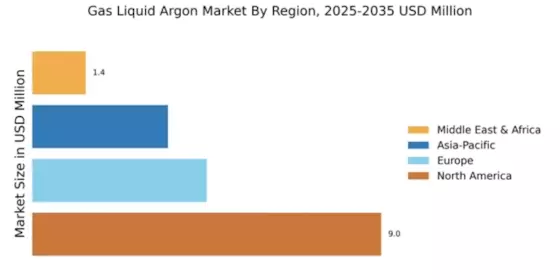
North America is poised to maintain its leadership in the Gas Liquid Argon market, holding a significant market share of 9.0 in 2024. The region's growth is driven by increasing demand from industries such as healthcare, electronics, and manufacturing. Regulatory support for clean energy initiatives and advancements in production technologies further catalyze market expansion. The focus on sustainable practices is also shaping demand trends, as companies seek to reduce their carbon footprint. The competitive landscape in North America is robust, featuring key players like Air Products, Praxair, and Matheson Tri-Gas. These companies are investing in innovative technologies and expanding their production capacities to meet rising demand. The U.S. remains the leading country, supported by a strong industrial base and significant investments in research and development. The presence of established firms ensures a dynamic market environment, fostering competition and innovation.

Europe : Emerging Market with Growth Potential

Europe's Gas Liquid Argon market is on a growth trajectory, with a market size of 4.5 in 2025. The region benefits from stringent environmental regulations that promote the use of cleaner gases in various applications, including metal fabrication and food processing. The push for sustainability and energy efficiency is driving demand, as industries adapt to comply with EU regulations. Additionally, the increasing focus on research and development in the chemical sector is expected to further enhance market growth. Leading countries in Europe include Germany, France, and the UK, where major players like Linde and Air Liquide are actively expanding their operations. The competitive landscape is characterized by strategic partnerships and collaborations aimed at enhancing product offerings. The presence of advanced manufacturing facilities and a skilled workforce positions Europe as a key player in The Gas Liquid Argon. "The European market is evolving rapidly, driven by innovation and regulatory frameworks that support sustainable practices," European Commission report.

Asia-Pacific : Rapidly Growing Market Region

The Asia-Pacific region is witnessing significant growth in the Gas Liquid Argon market, with a market size of 3.5 in 2025. This growth is fueled by increasing industrialization, particularly in countries like China and India, where demand for argon in manufacturing and healthcare is surging. The region's regulatory environment is becoming more favorable, encouraging investments in gas production and distribution. Additionally, the rise of the electronics and automotive sectors is further driving demand for high-purity argon. China stands out as the leading country in the region, with major companies like Taiyo Nippon Sanso and Nippon Gases expanding their market presence. The competitive landscape is marked by a mix of local and international players, all vying for market share. As the region continues to industrialize, the demand for gas solutions is expected to grow, making Asia-Pacific a critical market for future investments. The focus on technological advancements will also play a key role in shaping the market landscape.

Middle East and Africa : Emerging Market with Untapped Potential

The Middle East and Africa region is emerging as a potential market for Gas Liquid Argon, with a market size of 1.38 in 2025. The growth is driven by increasing industrial activities, particularly in the oil and gas sector, where argon is used in various applications. Additionally, the region's focus on diversifying its economy is leading to investments in manufacturing and healthcare, further boosting demand for argon. Regulatory frameworks are gradually evolving to support industrial growth, creating a conducive environment for market expansion. Leading countries in this region include South Africa and the UAE, where key players are beginning to establish a foothold. The competitive landscape is still developing, with opportunities for both local and international companies to enter the market. As infrastructure improves and industrial activities increase, the demand for Gas Liquid Argon is expected to rise, making this region a focal point for future investments. The potential for growth is significant, given the region's untapped resources and expanding industrial base.

Key Players and Competitive Insights

The Gas Liquid Argon Market is characterized by a competitive landscape that is increasingly shaped by innovation, strategic partnerships, and regional expansions. Key players such as Air Products (US), Linde (DE), and Air Liquide (FR) are actively pursuing strategies that enhance their market positioning. Air Products (US) has focused on technological advancements in production processes, which not only improve efficiency but also reduce environmental impact. Linde (DE) emphasizes strategic acquisitions to bolster its market share, while Air Liquide (FR) is investing in digital transformation initiatives to optimize its supply chain and enhance customer engagement. Collectively, these strategies contribute to a dynamic competitive environment where companies are not only vying for market share but also striving to lead in sustainability and innovation.

The business tactics employed by these companies include localizing manufacturing to reduce logistics costs and enhance responsiveness to regional demands. The market structure appears moderately fragmented, with several players holding significant shares, yet the influence of major companies is pronounced. This competitive structure allows for a diverse range of offerings, catering to various industrial applications, while also fostering innovation as companies seek to differentiate themselves in a crowded marketplace.

In November 2025, Air Products (US) announced a partnership with a leading renewable energy firm to develop a new facility aimed at producing liquid argon using sustainable energy sources. This strategic move is likely to position Air Products as a frontrunner in the sustainable production of industrial gases, aligning with global trends towards greener operations. The collaboration not only enhances their production capabilities but also reinforces their commitment to sustainability, which is increasingly becoming a key differentiator in the market.

In October 2025, Linde (DE) completed the acquisition of a regional gas supplier, which is expected to expand its distribution network and enhance its service capabilities in the European market. This acquisition is strategically significant as it allows Linde to leverage existing customer relationships and optimize its supply chain, thereby improving its competitive edge. The integration of the acquired company’s operations is anticipated to yield synergies that will further strengthen Linde’s market position.

In September 2025, Air Liquide (FR) launched a new digital platform designed to streamline customer interactions and improve order processing for liquid argon products. This initiative reflects a broader trend towards digitalization in the industry, where companies are increasingly utilizing technology to enhance customer experience and operational efficiency. By investing in digital solutions, Air Liquide is likely to improve its responsiveness to market demands and solidify its reputation as a customer-centric organization.

As of December 2025, the competitive trends in the Gas Liquid Argon Market are heavily influenced by digitalization, sustainability, and the integration of advanced technologies such as AI. Strategic alliances are becoming more prevalent, as companies recognize the value of collaboration in driving innovation and enhancing operational capabilities. The competitive differentiation is shifting from traditional price-based competition to a focus on technological advancements, sustainability initiatives, and supply chain reliability. This evolution suggests that companies that prioritize innovation and strategic partnerships will likely emerge as leaders in the market.

Key Companies in the Gas Liquid Argon Market market include

Industry Developments

Bruker released a few novel apps in 2019 to improve its product category and expand its product portfolio. G6 Leonardo, for example, is an inert gas fusion analyzer. The machinery is dependable, precise, and cost-effective. The machine includes pre-calibrated standard procedures as well as argon, which helps to streamline a variety of industrial operations. Air Products stated in December 2018 that it would construct, own, and operate a new

air separation

unit (ASU) in Minnesota to create huge amounts of argon, oxygen, and nitrogen. Mostly for local customers and distributors, these will be accessible in liquid form.

Future Outlook

Gas Liquid Argon Market Future Outlook

The Gas Liquid Argon Market is projected to grow at an 18.22% CAGR from 2024 to 2035, driven by increasing demand in healthcare, manufacturing, and electronics sectors.

New opportunities lie in:

  • Expansion of cryogenic storage facilities for industrial applications.
  • Development of advanced argon purification technologies.
  • Implementation of automated argon delivery systems for efficiency.

By 2035, the Gas Liquid Argon Market is expected to achieve substantial growth and innovation.

Market Segmentation

Gas Liquid Argon Market Application Outlook

  • Welding
  • Metal Fabrication
  • Electronics Manufacturing
  • Cryogenics

Gas Liquid Argon Market Purity Level Outlook

  • Standard Purity
  • High Purity
  • Ultra High Purity

Gas Liquid Argon Market End Use Industry Outlook

  • Automotive
  • Aerospace
  • Healthcare
  • Food and Beverage

Gas Liquid Argon Market Distribution Channel Outlook

  • Direct Sales
  • Distributors
  • Online Sales

Report Scope

MARKET SIZE 202418.38(USD Million)
MARKET SIZE 202521.73(USD Million)
MARKET SIZE 2035115.82(USD Million)
COMPOUND ANNUAL GROWTH RATE (CAGR)18.22% (2024 - 2035)
REPORT COVERAGERevenue Forecast, Competitive Landscape, Growth Factors, and Trends
BASE YEAR2024
Market Forecast Period2025 - 2035
Historical Data2019 - 2024
Market Forecast UnitsUSD Million
Key Companies ProfiledAir Products (US), Linde (DE), Praxair (US), Messer Group (DE), Air Liquide (FR), Taiyo Nippon Sanso (JP), Matheson Tri-Gas (US), Nippon Gases (JP), Universal Industrial Gases (US)
Segments CoveredApplication, End Use Industry, Distribution Channel, Purity Level
Key Market OpportunitiesGrowing demand for high-purity gas in electronics and healthcare sectors drives Gas Liquid Argon Market expansion.
Key Market DynamicsRising demand for gas liquid argon in industries drives competitive dynamics and influences supply chain strategies.
Countries CoveredNorth America, Europe, APAC, South America, MEA

Market Highlights

Author
Anshula Mandaokar
Team Lead - Research

Anshula Mandaokar holds an academic degree in Chemical Engineering and has been contributing to the field for more than 5 years. She has expertise in Market Research and Business Consulting and serves as a Team Lead for a reputed Market Research firm under the Chemicals and Materials domain spectrum. She has worked on multiple projects, generating explicit results in a quick turnaround time. Her understanding of data interpretation justifies her role as a leader.

Leave a Comment

FAQs

At what CAGR is the Gas and Liquid Argon Market predicted to grow during the forecast period?

Gas and Liquid Argon Market is predicted to grow at 5.52% through forecast period of 2025-2035.

What is the forecast period of Gas and Liquid Argon Market research report?

The forecast period for Gas and Liquid Argon Market research report is 2025-2035.

Which region will lead the global Gas and Liquid Argon Market?

Gas and Liquid Argon Market is dominated by APAC region.

What are the key factors driving the Gas and Liquid Argon Market?

The high operation costs and complex manufacturing process of argon is also likely to compel end users to look for alternatives, which could hinder the growth prospects of the global gas and liquid argon market over the forecast period.

Who are the key players in the Gas and Liquid Argon Market?

Air Liquide (France), Praxair Inc. (U.S.), Messer Group (Germany), Eurochem (Switzerland), BASF SE (Germany), Nippon Shokubai Co. Ltd. (Japan), SOL Spa (Italy), SABIC (Saudi Arabia), The Linde Group (Germany), and Air Products and Chemicals Inc.

Download Free Sample

Kindly complete the form below to receive a free sample of this Report

Compare Licence

×
Features License Type
Single User Multiuser License Enterprise User
Price $4,950 $5,950 $7,250
Maximum User Access Limit 1 User Upto 10 Users Unrestricted Access Throughout the Organization
Free Customization
Direct Access to Analyst
Deliverable Format
Platform Access
Discount on Next Purchase 10% 15% 15%
Printable Versions