×
Request Free Sample ×

Kindly complete the form below to receive a free sample of this Report

* Please use a valid business email

Leading companies partner with us for data-driven Insights

clients tt-cursor
Hero Background

Welding shielding gas Market

ID: MRFR/Equip/2070-HCR
111 Pages
Tejas Chaudhary
October 2025

Welding Gas/Shielding Gas Market Research Report Information Report by Type (Argon, Carbon Dioxide, Others), by Application (Gas Metal Arc Welding, Tungsten Gas Arc Welding, Others), By End Use Industry (Construction, Energy, Aerospace, Metal Manufacturing & Fabrication, Others( Automotive & Transportation Equipment),By Storage (Cylinder & Packaged Gas Distribution, Merchant Liquid/Bulk Distribution) and By Region - Forecast to 2035

Share:
Download PDF ×

We do not share your information with anyone. However, we may send you emails based on your report interest from time to time. You may contact us at any time to opt-out.

Welding shielding gas Market Infographic
Purchase Options

Welding shielding gas Market Summary

As per MRFR analysis, the Welding shielding gas Market Size was estimated at 3063.8 USD Million in 2024. The Welding shielding gas industry is projected to grow from 3198.61 USD Million in 2025 to 4920.01 USD Million by 2035, exhibiting a compound annual growth rate (CAGR) of 4.4 during the forecast period 2025 - 2035.

Key Market Trends & Highlights

The Welding shielding gas market is poised for robust growth driven by technological advancements and increasing demand across various sectors.

  • Technological advancements are enhancing the efficiency and effectiveness of welding processes in North America.
  • Sustainability initiatives are gaining traction, influencing the development of eco-friendly gas solutions in the Asia-Pacific region.
  • Customization of gas solutions is becoming increasingly important to meet the specific needs of the automotive sector, which is the fastest-growing segment.
  • The rising demand in the automotive sector and growth in construction activities are key drivers propelling the market forward.

Market Size & Forecast

2024 Market Size 3063.8 (USD Million)
2035 Market Size 4920.01 (USD Million)
CAGR (2025 - 2035) 4.4%

Major Players

Air Products (US), Linde (DE), Praxair (US), Messer (DE), Matheson Tri-Gas (US), Air Liquide (FR), Taiyo Nippon Sanso (JP), Nippon Gases (IT), BOC (GB)

Welding shielding gas Market Trends

The Welding shielding gas Market is currently experiencing a dynamic evolution, driven by advancements in technology and increasing demand across various industries. The shift towards automation and the integration of sophisticated welding techniques have necessitated the use of high-quality shielding gases. This trend is further amplified by the growing emphasis on safety and environmental regulations, which compel manufacturers to adopt cleaner and more efficient gas solutions. As industries such as automotive, construction, and manufacturing expand, the need for reliable welding processes becomes paramount, thereby influencing the market landscape. Moreover, the Welding shielding gas Market is witnessing a notable shift towards specialty gases, which are tailored to meet specific welding requirements. This customization allows for enhanced performance and efficiency in welding applications. Additionally, the rise of alternative energy sources and the push for sustainable practices are likely to shape future developments in this sector. Companies are increasingly focusing on research and development to innovate and provide solutions that align with these evolving market demands. Overall, the Welding shielding gas Market appears poised for growth, with various factors indicating a robust trajectory in the coming years.

Technological Advancements

The Welding shielding gas Market is influenced by rapid technological advancements that enhance welding processes. Innovations in gas mixtures and delivery systems improve efficiency and quality, catering to diverse industrial needs.

Sustainability Initiatives

There is a growing trend towards sustainability within the Welding shielding gas Market. Companies are increasingly adopting eco-friendly gases and practices, aligning with global efforts to reduce environmental impact.

Customization of Gas Solutions

The demand for customized gas solutions is rising in the Welding shielding gas Market. Tailored gas mixtures are being developed to meet specific welding requirements, improving performance and operational efficiency.

Market Segment Insights

By Application: Metal Fabrication (Largest) vs. Automotive (Fastest-Growing)

In the Welding shielding gas market, the application segment is led by Metal Fabrication, which holds the largest share due to its extensive use in various industries for welding processes. This is closely followed by the Automotive sector that is experiencing rapid growth, driven by the increasing demand for lightweight and high-strength materials in vehicle manufacturing. Other notable segments include Construction, Shipbuilding, and Aerospace, which also contribute significantly to market dynamics.

Metal Fabrication (Dominant) vs. Automotive (Emerging)

Metal Fabrication is a dominant application in the Welding shielding gas market, characterized by its necessity in manufacturing components for a wide range of sectors, including machinery and heavy equipment. This segment benefits from consistent demand as companies seek efficient and reliable solutions for high-quality welds. Conversely, the Automotive sector, while currently the fastest-growing, is emerging as a critical player due to technological advancements and innovations in welding processes. The shift towards electric and hybrid vehicles is further increasing the demand for specialized welding gases, allowing manufacturers to embrace newer techniques that enhance efficiency and safety.

By End Use: Manufacturing (Largest) vs. Automotive (Fastest-Growing)

The Welding shielding gas market is predominantly driven by the manufacturing sector, which holds the largest share due to its extensive applications in producing various metal components and structures. This segment encompasses a wide array of industries, including aerospace, electronics, and heavy machinery, all of which rely heavily on welding processes. In contrast, the automotive sector, while smaller in market share, is experiencing rapid growth as electric and hybrid vehicles gain traction requiring advanced welding techniques, thus increasing the demand for specialized shielding gases.

Manufacturing (Dominant) vs. Automotive (Emerging)

The manufacturing segment is characterized by its dominance in the Welding shielding gas market, leveraging advanced technologies and a broad range of applications across several industries. Its established infrastructure and high-volume production processes ensure a consistent demand for shielding gases, which play a crucial role in improving weld quality and efficiency. On the other hand, the automotive segment is emerging rapidly, adapting to innovations in welding methods required for the production of lightweight and fuel-efficient vehicles. Increased automation in production lines and the need for superior welding solutions are driving growth within this segment, as manufacturers seek to optimize performance and reduce production costs.

By Gas Type: Argon (Largest) vs. Carbon Dioxide (Fastest-Growing)

The welding shielding gas market reveals that Argon dominates with a substantial share, primarily due to its versatile applications in diverse welding processes. Meanwhile, Carbon Dioxide, traditionally recognized for cost-effectiveness, is carving out a significant niche as industries seek more efficient and eco-friendly solutions. This shift indicates a transition in preferences among end-users, driven by technological advancements and the need for improved welding outcomes. Emerging trends highlight Carbon Dioxide as the fastest-growing segment, fueled by increasing demand for more sustainable welding practices and innovations in machinery. The rise in complexity of welding applications has seen end-users pivot towards gases that offer both economic and environmental benefits. This evolution presents opportunities for market players to expand their offerings and meet evolving customer requirements.

Argon (Dominant) vs. Helium (Emerging)

Argon is firmly positioned as the dominant gas in the welding shielding gas market due to its inert nature, which effectively prevents oxidation and contamination during the welding process. Its widespread use in MIG and TIG welding makes it a preferred choice among professionals seeking reliable and high-quality welds. In contrast, Helium is emerging as a significant player, especially in high-heat applications such as pipe welding and aerospace. While its usage is more specialized and often comes at a higher cost, Helium's effective thermal conductivity and arc stability are driving its adoption in niche markets. As advancements in technology and machinery improve efficiency, Helium's market share is expected to grow, presenting a dynamic competition against Argon.

By Welding Process: Gas Metal Arc Welding (Largest) vs. Gas Tungsten Arc Welding (Fastest-Growing)

In the Welding shielding gas market, Gas Metal Arc Welding (GMAW) commands the largest share, driven by its wide applicability in various industrial sectors. This process is favored for its efficiency and versatility, making it a preferred choice for both manufacturing and repair applications. On the other hand, Gas Tungsten Arc Welding (GTAW), although smaller in market share, is rapidly gaining traction. It is primarily used in high-precision applications, enhancing its appeal among specialized industries such as aerospace and automotive.

Gas Metal Arc Welding (Dominant) vs. Gas Tungsten Arc Welding (Emerging)

Gas Metal Arc Welding (GMAW) remains the dominant welding process in the market due to its flexibility and ability to handle a variety of materials, including steel and aluminum. It is especially favored for its high welding speeds and reduced post-weld cleanup. Conversely, Gas Tungsten Arc Welding (GTAW) is considered an emerging technology, known for its precision and clean welds. It is often employed in critical applications requiring high-quality welds, such as in the aerospace and nuclear industries. The growing demand for high-integrity welds in these sectors positions GTAW as a competitive alternative that is steadily increasing in market relevance.

Get more detailed insights about Welding shielding gas Market

Regional Insights

North America : Market Leader in Shielding Gas

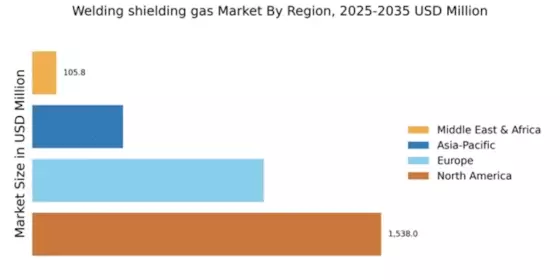
North America is poised to maintain its leadership in the welding shielding gas market, holding a significant market share of 1538.0 million. The growth is driven by robust industrial activities, particularly in manufacturing and construction, alongside increasing investments in infrastructure. Regulatory support for safety standards and environmental compliance further catalyzes demand for high-quality shielding gases. The United States stands as the largest market, with key players like Air Products, Praxair, and Matheson Tri-Gas leading the competitive landscape. The presence of advanced manufacturing technologies and a focus on innovation in welding processes contribute to the region's dominance. Additionally, partnerships among major companies enhance market penetration and service offerings, solidifying North America's position in the global market.

Europe : Emerging Market with Growth Potential

Europe's welding shielding gas market is valued at 1020.0 million, reflecting a growing demand driven by the automotive and aerospace sectors. The region benefits from stringent regulations promoting safety and environmental sustainability, which are key growth catalysts. The shift towards automation and advanced welding technologies is also enhancing market dynamics, leading to increased consumption of specialized shielding gases. Germany, France, and the UK are the leading countries in this market, with major players like Linde and Air Liquide dominating. The competitive landscape is characterized by innovation and strategic collaborations among companies to enhance product offerings. As the region focuses on green technologies, the demand for eco-friendly shielding gases is expected to rise, further propelling market growth.

Asia-Pacific : Rapid Growth in Emerging Economies

The Asia-Pacific region, with a market size of 400.0 million, is witnessing rapid growth in the welding shielding gas sector, driven by industrialization and urbanization. Countries like China and India are experiencing significant demand due to their expanding manufacturing bases. Government initiatives aimed at boosting infrastructure development and enhancing safety regulations are also contributing to market growth. China is the largest market in the region, with key players such as Taiyo Nippon Sanso and Nippon Gases leading the charge. The competitive landscape is evolving, with local manufacturers emerging alongside established global players. As the region continues to invest in advanced welding technologies, the demand for high-quality shielding gases is expected to increase, positioning Asia-Pacific as a vital market in the global landscape.

Middle East and Africa : Emerging Market with Unique Challenges

The Middle East and Africa region, with a market size of 105.8 million, is gradually emerging in the welding shielding gas market. The growth is primarily driven by increasing industrial activities and infrastructure projects, particularly in the Gulf Cooperation Council (GCC) countries. However, challenges such as political instability and fluctuating oil prices can impact market dynamics and investment levels. Countries like Saudi Arabia and South Africa are leading the market, with a growing presence of international players. The competitive landscape is characterized by a mix of local and global companies, including BOC and Messer. As the region focuses on diversifying its economy away from oil dependency, the demand for welding shielding gases is expected to rise, presenting opportunities for growth.

Key Players and Competitive Insights

The Welding shielding gas Market is characterized by a competitive landscape that is increasingly shaped by innovation, sustainability, and strategic partnerships. Key players such as Air Products (US), Linde (DE), and Air Liquide (FR) are actively pursuing growth strategies that emphasize technological advancements and regional expansion. Air Products (US) has focused on enhancing its product offerings through the development of environmentally friendly gases, which aligns with the growing demand for sustainable solutions in welding applications. Meanwhile, Linde (DE) has been investing in digital transformation initiatives to optimize its supply chain and improve customer engagement, thereby reinforcing its market position. Collectively, these strategies indicate a shift towards a more integrated and responsive market environment, where companies are not only competing on price but also on innovation and service quality.

In terms of business tactics, companies are increasingly localizing manufacturing to reduce lead times and enhance supply chain efficiency. The market structure appears moderately fragmented, with several players vying for market share while also collaborating through strategic alliances. This dynamic fosters a competitive atmosphere where innovation and operational excellence are paramount. The collective influence of these key players is significant, as they drive trends that shape customer preferences and industry standards.

In November 2025, Air Liquide (FR) announced a partnership with a leading automotive manufacturer to supply advanced welding shielding gases tailored for electric vehicle production. This collaboration is strategically important as it positions Air Liquide at the forefront of the rapidly evolving automotive sector, which is increasingly focused on sustainability and efficiency. By aligning its offerings with the needs of the electric vehicle market, Air Liquide is likely to enhance its competitive edge and capture new growth opportunities.

In October 2025, Linde (DE) launched a new line of high-performance shielding gases designed specifically for additive manufacturing processes. This strategic move underscores Linde's commitment to innovation and its ability to adapt to emerging technologies in the welding sector. By catering to the unique requirements of additive manufacturing, Linde is not only expanding its product portfolio but also reinforcing its position as a leader in the market.

In September 2025, Air Products (US) completed the acquisition of a regional gas supplier, which is expected to enhance its distribution capabilities and market reach. This acquisition is significant as it allows Air Products to strengthen its supply chain and improve service delivery to customers, thereby solidifying its competitive position in the Welding shielding gas Market. The integration of local expertise and resources is likely to yield operational synergies that benefit both the company and its clientele.

As of December 2025, the competitive trends in the Welding shielding gas Market are increasingly defined by digitalization, sustainability, and the integration of artificial intelligence (AI) into operational processes. Strategic alliances are playing a crucial role in shaping the current landscape, enabling companies to leverage complementary strengths and enhance their market offerings. Looking ahead, it is anticipated that competitive differentiation will evolve, with a pronounced shift from price-based competition to a focus on innovation, technology, and supply chain reliability. This transition suggests that companies that prioritize sustainable practices and technological advancements are likely to thrive in the future.

Key Companies in the Welding shielding gas Market market include

Industry Developments

March 2020 - Gardner Denver Holdings, Inc. completed the merger with the Ingersoll Rand Industrial 

Future Outlook

Welding shielding gas Market Future Outlook

The Welding shielding gas market is projected to grow at a 4.4% CAGR from 2024 to 2035, driven by increasing industrial automation, demand for high-quality welding, and environmental regulations.

New opportunities lie in:

  • Development of eco-friendly gas mixtures for sustainable welding solutions.
  • Expansion of online platforms for gas supply and distribution.
  • Investment in advanced gas monitoring technologies for enhanced safety and efficiency.

By 2035, the market is expected to achieve robust growth, reflecting evolving industry needs and technological advancements.

Market Segmentation

Welding shielding gas Market End Use Outlook

  • Manufacturing
  • Repair and Maintenance
  • Construction
  • Automotive
  • Shipbuilding

Welding shielding gas Market Gas Type Outlook

  • Argon
  • Carbon Dioxide
  • Helium
  • Oxygen
  • Nitrogen

Welding shielding gas Market Application Outlook

  • Metal Fabrication
  • Automotive
  • Construction
  • Shipbuilding
  • Aerospace

Welding shielding gas Market Welding Process Outlook

  • Gas Metal Arc Welding
  • Gas Tungsten Arc Welding
  • Shielded Metal Arc Welding
  • Flux-Cored Arc Welding
  • Submerged Arc Welding

Report Scope

MARKET SIZE 20243063.8(USD Million)
MARKET SIZE 20253198.61(USD Million)
MARKET SIZE 20354920.01(USD Million)
COMPOUND ANNUAL GROWTH RATE (CAGR)4.4% (2024 - 2035)
REPORT COVERAGERevenue Forecast, Competitive Landscape, Growth Factors, and Trends
BASE YEAR2024
Market Forecast Period2025 - 2035
Historical Data2019 - 2024
Market Forecast UnitsUSD Million
Key Companies ProfiledAir Products (US), Linde (DE), Praxair (US), Messer (DE), Matheson Tri-Gas (US), Air Liquide (FR), Taiyo Nippon Sanso (JP), Nippon Gases (IT), BOC (GB)
Segments CoveredApplication, End Use, Gas Type, Welding Process
Key Market OpportunitiesGrowing demand for environmentally friendly Welding shielding gases presents significant market opportunities.
Key Market DynamicsRising demand for environmentally friendly welding processes drives innovation in shielding gas formulations and applications.
Countries CoveredNorth America, Europe, APAC, South America, MEA

Market Highlights

Author
Tejas Chaudhary
Research Analyst Level II

I have a degree in Engineering (Civil), with masters in Business Administration (Marketing). With more than 4 years of experience in market research and consulting, I am involved in end-to-end process of market research, proposals, project kickoffs and delivery. I have research knowledge and expertise in consumer goods/packaging domain. Also I have worked for various other domains like construction & equipment. Effectively managed and delivered more than 60 report studies for regional as well as global clientele.

Leave a Comment

FAQs

What is the expected growth rate of the market for the forecast period?

The market is expected to strike 8.74% CAGR.

Who are the major key players in the Welding gas/shielding gas market?

The major key players in the Welding gas/shielding gas market are Air Products & Chemicals, Inc. (U.S.), Taiyo Nippon Sanso Corporation (Japan), SIG Gases Berhad (Malaysia), Gulf Cryo (Bahrain), The Linde Group (Germany), Iwatani Corporation (Japan), Praxair, Inc. (U.S.), Iceblick Ltd. (Ukraine), Air Liquide SA (France) and Messer Group GmbH (Germany).

What are the different types of segments assessed in this report?

Argon, carbon dioxide, and others are the different types of type based segments of the market.

Which is the fastest-growing region in the Welding gas/shielding gas market?

Asia- Pacific is the fastest-growing region in the Welding gas/shielding gas market.

What is anticipated to drive the growth of the market in the forthcoming years?

Increasing constructional development for residential and commercial purposes is projected to lead the expansion of the market in the nearing years.

Which region holds the highest share in the Welding gas/shielding gas market?

North America holds the highest share in the Welding gas/shielding gas market.

Download Free Sample

Kindly complete the form below to receive a free sample of this Report

Compare Licence

×
Features License Type
Single User Multiuser License Enterprise User
Price $4,950 $5,950 $7,250
Maximum User Access Limit 1 User Upto 10 Users Unrestricted Access Throughout the Organization
Free Customization
Direct Access to Analyst
Deliverable Format
Platform Access
Discount on Next Purchase 10% 15% 15%
Printable Versions