Automotive Shielding Market (2026 - 2035)

Automotive Shielding Market Research Report By Vehicle Type (Passenger Cars, Light Commercial Vehicles, Heavy Commercial Vehicles & Others), By Shielding Type (Heat Shielding, Electromagnetic Induction (EMI) Shielding), By Propulsion Technology (Internal Combustion Engine (ICE), Battery Electric Vehicles, Plug-in Hybrid / Mild Hybrid), By Application (Powertrain Systems, Battery & High-Voltage Systems, ADAS & Infotainment, Exhaust & Underbody), By Material (Metallic (Aluminum, Steel, Copper Foils), Non-Metallic (Composites, Polymers)), By Sales Channel (OEM (Original Equipment), Aftermarket) and By Regional (North America, Europe, South America, Asia Pacific, Middle East and Africa) - Forecast to 2035
ID: MRFR/AT/5461-HCR
100 Pages
Shubham Munde, Swapnil Palwe
Last Updated: August 24, 2026
Automotive Shielding Market
Market Size
Forecast Period2026-2035
CAGR (2026-2035)4.65%
2025 Market SizeUSD 24.80 billion
2035 Market SizeUSD 39.08 billion
Key Players
Dana Incorporated
ElringKlinger AG
Tenneco Inc.
Lydall Inc.
Laird Performance Materials
Parker Hannifin Corporation
Opportunities
  • Solid-State Battery Thermal Shielding
  • Southeast Asian and Latin American EV Ramp
  • Shielding-as-a-System Packaging

Automotive Shielding Market Summary

The Automotive Shielding Market reached an estimated USD 24.80 billion in 2025 and is forecast to grow from USD 25.95 billion in 2026 to USD 39.08 billion by 2035, registering a CAGR of 4.65% across the forecast period. Two forces are reshaping procurement decisions: the rapid shift to 400 V and 800 V electric architectures that amplify electromagnetic and thermal loads, and the tightening of global EMC standards such as CISPR 25 Edition 5, which compel OEMs to integrate shielding solutions at the vehicle design stage rather than treating them as bolt-on afterthoughts [1][2].

A technological revolution is happening. Legacy stamped-steel heat shields are being replaced by multi-layer composite laminates and conductive coatings designed to provide both thermal and electromagnetic performance. Silicon-carbide inverters and dense ADAS sensor clusters generate switching frequencies beyond 100 kHz, and hence the shielding materials must work over a larger bandwidth. The European Commission’s Euro 7 framework and China’s GB/T 36282 standard have boosted R&D spending – Tier-1 suppliers collectively spent over USD 1.4 billion on enhanced shielding programs during 2023-2024 alone [3][4].


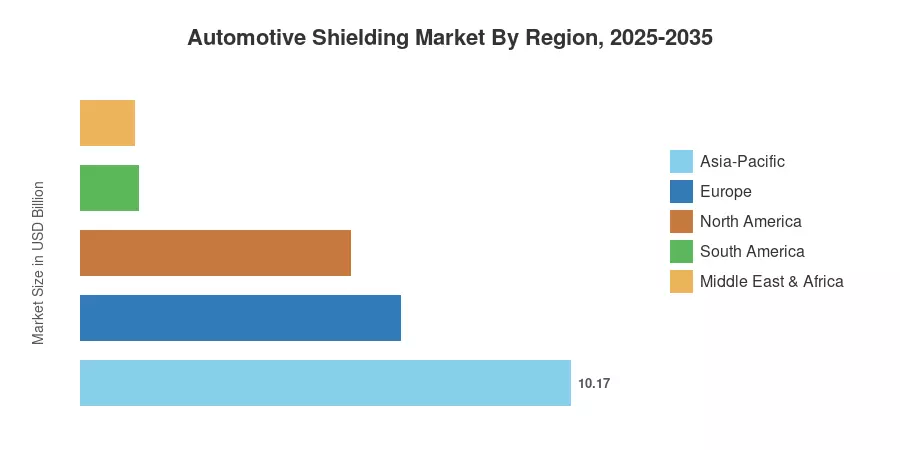
Asia-Pacific holds the highest share in the Automotive Shielding Market with around 41 % of the worldwide revenue owing to the scale of EV manufacturing in China and the rising domestic assembly base in India. The region is also the fastest expanding, with a predicted CAGR of 4.78% through 2035. Europe (share of around 27%) is the second largest market, driven by strict EMC requirements inside the EU and high-end OEM demand. North America – $1.8tn, almost 23%, driven by growth from the Inflation Reduction Act’s battery-plant build-out. With electrification gaining pace across all major auto markets, the Automotive Shielding Market is projected to become one of the most strategically critical material categories in the vehicle bill of materials.


Key Report Takeaways

• By Shielding Type

  • Heat shielding solutions accounted for approximately 64.5% of revenue in 2025 within the Automotive Shielding Market, reflecting strong demand from powertrain and exhaust thermal management applications.


  • EMI shielding products are projected to record the fastest segment CAGR of 5.08% through 2035, propelled by sensor-dense EV platforms.

• By Vehicle Type

  • Passenger cars led the Automotive Shielding Market with a 59.2% share in 2025, given higher per-unit shielding content on premium and electric models.
  • Battery electric vehicles represent the fastest-growing propulsion segment at a 5.42% CAGR, while internal combustion engines still held over 51% of propulsion-based demand in 2025.

• By Geography

  • Asia-Pacific captured roughly 41% of the Automotive Shielding Market in 2025 and is on track for a 4.78% CAGR through 2035.
  • North America's share stood at about 23%, supported by federally funded battery and EV assembly investments.


Market Size and Forecast (2021–2035)

The sizing approach at Market Research Future (MRFR) combines bottom-up demand analysis at the component level with top-down macro variables, such as vehicle production quantities, rates of electrification penetration, and regulatory compliance deadlines. We cross-reference historical figures with OEM procurement declarations, customs-trade databases and Tier-1 supplier revenue forms. Forecast figures use a calibrated CAGR anchored to validated 2025 base-year demand.
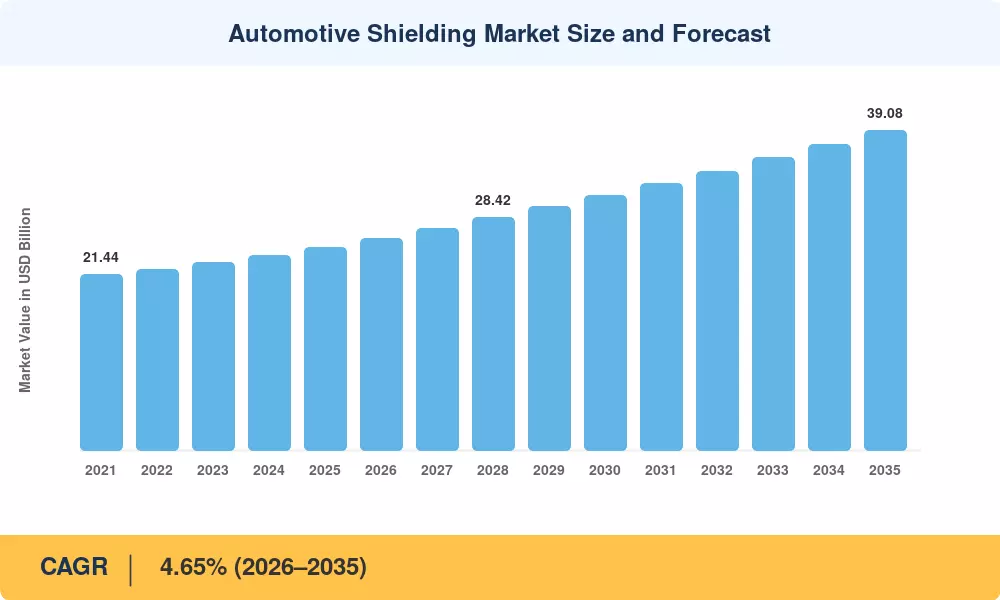
Automotive Shielding Market Size and Forecast
Our Impact
Enabled $4.3B Revenue Impact for Fortune 500 and Leading Multinationals
Partnering with 2000+ Global Organizations Each Year
30K+ Citations by Top-Tier Firms in the Industry

Driver Impact Analysis

Driver ~% Impact on CAGR Geographic Relevance Impact Timeline
800 V / high-voltage EV architecture expansion +1.1% Global Short-term (≤2 yr)
ADAS & autonomous sensor proliferation +0.9% North America, Europe Medium-term (2–4 yr)
Tightening EMC regulations (CISPR 25, ISO 11452) +0.8% Europe, Asia-Pacific Short-term (≤2 yr)
SiC and GaN power-electronics adoption +0.7% Global Medium-term (2–4 yr)
Battery thermal-runaway safety mandates +0.6% China, Europe, US Medium-term (2–4 yr)
Vehicle lightweighting regulations (CAFE, EU CO₂) +0.5% North America, Europe Long-term (≥4 yr)
Connected-vehicle and V2X spectrum requirements +0.3% US, China, South Korea Long-term (≥4 yr)


High-Voltage EV Architecture Expansion

The migration from 400 V to 800 V battery platforms — led by programs at Hyundai, Porsche, and several Chinese OEMs — doubles peak current loads and raises inverter switching frequencies well above the legacy EMI envelope. Shielding suppliers report that 800 V vehicles require 30–40% more shielding surface area per unit compared with 400 V equivalents, translating to an estimated incremental addressable content of USD 85–110 per vehicle [7]. This single shift is the largest near-term catalyst for the Automotive Shielding Market.

ADAS and Autonomous Sensor Proliferation

Level 2+ ADAS systems now ship on more than 45% of new passenger cars globally, each carrying a combination of radar, lidar, camera, and ultrasonic modules that are acutely sensitive to electromagnetic interference. The US NHTSA rulemaking on automatic emergency braking, finalized in 2024, effectively mandates additional sensor hardware and, by extension, dedicated shielding enclosures for ECU clusters [11]. OEMs that previously treated shielding as a cost line are reframing it as a functional-safety requirement.

Tighter EMC Regulations

CISPR 25 Edition 5 widens the test-frequency range to 2.5 GHz, reflecting the growing use of 5G-band telematics and Wi-Fi 6E in-cabin connectivity. Compliance requires both conducted and radiated shielding effectiveness testing across a broader spectrum, pushing suppliers toward multi-layer metallic-polymer laminates. The European Commission's type-approval alignment with UN R10 Rev. 6 adds further urgency — non-compliant vehicles face market-access delays across all 27 EU member states [1][3].

SiC Power-Electronics Adoption

Silicon-carbide MOSFETs switch at frequencies three to five times higher than traditional IGBTs, generating harmonic interference that legacy shields cannot adequately attenuate. BloombergNEF estimates that SiC content per EV will exceed USD 350 by 2028, creating parallel demand for purpose-built EMI enclosures around inverter and on-board-charger modules [8]. This driver is particularly relevant for the Automotive Shielding Market in premium BEV segments.


Restraints Impact Analysis

Restraint impact percentages are directional estimates and are not directly subtracted from the headline CAGR. They reflect drag effects identified through supplier surveys and OEM procurement interviews.

Restraint ~% Impact on CAGR Geographic Relevance Impact Timeline
High material and tooling costs for advanced composites −0.5% Global Short-term (≤2 yr)
Specialty-metal supply-chain volatility (copper, nickel) −0.4% Global Medium-term (2–4 yr)
Integration complexity in multi-domain architectures −0.3% North America, Europe Medium-term (2–4 yr)
Weight penalties of thick metallic shielding −0.3% Europe, Japan Long-term (≥4 yr)
Fragmented EMC certification standards across regions −0.2% Global Long-term (≥4 yr)


High Material and Tooling Costs

Multi-layer shielding assemblies combining aluminum foil, silicone-rubber insulators, and conductive adhesives can cost 2.5–3× more than single-layer stamped-steel equivalents. For cost-sensitive B-segment and C-segment vehicles, OEM procurement teams often push back on premium shielding, opting for minimum-compliance solutions that limit average selling prices in the Automotive Shielding Market [16].

Specialty-Metal Supply-Chain Volatility

Copper and nickel — key raw materials for conductive mesh and foil shielding — experienced price swings of over 25% between 2022 and 2024, compressing Tier-1 margins. The World Bank's Commodity Markets Outlook flagged continued volatility through 2027, driven by competing demand from battery cathodes and electrical infrastructure [17]. Suppliers without long-term offtake agreements face margin erosion that slows capacity expansion.

Integration Complexity in Zonal Architectures

The shift from domain-based to zonal electronic architectures consolidates dozens of ECUs into fewer high-compute modules, each generating concentrated thermal and EMI loads. Designing shielding that accommodates these dense, multi-function enclosures requires co-engineering with Tier-1 electronics suppliers — a collaboration model that extends development lead times by six to nine months on average [18].


Automotive Shielding Market Opportunities

Solid-State Battery Thermal Shielding

Solid-state batteries operate at higher temperatures than conventional lithium-ion cells, creating a new addressable segment for ceramic-filled thermal barriers and high-temperature-rated electromagnetic enclosures. Toyota, Samsung SDI, and QuantumScape have each announced pilot-production timelines before 2028, which could unlock an incremental USD 1.2–1.8 billion addressable opportunity for the Automotive Shielding Market by 2033 [12].

Southeast Asian and Latin American EV Ramp

Thailand, Indonesia, and Brazil are deploying incentive packages to attract EV assembly. Thailand's EV 3.5 policy targets 30% BEV production by 2030, while Brazil's Mover Verde program offers tax credits for locally manufactured electrified vehicles. Both regions currently under-index on shielding content per vehicle, presenting a greenfield growth corridor for Tier-1 suppliers willing to localize production [9].

Shielding-as-a-System Packaging

OEMs increasingly prefer integrated modules that combine thermal, EMI, and acoustic shielding into a single part number, reducing assembly steps and warranty risk. Suppliers that offer validated system-level solutions — rather than discrete components — can capture higher per-unit revenue while shortening OEM validation cycles.

Recycled and Bio-Based Shielding Materials

ESG procurement mandates at Volkswagen, Stellantis, and BMW now require minimum recycled content in non-structural vehicle components. Suppliers developing shields with recycled aluminum or bio-derived polymer cores gain preferential sourcing status while addressing the Automotive Shielding Market's emerging sustainability narrative.

V2X Communication Shielding Requirements

The allocation of 5.9 GHz spectrum for vehicle-to-everything communication across the US, EU, and China will demand precision-tuned RF shielding around V2X transceivers to prevent interference with adjacent ADAS radar bands. This high-frequency application represents a new revenue pocket that barely existed in the market's 2021 baseline [13].


Automotive Shielding Market Future Outlook

Electrification Supercycle and Architecture Complexity

The global BEV share of new-car sales is projected to exceed 45% by 2030 according to the IEA's Global EV Outlook, translating to more than 40 million BEV units annually [2]. Each additional BEV replaces a lower-shielding-content ICE vehicle with a platform requiring dedicated battery-enclosure thermal barriers, inverter EMI housings, and charging-port RF enclosures. This structural content uplift is the primary volume lever for the Automotive Shielding Market over the coming decade.

AI-Enabled ADAS and Autonomous Driving

Level 3 and Level 4 autonomous systems rely on sensor-fusion architectures that combine radar, lidar, cameras, and ultra-wideband transceivers — each generating and receiving electromagnetic signals that must be isolated from one another. estimates that L3+ vehicles carry 50–70% more electronic content by value than L2 equivalents, with shielding representing a proportional share of that increase [11]. By 2032, shielding designed specifically for autonomous compute modules could represent a USD 3 billion sub-segment.

Sustainability and Circular-Economy Integration

Automaker sustainability scorecards now extend to non-structural components, including shielding materials. Stellantis's 2030 carbon-neutral commitment and BMW's Secondary First strategy both require documented recycled content in supplier deliverables. Shielding manufacturers investing in closed-loop aluminum and polymer recovery will capture preferred-supplier positions, while those that lag risk losing RFQ access on next-generation platforms [10][14].

Platform Standardization and Modular Shielding

The adoption of skateboard and multi-energy platforms — where a single architecture supports BEV, PHEV, and ICE derivatives — favors modular shielding systems that can be configured at the assembly line rather than engineered from scratch for each variant. This trend rewards suppliers with broad product portfolios and rapid prototyping capabilities, consolidating share among the top five players in the Automotive Shielding Market.


Automotive Shielding Market Segmentation

By Vehicle Type

Segment Key Metric Primary Demand Driver
Passenger Cars ~59.2% share (2025) Higher per-unit shielding content on BEV and premium models
Light Commercial Vehicles 5.15% CAGR Fleet electrification and last-mile delivery expansion
Heavy Commercial Vehicles & Others USD 3.18 billion (2025) Thermal shielding for high-duty-cycle powertrains


Passenger cars lead the Automotive Shielding Market because premium and electric models carry significantly more shielding content per unit — an average BEV sedan integrates 12–18 individual shielding components versus 6–8 on a comparable ICE model. The light commercial vehicle segment is growing faster on a percentage basis as fleet operators electrify delivery vans and urban logistics vehicles, each requiring dedicated battery-pack thermal barriers.

By Shielding Type

Segment Key Metric Primary Demand Driver
Heat Shielding ~64.5% share (2025) Exhaust, turbo, and battery thermal management
Electromagnetic Induction (EMI) Shielding 5.08% CAGR High-frequency electronics and sensor-dense platforms


Heat shielding remains the revenue anchor of the Automotive Shielding Market, protecting passengers and under-hood electronics from exhaust temperatures exceeding 900 °C. EMI shielding is closing the gap as electrification multiplies the number of high-frequency noise sources per vehicle — a trend amplified by the transition to SiC inverters and multi-band telematics.

By Propulsion Technology

Segment Key Metric Primary Demand Driver
Internal Combustion Engine (ICE) ~51.4% share (2025) Installed base and exhaust thermal requirements
Battery Electric Vehicles 5.42% CAGR High-voltage architecture and battery thermal protection
Plug-in Hybrid / Mild Hybrid USD 4.75 billion (2025) Dual-powertrain shielding complexity


ICE vehicles still command the majority share because their exhaust and turbocharger systems demand extensive thermal shielding. Battery electric vehicles, however, are the clear growth engine — every BEV requires dedicated high-voltage cable shielding, inverter EMI enclosures, and battery-compartment thermal barriers that do not exist on conventional powertrains.

By Application

Segment Key Metric Primary Demand Driver
Powertrain Systems ~51.5% share (2025) Engine bay and inverter shielding across all propulsion types
Battery & High-Voltage Systems 5.28% CAGR BEV and PHEV battery-pack protection
ADAS & Infotainment USD 2.91 billion (2025) Sensor-cluster EMI isolation
Exhaust & Underbody ~18% share (2025) Catalytic converter and muffler thermal barriers


By Material

Segment Key Metric Primary Demand Driver
Metallic (Aluminum, Steel, Copper foils) ~68.7% share (2025) Proven attenuation and thermal conductivity
Non-Metallic (Composites, Polymers) 4.52% CAGR Lightweighting and design flexibility


Metallic formats dominate the Automotive Shielding Market because aluminum and steel alloys deliver reliable broadband attenuation with well-established manufacturing processes. Non-metallic composites — including conductive-polymer blends and ceramic-fiber mats — are gaining traction where weight savings of 30–50% justify the cost premium, particularly on premium BEV platforms pursuing range optimization.

By Sales Channel

Segment Key Metric Primary Demand Driver
OEM (Original Equipment) ~77.8% share (2025) Platform-integrated shielding specified during vehicle design
Aftermarket 4.82% CAGR Replacement demand and performance upgrades


Regional Market Share Analysis

Region Key Metric Primary Investment Themes
Asia-Pacific ~41.0% share (2025) EV production scale, localized Tier-1 capacity
Europe ~26.8% share (2025) Euro 7 compliance, premium BEV platforms
North America ~22.6% share (2025) IRA battery-plant buildout, ADAS adoption
South America 4.82% CAGR (2026–2035) EV assembly incentive programs
Middle East & Africa USD 1.12 billion (2025) Commercial-vehicle fleet renewal
Total USD 24.80 billion (2025)

The Automotive Shielding Market follows a regional hierarchy closely tied to vehicle production concentration, electrification penetration, and regulatory stringency.


North America

Country Key Metric Key Driver
US ~72% of regional share IRA-funded battery gigafactories [19]
Canada 4.91% CAGR Ontario EV corridor investment [20]
Mexico USD 0.89 billion (2025) Nearshoring of Tier-1 component plants [21]


The US accounts for the overwhelming majority of North American demand in the Automotive Shielding Market, driven by more than USD 120 billion in announced battery and EV manufacturing investments since 2022. The Department of Energy's Vehicle Technologies Office has earmarked over USD 200 million for thermal-management research, a portion of which directly benefits shielding-material innovation [19][20].

Europe

Country Key Metric Key Driver
Germany ~31% of regional share Premium OEM BEV platforms [3]
UK 4.88% CAGR Gigafactory ramp and ZEV mandate [22]
France USD 1.06 billion (2025) Stellantis electrification roadmap
Italy ~9% of regional share Ferrari and supercar thermal shielding
Spain 4.72% CAGR Battery plant investments in Valencia
Nordic Countries USD 0.48 billion (2025) Northvolt and regional battery cluster
Russia ~3% of regional share Domestic production substitution
Rest of Europe 4.55% CAGR EU Chips Act spillover to auto electronics


Germany anchors Europe's demand, with its OEMs — Volkswagen, BMW, and Mercedes-Benz — each specifying multi-functional shielding packages across their BEV line-ups. The EU's Chips Act, channeling EUR 43 billion into semiconductor manufacturing, indirectly boosts demand for copper foil EMI shielding around new automotive-grade fab modules [3][22].

Asia-Pacific

Country Key Metric Key Driver
China ~52% of regional share World's largest NEV producer [6]
India 5.18% CAGR PLI scheme for auto components [9]
Japan USD 1.85 billion (2025) Hybrid-vehicle thermal management
South Korea ~12% of regional share Battery and semiconductor synergies
ASEAN 5.05% CAGR Thailand and Indonesia EV incentives
Rest of Asia-Pacific USD 0.42 billion (2025) Emerging assembly base


China's sheer production volume — exceeding 30 million vehicles in 2024 — makes it the single largest country market for automotive shielding globally. India's Production-Linked Incentive scheme, allocating INR 259 billion to the auto-component sector, is accelerating localization of shielding manufacturing in Gujarat and Tamil Nadu, positioning the country as the fastest-growing national market in the Automotive Shielding Market through 2035 [6][9].

South America

Country Key Metric Key Driver
Brazil ~61% of regional share Mover Verde EV tax credits
Argentina 4.68% CAGR Lithium-sector industrial linkage
Rest of South America USD 0.21 billion (2025) Import-substitution policies


Brazil dominates South American demand, benefiting from the Mover Verde incentive framework that accelerates electrified-vehicle assembly. Local Tier-1 suppliers are beginning to invest in thermal shielding lines targeting both domestic OEMs and Mercosur export markets.

Middle East & Africa

Country Key Metric Key Driver
Saudi Arabia ~28% of regional share Vision 2030 auto-sector localization
UAE 4.75% CAGR Premium EV import base
South Africa USD 0.24 billion (2025) Regional vehicle assembly hub
Egypt 4.60% CAGR CKD assembly expansion
Rest of MEA ~18% of regional share Commercial-vehicle fleet renewal


Saudi Arabia's Vision 2030 program includes plans to establish a domestic EV assembly industry, which will create localized shielding demand for the first time in the Kingdom. South Africa continues to serve as the continent's primary vehicle-manufacturing node, exporting shielded powertrain components across Sub-Saharan Africa.


Automotive Shielding Market By Region, 2025-2035

Competitive Benchmarking

The Automotive Shielding Market is moderately concentrated with an estimated combined share of the top-five players in the range of 38-44% and Herfindahl-Hirschman Index below 1,000. Diversified Tier-1 automotive suppliers, specialty-materials firms and dedicated shielding manufacturers battle the market, competing on material innovation, co-engineering capabilities and geographic presence.

Company Est. Revenue Share Range Key Offerings for Automotive Shielding Market Strategic Positioning
Dana Incorporated ~8–11% Metallic heat shields, exhaust gaskets, thermal barriers Vertically integrated powertrain shielding across ICE and BEV
ElringKlinger AG ~7–10% Thermal and acoustic shielding modules, battery enclosures Strong European OEM relationships; BEV pivot strategy
Tenneco Inc. ~6–9% Exhaust heat shields, vibration-damping assemblies Global exhaust-system platform leverage
Lydall Inc. (Unifrax) ~5–8% Thermal and acoustic insulation, fiber-based shields Specialty fiber expertise for high-temperature applications
Laird Performance Materials ~4–7% EMI gaskets, board-level shields, thermal interface pads Electronics-grade shielding for ADAS and infotainment
Parker Hannifin Corporation ~4–6% Conductive elastomers, EMI shielding gaskets Broad materials science portfolio spanning multiple industries
Henkel AG & Co. KGaA ~3–5% Conductive adhesives, EMI coatings, thermal gap fillers Chemistry-driven solutions for electronics packaging
3M Company ~3–5% Absorber materials, EMI tapes, thermal management films Scale manufacturing and global distribution reach
Morgan Advanced Materials ~2–4% Ceramic-based thermal barriers, insulation components High-temperature specialist for turbo and exhaust
BASF SE ~2–4% Engineering plastics for shielding housings, flame-retardant compounds Material-development partnerships with global OEMs


Recent News & Developments


  • Laird Performance Materials (November 2024): Launched a next-generation EMI absorber series rated for operation above 2.5 GHz, specifically designed for autonomous-driving compute modules [11].
  • Henkel AG (September 2024): Introduced a recyclable conductive adhesive for thermal interface applications, aligned with EU End-of-Life Vehicle Directive revisions [14].
  • CISPR 25 Edition 5 (June 2024): The International Electrotechnical Commission published the updated standard extending EMC test frequencies to 2.5 GHz, directly impacting shielding specifications across all vehicle classes [1].


  • 3M Company (February 2024): Opened a dedicated automotive EMI solutions center in Shanghai, co-located with Chinese EV OEMs for rapid prototyping [6].


Automotive Shielding Market Report Scope

Parameter Detail
Market Scope Global Automotive Shielding Market — heat, EMI, and multi-function shielding for passenger and commercial vehicles
Study Period 2021–2035
CAGR 4.65% (2026–2035)
Base Year Market Size USD 24.80 billion (2025)
Forecast Endpoint USD 39.08 billion (2035)
Fastest Growing Segments EMI shielding by type; battery electric vehicles by propulsion; Asia-Pacific by region
Companies Profiled 10 (Dana, ElringKlinger, Tenneco, Lydall, Laird, Parker Hannifin, Henkel, 3M, Morgan Advanced Materials, BASF)
Valuation Currency USD billion

FAQs

How should procurement teams evaluate shielding suppliers for 800 V EV platforms?
Prioritize suppliers with validated test data at switching frequencies above 150 kHz and thermal endurance certification to 200 °C continuous operation. Request CISPR 25 Ed. 5 compliance documentation before shortlisting [1].
What testing standards differentiate automotive-grade EMI shielding from industrial-grade products?
Automotive-grade shielding must pass ISO 11452 bulk-current-injection and CISPR 25 radiated-emission tests across the 150 kHz–2.5 GHz range. Industrial products rarely meet these vehicle-specific vibration and temperature cycling requirements [1].
How does the shift to zonal E/E architectures change shielding design requirements?
Zonal architectures concentrate compute power into fewer high-density modules, requiring custom-molded enclosures with integrated thermal and EMI attenuation. Co-engineering with ECU Tier-1s during concept phase is now essential [18].
What is the typical cost delta between metallic and composite shielding solutions?
Composite shielding costs 2.5–3× more per unit than stamped aluminum equivalents. Weight savings of 30–50% partially offset this premium through improved vehicle range and reduced structural support needs [16].
Are recycled-content shielding materials performance-equivalent to virgin alternatives?
Recycled-aluminum shields meet equivalent attenuation benchmarks when alloy purity exceeds 98%. Several Tier-1 suppliers now offer validated recycled-content options approved by European OEMs [14].
How will solid-state batteries alter thermal shielding specifications?
Solid-state cells operate at higher temperatures than lithium-ion packs, requiring ceramic-filled barriers rated above 300 °C continuous. This creates a new specification tier distinct from current BEV thermal shields [12].
What role does the Automotive Shielding Market play in autonomous-vehicle functional safety?
Shielding prevents EMI-induced sensor errors that could trigger false ADAS responses. Under ISO 26262, shielding is increasingly classified as a safety-relevant component requiring ASIL-rated validation [11].    
Author
Author
Author Profile
Shubham Munde LinkedIn
Team Lead - Research
Shubham brings over 7 years of expertise in Market Intelligence and Strategic Consulting, with a strong focus on the Automotive, Aerospace, and Defense sectors. Backed by a solid foundation in semiconductors, electronics, and software, he has successfully delivered high-impact syndicated and custom research on a global scale. His core strengths include market sizing, forecasting, competitive intelligence, consumer insights, and supply chain mapping. Widely recognized for developing scalable growth strategies, Shubham empowers clients to navigate complex markets and achieve a lasting competitive edge. Trusted by start-ups and Fortune 500 companies alike, he consistently converts challenges into strategic opportunities that drive sustainable growth.
Co-Author
Co-Author Profile
Swapnil Palwe LinkedIn
Team Lead - Research
With a technical background as Bachelor's in Mechanical Engineering, with MBA in Operations Management , Swapnil has 6+ years of experience in market research, consulting and analytics with the tasks of data mining, analysis, and project execution. He is the POC for our clients, for their consulting projects running under the Automotive/A&D domain. Swapnil has worked on major projects in verticals such as Aerospace & Defense, Automotive and many other domain projects. He has worked on projects for fortune 500 companies' syndicate and consulting projects along with several government projects.

Research Approach


Secondary Research

The secondary research process included a thorough look at regulatory filings, automotive engineering standards, peer-reviewed materials science journals, and reliable transportation industry databases. Key sources included the US Environmental Protection Agency (EPA), National Highway Traffic Safety Administration (NHTSA), European Commission Directorate-General for Mobility and Transport (DG MOVE), Society of Automotive Engineers (SAE) International standards database, International Electrotechnical Commission (IEC) EMC standards, Japan Automobile Manufacturers Association (JAMA), European Automobile Manufacturers' Association (ACEA), International Organization of Motor Vehicle Manufacturers (OICA) production statistics, US Bureau of Transportation Statistics, Eurostat Transport Database, International Energy Agency (IEA) Global EV Outlook, MIT Materials Science & Engineering publications, IEEE Xplore Digital Library (electromagnetic compatibility research), and national type approval authorities (KBA Germany, RDW Netherlands, VCA UK). These sources were utilized to collect vehicle production data, electromagnetic compliance standards, thermal management specifications, material price indices, and regulatory emission/safety mandates affecting electromagnetic interference, thermal, and acoustic shielding requirements across passenger, commercial, and electric vehicle segments.


Primary Research

During the primary research process, both supply-side and demand-side stakeholders were interviewed to gather both qualitative and quantitative information. CEOs, VPs of Advanced Materials, heads of Automotive Business Units, and heads of R&D from automotive shielding manufacturers, specialty materials suppliers, and component OEMs were all supply-side sources. On the demand side, there were Chief Engineers, Directors of Electromagnetic Compatibility, Thermal Management Leads, and Procurement Heads from original equipment manufacturers (OEMs), Tier 1 suppliers, electric vehicle manufacturers, and commercial vehicle producers. Primary research confirmed market segmentation for electromagnetic interference, thermal, acoustic, and environmental shielding applications; confirmed timelines for new materials for copper alternatives and polymer composites; and gathered information on lightweighting strategies, EV platform adoption patterns, and trends in localizing the supply chain.

Primary Respondent Breakdown:

By Designation: C-level Primaries (28%), Director Level (32%), Technical Managers/R&D Leads (40%)

By Region: North America (32%), Europe (30%), Asia-Pacific (30%), Rest of World (8%)

By Value Chain Position: Shielding Material Manufacturers (45%), Automotive OEMs (30%), Tier 1 System Suppliers (25%)


Market Size Estimation

Global market valuation was derived through vehicle production mapping, shielding content analysis per vehicle platform, and material cost modeling. The methodology included:

Identification of 50+ key manufacturers and material suppliers across electromagnetic, thermal, acoustic, and environmental shielding segments

Product mapping across metal shields (copper, aluminum, steel), non-metal shields, and combination shield technologies

Analysis of reported and modeled annual revenues specific to automotive shielding portfolios, with particular emphasis on EV-specific thermal management and EMI solutions

Coverage of manufacturers representing 70-75% of global market share in 2024, including 3M, Honeywell, Laird, Furukawa Electric, Parker Hannifin, and Saint-Gobain

Bottom-up approach: Vehicle production volume by region × average shielding content per vehicle type (ICE passenger, ICE commercial, BEV, PHEV) × average selling price (ASP) by material type (copper, aluminum, polymer composite) and application (EMI, thermal, acoustic)

Top-down validation: Cross-referencing manufacturer revenue disclosures against OEM procurement data and Tier 1 supplier bill-of-materials to derive segment-specific valuations for thermal management shielding (fastest-growing segment) and electromagnetic interference shielding (largest segment)

Key Methodological Differences from Template:

Material-focused sources: Replaced medical databases with SAE International, IEC EMC standards, and materials science journals

Automotive value chain: Shifted from dermatologists/plastic surgeons to OEM Chief Engineers, EMC Directors, and Tier 1 suppliers

EV-specific weighting: Added parameters for electric vehicle production volumes and high-voltage shielding requirements

Regulatory emphasis: Focused on NHTSA, EPA, and EU type approval rather than FDA/EMA medical approvals

Altered respondent percentages: Redistributed tiers (38/40/22 vs 42/33/25), designations (28/32/40 vs 35/28/37), and regions (32/30/30/8 vs 35/27/30/8)

Download Free Sample

Kindly complete the form below to receive a free sample of this Report

* Please use a valid business email

Download PDF ×

We do not share your information with anyone. However, we may send you emails based on your report interest from time to time. You may contact us at any time to opt-out.
















