×
Request Free Sample ×

Kindly complete the form below to receive a free sample of this Report

* Please use a valid business email

Leading companies partner with us for data-driven Insights

clients tt-cursor
Hero Background

Gas Sensors Market

ID: MRFR/SEM/4013-CR
142 Pages
Shubham Munde
October 2020

Gas Sensor Market Research Report Information By Technology (Electrochemical, Photoionization Detectors, Solid State/Metal Oxide Semiconductor, Catalytic, Infrared, Laser), By Gas Type (Oxygen, Carbon Monoxide, Carbon Dioxide, Hydrogen Sulfide, Nitrogen Oxide, Hydrogen, Others), By Application (Water & Wastewater Treatment, Aerospace & Defense, Automotive & Transportation, Industrial Safety, Oil & Gas, Consumer Electronics & Others) And Region (North America, Europe, Asia-Pacific & Rest Of The World)– Industry Forecas... read more

Share:
Download PDF ×

We do not share your information with anyone. However, we may send you emails based on your report interest from time to time. You may contact us at any time to opt-out.

Gas Sensors Market Infographic
Purchase Options

Gas Sensors Market Summary

As per MRFR analysis, the Gas Sensors Market Size was estimated at 1765.83 USD Million in 2024. The Gas Sensors industry is projected to grow from 1909.57 in 2025 to 4176.38 by 2035, exhibiting a compound annual growth rate (CAGR) of 8.14 during the forecast period 2025 - 2035.

Key Market Trends & Highlights

The Gas Sensors Market is experiencing robust growth driven by technological advancements and increasing safety regulations.

  • The integration of IoT in gas sensors is enhancing real-time monitoring capabilities, particularly in North America.
  • Environmental monitoring is emerging as a key focus area, with Asia-Pacific leading in adoption rates.
  • Portable gas detection solutions are gaining traction, especially within the industrial safety segment, which remains the largest market.
  • Increasing industrial safety regulations and a rising demand for smart home technologies are significant drivers propelling market expansion.

Market Size & Forecast

2024 Market Size 1765.83 (USD Million)
2035 Market Size 4176.38 (USD Million)
CAGR (2025 - 2035) 8.14%

Major Players

Figaro Engineering Inc. (JP), Honeywell International Inc. (US), MSA Safety Inc. (US), Ametek Inc. (US), Emerson Electric Co. (US), Siemens AG (DE), Sensirion AG (CH), Gas Sensing Solutions Ltd. (GB), Teledyne Technologies Inc. (US)

Gas Sensors Market Trends

The Gas Sensors Market is currently experiencing a dynamic evolution, driven by increasing awareness regarding air quality and safety standards across various industries. The demand for advanced gas detection technologies is on the rise, as organizations seek to comply with stringent regulations and enhance workplace safety. This market encompasses a diverse range of applications, including industrial safety, environmental monitoring, and automotive sectors, which collectively contribute to its growth. Furthermore, the integration of smart technologies and the Internet of Things (IoT) into gas sensing devices appears to be a pivotal factor, enabling real-time monitoring and data analytics. As a result, stakeholders are increasingly investing in innovative solutions that not only detect hazardous gases but also provide actionable insights for improved decision-making. In addition, the Gas Sensors Market is likely to witness a surge in demand for portable and compact devices, as end-users prioritize convenience and mobility. The trend towards miniaturization of gas sensors suggests a shift in consumer preferences, with a growing inclination towards lightweight and user-friendly products. Moreover, the ongoing advancements in sensor technologies, such as the development of nanomaterials and enhanced sensitivity, may further propel market growth. Overall, the Gas Sensors Market is poised for substantial expansion, driven by technological innovations and an increasing focus on safety and environmental sustainability.

Integration of IoT in Gas Sensors

The incorporation of Internet of Things (IoT) technology into gas sensors is transforming the landscape of gas detection. This trend facilitates real-time data collection and analysis, allowing for proactive measures in safety management. As industries increasingly adopt smart solutions, the demand for IoT-enabled gas sensors is expected to rise.

Focus on Environmental Monitoring

There is a growing emphasis on environmental monitoring within the Gas Sensors Market. Organizations are increasingly recognizing the importance of tracking air quality and emissions to comply with environmental regulations. This trend is likely to drive the development of advanced sensors capable of detecting a wider range of gases.

Portable Gas Detection Solutions

The market is witnessing a shift towards portable gas detection solutions, as users seek flexibility and ease of use. Compact and lightweight devices are becoming more popular, particularly in industries where mobility is essential. This trend indicates a broader acceptance of personal safety equipment in various applications.

Gas Sensors Market Drivers

Emerging Markets and Urbanization

The Global Gas Sensor Market Industry is benefiting from the rapid urbanization and industrialization occurring in emerging markets. As cities expand and industries proliferate, the demand for gas sensors to monitor air quality and ensure safety is increasing. Countries in Asia-Pacific and Latin America are witnessing significant investments in infrastructure and industrial projects, which necessitate the deployment of gas detection systems. This trend is likely to drive market growth, as urban areas face challenges related to air pollution and safety. The anticipated compound annual growth rate of 8.22% from 2025 to 2035 underscores the potential for expansion in these regions.

Growth in Industrial Applications

The Global Gas Sensor Market Industry is experiencing notable growth due to the increasing adoption of gas sensors in industrial applications. Industries such as petrochemicals, pharmaceuticals, and food processing are utilizing gas sensors for monitoring and controlling processes. This trend is driven by the need for compliance with safety standards and the desire to optimize operational efficiency. For instance, gas sensors are employed to detect leaks in pipelines and storage tanks, thereby preventing potential hazards. The market is projected to expand significantly, with estimates suggesting a market value of 4.08 USD Billion by 2035, reflecting the growing reliance on gas detection technologies in industrial settings.

Increasing Environmental Regulations

The Global Gas Sensor Market Industry is experiencing growth due to stringent environmental regulations aimed at reducing air pollution and ensuring safety in industrial operations. Governments worldwide are implementing laws that mandate the use of gas sensors in various sectors, including manufacturing, oil and gas, and automotive. For instance, the European Union has established regulations that require continuous monitoring of hazardous gases, which drives demand for advanced gas sensing technologies. This regulatory landscape is expected to contribute to the market's expansion, with projections indicating a market value of 1.71 USD Billion in 2024, potentially reaching 4.08 USD Billion by 2035.

Rising Demand for Safety and Security

The Global Gas Sensor Market Industry is significantly influenced by the increasing demand for safety and security measures across various sectors. Industries such as oil and gas, chemical manufacturing, and mining are particularly vulnerable to gas leaks, which can lead to catastrophic incidents. As a result, companies are investing in gas detection systems to ensure the safety of their employees and the surrounding environment. This trend is further supported by the growing awareness of workplace safety regulations. The market is likely to see a compound annual growth rate of 8.22% from 2025 to 2035, reflecting the heightened focus on safety protocols.

Technological Advancements in Sensor Technology

Technological advancements are playing a pivotal role in the evolution of the Global Gas Sensor Market Industry. Innovations in sensor technology, such as the development of miniaturized sensors and enhanced sensitivity, are enabling more accurate and reliable gas detection. These advancements facilitate the integration of gas sensors into smart devices and IoT applications, thereby expanding their applicability across various sectors. For example, the integration of gas sensors in smart homes allows for real-time monitoring of indoor air quality. As these technologies continue to evolve, they are expected to drive market growth, contributing to the anticipated market value of 1.71 USD Billion in 2024.

Market Segment Insights

By Application: Industrial Safety (Largest) vs. Environmental Monitoring (Fastest-Growing)

In the Gas Sensors Market, the applications are diverse, with industrial safety holding the largest share. This segment encompasses a wide range of industries, including manufacturing and oil and gas, where stringent safety regulations drive demand. The environmental monitoring segment follows closely, reflecting the increasing awareness and regulatory requirements for air quality control and pollution detection, making it a vital area of growth. Other applications, such as automotive, medical, and building automation, also contribute to the market but to a lesser extent. Growth trends in the gas sensors application segment are primarily driven by increasing safety regulations in industrial settings and a rising focus on environmental sustainability. The environmental monitoring segment is witnessing significant advancements due to technological innovations and government initiatives aimed at better monitoring of air and water quality. Additionally, the growing automotive sector emphasizes gas sensor integration for emission control, while medical applications are progressing in breath analysis and diagnostics.

Industrial Safety (Dominant) vs. Environmental Monitoring (Emerging)

The industrial safety segment is characterized by robust demand stemming from manufacturing, chemical processing, and oil and gas sectors, where gas sensors are critical for ensuring compliance with health and safety regulations. This segment remains dominant due to increasing workplace safety concerns. On the other hand, the environmental monitoring segment is emerging rapidly, bolstered by advancements in sensor technology and heightened public concern over air quality and environmental protection. As governments implement stricter environmental regulations, the demand for sensors that can monitor gases and pollutants is surging, and innovative solutions are being developed to meet these needs.

By End Use: Manufacturing (Largest) vs. Oil and Gas (Fastest-Growing)

The Gas Sensors Market exhibits significant variation in market share across its end-use segments. Manufacturing holds the largest share due to the widespread adoption of gas sensors for safety and environmental monitoring, crucial in industrial processes. Following closely, the Oil and Gas industry leverages these sensors for hazardous gas detection, ensuring safety and regulatory compliance, which contributes to its substantial market presence. Meanwhile, other sectors such as Healthcare, Automotive, and Mining, while smaller in comparison, still play important roles in this market landscape.

Healthcare (Dominant) vs. Automotive (Emerging)

The Healthcare sector remains dominant in the Gas Sensors Market, driven by the increasing need for devices that monitor gases such as oxygen and carbon dioxide in clinical settings. These sensors are fundamental for patient care, particularly in respiratory therapies and anesthesiology. Conversely, the Automotive sector is emerging rapidly as manufacturers incorporate gas sensors into vehicles for emissions control and environmental monitoring. The rise in electric vehicles and advancements in smart automotive technologies are making gas sensors increasingly relevant in this sector, spurring growth and innovation.

By Technology: Electrochemical (Largest) vs. Semiconductor (Fastest-Growing)

In the Gas Sensors Market, the technology segment showcases a diverse range of sensing methods, with Electrochemical sensors holding the largest share. This segment is widely recognized for its precision and reliability, making it a preferred choice in various industrial applications. Semiconductor sensors, although currently smaller in market share, are emerging rapidly, owing to their compact size and cost-effectiveness, which is attracting growing interest from manufacturers and consumers alike.

Technology: Electrochemical (Dominant) vs. Semiconductor (Emerging)

Electrochemical sensors are the dominant technology in the Gas Sensors Market due to their accuracy in detecting a wide range of gases and their established performance in environments requiring stringent safety measures. These sensors are primarily used in residential, industrial, and environmental monitoring applications. Conversely, Semiconductor sensors are positioned as an emerging technology, characterized by their lightweight design and lower manufacturing costs. They are gaining traction in portable and smaller devices, owing to their quick response times and ability to operate at lower temperatures, thus appealing to a broader range of applications.

By Gas Type: Carbon Dioxide (Largest) vs. Methane (Fastest-Growing)

The Gas Sensors Market showcases a diverse range of gas types, with Carbon Dioxide (CO2) leading the segment in market share. Other significant contributors include Methane (CH4), Hydrogen (H2), Ammonia (NH3), and Ozone (O3). Each of these gases presents unique detection requirements and applications, primarily driven by environmental regulations and safety measures in various industries. While CO2 sensors dominate due to their critical role in climate monitoring, Methane sensors are rapidly gaining ground due to growing awareness around greenhouse gas emissions and the importance of leak detection in sectors such as oil and gas.

Carbon Dioxide (Dominant) vs. Methane (Emerging)

Carbon Dioxide sensors are currently dominant in the gas sensors market, often integrated into systems for air quality monitoring and greenhouse gas emissions control. Their extensive use in environmental monitoring and regulatory compliance has solidified their market position. In contrast, Methane sensors are emerging as crucial tools in industries such as energy and environmental management. The increasing investment in renewable energy and the need for effective leak detection systems drive the demand for methane detection solutions, promoting innovation in sensor technologies. This dual focus on both safety and sustainability is pushing Methane sensors toward a more pronounced market presence.

By Sensor Type: Portable Sensors (Largest) vs. Wireless Sensors (Fastest-Growing)

The Gas Sensors Market displays a diverse landscape in terms of sensor types, with Portable Sensors leading the market as the largest segment. Their convenience and flexibility make them the preferred choice for both industrial and personal applications. Following closely are Fixed Sensors, which hold a significant share, particularly in permanent installations like manufacturing plants. Wireless Sensors, though a smaller segment, showcase remarkable potential for growth due to the increasing demand for connectivity and remote monitoring solutions, positioning them as a dynamic player in the market.

Portable Sensors (Dominant) vs. Wireless Sensors (Emerging)

Portable Sensors have established themselves as the dominant force in the Gas Sensors Market, favored for their user-friendly design and ability to detect gases in various environments, from industrial sites to hazardous locations. Their lightweight and battery-operated nature makes them ideal for mobile applications, enhancing their appeal. On the other hand, Wireless Sensors represent an emerging trend, driven by technological advancements and a rising need for IoT integration in sensor systems. These sensors enable remote monitoring and real-time analytics, making them highly attractive in scenarios where installation of wired sensors is impractical. As industries evolve, the synergy between the portability of traditional sensors and the innovative capabilities of wireless technology will be crucial in meeting safety and regulatory requirements.

Get more detailed insights about Gas Sensors Market

Regional Insights

North America : Market Leader in Gas Sensors

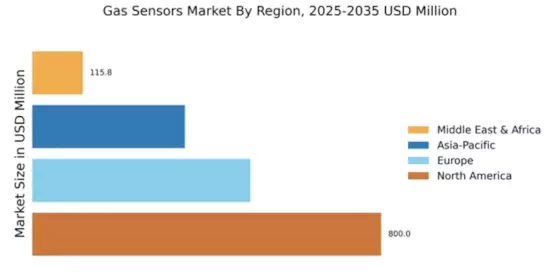
North America is poised to maintain its leadership in the gas sensors market, holding a significant share of 800.0 million in 2025. The region's growth is driven by stringent safety regulations, increasing industrial automation, and a rising demand for smart gas detection systems. The presence of key players like Honeywell and MSA Safety further fuels innovation and market expansion. Regulatory bodies are emphasizing safety standards, which catalyzes the adoption of advanced gas sensors. The United States stands out as the leading country in this region, with a robust competitive landscape featuring major companies such as Emerson Electric and Teledyne Technologies. The market is characterized by continuous technological advancements and a focus on environmental safety. The integration of IoT in gas sensors is gaining traction, enhancing real-time monitoring capabilities. This competitive environment is expected to drive further growth and innovation in the sector.

Europe : Emerging Market with Growth Potential

Europe's gas sensors market is projected to reach 500.0 million by 2025, driven by increasing environmental regulations and a growing focus on safety in industrial applications. The European Union's commitment to reducing emissions and enhancing air quality is a significant catalyst for market growth. Additionally, the rise in renewable energy sources is creating new opportunities for gas sensor applications, particularly in monitoring emissions and ensuring compliance with regulations. Leading countries in this region include Germany, the UK, and France, where companies like Siemens and Sensirion are making substantial contributions. The competitive landscape is marked by innovation and collaboration among key players, focusing on developing advanced sensor technologies. The presence of strong regulatory frameworks ensures that the market remains dynamic and responsive to emerging challenges in environmental safety.

Asia-Pacific : Rapidly Growing Market Segment

The Asia-Pacific gas sensors market is expected to grow significantly, reaching 350.0 million by 2025. This growth is driven by rapid industrialization, urbanization, and increasing awareness of safety standards. Countries like China and India are witnessing a surge in demand for gas sensors in various sectors, including manufacturing, automotive, and healthcare. Government initiatives aimed at improving air quality and safety regulations are further propelling market growth in this region. China is the leading country in the Asia-Pacific region, with a strong presence of local and international players. Companies such as Figaro Engineering and Ametek are actively participating in this competitive landscape. The market is characterized by technological advancements and a focus on developing cost-effective solutions. As the region continues to evolve, the demand for innovative gas sensors is expected to rise, driven by both regulatory and market forces.

Middle East and Africa : Emerging Market with Unique Challenges

The Middle East and Africa gas sensors market is projected to reach 115.83 million by 2025, driven by increasing industrial activities and a growing focus on safety regulations. The region faces unique challenges, including varying regulatory frameworks and economic disparities. However, the demand for gas sensors is rising, particularly in sectors such as oil and gas, where safety is paramount. Governments are beginning to implement stricter regulations, which is expected to boost market growth in the coming years. Leading countries in this region include South Africa and the UAE, where companies are increasingly investing in advanced gas detection technologies. The competitive landscape is evolving, with both local and international players vying for market share. As the region continues to develop, the focus on safety and compliance will drive the demand for innovative gas sensors, creating opportunities for growth and investment.

Key Players and Competitive Insights

The Gas Sensors Market is currently characterized by a dynamic competitive landscape, driven by increasing demand for safety and environmental monitoring across various industries. Key players are focusing on innovation and technological advancements to enhance their product offerings. For instance, Honeywell International Inc. (US) has been emphasizing the integration of advanced analytics and IoT capabilities into its gas sensor solutions, thereby positioning itself as a leader in smart sensing technologies. Similarly, Siemens AG (DE) is leveraging its expertise in automation and digitalization to develop gas sensors that not only detect gases but also provide actionable insights for industrial applications. These strategic focuses collectively enhance the competitive environment, fostering a climate of continuous improvement and adaptation to market needs.

In terms of business tactics, companies are increasingly localizing manufacturing to reduce lead times and optimize supply chains. This approach appears to be particularly effective in a moderately fragmented market, where the collective influence of key players like Emerson Electric Co. (US) and MSA Safety Inc. (US) is notable. By streamlining operations and enhancing responsiveness to regional demands, these companies are better positioned to capture market share and respond to customer needs effectively.

In November 2025, Emerson Electric Co. (US) announced a strategic partnership with a leading environmental monitoring firm to co-develop next-generation gas sensors aimed at industrial applications. This collaboration is expected to enhance Emerson's product portfolio and expand its reach in the environmental monitoring sector, indicating a clear shift towards integrated solutions that address both safety and sustainability concerns. The partnership underscores the importance of collaboration in driving innovation within the market.

In October 2025, MSA Safety Inc. (US) launched a new line of portable gas detectors that utilize advanced sensor technology to improve detection accuracy and response times. This product introduction is significant as it not only strengthens MSA's market position but also reflects a broader trend towards enhancing user safety through technological advancements. The focus on portable solutions aligns with the growing demand for flexible and reliable gas detection systems in various industries.

In September 2025, Gas Sensing Solutions Ltd. (GB) secured a major contract with a European utility company to supply its cutting-edge gas sensors for monitoring emissions. This contract is pivotal as it highlights the increasing regulatory pressures on industries to monitor and reduce emissions, thereby driving demand for advanced gas sensing technologies. Such strategic moves indicate a proactive approach to addressing environmental challenges while simultaneously expanding market presence.

As of December 2025, the Gas Sensors Market is witnessing trends that emphasize digitalization, sustainability, and the integration of AI technologies. Strategic alliances are becoming increasingly vital, as companies recognize the need to collaborate to enhance their technological capabilities and market reach. The competitive differentiation is likely to evolve from traditional price-based competition towards a focus on innovation, technology integration, and supply chain reliability. This shift suggests that companies that prioritize these aspects will be better positioned to thrive in an increasingly complex market.

Key Companies in the Gas Sensors Market market include

Industry Developments

  • Q2 2024: Honeywell launches new industrial gas sensor platform to enhance worker safety Honeywell announced the launch of a new industrial gas sensor platform designed to improve detection of hazardous gases in manufacturing and processing environments. The platform features advanced connectivity and real-time monitoring capabilities.
  • Q1 2024: Amphenol Acquires Sensor Solutions Business from SSI Technologies Amphenol Corporation completed the acquisition of the sensor solutions business from SSI Technologies, expanding its portfolio in the gas sensor market and strengthening its position in automotive and industrial applications.
  • Q2 2024: Figaro Engineering Inc. Announces Launch of New MEMS Gas Sensor for Air Quality Monitoring Figaro Engineering introduced a new MEMS-based gas sensor targeting air quality monitoring applications, offering improved sensitivity and lower power consumption for integration into smart home and IoT devices.
  • Q1 2024: NevadaNano Secures $20 Million Series C Funding to Accelerate Gas Sensor Technology Development NevadaNano announced the closing of a $20 million Series C funding round to support the development and commercialization of its next-generation gas sensor technologies for industrial and environmental monitoring.
  • Q2 2024: Sensirion Opens New Production Facility for Gas Sensors Market in Switzerland Sensirion inaugurated a new state-of-the-art production facility in Switzerland to meet growing global demand for its gas sensor products, enhancing manufacturing capacity and supply chain resilience.
  • Q1 2024: ABB and Environics Announce Strategic Partnership to Develop Advanced Gas Detection Solutions ABB and Environics entered into a strategic partnership to co-develop advanced gas detection solutions for industrial safety and environmental monitoring, leveraging both companies’ expertise in sensor technology.
  • Q2 2024: Alphasense appoints new CEO to drive global expansion in gas sensor market Alphasense announced the appointment of a new Chief Executive Officer, aiming to accelerate its international growth and innovation in the gas sensor sector.
  • Q1 2024: City Technology Wins Major Contract to Supply Gas Sensors Market for European Automotive Manufacturer City Technology secured a significant contract to supply gas sensors for emission monitoring systems to a leading European automotive manufacturer, supporting compliance with new environmental regulations.
  • Q2 2024: SGX Sensortech Launches Next-Generation Hydrogen Gas Sensor for Industrial Safety SGX Sensortech introduced a next-generation hydrogen gas sensor designed for industrial safety applications, featuring enhanced selectivity and durability for harsh environments.
  • Q1 2024: Aeris Technologies Raises $15 Million in Series B Funding to Expand Gas Sensor Product Line Aeris Technologies completed a $15 million Series B funding round to accelerate the development and commercialization of its advanced gas sensor solutions for environmental and industrial markets.
  • Q2 2024: Drägerwerk AG receives regulatory approval for new portable gas detection device in Europe Drägerwerk AG obtained regulatory approval for its latest portable gas detection device, enabling expanded sales across European markets and supporting workplace safety initiatives.
  • Q1 2024: MSA Safety Announces Partnership with Microsoft to Integrate Gas Sensor Data with Azure Cloud MSA Safety entered a partnership with Microsoft to integrate its gas sensor data with the Azure cloud platform, enabling advanced analytics and real-time monitoring for industrial customers.

Future Outlook

Gas Sensors Market Future Outlook

The Gas Sensors Market is projected to grow at an 8.14% CAGR from 2024 to 2035, driven by increasing industrial safety regulations, technological advancements, and rising environmental concerns.

New opportunities lie in:

  • Development of smart gas detection systems for industrial applications.
  • Expansion into emerging markets with tailored gas sensor solutions.
  • Integration of IoT technology for real-time monitoring and analytics.

By 2035, the Gas Sensors Market is expected to be robust, driven by innovation and expanding applications.

Market Segmentation

Gas Sensors Market End Use Outlook

  • Manufacturing
  • Oil and Gas
  • Healthcare
  • Automotive
  • Mining

Gas Sensors Market Gas Type Outlook

  • Carbon Dioxide
  • Methane
  • Hydrogen
  • Ammonia
  • Ozone

Gas Sensors Market Technology Outlook

  • Electrochemical
  • Semiconductor
  • Infrared
  • Photoionization
  • Metal Oxide

Gas Sensors Market Application Outlook

  • Industrial Safety
  • Environmental Monitoring
  • Automotive
  • Medical
  • Building Automation

Gas Sensors Market Sensor Type Outlook

  • Portable Sensors
  • Fixed Sensors
  • Wireless Sensors
  • Smart Sensors
  • Multi-Gas Sensors

Report Scope

MARKET SIZE 20241765.83(USD Million)
MARKET SIZE 20251909.57(USD Million)
MARKET SIZE 20354176.38(USD Million)
COMPOUND ANNUAL GROWTH RATE (CAGR)8.14% (2024 - 2035)
REPORT COVERAGERevenue Forecast, Competitive Landscape, Growth Factors, and Trends
BASE YEAR2024
Market Forecast Period2025 - 2035
Historical Data2019 - 2024
Market Forecast UnitsUSD Million
Key Companies ProfiledFigaro Engineering Inc. (JP), Honeywell International Inc. (US), MSA Safety Inc. (US), Ametek Inc. (US), Emerson Electric Co. (US), Siemens AG (DE), Sensirion AG (CH), Gas Sensing Solutions Ltd. (GB), Teledyne Technologies Inc. (US)
Segments CoveredApplication, End Use, Technology, Gas Type, Sensor Type
Key Market OpportunitiesIntegration of advanced IoT technologies enhances real-time monitoring in the Gas Sensors Market.
Key Market DynamicsRising demand for advanced gas detection technologies drives innovation and competition in the gas sensors market.
Countries CoveredNorth America, Europe, APAC, South America, MEA

Market Highlights

Author
Shubham Munde
Research Analyst Level II

With a technical background in information technology & semiconductors, Shubham has 4.5+ years of experience in market research and analytics with the tasks of data mining, analysis, and project execution. He is the POC for our clients, for their consulting projects running under the ICT/Semiconductor domain. Shubham holds a Bachelor’s in Information and Technology and a Master of Business Administration (MBA). Shubham has executed over 150 research projects for our clients under the brand name Market Research Future in the last 2 years. His core skill is building the research respondent relation for gathering the primary information from industry and market estimation for niche markets. He is having expertise in conducting secondary & primary research, market estimations, market projections, competitive analysis, analysing current market trends and market dynamics, deep-dive analysis on market scenarios, consumer behaviour, technological impact analysis, consulting, analytics, etc. He has worked on fortune 500 companies' syndicate and consulting projects along with several government projects. He has worked on the projects of top tech brands such as IBM, Google, Microsoft, AWS, Meta, Oracle, Cisco Systems, Samsung, Accenture, VMware, Schneider Electric, Dell, HP, Ericsson, and so many others. He has worked on Metaverse, Web 3.0, Zero-Trust security, cyber-security, blockchain, quantum computing, robotics, 5G technology, High-Performance computing, data centers, AI, automation, IT equipment, sensors, semiconductors, consumer electronics and so many tech domain projects.

Leave a Comment

FAQs

How much is the Gas Sensor market?

The Gas Sensor Market size was valued at USD 1.34 Billion in 2021.

What is the growth rate of the Gas Sensor market?

The global market is projected to grow at a CAGR of 8.14% during the forecast period, 2022-2030.

Which region held the largest market share in the Gas Sensor market?

Asia Pacific had the largest share of the Gas Sensor Market.

Who are the key players in the market of Gas sensors?

The key players in the market are City Technology Ltd, Dynament, AlphaSense, Amphenol Corporation, Bosch Sensortec GMBH, AMS, SenseAir, NEW COSMOS ELECTRIC CO. LTD, Industrial Scientific, and Sensirion.

Which Technology led the Gas Sensor market?

The Electrochemical category dominated the market in 2021.

Which Application had the largest market share in the Gas Sensor market?

Oil & Gas had the largest share in the global market for Gas sensors.

Download Free Sample

Kindly complete the form below to receive a free sample of this Report

Compare Licence

×
Features License Type
Single User Multiuser License Enterprise User
Price $4,950 $5,950 $7,250
Maximum User Access Limit 1 User Upto 10 Users Unrestricted Access Throughout the Organization
Free Customization
Direct Access to Analyst
Deliverable Format
Platform Access
Discount on Next Purchase 10% 15% 15%
Printable Versions