×
Request Free Sample ×

Kindly complete the form below to receive a free sample of this Report

* Please use a valid business email

Leading companies partner with us for data-driven Insights

clients tt-cursor
Hero Background

GCC Application Transformation Market

ID: MRFR/ICT/62310-HCR
200 Pages
Aarti Dhapte
October 2025

GCC Application Transformation Market Research Report By Service (Portfolio Assessment, Cloud Migration, Replatforming, Integration, UI Modernization, Post Modernization), By Organization Size (Small and Medium-Sized Businesses, Large Enterprises) and By Vertical (Retail, IT and Telecommunication, Healthcare, Banking, Financial Services, Insurance, Government, Manufacturing)- Forecast to 2035

Share:
Download PDF ×

We do not share your information with anyone. However, we may send you emails based on your report interest from time to time. You may contact us at any time to opt-out.

GCC Application Transformation Market Infographic
Purchase Options

GCC Application Transformation Market Summary

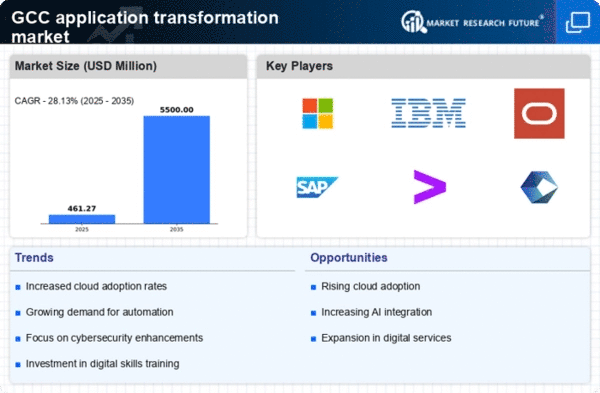
As per MRFR analysis, the GCC application transformation market size was estimated at 360.0 USD Million in 2024. The GCC application transformation market is projected to grow from 461.27 USD Million in 2025 to 5500.0 USD Million by 2035, exhibiting a compound annual growth rate (CAGR) of 28.13% during the forecast period 2025 - 2035.

Key Market Trends & Highlights

The GCC application transformation market is experiencing robust growth driven by digitalization and evolving user needs.

  • Cloud migration remains a dominant trend, facilitating the transition to more scalable and flexible IT environments.
  • Enhanced cybersecurity measures are increasingly prioritized as organizations seek to protect sensitive data and maintain compliance.
  • The focus on user experience is intensifying, with businesses striving to create more intuitive and engaging applications.
  • Rising demand for digital services and government initiatives are key drivers propelling the market forward.

Market Size & Forecast

2024 Market Size 360.0 (USD Million)
2035 Market Size 5500.0 (USD Million)
CAGR (2025 - 2035) 28.13%

Major Players

Microsoft (US), IBM (US), Oracle (US), SAP (DE), Accenture (IE), Cognizant (US), Capgemini (FR), TCS (IN), Infosys (IN)

GCC Application Transformation Market Trends

The application transformation market is currently experiencing notable growth, driven by the increasing demand for digital solutions across various sectors. Organizations are recognizing the necessity of modernizing their applications to enhance operational efficiency and improve customer experiences. This trend is particularly evident in the GCC region, where businesses are investing in innovative technologies to remain competitive. The shift towards cloud-based solutions and the integration of advanced analytics are reshaping the landscape, allowing companies to leverage data more effectively. Furthermore, the emphasis on cybersecurity is prompting organizations to transform their applications to safeguard sensitive information and comply with regulatory requirements. In addition, the rise of remote work and the need for agile business models are influencing the application transformation market. Companies are seeking to adopt flexible solutions that can adapt to changing market conditions. This has led to an increased focus on application modernization, which encompasses the migration of legacy systems to more efficient platforms. As organizations in the GCC continue to prioritize digital transformation, the application transformation market is poised for sustained growth, reflecting the broader trends in technology adoption and innovation.

Cloud Migration

The transition to cloud-based platforms is a prominent trend within the application transformation market. Organizations are increasingly migrating their applications to the cloud to enhance scalability, reduce costs, and improve accessibility. This shift allows businesses to leverage cloud services for better performance and flexibility.

Enhanced Cybersecurity Measures

As cyber threats become more sophisticated, there is a growing emphasis on integrating robust security features into applications. Organizations are prioritizing the transformation of their applications to include advanced security protocols, ensuring the protection of sensitive data and compliance with regulations.

Focus on User Experience

Improving user experience is a critical aspect of application transformation. Companies are investing in redesigning their applications to provide intuitive interfaces and seamless interactions. This focus on user-centric design aims to enhance customer satisfaction and engagement.

GCC Application Transformation Market Drivers

Adoption of Agile Methodologies

The adoption of agile methodologies is becoming a critical driver in the application transformation market within the GCC. Organizations are increasingly recognizing the benefits of agile practices, which promote flexibility, collaboration, and rapid delivery of applications. This shift towards agile development enables businesses to respond more effectively to changing market demands and customer preferences. As companies implement agile frameworks, they often find that their existing applications require transformation to align with these new processes. This need for modernization is driving investments in application transformation initiatives. Furthermore, the emphasis on continuous improvement and iterative development inherent in agile methodologies encourages organizations to regularly update and enhance their applications. Consequently, the application transformation market is likely to experience growth as more companies embrace agile practices and seek to optimize their application portfolios.

Increased Focus on Data Analytics

The application transformation market is witnessing an increased focus on data analytics as organizations in the GCC strive to leverage data for informed decision-making. With the exponential growth of data generated from various sources, businesses are recognizing the need to transform their applications to harness this valuable resource effectively. By integrating advanced analytics capabilities into their applications, organizations can gain insights that drive operational improvements and enhance customer experiences. Reports indicate that the data analytics market in the GCC is expected to grow at a CAGR of 25% through 2025, underscoring the urgency for application transformation. This trend compels companies to modernize their applications, ensuring they are equipped to handle large volumes of data and provide real-time analytics. Consequently, the application transformation market is likely to expand as organizations prioritize data-driven strategies.

Government Initiatives and Support

Government initiatives in the GCC are playing a pivotal role in shaping the application transformation market. Various national strategies aim to enhance digital infrastructure and promote innovation, thereby fostering an environment conducive to application modernization. For instance, the UAE's Vision 2021 and Saudi Arabia's Vision 2030 emphasize the importance of digital transformation in achieving economic diversification and sustainability. These initiatives often include funding programs, tax incentives, and regulatory frameworks that encourage businesses to invest in application transformation. As a result, organizations are more inclined to adopt new technologies and methodologies, which is expected to drive the application transformation market significantly. The support from government entities not only accelerates the pace of transformation but also enhances collaboration between public and private sectors, creating a synergistic effect that benefits the overall economy.

Rising Demand for Digital Services

The application transformation market is experiencing a notable surge in demand for digital services across various sectors in the GCC. As businesses increasingly recognize the necessity of digital transformation, they are investing in modernizing their applications to enhance operational efficiency and customer engagement. According to recent data, the GCC's digital economy is projected to reach $100 billion by 2025, indicating a robust growth trajectory. This shift towards digitalization compels organizations to adopt agile methodologies and cloud-based solutions, thereby driving the application transformation market. Companies are prioritizing the integration of advanced technologies such as artificial intelligence and machine learning into their applications, which further propels the need for transformation. Consequently, the application transformation market is likely to witness sustained growth as organizations strive to meet evolving consumer expectations and remain competitive in a rapidly changing landscape.

Competitive Pressure and Market Dynamics

The application transformation market is significantly influenced by competitive pressure and evolving market dynamics within the GCC. As businesses strive to maintain their market positions, they are compelled to innovate and enhance their application offerings. This competitive landscape drives organizations to invest in application transformation initiatives to improve efficiency, reduce costs, and deliver superior customer experiences. The rise of startups and tech-driven companies in the region further intensifies this competition, pushing established players to modernize their applications. Additionally, the increasing availability of cloud services and development tools facilitates faster transformation processes, allowing companies to respond swiftly to market changes. As a result, the application transformation market is expected to grow as organizations seek to differentiate themselves and capitalize on emerging opportunities.


Market Segment Insights

By Service: Cloud Migration (Largest) vs. Integration (Fastest-Growing)

In the GCC application transformation market, the distribution of market share among the various service segment values reveals substantial interest in Cloud Migration, which currently holds the largest share. Following closely is Integration, which, while not as dominant, is rapidly gaining traction due to increased demand for interconnected applications and streamlined operations. Other significant service areas include Portfolio Assessment, Replatforming, UI Modernization, and Post Modernization, each contributing uniquely to the evolving market landscape. Looking ahead, growth trends in this segment are propelled by the region's shift towards digital transformation and cloud-centric strategies. Organizations are increasingly prioritizing Cloud Migration to enhance flexibility and scalability, while Integration services are emerging as essential for orchestrating disparate systems. As businesses aim for agility, UI Modernization and Replatforming become pivotal in improving user experiences and operational efficiency, driving sustained investments in these areas.

Cloud Migration (Dominant) vs. Integration (Emerging)

Cloud Migration stands out as the dominant service in the GCC application transformation market due to its critical role in enabling businesses to transition to more agile, cost-effective cloud environments. This service allows organizations to reduce IT overhead and improve accessibility, making it a preferred choice among enterprises. In contrast, Integration emerges as a vital service aimed at connecting diverse applications and data sources, ensuring seamless workflows and interoperability. As companies pursue holistic solutions that unify their digital ecosystems, Integration services are rapidly gaining importance. The increasing emphasis on data-driven decision-making and operational efficiency further enhances the attractiveness of Integration, positioning it as a key player in the market's evolution.

By Organization Size: Small and Medium-Sized Businesses (Largest) vs. Large Enterprises (Fastest-Growing)

In the GCC application transformation market, the distribution of market share reveals that Small and Medium-Sized Businesses (SMBs) constitute the largest segment, driven by their increasing adoption of digital transformation strategies to remain competitive. Their need for agility and cost-effective solutions positions them favorably, capturing a significant share of the market as they seek innovative applications to enhance operational efficiency. Conversely, Large Enterprises are identified as the fastest-growing segment within this market. They are rapidly implementing advanced applications to manage vast operational complexities and improve productivity. Factors such as significant IT budgets, a focus on integration across services, and the demand for scalable solutions are propelling their growth, showcasing a shift towards more sophisticated application transformation efforts to harness the benefits of digital technologies.

Small and Medium-Sized Businesses (Dominant) vs. Large Enterprises (Emerging)

Small and Medium-Sized Businesses play a dominant role in the GCC application transformation market due to their need for tailored applications that cater to specific business needs, allowing for flexibility and quicker decision-making. Their focus on cost efficiency drives the demand for cloud-based solutions, enabling easy scalability and access to cutting-edge technologies without the burden of heavy investments. On the other hand, Large Enterprises are an emerging force, characterized by their substantial resources and a strategic push towards integrating advanced applications across their operations. This segment's emphasis on innovation and comprehensive application ecosystems allows them to tackle complex operational challenges, foreshadowing their significant impact on the market's evolution in the coming years.

By Vertical: Retail (Largest) vs. Healthcare (Fastest-Growing)

The GCC application transformation market is witnessing a diverse distribution of market share among various verticals, with the retail sector currently holding the largest portion of the market. Driven by increasing consumer expectations and the need for seamless digital experiences, retailers are rapidly adopting application transformation strategies to enhance customer engagement and operational efficiency. On the other hand, the healthcare sector is emerging as the fastest-growing segment within the market. The COVID-19 pandemic accelerated the adoption of digital technologies in healthcare, prompting organizations to transform their applications to improve patient care, streamline operations, and comply with regulatory changes. This shift is expected to continue as healthcare providers increasingly seek innovative solutions to meet the evolving needs of patients and the industry.

Retail: Dominant vs. Healthcare: Emerging

The retail sector in the GCC application transformation market remains dominant due to its significant investments in technology to enhance customer experiences and streamline operations. Retailers are leveraging advanced analytics, mobile applications, and omnichannel strategies to meet the demands of modern consumers. These transformations facilitate personalized shopping experiences and efficient supply chain management. Conversely, the healthcare sector is characterized as emerging, driven by rapid technological advancements and the necessity for digital transformation in response to healthcare challenges. As healthcare providers embrace telehealth, electronic health records, and patient engagement solutions, they are transforming their applications to achieve operational efficiencies and improved patient outcomes. This growing focus on digital solutions positions healthcare for notable growth in the market.

Get more detailed insights about GCC Application Transformation Market

Key Players and Competitive Insights

The application transformation market is currently characterized by a dynamic competitive landscape, driven by the increasing demand for digital transformation and the need for businesses to modernize their IT infrastructure. Key players such as Microsoft (US), IBM (US), and Accenture (IE) are strategically positioned to leverage their technological expertise and extensive service offerings. Microsoft (US) focuses on cloud-based solutions and AI integration, while IBM (US) emphasizes hybrid cloud strategies and enterprise-level transformations. Accenture (IE) is known for its consulting prowess and partnerships with technology providers, which enhance its service delivery capabilities. Collectively, these strategies foster a competitive environment that prioritizes innovation and customer-centric solutions.

In terms of business tactics, companies are increasingly localizing their operations to better serve regional markets, optimizing supply chains to enhance efficiency, and investing in advanced technologies. The market appears moderately fragmented, with several key players exerting influence while also facing competition from emerging firms. This structure allows for a diverse range of solutions, catering to various customer needs and preferences.

In October 2025, Microsoft (US) announced the launch of its new Azure-based application transformation suite, aimed at accelerating digital transformation for enterprises. This strategic move is significant as it positions Microsoft (US) to capture a larger share of the market by providing comprehensive solutions that integrate seamlessly with existing IT environments. The emphasis on cloud services aligns with the growing trend of businesses migrating to cloud platforms, thereby enhancing operational agility.

In September 2025, IBM (US) unveiled its latest AI-driven analytics tool designed to optimize application performance and reduce operational costs. This initiative underscores IBM's commitment to integrating AI into its service offerings, which is likely to enhance its competitive edge. By focusing on AI capabilities, IBM (US) not only addresses current market demands but also sets the stage for future innovations in application transformation.

In August 2025, Accenture (IE) entered into a strategic partnership with a leading cloud provider to enhance its application transformation services. This collaboration is pivotal as it allows Accenture (IE) to leverage cutting-edge technologies and expand its service portfolio. Such partnerships are indicative of a broader trend where companies seek to combine strengths to deliver more robust solutions to clients.

As of November 2025, the competitive trends in the application transformation market are increasingly defined by digitalization, sustainability, and the integration of AI technologies. Strategic alliances are playing a crucial role in shaping the landscape, enabling companies to pool resources and expertise. Looking ahead, competitive differentiation is likely to evolve from traditional price-based competition to a focus on innovation, technological advancement, and supply chain reliability. This shift suggests that companies that prioritize these elements will be better positioned to thrive in an increasingly complex market.

Key Companies in the GCC Application Transformation Market market include

Future Outlook

GCC Application Transformation Market Future Outlook

The application transformation market is poised for growth at 28.13% CAGR from 2024 to 2035, driven by digitalization, cloud adoption, and evolving customer demands.

New opportunities lie in:

  • Development of AI-driven application modernization tools
  • Expansion of cloud-native application services
  • Integration of IoT solutions for enhanced operational efficiency

By 2035, the market is expected to achieve substantial growth, reflecting robust demand and innovation.

Market Segmentation

GCC Application Transformation Market Service Outlook

  • Portfolio Assessment
  • Cloud Migration
  • Replatforming
  • Integration
  • UI Modernization
  • Post Modernization

GCC Application Transformation Market Vertical Outlook

  • Retail
  • IT and Telecommunication
  • Healthcare
  • Banking
  • Financial Services
  • and Insurance
  • Government
  • Manufacturing

GCC Application Transformation Market Organization Size Outlook

  • Small and Medium-Sized Businesses
  • Large Enterprises

Report Scope

MARKET SIZE 2024 360.0(USD Million)
MARKET SIZE 2025 461.27(USD Million)
MARKET SIZE 2035 5500.0(USD Million)
COMPOUND ANNUAL GROWTH RATE (CAGR) 28.13% (2024 - 2035)
REPORT COVERAGE Revenue Forecast, Competitive Landscape, Growth Factors, and Trends
BASE YEAR 2024
Market Forecast Period 2025 - 2035
Historical Data 2019 - 2024
Market Forecast Units USD Million
Key Companies Profiled Microsoft (US), IBM (US), Oracle (US), SAP (DE), Accenture (IE), Cognizant (US), Capgemini (FR), TCS (IN), Infosys (IN)
Segments Covered Service, Organization Size, Vertical
Key Market Opportunities Integration of artificial intelligence and cloud solutions drives growth in the application transformation market.
Key Market Dynamics Rising demand for cloud-native applications drives competitive innovation in the application transformation market.
Countries Covered GCC

Leave a Comment

FAQs

What is the expected market size of the GCC Application Transformation Market in 2024?

The GCC Application Transformation Market is expected to be valued at 214.92 million USD in 2024.

What is the projected market value for the GCC Application Transformation Market by 2035?

By 2035, the GCC Application Transformation Market is anticipated to reach a value of 510.0 million USD.

What is the expected compound annual growth rate (CAGR) for the GCC Application Transformation Market from 2025 to 2035?

The anticipated CAGR for the GCC Application Transformation Market from 2025 to 2035 is 8.173 percent.

Which service segment is projected to have the largest market size in 2035?

The Integration service segment is expected to be valued at around 150.0 million USD in 2035, making it one of the largest segments.

What is the estimated market value for Cloud Migration services in 2024?

Cloud Migration services in the GCC Application Transformation Market are valued at approximately 50.0 million USD in 2024.

Who are the key players in the GCC Application Transformation Market?

Prominent players in the GCC Application Transformation Market include Oracle, Hewlett Packard Enterprise, Tata Consultancy Services, and Accenture, among others.

What is the expected market value for Portfolio Assessment services by 2035?

Portfolio Assessment services are projected to be valued at 70.0 million USD by 2035.

What are the growth drivers for the GCC Application Transformation Market?

Key growth drivers include increasing demand for cloud migration, UI modernization, and efficient integration solutions.

What market value is anticipated for Replatforming services in 2024?

Replatforming services are estimated to have a market value of around 40.0 million USD in 2024.

What challenges might impact the GCC Application Transformation Market?

Challenges may include the rapid pace of technological change and the need for skilled workforce to manage transformations.

Download Free Sample

Kindly complete the form below to receive a free sample of this Report

Compare Licence

×
Features License Type
Single User Multiuser License Enterprise User
Price $4,950 $5,950 $7,250
Maximum User Access Limit 1 User Upto 10 Users Unrestricted Access Throughout the Organization
Free Customization
Direct Access to Analyst
Deliverable Format
Platform Access
Discount on Next Purchase 10% 15% 15%
Printable Versions